

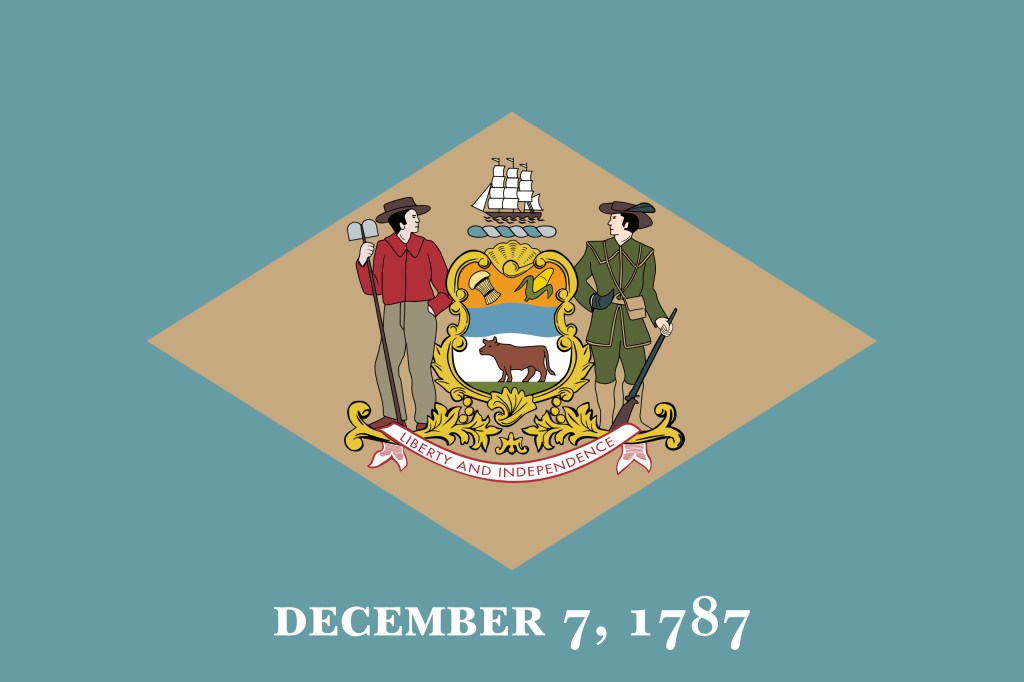
In 1981, when I was fourteen years old, my family relocated from the Long Island New York home that I’d known for most of my life to Delaware, the first state, which was becoming a hub of corporate activity thanks to its law regarding taxes. My father had been sent there to help set up a new division of the Chase Manhattan Bank corporation for which he worked–a big opportunity for him, an unwelcome disruption of a comfortable life for me. And especially disrupted was my comic book collecting.
The area we lived in on Long Island had easy access to any number of outlets that sold comic books, including a recently-established Direct Sales comic book shop from which I’d begun to purchase all of my new books. This was possible in large part thanks to the Pennysaver newspaper route that I worked twice a week, which brought me in enough income to underwrite whatever comic book spending I felt was necessary. But the development we’d be moving into in Delaware was brand new and remote, in an area that wasn’t yet fully developed. There was absolutely nothing around within bike-riding distance, which left me in a bit of a pickle. I wouldn’t get my driver’s license for another two years, so I was completely at the mercy of other people to get around in terms of access to civilization. Additionally, that paper route was gone–there was no way to secure something similar in the new area as those spots had already been long snatched up. So I was facing a new environment with dicey prospects and a dearth of income.
For a time right at the outset, I attempted to get my new comics by mail order through Geppi’s Comic World in Baltimore. Steve Geppi (who would eventually form Diamond Distributors) offered a monthly mail-order service that would come right to my doorstep. But I quickly learned about the downsides of this arrangement. For one thing, those shipments were made Cash-On-Delivery, which meant that I had better have the necessary funds available to me when the postman arrived with my package or i was going to be screwed; not having a reliable source of income made this a dicey proposition at best, and I sweated the situation out month after month, swiping nickels and dimes from my father’s bedside table in an effort to gather up enough before D-Day. But the other difficulty was that, in my regular family travels, I would continually come across outlets that has new comics for sale that I didn’t yet possess–and I had to leave those books behind rather than buying and reading them right then, because I had those issues on order. This was always painful–and getting an entire month’s worth of comics all in a single shipment wasn’t ideal either. it was a feast-or-famine situation, with neither eventuality being particularly satisfying. Before too many months, I gave up my Geppi’s subscription and opted to go ad hoc, counting on my now-increased familiarity with the area and my family’s regular activities to provide me with the purchasing opportunities that I needed.
Eventually, though, as detailed at the start of the GOODBYE, HELLO feature:
I hit a point where my finances weren’t able to keep up with all of the new comics that I wanted to buy, especially since the exploding Direct Sales market was providing a wealth of new and innovative releases that I wanted to sample as well. I wound up cutting my buying list dramatically so as to better match my available resources. It wasn’t really until I got my driver’s license in 1984 and started my job as a cook for a Roy Rogers restaurant that I could finally start to expand my horizons a bit further.
In any case, there’s an entire bevy of comic books that were impactful to me in one way or another during this time. And it’s a period that I’m never going to reach in the main Brevoort History of Comics feature at its current rate of two comic books every week. Even getting to the end of 1979 will still take years. So as with the earlier GOODBYE, HELLO series, I thought it might be worthwhile to look at some of the books that I bought during this decade, my last as simply a fan. So that’s what FIRST STATE COMICS will be all about. This decision was made easier due to me having excavated a handwritten log of my comic book purchases for a part of this period, which indicates what I bought and when, and how much I paid for it. I kept a running log of my purchases for years and years, only giving it up shortly before I cut back on my pull list, though regretfully, my earliest such log had vanished over the years.
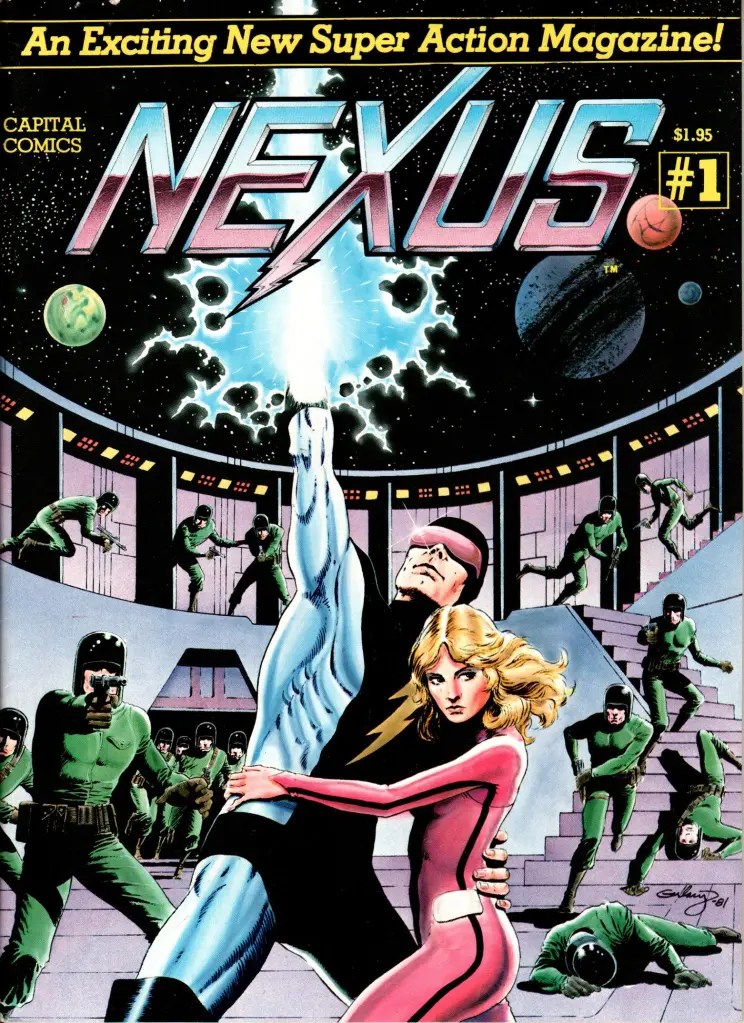
The first two books that I might have discussed in this area I’ve already covered extensively enough in other places. So I’ll direct your attention to those entries. The first was NEXUS #1, the black -and-white magazine from Capital Comics that launched Mike Baron and Steve Rude’s cosmic crusader. I got my copy in my first or second shipment from Geppi’s:
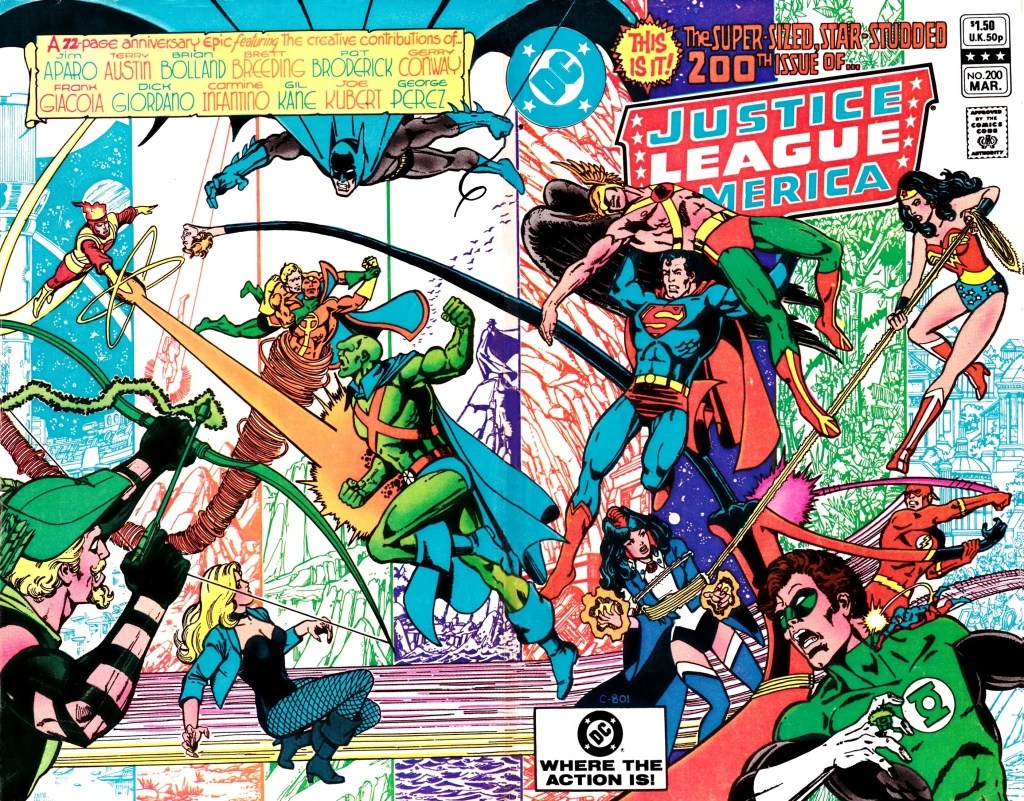
And the second book was the thoroughly terrific 200th issue of JUSTICE LEAGUE OF AMERICA, a title that I’d loved almost from the start of getting into the hobby. My copy, though, was a bit dinged up in the Geppi’s shipment, the cover wrinkled and bowed. The fact that it was squarebound made this easier to happen. This was another thing that made me give up the mail-order service, not being able to select copies that were in good condition for purchase.
And so, we’ll continue from here moving forward, on an irregular basis!
 The Tom Brevoort Experience
at one point in the mid 90s, New Castle County ( so not be,ow the Canal) had at least seven comic shops and, for the most part, they had their own niche. CBH in Newark (where I was working) had the college crowd in Newark and was the Indy friendly store, First State had comics and toys, Comicmania had the speculator s, Wein’s World had adult comics and so on. And for the most part, everyone had their turf and got along.
During the UPS Strike, stores took turns driving to Baltimore to pick up,everyone’s books for the week. And when we started having the ACME Small Press conventions every year, most everyone was good about helping to promote it.
LikeLiked by 1 person
The Roy,Rogers in Main St in Newark? Or another location?
Was there a RR at 896 & Rt 40?
By the late 80s there were a handful of comics shops I could reach by car. Captain Blue Hen on Main St.
Comics & Robots in Claymont I think. I was only there once or twice. I met Chuck Dixon & Tom Lyle for the 1st time when they launched the “Skywolf” miniseries , or maybe it was for “Strike”.
There was another tiny comics shop on Rt 202, in PA. I forget the name, now. Damn. It reminded me of the cartoon ad with the little house drawn for for Westfield Comics mail order service. .It was surrounded by mostly fields & a frew strips of stores, spread apart. Now it’s all built up. Well, it WAS 40 years ago.
Between Books near the Tri-State Mall carried comics, as well as D&D stuff & various fantasy, sci-fi, & mystery books. Sometime later they moved to a shopping center off Rt 13.
Captain Blue Hen would move from the old tan house it used 1/2 of the 1st floor of, on Mian St, to a little strip built just behind it, where it was 2x’s the size. And then growing even larger in the years after.
When I first moved from DE to PA in ‘884 or 85 I’d also buy comics from a small shop in the Booth’s Corner’s Farmers Market that sold magazines &maybe old paperback books. The selection was thin. All news stand issues, no “Baxter” paper comics like New Teen Titans or Legion of Super-heroes. No independents except Archie & it’s “BlueRibbon/Red Circle” heroes by Rich Buckler
No “Dark Knight Returns”, though book stores in the big malls carried the individual issues. But I’d get “Avengers”, “Batman”, Detective “, “All-Star Squadron “, & some Spidey monthlies at that Booths Corner shop. it was in walking distance. Luckily I started driving in ’87 & could get to Between Books easily.
I guess it was around 1992 when Mike Romangoli opened his First State Comics on Rt 40 in Bear, DE. The same shopping center as an Acme. Fox Run?. Mike graduated from U if D. You may have known him at some point. I was back in DE by then & got my comics there. So it’s funny that you’re using that name for this feature.
LikeLike
The weirdest comic shop I ever went to was when I worked at a Cumberland Farms and the son my age(ish) that was running the laundry for his dad next door converted half of it into a comic shop. He called it Gelatinous Comics.
LikeLiked by 1 person
The Roy Rogers on Main Street in Newark. I worked there for more than five years all told.
LikeLiked by 1 person
@Steve McBeezlebub; “Gelatinous Comics”. lol
LikeLike
My sister and I worked at a Roy Roger’s in Moon Township, PA. We were both attending Moon High so it had to be 1979 or 80.
LikeLiked by 1 person
I started reading NEXUS with issue 2, because I had a summer job in 1981 working for New Media/Irjax — technically I was an editorial dogsbody on magazines like COMICS FEATURE, LoC and ADVENTURE ILLUSTRATED, but the office was also the location of NMI’s Solar Spice Distribution, a sub-distributors that handled direct-market distribution in terms of Boston area, and every time a new shipment came in, it was all-hands-on-deck to break it down and get it out to local stores.
But we could borrow whatever books we wanted, which was how I got exposed to a number of titles, including the Doyle/deCarlo BETTY & VERONICA, the DeFalco/Wilson TWO-IN-ONE and NEXUS, among other books.
LikeLiked by 1 person
I had the similar dilemma coming back into comic reading and collecting in the Fall of 1980. I saw X-men #141 on the spinner rack, along with DD #172 (bullseye standing in a pile of dead DDs) and started buying off the rack. Quickly, I determined I could save by enrolling in 4 titles for 3 Marvels, and added the Avengers and Captain America. However, it was murder, waiting for the post office to get around to delivering those single issues in a brown paper slip cover, weeks after the new issues were showing up on the spinner rack. I eventually let my subscription lapse, as I found comic book shops exploding in the Detroit suburbs where I now worked and lived on my own.
LikeLiked by 1 person
I had a mail order subscription to “Batman”, starting in the 390’s. My copy of #v400 was all beat up in the brown paper sleeve. I wound up buying another copy ASAP. Same for “Batman: Year One” in #404-407. My mailed copied were bent up. So I bought’em again off the rack. I let my subscription run out, once I could drive to a comics shop.
LikeLike
I can’t remember which DC titles I subscribed to but yeah, by the time they were running out I was buying them new sometimes week before the folded and otherwise damaged copies showed up.
LikeLiked by 1 person
The poor shipping conditions undermined comicbooks’ collectability. The decline of mail subscriptions likely boosted sales in comicbook stores.
LikeLike
there are a few Roy Rogers left. At least one or two on rest stops on the PA Turnpike and at least two in Frederick MD. Whenever I go out to the Mid West, I plan the trip so I can stop at one to have lunch. And, being MD, the stores there have Old Bay at the Fixins Bar.
LikeLike