


I was continuing to work my way through the complete run of SHAZAM that I had borrowed from my grade school friend Donald Sims. By this fifth issue, the series had settled into something of a groove, and stresses were beginning to become apparent among the creative team. After an inaugural issue that posted big numbers thanks to unscrupulous speculators scooping up crates full of copies from the local distributors, sales had settled down to a modest level. But artist C. C. Beck wasn’t happy with the quality of the scripts that he was getting , and wasn’t shy about saying so. He’d been a key contributor to Captain Marvel all throughout the Golden Age and had a paternal proprietary feeling towards the Big Red Cheese. However, the DC of this time, most immediately in the person of editor Julie Schwartz, wasn’t really all that interested in taking on board the opinions of a mere artist. This tension would become more pronounced the longer the series went on.
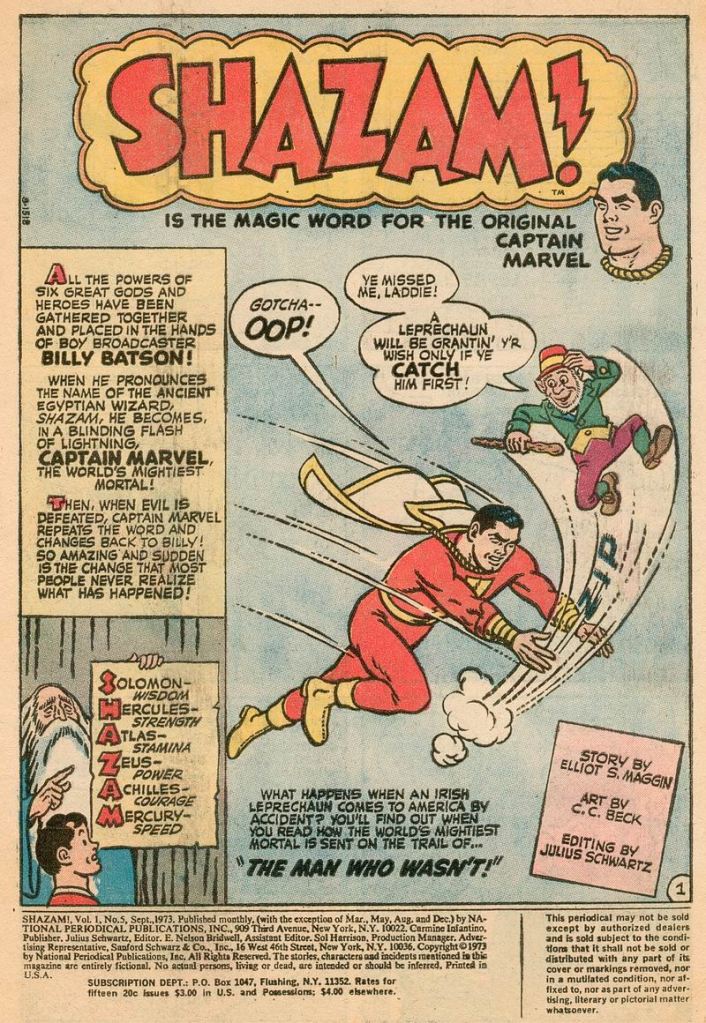
As with the prior issues, this one contained three stories in its scant 22 story pages. For the first time, writer Denny O’Neil is absent–he has been editor Schwartz’s go-to for any big assignment in recent years, but his grounded approach wasn’t really in synch with the world of Captain Marvel and his friends, so he left as soon as he was able to. Instead, relative newcomer Elliot S! Maggin wrote all of the new material in this issue. Schwartz had discovered Maggin when the writer sent him a spec script that he’d done as a part of earning his degree, and Schwartz found it to be excellent and bought it. Elliot was still learning the ropes at this point, but he’d already become a mainstay in Schwartz’s stable, used across Julie’s assorted titles.
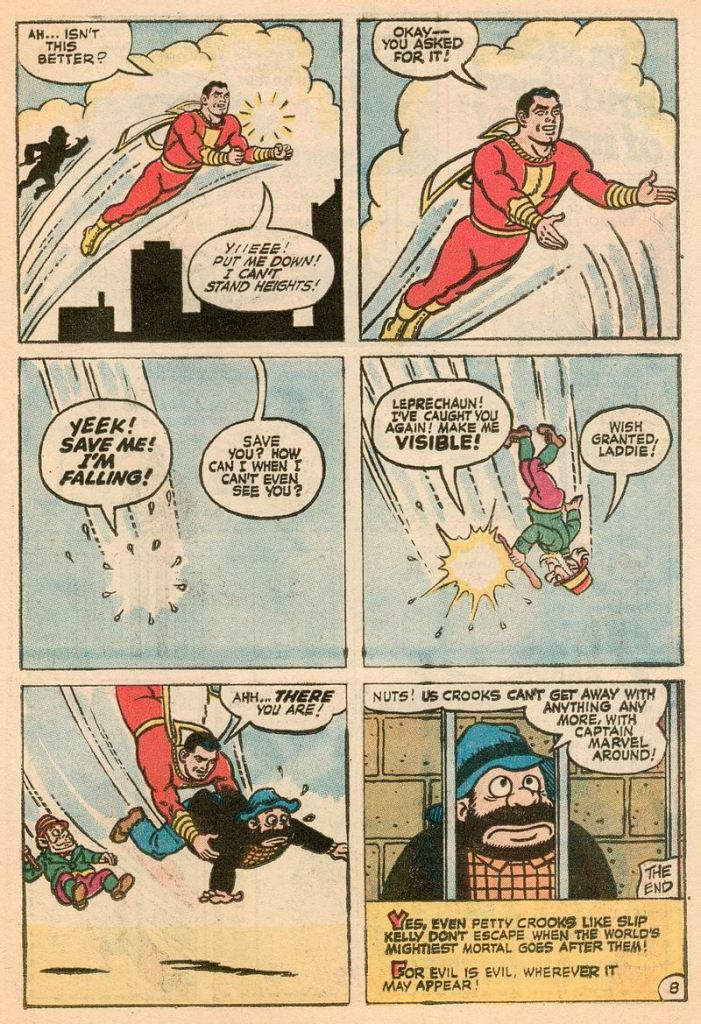
When C. C. Beck complained that the scripts that he was getting were dumb, it’s difficult to argue in this case. It’s about a Leprechaun whose on vacation in the big city. Caught by a criminal, he grants the crook’s wish to become invisible. Chasing down the invisible thefts, Captain Marvel discovers that the Leprechaun is responsible, and arranges for the crook to experience the downsides of being invisible, being almost run over in the street and accosted by pedestrians who don’t realize that he’s there. It’s really dopey stuff, and Beck’s artwork in uninspired–he clearly didn’t like working on this tale at all.
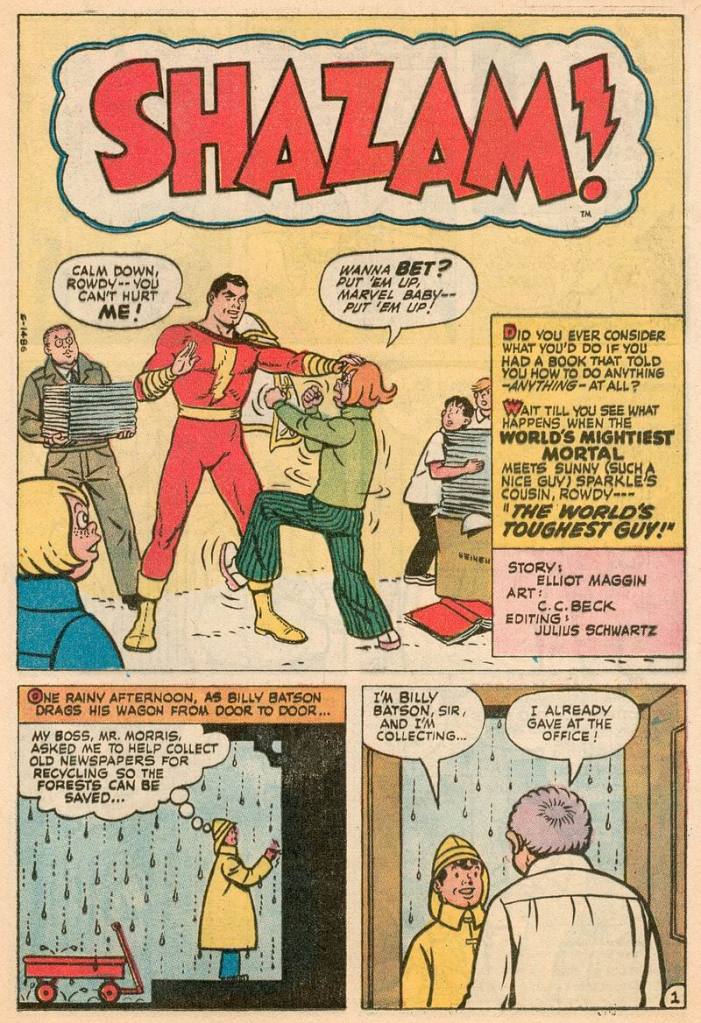
The second story is a follow-up to an earlier tale that had introduced the character of Sunny Sparkle, a kid whose demeanor is so nice that everybody gives him anything that he asks for. This sequel introduces Sunny’s cousin Rowdy, who’s a bad egg. It opens with Billy Batson on a paper drive, collecting for recycling. He convinces Sunny to help him, as nobody can refuse Sunny anything. Sunny, though, brings along his cousin Rowdy. The trio winds up collecting a rare spell book among other things, and when they’re caught in a downpour, Billy is able to use the magic in the book to stop the rain. Rowdy, seeing that the magic is real, uses the book to make himself the toughest person on Earth.
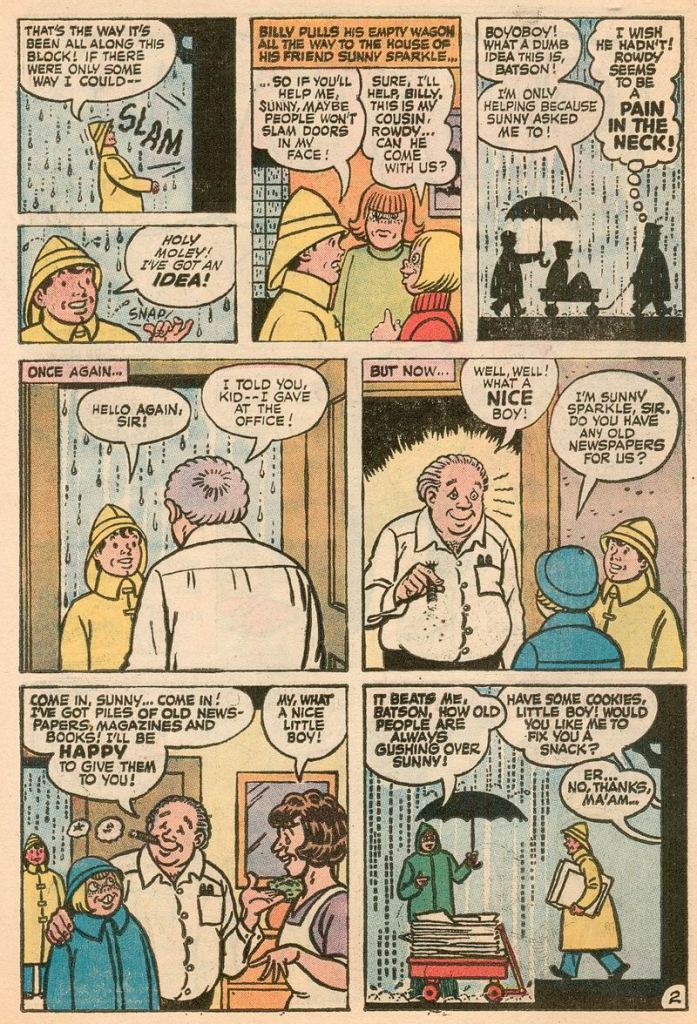
With his new might, Rowdy begins to make things tough for everybody around him. But Captain Marvel is able to return him to normal by destroying the magi book that first enchanted him. That’s the entire thing. Oh, and there’s a weird extended cameo appearance in this story by Archie and Edith Bunker of the then-popular All In The family television program. It’s a strange choice, and it’s really weird to see C. C. Beck drawing the both of them. But it does cement this story into the era, oddly enough. Like the lead story, there is almost nothing in the way of genuine stakes or drama or jeopardy. It reads as though Schwartz and company figure that Captain Marvel is aimed at younger kids than the average Superman story, and are overcorrecting in that direction.
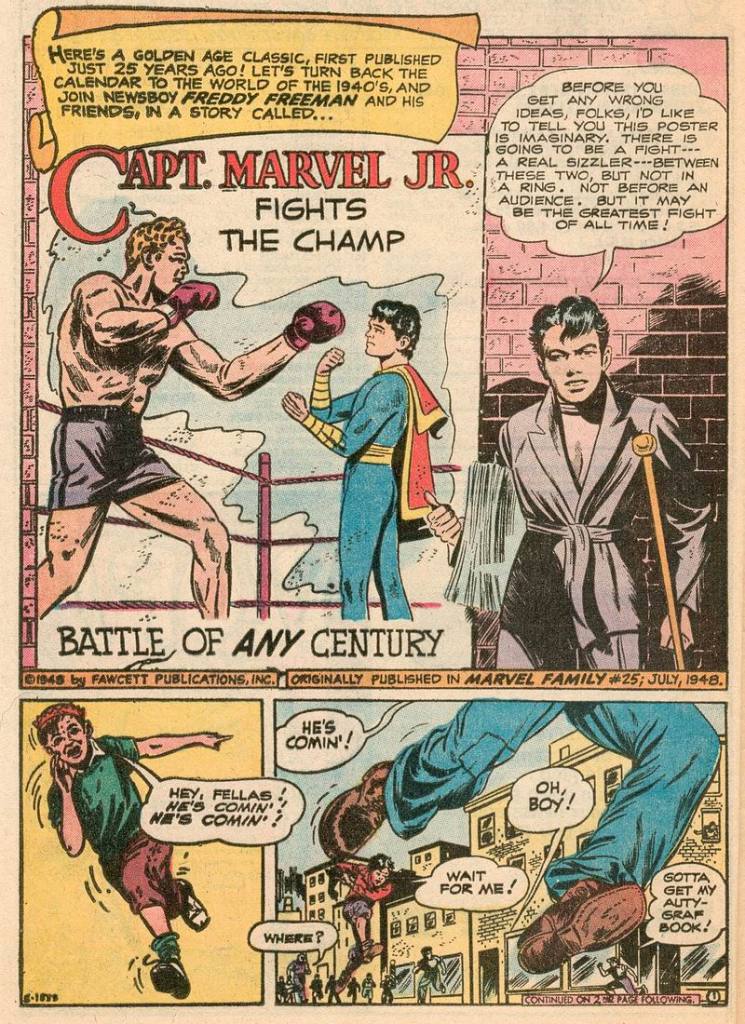
The back-up reprint story this time out has a different flavor to it, given that it features Captain Marvel Jr. Back in the 1940s and 1950s, while its operating parameters were identical to that of Captain Marvel’s stories, Junior’s adventures were depicted in a more quasi-realistic art style, one best exemplified by the strip’s most famous artist, Mac Raboy. This story isn’t by Raboy, though–it was written by Joe Millard and illustrated by Sheldon Moldoff, a name familiar to those who know DC history.

It’s an inoffensive little tale about the champ, an otherwise-unnamed boxer who is a bit of a jerk, and who slaps a kid trying to get his autograph. Junior comes to the rescue and teaches the Champ some humility, and then helps him get out of an agreement with some mobsters to throw his next fight for a payout of $50,000. It’s all to teach the Champ about the responsibility he has to be a role model to his young fans, and by story’s end, the boxer seems to be back on the right path. It isn’t a great story, but once again the reprint is the strongest thing in the issue. It was becoming clear that the DC team of the 1970s couldn’t quite capture the magic that Captain Marvel had possessed in his heyday. But that didn’t mean that they were going to stop trying.
 The Tom Brevoort Experience
You would think they would read the reprints to get inspiration for writing a Captain Marvel story ( Doing whatever updating they needed to do for readers of 1970s ) or treat it like any other DC series or listen to C.C. Beck ( I wonder if Beck even made suggestion on how to improve the stories he was working on with the writer or if it was just with the editor? ).
LikeLike
I find Beck’s art here charming — it’s simpler and bolder than in his heyday, but it’s still very good. Unfortunately, I don’t think it would have gone over any better even if he’d liked the scripts more. What he wanted to draw, and what he wanted others to write, was just out of step for the times, I think.
Though it’d have been fun to see, say, Sheldon Mayer write a few scripts.
LikeLike
The lead story is rather insulting to the intelligence of even young kids – “How can I [save you] when I can’t even see you?” – but you can hear him. And even if not, you should be fast enough (speed of Mercury, remember?) to just cover the entire general area where he might be. Plus it’s a bit out of character for Cap to basically threaten the guy with death. The whole scene is fundamentally Cap telling him in a snide way, give up the invisibility, or I’ll kill you right now. It’s not whimsical at all.
Also, given the Fantastic Four comic has been around for a long time by this point, kids know that the correct wish is for the power of invisibility.
LikeLike
I was never a fan of Cap in reprints or the original revival so I guess it was completism that kept me buying. Junior was a favorite though, whether Raboy and others or Don Newton in the new stories.
LikeLike
That Captain Marvel Jr. story really does stand out. Giving Cap Jr. his own distinctive “look” was probably a good strategy, as it made him seem like more than just a knock-off of Cap Sr. I’d say the same thing was true (to a lesser extent) with Jack Binder’s art on Mary Marvel.
LikeLike
Didn’t Beck submit a script to Schwartz, that Schwartz did not use? I wonder what it was that Beck wanted to do?
Leprechaun are not warm and cuddly figures in Irish myths, Maybe that story would have worked better If the Leprechaun had been the perversely just forces they are in Irish folklore. (Maybe Joe Orlando would have been better for that or Murray Boltinof, as Kurt Busick has speculated.)
LikeLike
I agree with everything you wrote, but I have a soft spot for this issue because it was the first back issue that I ever bought, from the first comic shop that I ever visited (probably late 1984). Discovering that comic shops existed (my father just looked it up in the Yellow Pages) was mind blowing to me. So as dumb as the issue was, I can’t hate on it.
LikeLike
The funny thing is, a leprechaun and an invisible thief would have fit write in to the old Captain Marvel Adventures. But yeah, they can’t pull it off here.
I presume the use of Archie is to show that Sunny can charm even a notoriously crabby grouch.
The ending story fascinates me because it’s a reminder how cool “the sweet science” was a couple of decades before I read it.
LikeLike