

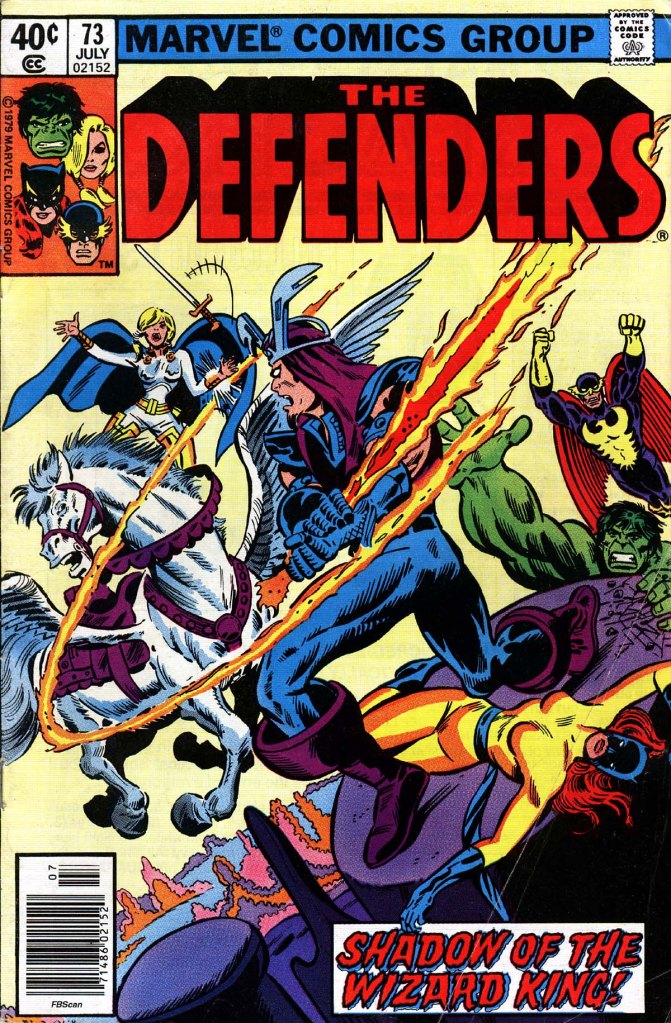
I know that I say this every time we roll around to another issue, but it’s positively baffling to me just how long I continued to buy DEFENDERS despite not really enjoying the title for years. I’m sure that some of this was simply having the available funds–I was never confronted with a need to be more selective at a time when an issue of DEFENDERS was on the line. And also, I’d bought into the mythology that everything that happened in the contiguous Marvel Universe might someday be important to some future story. The team titles seemed especially important to me. So through momentum and ennui, I kept on dropping my four dimes when a new issue of DEFENDERS turned up at the 7-11.
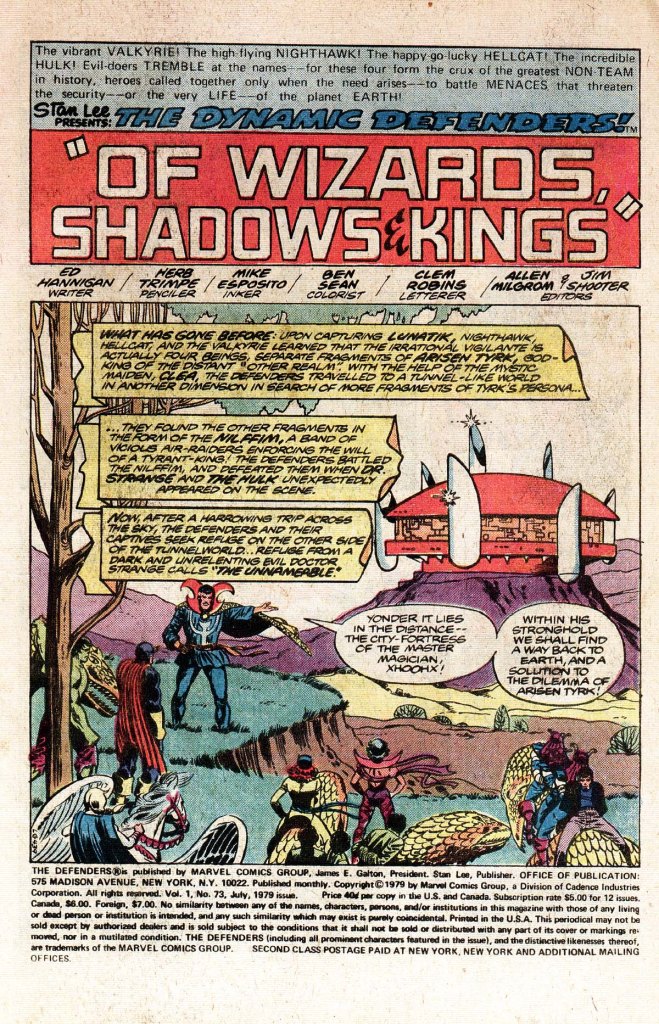
This particular storyline may have been the nadir of the entire run. What had started out as an exploration into the origins of the recurring gadfly Lunatik had transitioned into a half-baked fantasy adventure where the situation and the stakes were absolutely nothing that I cared about or was interested in. Fortunately, this was the concluding chapter to the whole thing. Unfortunately, I still had to get through it. Writer Ed Hannigan opened the issue with three enormous captions recapping the story so far–enough text that it practically crowded the artwork off of the splash page. This was not the most inviting way to bring a reader into the story, it acted instead as a barrier to entry. And even though I had read all of this stuff in prior issues, it felt like an insurmountale wall to climb when I first opened up the book.

But to sum things up quickly: the Defenders have traversed the tunnel-shaped world in search of the wizard Xhoohx, who can, they hope, help them to return to Earth. But the whole place is under siege by a shadowy foe whose name even Doctor Strange dares not speak. So it gets called the Unnamed a whole lot. As they near the stronghold of the magician they seek, the Defenders are put upon by the Unnamed’s creatures, furry bloblike things with multiple eyes and arms. This leads to a handy fight sequence to keep matters from growing too visually dull for the average comic book reader.
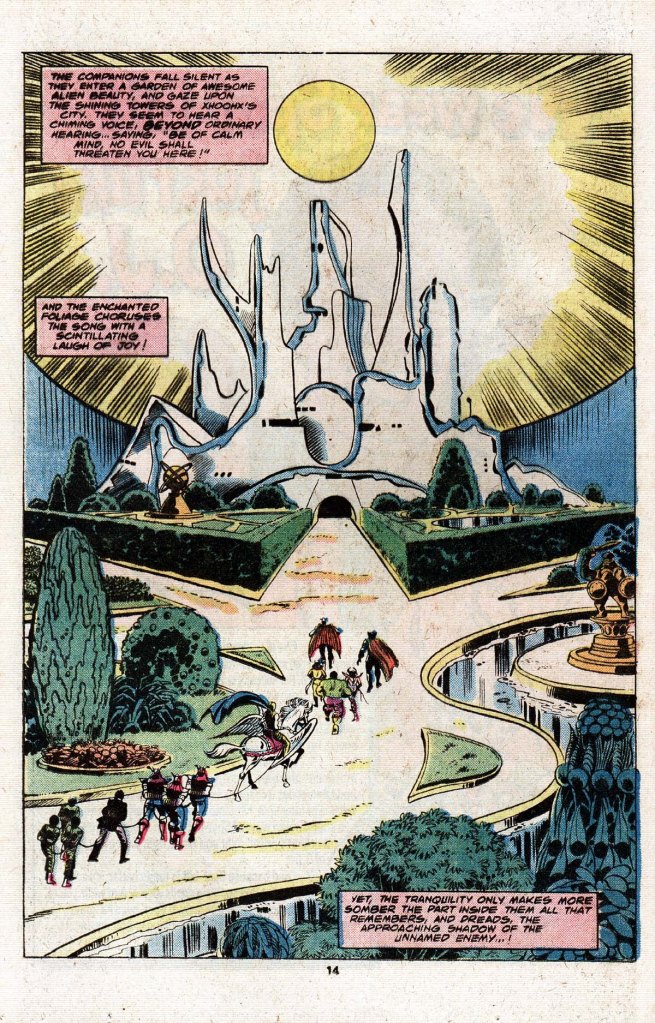
It’s the Defenders’ comic, so of course they’re able to trounce their attackers after a couple pages of action, and before you know it, they’ve arrived at the citadel of Xhoohx. The place is massive, but Nighthawk finds an aperture high up that he can soar into, and he’s thereafter able to locate the door and let his partners on through as well. Within the colossal structure, the Defenders approach the wizard’s city–a citadel-within-a-citadel for some reason. Artist Herb Trimpe tries his best to make the place impressive, but that sort of spectacle and wonder is a bit beyond his powers at this point. Herb was best at storytelling and Marvel-style action, but his images weren’t especially magnificent. So the awesome wizard-city is just kinda a bunch of oddly-shaped glowy buildings.
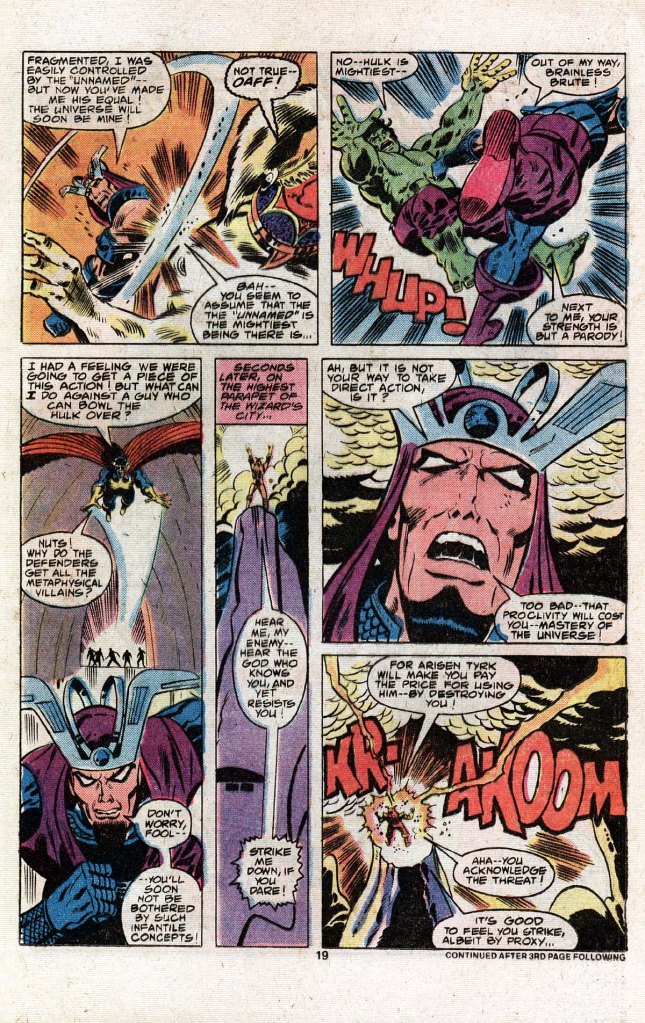
Xhoohx turns out to be a similar blob-creature with a speech pattern that evokes a cross between the not-yet-created Yoda and a Dr. Seuss character. In addition to a return home, the Defenders have brought the multiple fragmented versions of Lunatik AKA Arisen Tyrk with them, hoping that Xhoohx will be able to reunite them into a single being. This the wizard does–but the restored Tyrk immediately becomes hostile, proclaiming himself the God-King and moving to attack the Unnamed. The Defenders are scattered by the powerful Tyrk, who unleashes magic against his unseen foeman.
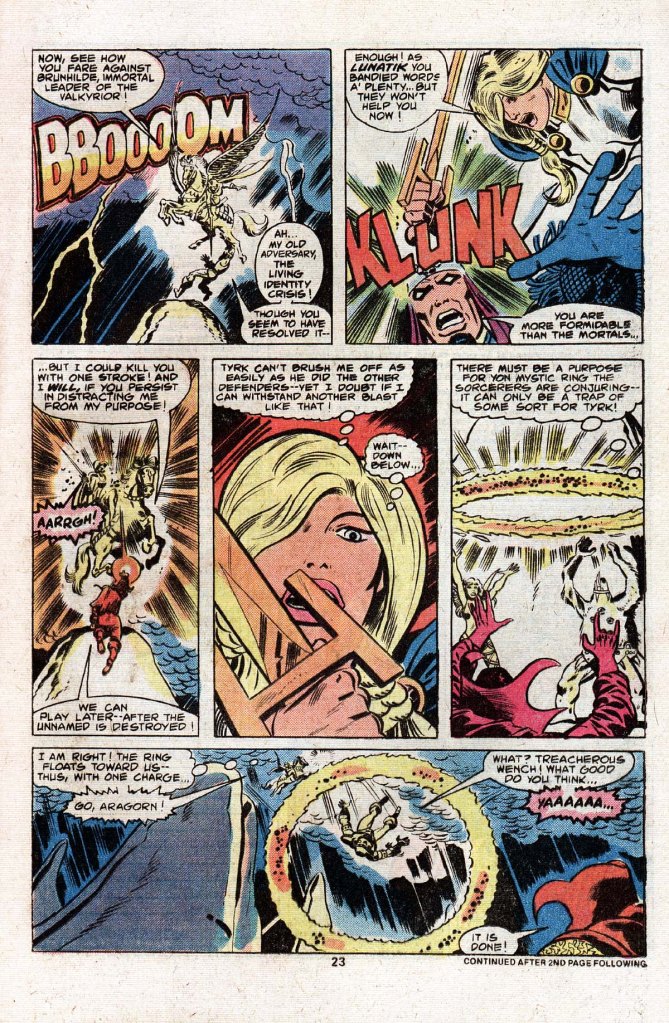
Unfortunately, Tyrk’s attack is exactly what the Unnamed wants, and so the entirety of Tunnelworld is now in peril. Valkyrie hurls herself against Tyrk–since his introduction, Lunatik was always mainly her adversary, after all–while Doctor Strange, Clea and Xhoohx get busy conjuring a mystic portal into which to throw Tyrk and banish him once again. Xhoohx half-heartedly tries to explain the plot at this point, but even the Defenders are sick of this story by now, and they pile off into another portal with the intent of returning home (though Doctor Strange immediately turns around and heads back to Tunnelworld as soon as he’s dropped them off, to join his power with that of Xhoohx in confronting the Unnamed. It’s a bout we will never see, thankfully.)
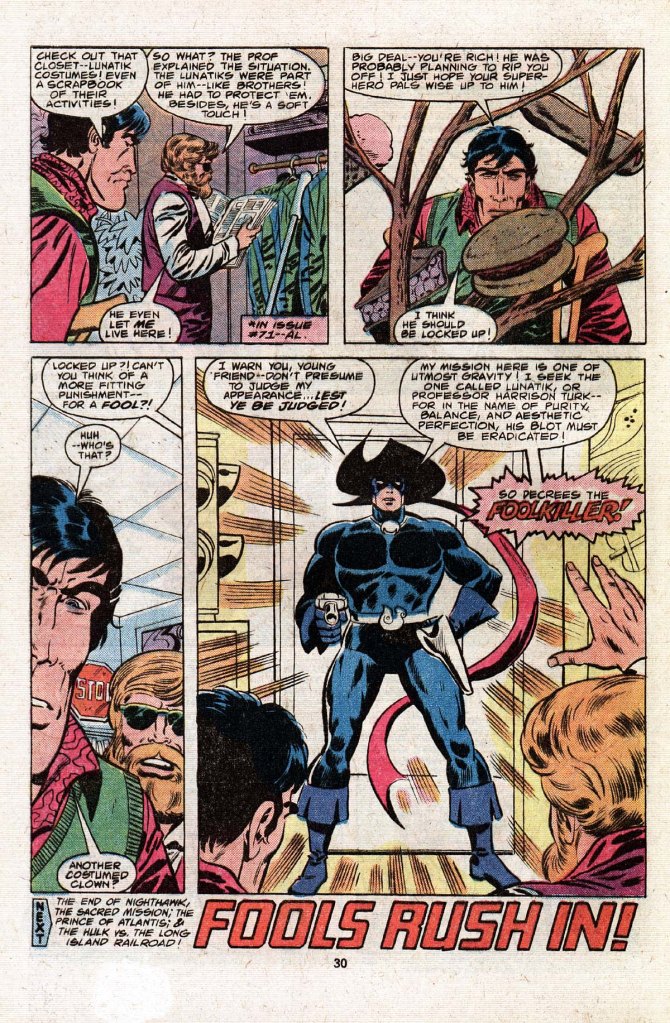
From the moment they touch back down on Earth, the assorted Defenders put the events of Tunnelworld behind them and go back about their own regular business. Kyle Richmond takes a call from his lawyer about the fact that he’s being subpoenaed, the Hulk wanders off, wondering why he hangs around with the Defenders, and Patsy and Valkyrie kick back. Elsewhere, on the Empire State University campus, Dollar Bill and his buddy Ledge are checking out Professor Turk’s now-abandoned digs (since he was one aspect of Lunatik, now gone.) But before they can get to far into things, they’re confronted by the Foolkiller, another of-beat creation of former DEFENDERS writer Steve Gerber. Foolkiller has come to wipe out Lunatik, not realizing that he’s gotten around to this a bit too late. But that’d be a problem for next issue, for now the book had reached its end.
 The Tom Brevoort Experience
There’s no hero team I like more than the Defenders. The series rarely lived up to the potential. I think “non-team” status was the wrong direction. A “loose alliance” was the phrase I always had in my head. But thinking about the 7 or so characters generally thought of as the Defenders, they’re on par w/ the JLA & the Avengers. They just operated independently, like the X-Men, without official sanction from any government agency.
This was OK stuff, but no where near the best of the time it was published. I like that Nighthawk was prominent. Trimpe’s not a fave of mine, but I’ve seen far worse visuals than these. As much as I loved the Defenders’ line-up, I rarely bought the book. If Mavel ever returned the core characters, I’d hope they’d really do it justice.
LikeLike
To the best of my memory, I was always ride-or-die for any series once I’d begun it (at least until the mid-1980s, when I stopped buying most Marvels en masse for a long time)…but DEFENDERS was, between 1966 and 1985, the sole exception. I thorougly enjoyed the insanity of #62-64’s membership madness, but #67 was as far as I could go. I’ve tried repeatedly since to go back to at least see what others saw in it, but I can never make it past one single issue. An artist, any artist, to my personal taste might have changed that, but boy was I never the audience for Herb or for Don Perlin.
LikeLike
I don’t think others were really seeing much in it, at least not until DeMatteis shows up around issue 93. I don’t see many people ever talking about loving this are of the book, aside from the Defender for a Day trilogy.
Once the weirdness of Kraft/Giffen has petered out, I think the book is just running on momentum and the two advantages it had: Marvel was getting a line wide boost from the growing direct market that wouldn’t really fragment until US1, and the Hulk was popular.
LikeLike
What is US1? Can someone clarify that term to a novice?
LikeLike
US1 was a comic that I skipped even though I was buying everything Marvel except magazines and barbarians. It was about a long distance trucker.
LikeLike
Marvel published a comic book series called US1. It was a licensed-property book based on toys, like G.I. JOE and TRANSFORMERS, but in this case it was about a truck.
The series was not very good and it sold worse and worse every issue, but more importantly, Marvel’s other low-selling titles started dropping in sales too, lower than they’d gone before.
US1 is considered the book that broke the “Marvel Zombie” — the book that made the then-large group of fans who bought every single Marvel Comic simply because it was a Marvel comic. Once they read US1 and thought, “Hell no, I’m not buying this anymore,” they no longer bought everything reflexively, and started dropping other titles as well.
I think it was something like US1 being the first book to drop below 100,000 copies sold per issue, and once it broke that line, other books followed.
Whether or not dropping US1 was the break that gave the Marvel completists mental permission to start dropping other titles, it was widely believed at the office that it did, and widely observed by retailers that it did. Anecdotal, but a lot of them told Marvel it was happening.
And thereafter, the term “Marvel Zombie” changed in meaning, from “a devoted Marvel fan who bought all Marvel comics” to “a devoted fan who bought only Marvel comics, but not necessarily all of them.”
And just to fill in that bit of history, the term “Marvel Zombie” had been coined by retailer Cliff Biggers, to describe fans who complained to retailers or wrote letters to Marvel saying the Epic Comics series GROO THE WANDERER should be canceled because they didn’t like it, but had to buy it because it was a Marvel Comic.
So anyway, US1 is considered something of a watershed event in Marvel history — the point at which Marvel went too far and broke the loyalty of the most-devoted Marvel fans.
LikeLike
I would still have to continue a series I’d started no matter what but just the ad copy for US1 did indeed stop me from blindly sampling. I never knew i was one of many that way. Thank god I’m better now. I’ve dropped even mini series partway through and won’t read parts of a crossover that are in books I don’t already read. Imperial is a very recent exception. I haven’t read any Spider-Man besides Superior Spider-Man through Slott exiting but picked up a recent issue because of Imperial in the solicitation. I’m now a Spder-Man reader again thanks to that.
LikeLike
That’s a much healthier approach, though Marvel and retailers really liked the blind loyalty of the Marvel Zombie. It was more profitable for them.
LikeLiked by 1 person
That’s fascinating! I skipped most of the toy-based books anyway (other than Micronauts, with that sweet Michael Golden art), so I never clocked that US1 was particularly hated. But I guess it makes sense — stuff like ROM and SHOGUN WARRIORS at least had a sci-fi element to them, whereas I gather that US1 was literally just a regular guy driving a truck? It’s hard to imagine why anyone thought that was going to take off.
LikeLike
Razorback was cooler and that right there is pretty damning.
LikeLike
Well, Marvel managed to add weird superhero-esque espionage, action and mystery stuff to it, but don’t ask me for details because I only read a few issues.
It also had characters with named like Poppa Wheelie, Wide Load Annie and Baron von Blimp. So at least the writer, Al Milgrom, seemed to be having fun.
LikeLike
Nobody has mentioned Ulysses Solomon Archer’s gadget-superpower, where he had radio-reception as an accidental result of having a metal plate in his skull.
But I suspect the US1 comic was just in the wrong place at the wrong time, when the market was changing due to many factors, and it took the blame. From what I’ve seen of it, it’s not good, but it’s not horrible. It’d be purely an obscure oddball if not for the undeserved legend around it. I think it got a lot of hate at first since it was late to the trucker fad, and dumping on it was a way of saying “Truckers? That’s so over, it’s uncool“. And then disdain grew from there, similar to the refrain “Aquaman is useless, he talks to fish”.
https://www.cbr.com/us1-worst-series-hate-marvel/
LikeLike
I don’t the US1 is Marvel’s worst series — after all, Marvel published STREET POET RAY, which sold far worse — but I’m not sure its reputation for being the series that broke the Marvel Zombie is undeserved.
Too many retailers reported US1 as the book that made readers who had “all Marvel” on their pull lists change that to “…except US1,” and then shortly thereafter, once they weren’t buying all Marvel books, started dropping others as well.
It may have been the wrong book at the wrong time — though comics are well known for launching new series just as the fad that supports them has died out — or it may be something where more stylish art or a more quirky sensibility could have made it a hit, but Herb Trimpe, possibly the last guy you’d call on to handle car chases, much less hot trucking action, was just not the right guy. I mean, there’s delivering humor in a deadpan style and there’s delivering humor in a non-functional style, too, and those characters might have been better saved by more charm, more expressive cartooning or, I dunno, more something.
LikeLike
…or it may be something where more stylish art or a more quirky sensibility could have made it a hit, but Herb Trimpe, possibly the last guy you’d call on to handle car chases, much less hot trucking action, was just not the right guy. I mean, there’s delivering humor in a deadpan style and there’s delivering humor in a non-functional style, too, and those characters might have been better saved by more charm, more expressive cartooning or, I dunno, more something.
marvel at least learned their lesson a little bit in that regard, when they made the sectaurs comic a few years-ish later they had texeira on it. i mean, they still produced a sectaurs comic…
LikeLike
“And just to fill in that bit of history, the term “Marvel Zombie” had been coined by retailer Cliff Biggers, to describe fans who complained to retailers or wrote letters to Marvel saying the Epic Comics series GROO THE WANDERER should be canceled because they didn’t like it, but had to buy it because it was a Marvel Comic.”
That’s interesting, because the last issue of U. S. 1 was published five months before the first Epic issue of Groo.
It’s also interesting, to extrapolate from what you’re saying, that Dennis the Menace saw substantial sales in comics stores strictly because it was being published by Marvel.
For context, it probably should be noted that when U. S. 1 was being published–1983 and the first half of 1984–comics stores accounted for about a third of Marvel’s North American sales, and Marvel accounted for over three-quarters of new-issue sales in comics stores.
Judging from the later performance of other toy tie-in comics–Transformers and G. I. Joe in the mid-1980s were two of Marvel’s top-three sellers among ongoing titles, and both sold modestly in comics stores–perhaps the comics stores weren’t the target market for U. S. 1? It apparently didn’t do well in the newsstand market, either, but perhaps it was intended for an audience outside the Marvel superhero fans, and those fans weren’t a big concern?
LikeLike
Mark, I consider myself to be in fine company to have stopped reading The Defenders at the same exact issue that you did. 🙂
And I concur regarding the art for the remainder of the title. Certain artists kept me from also reading West Coast Avengers, as well as a handful of other books.
LikeLike
that cover is egregious…even for a book that was made by folks in the trenches, who most likely had been there a while, just trying to hit deadlines and get the book out the door, no rah rah fanfare, just meat and potatoes stuff…the cover is coloring book material.
(none of this is deriding or criticizing the creatives on the book, they didnt put any less into their work than the kirbys or adams, or millers or byrnes, sometimes shit just doesnt land or despite ones best efforts, its just not very engaging, it happens)
LikeLike
I did actually drop Defenders around this time, although I would still “check in” occasionally to see if things had improved. Despite everything, I still had a lot of affection for Valkyrie, Nighthawk, and Hellcat as characters. I picked it back up for a while during the DeMatteis era — he had a lot of interesting ideas. But the combination of bland artwork and the general depressing tone of the stories wore me down, and I eventually dropped it again, this time for good.
LikeLike
Riddle me this: how in the heckity heck do you pronounce “Xhoohx”?
LikeLike
Riddle me this: how in the heckity heck do you pronounce “Xhoohx”?
LikeLike
I always say it like Zooks, but maybe it sounds a bit more hoarse and throaty? Anyway, I his speech patterns always liked have. Arroo.
LikeLike
I think I had a subscription to Defenders at this time and road it out until #77 and then I was out when Doc Strange, Namor, and Hulk returned. The book had been sputtering for a while but I preferred the lower ranks of Nighthawk, Hellcat, and Valkerie to Strange, Namor, and Hulk.
This particular storyline is rough since I recall wondering why the Defenders seem so intent on going on a long and dangerous journey just to reunite the fragments of a guy who is clearly awful. Who did they think they were helping? Superheroes have good intentions that blow up unexpectedly in their face all the time, but here they seem to miss the obvious of what would happen when they fuse a bunch of guys called “Lunatik” back together.
LikeLike
It strikes me that people understood that DEFENDERS was supposed to be “weird,” but when writers and artists who aren’t predisposed to weirdness try to do weird, they half-ass it because they don’t really get the idea.
Gerber could do weird in his sleep. Kraft was weird but wasn’t a disciplined enough writer to make it into a coherent and satisfying story. Hannigan was not weird and should have just gone in a different direction. Trimpe was also not-weird.
They might have been better off taking their cues from Roy Thomas’s Defenders, or Len Wein’s, rather than from Gerber and Kraft.
LikeLike
Trimpe tried but when he’s given crap like this or that tap dancing goon, there’s no way an artist can make it work. And to be honest I loved Perlin’s run. Yes, his art was prosaic and he was traditionally better suited to maybe Westerns but that’s what worked for me. Perlin grounded the weirdness and made it seem more realistic to me. Alpha Flight had an artist for a time I liked for the same reason. Calimee? (I don’t feel like Googling. Sue me.)
LikeLiked by 1 person
Tapping Tommy? He was drawn by Sam Grainger.
And I kinda liked him. He’s absolutely an example of what I mean when I talk about writers who are trying for weird but don’t have the sensibility for it, but I find him charmingly bad rather than thuddingly bad.
Maybe the Gold-Diggers of Fear should have had a few stories where they try to get a new front man — the Eel? the Gladiator? — and it just doesn’t work out.
LikeLike
Tapping Tommy and John Calimee are both things you can like if you’re in the right mood. Tommy’s a Bill Mantlo fill-in story, and I’m always strangely fond of seeing those, and the art in that one is rather good. Calimee’s art and Hudnall’s writing on Alpha Flight are uniformly awful, but I can and do still read back through the whole sequence now and then and enjoy it!
LikeLike
Collecting the whole run of Defenders was one of my first obsessions in comics, and even this era (with hindsight it’s amazing how long the comic was trying to be Steve Gerber and not quite getting it) was interesting enough to keep me picking up the cheap back issues wherever I found them.
The whole Tunnelworld and Xhoohx thing isn’t a story I ever really feel like picking up and reading again now, but there’s still a certain charm to it. It’s good enough that I can see why everyone kept on buying and reading it!
LikeLike
This was the era that broke me off reading the book, though much earlier than this issue.
Fascinating to learn US 1 had such an (alleged) impact. As someone who flipped through it on the stands, the Zombies totally made the right choice.
LikeLiked by 1 person
Tom, I am equally baffled as to why I kept buying the Defenders during this period. Out of habit? Because I thought it might get better? I really don’t know. What has especially surprised me in reading your posts on Defenders 66-68 and this series of stories that finally dealt with this Lunatik character is that I really don’t remember anything about any of these stories! I have strong memories of the Thomas, Englehart, Wein and of course, Gerber Defenders stories and some of the Kraft issues such as Defender for a Day (which was quite entertaining). But these stories… And yet, I recall that I continued to buy Defenders for some time, finally dropping this series around the same time you did (120, I think, but not sure). But I do have the vague memory that there were some mediocre to poor stories to come (after 73). I don’t think Hannigan knew how to handle Gerber’s concept of the Fool-Killer, and then there was an interminably long story in Defenders 78-83 that brought back the original Defenders, the strange Tunnelworld and the annoying wizard Xhoohx, who, yes, I actually do recall spoke in a speech pattern similar to Yoda but the story came out several months before The Empire Strikes Back (Yoda’s first appearance). I don’t remember much about that storyline except that it seemed to go on forever (so that may have been the nadir of the Defenders for me), but Marvel was doing things like that in 1979-1980, when at the same time Roy Thomas was writing a very lengthy story line in Thor that went on even longer (which of course you are just starting to get into now). This was just not a great period for the Defenders and I would have to agree that while Trimpe is a very competent artist, I just don’t believe he was right for this series. Sal Buscema should have been brought back. His work on the Defenders was really solid and very good. Oh well…
LikeLike
Bad art. With bad covers and bad interiors, nothing that I wanted to see here. I just couldn’t understand the Defenders.
I can’t tell you why the Avengers made sense or the Fantastic Four when eventually everyone could become a member.
I liked the team books because then I didn’t have to buy the solo books. There was just enough usually with this character or that one to maintain interest but then in the mid 80s art just plummeted as artists ended their careers and my interest in comics. There would be Perez on the cover and then something abominable inside.
LikeLike