


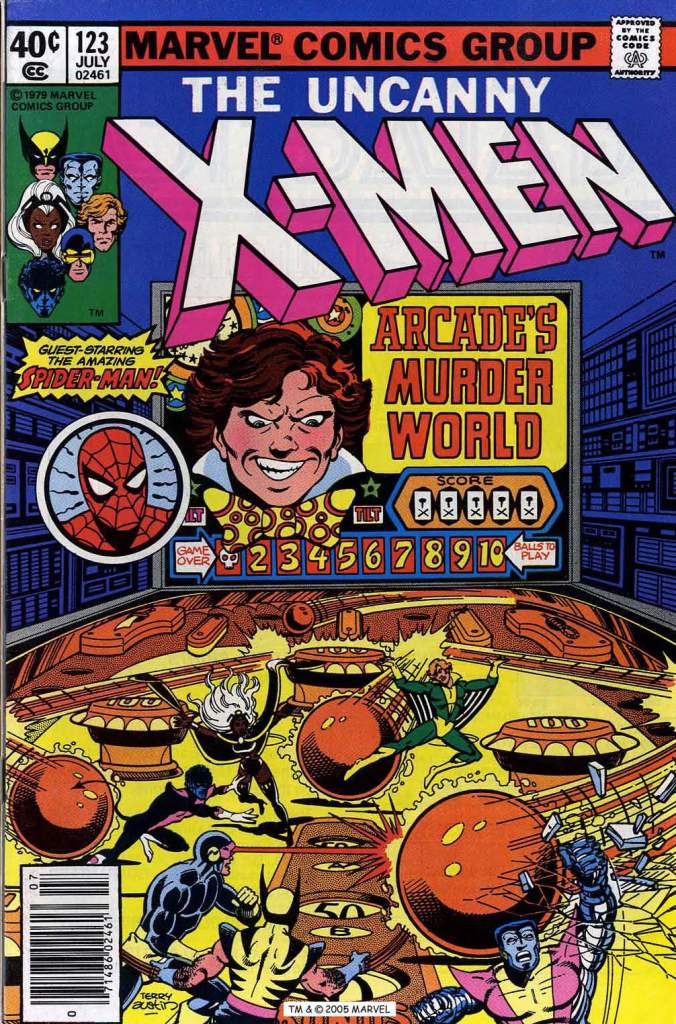
This next issue of UNCANNY X-MEN was a bit of a favorite of mine, possibly down to the fact that the central villain of the piece, Arcade, was a bit closer in tone and spirit to the Flash’s rogues gallery members than most Marvel villains. The series had been steadily rising in my estimation, and was one of the best and most looked-forward-to comics of this era, even if it didn’t entirely explode in popularity for another couple of years. As I’ve mentioned previously, back issue prices had already jumped up dramatically as compared to everything else around them as more and more readers discovered this new group of X-Men and raced around attempting to fill in their backstory. The print runs on the earliest issues of the ALL-NEW, ALL-DIFFERENT team had been relatively small (set as though the title was still a reprint series) which meant that demand way outstripped supply. This was also why X-MEN #94 commanded generally higher prices than GIANT-SIZE X-MEN #1 in which the characters had mostly debuted. It was simply easier to find copies of GIANT-SIZE X-MEN #1.
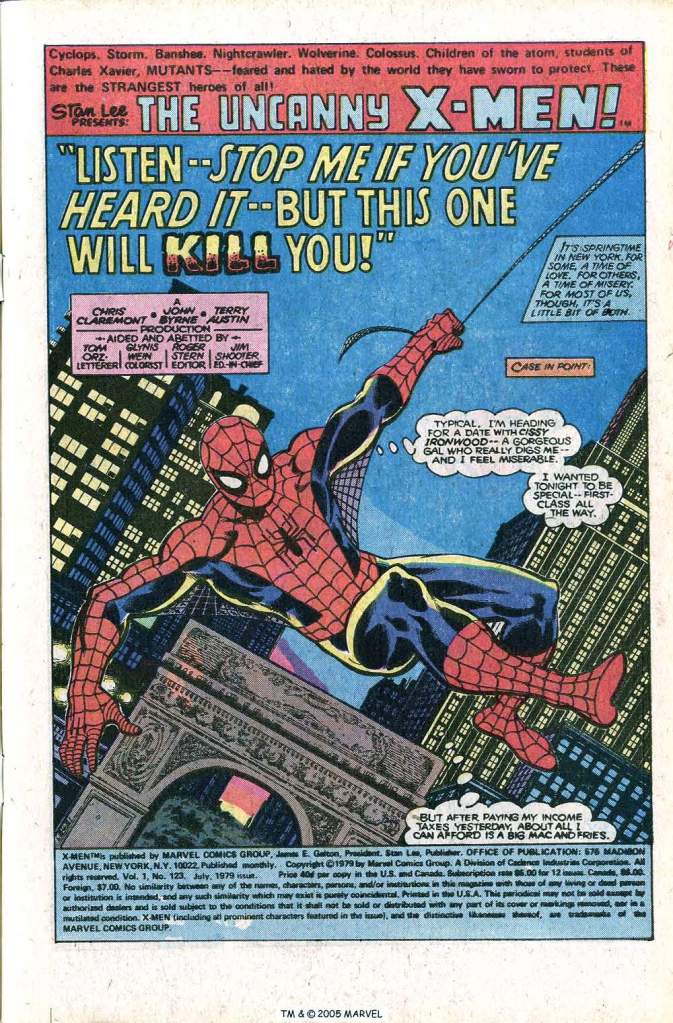
At the time I read this issue of X-MEN, I hadn’t yet seen writer Chris Claremont and artist John Byrne’s first story featuring Arcade, which ran in two issues of MARVEL TEAM-Up pairing Spider-Man with Captain Britain. So I was unaware that the team was pretty much recycling all of the same gags and traps here. Which I suppose makes some sense; if Murderworld is set up in a particular way, then it’s going to attempt to kill whomever is trapped within it in the same way regardless of who they are or what book they were in. But I was a bit slack-jawed years later when I eventually read those two MARVEL TEAM-UP stories to see just how much of the action and trajectory of that story mirrored this two-parter.
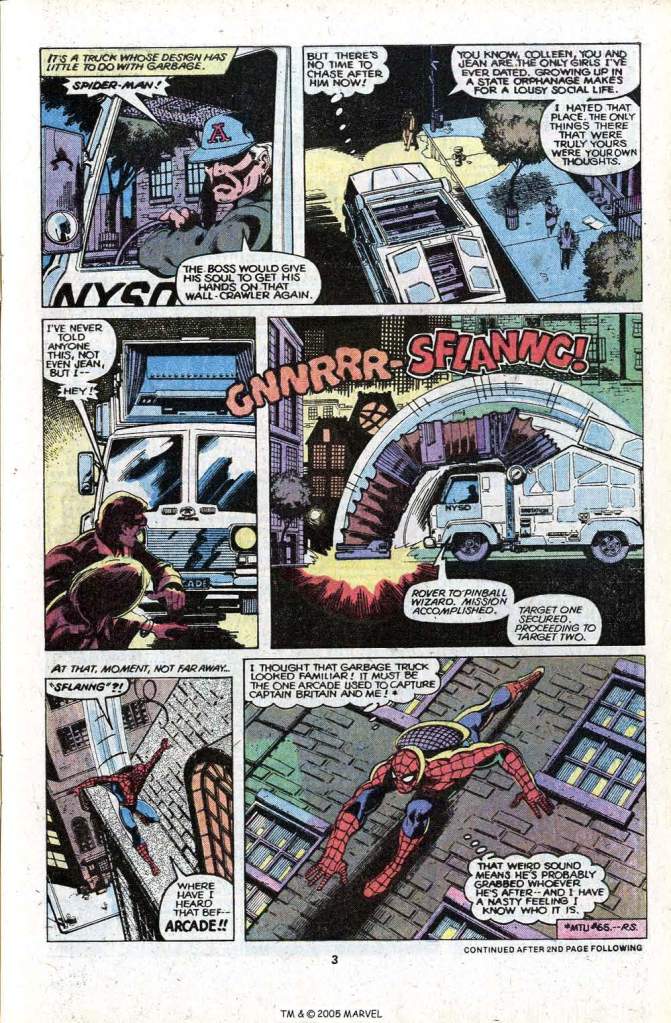
As if to acknowledge what they were doing, Claremont and Byrne opened up this issue focusing on special guest-star Spider-Man having a chance encounter with Scott Summer and Colleen Wing just moments before the pair is vacuumed up by Arcade’s Murderworld garbage truck. Having experienced this firsthand himself, Spidey recognizes the sound of what happened, but is unable to locate the vehicle as it makes its escape. He attempts to warn the other X-Men about what just happened to Cyclops, but by the time he’s able to call the Mansion, Arcade and his teams have already incapacitated the rest of the mutants. That’s all we’ll be seeing of Spidey in this story, as it turns out–hopefully somebody at some point after the adventure thought to find a way to reach out to him and let him know that everyone was all right.
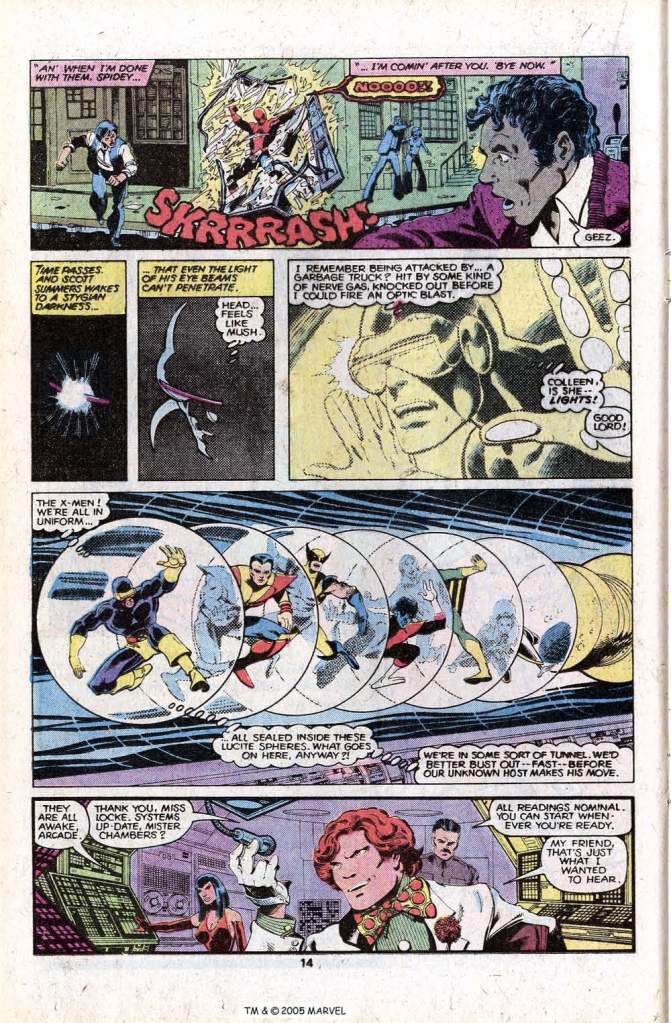
As far as plot goes, that’s pretty much it for this issue. From here on out, it’s all action and fighting and death-traps. Arcade has been commissioned to kill the X-Men by their enemies Black tom Cassidy and Juggernaut, and that’s what he and his associates intend to do. The heroes wake up to find themselves dressed for action (which is sort of creepy when you think about it) and trapped inside giant pinballs. Before they can affect any sort of escape, a gigantic striker sends them hurtling out across the surface of a gargantuan pinball machine, where every contact with a bumper sends an electric charge through the spheres encasing them. Before anybody can work out a way to fight back, each of their balls winds up falling through a different slot into some other unknown danger.
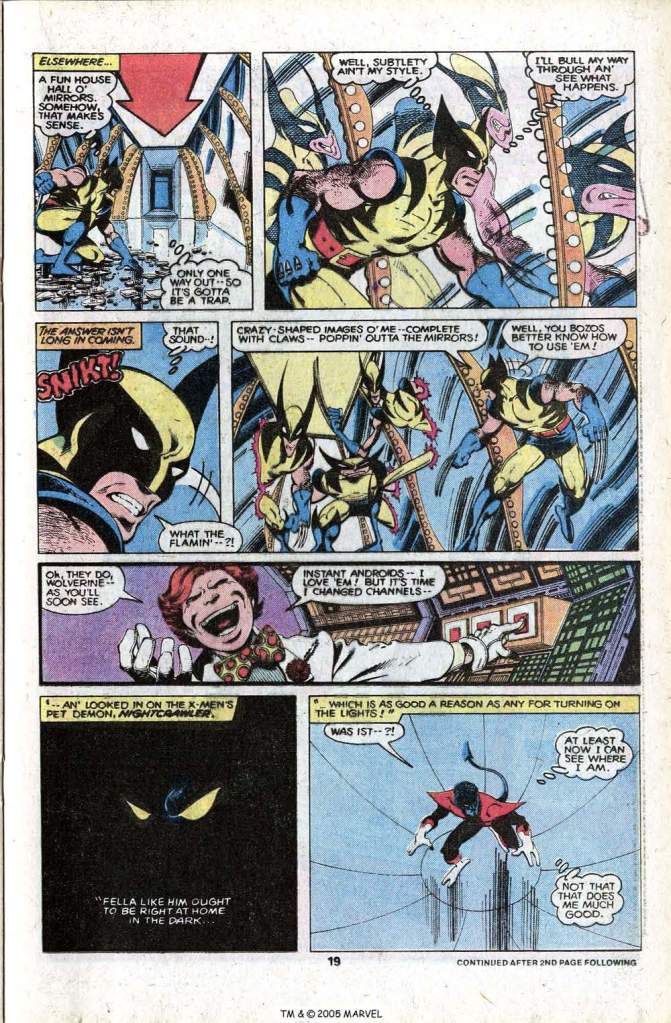
Well, unknown unless the reader had previously consumed MARVEL TEAM-UP #65-66, in which Spider-Man and Captain Britain faced and defeated many of these same dangers. But putting that aside, it’s still a fun sequence (and experiencing it for the first time myself here, I thought it was pretty entertaining.) Cyclops is trapped in a Lady-Or-The-Tiger room where a moving wall forces him to choose one of three exits, only one of which is said to be safe. Wolverine is in a hall of mirrors that generates distorted android copies of his homicidal self. Nightcrawler is encased in a spherical room and buzzed by swift-moving bumper cars with razor-sharp teeth, Banshee’s in a holographic room where he’s strafed by vintage fighter planes, Storm is trapped in the dark in a tight chamber filling with water designed to trigger her claustrophobia. And Colossus is in the weirdest trap of all: he’s hypnotically interrogated by what claims to be high-ranking operatives of his Russian homeland who intend to convince him to use his powers for the good of the State.
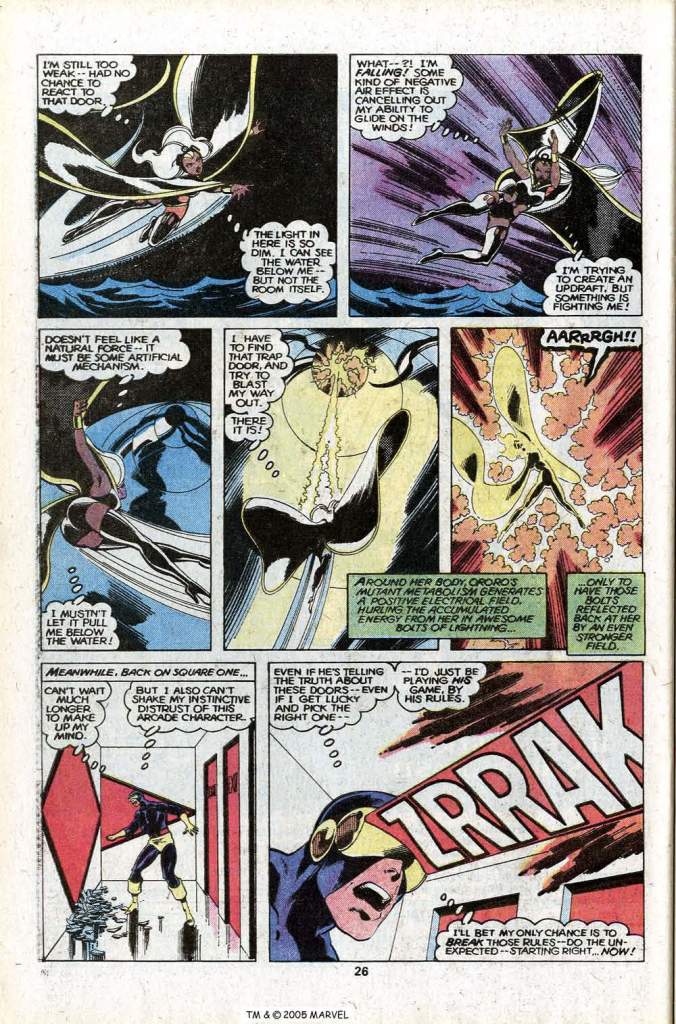
By the end of the issue, the X-Men begin to get their bearings and to fight back against their imprisonment. Figuring that Arcade can’t be trusted, rather than selecting one of the handy doorways, Cyclops instead chooses to turn his optic blasts against the moving wall, punching himself a pathway to safety. This winds up bringing him out in the hall of mirrors where Wolverine is slowly being overwhelmed by his android duplicates–for each one he’s able to disembowel, another one forms. But Cyclops’ presence is enough to turn the tide, at least until the duo can zap the mechanism generating the androids.
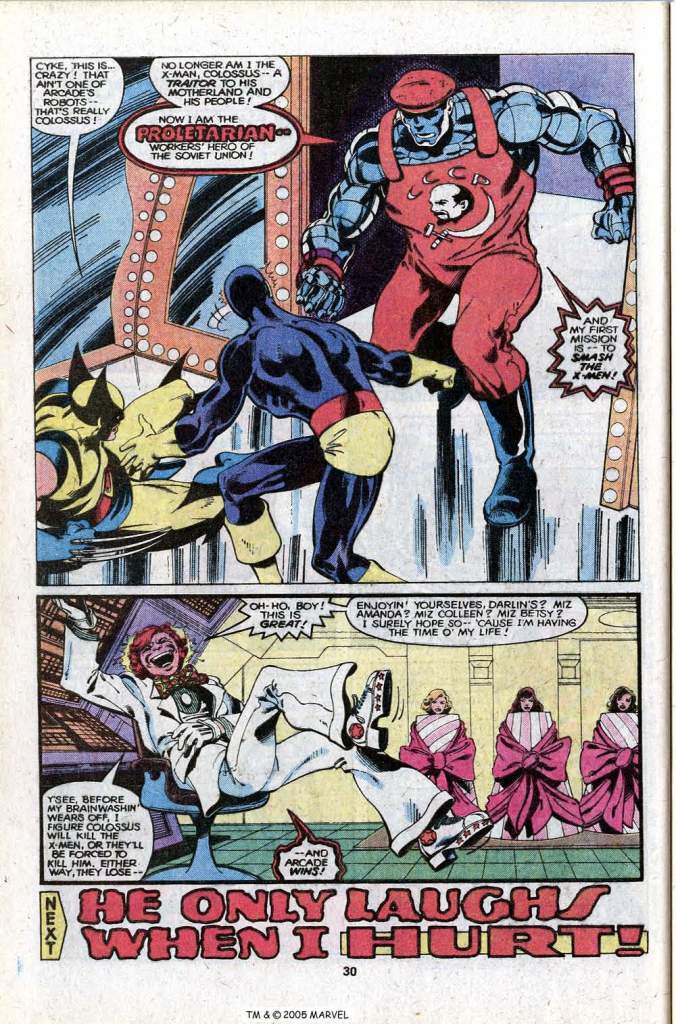
But as Cyclops and Wolverine move to exit, Logan is sucker punched by a figure lurking in the darkness. As the lights go up, this is revealed to be Colossus, thoroughly brainwashed by Arcade’s attack and now attired as the Proletarian, the hero of the Russian people. And in order to prove his loyalty to the cause, he must first kill his fellow X-Men. As Arcade laughs manically about this turn of events, the story is To Be Continued! It’s somewhat surprising to realize that in all the years since this story, nobody has as-yet brought back the Proletarian as a separate character to battle Colossus or the X-Men. That seems like such a Claremont thing to do. So perhaps that was an idea of Byrne’s that Chris simply went along with, or else it just never occurred to him or those who followed him.


I loved Arcade and his Murderworld! He’s a character that can’t be used too often but makes a great foe any hero or group of heroes when some villain is willing to pay his price.
LikeLiked by 1 person
Question has any writer gone back and answered the question as to why yet to be revealed sorceress Amanda Sefton ( Jimaine Szardos ) chose to play damsel while her boyfriend Nightcrawler and his team-mates/friends lives were endanger.
LikeLiked by 2 people
A) Margali and her daughter followed a Winding Path and their position on it varied their powers from basically stage magician at one end and unstoppable at the other, right? Arcade luckily caught her at the nadir of her powers.
2) Claremont hadn’t thought of it yet.
LikeLike
I just recently reread X-Men from 1-176 and I was stunned when I got to the Claremont run and realized how few original villains there were. Not standard Marvel ones so much as ones he himself had used in other stories.
LikeLiked by 1 person
I think the Roy Thomas ethos of bringing back old characters prevailed until Marvel introduced creator bonuses.
LikeLike
I think the Roy Thomas ethos of bringing back old characters prevailed until Marvel introduced character creator bonuses.
LikeLike
I’d read the MTU with Arcade and I still enjoyed the heck out of this story. Arcade is just fun. Though according to a later letter column, some readers hated that there was no complexity to his personality, he’s just a dude who likes killing people. Me, I’m okay with villains like that once in a while.
LikeLiked by 1 person
He’s just a dude who likes killing people: But doesn’t that fit Bullseye too. Not to glorify the killing of people even fictional people but using Murder World Arcade does it with style, Bullseye only does that when he using something like a playing card. Like I said before, I like Arcade. Maybe next time the Joker could hire him to try to kill the Batman instead of Deadpool.
LikeLike
Oh, Arcade’s way more fun that Bullseye for sure. I’m divided whether Arcade’s sense of fun would make him a natural partner for the Joker or the latter would see him as too close in style (“There’s only room for one Clown Prince, Arcade!”).
LikeLike
Reasons the Proletarian may never have been spun out into his own separate existence:
1. Bad name.
2. Uninteresting costume.
3. The CCCP collapsed in 1991, so the window to do it in was limited — these days, the X-Men didn’t even exist while the CCCP was an ongoing nation.
LikeLiked by 1 person
On #1….Not that it would have made much of a difference but “Proletarian” is an odd choice over “Proletariat”. The difference between “Sub-Marinish” and “Sub-mariner.” One suggests a leaning and the other is a guy.
#2. Agreed. those are biballs.
#3. woof…. how things have changed.
LikeLike
“Proletariat” wouldn’t be a guy, it’s a class of people. “Proletarian,” in noun form, means a member of the proletariat, so that was accurate, at least.
As an adjective, though, it means “ordinary” or “modest, unassuming,” among other things, so it’s a little like calling your new hero/villain, The Boring!
The definitions are related, but it’s still a name that has no juice. It means something, intellectually, but there’s no emotional power to the name. Not like, say, Erik the Red, another alternate ID for a hero that Claremont re-used as a villain.
LikeLike
Proletarian vs Proletariat: I did get that reversed class vs individual.
LikeLike
It would kind of have to be “The Proletarian” (like “The Batman”) in order for the name NOT to be proletarian . . . . and isn’t being “The Platearian” intrinsically sort of bughouse . . . .
LikeLike
It _is_ “The Proletarian.”
”Bourgeois” can be his adjective.
LikeLike
bourgeoisie
LikeLike
I thought either Claremont or Byrne said somewhere that Man with the Golden Gun was an influence, where the maniacal Arcade is more Hervé Villechaize than Christopher Lee, but can’t find a quote.
LikeLiked by 1 person
I liked Colleen for Scott better than Jean. Heck, I even liked whatshername that got sent off to Magneto then Skull The Slayer better. Emma is his true soul mate anyways.
LikeLike
Aleytys “Lee” Forrester. I figure Claremont was reading Jo Clayton’s Diadem novels, as I don’t recall ever seeing the name Aleytys anywhere else.
LikeLiked by 1 person
The Proletarian WAS brought back recently – at least in robot form – in Avengers Infinity comic, found in the ruins of this old Murderworld. https://marvel.fandom.com/wiki/Proletarian_(Robot)_(Earth-616)
LikeLike
It’s hard to imagine Spidey just giving up at that point, although he doesn’t have much to go on. It might’ve been nice to include a couple panels at the end of part two, having him arrive at Arcade’s amusement park just in time to see the X-Men walking out under their own power. But then, tying up loose ends was never Claremont’s strong suit…
LikeLike
I thought it very improbable that Arcade would be able to brainwash Colossus so quickly, as if he’d been studying Peter Rasputin’s psychology for years.
Also didn’t like that Claremont raised the subject of Colossus and his divided loyalties and then dropped it
LikeLike
Think of it as a sneak peak at all the times Peter has been mind controlled for reals.
LikeLike