

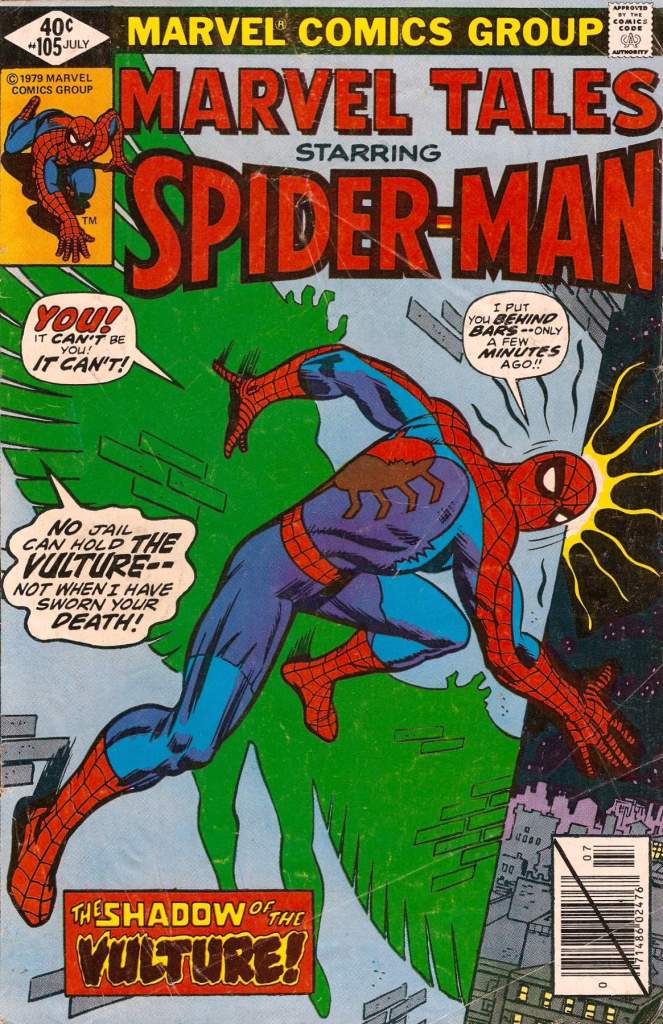
I continued to make MARVEL TALES a regular purchase, it being one of the few remaining reprint titles at this point. My circle of comic book reading friends looked down our noses at reprint books, the understood belief was that they were “worthless” because they wouldn’t accrue in value as back issues, something that we were all very invested in despite the fact that nobody among us especially thought about selling his comic books. But that monetary return was one of the ways we justified reading and collecting comic books to other kids and adults on a level that they could understand. We weren’t just buying them because we loved them, we were also making a canny financial decision that would reap benefits in our future. Today, we were right at least as far as this issue of MARVEL TALES is concerned. Despite its age, it isn’t really worth much of anything on the back issue market.
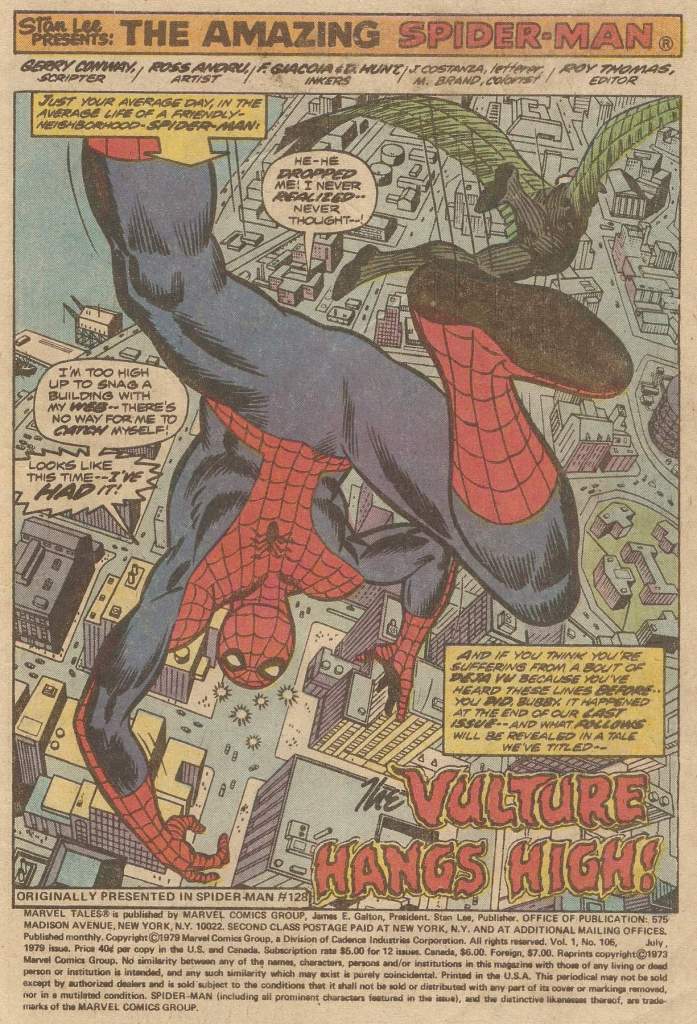
The stories then being reprinted in MARVEL TALES had been published only about six years earlier in the pages of AMAZING SPIDER-MAN. And as back issues themselves, they didn’t cost much. But MARVEL TALES was an easy title for Marvel to put together and bring in a few thousand dollars, as the cost to run these reprinted stories was minimal. In a couple of years, new editor Tom DeFalco would decide to start over again at the beginning, devoting MARVEL TALES to the earliest Spider-Man stories, which weren’t so readily available and which were costly as back issues. That was a smart move at the time, but it was still a couple of years away at this point.
During the 1970s, the tone and tenor of Spider-Man was very much established by the creative team of Gerry Conway and Ross Andru. Even after they had departed the series, the template they had laid out was followed by their successors, at least for a while. Conway’s Spider-Man (and Peter Parker) was a lot hipper and more worldly than the previous Stan Lee version. But he was also prone to adolescent outbursts of temper and carried a neurotic streak that was sharper and more keenly drawn than how Lee had handled the character. His world also got more immersive with the addition of new supporting cast members such as Glory Grant and a returned Flash Thompson and Liz Allan. Under Conway, Spidey was a hard-luck hero in a totally different way than he had been, and his veneer of being a bit of a socially awkward nerd was gone completely. Conway’s Peter Parker was a confident young man, for all that he was also emotionally immature much of the time.
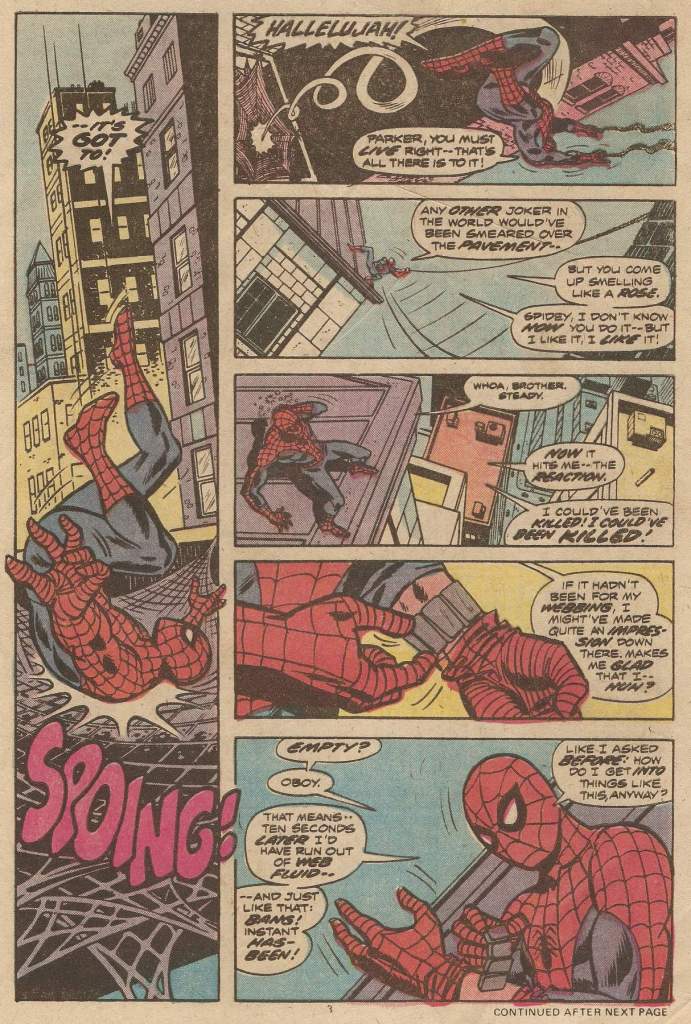
Having cleared the decks of Gwen Stacy, Peter Parker’s former girlfriend whom Conway found to be something of a wet blanket, the writer wasted no time in bringing Peter closer to Conway’s preferred romantic choice, the flighty Mary Jane Watson. And so, in this two-part story, MJ happens to accidentally see a murder outside of her apartment, making her a target for the killer, who appears to be Spider-Man’s old foe, the Vulture. But there’s a bit more going on here that that. The story opens with Spidey surviving another fall from a great height. It feels like Conway and his successors used this cliffhanger repeatedly, each time illustrated by Ross Andru. Here, though, Spidey does have a fun reaction after the fact to the reality that he was almost genuinely killed. This kind of moment made Spider-Man seem more human and fallible than most other super heroes of the time.
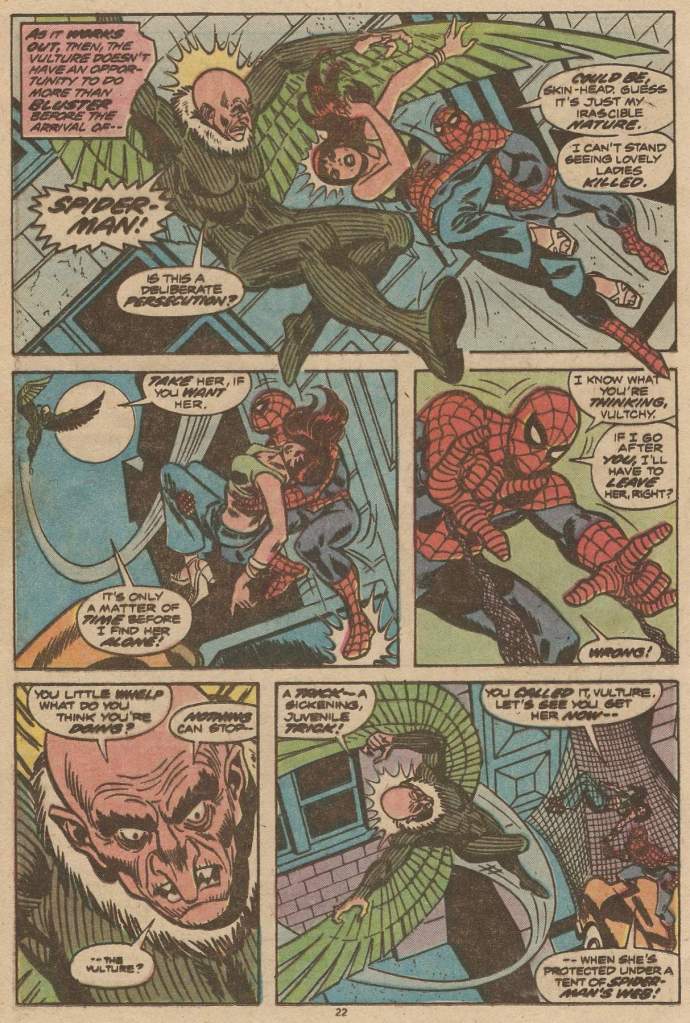
As Peter Parker, the web-slinger follows a trail of clues to the Vulture’s lair, but it almost killed by the villain as a result–dropped from a height into the river. Seems to be the Vulture’s go-to move. Of course, Spidey survives. And what’s more, he convinces Mary Jane that she has to go to the police and come forward with what she saw. But as the pair take a cab to the local precinct house, they’re again attacked by the Vulture. Peter makes himself scarce so he can change to Spidey, leaving MJ in the Vulture’s hands, if only for a moment. Then it’s back into the fray as the battle is joined again. Spidey rescues MJ from the Vulture’s grasp and protects her with a tent of his super-strong webbing, then he turns his attention to clobbering the Vulture. But he’s too late, with his victim beyond his power, the Vulture takes off.
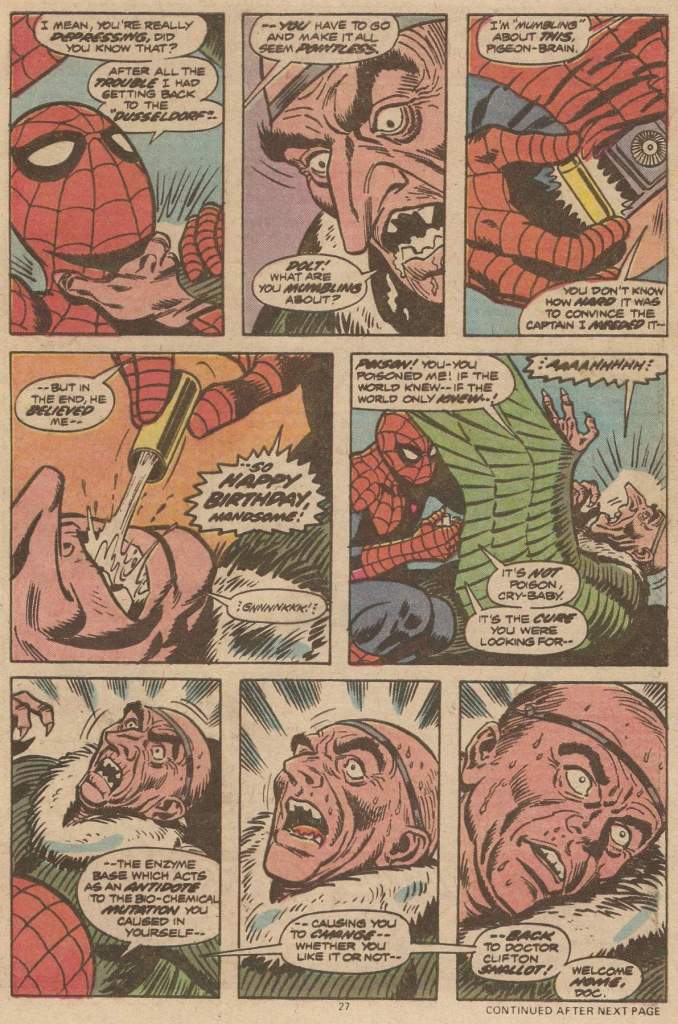
But the web-slinger has already worked out what’s going on, and the fact that the foe that he’s been facing isn’t the genuine Vulture at all, but rather one Doctor Clifton Shallot, who used a bio-enzyme to mutate himself into a human vulture. Spidey heads for a showdown at Shallot’s lab, where he’s able to confront the scientist. Spidey’s brought along the antidote to Shallott’s transformation as well, which he force-feeds to the pinned down criminal, returning him to his normal human state. This whole thing was Conway’s attempt to field a Vulture who was more monstrous and formidable than Adrian Toomes, who presented often as an old man. Didn’t quite take, though, and so Shallott was never seen again.
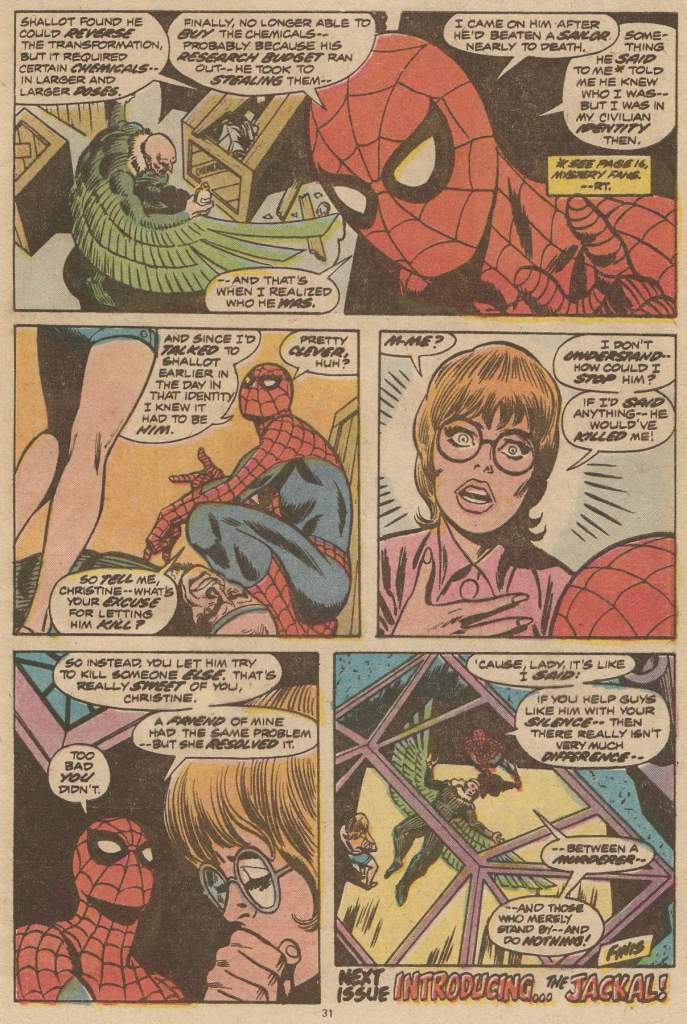
There’s a final wrap-up page or two where Spidey explains the murder mystery to the readers. It was Shallott’s assistant Christine who had been the real target of the murder, but her similar-looking roommate got killed by the Vulture rather than her, and MJ saw the whole thing, making her the next target. The wall-crawler dresses Christine down for not doing anything and letting one innocent person die and a second be terrorized. It’s a perfectly fine story, very grounded, very real world despite the fact that it also includes scientists transforming themselves into winged monsters. Most Spider-Man stories of this period felt just a hair more real-world and plausible than most super hero fare, even when they were being silly or weird. This too was a big part of Spidey’s appeal in the 1970s.
 The Tom Brevoort Experience
#128 was my first Spider-man issue. I guess I wasn’t impressed. since the next one I picked up was the Tarantula’s debut a few issues later. I just missed the Punisher’s first issue.
LikeLiked by 1 person
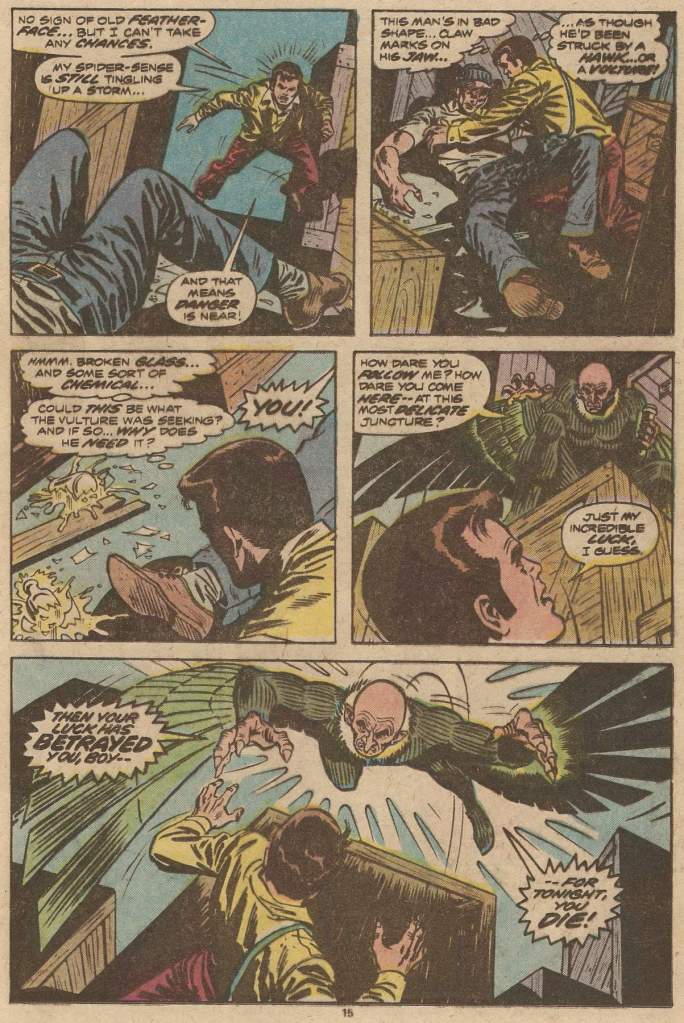
Page 15 panel 1 ( My Spider-Sense is still tingling up a storm… ) — that should have been a Thought Balloon and not a Word Balloon for the sailor or the Vulture to hear. It always bothers me when they do that ( Having him mention his Spider-Sense out loud ). He shouldn’t mention Spider-Senses out loud, Daredevil shouldn’t mention Radar Sense & Heightened Senses out loud and Superman shouldn’t tell people about his X-Ray Vision or Super-Hearing — that is just tactically stupid ( See the Vamp stupidly telling Captain America her belt is the source of her power as proof ).
LikeLiked by 1 person
Andru inked by Giacoia rather than Esposito was always a treat.
And the year of so after Gwen’s death was an enjoyable stretch, as Spider-Man (and Gerry, and the strip in general) reacted to the death rather than just putting it in the past and moving on. It felt like the death of Gwen was a starting point as much or more than and ending.
LikeLiked by 1 person
Andru wasn’t the artist of the first Spider-Man comics I read but to this day his version is my Spider-Man. I don’t think I’ve ever been as excited by anyone else’s run since then.
LikeLiked by 1 person
Ross’s was a definitive Spidey artist. But I did enjoy good art on Spidey from several later artists. Keith Pollard. JR,Jr. Mark Silvestri. Mark Beachum. Ron (“Spider-Man & His Amazing….”) Frenz. (which paid homage a bit to both Ditko and JR, Sr.) .
LikeLike