

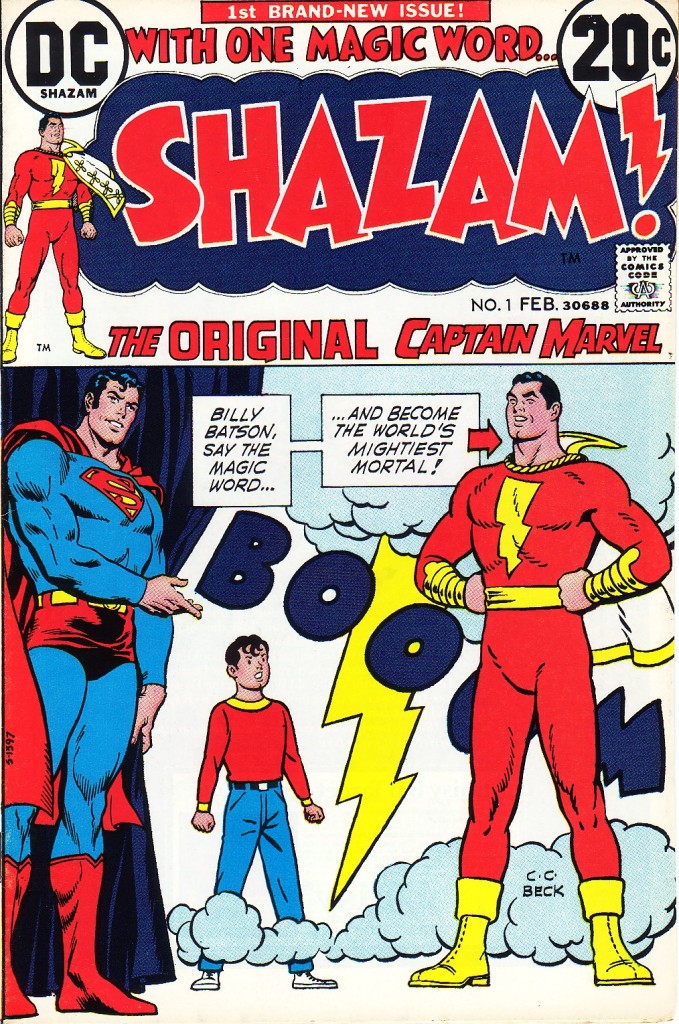
My grade school friend Donald Sims had inherited a bunch of comic books from some older relative who had tired of them and passed them along. He mostly had a smattering of stuff, but there was one complete run among his possessions. And that was SHAZAM, DC’s 1970s revival of the original Captain Marvel, a character that a lawsuit with the firm had put out of business in 1953. Among fans of a certain age, Captain Marvel held great nostalgic power, and the fact that nobody could legally reproduce any of his adventures helped to give the character a bit of a mystique at this time. By the early 1970s, though, comic book sales were in a state of sharp decline, with the Mom & Pop candy store outlets where comics were often sold giving way to national convenience store chains and the like. DC’s Publisher Carmine Infantino was desperately flailing around in all directions trying to find a new book that would be a hit. According to legend, it was Jack Kirby who suggested that DC strike a deal with Fawcett Publications to license Captain Marvel. No other company could do so due to DC’s injunction against the character.
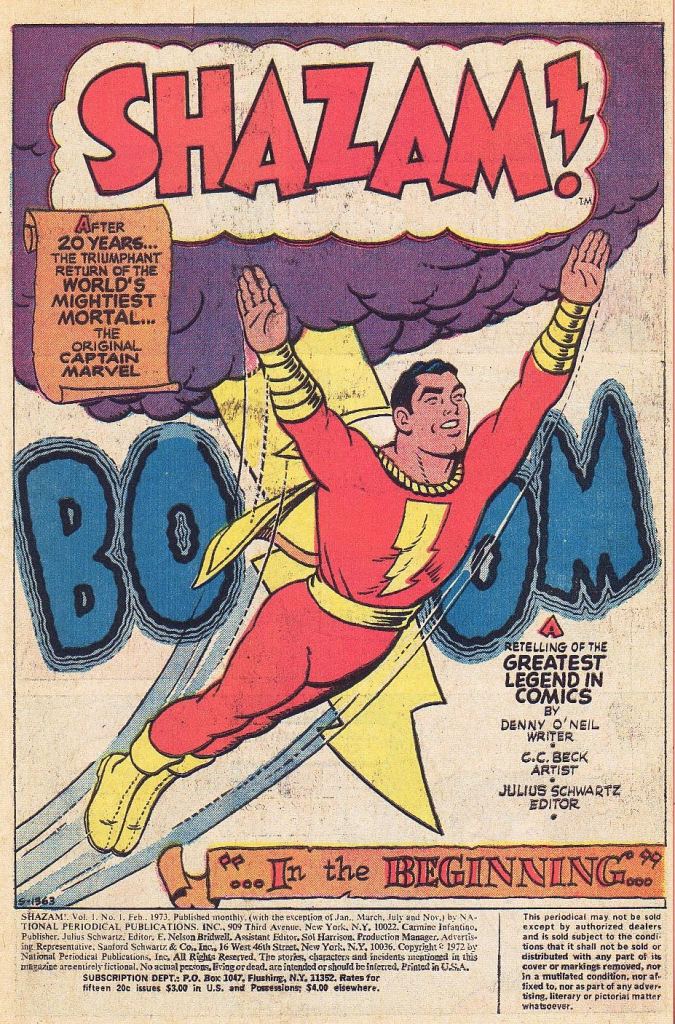
One of the problems, though, with bringing the character back is that, in the intervening years, competitor Marvel Comics had put out a title called CAPTAIN MARVEL and trademarked it. so any revival would need to be delivered under some alternative name. Calling the book SHAZAM after the magic word that transformed boy newscaster Billy Batson into the World’s Mightiest Mortal was a very elegant solution–though one that caused most civilians to conflate the word with the character’s name, to the point where DC went ahead and made that official 40 years later. The subheading THE ORIGINAL CAPTAIN MARVEL appeared on the first bunch of issues of SHAZAM until somebody at Marvel complained that this was still a trademark violation, and from that point on, the character couldn’t be named on his own covers.
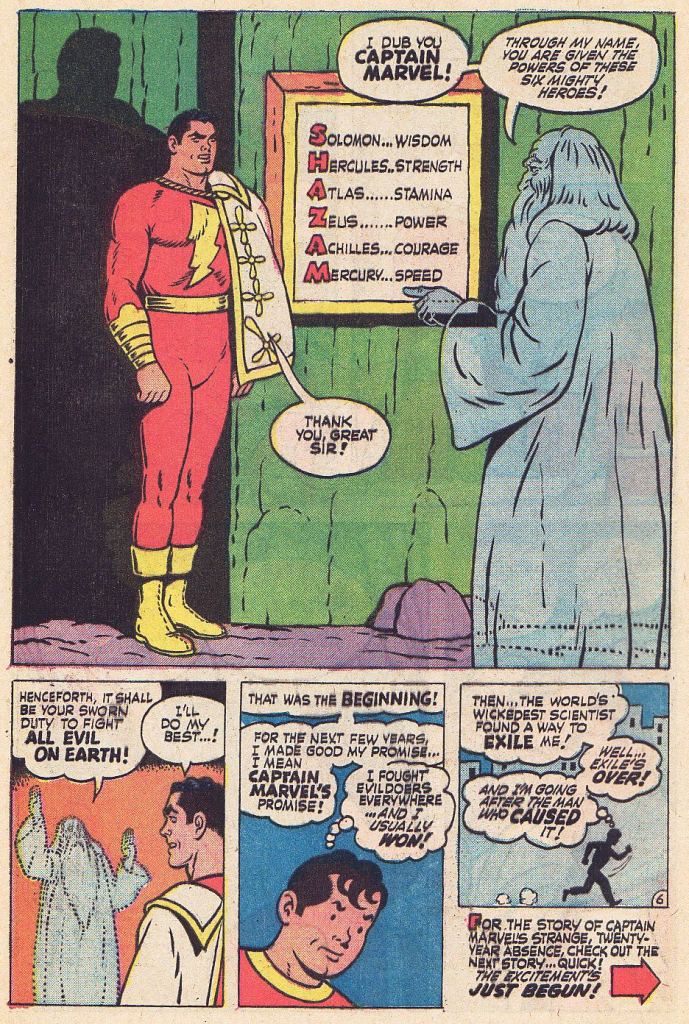
The big question facing DC at this moment, once a deal had been worked out, was precisely how to bring the character and his world back. The golden age Captain Marvel stories had a certain sense of whimsey about them, a stylized reality all their own. They were also very clever. But would such an approach work in 1972? And if not, then what was the company actually buying? Carmine turned to editor Julie Schwartz with the assignment. Julie had spearheaded the revivals of DC’s own golden age heroes in the 1960s and he was contemporarily editing SUPERMAN, so he seemed the right man for the job. Unfortunately, the more science-oriented Schwartz didn’t really quite have the proper touch for Captain Marvel’s more fanciful adventures, and so the results were uneven at best.
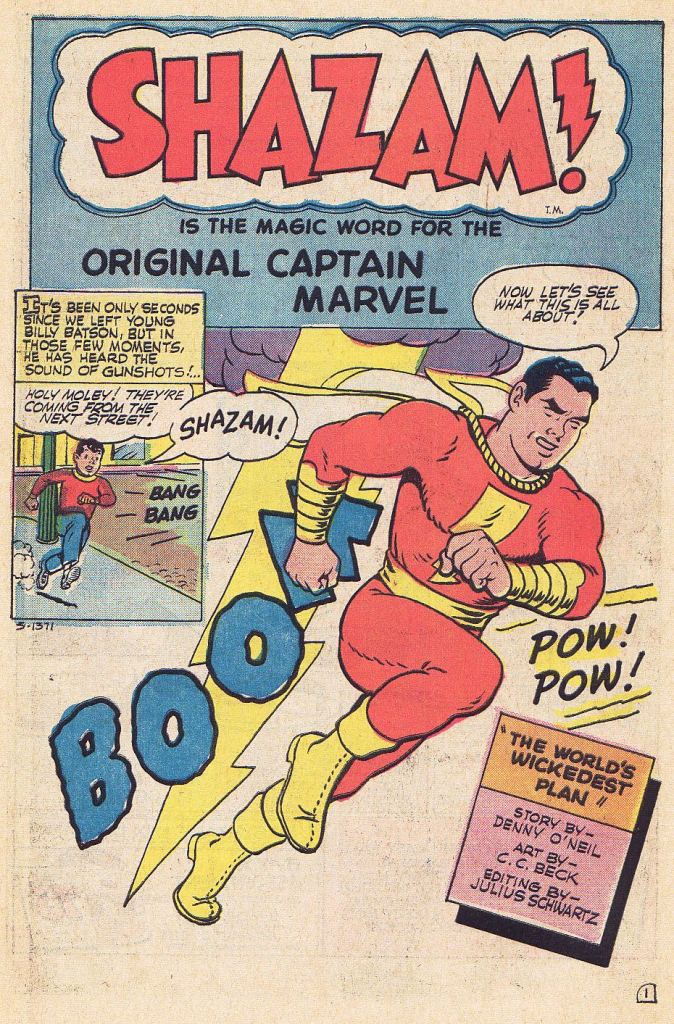
Julie turned to his favorite writer of the period to helm the revival, Denny O’Neil. Denny had proven his skill over the preceding couple of years. But his forte was stories that were steeped in a bit more realism than what would be required to make Captain Marvel work. It seemed like he had a hard time committing to the rules of the universe in which he was writing. On the art side, Infantino was able to convince Captain Marvel’s most storied artist C.C. Beck to come out of comic book retirement to provide artwork for the revival. Beck had been campaigning for a return of the Big Red Cheese for many years, so this seemed like a no-brainer. But he quickly came into conflict with Schwartz and the writers as his conception of what was right for the character was often in opposition with what they were trying to do. Beck bluntly said that the new scripts were childish and stupid, and eventually he quit the assignment after Schwartz refused to let him work on a story for the character that he himself had written.
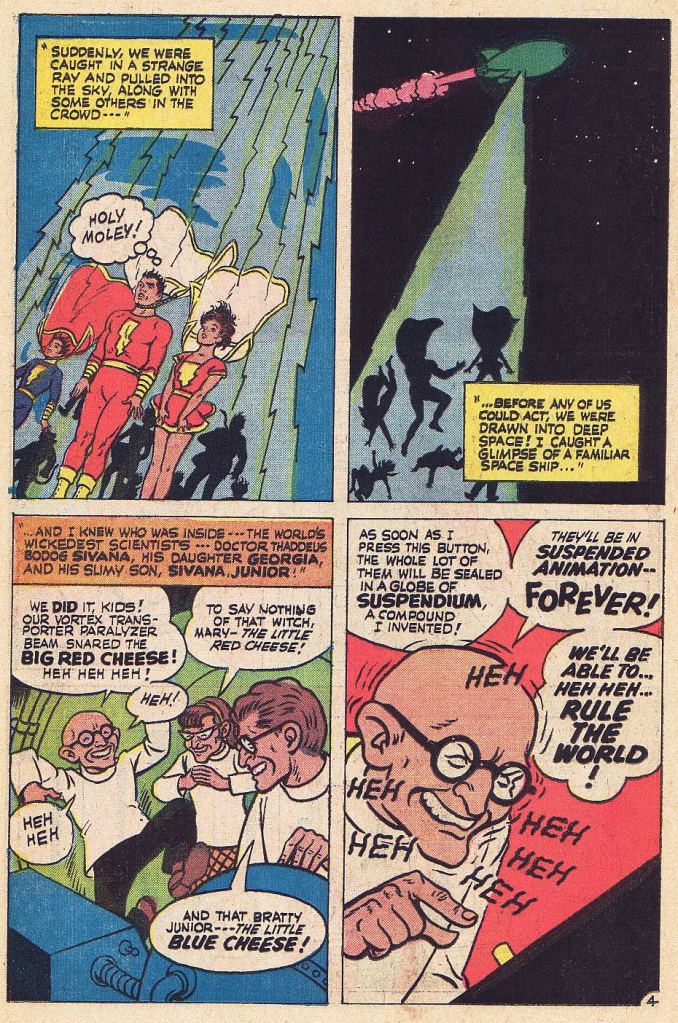
Story-wise, O’Neil and Schwartz decided to explain the Captain’s long absence on he and pretty much everybody else in his extended cast of characters having been trapped in a sphere of Suspendium by his enemy Dr. Sivana for two decades–pretty much the Captain America gambit, but on a much grander scale. This transplanted not just the Captain but also Junior and Mary Marvel and everybody else to the present. The concept of their loss of twenty years of time was discarded after three issues or so, and at that point the book just played as though they’d always been around.
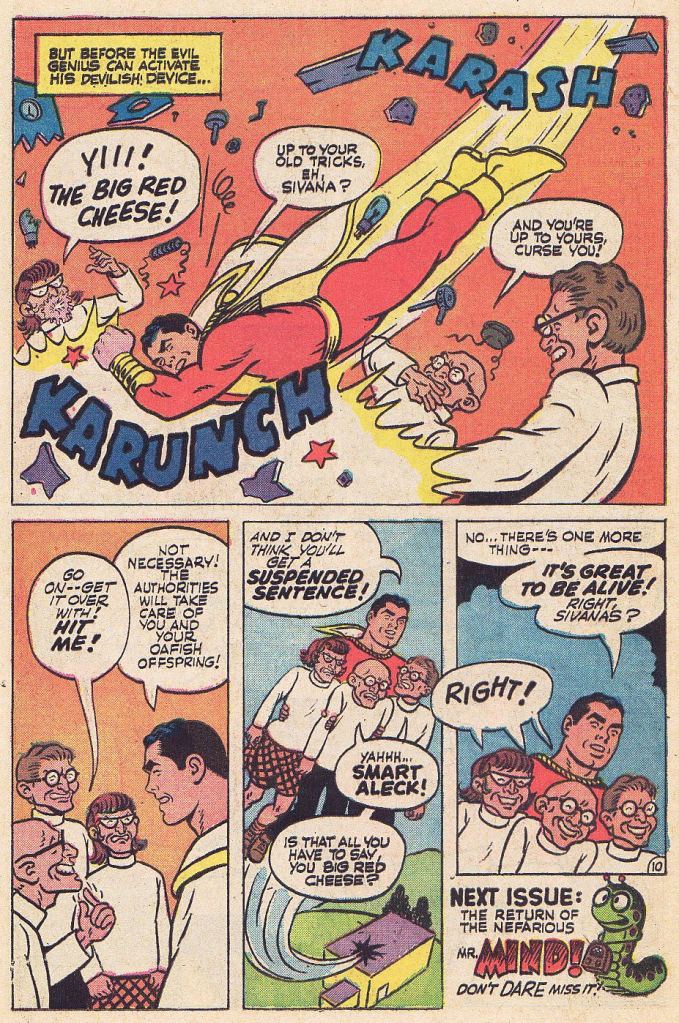
Sales on this first issue of SHAZAM were hyper-inflated by speculators intercepting entire shipments of the comic and purchasing them direct from the distributor, bypassing regular retail outlets in the belief that these books would accrue wildly in value. That wound up not happening, especially once it became apparent that SHAZAM wasn’t anywhere near the hit that it initially seemed to be. Within a few years, the title was almost cancelled. It was coming out quarterly and was filled entirely with reprints, kept alive because of the merchandising that the character was a part of and his other media appearances, such as the live action Saturday Morning television show. DC was never quite able to capture the magic of the original stories with the character, despite the earnest efforts of some very talented people.
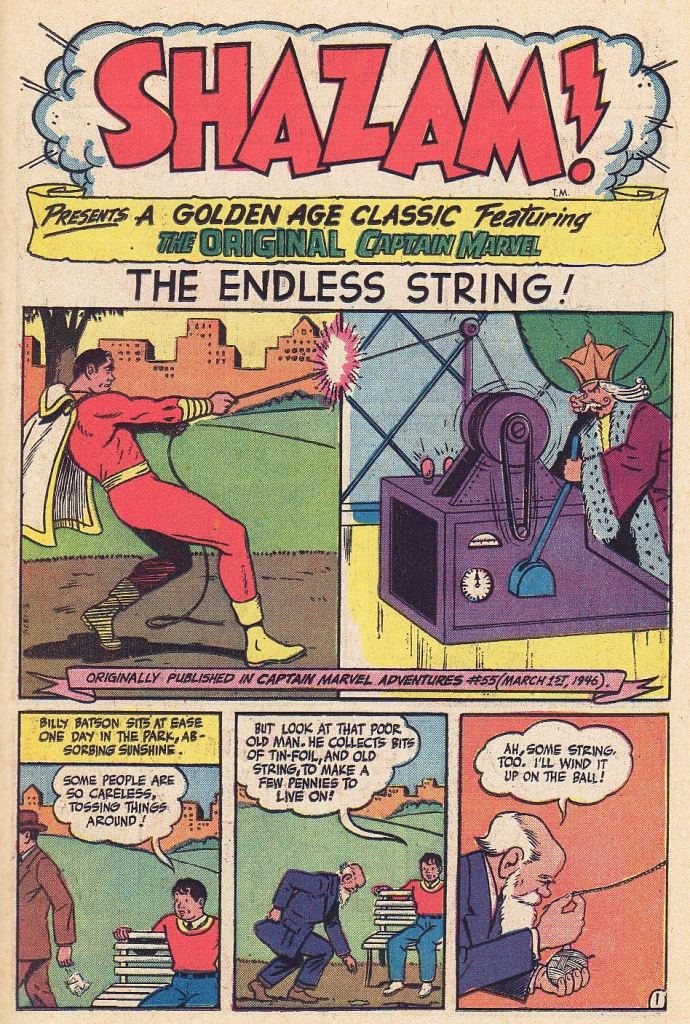
Right from the jump, though, SHAZAM featured reprinted material from the character’s classic era. These stories were inevitably the best and most entertaining things in each issue, and crafted with a greater sense of verisimilitude. There was often a vibe from the new material that the creators working on it felt like it was kiddy stuff, and so consequently didn’t approach it with any true reverence or sincerity. The reprinted material, on the other hand, never had that difficulty. Those creators believed in the fictional reality that they were crafting and weren’t in any way embarrassed working on it. Beck’s artwork on the reprinted stories tended to be better as well, less open and sparse and simplified. Those reprints were where the magic really happened in SHAZAM.
 The Tom Brevoort Experience
That pretty much sums it up.
I think E. Nelson Bridwell managed to hit the sweet spot between “zany and absurd” and “more like a modern comic.” I loved his run on the book.
LikeLike
DC had somewhat similar problems with Plastic Man. Under creator Jack Cole’s artistry, Plastic Man also inhabited a unique, whimsical world which no one else could quite re-create and, like the Fawcett Captain Marvel, he was a poor fit in the more staid world of the DC superheroes. They were trying to recreate worlds that were beyond their sensibilities or trying to force oblong-shaped pegs into square holes.
LikeLiked by 2 people
Suppressing the superior and vastly more popular Captain Marvel to try and help Superman succeed is the DC Original Sin. And copying Captain Marvel by adding its goofy elements to Superman in an act of hateful cannibalism flawed Superman permanently. Which is ironic but fitting.
LikeLiked by 1 person
Both Captain Marvel and Plastic Man deserved better.
LikeLike
I’ve heard that Kirby suggested that DC license Captain Marvel because he wanted to edit it. I’d love to have seen that.
Beyond that, they could have given the book to Murray Boltinoff, and had Leo Dorfman write it, which I think would have given it that feeling of being taken seriously but still being light in tone that you reference.
Heck, Joe Orlando or Joe Kubert likely wouldn’t have wanted the assignment, but they’d have certainly taken it in different editorial directions. Even Archie Goodwin was there at the time, and would have produced an interesting book.
LikeLiked by 2 people
Artwise I really liked Schaffenberger’s take. It looked slick enough like regular comics of the day but all the characters remained on model.
LikeLike
I was 11 when Shazam! returned to the comics stands and even at that young age thought the Golden Age reprints were superior to the contemporary stories. (Although I did like Bob Oksner’s ‘70s-appropriate update on Mary Marvel!)
LikeLiked by 1 person
Schwarz was a great comic book editor, but I think everyone agrees he was not suited to this material.
Schwartz got input from several writers who had worked for him who were also associated with CPT Marvel (Otto Binder & Manley Wade Wellman), whose letters were published in early issue.
Given Schwartz;s relationship with his “best friend, best writer and Best Man.” John Broome, I assume Schwartz wrote him too.
Broome had been a Fawcett CPT Marvel (and Lance O’Casey and text feature) writer before he went to DC. I would guess, since Schwartz did not print a reply Broome (having left comics to teach English in Japan by this time), had either said it was unlikely to succeed or he thought Schwartz and O’Neil were wrong for the material.
Here are some things that might have worked:
—as Kurt Busick says, it might have been a good project for Kirby (Simon and Kirby had done several issues of CPT Marvel Adventures for Fawcett early on to launch that book)’:
—it might have been worth looking at Manley Wade Wellman’s 1970s takes on earlier prose characters of his (Silver John, Evadare and John Thunstone) which deal with how decent, principled people oppose true evil;
—getting O’Neil and Maggin to look at some more light heated Broom superhero stuff (The Amazing Transformation of Horace Tolliver) as a model for CPT Marvel;
—Since the 1952-’54 CPT Marvel stories had a slightly darker (Lovecraftian?) tone maybe Orlando might have been a good fit (John Albano had done some good Plastic Man stories in the 1979s (# 17-19 with Ramona Fradon): and
—by his last issue (#20). Schwarz seemed to have figured out a workable formula for the Marvel Family with Maggin and Scharffenberger.
E. Nelson Bridwell (as frasherseherman points out above) had a workable approach to the material when it came into his control in the late 1970s and early 1980s, I think Schwartz used him more for his archival skills his editorial or creative ones.
LikeLike
Speculating about Kirby doing Captain Marvel, I can’t help but think of Infinity Man in Forever People (who seemed very Cap-inspired). And now I’m thinking of a scenario where Kirby combined the two — something happens to Billy Batson, and he passes the “custody” of Captain Marvel on to the New Genesis kids. I bet fans would’ve thrown a fit, though…
LikeLike
TAARU-ZAM!
The two do have some “Affinity” (if not “Infinity___).
LikeLike
Sadly DC’s handling of the Shazam franchise has been a fifty year long train wreck. But still I am grateful that they have occasionally reprinted some of the wonderful Fawcett stories. That’s what led me to become an avid fan and collector of Fawcett comics.
LikeLike
Dial H for Hero is another one I love, and like Captain Marvel I feel most of the ones after Chris and Vicki are stories in service of some warped agenda rather than fun storytelling. Even the original House of Mystery run had some cool little twists like the solar radiation affecting the dial and the V-I-L-L-A-I-N and even the mystery of Robby’s parents.
The whole WATCMAN-ization and “ooh look how clever and hip and deconstructive we are! Look look look!” crap is played out and was never universally popular in the first place.
Captain Marvel would have been the American version of Tintin or something, something so culturally central and universally loved, and instead of the best bits of his goofy world being stolen and stapled to Superman, the boy-turns-into-adult-hero perfectly explains any crazy elements or incongruities. Imagine Silver Age Marvel only it’s Silver Age Fawcett.
Kirby’s Thor has strong elements of Captain Marvel, down to the lightning bolt boom as Blake changes to Thor and the wish fulfilment element of going from nebbishy doctor to he-man He-Man. And like Captain Marvel the goofy or ultra-Kirbyesque elements are explainable since Thor is part of “Asgard” – all of it much better than Superman’s agglomerative mess, parodied and laughed at rightly since the day it began. Captain Marvel’s world was consistent, Superman as the soulless corporate husk it’s been since the post-WW2 period is and always has been a schizoid trademark farm.
Mary Marvel vs Supergirl for example- Mary Marvel resisted sexualization for incredibly long decades of time, Supergirl was sexualized almost immediately. There’s always been something …off about Superman, good corporate citizen that he is. Captain Marvel opposed the sins / enemies of man, Superman opposes whatever DC is being paid to oppose or a generic censor board approved set of values that will always fall short.
Same with Dial H for Hero. It is a similar “with one mighty word…” story basis that simply can’t properly be warped.
I think what really misses the mark in the non-Captain Marvel and non-Kirby Thor stuff Superman included is that it isn’t a bildungsroman. Captain Marvel isn’t either but it convinces us it is. Thor was when Kirby wrote and drew it. A child becoming a man or a nerd becoming a he-man is wish fulfilment and escapist fantasy. It isn’t hard to write, some people just make it look hard. Smallville is the best Superman of the last 75 years in most respects.
Kingdom Come did a better job of this and I think they were very well aware of the conflicts inherent in what happened to Fawcett.
tl;dr
No one really likes Superman.
LikeLiked by 1 person
I agree with your take on the facile deconstruction meme, but disagree regarding the Superman cosmos being a “soulless husk.” I can see the appeal of the Shazam universe but there are an awful lot of very ordinary stories mixed in with the gems. Though it’s true that DC shafted Siegel & Shuster– who aren’t without responsibility for just selling off their greatest idea as if it was no more valuable than “Federal Men”– I don’t think there’s much of note for the first fifteen years of the Superman feature, not even the number of gems in the Shazam universe. For assorted reasons Mort Weisinger became more venturesome with the Super-books in the late fifties through the rest of the Silver Age, and even though I doubt he wanted to employ Siegel, Siegel wrote the best stories of his life (IMO) during that period, while the same was true of Dorfman and Hamilton. I would stack that period of Superman up against Cap Marvel’s entire Golden Age repertoire without hesitation.
To each his own obviously
LikeLike
Of course! I think what I like about the high water mark of the Fawcett stories, as murderous as they are lol is that it was the fever pitch of a war of survival, peak WW2. The comics were so of their time. As that time passed, so did the golden age. Superman for so long never rose above the level of a throwaway newspaper strip. It was bafflingly bad. And utterly derivative. Imagine having the first modern superhero and just letting it dribble away for nearly two decades.
LikeLike
OG Captain Marvel needs to be returned to his separate world to start with. A tone like the current Supergirl book would work very well too. Stakes that are high but not disturbing and the cast not bent out of shape from their original incarnations would help. I long ago had a thought experiment where I would attempt to see what Cap would be like if continuously published through to present day by applying changes per era made to Superman. I wonder if the end result would have aided in coming up with a contemporary Captain Marvel series having staying power like none other has.
LikeLike
I’m not sure there’s a place in the current market nowadays for a defining aspect of the original Captain Marvel: He’s a boy who transforms into an adult hero. The modern version treats him as basically, Iron Man, just that he’s wearing form-fitting armor which is magical. I think of the original transformation as more like a purely-positive Hulk. When transforming, he gets both stronger and wiser. And while there’s menaces for a story, it’s clear being Cap is fun, not a curse to borne because it’s necessary. All of that seems very out-of-step with the modern audience.
LikeLike
I forgot to venture the possibility that Schwartz probably got the nod for Shazam because he was editing Superman, and more than one DC editor may have thought, “well, we’re going to have the two features cross over because fans will expect it, so since Schwartz is already controlling Superman, he should also coordinate the adventures of Shazam.”
LikeLike