

I would occasionally venture over to my friend Don Sims’ house across town, located several blocks behind my regular 7-11 haunt (which became a communal space for us on Thursdays) down on the access road that paralleled the Long Island Expressway. Don had a nice little collection of comic books, including a bunch that had been given to him by some older relative who had outgrown them. At the time, which would have been 1977 or so, any comic book produced earlier than 1973 when I’d started reading them seemed somehow alien and strange and fascinating to me. And so I would pore over these books with an exaggerated scrutiny, marveling at the different styles and the different ads, the different everything. They felt like something out of an archaeological dig to me.
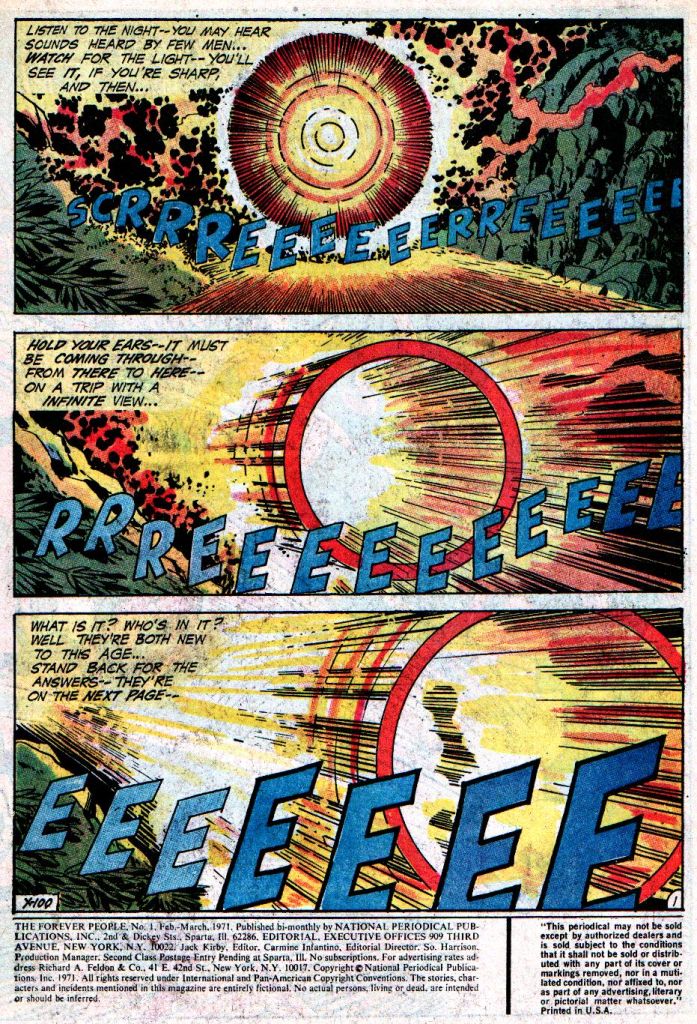
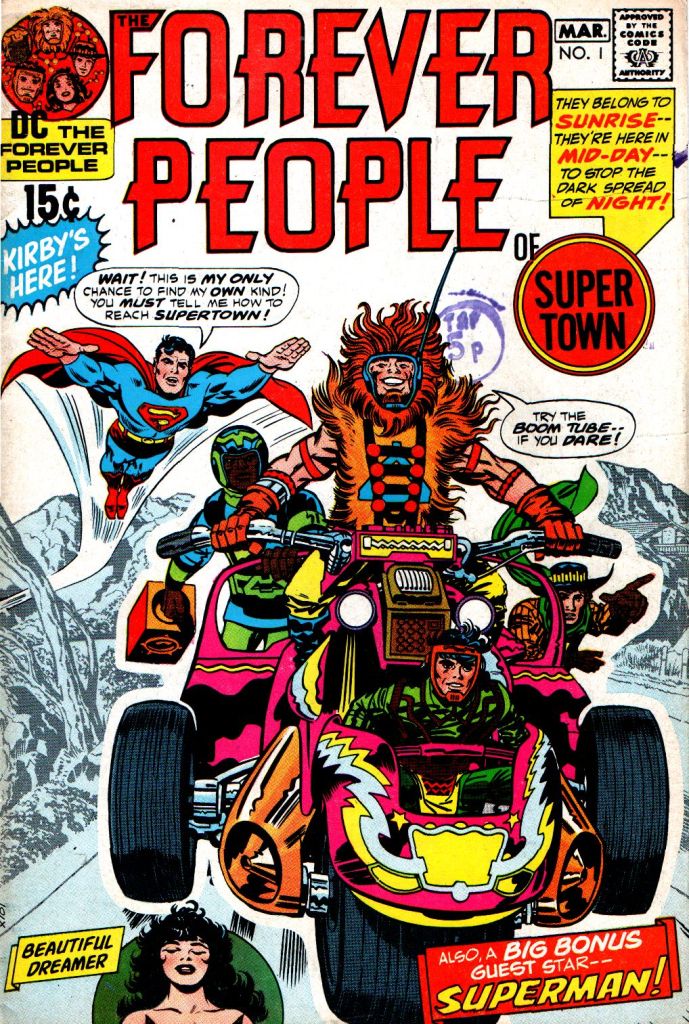
One book that I was enchanted by, and which I prevailed upon Don to loan to me so that I could read it more closely, was FOREVER PEOPLE #1. Now, DC, then known corporately as National Periodical Publications, was publishing a wide range of material throughout the 1970s, not just super heroes. They maintained a full line of war, western, weird, fantasy, humor and other titles. But I had never seen a DC comic book like FOREVER PEOPLE #1 before. It kind of frightened me in that it was clearly so different from what I was used to. But the recognizable figure of Superman on the front cover reassured me that despite looking strange, this really was a super hero comic book, the type that I favored. And so I took the plunge.
A ton of people, including myself, have written a mountain of text about the creative force that was Jack Kirby, and how in 1970 he left what had been his central account at Marvel Comics to switch over to rival DC and create a bunch of new books for them. Kirby had felt both creatively stifled and unrecognized, all of the glory from the books he was working on and all the credit for their success went to editor and scripter Stan Lee. Kirby had been building up a backlog of exciting characters, holding them back from his Marvel work until conditions would grow more favorable for him, and upon his relocation to DC he unleashed them across four interlocking titles that made up what came to be known as “Kirby’s Fourth World”. Those books were NEW GODS, MISTER MIRACLE, SUPERMAN’S PAL JIMMY OLSEN (of all things) and FOREVER PEOPLE. These titles were both written and drawn by Kirby, who was also their editor of record. So there was no question that they largely if not entirely reflected jack’s vision.
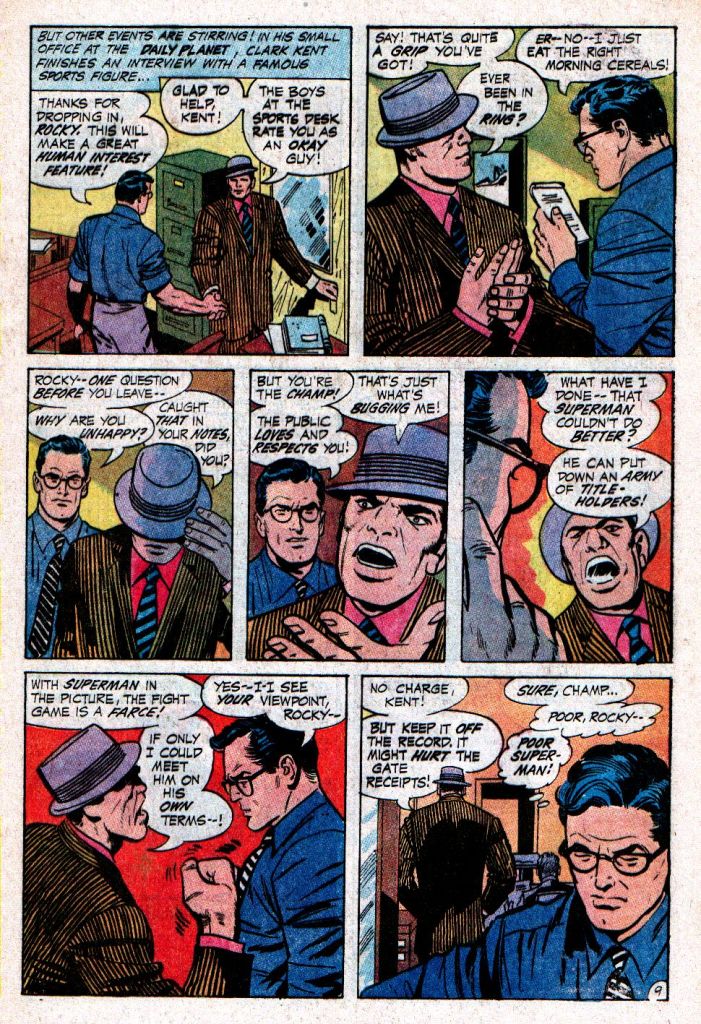
According to records, FOREVER PEOPLE #1 was the first book that Kirby put together upon his switch to DC, even though it wound up seeing print several months after his issues of JIMMY OLSEN started coming out. Consequently, it lays out the broadest strokes of the larger conflict that would form the backdrop of all of his Fourth World titles while also introducing its own individual leads. It also contained a novel approach to Superman. For teh first time, we see Superman treated as not simply a revered champion of law and order, but as somebody who made even the most accomplished of men, like championship boxer Rocky, feel small. His accomplishments, unearned in that his super-powers were a quirk of fortune, robbed others of their own feelings of success. Consequently, Superman feels a bit alienated and apart in the human world that he’s made his home.
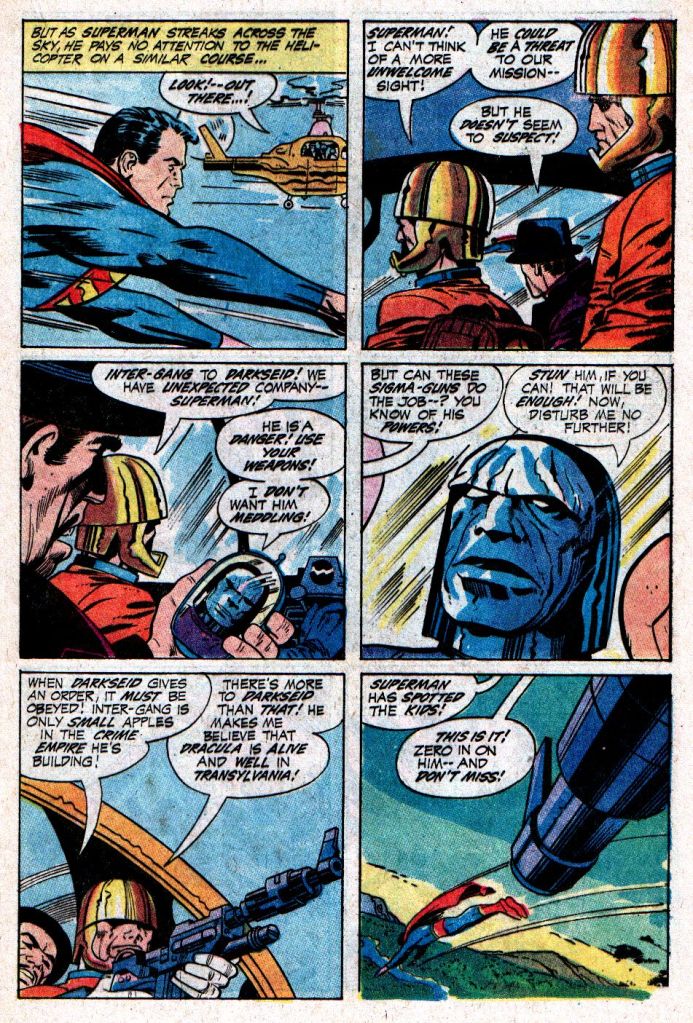
The Forever People themselves were a reflection of the Flower Children and Hippies that Kirby saw in the world around him in the late 1960s and early 1970s, a next generation that had their own way of doing things. By the time I would have read this story around 1977, they were already a thing of the past. They’d journeyed to Earth from their home in Supertown on New Genesis in search of one of their band, Beautiful Dreamer, who had been abducted by the forces of Darkseid of Apokolips. Darkseid was obsessed with locating the Anti-Life Equation, through which all free will other than his own could be subsumed. He believed that Dreamer held a portion of the Equation, and was attempting to extract it from her. having heard reports from Jimmy Olsen about the quartet of strange kids in the area of Metropolis, Superman sets out to locate them. But in doing to, he crosses the path of Intergang, Darkseid’s criminal underlings on Earth. At Darkseid’s command, Intergang attempts to stun the Man of Steel to prevent him from interfering.
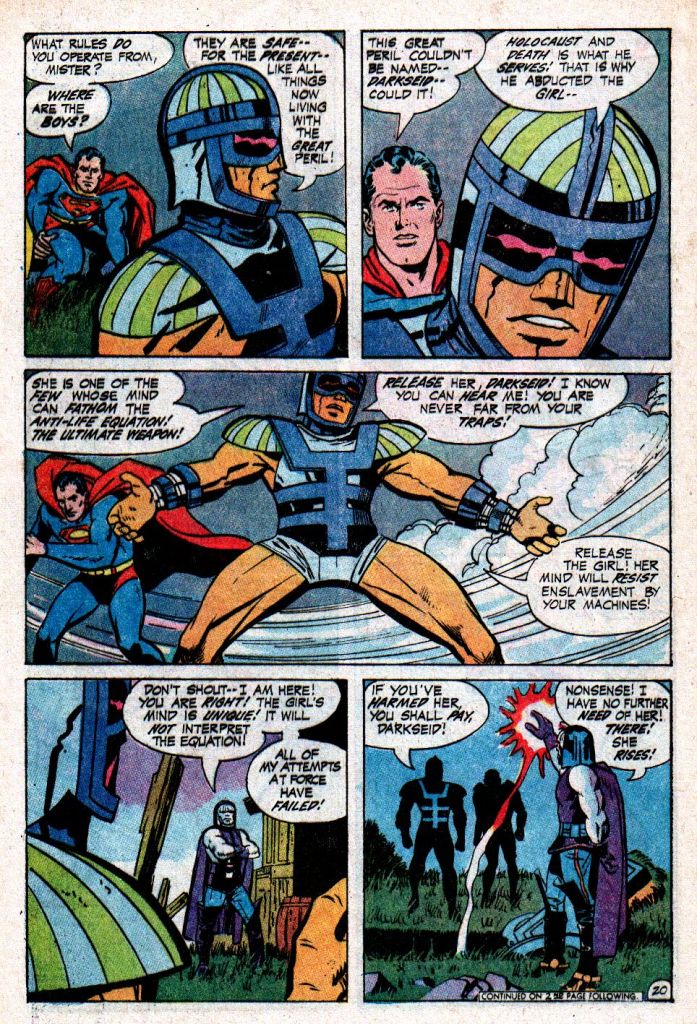
Up to the point at which this comic book was published, it was almost a religious mantra that Superman was only vulnerable to two things: Kryptonite and magic. In most stories, his reaction to both was absolute, as was his imperviousness to all else. But Kirby didn’t truck with such things, and he discarded those rules. Intergang, armed with weapons from Apokolips, could hurt the Man of Steel simply because they were that powerful. The footsoldiers of Apokolips could give Superman a challenge simply because they were that mighty. It was the Marvel formula applied to DC’s world, and it immediately made the conflict seem more danger-laden and real. At a certain point, the four Forever People, under siege, reveal their trump card. Through a ritual enacted by their sentient computer Mother Box, they switch atoms with the Infinity Man, a being for whom the natural laws of physics do not apply. Together with Superman, the Infinity Man succeeds in driving off Darkseid’s forces and in liberating Beautiful Dreamer from Darkseid’s custody.
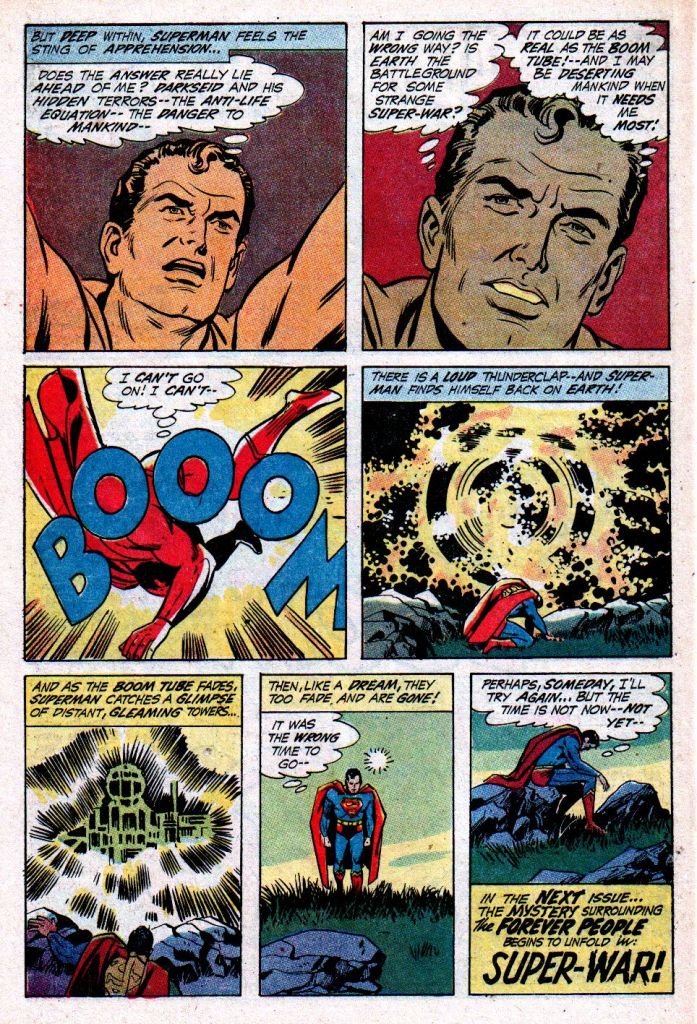
In the aftermath, the Infinity Man gives way to the Forever People once more, and they answer Superman’s questions about the world they come from. Manifesting a Boom Tube, they show him the way to Supertown, though they implore him to remain on Earth where the fight against Darkseid is just beginning. Superman is tempted–Supertown represents a world where he wouldn’t be an outsider. But before he traverses the whole of the Tube, he has second thoughts, remembering all of his many friend on Earth who are now in the shadow of peril. So he chooses to halt his journey and stay. This take on Superman stayed with me, stuck to my ribs in some ineffable manner, and the sadness of Superman as the last of his kind (no matter how many other Supergirls or Bottle Cities there might be) became one of the defining metrics of his character to me. And that was really all down to this book showcasing that aspect of his personality.
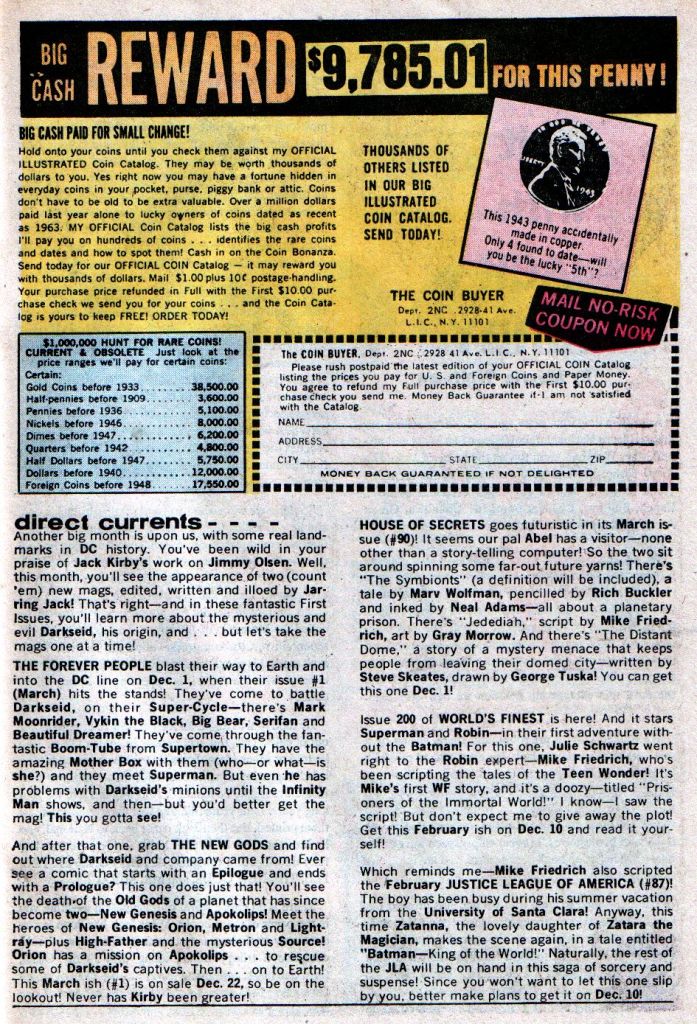
As with any vintage comic book, the ads were almost as exciting to me as the story was, and this issue was no exception. At the end of the book, there was this half-page Direct Currents checklist of then-upcoming releases that teased me with thoughts of old comic books that I might never be able to read for myself. Don had a copy of WORLD’S FINEST #200 as well, so that story I would get to experience in short order.
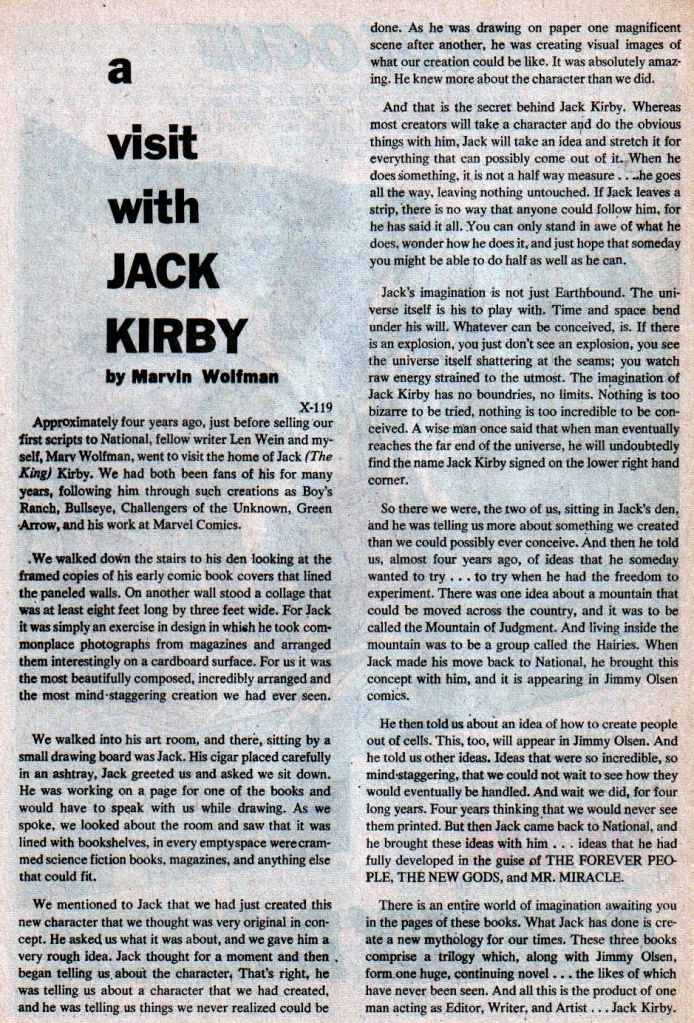
Also fascinating to me was the text page in this issue, which was written by writer Marv Wolfman, who I knew from his Marvel work. It talks about a time several years earlier when Marv and fellow fan Len Wein had gone to visit Jack Kirby at his home. This was a mind-blowing revelation for me. i had never considered that one might actually meet and interact with the people who were making these comics that I so enjoyed. And the line about explorers reaching the outer edge of the universe and finding Kirby’s signature there has stuck with me ever since.
 The Tom Brevoort Experience
Comics Archeology just reviewed Forever People last month. Must be something in the water.
LikeLike
I keep thinking that the Fourth World, as ambitious and creative as it was, was likely not the best way for Kirby to launch his 70s DC tenure.
Having all the books connected like that gave people a reason to read them all…but it also gave them a reason not to read them all, if they didn’t like one of them. It might have been a better idea to start with separate books that would stand completely on their own, so if one of them didn’t catch on, it would be easy to swap it out with a new book without pulling a chunk out of an interrelated line. I could be wrong, though — this could be a reflection of me not being introduced to the Fourth World as it came out, one issue at a time — I got handed the whole stack by Richard Howell, sorted into publication order, and told, “Read this. You should really read this.” So for me it started as a single mass.
It also occurred to me today, for the first time, that at Marvel he’d been doing FANTASTIC FOUR, THOR and CAPTAIN AMERICA, and at DC, his new (i.e., non-JIMMY) books were FOREVER PEOPLE (team book), NEW GODS (god book) and MISTER MIRACLE (liberty-focused acrobatic hero book). I wonder if that was a conscious choice, or if it just happened that way.
LikeLike
I guess you owe Jack Kirby creating the Super-Cycle and inspiring the creation of the “Supreme Cycle” [ Avengers Forever#10 ( September 1999 ) ]. Oh look, both books have Forever in the title.
LikeLike
To a degree, yeah. I realized we needed to bring the Supreme Intelligence into the scene, but he’s a big ol’ head in a tank, so how could we do that? And I figured if it was a Kirby story, Jack would have just installed him in the back of a big Kirbyesque dune buggy, so why don’t we do that? The Super-Cycle was probably the immediate inspiration for it, and the one Carlos fastened on, but the various Fantasticars and the Kirby design for the super-train called (I think) the Mountain of Judgment in JIMMY OLSEN (and which I’d used a variant design of for the Omni-Bus in TEENAGENTS) and things like that were in my mind when I cam up with it.
So definitely a Kirby Vehicle, for sure!
LikeLiked by 1 person
Fourth World was probably the first time we got pure unadulterated Kirby. I do wonder how mindful he was at the start of what would happen if sales of a particular title failed? I suppose it works both ways.
On one hand he could say “it’s all intertwined and one big epic story , you have to have every title out there – don’t cancel anything”, on the other hand one could argue – the characters recur and if one title was dropped, we just pick up the narrative in another. which I suppose is what cold hard sales business would determine.
LikeLike
Not the first time. He wrote and drew his own stuff pre-Silver Age Marvel, too, on romance and crime stories, Westerns and horror. We don’t know for sure which were all his and which had someone else’s involvement, other than “Mother Delilah” in BOYS’ RANCH, which is a masterpiece.
He even wrote a lot of his pre-FF Marvel output.
Post-1970, though, he got credit for it, too.
LikeLike
It is probably too bad this came about 11 or 12 years before the Miniseries.
An intro in Jimmy Olson. this Forever People story as the first issue of an on-going New Gods book with the intro of the New Gods (High Father, Orion. Light Ray and Metron) in issue #2 might have had more impact..
Then perhaps a Mister Miracle mini series (maybe The Great Scot Free Bust Out and Himon) and then a Forever People mini-series (maybe the Sonny Sumo arc). Maybe The Pact presented in a double sized book (as it actually was).
Smaller, mor digestible and presented to emphasize key events.
DC’s 00.25 USD pricing experiment also added complexity (and real work budget considerations) into fans’ buying decisions.
LikeLiked by 1 person
The Forever People’s hippy-ness often came off clunky to me reading at the time. On the other hand, this book dived into the Anti-Life Equation’s horrors and the theme of the Fourth World (free will vs. total slavery) which gave it more interest. I also give Kirby points for showing the hippy heroes in a positive way — lots of comics writers of his generation seemed to be muttering Kids These Days when they sat down (Bob Haney’s writing also seemed sympathetic to kids, regardless of their crazy hobbies.
LikeLiked by 1 person
John Broome may have been the worst of the grumpy oldsters. Anyone remember “Hip Jordan?”
LikeLike
Bad as Hip Jordan was, he pales before Joe Simon’s handling of hippies in Brother Power (https://atomicjunkshop.com/i-thought-joe-simons-work-on-prez-was-bizarre-then-i-reread-brother-power-the-geek/)
LikeLike
Jack Kirby couldn’t have felt respected by DC when they had Al Plastino make uncredited alterations to Superman/Clark Kent ( faces ) and over at Superman’s Pal Jimmy Olsen to Clark Kent/Superman & Jimmy Olsen ( faces ). I wouldn’t mind seeing the untouched version to see why they thought his Clark Kent/Superman & Jimmy Olsen faces weren’t good enough. One more thing, have Marvel showed him the respect he earned would the Jimmy Olsen stories been Rick Jones stories? If so was the Hulk going to take Superman place?
LikeLiked by 2 people
I can see Thor interacting with the Fourth World books, plus Orion and Thor being manipulated into fighting each other ( Orion having the red eyes and rage of mythological Thor ). Thor using Mjolnir to absorb Darkseid’s Omega Effect and sending back at him.
LikeLiked by 1 person
I kept thinking about how Superman’s faces were always being redrawn in the Kirby DC books. I didn’t realize or remember it was Al Plastino who redrew them. Before seeing the examples in this article, I thought it was Swan or Murphy Anderson. Maybe they did also redraw Kirby’s Superman faces in subsequent issues or other series, but Al did them in this issue. They look out of place.
I’m kind of surprised Tom didn’t mention it here.
I’ve known about Steve Rude’s love & homage of Kirby’s stuff. I’m reminded of it again here. He really infused that influence in his own work. I have a couple of issues of LotDCU where Steve draws 4thWorld characters, some w/ Superman in them. Eye candy, for sure. I also love that Superman/Hulk crossover, written by Roger Stern and drawn by Steve. Fun book.
Interesting to see how Darkseid’s physical size has grown so much since Kirby’s initial depiction of this particular dark lord.
LikeLiked by 1 person
I loved that The Incredible Hulk vs. Superman that Roger Stern and Steve Rude did. Legends of the DC Universe#14 ( March 1999 — Jimmy Olsen & Guardian vs. Hyper-Hounds ) — when I saw this Timely Comics Captain America story [ USA Comics#8 ( May 1943 ) The Invasion of the Killer Beasts! — a select group of Nazi soldiers are hand picked to be the vanguard of an invasion of America, using a secret weapon created by Nazi scientists DOGS developed with poison sacs, which help the curs inflict a horrible death on whomever they bite! — comics.org ] — the Hyper-Hounds don’t have that ability.
LikeLiked by 1 person
Al Plastino did the alterations for FP #1 and the first couple of Jimmy Olsen issues, then Murphy Anderson took over.
LikeLiked by 2 people
@Alan Stewart, thanks!
LikeLike
They stopped doing this when Royer (a former Anderson and Russ Manning assistant) took over the inks.
I thought Anderson showed some signs in some panels and the one cover he inked of understanding what Joe Sinnott came to understand: the challenge of inking Kirby was figuring out how to translate Kirby’s pencils into the different but related medium of an ink drawing.,
LikeLiked by 1 person
Mark Evanier has a whole discussion and some examples about Kirby’s Superman face issue in this old blog post:
https://www.newsfromme.com/2003/08/22/jack-kirbys-superman/
LikeLiked by 3 people
I disagree with Mark Evanier in that I’ve always thought the early O’Neil/Swan/Anderson issues did modernize Superman, even if said update was still conservative compared to the comics published by Marvel. But, as Evanier wrote, it was certainly insulting to put Jack Kirby on a Superman-adjacent comic and then do everything in your power to water down the King’s version of Superman. I still loved the Forever People anyway, but those Al Plastino and Murphy Anderson heads are jarring.
LikeLiked by 1 person
Yeah, the different drawing styles detracts from the book as a whole. Jack’s more vague facial features for Superman work for me, and fit with everything else on the page.
I understand having the S emblem changed. Makes more sense to keep it consistent with the official version.
Though Kirby’s version actually looks closer to the S chest emblem in James Gunn’s $600M Superman movie.
LikeLike
Because of licensing issues, DC was a bit too obsessed with being “on-model” (of course, I have heard DC made most of its money from licensing at around this time to a bit later).,
LikeLiked by 1 person
Mark Evanier made the point that Kirby really never got the S Symbol down and it was legitimate to change that.
In fairness to Kirby, his Superman showed a certain Shuster influence, who was doing (or had recently created the visuals) when Kirby started at DC the first time. Shuster’s “S Symbol” developed over time and they are experimenting with it now , , , ,.
LikeLiked by 1 person
Forever People was the one Fourth World book I never quite warmed up to. Compared to vivid, fascinating characters like Orion, Metron, Big Barda, et. al., the kids never seemed to develop much personality. And that goes double for Infinity Man. I don’t discount the series entirely, because it has some great bits with Darkseid, but the putative stars of the show are a bunch of ciphers.
LikeLike
I thought that it might have worked better if had been Jimmy Olsen and New Gods for a while. The Forever People and Mister Miracle seemed a bit less strong premises for series (although MM lasted the longest) . . . .
LikeLiked by 1 person
Yeah, and I thought the first issue signaled that the kids were going to call upon the Infinity Man on a regular basis because they initially didn’t seem to have much in the way of personal power. It seems like maybe Kirby changed horses in mid-stream there.
LikeLike
The Vince Colletta inking and the redrawn Superman faces are like fingernails on a chalkboard to me.
LikeLiked by 1 person
Frank Giacoia was the first inker assigned to Kirby’s work at DC then and he was told he’d be inking as much of Jack’s pencils as he could handle. Then Vince Colletta made a deal to ink Kirby for a lower rate providing he got it all plus a certain amount of non-Kirby work. So Giacoia was out and he was not happy about it.
LikeLike
Too bad, that cover is great.
I wonder if he could have kept up with the work load, though. He did not stay on Cap’s own book . . . .
LikeLike
It was never intended that Frank Giacoia would ink all of Kirby’s DC work. I’m not sure there was an inker then working for DC except Vince Colletta who could have done that. But Frank was told he would ink as much of it as he could…and then they reneged.
Giacoia could generally ink two books a month with ease. When he left a book — like you saying he left Captain America — it was because the editors moved him to something else. He was also very valuable to them as an inker of covers.
LikeLike
Does anyone know why this cover was the only Frank Giacoia inks (other than Sandman #1) on Kirby’s 1970s DC work?
LikeLiked by 1 person
My understanding is that having Giacoia ink the books would cost more than DC wanted to pay. Same for Wally Wood, who was reportedly also under consideration. Colletta was cheaper, so he got the gig. When Mike Royer took over as inker, it was only then that the characters and action started leaping off the page for me, just in time for classics like “Glory Boat” in New Gods.
And I always found it odd that all the males had these complex costumes, but Beautiful Dreamer only wore an orange rag or (later) a magenta-colored repurposed flapper’s outfit.
LikeLike
It seems like if you were hiring Kirby, you would want (and pay for0 an inker who had a knack for working with him. Given that Kirby & Wood did the Challs for DC in the then-recent past, I might have spent the $$.
Of course, you wanted someone who could handle Kirby’s out put and that was a big plus for Colletta, as opposed to Wood or Giacoia,.
LikeLike
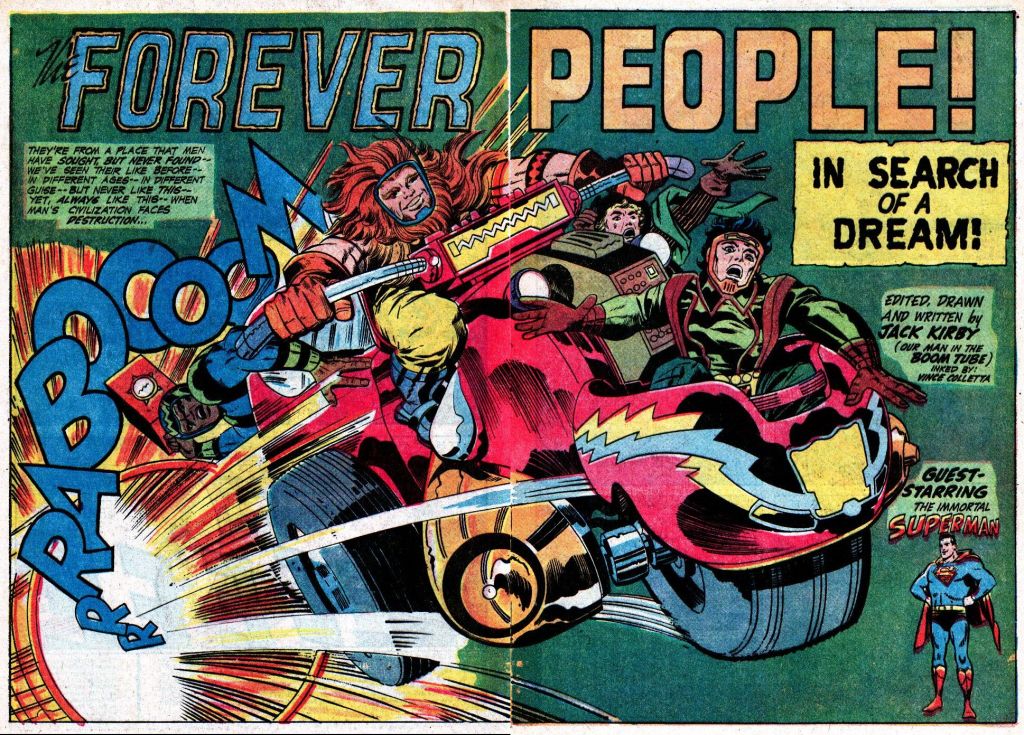
Got this when it came out and was definitely wowed by it. The Superman figure on the double page splash looks really off to me, with the thick torso, skinny legs and the S shield not angled right, it looks like we are looking straight at it even though the figure is at a bit of an angle. It’s a shame the series ended before the characters got much development and so many unanswered questions.
LikeLiked by 1 person
I don’t think Kirby drew the Superman figure on the double splash. It looks like a Wayne Boring (or someone similar) drawing to me.
LikeLike
I got a Wayne Boring vibe too. Glad to know it’s not just me.
LikeLike
Jack wrote and drew NEW GODS #1 before he wrote and drew FOREVER PEOPLE # despite what the little “X” numbers said.
LikeLike
Question, am I the only one to notice the similarities with what Darkseid did to the Infinity Man [ Forever People#3 ( June-July 1971 ) & 11 ( October-November 1972 ) Flung by Darkseid’s power into a corner of the universe where time, space, and matter change and merge, Infinity Man rides the currents of despair —! ( Infinity Man says “For a being such as myself no more cunning prison was ever devised” & ” A universe to roam and explore, but never to leave! — because of the BARRIER!!” ] and what Galactus did to the Silver Surfer [ Fantastic Four#50 ( May 1966 ) the Barrier around Earth to imprison the Silver Surfer ].
LikeLiked by 1 person
I believe it was Doctor Doom and not the Silver Surfer to be the first one to encounter the Galactus’ barrier around the Earth [ Fantastic Four#60 ( March 1967 )].
LikeLike
as much as I loved Kirby at Marvel, I never really liked most of his DC output. Fourth World, Kamandi, Demon, all the others were just such a let-down to me. I bought and read all of Kirby’s DC comics as they came out. I enjoyed Jimmy Olsen and Forever People but did not like New Gods at all–too much going on! And Mister Miracle I really disliked; Kirby would spend a page or three with Scott trying to escape an impossible deadly trap, only to have him pop out and crediting Mother Box for his escape. To me, that was just cheating. Anyway, I was just as disappointed when he went back to Marvel. It was like the magic had gone out. I know I’m in the minority here, but it’s how I felt.
LikeLike
On art, everyone will have a different take
Some of Kirby’s 1970s DC stuff was stories he had been exploring since the 1940s and anything with that focused a vision tends to be controversial..
LikeLike