

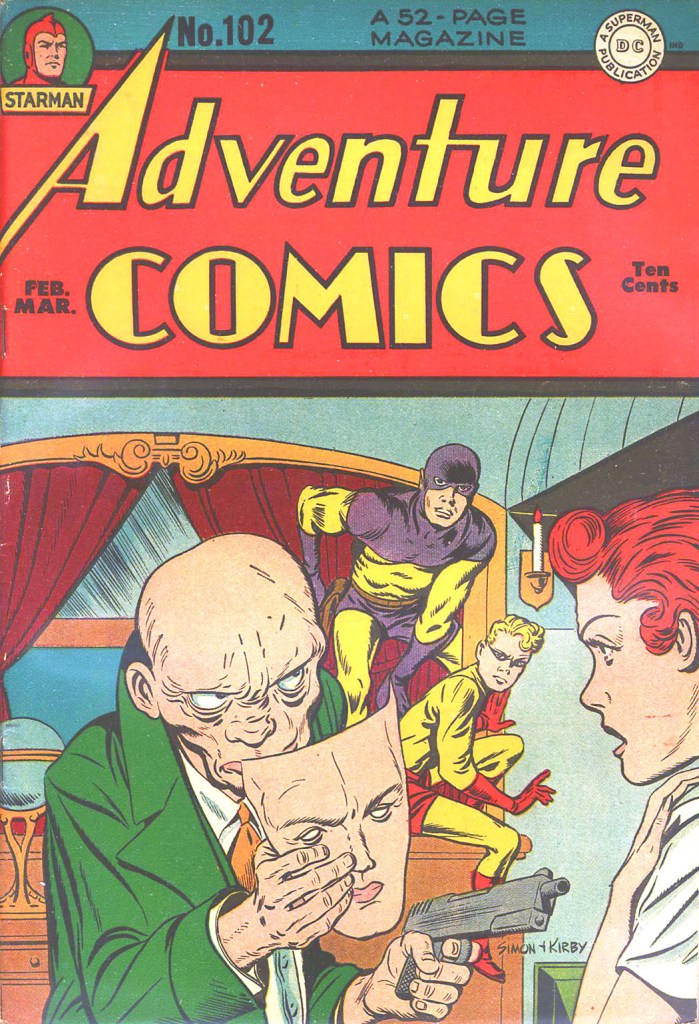
By the time 1946 rolled around, the excitement over costumed super heroes had cooled considerably on the nation’s newsstands. With the war over, the active servicemen who needed portable easy-to-read entertainment went back to public life, and sales of super hero titles fell sharply. Other genres, such as teen humor, funny animals, crime, romance and westerns became more popular and more dominant. Consequently, one by one many of the great super heroes of the Golden Age were sent to the showers, replaced by more popular material
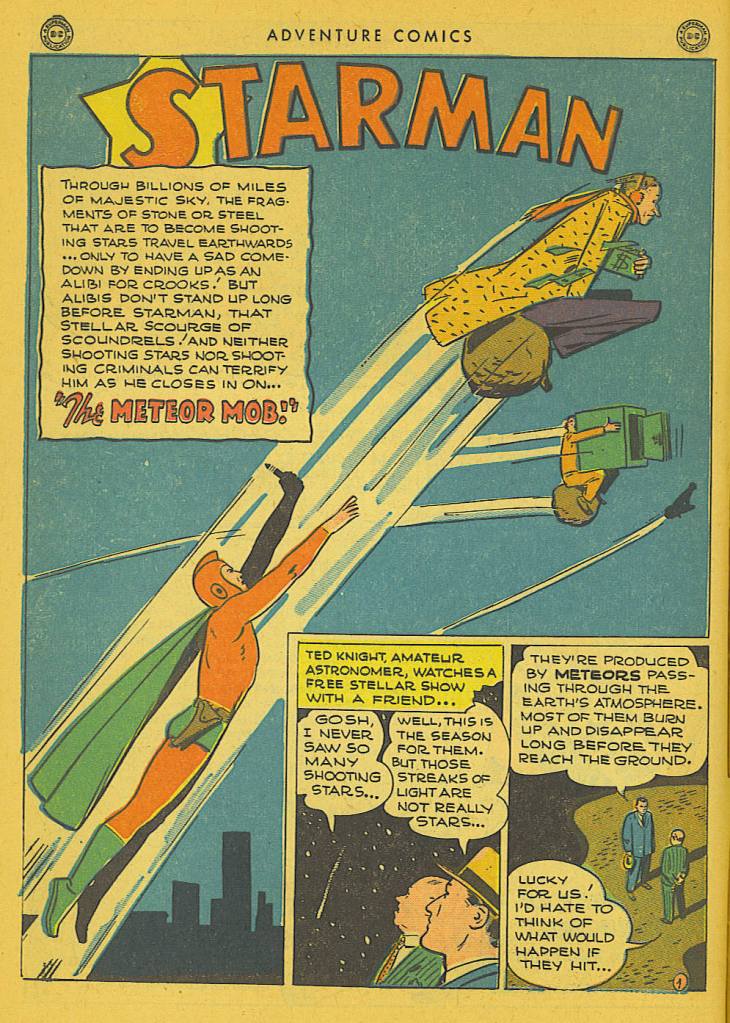
In particular, the long-running ADVENTURE COMICS underwent a massive overhaul following its 102nd issue. It absorbed a number of features that had been making MORE FUN COMICS their home up to this point, notably Superboy but also including Green Arrow, Johnny Quick and Aquaman. This left very little room for the features that had been spotlighted in ADVENTURE COMICS up to this point, and consequently a couple of them were discontinued. One of these was Starman.
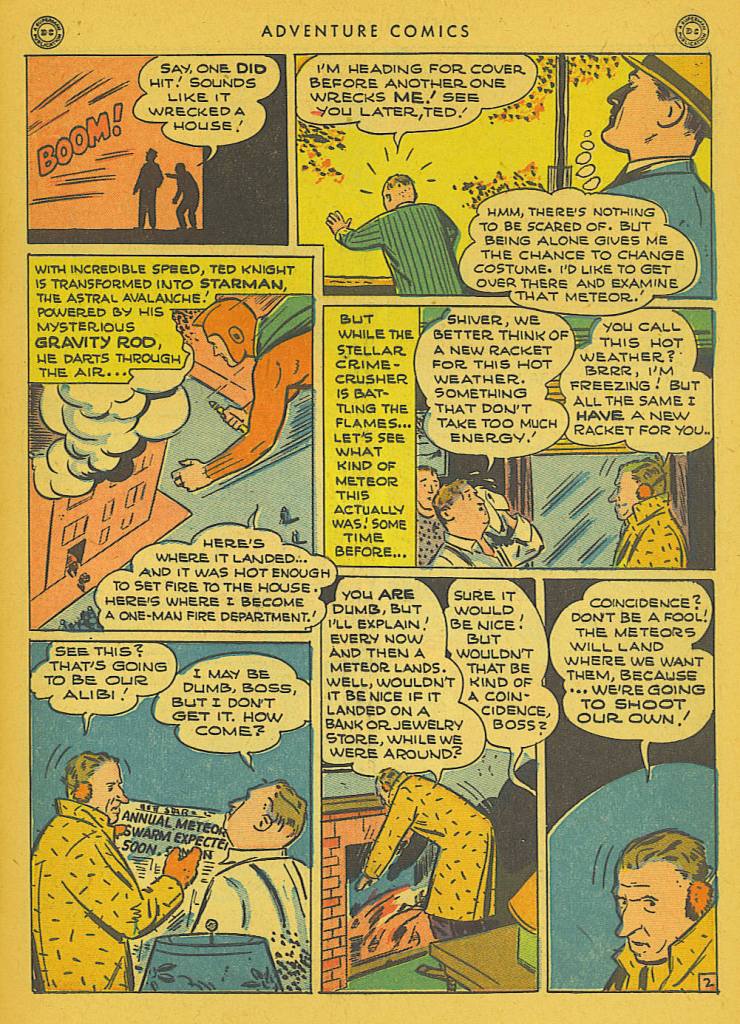
Starman had been created editorially by a committee and was thought at the time of his creation to be a shoe-in as the next wildly popular comic book feature. Alas, what the Astral Avenger ended up as instead was a somewhat-generic crime-buster. The often excellent artwork of Jack Burnley, who had been handpicked for the assignment, didn’t do enough to overcome the overwhelming sense of sameness that the Starman feature exuded. It was a patchwork of tropes and ideas from other popular strips without any particular personality of its own. Burnley was eventually rotated off of the series towards other things, leaving lesser hands to execute Starman, which had been displaced as the cover feature.
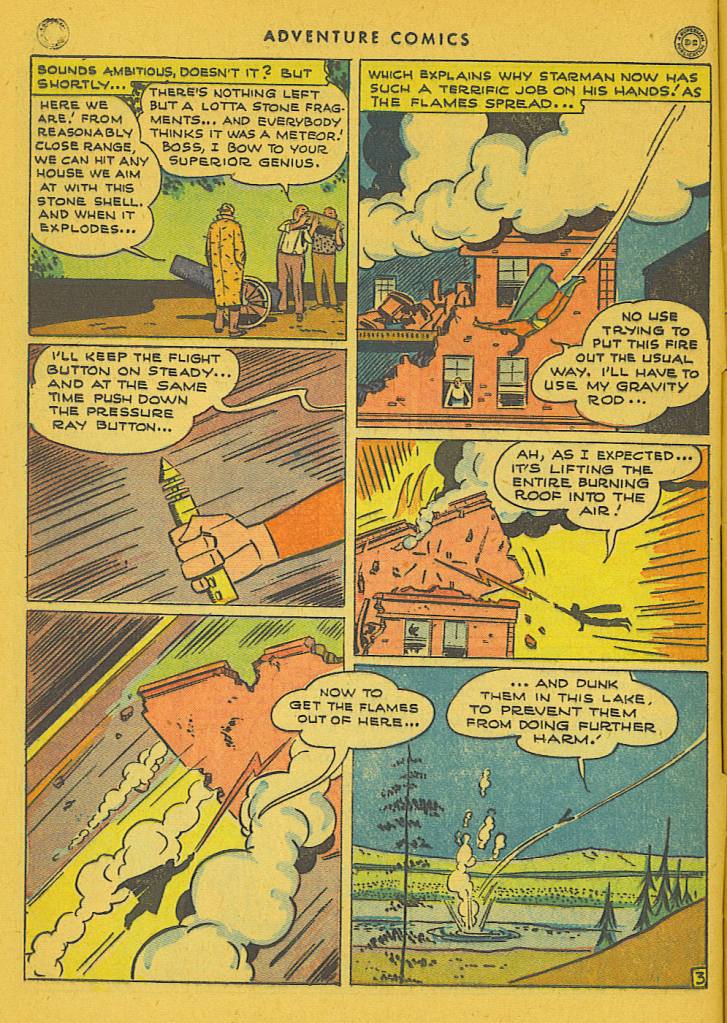
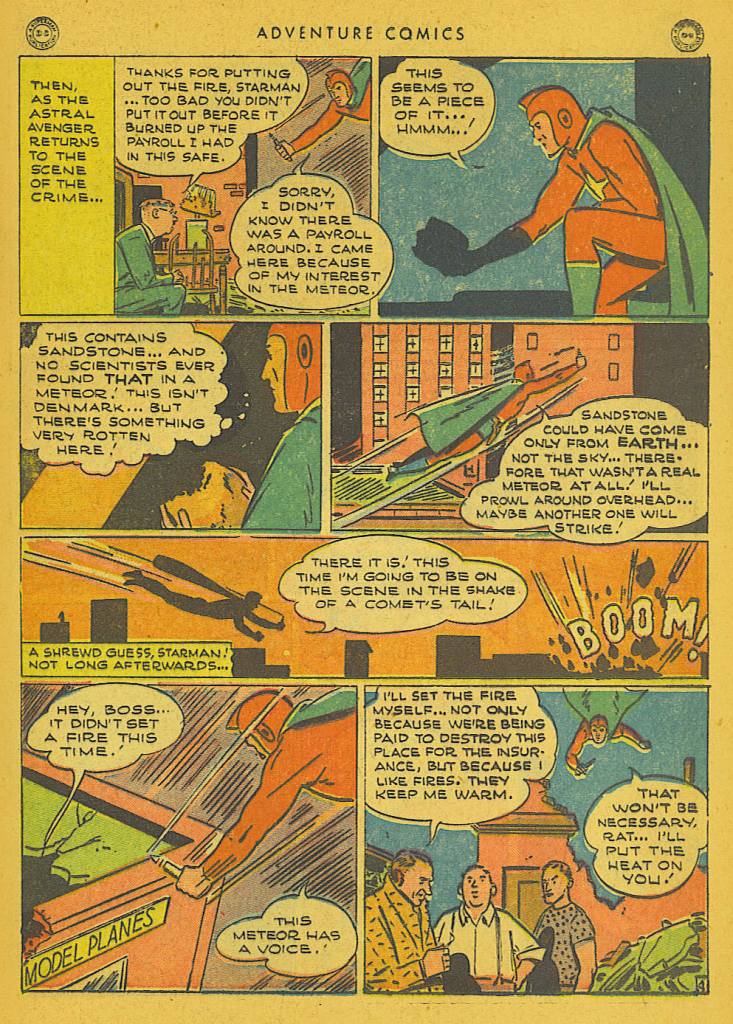
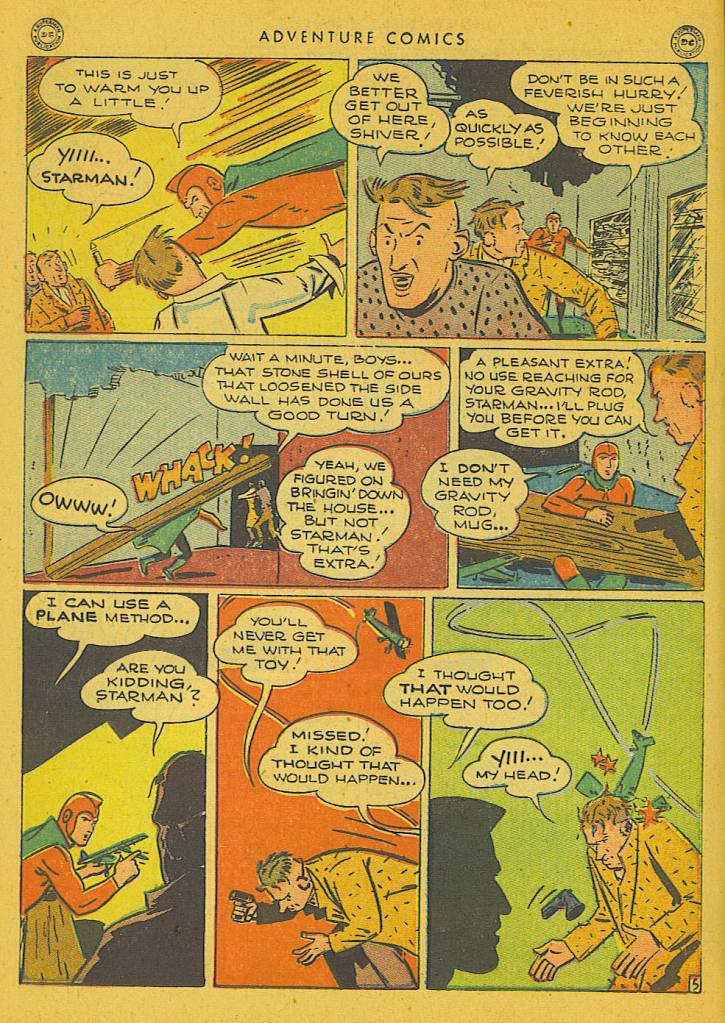
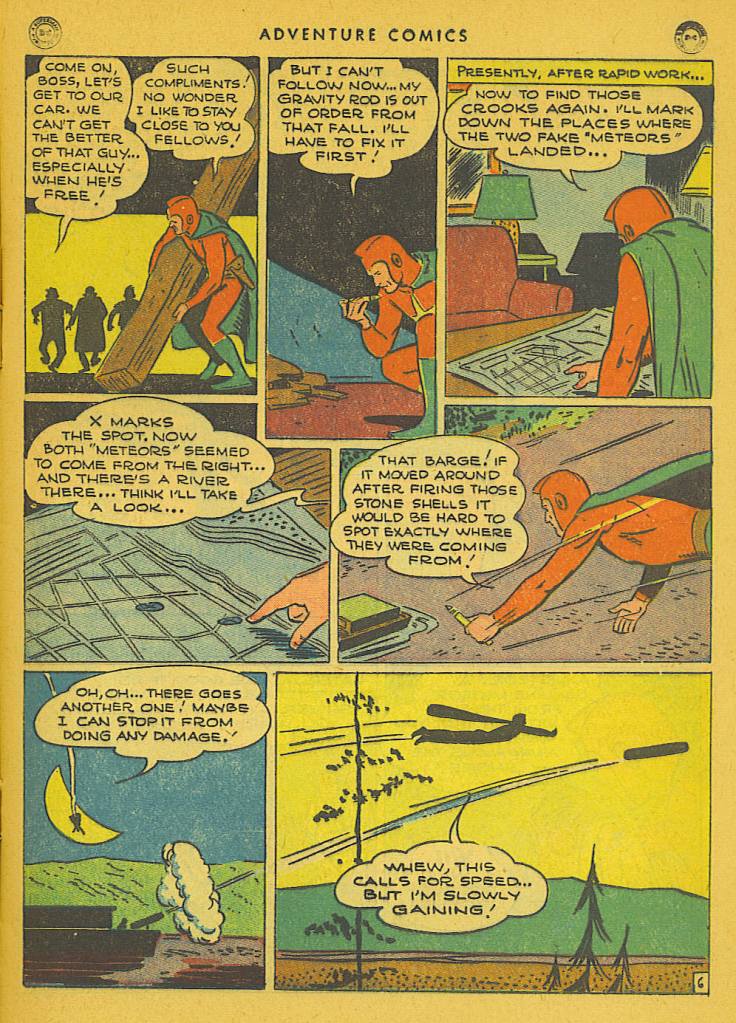
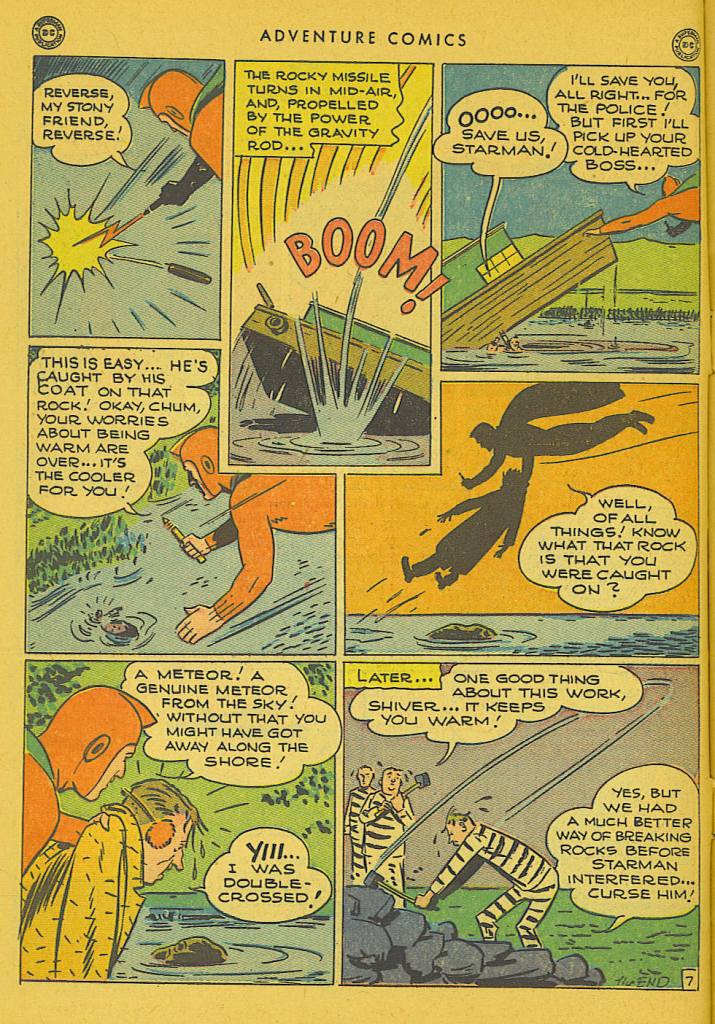
The final Starman story of the Golden Age appeared in ADVENTURE COMICS #102. It was written by Joe Samachson and illustrated by Emil Gershwin. And it’s completely pedestrian. It’s solidly crafted enough, but there isn’t anything here to get any readers excited about the feature.
Of course, this wasn’t the end of Starman over the long haul. Attempts were made to revive the character in the 1960s, and the name was recycled for a number of other characters throughout the 1970s and 1980s. Eventually, writer James Robinson and artist Tony Harris would find a hit in a STARMAN series that featured the son of the original who had taken up the family calling in his own way. It was a series that had a very unique approach and it finally associated the name Starman with a success story.
 The Tom Brevoort Experience
Much of Robinson’s run happened during the one sabbatical from buying comics I’ve ever taken since 1973 but I’ve read very little of it. See, my favorite Starman was Stern’s and when I read somewhere what Robinson did to the character I never touched another back issue.
LikeLiked by 1 person
Stern’s Starman was lots of fun. I was okay with Robinson’s work with him though. It was better than using him as a sacrificial lamb in Total Eclipse.
LikeLike
Maybe it’s on my end, but I dont see the “Like” button to click.
I like this art. Reminds me of better “indie” styles. It’s anatomically correct, fundamentally sound.
Stylistically not very far (to my eyes) from Marshall Rogers, Michael Lark, or early Paul Smith.
If a writer I trusted was handling the stories, I’d try it out.
LikeLike
Though Ive never cared for so much red in a suit. Whether it’s the Golden Age Starman, Silver Age Flash, or late Silver Age Daredevil.
LikeLike
The “Like” appeared..
LikeLiked by 1 person
I like this art a lot too! It’s solid cartooning with a good amount of variation from panel to panel. The overall simplicity and clever shorthand approach is part of the charm.
LikeLiked by 1 person
Emil Gershwin was an influence on Alex Toth, which you can see in the faces here, and in the simplicity of his panel layouts. His layouts also remind me of C.C. Beck and the Fawcett Comics approach, and Gershwin did draw Spy Smasher for Fawcett for a while. But they also remind me of Roy Crane’s WASH TUBBS & CAPTAIN EASY and BUZ SAWYER, so I’m guessing he was influenced by Crane.
Which is interesting, in a world of comic book artists who mostly seemed to want to be Milt Caniff, Hal Foster or Alex Raymond. You don’t often see a Crane influence on superheroes, but Gershwin (and Toth, following in his path), make it charming.
LikeLiked by 1 person
If only the fight scenes had sound effects like LICKETY-WOP!
LikeLiked by 1 person
I’m see a Roy Crane influence as well. As a side note, I regret never picking up those Fantagraphics Captain Easy collections…
LikeLiked by 1 person
They’re good! Not that that’s any kind of surprise…
LikeLike
Joe Shuster is the most important superhero artist I can think of who shows a major Roy Crane influence.
LikeLike
I had to look Roy Crane up. The name sounded familiar. I wouldn’t be surprised if David Mazzucchelli was familiar with Crane and Gershwin. Some of Mazz’s art in “Batman: Year One” was leaning towards a minimalistic style like Gershwin’s in this Starman story. And that ethos of only the essentials, like Toth’s. Batman’s figure in B:YR is often devoid of interior detail, relying more on body shapes.
I knew the Toth reference by Mazz; I remember reading a letter Toth had sent to DC after seeing B:Y1, & then-editor Denny O’Neil had it printed in the letter column, commenting that Mazzucchelli really appreciated Toth’s praise. I hadn’t heard of Gershwin ’til now, here. But Mazz used even less interior figure lines & detail in B:Y1 than he dd in “Daredevil: Born Again”.
From reading interviews with Toth, I knew his repeated references to, & high regard for, Noel Sickles, who’s “Scorchy Smith” stuff I looked & was really taken with. I AM NOT DISPUTING that Toth was or could’ve been influenced by Gershwin (what a surname to have in the same era as big band pop music & musical theater). I see the similarities in the drawings. And Gershwin’s “Starman” seems more honed than Toth’s Green Lantern around the same time.
Always good to have new artists, even from 80 years ago, to get a look at what I’ve been missing. So, thanks.
LikeLike
The caption on page 2, panel 3, jarred me with an interesting bit of linguistic drift. Nowadays, “astral” tends to indicate something like “ghost/spiritual/psychic”. As in, “astral form”, “astral projection”, “astral plane”, etc. The only common phrase directly meaning physical stars that I can think of, is the motto “Ad Astra”. Today, an “Astral Avalanche” sounds like a bunch of ghosts piling in through an open spirit-world portal.
LikeLiked by 1 person
Like astral projection for mages. ‘Im no linguist. The celestial & spiritual uses are both common in English. In Greek (Elliniki), astra is star. I think psyche is spirit, soul, mind. Celeste, celestial is Latin.
LikeLike
Related to “astronaut”, star sailor.
LikeLike
Or more specifically, Dr. Strange is always using his “astral form”. What I mean is popularly, the word “astral” seems to have shifted from “physical stars”, to primarily having a more metaphorical sense, of heavens and so spiritual/supernatural. A character known as the “Astral Avenger” strikes me now as conjuring up someone like Deadman or The Spectre, as opposed to a hero related to real stars. It’s not that the star meaning is entirely gone (good catch on “astronaut”, though I think the “-o” makes it psychologically different). Rather, the star meaning doesn’t come to mind in terms of heroes and similar, as opposed to the supernatural meaning. Compare e.g. “Geo-Force”, where geo == earth hasn’t drifted like that.
LikeLike
I think it’s just our experience & association. You can refer to dictionaries, etc. But in my limited experience, just because I’m not aware of something, doesn’t mean it’s not true.
And as collective knowledge expands, so does common or shared vocabulary. Astra/Astro was most definitely a reference to stars in ancient Greek. I think “Cosmos” was used farther out than the visible stars (and it’s where Soviet Russia got “Cosmonaut”).
And in the ancient & medieval periods around the Mediterranean Sea’s basin, Greek was often used in places of higher learning and written texts (Latin, too, in Southern & Western Europe).
LikeLike
@Seth we could further into the weeds. Astronomy is something like measuring the stars. Astrology is the study of stars. But in practice astrology isn’t a solid, fact based science like Astronomy is.
Where geology IS a “solid”, fact based science. Geometry is math that I don’t know that it’s limited to “measuring the earth”, as it name might translate into. That seems to be “geography”, The suffix seems to be similar to “measuring” but I thought it actually translated to books or writing. Like a biography, written about someone’s life. I don’t know why there isn’t a “geonomy.” 🙂
Suffixes like “ology”, “onomy”, “ometry”, “ography” don’t always line up with the same prefixes.
There’s “ecology” and “economy”, but no “ecometry”. or “ecography” (that I know of).
No “astrometry” or “psychometry”, either. Although a “psychometer” sounds like something in Victorian era science fiction. 😉
LikeLike
Psychometry: ‘the supposed ability to discover facts about an event or person by touching inanimate objects associated with them’ I have to say I’ve never seen it work outside fictional works in all media but it is a word (and a cool power for the hero to have).
LikeLiked by 1 person
@Steve McBeezlebub, sounds cool. Maybe there’s an on-line Psychometry class that I can pay for telepathically. 😉
LikeLiked by 1 person
Dictionary ( Googled ) Astral: adjective — of, connected with, or resembling the stars. example given — “astral navigation”. Also, relating to a supposed nonphysical realm of existence to which various psychic and paranormal phenomena are ascribed, and in which the physical human body is said to have a counterpart. example given –“spiritual beings from the astral plane”.
LikeLiked by 1 person
Thank you, sir.
LikeLike
The concept of an “astral body” is neo-Platonic, got revived during the Renaissance, and then again by Eliphas Levi (whose “astral light” is very Mesmeric) and Theosophy (see CW Leadbeater’s book “The Astral Plane”) from which it found its way into Dr. Strange. The ancient idea was a kind of harmony between the soul and the cosmos (macro-microcosm) that explains, among other things, why astrology works. In Theosophy, the astral plane is one of a number of higher (than the physical) planes on which we simultaneously exist, and through which our souls may progress. (There’s both involution and evolution.) There are apparently other entities living on it too. Eliphas Levi thought it could be manipulated (this is how magic works), or peered into (for divination).
A joke from Swami Beyondananda:
Q. What’s the relationship between astral projection and quantum mechanics?
A. If your astral projector doesn’t work, you take it to a quantum mechanic!
LikeLike
The second DC Comics Starman was Batman [ Detective Comics#247 ( September 1957 ) using variants of his usual equipment, but with a star motif instead of a bat, due to him having been hypnotized to be given a fear of bats by Professor Milo in the belief that this would render him incapable of being a hero ( Starman Secret Files and Origins had Doctor Mid-Nite take Batman’s place as that Starman –wikipedia ) ]. Star-Man [ Detective Comics#286 ( December 1960 ) ] a villain appeared to menace Batman and Robin whose super-strength waned in the presence of a Tibetan belt worn by Batwoman. Then Mikaal Tomas [ 1st Issue Special#12 ( March 1976 ) ], Prince Gavyn [ Adventure Comics#467 ( January 1980 ) ], Will Payton [ Starman#1 ( October 1988 ) ] and David Knight [ Starman#26 ( September 1990 ) the elder brother of Jack Knight ]. Jack Knight, Thom Kallor ( Starboy of the Legion of Super-Heroes ), Farris Knight ( the Starman of the 853rd century and member of Justice Legion Alpha ) and Victor Sono ( Star Man of the Old West — Jonah Hex vol.2#27 ( March 2008 ) ).
LikeLike
The Meteor Mob and the Moonman ( I mentioned last weekend ) aren’t Starman’s only astronomical names foes: Sun and his Satellites ( a.k.a. The Moroni Gang – the Sun ( Moroni ), the Moon, Comet, Saturn, Mercury ) [ Adventure Comics#76 ( July 1942 ) – outfitted with fantastic weapons and a rocketship & #89 ( December 1943-January 1944 ) escaped prison and went after the Green Star ( very valuable emerald ) ]. Plus astrology foes: Astra ( a cunning astrologist ) [ Adventure Comics#85 ( April 1943 ) — an gang ] and a unnamed astrologist [ Adventure Comics#81 ( December 1942 ) — Hunch Haggard and Muggsy ].
LikeLiked by 1 person
I guess having him live in Star City was too on the nose. Opal City worked out very well.
LikeLike
Thanks for sharing. In both story and art, a reminder that these comics were created for an audience of children, first and foremost.
LikeLike
Joe Samachson was a biochemist and university professor who also wrote Science Fiction, Mystery Stories, scripts for CPT Video and comics.
like Ed Hamilton and others he probably came into comics through working on Weisinger’s CPT Future pulp for Standard Magazines..
LikeLike
That artwork was really nice! I can definitely see the influence on Alex Toth.
LikeLike