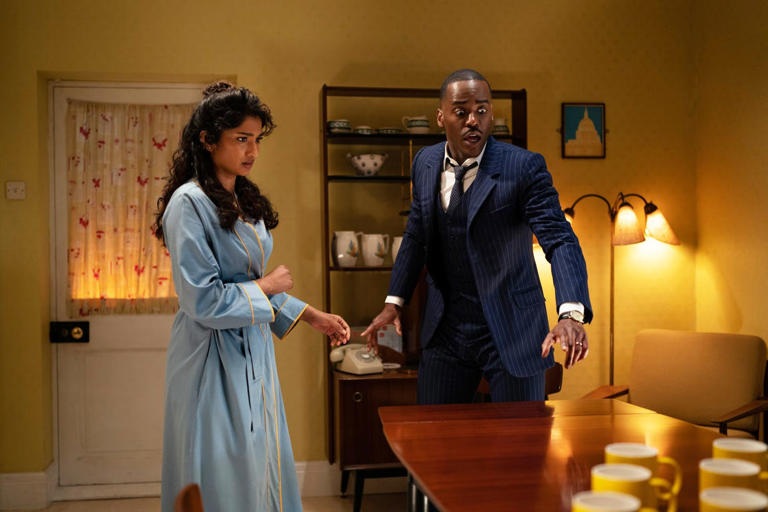


We’re into the finale of this season of DOCTOR WHO, and unfortunately, finales have not traditionally been where showrunner Russell T. Davies has ever done his strongest work. Needing to make teh stakes bigger, higher, madder than ever before, he’s tended to employ a lot of dodgy skip-logic in the plotting, winding up with episodes where the Doctor’s triumph over whatever is going on seems to come about simply because it’s his name that’s on the logo. And unfortunately, this episode feels very much of-a-piece with that tradition. It was a perfectly entertaining viewing experience, but it’s stuffed to the gills with concepts and ideas and callbacks, to the point where the odds on everything being pulled together in a satisfactory manner by the end of next week’s actual finale appear to not be very good at all.
Let’s start with the Rani, who has bigenerated into two separate characters and who thus requires twice as much screen time. I completely understand why Davies chose to do this–having set up the mystery of Mrs. Flood across two whole seasons, he didn’t want to discard her once the reveal happened. But the consequence is that both Ranis come across feeling a little bit thin. Mrs Flood plays very much as she always has, with the revelation of her true identity and nature seeming to have had very little effect on her cover identity as a little old lady living down the road. On the other hand, Archie Panjabi’s modern Rani never entirely takes off. She feels like nothing so much as a cut-rate version of John Simm’s version of the Master rather than as a distinct personality. The rani was always a troubled character when she was first created during some of the original series’ nadir episodes–she was said to be a coldly calculating scientist, the Doctor without his morality, but she tended to come across as the worst sort of moustache-twirling comic book super-villain. Given the opportunity to establish a greater depth to the character, “Wish World” is too busy spinning a dozen other plates to do anything with it.
It doesn’t really help that the Rani’s plan–and thus the plot that’s been driving the entirety of the season–is absent a certain amount of internal logic. It feels like a scheme reverse-engineered from elements established in other episodes. On top of which, for all that the season has been attaching enormous significance to today’s May 24th date, and the episode references its importance a couple of times, that element doesn’t seem to really amount to much of anything. Yes, this is the day that the world explodes, but it feels like this could have happened on any other day just as easily. Plus, I’m left to wonder: if the Doctor and Belinda arrived at May 24th at the end of last episode when the doors to the TARDIS exploded inward, then were they displaced backwards in time by the Rani so that they could live out the day and set off that explosion? It doesn’t really track, and the episode expects you to simply go along with it all.
In terms of the fun and games of the Rani’s transformed world, those are put forward pretty well, though I feel as though they go on a bit too long, In part, this is due to the need to bring a wide assortment of characters–Ruby, Shirley, Kate, Colonel Ibrahim, Mel, Poppy, Rogue, etc, etc–into the narrative. Consequently, the Doctor and Belinda get sidelined for a huge portion of the episode, neither one recalling their true selves until right at the very climax. On top of all that, we have Conrad from “Lucky Day” set up as the imagineer of this altered world, a baby god from the Pantheon whose wishing powers make it happen, and the McGuffin that this is all being done in the service of releasing the legendary Time Lord Omega. The whole structure feels overstuffed–I haven’t even mentioned Susan yet–and I can’t help but feel that the production would have been stronger with fewer elements to juggle. Certainly, Varada Sethu gets the worst of it, with much of the material that might have been hers given to her predecessor Millie Gibson. And yet, for all that, the subplot with Ruby and Shirley and the nascent underground doesn’t really seem to go anywhere or accomplish anything (apart from letting Russell comment metaphorically on the efforts of right-leaning people to erase anyone considered abnormal or outside of a very narrow and restrictive set of parameters) and so I feel like it could maybe all have been excised. We’ll see next time whether this batch of characters proves to be essential to the climax.
And once again, the Doctor is reduced to being led around by his nose, and can’t seem to even comprehend the plot that’s going on around him until the Rani explains it all piece by piece in excruciating detail. I’m put in the mind of “Human Nature”, another story in which the Doctor’s true nature was subsumed underneath a fictional sense of self. However, in that episode, he was still enough the Doctor to be able to save a woman from a falling piano by setting off a Rube Goldberg-like set of actions and reactions with a thrown object. In other words, he was still the Doctor, even while he wasn’t. Ncuti Gatwa is good here in the role of ordinary heterosexual man John Smith, and the change from his typically bombastic personality makes the point effectively. But rather than the Doctor needing to be handed the solution by first Rogue and then the Rani herself, I’d have preferred it if he was able to begin working it out himself. If nothing else, this would have made the reveal that what the Rani was actually attempting to harvest was the Doctor’s own doubt hit a little stronger. As it is, while John Smith had his doubts, left to his own devices, he would have continued to run from them. So it seems like a bit of a cheat for the Rani to just give him the answer–that doesn’t lead to doubt, does it? Anyway, once again here, the production forgets to make the Doctor the hero–and so his final pronouncement lacks the gravitas that it might otherwise have.
So where does this leave us heading into next week’s episode? Well, my guess is that we’ll see relatively little of the Wish World in it (though there needs to be a certain amount, if only to justify the narrative space given to Ruby and Shirley and their crew this time out.) I suspect that the runner of Susan isn’t going to be definitely answered, and that perhaps the episode (and the series, depending on which rumors of impending doom for the show turn out to be legitimate) will end with the Doctor heading off to rendezvous with his granddaughter, companionless. I’m sure there’ll be the usual heroics, crazy plans, spectacular pyrotechnics and probably a wrap-up move that’ll be more about the power of wishing that anything that intrinsically makes any sense. I do hope they remember to give Belinda a few moments of reunion with her parents and with the Earth in general, as her return has been such a central driving thrust this season. Beyond that, I really don’t know–and I can’t say that the show’s plotting makes me feel confident that they’ll stick this landing. But we’ll see when we see.


I did love the ep even as I acknowledge all your problems with it. I think RTD’s greatest gift is making you love ridiculous plotting. My sole quibble was didn’t the Rani (How dare you besmirch one of the Doctor’s greatest enemies!) have Time Lord tech herself so why would she need the Doctor to take the vindicator all over? Why not do it herself?
LikeLike
It did look to me at the end like the Doctor’s balcony was about to fall on top of Ruby, Shirley, and the third woman whose name I don’t recall if we ever knew it. So that will presumably put them together for next episode.
LikeLike
I’d have liked this better if Disney Who had any cred with me. But they’ve used that up. The structure’s too similar to last season’s finish and I doubt they’ll do Omega right. Likewise, much as I like the Rani in Classic Who I agree she’s generic evil here.
Conrad likewise seems generic. I think regardless of what the Rani said he’d have Baby Wish create a world in keeping with Conrad’s paranoid delusional worldview (“These disabled people are just UNIT stooges trying to separate us from our money!”).
You’re spot on about the Doctor not saving himself.
LikeLike
There’s a core of a solid idea here — weaponizing a baby god seems like a very Rani thing to do. But as you say, there’s so much seemingly-irrelevant nonsense piled on top of it that the impact is lost. Maybe RTD was aware that this might be his last hurrah, and wanted to get every single idea in his head out there while he had the chance, but yikes.
LikeLike