

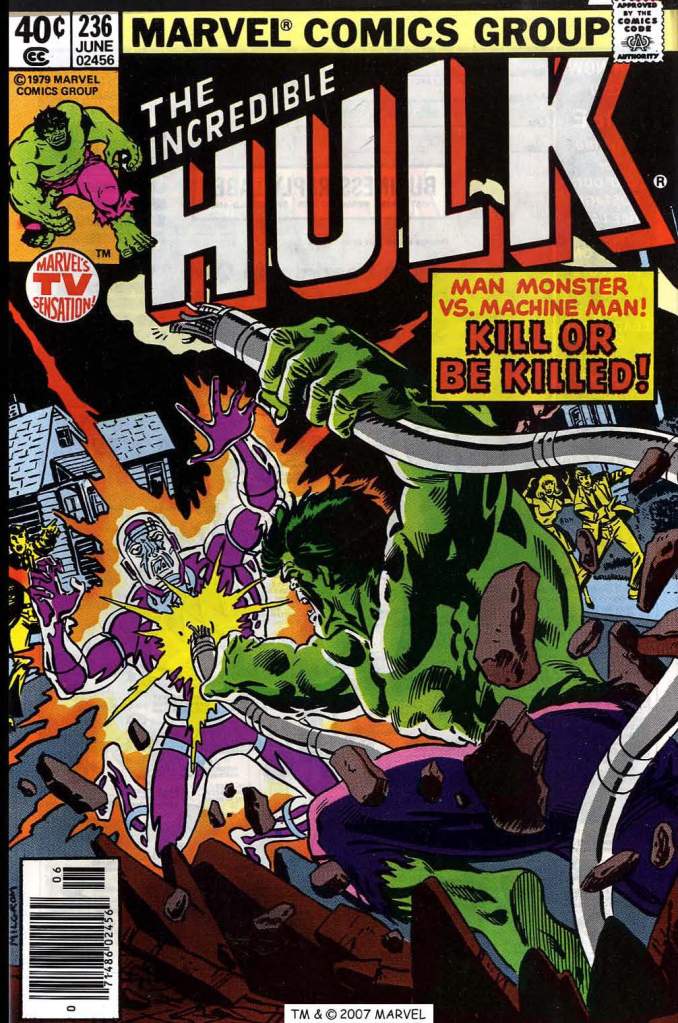
I expect that I picked up this issue of INCREDIBLE HULK on my weekly bicycle trip down to my neighborhood 7-11 on Thursday afternoon, which is when the new comic books arrived back in those days. It was a series that I was following, more because it was a part of the larger Marvel Universe than anything else. I enjoyed the book well enough, but the Hulk–in particular, this incarnation of the childlike brute–was never a huge favorite of mine. I think that’s because the element of wish fulfillment didn’t connect for me. The Hulk was more monster than hero, and that didn’t appeal to me in the same way. I could imagine myself clad in armor like Iron Man or wielding a shield like Captain America, but being strong-but-dim held little appeal for me. If I wanted to fantasize in that direction, the thing was a much better fit for me.

That all said, INCREDIBLE HULK was a solidly entertaining comic book series during this period, thanks to the efforts of its stable creative team. Roger Stern was only just beginning to make a name for himself as somebody who could channel the essence of the formative 1960s Marvel stories into more modernistic tales that worked in the late 1970s, and Sal Buscema was, while not always the most exciting artist in the field, completely reliable as a visual storyteller. He could deliver the requisite Marvel-style actin and drama instinctively. Not every story was a winner, but even the clunkers were delivered with an appreciable sense of craft.
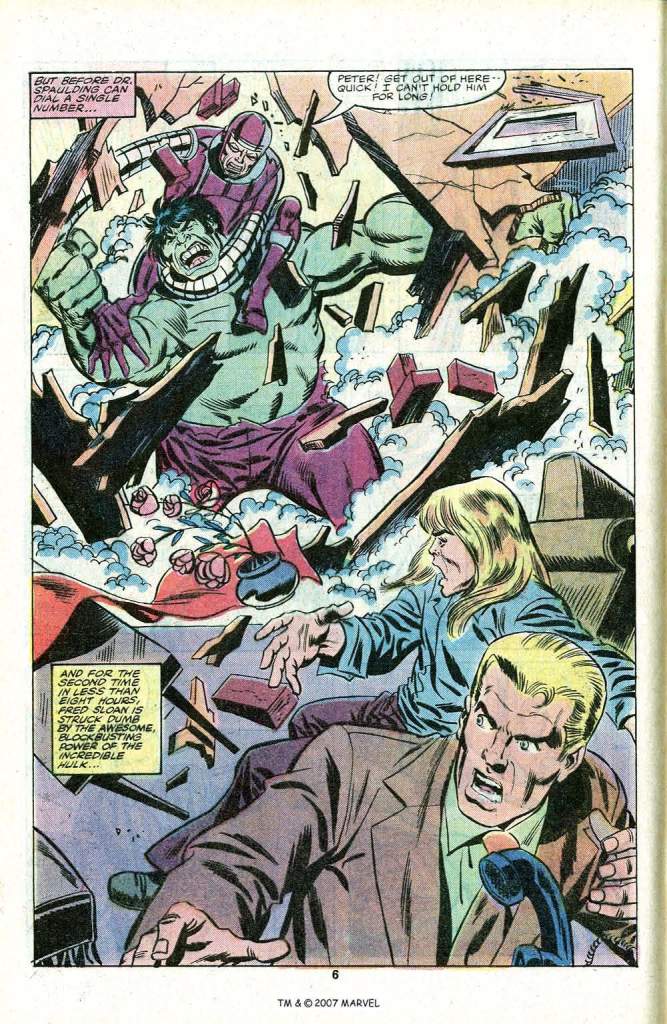
As we saw last time, the villainous Corporation had decided to try to eliminate two separate problems that had been bedeviling them–the Hulk and Machine Man–by manipulating the two heroes into fighting one another to the death. To that end, Corporation agents abducted the Hulk’s friend Trish Starr, with one dressed to look like Machine Man. The Hulk and his hippie buddy Fred Sloan went looking to rescue Trish, seeking out Machine Man at the home of his sponsor, Dr. Peter Spaulding. And as desired, a battle sequence began–one that continues through the first half of this issue. machine Man and Dr. Spaulding have no idea why the enraged Hulk has turned up on their doorstep, but Sloan gives Spaulding a quick rundown at gunpoint. But Sloan can’t bring himself to shoot another human being, and Spaulding is able to disarm him. But knowledge of what’s been going on isn’t enough to stop the fight.
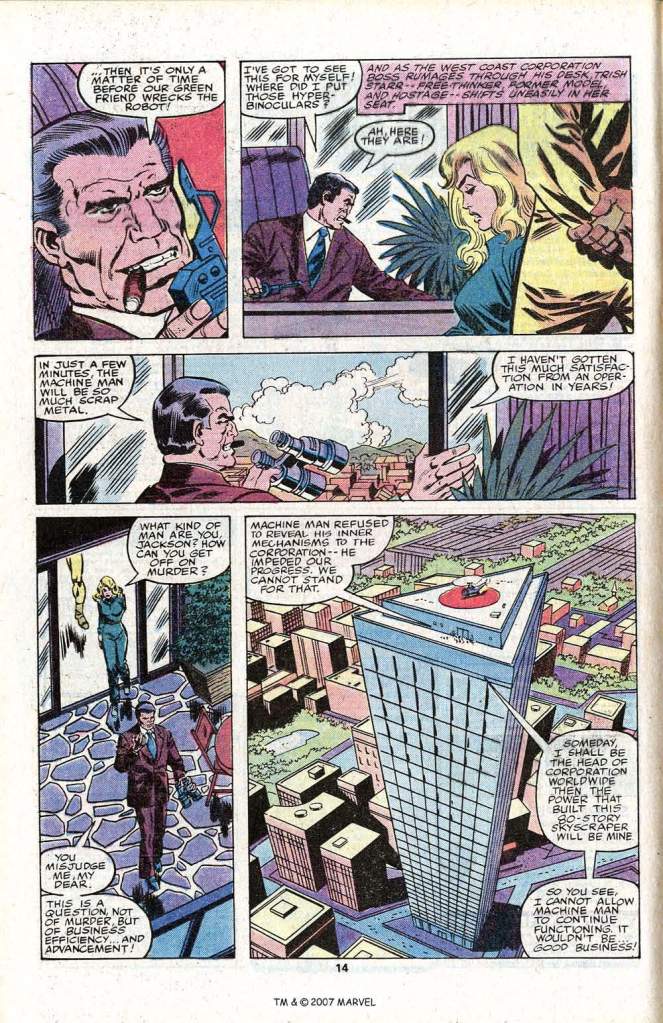
As with most issues of INCREDIBLE HULK, action and mayhem were the name of the game, and so Aaron Stack and Bruce Banner’s hulking alter ego mix it up for page after page, with Machine Man never really able to halt his foe’s forward progress towards smashing both him and Spaulding alike. Nearby, Corporation executive Jackson receives reports of how his gambit is going. He pulls out a pair of hyper-binoculars in order to watch events with his own eyes. Captive Trish Starr looks for some way to liberate herself and turn things around on Jackson, but no such opportunity presents itself.
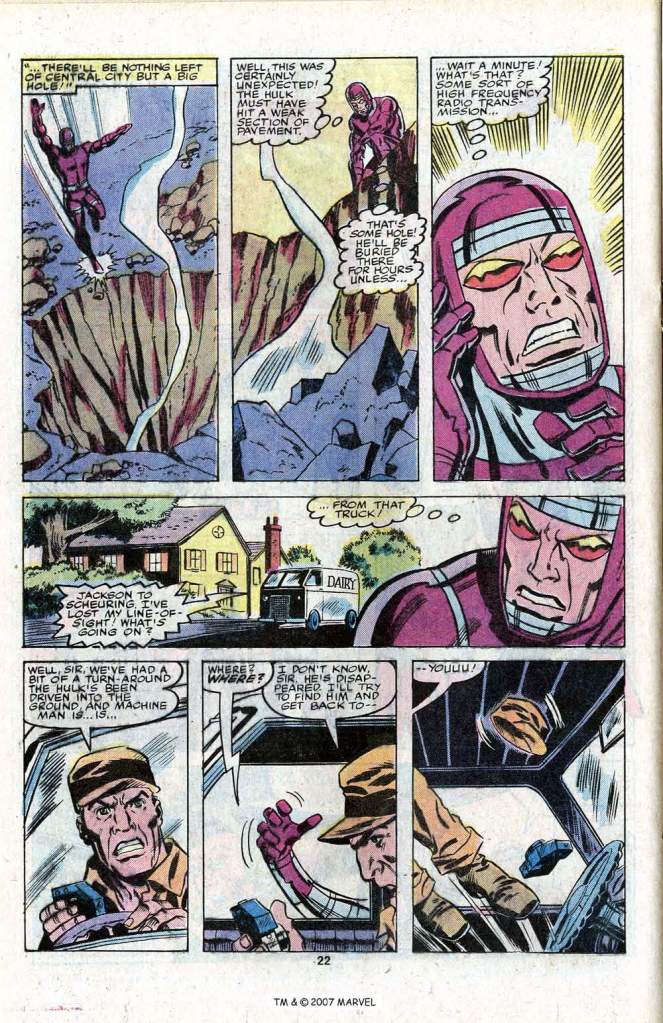
And so, the battle continues. Machine Man attempts to escape using his ability to “cancel the gravity equation” and when his pursuer leaps after him, Stack is able to divert the Hulk’s course back towards Earth with a well-placed kick. It’s at this point that Machine man’s built-in transceivers pick up the radio play-by-play being broadcast to Jackson by an agent in the vicinity. Aaron seeks out this individual, incapacitates him, and then uses his ability to change the timber of his vocal unit to mimic the spotter’s voice in an attempt to get information on Jackson’s whereabouts.
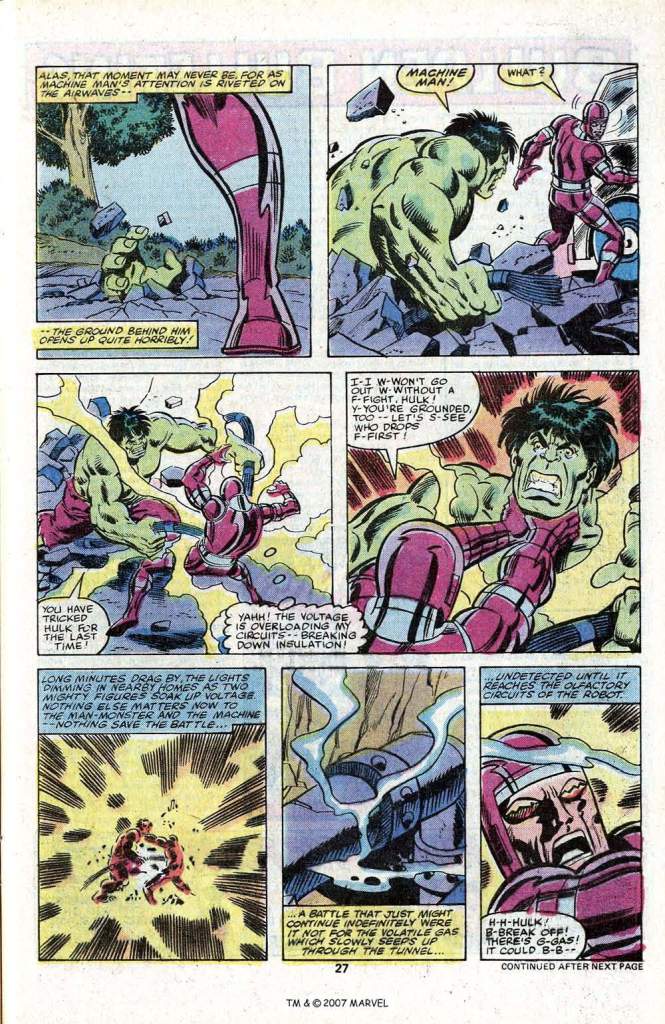
The Hulk, meanwhile, has been driven through the pavement by his fall. But this brings back a dim memory in the Green Goliath’s mind of an earlier battle he’d had with the Thing in which Ben Grimm socked him with electrical cables torn out of the ground. The Hulk decides to replicate that strategy against Machine Man. The amount of current in the neighborhood is enough to overload Machine Man’s circuits, but he’s able to feed it back into the Hulk through physical contact. So now it’s a question of which hero can take the jolt the longest.

But we never learn the answer to that question, because a gas pipe has been cracked by the violent clash, and eventually the escaping gas fumes make contact with all of the voltage flying around, setting off a massive explosion that engulfs Machine Man and Hulk alike. And it’s on that note that the story is To Be Continued. In terms of integrating Jack Kirby’s assorted creations from his second tenure at Marvel into the wider Marvel Universe, this three-parter’s integration of Machine Man works relatively well–even if it damages X-51’s position as the world’s first self-aware automaton to exist in a world where we’ve already encountered several others. Kirby wasn’t interested in playing in the greater Marvel sandbox, but those who came to his characters after him moved Heaven and Earth to shoehorn them into the greater Marvel cosmology, with mixed results.
 The Tom Brevoort Experience
Machine Man was least unwieldy of the Kirby characters integrated. There wasn’t the gigantic dissonance of the Eternals or the patent ridiculousness of what Panther was put through.
LikeLike
I think the PANTHER stuff integrates into the Marvel Universe just fine — as it should, really. But a lot of those characters came back, and are very Marvel, overall — an association of Collectors, weird future tech, a cybernetic mastermind, intangible footsoldiers, a radiation-mutated monster…really, the bit that felt most jarring was the Black Musketeers.
But Machine Man was so strongly about X-51 being unique, and the first big change along those lines, that it wasn’t so much that Machine Man characters disrupted the MU so much as the MU diminishing everything that made Machine Man’s world distinctive.
LikeLike
Kirby had some interesting ideas in Black Panther but it felt to me like he was more interested in them than in T’Challa, who could have been replaced by any tough Marvel hero for the first seven issues or so.
LikeLike
It did seem that way, until you back off and look at them from a bit of a distance. The Collectors are looters of antiquity, like the Egyptologists of Kirby’s youth, T’Challa’s half-brother (?) who becomes a monster is a palace intrigue character who is powered by the vibranium mound, and Kiber is built on the root meaning of Khyber and cyber — Kirby was playing with ideas of royalty and antiquity and Africa (and environs) that he probably wouldn’t have if he wasn’t writing about a hi-tech African kingdom with ancient roots.
Kirby’s T’Challa himself is fairly impersonal, but if you threw in a page or two every issue where he mused about the responsibilities of kingship, the implication of the threats to his kingdom, his wish for some peaceful time with Monica (or some other love interest) — the kind of soul-searching we’d expect from a Marvel hero in the hands of a post-Stan writer — I think readers would think it was wild stuff but still personally connected to the series concept and lead. None of it is stuff he’d have done with Cap or Machine Man.
I thought it flowed really unusually, like a newspaper adventure strip of the 30s-40s rather than a comic book, as we segued from story to story. But those were Kirby’s roots, and he never really fell into the genre formulas even as he’d helped create them.
LikeLiked by 1 person
I agree that Kirby’s PANTHER run is weird, but it’s a weirdness that grows from how Kirby saw the Panther when he (co-)created him, not Roy’s Panther or Don McGregor’s. It’s a seething hybrid of pre-war pulp adventure about “exotic” lands stirred up with pulp SF — but it’s all coming out of the Panther concept. At least, out of Kirby’s Panther concept.
LikeLiked by 1 person
I’d rather see The Eternals and Machine Man in the mainstream Marvel Universe than that cartoon duck ( Howard the Duck ). Who would give someone that short a driver’s license and how does he even see over the dashboard or reach the pedals of a car? In a world where people are freaked out by or hating on mutants how are they not freaked out by a talking cartoon duck?
LikeLike
I haven’t read any of Howard’s recent appearances, but I don’t recall him ever driving a car in the Gerber run. And people were frequently freaked out by him, leading to one of my favorite exchanges in any comic:
Nighthawk: “Y-you’re a DUCK!”
Howard: “No offense, pal, but you’re hardly in a position to criticize.”
LikeLiked by 3 people
I think it’s possible to take a desire for consistency too far. Howard is absurd, but his series is about absurdity, so it works there, while it might not works so well in IRON MAN or IRON FIST, since their fantasy is of a different flavor.
If ducks around the world were starting to talk and smoke cigars, people might see them as mutants. But when it’s just one, it’s an oddity, in a world that has a lot of oddities in it. And despite Howard’s physical proportions, people in the MU often assumed he was a short person in a costume. People believe what they’re willing to accept.
Plus, Howard’s easier to ignore than the Eternals, who have big implications for Marvel’s world-structure and history, while Howard is just the result of a dimensional fart and usually sticks to his own book.
LikeLiked by 3 people
See, e.g., the Michael Dunn character’s modified care in Goodnight, My Love (1972). It would be possible.
Also, he is strange because he is a duck with human traits, but he is not a “cartoon duck.” The issue is that he is a real duck with disturbingly human traits.
LikeLiked by 1 person
Howard is driving a cab in Marvel Team-Up#96 ( August 1980 ) starting on the first page and seen at a height below a human adult knee on page 11 panel 1 ( Is there a real world non-child that short? ). As for The Eternals/Celestials they add to the Marvel Universe, I just wish writers would not ignore Thor#300 ( October 1980 ) as to how powerful ( Easily defeated in the past Odin, Zeus an Vishnu and in what then the present withstood the gigantic powered by the souls of all Asgardians ( minus Thor ) Destroyer who cut off a limb of a Celestial ( I didn’t see and bone or tissue — so energy being or …. ) which quickly regrew ) — me wondering how there could be Celestial head out in space.
LikeLike
Correction on what I saw after the Destroyer cut of a Celestial’s arm, there was circles seen that could mean it has a skeleton. Not as clear as what we saw after the Vision cut off his own melted arm in Vision and the Scarlet Witch vol.1#2 page 20 panel 5 ( bone, marrow and tissue ) and panel 1 says ( The pain in my arm is overwhelming ( A machine shouldn’t feel anything ). Though I am a Synthozoid — a creature of synthetic organs and parts — ( you can see on his melted arm, muscles and veins )
LikeLike
I think it’d be a fun running gag if Howard kept encountering ordinary people who assumed he was a Donald Duck cosplayer. It could even refer back to the copyright controversy, have Howard rant that he looks nothing like Donald Duck.
I don’t see him as having too much trouble day-to-day, at least in a major city. Casually, people might think he’s an actor and he’s still wearing the costume and prostheses (because they take a very long time to apply and get right). It could get a little difficult with legal stuff like actually getting a driver’s license. But still, big-city workers tend to be really blase about weird-looking people. Someone seemingly dressed as a duck is probably way down on the strangeness scale of what they’ve seen.
Howard isn’t scary. He just looks odd, but in the larger scheme of things, he doesn’t looks threatening or dangerous.
LikeLiked by 1 person
John Holstein – Yes, for “Is there a real world non-child that short?”
According to the Official Handbook, Howard’s height is 2 feet 7 inches. According to Guinness World Records, “The shortest man living (mobile) is Afshin Ghaderzadeh (Iran), who measured 65.24 cm (2 ft 1.68 in) in Dubai, UAE, on 13 December 2022.”
Thus, Howard is actually significantly taller than an existing real active adult human.
There’s several other real mobile adults less than Howard’s height listed here:
https://kids.guinnessworldrecords.com/news/2020/1/meet-worlds-shortest-man-khagendra-thapa-magar-603762
Given that there’s an acting niche for very short people, and Howard speaks like a typical adult with normal intelligence, it does seem quite reasonable that he’d often just be taken as such an actor still in costume.
Legally, he can be regarded as a refugee from a foreign country, with a genetic condition that makes him extremely short and has skin effects, etc. And that’s all completely true.
LikeLike
Re Thor 300: I hated that with a burning passion. The worst feature of Kirby’s original series was that the Celestials are cosmic genocides who’ve destroyed hundreds of worlds for not meeting their standards. The implication of Gruenwald’s story was that they’re so cosmic and wise, we should respect their judgment.
I could ignore this issue in the Kirby books because the Day of Judgment was 50 years out and who knows, Kirby might have questioned this point down the road. By MU standards, they’re just evil. But of course this was the era when Marvel decided Galactus destroying planets wasn’t such a bad thing.
LikeLike
As robots the Hulk as fought go, Machine Man was one durable robot. He clearly in the previous issue detached ( or made them ready to detach ) his body parts to prevent the Hulk from doing structural damage.
LikeLike
I’m not sure that the Priest stories that bring together his Panther and Kirby’s Panther hang together in every way, but they were fun.
LikeLike
Partly because he mocks the absurdity of King Solomon’s Frog and other elements.
LikeLiked by 1 person
Mr. Busiek makes a good enough case I’ll reread the Black Panther book on the app.
LikeLike
The Thing tricking the Hulk ( Green version of the Grey Hulk in intelligence ) into grabbing electrical cables was Fantastic Four#25 ( April 1964 ) page 15.
LikeLiked by 1 person
“As for The Eternals/Celestials they add to the Marvel Universe…”
Yeah, my trouble there is that I don’t like what they add — a second set of “gods” to explain myths that were already real in the MU, a nonsensical, anti-science definition of mutants (not Kirby’s doing, but part of how Marvel chose to stitch them in)…they’d work much better in a separate universe, as Kirby intended, resisting pressure to put them into the main Marvel U.
LikeLiked by 1 person
What Jack Kirby did with the Celestial was the borrow the alien abduction and experiment stories to create The Eternals & Deviants ( Either the original or the Deluxe edition explained that the 3rd ape-like humanoid were given the potential for mutation ( Mutates ( FF, Hulk, Power Man ) & Mutants ) ) why 21st century writers “think” they have to re-invent the wheel and mess things up is beyond me. I get why you wish they weren’t made a part of mainstream Marvel, but I glad powers at be at Marvel chose to make them apart of the same universe. Plus you could always see Kirby’s version as his Ultimate Universe and Machine Man & The Eternals in the Marvel Universe as almost identical characters with almost identical stories. The Eternals could be no different than Aliens ( The Horusians [ The Incredible Hulk#145 ( November 1971 ) ] who dress like ancient Egyptian Gods or the Axi-Tun [ The Invaders#1-2 ( August-October 1975 ) Donar, Loga, Froh & Brunnhilde ( who either came to Earth dressed like Norse/German Gods or Brain Drain dressed then that way and gave Donar an Ax that returns to his hand ) ][ Giant-Size Fantastic Four#3 ( November 1974 ) as the Four Horsemen of the Apocalypse ( Death, Famine, Pestilence & Famine ) from the Bible ] or Iron-Fist’s Gods of K’un-Lun [ Marvel Premiere#15 ( May 1974 ) ] using Chinese Myth names Yu-Ti, Lei Kung and Dragon Kings ).
LikeLike
Oh dear, what did they do with mutants?
LikeLike
They established that mutants all have an “X-gene,” implanted in humanity by the Celestials.
But having attributes that come from an inherited gene, that’s not what mutation is. It’s very much what mutation isn’t.
So Marvel’s mutants are no longer mutants.
LikeLike
Wasn’t the X-gene established before the Celestial connection?
I think mutants got redefined as soon as the second generation started popping up. Even if they carry a hereditary mutation, I don’t believe they’d be called mutants in normal genetics (I will admit it’s been a while since I took classes).
LikeLike
“Wasn’t the X-gene established before the Celestial connection?”
No, I don’t think so.
And second generation mutants wouldn’t be mutants if they inherited their parent’s abilities, so, like Polaris. Unless she has a different mutation as well. But back when Quicksilver was Magneto’s son, he didn’t inherit the superspeed.
LikeLike
Apparently the specific manifestations of the X-gene are not consistent between generations: Wanda IIRC would have been an energy-manipulator like Magneto if not for Cthon, but she might not have been magnetic. Or between siblings: both Alex and Scott absorb and unleash energy but not quite the same. Which doesn’t affect the point that no, not mutants after second generation.
LikeLike
If the X-gene is manifesting, it’s not mutants either. It’s inheritance.
I’d say that if Wanda inherits the propensity to channel energy, but a mutation (in this case, diverted by Chthon) is responsible for the kind of energy (or, perhaps, water or fire or who knows what), it could still be mutation.
Just not if it’s caused by an inherited gene.
LikeLike
“It was a series that I was following, more because it was a part of the larger Marvel Universe than anything else,” and “And it’s on that note that the story is To Be Continued.”
I know that these were features, not bugs, of the Marvel Universe, and were what a lot of Marvel fans loved about the company, but for me, these were the two things that really turned me off to Marvel’s comics as a kid. I always felt like I was coming into the middle of a story, and never got a conclusion to the story I just read. And I felt like I had to read three other titles just to understand what was going on. The same thing eventually turned me off of the MCU as well. To be clear, I’m not advocating for one-and-done comics stories (although those are fine, too). I like long-form, serialized storytelling, but I also want my stories to have a clear beginning, middle, and an end. And Marvel has always just felt like one continuous, never-ending soap opera.
This is one of the reasons why, when I was a teenager in the 1980s, I really gravitated towards DC’s focus on mini-series, particularly Prestige and Deluxe format mini-series that felt more like movies and less like soap operas. Complete stories that really focused on narrative structure, and which were satisfying in and of themselves (instead of being just one more brick in an ever expanding wall).
LikeLike
the Continued aspect was a problem for me too — on my limited budget there was no way I could be confident of being able to buy all the installments. I remember reading the middle installment of the first Sentinels story, then missing the conclusion and picking up with the follow-up story — and missing part two where they beat Magneto.
LikeLike