

This was, I think, the most Russell T. Davies episode of DOCTOR WHO in years–which makes it only slightly surprising that Russell didn’t write it. Rather, that honor went to novelist Juno Dawson. But she completely nails the tone and the style of the earlier Russell-helmed episodes, making this one of the best outings in recent memory–for all that it’s still a bit ragged around the edges and slightly all over the place in terms of its tone, never entirely committing itself to one thing. If you haven’t seen it yet, this one turns over a couple of different cards for the season, and I’m absolutely going to spoil everything, so I’d advise not reading ahead unless you’re comfortable with that.
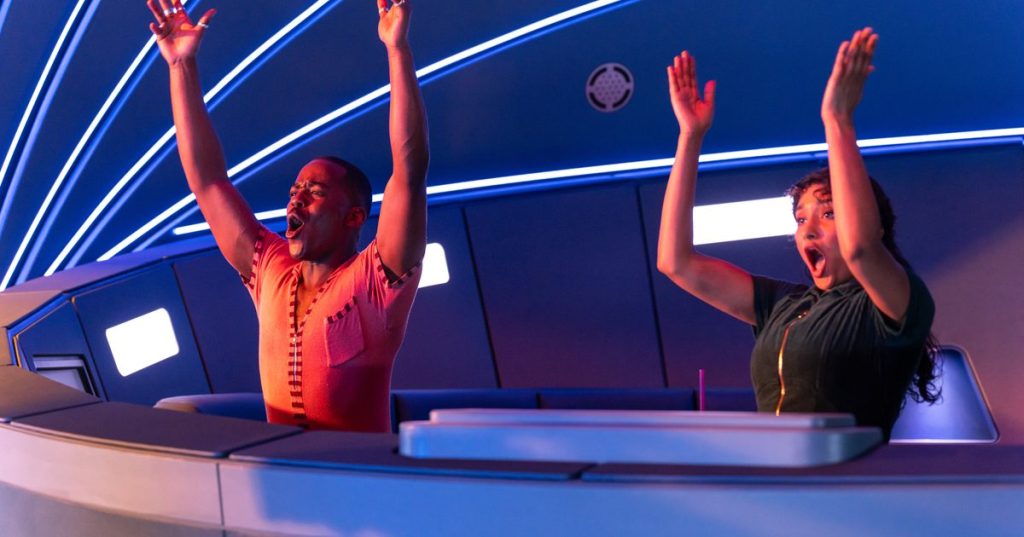
The concept of this episode is classically Russell, taking the Eurovision competition and extrapolating it into the future. As a result, the proceedings are a bit campy, but not so much that there isn’t a genuine sense of urgency. More than anything, it game me flashbacks to the revival show’s second episode, “The End Of The World”, which likewise featured an assortment of campy aliens on a platform in space under siege from an outside threat. And honestly, perhaps the thing that I liked the most about it is that there wasn’t any hint of fantasy or supernatural or mythological aspects in it at all. Yes, it was often broad and goofy, but the episode was steeped in the sort of “science leads” ethos that was always its hallmark, at least up until the most recent seasons. So it felt like DOCTOR WHO again.
And a lot of that came down to how the show and its set-up allowed for the Doctor to be the Doctor. One of my biggest qualms about the show going back years now is how often it forgets to let its hero be the hero. The Doctor is meant to be the smartest, cleverest person in the universe, and yet in recent years he’s seemed flummoxed by the simplest situations, rendered impotent by creatures and enemies that he should have been five steps ahead of. Here, though, the Doctor is on top of things from the jump, and is an active player–THE active player past a certain point–moving the plot forward. In other words, the episode remembers that he’s the hero, and lets him be that. The Doctor uses a confetti cannon to propel him back to Harmony Station! The Doctor sets up a Gravity (Mavity–that dumb joke is still going) Shell to keep the 100,000 spectators who’ve been flung into space alive! The Doctor motivates those around him to combine their skills to rescue and revive the stranded people! And the Doctor confronts the architect of everyone’s suffering and undoes him through cleverness! This is exactly what the series has been lacking for far too long.
It was also welcome, at least to me, to see the Doctor’s mood turn dark again in this story. There’s a juxtaposition to the best incarnations of the character between him being silly and daffy and simultaneously being a deadly threat capable of unleashing the worst horrors upon those who transgress in front of him. Russell, it seems, has made a conscious choice to downplay this aspect of the Time Lord in recent seasons, steering into Ncuti Gatwa’s charisma and likability to make his incarnation of the Doctor more overtly emotional and open, without any substantial darker elements to him. I always prefer a Doctor who has that hint of an edge to him, even if it’s most often hidden, so I was completely on board with the Doctor becoming vengeful when faced by the attempted annihilation of billions of people. This beat isn’t 100% successful, though, as the episode attempts to steer the tone back to a more joyful bonkers flavor by the climax, and so it feels like the Doctor’s rage and the after-effects of his actions aren’t truly explored or given the weight they require. In fact, it’s downright strange to end on the note of Belinda telling the Doctor how wonderful he is such a short time after she was horrified at how homicidal and out-of-control he was only hours earlier. The whiplash of that shift was profound, but I went along with it largely because I liked the beat so much.
Speaking of Belinda, much like Ruby Sunday before her, she seems to have become stuck in a sort of limbo in terms of her ongoing development as a character. Somehow, she stops feeling like a person and comes across more as a role, a position, a job. It’s really up to actress Varada Sethu to provide the nuance and the feeling of sustained growth that the scripts aren’t giving her–can’t give her, in the case of those scripts written by non-Russell writers, as she only existed to those scribes as a character description and they clearly stuck to that. So it’s frustrating, and the shorter season lengths don’t really help matters in terms of being able to provide a sustained character arc for the companions (especially as in this season, where one episode virtually wrote out the Doctor and Belinda.) That said, in terms of running the bases and getting across the basics, I liked Belinda this episode. She did feel engaged by the situation, and I really liked her momentary panic attack upon realizing that, even if she was to survive the catastrophe on harmony Station, she would still be marooned millions of years and light-years from her home, cast adrift into a strange culture about which she knows almost nothing.
The other element that made this feel like a classic Russell outing is the sustained use of ordinary people prompted to display their heroism by the Doctor and Belinda. In this regard, the episode harkened back to earlier entries such as “Voyage of the Damned”. I didn’t think any of the supporting players were especially fully-realized, they were pretty much all “types”, but I did like the manner in which they were constantly called upon to use their real-world skills in the service of helping the Doctor to save them and those around them. That’s one of the show’s most sustained mantras, the underlying heroism of ordinary people, so it’s always nice to see on display.
The place where the episode fell down the most, though, was in its villains. The story had a point that it wanted to get across, and it ultimately did so (and without resorting to having the lead characters turn to camera and straight-up give the moral, as the show has been doing a bit too much recently) but the delivery system for that exploration was thin. Kid’s backstory is meant to be tragic, and to ground his over-the-top villainy in an understandable motivation. But it doesn’t work because it’s delivered so haphazardly and doesn’t seem to quite link up with the performance. Rather than being a wronged party who is striking back at what he perceives to be the Corporation that wronged him, Kid instead comes across as a guy trying too hard to be edgy and disaffected by showing off his disregard for life, human or otherwise.
So now it’s time to get to the two bit reveals of the episode. I’ll admit that I had a heads up about both of them some time ago–rumors about the specifics of this season have been floating all over the place online–so I wasn’t especially surprised in either case. It turns out that the mysterious Mrs. Flood is actually the Rani, which has been a popular fan theory from the start–largely because whenever any mysterious female character would show up, certain people would be sure that it was the Rani. A creation of the last few years of the original show’s run, the Rani had appeared twice, as a sort of alternate take on a villainous Time Lord to the Master. In her case, she’s a driven scientist lacking the Doctor’s empathy, which drives her to use her skills in the pursuit of knowledge, often to the detriment of those around her, whom she sees as expendable components to be used in her studies. Truth to tell, she wasn’t really all that great of a character, so it’ll be down to Russell to make her more interesting and different than that sounds. I also didn’t love the choice to immediately Bigenerate her upon the reveal, although I certainly understand it: as with the Master years ago, you weren’t going to be able to cast Sir Derek Jacobi to be the character on a permanent basis, so using him to re-establish the Master’s malevolence and then having him give way to the more readily available John Simm was a good move. Here, I can completely understand not wanting to discard Mrs. Flood actress Anita Dobson after having had her work for two series to get to this point, but I also understand that she really isn’t at the level of being able to go toe-to-toe with Ncuti’s Doctor. Thus, the need for Archie Panjabi. But it’s still a weird choice to split the character in two this way. This was going to inevitably be done sooner or later, though, once Russell introduced the Bigeneration concept, so maybe simply getting on with it and not waiting for the Master to execute it makes a bit of sense. (I do have to say, the actual Bigeneration effect looked equally terrible here–if they’re going to keep doing this, they need to make the process more polished.)
And finally, the big out-of-left-field development this time was the reappearance of Carole Ann Ford as Susan Forman, the Doctor’s granddaughter Susan, last seen living in the 22nd century following the Dalek Invasion of Earth (though she made a brief comeback for “The Five Doctors” forty-plus years ago.) Again here, I’d been tipped that this was coming, and Russell had been setting teh ground work for it since last season, but it was still a surprise to see her turn up–even if her reappearance at that moment feels more convenient for the plot than anything else. Susan goes right back to the very earliest days of the show–she’s the “Unearthly Child” that inspires the name of the very first episode in 1963. And Ford has been vocal about wanting to come back and do a spot again in the present for some time, so I’m glad that she’s getting to do so while she’s still able to. I can’t say what viewers with no understanding of who and what she was made of her reappearance here, but to me, it was a nostalgic link to the past, one that I welcomed–enough so that I almost stopped the episode on my first watch-through of it to go back and see that moment a second time. The hope now is that what Russell has planned for the two-part season finale is good enough to warrant her return. (And here, too, I’ve heard some things–not that I’m going to spoil them for you, assuming my information is even accurate.)
I will say that an explosion blowing the doors of the Tardis off and into the ship made for a great cliffhanger and something the show has never done before. So bring on May 24th.
 The Tom Brevoort Experience
Just a question for everybody before my real comment: Does anyone else find themselves unable to fast forward through the theme music in the beginning and end credits? I used to try to no avail. Now I just accept I need to let it play. The adrenal rush is worth it though.
LikeLike
And as to the ep itself? I absolutely loved it. It’s the best installment I’ve seen since Capaldi. Yes, it spent too little time on some beats and shortchanged some characterization but Doctor Who does that all the time. Chibnall’s ineffective Doctor has lingered somewhat with Extra New Who but this was the first time there was no sign of that ridiculous trope here. Hopefully it’ll continue on this way.
You hit on the essential difference between Gibson and Sethu. For all her likability and how telegenic Gibson was, she didn’t have the acting chops to fill in the blanks that an actor playing companion has to do. The companion is how the Doctor explains things to the audience, gets to be rescued, and rarely gets anything too deep. The modern exceptions have been Clara and Rose. Sethu is more like Tate, bringing depth and likability to a broad character.
And I’ll admit that last series I was on the Rani train because I’ve wanted her back since her second appearance. I think mostly because the actor was so good. This year I decided the title, The Rani, and Sethu being from the same geographic area made it a real possibility. I’m glad Mrs Flood bi-regenerated since while I loved Dobson back when East Enders first debuted on PBS, the way she’s played the character lacks the menace necessary. We know if she had channeled her Angie self it would be a different story but as it stands The Rani in this episode is more like O’mara did and gave me goosebumps. as for Susan, I have zero expectations and not much affection for the character. I came on with Baker and have watched almost no black and white episodes outside of short clips.
LikeLike