

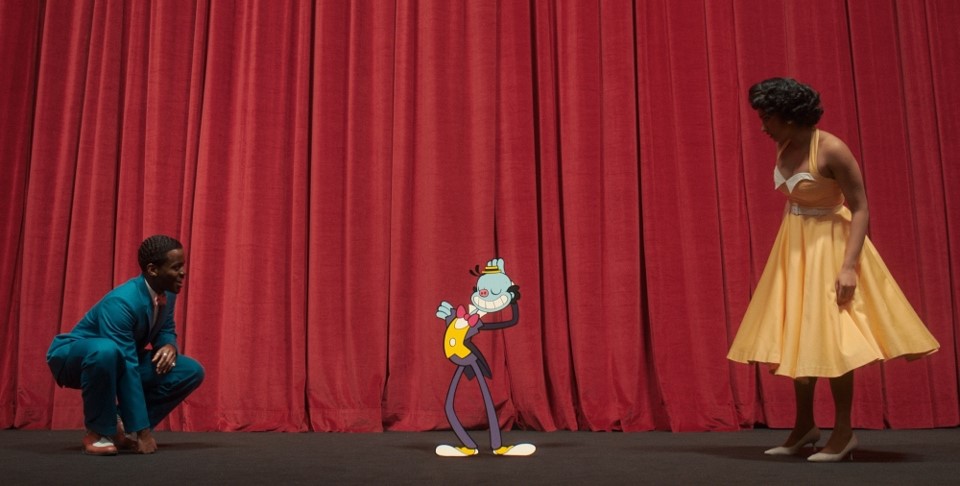
All in all, this was a pretty enjoyable outing for DOCTOR WHO–not quite a return to form per se but at the very least a step in the right direction. I find that the few complaints that I can muster boil down to some dodgy story beats and some thin characters. As a technical achievement, though, Lux is certainly the product of the series’ new inflated Disney+-backed budget, which it uses to good effect here. The effect works for the most part, outside of a few places where the animation is just a bit choppy (in particular when the Doctor and Belinda have become cartoons themselves).
For those strange people who may be reading this reaction before having seen the episode, a quick summary: continuing in his efforts to get new companion Belinda Chandra back home, the Doctor lands in Miami 1952, where fifteen people have mysteriously vanished inside a haunted moviehouse, one that’s been inhabited by a 1930s cartoon character come to three-dimensional life: Mr. Ring-A-Ding. That simple premise gets pushed to metatextual extremes as the Time Lord and his inadvertent companion cross swords with Ring-A-Ding, who turns out to actually be Lux Imperator, one of the mystical gods from beyond our universe that the Doctor accidentally invited into our reality back in the Specials.
Lux/Mr. Ring-A-Ding himself is wonderfully voiced by Alan Cummings, who is equally adept at humor and menace, and who modulates his performance so as to not veer into full-on scenery chewing. He’s an effective creation, one that must have required a considerable amount of extra effort as he was animated by hand throughout the episode. Less successful are pretty much everybody else in the guest cast: a heartbroken film projectionist, the counterboy at a neighborhood diner, and the mother of one of the missing film-patrons, all of whom are sketched quickly and performed a bit too broadly in an evocation of film performances of the era. This is a shame, because it’s the element that impacts on the believability of the enterprise the most–these characters all being so flat means that the stakes and danger veer in that direction, too.
The leads, though, are in fine form and seemed to be having a great time messing around both in the worlds of animation and in an evocation of the 1950s. Certainly, the wardrobe this time out is really great. And I thought it was appropriate that the show acknowledged the racism of the period (a time when spaces such as the Diner and the Projection House were segregated and not readily available to patrons of color) without it becoming a huge message in and of itself. The current WHO has sometimes struggled with letting the story lead viewers to a conclusion, feeling the need to hammer the point home a bit too much for my liking. Here, though, the balance is well maintained.
The big fourth wall break that happens halfway through was surprising and effective as well, though Lizzie, Hasan and Robyn are similarly characterized in the sketchiest of ways. I feel as though Russell had been better at doing this sort of thing in the past. In the case of this trio, however, that was part of the point. And the final callback to them at the episode’s end was another fun surprise.
It does feel, however, that we’re still very much in a John Nathan-Turner 1980s period for DOCTOR WHO, in that past a certain point, the drama and especially the sense of disquiet or menace is swept away by broad camp. That’s the tone of the series right now, so there isn’t any getting around it, and it’s a valid enough choice to make. But speaking for myself, I tend to prefer it when the show makes something ordinary into something creepy and disturbing, as it often used to do, and the characters all reacted to the situations with appropriate levels of seriousness. You need that verisimilitude to take the drama seriously. The bits that are meant to be sad or depressing somehow aren’t quite landing with effectiveness–chief among them in this episode being the longing of the projectionist for his dead wife. The whole of the climax turns on this emotion, and yet the character has been played so broadly that the moment feels like schmaltz rather than carrying the necessary emotion. It doesn’t sink the moment, but it does damage it a little bit.
But all that said, I enjoyed it well enough. Both Ncuti Gatwa and Varada Sethu were in fine form, and the relationship between their characters is growing quite nicely. From the jump, I’ve been more taken with Varada’s Belinda as she seemed a bit more lived-in as a character than previous puzzle box girl Ruby Sunday. She’s again used very well here, both as somebody who doesn’t really want to be a participant on this big time travel adventure and as someone who simultaneously can’t resist the wonder of finding themself decades in the past. And Ncuti is the Doctor at this point. I still wish he would hit the moments of darkness peeking through his character with a bit more intensity, but I’m not sure how much of his restraint on that front is a deliberate choice on the part of the production. It certainly feels like, since the Disney+ acquisition, the series has been reluctant to go as intense or as dark as it often used to. Most episodes, and this goes for this one as well, feel more like play than like drama. And that’s all right, if that’s what DOCTOR WHO needs to be at this moment in time, it’s completely within bounds. But I can’t help but feel that the intermix is yet a bit off.
 The Tom Brevoort Experience
I could be wrong, but I took it as the Doctor/Belinda animation was intentionally choppy to resemble the Scooby-Doo cartoons referenced earlier.
LikeLike
Also, how did The Doctor see the marquee Harbinger reveal from inside the theatre?
LikeLike
The actors might have been getting less in the script but I think nearly all of them did an amazing job. I was alternately moved and tickled by what I just saw. And my guess to the Belinda situation is she isn’t another Clara Oswald knock off but an ordinary soul who was chosen to keep the Doctor occupied while The Big Bad sets his plan in motion.
LikeLike
I liked this episode much more than last week’s story. The tone is still reminiscent of Sylvester McCoy’s first season to me, but the execution was much better this go round. I even liked the meta bit with Who fans who all but said that Tennant was their favorite Doctor.
LikeLike
That was fun. I’m not sure the ending made sense — wouldn’t Lux have been destroyed the moment he came out into daylight anyway? — but that’s my only real objection. And yes, having Bel less than thrilled about being taken back to the segregated 1950s is a break from the usual companions of recent years.
LikeLike
I have to say, for myself, this episode disappointed me more than others.
First, I couldn’t see why it was set in 1952, yet featured an animated character from the 30s. There was lip-service given to segregation, yet it never impacted the story— and there was segregation in the 30s, too, when Mr. Ring-a-ling would have been current, and not an old movie reel the projectionist put on out of, I guess, nostalgia. It was like it was set in ’52 simply because they had access to a mid-century Miami set. In which case, why couldn’t they have come up with a 1950’s-style animated character?
And as soon as segregation was mentioned, it was diffused and abandoned. The counter-boy allowing the Doctor and Belinda to stay, the lady in the booth actually letting the Doctor hold her hand. If things like this were supposed to show how the enormity of the situation pushed racial feelings aside, I didn’t buy it. All it did was make this world seem less real to me— helped along by the very broad way these characters were played— which lessened the stakes.
I also found the “answer” to Mr. Ring’s “Don’t make me laugh!” unsurprising, and his “What do I never do?” quite sloppy. So he never goes outside because… it would make him too powerful? Being unable to leave the movie theater makes sense but was certainly never explained that way, and I would have thought exposing a creature of (cinema) light to sunlight would actually have the opposite affect— washing Mr. Ring out and making him LESS powerful, dissipating him, the way it’s harder to see a movie projected outdoors in the daylight.
So I found this episode visually stunning, but sloppy and slap-dash.
Your milage may vary.
LikeLike