

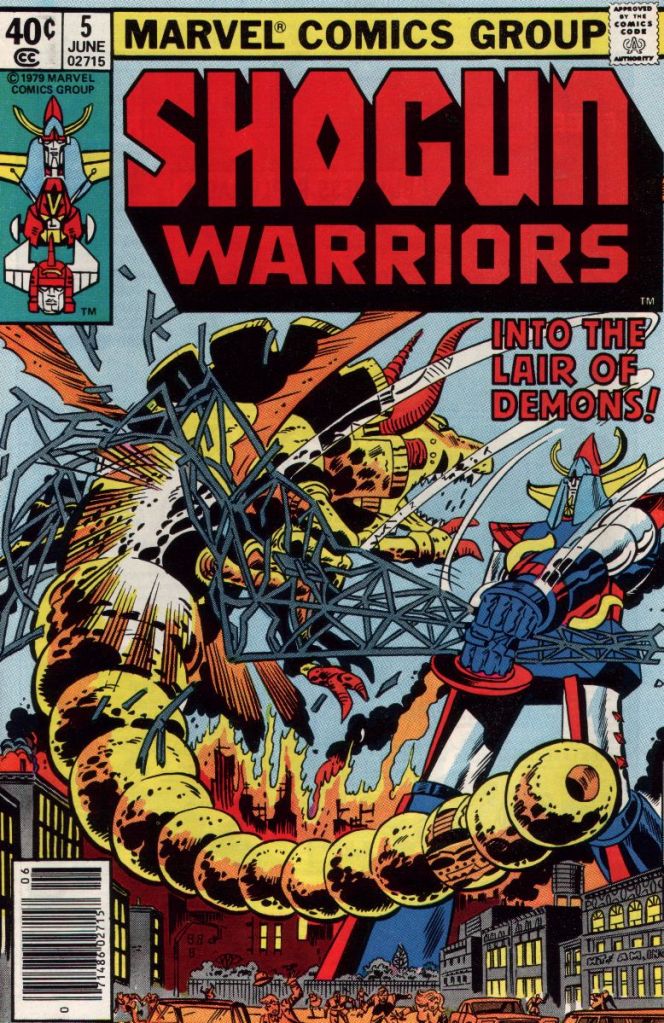
In the late 1970s, the Marvel Universe found itself inundated with visitors from the nation’s toy aisles, as the company licensed property after property in the hopes of landing on another hit the scale of STAR WARS. They wouldn’t quite get there until the one-two punch of G.I.JOE and TRANSFORMERS in the 1980s–by which point, the decision was made (largely; there were a couple of outlier appearances) to treat these comics as not taking place within the canonical Marvel Universe. But in the 1970s, things were loosey-goosey enough that Spider-Man or his friends could almost be stepped on by Godzilla, share an adventure with stuntman the Human Fly, have an encounter with the Micronauts and team up with the Shogun Warriors. As readers in this era, we viewed all of the toy tie-in books as being just as “legitimate” as the main Marvel fare (at least the ones that overtly intersected with the MU in the manner referenced above.)
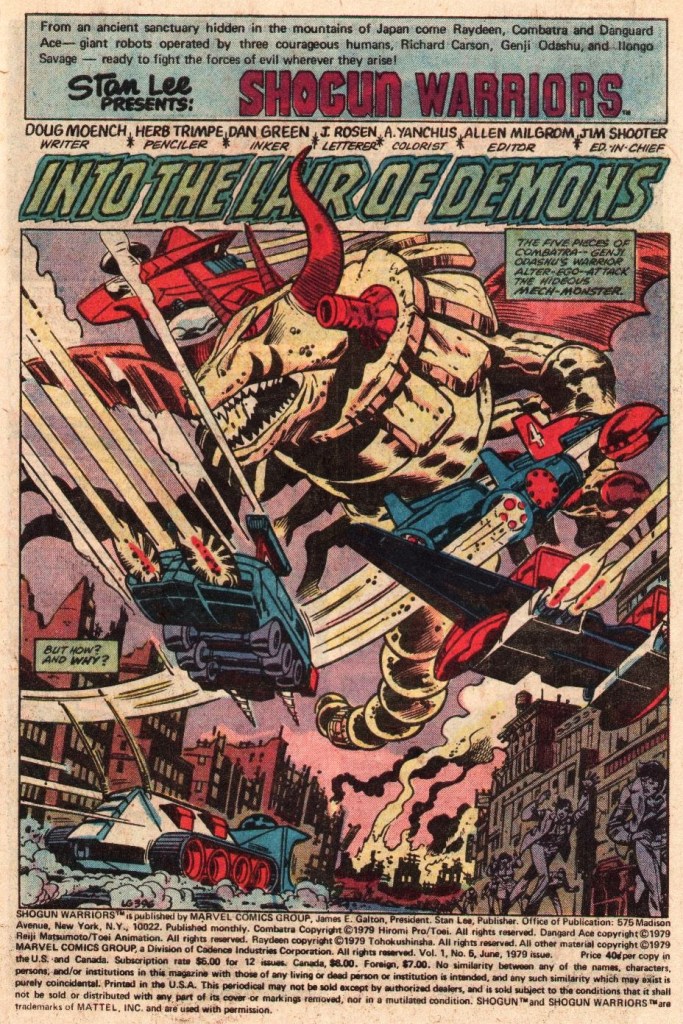
That said, internally, there was still something of a hierarchy among the various assignments that might be undertaken, with Marvel’s flagship series AMAZING SPIDER-MAN and FANTASTIC FOUR at the pinnacle. The toy books weren’t an especially coveted assignment, but the ones that worked lucked out by attracting creators who could invest their stories and premises with the same imagination and legitimacy as any other Marvel book. Writer Bill Mantlo certainly did that on ROM and MICRONAUTS ,and Doug Moench was equally effective in that regard in his work on SHOGUN WARRIORS. It was never an especially deep comic book (given its subject matter, how could it be?) but it evidenced care and craft and was true to itself. There was never any feeling of looking down on the material, or of not feeling the need to be quite so rigorous in the storytelling choices because it was just a dumb toy book anyway.
In these efforts, Moench was aided by the sure, straightforward storytelling of Herb Trimpe. A longtime contributor to the company, Trimpe’s somewhat stiff style had started to grow out of favor with what the fan audience in 1979 was looking for in their comics. The next decade-and-a-half would be an increasingly difficult struggle for Herb to find steady work. But SHOGUN WARRIORS, with its big, blocky robot designs, almost seemed tailor-made for Trimpe’s approach, and his Jack Kirby-inspired sensibilities meant that he always gave the action the requisite Marvel punch. Trimpe was also a reliable professional, and he and Moench remained as the creative team on the title all the way through its 20-issue run.
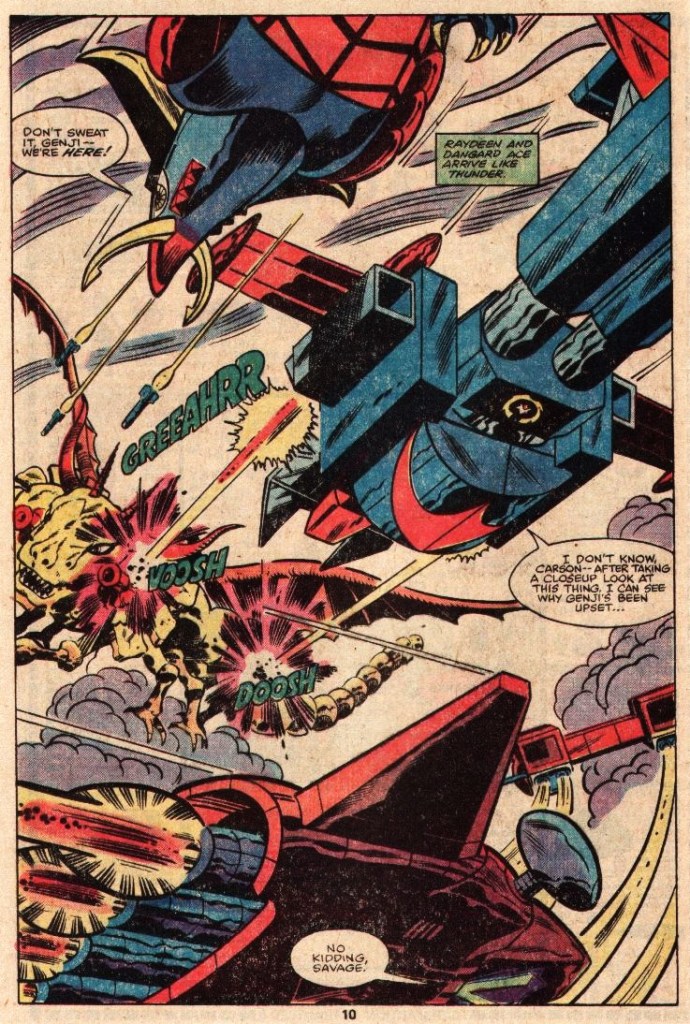
The story picks up where the last one left off: having encountered the strange hybrid of science and sorcery that is the Mech-Monster, Genji Odashu engages in combat with it in Combratra while alerting her fellow pilots of the danger back at the Sanctuary of Light. In order to hold the beast off from trampling through the city of Metrox, Genji split Combatra into its five component craft, the sections not under her direct command piloted by robot drones. But despite all of her efforts, she isn’t able to bring the Mech-Monster down. Things begin to take a turn for the better, however, once her comrades in Dangard Ace and Raydeen show up.
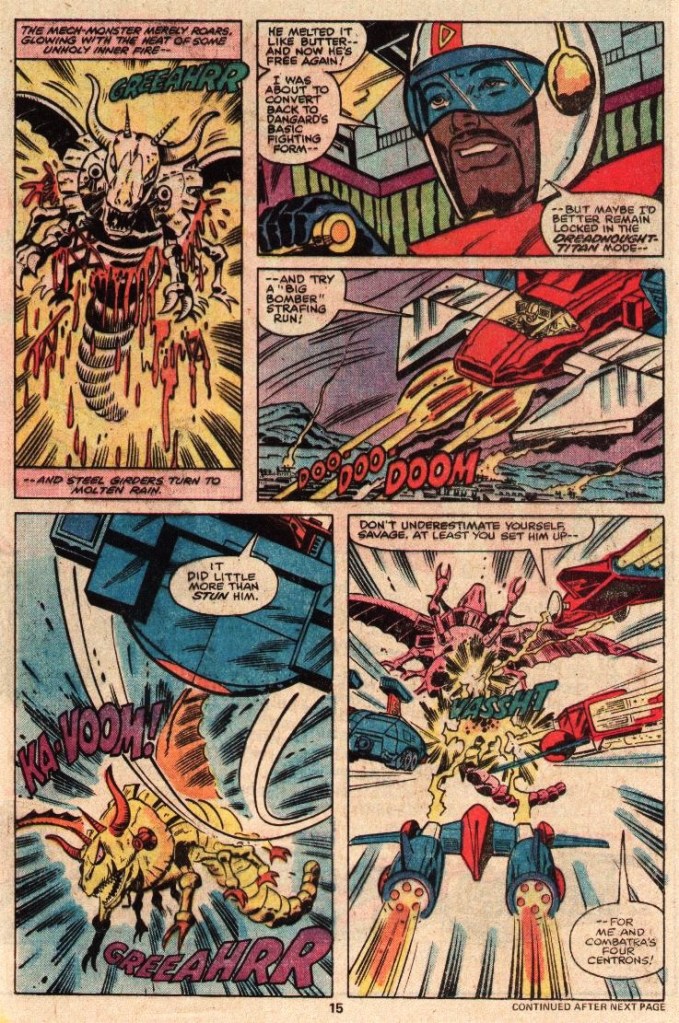
As this is only issue #5, a decent amount of space is taken up illustrating the transformation mechanism of each giant robot as it shifts from a flying dreadnought mode into a conventional robot mode. This transformation was a key play feature of the toys, so it’s no wonder that it was spotlighted so heavily. The now trio of robotic defenders all work in unison to assault the Mech-Monster, but despite their greater numbers and truly horrifying firepower, they still can’t take the creature down.
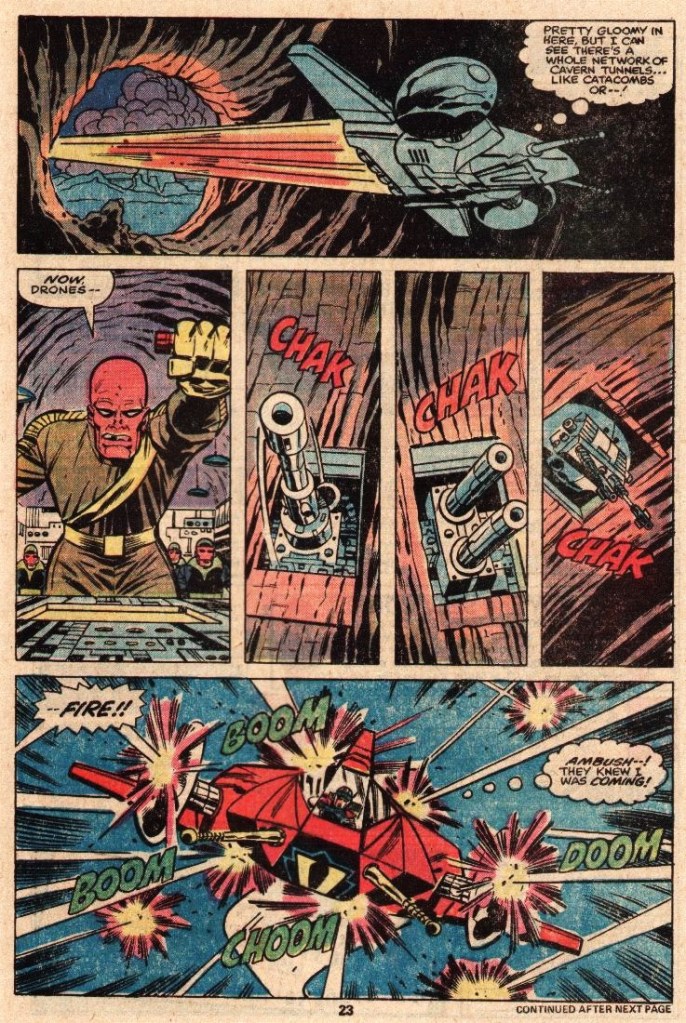
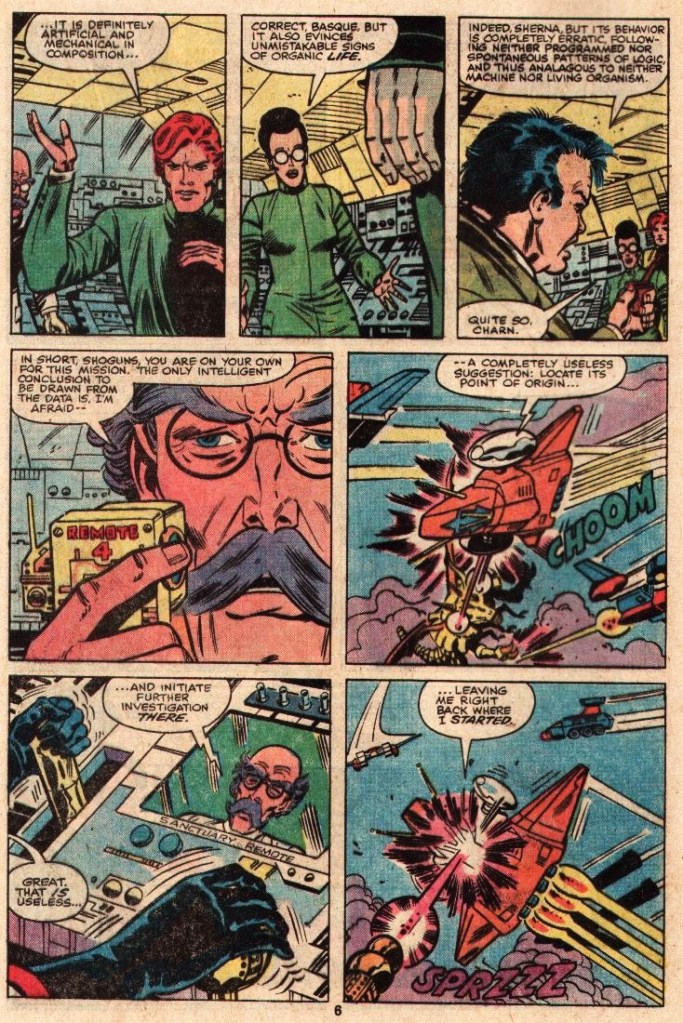
Reassembling Combatra’s five components into a robot once again, Genji has an idea based on a suggestion from the group’s mentor figure, Dr. Tambura. Leaving Raydeen and Dangard Ace to hold the line, Combatra streaks off in search of the origin point of the Mech-Monster, hoping to find a way to recall it. Combatra does soon follow the path of destruction back to the volcanic island from which the Mech-Monster came, but the entranceway into the mountainside is too small for Combatra to enter. So Genji separates her command module Delta V One from the rest of the robot and flies it inside.
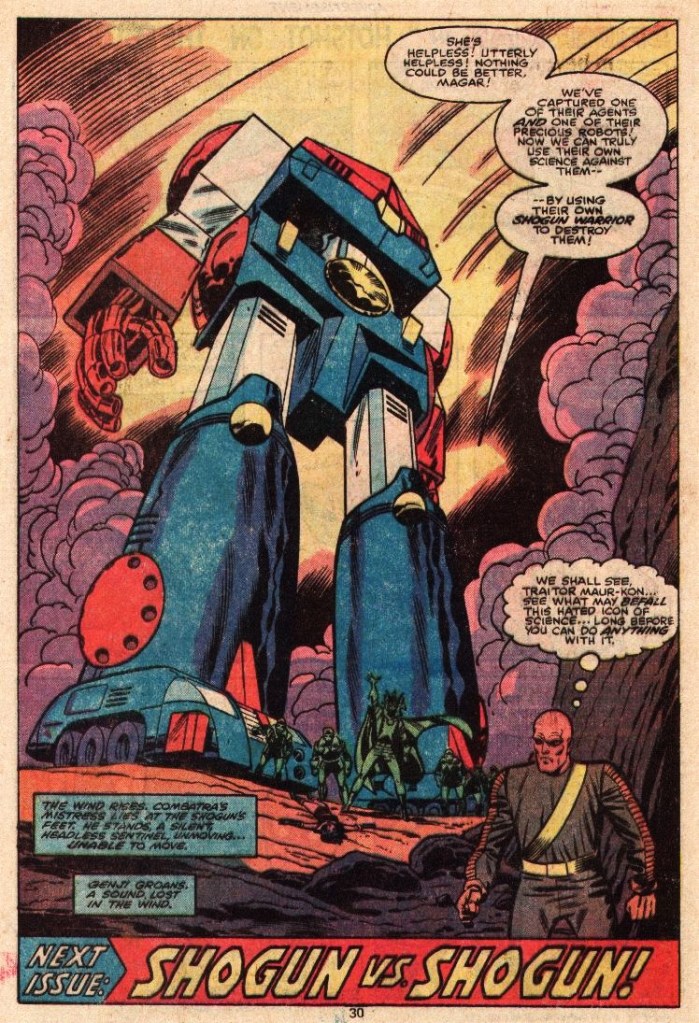
But Maur-Kon’s forces are ready for the intruder, and their defenses shoot the Delta V out of the sky, rendering Genji unconscious. And as the issue ends, with Dangard and Raydeen continuing to fight a doomed delaying action, Maur-Kon and his Followers of Darkness have now captured both Genji and Combatra, which Maur-Kon hopes to turn against the Followers of Light. To Be Continued!
 The Tom Brevoort Experience
I’m sure the rights surrounding Shogun Warriors are thornier than those of Godzilla, Rom, or Micronauts, but I’d love to see a modern collection of this book.
LikeLike
I was never into this kind of toy as a kid nor action figures, but I loved this book. Moench and Trimpe are solely the reason for that. The book might have been based on a toy but you’re right, they made this book as much of a Marvel worthy comic as possible. I was already a big fan of Trimpe, but I think this is around where I became as great a fan of Moench.
LikeLike
At the ripe old age of 14, I was too much of a comics snob to bother with “toy books” (with the exception of Micronauts, where Michael Golden’s art was irresistible). So I’ve never really seen any of these. As you say, it seems to be pretty on par with the average Marvel comic of the era. In retrospect, I’m surprised that big anime robots beating the crap out of each other didn’t prove to be more popular. Perhaps it was just ahead of it’s time, since the “Anime Invasion” didn’t really kick off till the ’80s.
LikeLike
The Mech-Monster is Marvel’s first robot enchanted by magic and its second by Earth-born scientist Lucius Dilby (servant of Doctor Doom ) [ Amazing Spider-Man Annual#14 ( October 1980 ) ] who crafted in the Dark Dimension using mystical powers granted by Dormammu a giant super strong robot which was resistant to most forms of magic, couldn’t be detected by defensive magic wards and would shatter all spells and magical constructs it came in contact with ( see marvunapp.com ).
LikeLike
I bought this and GODZILLA regularly, not because I was all that interested in them, but because they were part of the Marvel Universe and I was buying all the MU superhero books. So what was another 80¢ per month?
My thought, at the time, was that there were two Doug Moenches. The guy who did sophisticated stuff in MASTER OF KUNG FU and the guy who did meat-and-potatoes stuff here. And I liked them both, more or less. I thought the same of TOMB OF DRACULA Marv and NOVA Marv.
A little later, when Doug was writing FANTASTIC FOUR, I would gripe, “No, no, no! We need SHOGUN WARRIORS Doug for this book! Not MOKF Doug!”
LikeLiked by 2 people
There are no doubt different expectations for certain properties, but I think the Moench /Sienkiewicz/ Sinnott Fantastic Four run is perhaps a decent case study that very talented, capable creatives on a title can still miss the mark with good intentions. To be fair…it’s been many years since I read those issues, but I recall it as a somewhat dreary stretch of issues between the pretty good Wolfman/Pollard run and pretty great John Byrne run. Still love Doug M. and Bill S. as a team and apart though.
LikeLike
You can imagine what the editors must’ve been thinking: “Hey, Moench and Sienkiewicz are doing great things with this marginal character Moon Knight. If we put them on one of our flagship titles, they’ll do even better!” Alas, not so much.
LikeLike
The editors might also have been thinking, “Yow, Marv quit! Who’s got time in their schedule? Who’s under contract?” or “Yow, we just canceled SHOGUN WARRIORS! Doug needs another book, what’s open?” to “If we don’t get this Sienkiewicz kid a regular book, he’ll be drawing BATMAN in a couple of months. What’s open?!”
Sometimes it’s not about putting the perfect creator on the perfect assignment, but matching up people who need work with books that need pages filled and figuring out the best way to proceed long-term later.
LikeLike
Some creators just don’t work on some books. Much as I like Wolfman’s work, I hated 90 percent of his Superman stories, for instance.
LikeLike
I read and enjoyed Godzilla, Human Fly and Micronauts but for reasons I cannot remember missed out on Shogun Warriors. My loss, as I love giant robots fighting monsters on principle.
LikeLike
I get why there might not be a Shogun Warriors & Godzilla cross-over, but that didn’t mean that Godzilla’s supporting cast couldn’t have appeared in the Shogun Warriors: Dum Dum Dugan’s Godzilla Hunters/Busters could have lost track of him and heard about a Kaiju battling 3 giant robots and went to investigate. The Kaiju in question could be one that need at least 4 giant robots to defeat it, so enter Red Ronin ( & Rob Takiguchi ) and the S.H.I.E.L.D. Behemoth helicarrier. When Marvel announced Godzilla’s temporary return to the Marvel Universe it never occurred to me to suggest that the Big G battle Marvel Kaiju too ( Same day I thought of it I later saw a cover of him battling Fin Fang Foom ). To bad Godzilla doesn’t get to battle his Atlas Age prototype “Pre-History” ( a mutated dinosaur that appeared before Godzilla ) [ The Human Torch#36 ( April 1954 ) Human Torch second story — see profile at marvunapp.com ], who could either be a clone or saved by the Deviants or Time Travelled.
LikeLike
Dan Green was a good inker for Trimpe. Trimpe’s work looked much different with the right inker (Green, the Severins) who kept the power of it but provided more of (I don’t know) a professional finish (for lack of a better term),
I can’t be too hard on Trimpe, he was an Air Force Neurologist who served with 1st CAV in Vietnam. (I worked with those guys in the Gulf years later.) He also became a teacher in later life and was the Deacon in the Episcopal Church in New Palz, NY. A very involved guy in the community.
It’s funny, when they were both starting out, Trimpe’s art had some similarities to a younger contemporary or his, Barry Smith.
LikeLike
“Metrologist” some one who worked for the US Air Force Staff Weather Officer (“SWO”).
LikeLike
I See it as the Kirby influence TBH.
LikeLike
I agree.
LikeLike
When Marvel destroyed the Shogun Warriors robots in flashback [ FF# ] they could have created a new class of giant robots to keep the characters/concept active in the Marvel Universe even if they never got a series. So I Googled Japanese word for Warrior hoping that would help me give Marvel a new group name, only to find a potential name for one of the new class of robots: ( From Google ) Yes, YASUKE is widely considered the FIRST BLACK SAMURAI in Japanese history. He was an African warrior who served Oda Nobunaga, a powerful feudal lord during Japan’s Shengoku period. While details about his life are sparse, Yasuke’s status as a samurai is supported by historical records and the fact that he was granted a sword, a house, and a stipend, common privileges for samurai. Yasuke is pronounced YAH-suh_keh. Female samurai are known as Onna-musha or Onna-bugeisha ( Google ). Unfortunately there aren’t enough Shogun Warriors pilots to be given this name — CELESTIAL WARRIORS ( SHICHI SEISHI ) also known as Seven Star Warriors, refers to the 28 servants of the Four Gods who guard a nation. Each god divided up the sky into four equal quadrants, and the twenty-eight warriors are divided into seven ( Reminds me of how the Green Lantern Corps operates ).
LikeLike
Forgot to add Fantastic Four#226 ( January 1981 ) as the flashback issue for the Robots destruction, by Doug Moench and Bill Sienkiewicz. I guess like Marv Wolfman with Nova, he wanted to finish his series in FF too. Plus I forgot to use the Thunderiders ( formerly Team America — weren’t they toys too ) as an example — renamed in Captain America#269 ( February 1982 ). Never bought the series.
LikeLike