

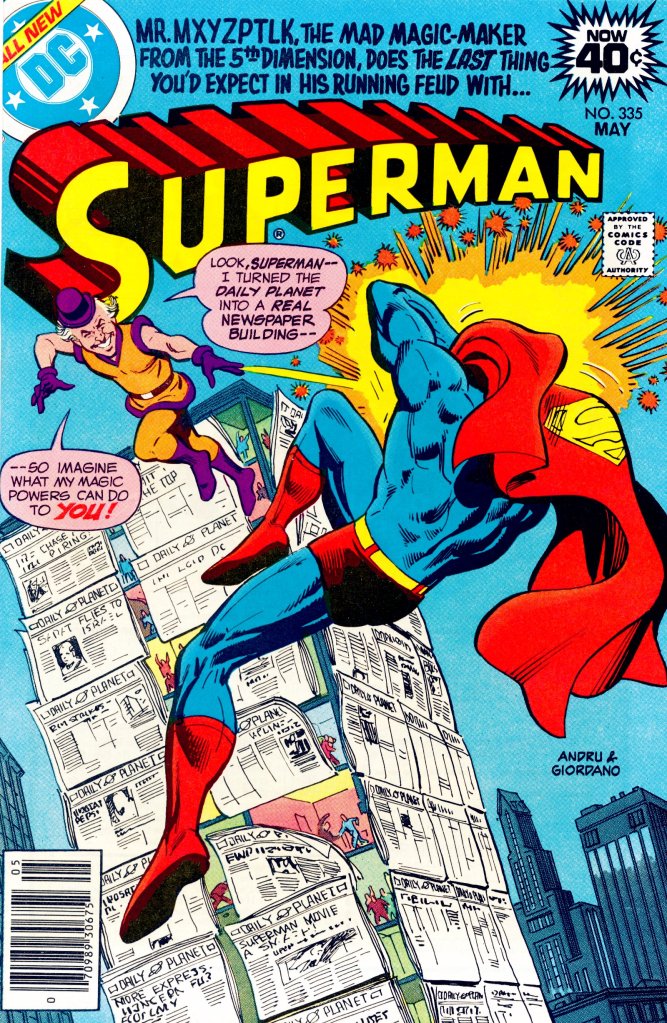
DC in the late 1970s had a bit of a problem, one that they’d start to correct for in the coming years. And that was the changing make-up of the primary audience for comic books. People at DC had realized that there were more older readers than had generally been thought–up to this point, the prevailing wisdom was that the audience was primarily 6-10 year olds–and they wanted to capture that audience. But they were also very set in their ways about how their comics should be done and what was appropriate for them. In other words, they didn’t want to do anything that might strain a 6-10 year old reader’s mind and cause them to fall off. Consequently, you wound up getting stories like the one in this issue of SUPERMAN. It’s overtly a bit of silly nonsense, but it’s sprinkled with an assortment of slightly more sophisticated ideas along the way. But not enough to appeal to the slightly older 11-14 audience that Marvel had been courting for a decade and a half, and which made up (with the older “lifer” fans of the era) the readership of the just-opening Direct Sales market that would prove to be comics’ future.
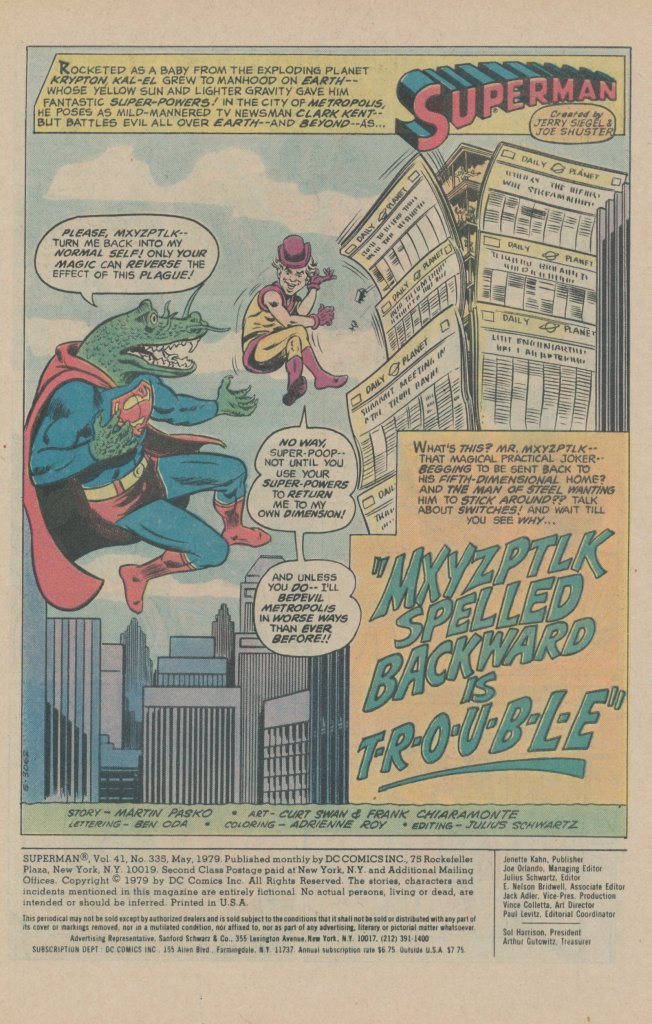
Editor Julie Schwartz and his creators had grown used to putting out a very consistent product. Every issue looked and felt like every other issue, and consistency was the watchword. Additionally, while there were now some small hints of soap opera, in general each story was a self-contained unit hat carried no impact on the stories that came after it, apart from the occasional return of a particular villain. The whole enterprise was aimed at a juvenile audience. And, still instinctively flinching from the watchdogging that had almost lead to the demise of the industry in the 1950s, the stories were most often about characters solving intellectual puzzles rather than winning out through physical force. At DC, fight scenes weren’t story, and action was more about color than excitement. This was very much in opposition to what Marvel was doing, where whole issues could be extended fight scenes with no real plot to speak of and the audience ate them up, attracted by the emotionalism of the characters and the quasi-intensity of the situations they were put into. In essence, DC stories of this period were about reason and Marvel stories were about emotion. And emotion was winning.

The result of this is that the young readers of the period began to voice their preference for the more quasi-adult material that Marvel was putting out. Even among kids who weren’t regular comic book readers, on the playgrounds across America, the common wisdom was that DC was for babies and little kids, whereas Marvel was cool. It’s not as though Marvel’s output was especially sophisticated during this time, most of it, but there was a feeling that the Marvel stories were meant to be taken seriously, and every 11-year-old in the world wants to be treated as a grown-up. If Marvel books were “supposed” to be read by college students, then they were definitely preferable to a Tween reader than DC’s outmoded stories. Editorially, for a good portion of the 1970s, DC’s staff didn’t try at all to meet Marvel where they lived. The feeling was that Marvel was a flash-in-the-pan, and that the tried-and-true approach of targeting the youngest segment of the audience would prove to be the better option in the long run. Even after Marvel’s sales eclipsed their own, DC was slow to adapt, slow to change. And at a moment where their flagship character was about to enjoy a moment at the center of pop culture thanks to SUPERMAN THE MOVIE, their creative output was ill-positioned to take advantage of the renewed interest in the character.

This story is a good example of the sort of institutional nonsense that tended to come to the fore in the Superman adventures of this period. It’s a Mr. Mxyzptlk story in which the Superman foe finds himself exiled to the 3-dimensional world for crimes against good taste back on his native Zrfff. This is a real problem for Mxy, as he was just about to marry the woman of his dreams, Miss Bgbznz (which I presume is pronounced “Miss Bigbusiness”). But even speaking his name backwards won’t return him home this time. Realizing that the only person who might be able to help him is is whipping boy superman, Mxy decides to draw the Man of Steel to him by engaging in his typical sort of mischief.
But Superman has other problems of his own making. Having renewed his relationship with Lois Lane, he’s contemplating marriage to her. But knowing that she’d be in constant peril from his enemies, he decides that (despite having failed at this in the past) he needs to find a way to give his prospective bride super-powers similar to his own. To this end, he’s experimenting in his Fortress of Solitude with a crocodile-like creature from a Red Sun planet similar to Krypton. But at a key moment, the beast’s super-powered jaws slam shut on the Man of Tomorrow’s hand, breaking the skin and injecting Superman with its venom. The effect is pronounced. Superman himself begins to transform into a similar crocodile creature, and as he does, his assorted super-powers all begin to wane. So he’s not really in great shape to be of much help to Mr. Mxyzptlk. That is, unless the two can be helpful to one another.

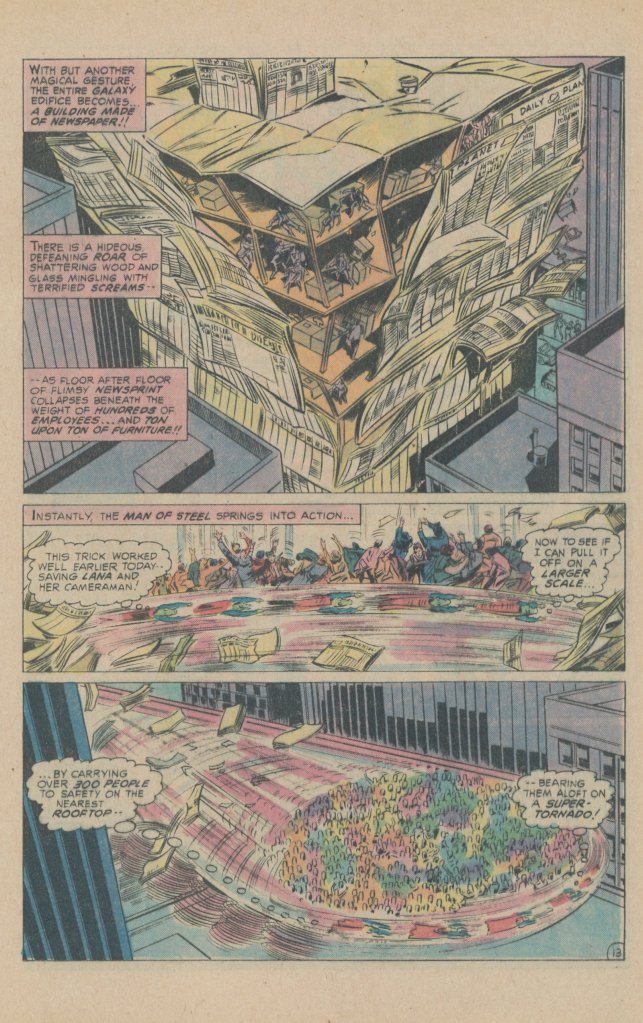
Concealing the fact that his powers are slowly draining away from him, Superman proposes a deal: if Mxyzptlk will cure him of the crocodile malady, he’ll help him get back to Zrff. But Mxy doesn’t trust Superman and insists that the Man of Steel carry out his part of the bargain first. But Superman is no more trusting, so the pair is at an impasse. Mxy loses his temper at this point and tells Superman that he’ll force him to help just to get rid of him–and he promptly turns the WGBS Building into newspaper. Superman has to hustle at superhuman speed to rescue all of the people within the collapsing structure. As a ploy, Superman steers into his horrific appearance and threatens to straight up murder Mxy, and the sorcerer quickly explains what his trouble is. Superman uses his telescopic vision to peer into the 5th Dimension–and wouldn’t you know it? Mis Bgbznz is about to be struck by a car!

To save his lady love, Mxyzptlk uses his magic to restore Superman to normal. But that whole telescopic vision thing was a trick by Superman–he’d already lost his telescopic vision by that point but was hoping he could trick Mxy into helping him. And just at that point, Mxyzptlk finds himself zapping back to Zrff. Turns out that a condition of his exile was that it would be lifted were he to use his magic unselfishly, as he did when he restored Superman to save Miss Bgbznz. So all’s well that ends well. Superman tells Lois that he’s giving up on trying to give her super-powers. And in Zrfff, after their wedding vows have been exchanged, Mis Bgbznz reveals that she’s actually a homely little thing who was using her own magic to ensnare Mxyzptlk into marrying her. So the whole story is sort of dopey and ridiculous, but fun in its own way. But it would have been a tough story to defend on those same playgrounds in an era when STAR WARS and its offspring were defining what “cool” meant.
 The Tom Brevoort Experience
Judging from the detail Swan put into Superman’s reptilian transformation, he did seem to enjoy this rare opportunity to go off-model!
LikeLike
The small print tells me I was eighteen when I read this and even though a legal adult, I still enjoyed books like this. I did and always will prefer Marvel to DC but back then it was basically two Marvels to one DC in my pile any given week. (I don’t think DC’s classic heroes should be as dark as they sometimes make them these days so some weeks it’s all Marvel now) Maybe because I wasn’t a kid I didn’t need every book to be more adult themed. I just know not all of us abandoned DC because of Schwartz and others’ keeping older standards and styles alive.
LikeLiked by 1 person
What you said. And I always have a soft spot for the Zrffian imp.
LikeLike
I have this one! I was 11-12 at the time and I remember enjoying it. My only complaint – which remained in place for several years – was Frank Chiaromonte inking Curt Swan. Chiaromonte was a fine inker but I never cared for how his work looked with Swan’s.
LikeLike
That cover is bending over backwards to maintain the mystery of what Superman is transformed into… but it visually reads like he doesn’t have a head. The giant newspapers covering the building don’t work either… it just looks like Superman and Mxyzptlk are fighting around a normal sized kiosk despite the word balloon saying what it is.
LikeLike
I agree. DC comics had plots. Marvel’s were just extended fight scenes. DC appealed to readers who appreciated that sort of nuance.
LikeLiked by 1 person
It would have worked better had they aimed those plots at even a slightly higher demographic. I did enjoy most of them but the visceral excitement of Marvel’s books as well as the likes of Englehart, Gerber, and others raising the bar story wise overall made Marvel more interesting.
LikeLike
I dunno… Marvel had been using subplots more consistently than DC for about 15 years at this point, and that gave their books an extra layer of story imo. Their books emphasized melodrama and action to resolve a conflict over a tricky gimmick….but I don’t think they were just extended fight scenes. I get the appeal of this Superman story for a younger reader, but its pretty daffy compared to what would have been happening over in Daredevil, Fantastic Four, Spider-man, Ironman etc. circa May 79.
LikeLiked by 1 person
Also, Marvel had the continuity thing going, which DC couldn’t get the hang of in the 1970s. Every story at Marvel, no matter how mediocre, could be mined to have some place in the company’s ongoing palimpsest (cool metaphor, yes?) The Hijacker and the Leap-Frog might still not have a very BIG place in subsequent appearances, but the sense of a Marvel Universe also gave a sense of something new and different in the world of entertainment– which is still pretty impressive even when you’re not a kid anymore.
LikeLike
Contrary to d9dunn, DC had plenty of continuity. If anything, one of the standard complaints from disgruntled fans at the time was that DC was bogged down by too much continuity.
LikeLike
So Superman had already lost his Telescopic Vision: Question for those who might know, did the Pre-Crisis Superman’s Telescopic Vision enable him to see into other dimensions? Cause if it did, then it was an Extrasensory Perception known as Remote Viewing ( a.k.a. Telesthesia or Remote Sensing –The ability to see a distant or unseen target using extrasensory perception —see Wikipedia — List of psychic abilities ).
LikeLike
Clark lied about still having telescopic vision AND about what it could do.
LikeLike
I forgot to add the lying part ( I did catch Tom writing that ).
LikeLike
In Superboy and the Legion of Super-Heroes#243 ( September 1978 ) on page 14 Superboy, Mon-El and Ultraboy focused their Telescopic Visions on coordinates 6 light years away from Webber’s World the last known location of the Legion Craft Brainiac 5 was in ( in real time ). 6 Light Years means it takes 6 years for the light to reach Webber’s World, so shouldn’t that mean the 3 of them would be seeing what happened at those coordinates 6 years ago ( Light from our Sun takes 8 minutes to reach us — meaning we are looking at it in our past ). So for those 3 Legionnaires to see 6 Light Year distance in real time they have to be using Remote Viewing and not Telescopic Vision ( which would be limited by the speed of light ).
LikeLike
I’d say it’s better to think of the names of the superpowers as concise metaphorical labels for what they do, as opposed to any sort of literal descriptions of their mechanism. “I have telescopic vision” is a way of saying he can perceive very distant events, not that his eyes have big lenses in them like a telescope. Nobody would understand “I have directional clairvoyance”. My favorite here is “superventriloquism”, which is a goofy name for a very underrated power. It’s something like “I can do some minor telekinetic manipulation but to such a fine-grained extent as to replicate a voice.”.
LikeLiked by 1 person
I think of Superman’s powers as working by a kind of symbolic logic. I can blow out a birthday candle, he can blow out a forest fire. I can see across the street, he can see across the galaxy.
LikeLike
I never go Superventriloquism, since in the real world Ventriloquist don’t really throw ( teleport ) their voice to some other location, they are basically vocal magicians experts in the art of vocal misdirection ( a.k.a. creating the illusion that the dummy is actually talking when in reality the sound is still coming from their own mouth which isn’t moving it they are really good ). Me, I would have kept either face changing ( Cause that would explained why no one even while wearing glasses, recognizes that Superman and Clark Kent are the same person. I know from the current movie that it is also larger size clothes and less heroic stance that sells that they are different ) and losing the full body changing. Me, I would give Superventriloquism to Steel ( John Henry Irons ) who’s armour would fire a tiny dart like device that he could speak through.
LikeLike
IMHO DC barely reacted to Marvel throughout the 60s & 70s. They got close during the DC Explosion but the Implosion did away with that. Not until New Teen Titans would they try again.
LikeLike
Last issue of Marty’s regular run on the book.
Next month: Len Wein!
LikeLike
I liked Marty Pasko’s work on this Superman run,. That was just before he started to sell more to TV in 1989 or so?
I thought his script on Kobra #3 was a nice solid and subtle bit of work. It was an early Keith Giffen penciling job. I also liked his work with Simonson on Metal Men; some clever ideas like The Responsometers were essentially constantly creating their own circuits on an atomic level.
Talented guy, unfortunately he passed away sat a fairly young age.
LikeLike
Should be “1980: not “1989” of course.
LikeLike
I generally agree with your sentiments although I did enjoy the soap opera exploits of Clark Kent and his supporting cast, which seemed as detailed as Spider-Man’s at that point. The only trouble for me was the lack of exciting challenges to Superman. I liked the fact that Superman used his brains as well as his brawn, but his villains never seemed like that much of a threat to the Man of Steel. That didn’t really change in my eyes until the Marv Wolfman/Gil Kane run on Action in the early ’80s.
LikeLiked by 1 person
That Gil Kane/Wolfman run was cool. Kane was 40+ years into his career at that point and still dynamic.
LikeLike
Not just “still,” but even more dynamic than he’d been earlier in his career. Gil paid attention to what was going on in comics art and was always trying to get more and more dynamic in his storytelling…
LikeLike
Well true… I recall that Kane cover with Superman’s fist raised having a similar impact as Simonson’s Thor relaunch. Kane was a dramatic artistic change for the character. I also loved his work on Sword of the Atom.
Kane was obviously a big inspiration for Frank Miller who had achieved no small success at the time… I presume that might have had some impact on Kane who was at a different point in his career in terms of regular assignments.
Much as I love his self inked work though I still prefer his work inked by Janson. What If #3 is a particular favorite.
LikeLike
I think Kane doing shorter runs on things in the 70s and 80s was like due to his own choice, rather than the market not being interested. He was always looking to make more money — he had multiple alimonies to pay — so he’d jump from project to project if it offered what seemed like a lucrative deal. And of course, he did STAR HAWKS in the middle of that.
I don’t know if he’d have settled in on a long monthly run of something in the 80s if someone sat him down and said, “Look, Gil, the royalty deal means that if you get on one well-selling book and stay there, you’ll do better than if you bounce all over the place.” But I’d like to have seen them try.
It’d probably have had to be at Marvel, though, because almost everything at Marvel paid at least some royalties, but nowhere near as many books at DC did. And the top-selling books at DC were spoken for.
LikeLike
I certainly would have enjoyed seeing Kane come back for a long run on Spider-Man or Captain America in that era. Or just about anything, really.
LikeLike
If he wanted sizable royalties, he’d have been best off at that time on One of the Spider-Man books (AMAZING well outsold SPECTACULAR, but I think Kane as regular on SPEC would boost it pretty well), CONAN (which he did some of), STAR WARS or AVENGERS. Though since AVENGERS was a team book, it’d have been more work.
I don’t know if Shooter would have tried to rein him in — they made a great team, albeit briefly, on DAREDEVIL and a WHAT IF they did, but Jim’s pushes to draw things his way eventually pissed off even as clarity-minded an artist as Sal Buscema, so there might have eventually been some friction there
If he wanted the really big money, it’s interesting to think about him taking over X-MEN instead of JRJr. A lot of work, but very well-paying work, that turned into something of an annuity once there were lots of TPBs in print. I don’t know if it’d have worked — I don’t think Claremont and Kane ever worked together, so it’s hard to imagine what that would read like. But I guess his office scenes at the Daily Planet might be a good basis to imagine what his character scenes at the X-Mansion might have been like.
LikeLike
My understanding is there were no creative conflicts between Shooter and Kane whatsoever. Kane had what Howard Chaykin described as “ethics” problems. Things like rampant invoice fraud and stealing original art out of the offices. By 1982, his days at Marvel were numbered because of the former, and after a particularly egregious example of the latter, he was blackballed. Shooter went to bat for Kane for as long as he could–I gather he had a lot of affection for Kane personally–but CFO Barry Kaplan and publisher Michael Hobson eventually said enough. Kane was never shy about criticizing editors and other creators in interviews, but he never had a harsh word to say about Shooter. Even Kane’s BFF Gary Groth couldn’t get a complaint out of him, and I’m sure it wasn’t for lack of trying.
LikeLike
Also, between 1983 and 1989, Kane made most of his money working in animation. He only did comics when there was an opening in his schedule.
LikeLike
Of the Marv Wolfman & Gil Kane stories I got ( Action Comics#544-546 ( June-August 1983 –New Brainiac ), #551 ( January 1984 ), #552-553 ( February-March 1984 – Forgotten Heroes ) ), I enjoyed these Superman stories. I wouldn’t mind seeing a G-Men/Forgotten Heroes team-up.
LikeLike
I like the way Mister Mxyzptlk looked ( based on the Golden Age Superman#30 ( September-October 1944 ) Mr. Mxyztplk original spelling ) in Superman: The Animated Series ( WB ) voiced by Gilbert Gottfried. I like the WB version of the character. In the episode “Mxyzpixilated” he had a hot redheaded wife named Gsptisnz ( Gez-pit-lez-nez ).
LikeLike
His Silver Age girlfriend, IIRC. If I’m misremembering, someone here will know, I’m sure.
LikeLike
Miss Gzptisnz ( nickname Gizpie ) [ Superman’s Pal Jimmy Olsen#52 ( April 1961 ) & last appearance in Superman’s Girl Friend Lois Lane#73 ( April 1967 ) ]. Also appears in Superman’s Pal Jimmy Olsen#65 ( December 1962 ) 2nd story “The Human Porcupine” ]– dc.fandom.com & comics.org.
LikeLike
“…the common wisdom was that DC was for babies and little kids, whereas Marvel was cool…”
It’s funny how within less than a decade that dynamic had flipped and, for a brief period (1986 to roughly 1990 or so), DC was the hipper, more sophisticated option garnering all of the popular press and defining the zeitgeist within the medium.
(My contention is that DC from 1986 to 1990 was the equivalent of Marvel from 1961 to 1970: a concentrated explosion of talent at one company pushing the medium forward after a decade or so of mediocrity)
LikeLiked by 3 people
I think Marvel lost some of its coolness factor when Shooter decided to emphasize superheroes more than anything else (though toy adaptations might run a close second). In contrast, DC had built up a sort of sub-universe of “DC Gothic” throughout their seventies horror titles, whereas Marvel couldn’t seem to get into that groove with all their character-based horror-titles. DC Gothic was arguably primed to lead to the Various Visions of Vertigo, and Marvel wasn’t able to follow DC there either, even while they had Frank Miller doing his best work in the 80s and 90s.
LikeLike
It’s ironic that this issue is the last in Pasko’s regular run, because even though it apes the silliness of the sixties, Pasko had garnered a dollop of fame for having done a slightly more adult version of Superman– using stuff like a Toyman who killed, or Superman allowing a woman to embrace her death rather than him miraculously restoring her to full health. (Kal Kevorkian, anyone?) But then, slightly later there was some convention, whose transcript the Journal reprinted, where Pasko was on a panel and said that he wouldn’t do that sort of thing again in SUPERMAN. Though I guess Julie deserves credit for briefly getting out of his comfort zone for those handful of “risky” Pasko stories.
LikeLike
Also I have the dim and unimportant memory that in Mxyzptlk’s only episode of the Filmation SUPERMAN cartoon, the imp calls the hero “Super-poop” there as well. I assume the writer was referencing “party poop,” and wasn’t thinking of the other potential meaning.
LikeLike
this comic came up somewhere in last few months somewhere else online. I said “another not in 2025” story given the twist.
LikeLike