

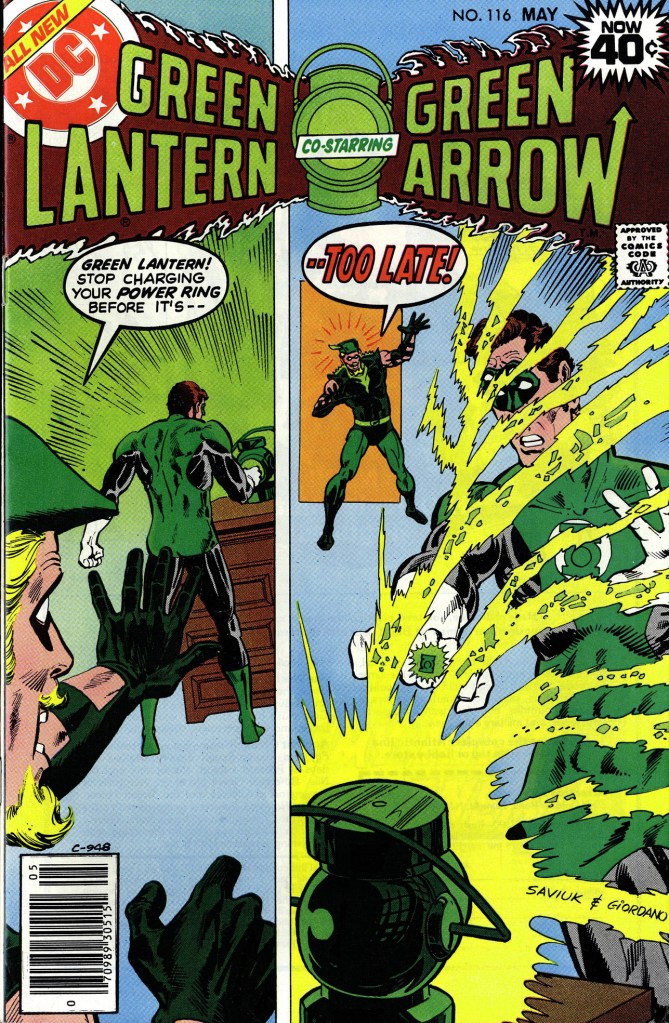
My memory of things is that GREEN LANTERN entered into a bit of a doldrums as a series at about this time, one that held on at least until Green Arrow was given his eviction notice from the series and really up until Marv Wolfman began to write it a couple of years later. It was still a title that I bought every issue, since I loved the character, but it was hard to work up a lot of enthusiasm for the stories in this period. We’ll see if I still feel that way today as we get into things.

While he’d garnered a lot of positive attention for his work on the earlier relevance stories he and Neal Adams had done together, it’s fairly apparent that writer Denny O’Neil didn’t especially feel any sort of close connection with his title character. It was clear that he much preferred to be focusing on the titular co-star Green Arrow as well as the archer’s lady Black Canary as they dealt with more worldly situations and concerns. But I suspect that Denny was sort of stuck here, both by the need to make a living (which kept more than one writer working on assignments that they didn’t really care for) as well as by reputation. The sort of science fiction adventure that had been the character’s bread and butter for so long wasn’t really what O’Neil liked to focus on.

This issue opens in the middle of the action as Green Lantern and Green Arrow attack a flying spy-eye robot dispatched by the villainous Professor Ojo. Hal attempts to strike it down with his power ring, but his attack boomerangs on him, almost killing him. This isn’t he first time in recent issues that his power ring hasn’t worked properly, and both he and Green Arrow are concerned in the aftermath. Hal intends to journey to the planet Oa, home of his bossed the Guardians of the Universe, in the hopes that they can determine the problem. Green Arrow isn’t a fan of this plan–and he has a point, why not simply call the Guardians rather that risking your life in an interplanetary space flight where your ring might conk out at any moment. But Hal is both fearless and brainless, so he resolves to do things his own way. But in order to not leave the Earth defenseless, he takes an unprecedented step before he sets of.

The next morning, Ollie goes to awaken Hal for breakfast. But entering Hal’s room, he sees a vision of the Emerald Crusader charging his power ring, and being obliterated by a backfire from the power battery! Shocked and stunned by what he has just witnessed, Ollie is in no mental condition to cope with the arrival of a newcomer, who walks in as though he owns the place. This is Guy Gardner, who had been introduced years before as a potential alternate Green Lantern. With his mission to space, Hal has activated Guy, called him up for duty, and apparently told him Green Arrow’s secret identity as well so that his archer friend can school Garner on the finer points of being a super hero. Not cool, Hal. Modern readers would find very little recognizable about the Guy Gardner of this era, as he hasn’t yet been cast in the image of a gung-ho reactionary loudmouth. Instead, he’s a perfectly reasonable Phys Ed teacher who also happens to be fearless and honest.

Guy and Ollie hit the streets in pursuit of the eye-robot from the other night, intending to track it back to its source. They find it quickly, but Guy is inexperienced with his ring and green Arrow’s shafts have little effect, so they’re unable to down it. Meanwhile, off in space, Hal finds himself crashing down on what appears to be the wrong planet, his ring having screwed up on him again. After waling across the desert for several hours, though, he’s pulled into a disguised stronghold and learns that he’s actually in the right place, Oa. But with his ring malfunctioning, the Guardians diverted him to a place where nothing would be damaged should the worst happen. They hear Hal’s report, then disassemble his ring in search of the problem. The ring itself works perfectly, but it’s the energy charge from his power battery that’s being warped. Hal theorizes that this must have been the result of recent foe the Crumbler having handled the power battery with his corrosive touch. The Guardians provide Hal with a replacement battery and send him on his way.

Back on Earth, Green Arrow and Black Canary are bonding with their new friend Guy Gardner. Ollie feeds him some of his awful chili and Gardner swiftly begs off, desiring to return to patrol for the eye. He feels he has something to prove. And on his own a short while later, he comes across the thing and downs it in a sneak attack before the drone even knows that he’s in the area. Meanwhile, Hal has returned from space, and he fills in Arrow and Canary about what he’s learned. Ollie takes this opportunity to tell Hal about he vision he saw of Green Lantern being disintegrated while recharging his ring–at what they now know is the corrupted power battery. With a sinking feeling, Hal races to where he keeps his battery.

But Hal is too late. Flush from his victory, Guy has begun to charge his power ring at the flawed battery, and he is instantaneously disintegrated by its backfire just as Green Arrow saw. It’s a horrifying moment, especially given that it’s merely an accident of circumstance, that there isn’t anybody to blame for it. But Guy Garner is dead nonetheless. It seems weird for O’Neil to have brought Guy into the story only to kill him off in the same issue–feels like maybe editor Jack C. Harris or somebody wanting to clear the decks of a complication (albeit one that hadn’t been seen in years at this point.) Either way, it isn’t much of an issue: Green Arrow and a replacement GL tangle with a faceless flying drone while Green Lantern gets a 100,00 mile check-up on his gear. As I said at the beginning: doldrums. Matters wouldn’t improve much in the coming months.
 The Tom Brevoort Experience
Looking back, I realize I never cared for O’Neil’s writing one bit. Add to how much I dislike Green Arrow I was like you back then: Buying it because I had always bought it. The point to Guy’s temporary case of death could have been to set up Hal looking like a total jerk for going after Guy’s grieving girlfriend maybe?
LikeLiked by 1 person
Wow. I had the same realization about O’Neil’s writing a few weeks ago when I was having trouble getting into the new GL/GA omnibus. I read all of these issues as a kid and enjoyed them, but upon further review, I am finding the work of his contemporaries to be much better. Can’t put my finger on exactly why that’s the case.
LikeLike
I was never a huge Denny O’Neil fan either, except for The Question. I recently re-read that in the omnibus collections, and that work holds up surprisingly well (it didn’t hurt that Denys Cowan was growing at an exponential rate as an artist in real time). But that could also have been editor Mike Gold’s influence (other than The Flash reboot (which I also just re-read in the recent omni, and which does not hold up at all), most of the mid-1980s DC reboots that Gold edited (Grell’s Green Arrow; Chaykin’s Blackhawk; Truman’s Hawkworld; O’Neil and Cowan’s Question) are still really, really good).
LikeLike
Yeah, I’d say there’s next to no doubt that O’Neil re-introduced Gardner for the purpose of a new soap-operatic plot. Kari Limbo debuted in #117 and six issues later she and Jordan are about to marry, only to have a certain not-dead-after-all boyfriend crop up. Then both Gardner and Limbo do a fast fade and don’t show up for the remainder of O’Neil’s run, so that minor plot-thread came off as filler, though I assume it got Gardner back before fans’ eyes again and led to his reinvention. There’s a rough parallel with O’Neil’s own invention of the character who’d become “Lady Deathstrike.” She was clearly meant to be a one-off character with no future, but Bill Mantlo resurrected her, leading to further reinterpretation and finally some degree of popularity.
LikeLike
I would bet that it’s far more likely Steve Englehart remembered Guy from the Silver Age than that he was paying much attention to this run, when he and Staton revamped Guy.
I know he reread the series from the beginning when he took over the book, but he’d still have run into Guy again in the Silver Age story. But he did use this story (if I’m remembering right) to set up Guy’s brain damage and personality shift.
LikeLike
I actually liked this period of GL/GA because I didn’t read it looking for it to be the Classic O’Neil/Adams GL/GA but as a sort of 1970s version of a Charlton “Action Heroes” comic from the mid to late 1960s, done in the 1970s. Underpowered heroes and underpowered bad guys clashing in a slightly more quotidian world.
In those terms, it is not bad, It is not as innovative and gutsy as GL/GA, It is less clever and subtly interesting in terms of the hero. an able, self-aware man.
John Broome. who wrote GL an d the Flash from when they were revived in Showcase until the begging of 1970, had served in the USAAF in WWII.
The Flash is an archetypical small town boy, a small town pharmacist or chemist working in a QC lab in a chemical plant somewhere before the war, who discovers he is a hero when put to the test in the top turret of a B-17 over Germany. .
Broome’s GL is an opposite (but related) archetype, a fighter pilot who has always known he is a hero, but finds out why. He’s the guy who was a top student and a jock and went to USMA or USNA or VMI or TAMU wanting to fly.
These are simple but round characters. They are a little harder to imagine for the subsequent generations who did not go through the Depression and WWII, when most people learned there were heroes, they were needed and they paid a price for it,
Thus you get O’Neil * Adams trying to do GL as “new journalism” or O’niel writting GL as a charlton “Action Hero.”
And you get Wolfman and Engelhardt and , Gerry Jones trying to echo what Broome wrote because he knew it and they didn’t. Emerald Dawn and Hal Jordan being a drunk and not some guy who wants to win his wings and needs to control his arrogance first is a better story we have forgotten how to tell,.
LikeLiked by 1 person
Denny was also either drinking substantially at this point or only recently sober, so I’m willing to excuse some sloppy writing at a time he had bigger issues to contend with.
I also think this period of doldrums for GL/GA wasn’t helped much by Alex Saviuk being a young artist stilll figuring out how to do his best work, and not that strong on new character design. And Jack C. Harris, who’d been an assistant editor to Murray Boltinoff (and others) for years, was a fairly low-key editor who mostly tried to keep whatever approach he’d inherited on course with few changes (he did get rid of Itty, and thousands cheered). But all that points to the big problem with the series — no one was driving the ship.
If writer, artist or editor had a vision driving them, the other two could have supported it, but instead, everyone was willing to just do acceptable comics, without trying to do much new here.
Although, that said, I’d be willing to bet it was Harris behind the return of Guy Gardner, as a way of getting something going — I doubt Denny would have thought of it — and that no one intended Guy to be dead here, just “vanished,” with the full intent that his return (and problems relating to that) would create some sub-plot drama for the book, as it did.
Beyond that, I think you’re right that the next guy to have a vision for the book was Marv. Joe Staton brought back a lot of visual drama, but Marv gave the book momentum, and an effective mix of new and old villains.
[And then Marv left it in an unstable position that Make Barr played out, leaving it to Len Wein and Dave Gibbons, and then Englehart and Staton, to supply vision and direction again, to both good and bad ends.]
LikeLike
I will note that Saviuk’s starting to find his footing here, with more dynamic layouts and effective body language than even a few issues earlier. And Dave Hunt, brought in by Harris, was a much better choice to ink Saviuk than Colletta or Chiaramonte, making everything feel bolder and more solid.
LikeLike
Funny you mention Chiaramonte since this looks more like his inking than Hunt, credit notwithstanding – but maybe the scans themselves are throwing my eye off.
LikeLike
I agree with all, except I would say the doldrums began when the title was relaunched at #90.
LikeLiked by 1 person
It lacked a real direction . . . . It wasn’t really the old GL/GA (although I think Grell was willing to try based on Long Bow Hunters and some of the stories he did in Maggin in Action.
It also did not really return to the old GL, until Wolfman/Staton took over..
LikeLiked by 1 person
There was also the fact that, true or not, everyone believed the faux relevant stuff with Adams and O’Neil didn’t sell. They revived the team up but I could see them stuck because they thought they couldn’t go to that well again.
LikeLiked by 1 person
From the days of “if I drop it because it sucks, I’ll have a gap when it finally becomes good again!” compulsive buying. It did get good again but man, O’Neil’s stuff was a mess. And Roma fortuneteller Kari Limbo was a dreadful stereotype.
It’s too Steve Englehart’s credit he could take Guy’s final fate a few issues from now and use it as the basis for a new, more interesting Gardner.
Sauviuk’s art has never worked for me.
LikeLiked by 1 person
In his first appearance Guy Gardner[ Green Lantern#59 ( March 1968 ) “Earth’s Other Green Lantern!” — The Guardians acting as Prototype What If? Watcher ( Uatu ) and show Hal Jordan what would have happened if Guy Gardner had been chosen by Abin Sur as his successor — most of the words from comics.org ] was also killed off. Wikipedia says Steve Englehart regretted not creating a new character ( after Guy became popular ) because the creative team received no royalties. Also Englehart thought Guy Gardner was “a completely useless character” — I know I wasn’t a fan ( other than get to see a hero kick the crap out of Guy ).
LikeLiked by 1 person
I have to admit I like the rebooted Gardner. A fun troublemaker to have in the mix if not as good solo. He really reached his pinnacle in JLI. Have to admit I based a D&D character on him who was tremendous fun to play.
LikeLike
Englehart thought Guy was a completely useless character pre-revamp, not post.
And he’s not that far wrong — since John Stewart had replaced Guy as “the substitute,” Guy didn’t really have a role to play, and was pretty bland besides. So remaking him as a Hawkeye/Wolverine style irritant gave him a new (and loud) place in the scheme of things.
LikeLike