

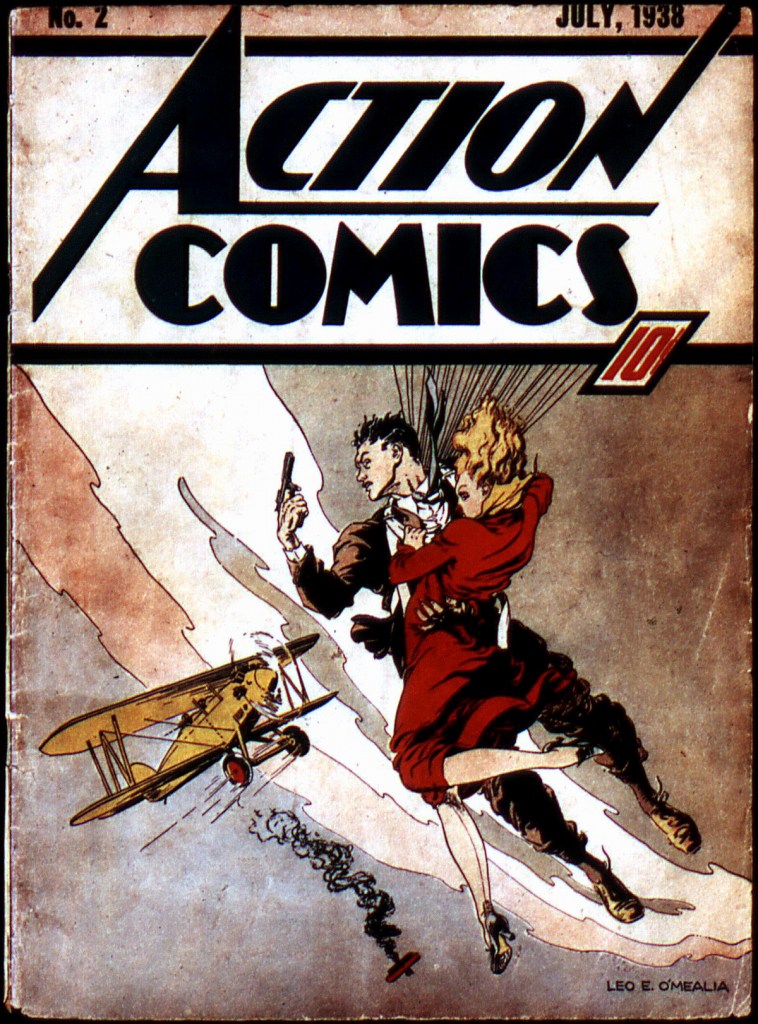
Pretty much everyone knows the story by now. Having conceived of their adventure strip about an indestructible, super-strong crusader for justice in the early 1930s, creators Jerry Siegel and Joe Shuster (and sometimes other, different artists) spent the next five or six years trying to find a buyer for what they felt confident was a sure-fire hit character. They produced a bunch of different sets of sample strips over the years, the latest of which was handed over to National Comics’ new owners Harry Donenfeld and Jack Liebowitz by workers at the McClure Newspaper Syndicate, and the pair decided to take a gamble on Superman as the lead feature in their upcoming new venture, ACTION COMICS. Siegel and Shuster were paid a princely $130.00 for all of the rights to their creation and given the task of reformatting their samples strips into thirteen comic book pages ready for publishing. But what happened then?
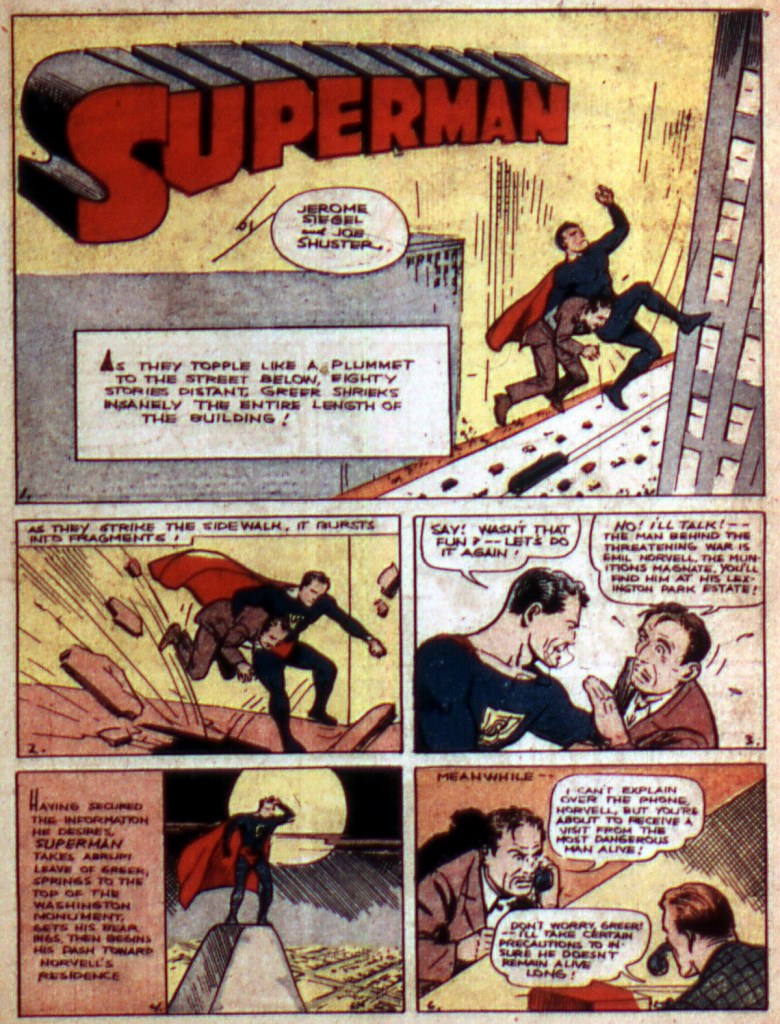
Well, among other things, the pair needed to finish up the storyline that they’d begun in those samples. The first Superman story is episodic because it was put together from about three weeks’ worth of proposed newspaper strip continuity that the pair had done as samples. It also opens in the middle of an adventure already in progress because Siegel had been told earlier that, rather than beginning with the long-winded origins of the character (one earlier set of samples ran for similar three weeks and by the end of it Clark Kent is still a boy with no Superman in sight) he should instead jump right into the action and sell the thing he was selling. As these later samples were what eventually sold, that proved to be decent advice.
But the most immediate problem that the pair had is that they now needed to deliver another 13 pages for publication the following month. Joe Shuster had never been the fastest artist in the world, and Jerry Siegel hadn’t really worked out where the storyline in the sample strips was supposed to go next, not in any detail. So the pair needed to scramble in order to get this all done. Accordingly, they cut some corners on this second Superman story, integrating panels and sequences originally created as parts of other non-Superman strip pitches. Whatever needed to be done in order to turn production around in time. Shortly, as Superman began to catch on, Shuster would hire assistants to help him out with his burden (they would eventually wind up drawing maybe 85-90% of the feature, with Shuster concentrating mainly on the Superman and Clark Kent heads)
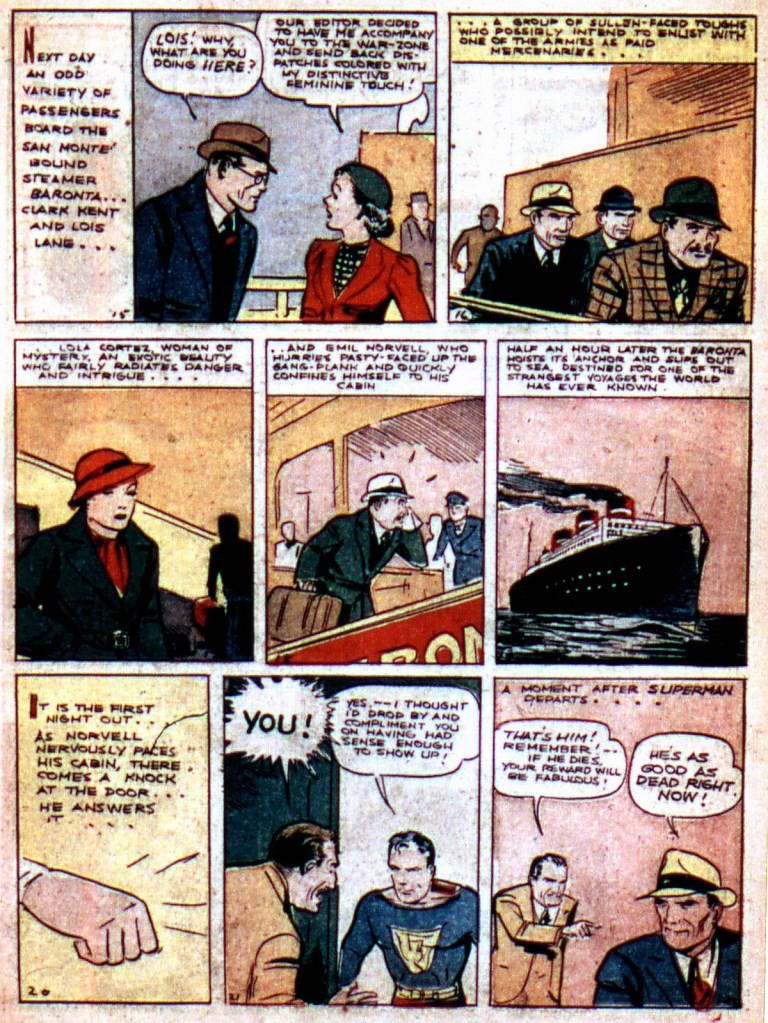
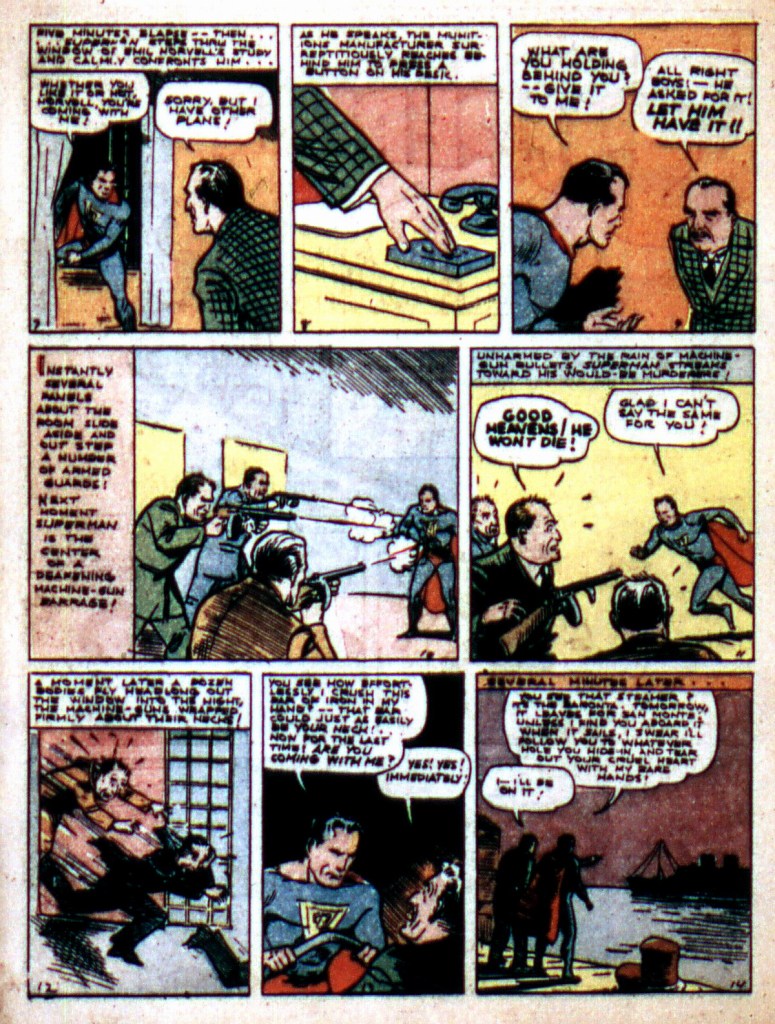
While the artwork on this issue is still clearly by Shuster’s hand, you can tell that he’s working a lot more quickly and therefore a lot more loosely. The first Superman story is tight, with lots of elaborate shading–Shuster was trying to put his best foot forward with those samples, and he had the time to slave over them. Not so this second story–it really has the feeling of being dashed out quickly. Looking at this third page, for example, I think it’s possible that parts of it had been drawn for some other feature and repurposed here. Lois shows up out of nowhere, and Superman’s costume appears haphazardly added onto his figure in the second-to-last panel. if you ignore the words and just focus on the visuals, there’s nothing that screams that this had to have been drawn as a Superman page.
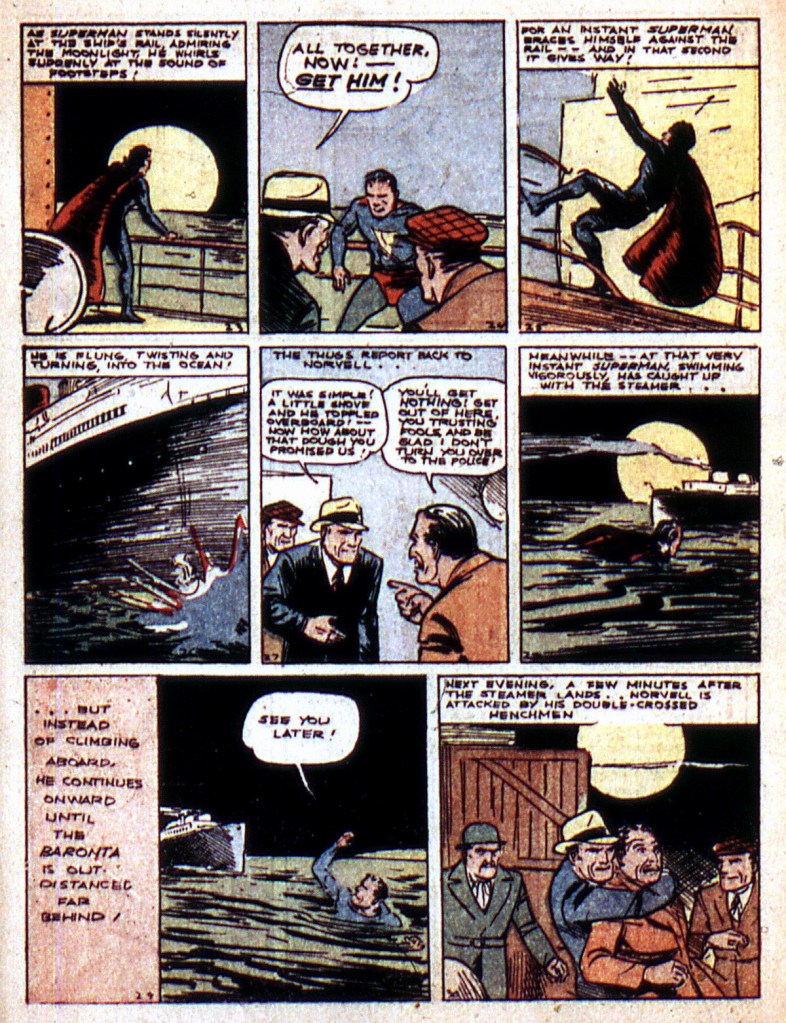
The top tier here as well. It’s pretty clear that Superman’s cape has been clumsily added to the figures in the first and third panels, who may have been a private eye in the vein of Slam Bradley (if not Slam himself) before these pages were repurposed. Same thing in Panel 6, which is incredibly awkward. Even Panel 7 looks more like the hero shaking his fist ruefully at the departing ship than Superman outswimming the boat.
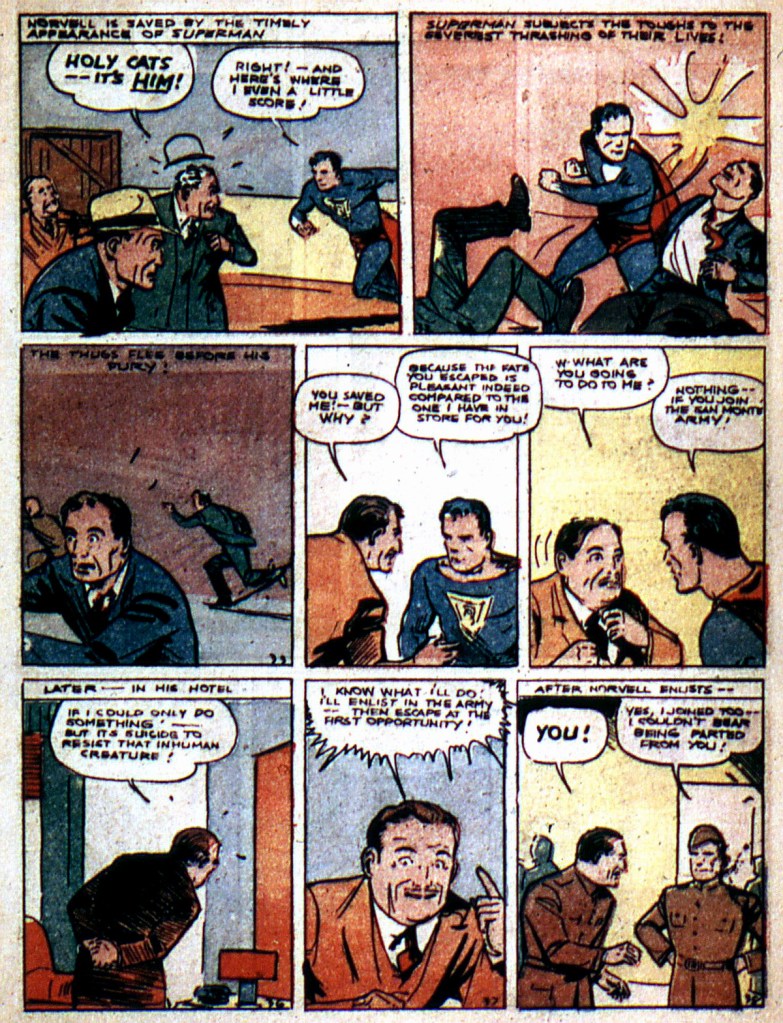
This page, too, looks like something laid out for a Slam Bradley adventure rather than a Superman one. Sure, the Man of Steel cleans up on those guys in Panel 2, but he does so in the manner of Bradley. Again, there’s nothing here that indicated Superman’s superhuman abilities innately. Even the final panel, where the hero appears in the garb of the military, may have been part of that earlier story and reworked here.
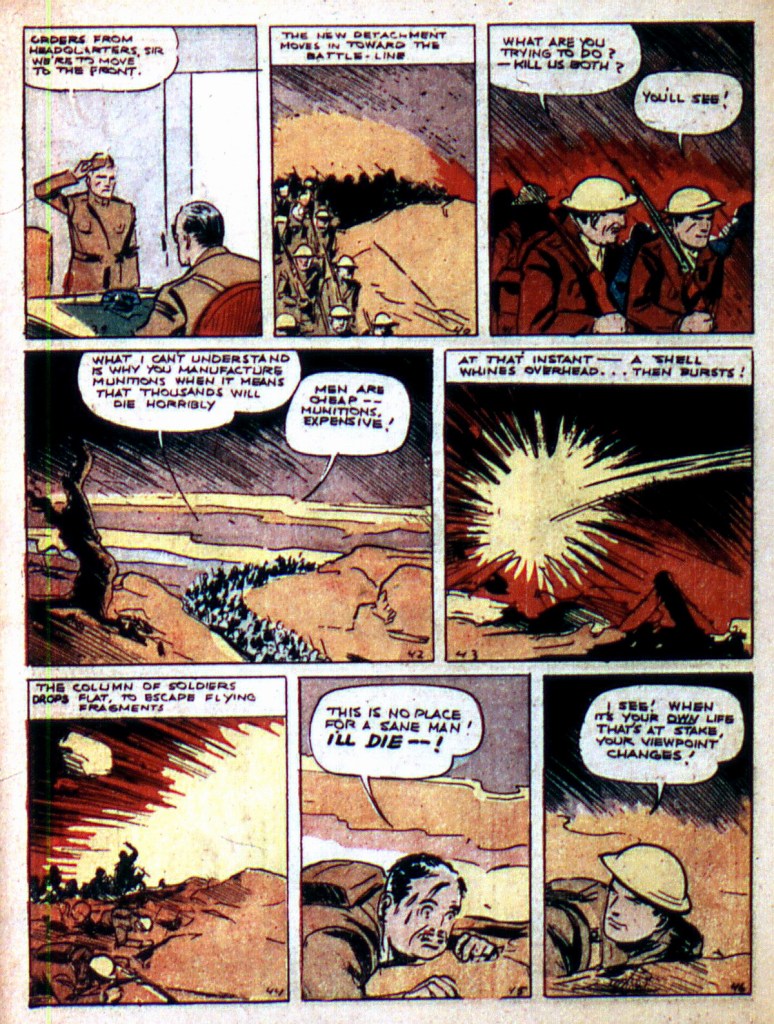
And this page too doesn’t have anything on it to indicate Superman’s extraordinary abilities. It’s pretty clear too that most of these panels have been extended vertically to properly fit the space.
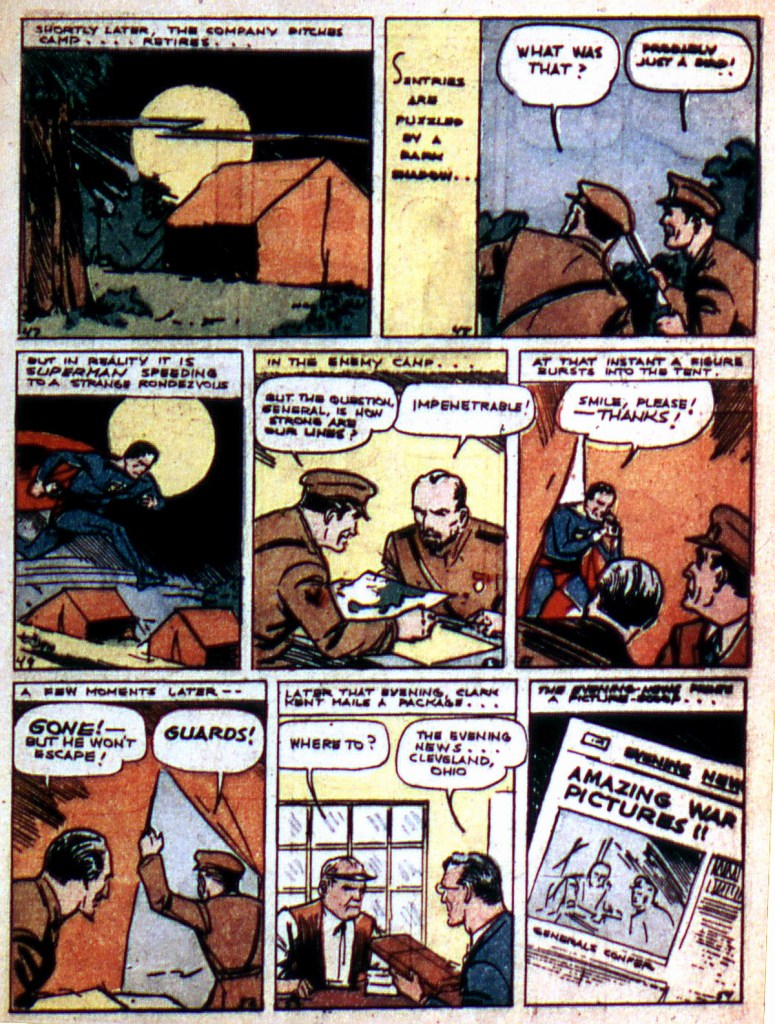
The panels on this page have been extended vertically as well, though it’s pretty clearly a Superman sequence through-and-through.
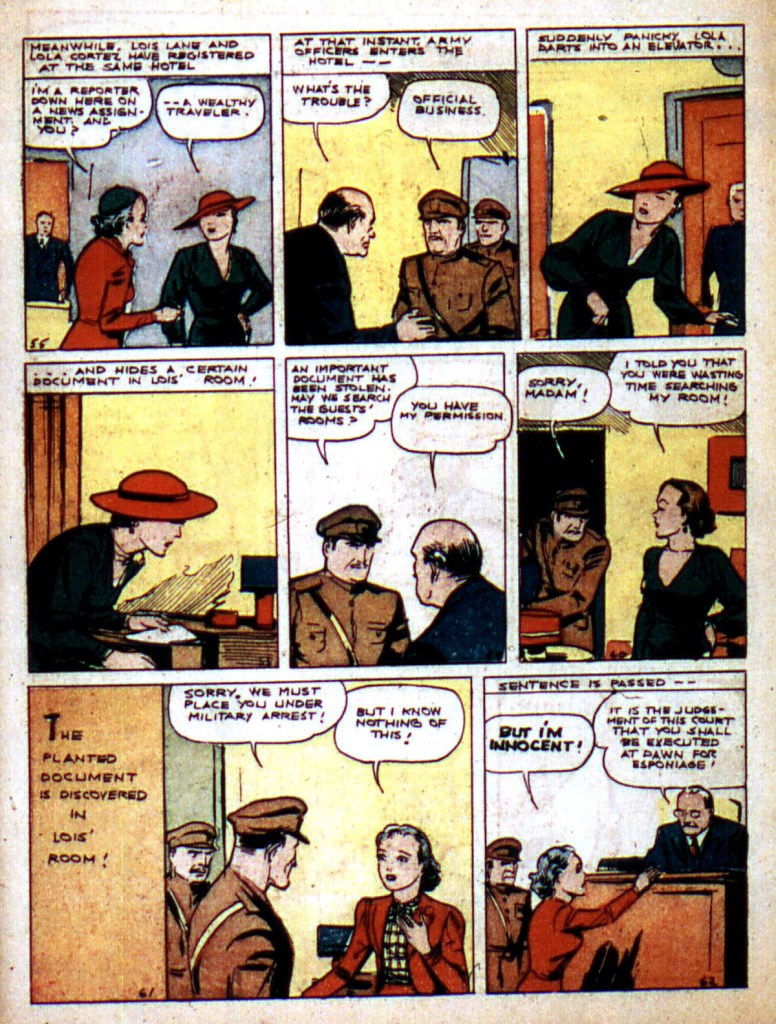
Another page that may have been repurposed from an earlier assignment, maybe an unfinished Spy strip for DETECTIVE COMICS. Again, lots of vertical extending here, with the balloons lettered way up high to conceal how much absolutely dead space there is in these panels.
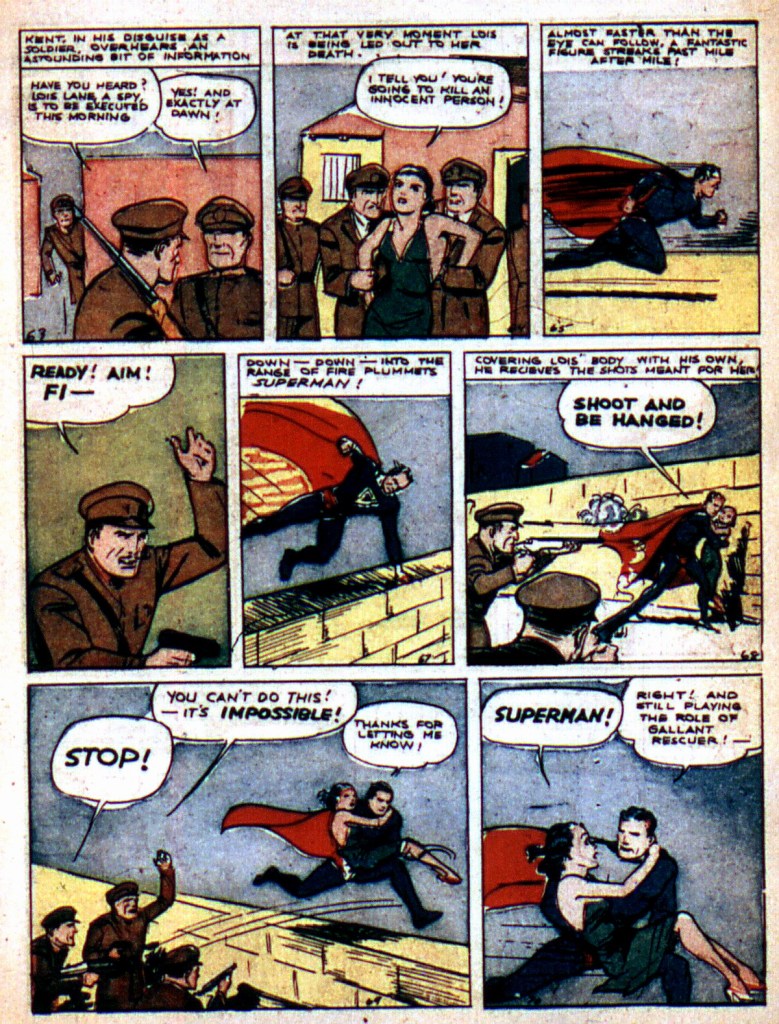
More vertical extending here, but this is certainly a Superman sequence.
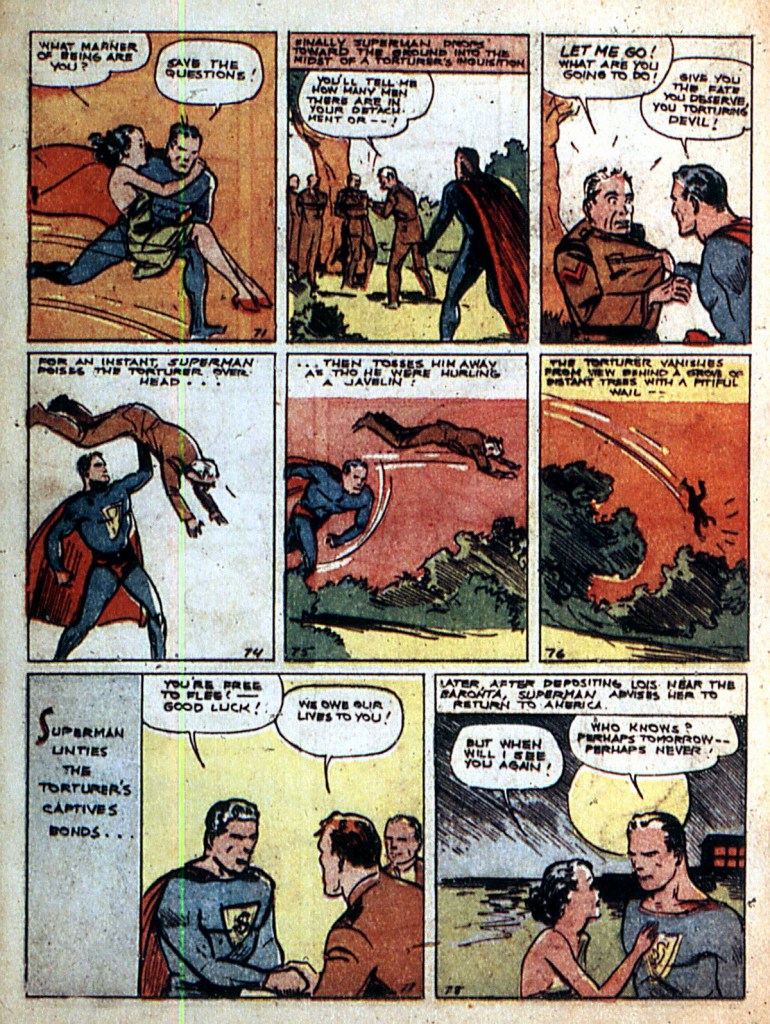
This middle sequence with Superman encountering and brutally (and presumably fatally) dispatching the abuser looks like it may have been a part of some other continuity and inserted here. Lois is absent from all of those panels, reappearing at the end of this page in a panel that frankly would make more sense if placed in sequence after Panel One. Panels 2 through 6 if rearranged in a line would make up a solid single sample strip depicting Superman’s great strength and fierce drive for justice.
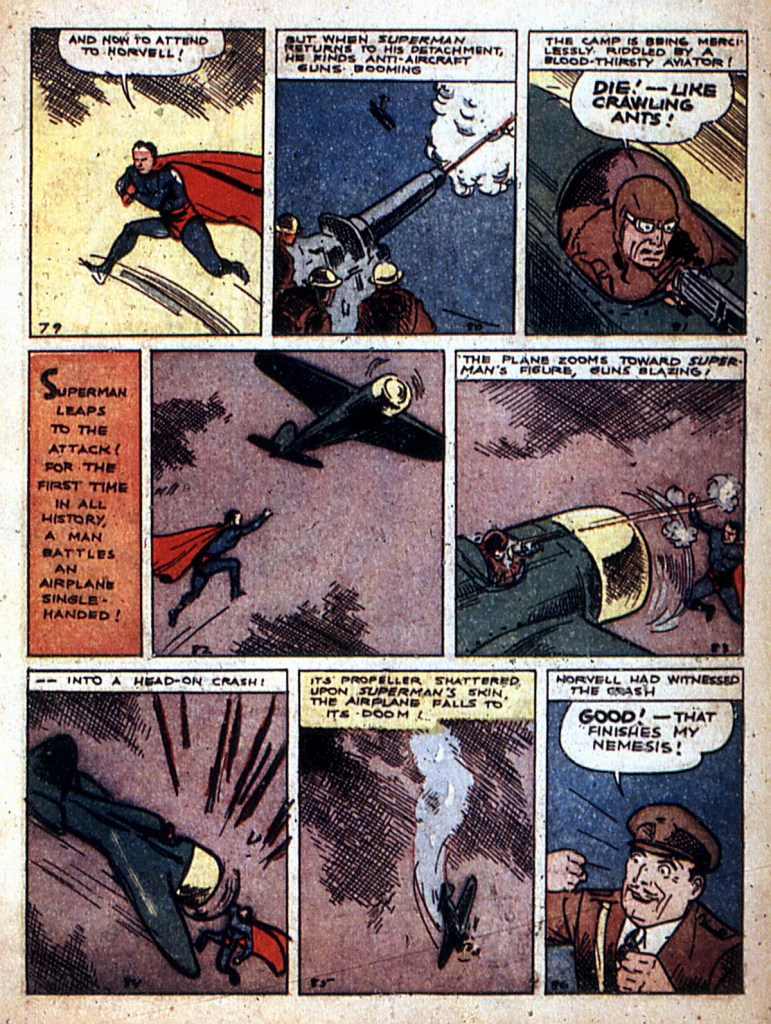
Again, we’ve got some vertical panel extending going on here, though this is a Superman sequence, one that the team would repeat almost verbatim a year later in the newspaper strip. The idea of a man versus a plane must have been terribly exciting in 1938.
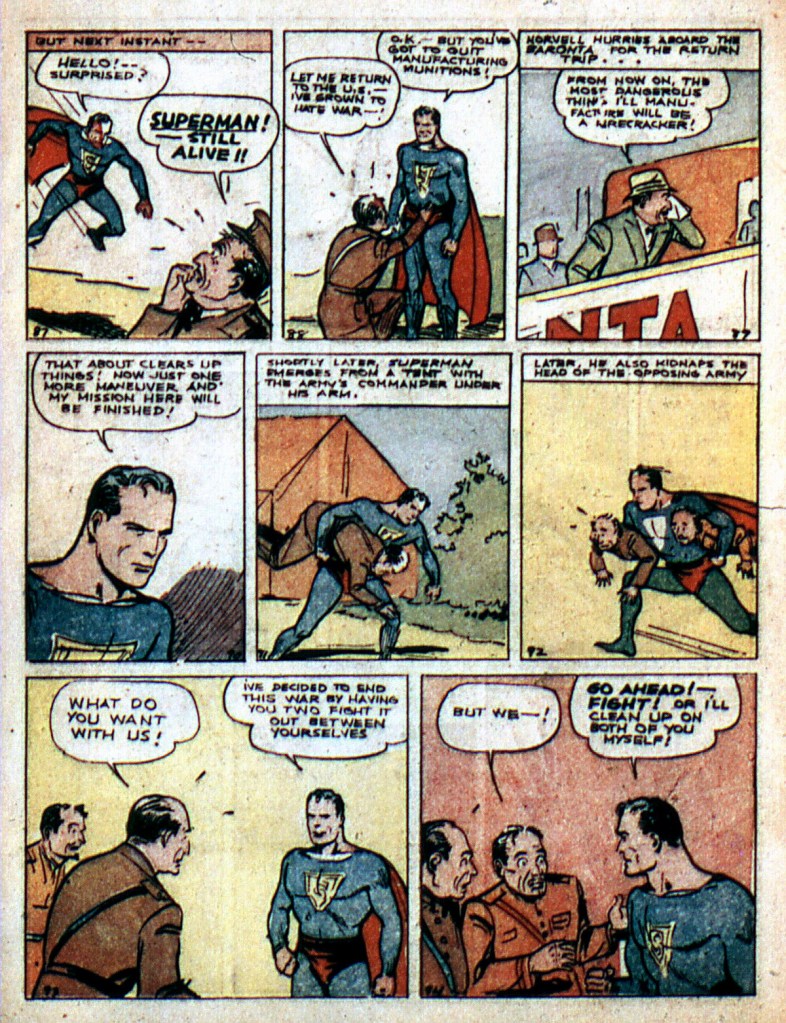
That first panel also looks to me like it may have come from that earlier presumed Bradley story. Superman doesn’t really look like he’s alighting there despite the heavy-handed zip-lines trying to convey that this is precisely what he’s doing. If you take those out, he seems like he’s simply rushing up to Norvell. His cape looks like an add-on there as well.
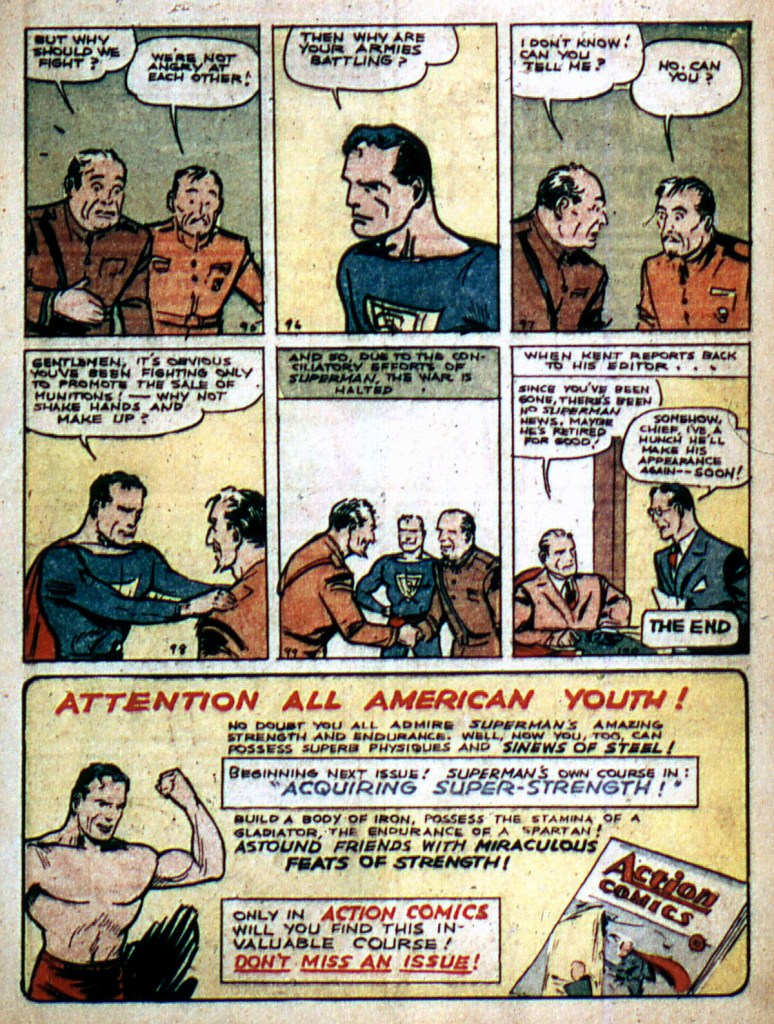
And some more vertical panel extensions to wind up this story. Siegel and Shuster would continue to integrate material from other sources at least up through the fifth Superman story in ACTION COMICS #5. By that point, Shuster had hired the help he needed, and production became somewhat more reasonable.
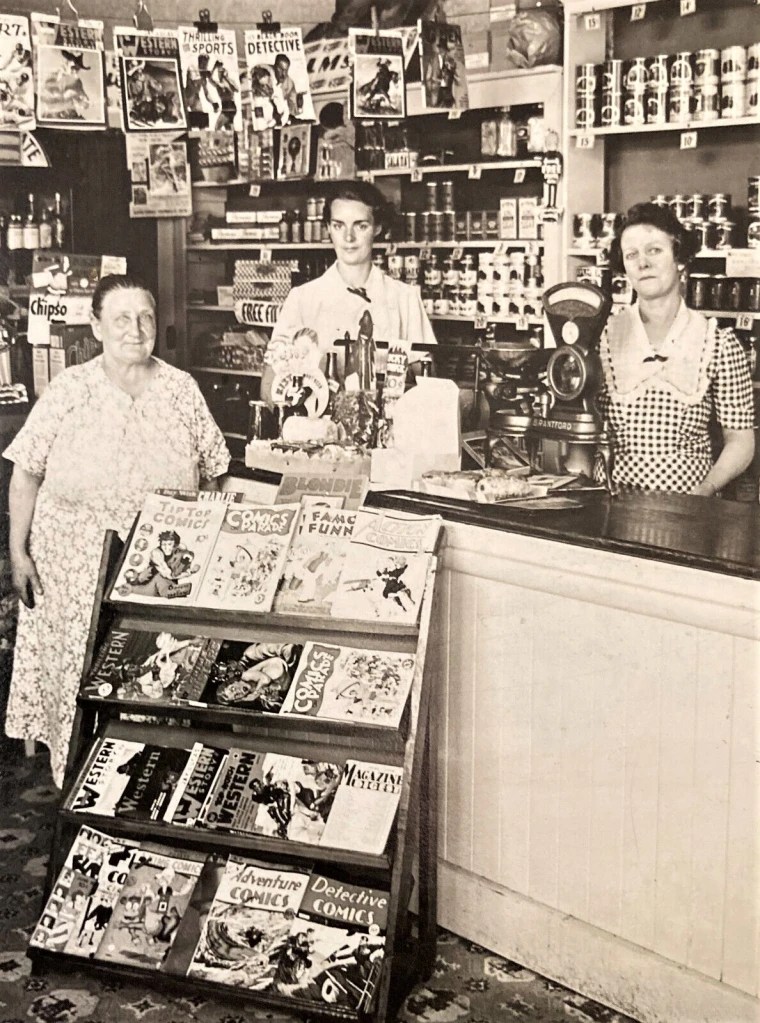
And here’s a photograph from 1938 showing ACTION COMICS #2 on sale among other comic book releases of the period, including issues of DETECTIVE COMICS, ADVENTURE COMICS and MORE FUN COMICS.
 The Tom Brevoort Experience
This is fascinating stuff. I’d never considered that this story might have been pasted together from odds & ends, but it explains a lot.
Thanks for going through it this way.
LikeLiked by 2 people
So Philip Wylie ( Gladiator — A,K,A. Hugo Danner ) did think about suing for plagiarism in regards to Superman being similar to his Gladiator character. He had decided against it when he found out the creators were making very little money from the character ( But why didn’t sue the company since Tom says Jerry sold Superman to them ( which is is clearly why they were getting very little money from their own creation ) ) — he had them dead to rights on Action Comics#1’s “..Nothing short of a bursting shell could penetrate his skin” — which was what happened to Hugo Danner ( see Wikipedia Hugo Danner – Powers and abilities – He collapses from exhaustion and wounds sustained from ARTILLERY SHELLS after he goes berserk against the Germans to avenge a friend’s death ). Jerry says he never read Gladiator, but what about a family member or friend who fanboying of fangirling told him about the character ( He might have forgot someone telling him but the the powers )?
LikeLiked by 1 person
SUPERMAN or DYNAMIC MAN who did it first: Superman uses his powers to reshape his features for the first time [ Superman#5 ( Summer 1940 ) 3rd story ] & Dynamic Man altered his appearance to look like Morgan ( scientist for King Bascom ) [ Mystic Comics#1 ( March 1940 ) Has super-intelligence, super-strength, x-ray vision, can manipulate magnetic rays, including flying by them and using them to make forcefields ( I remember him putting an electric field around a house ), and he can throw electric “thunderbolts” ( Jess Nevins site ) — I also remember the writer saying Dynamic Man had super Herculean strength and muscles that can freeze ( even a 1940s era writer would know the difference between a Robot and a biological being ) ]– Did DC/National’s cover dates match up with Timely Comics?
LikeLiked by 1 person
I’m not a lawyer, but I’ve studied a bit of copyright law. There’s an aspect called the “idea/expression” dichotomy. Ideas can’t be copyrighted, only expressions of ideas. For example, in the Fawcett/Captain Marvel case, the court said “the complainant is not entitled to a monopoly of the mere character of a `Superman’ who is a blessing to mankind”. In my view, it would be a pretty strong case that “Superman” and “Gladiator” are different expressions of the (uncopyrightable) idea of a “super” man. Siegel later said he had read “Gladiator”, and probably didn’t want to talk about it at the time due to legal advice to him. But I don’t see much of Hugo Danner, or Gladiator as a novel, in original Superman when considered apart from the general idea of powers. Hugo Danner is a rather unhappy, tortured, soul who drifts through society uncertain of his place in the world. Superman is a confident crime-fighter who’s straight out of the pulps. Performing a few generally similar superpowered feats here and there is not enough for infringement, as I’d score it (early Captain Marvel was much closer to Superman in terms of stories).
Of course, just the expense of defending a lawsuit is a factor, but there’s also the cost of bringing one. It’s entirely possible that Wylie got legal advice that his case wasn’t strong enough to justify a lawsuit against a company.
LikeLiked by 1 person
Your argument about Superman & Hugo Danner is exactly my argument for DC’s bogus and evil lawsuit against Fawcett over Captain Marvel ( There are gigantic difference between Captain Marvel ( whose alter-ego is a child that says a magic word ) and Superman ( an alien powered by Earth lesser gravity and yellow sun, plus an adult that has his powers in or out of costume. Lets not forget all the other powers Superman has that Captain Marvel doesn’t ) — I gave my examples twice on this site.
LikeLiked by 1 person
I don’t know if it was a Pulp thing, but I noticed in the first and second issues of Action Comics that Superman would use fear of him ( what he could do ) to get bad guys to either tell him things or confess to their crimes. This version of Superman would have gotten along with The Batman ( even Batman V Superman’s Batman ) or Pulp Heroes that use similar methods.
LikeLiked by 1 person
(replying to downthread, but putting it here)
Yes, I understand the argument you’re making. You might enjoy reading through the whole court decision that I talked about in the earlier thread. For some reason my comment took a while to get through moderation, but it’s there now. The judge pretty much discusses exactly what you say above, and much more.
Basically, think of it this way:
Is “Superman” too close an expression to “Gladiator” of the idea of a super-man?
vs
Is “Captain Marvel” too close an expression to “Superman” of the idea of a super-man?
It’s easy to see that the answer to the former could be “No” while the latter “Yes”. And, important, “too close” doesn’t require “not a sliver of daylight between them whatsoever”. It’s hard to quantify, but I’d say the “distance” between early Superman and early Captain Marvel is much smaller than between Gladiator/Hugo Danner and Superman (meaning not specific powers, but the whole story context). Again, it’s not just a super-man character, the novel Gladiator is an entirely different type of humanistic story than the pulp-style crime-fighters.
LikeLiked by 1 person
I love Shuster’s work. He owes a debt to Roy Crane, but he learned his lessons well at a young age. It’s very good cartooning even if it was possibly rushed and pasted and the lack of detail is Shuster’s forte and has a charm all it’s own.
LikeLiked by 1 person
Jerry Siegel was warning us about the “Military-Industrial Complex” long before Eisenhower coined the term!
LikeLiked by 1 person
Thanks for the very interesting analysis here – this is a revealing “mechanics” examination. It’s material of this sort which adds to my belief in the theory about FF#1 that the “Mole Man” second part was reworked from already existing pages of a standard “monster” story. It seems a similar situation – there’s a new hero feature being produced quickly, so reuse artwork from something else which is already available.
LikeLike
Was just reading these early stories, trying to find the point where Superman’s villains turned from the mundane (wife beaters, mine owners, etc.) to the sci-fi/super variety. Never considered re-working art nay have had something to do with it! Fascinating, indeed!
LikeLiked by 1 person
I find it interesting that in Action Comics 3,4 &5 Superman is barely in his costume at all. In issue three there is one panel of him in costume – he spends the rest of the story dressed as a coal miner. I just wonder if there were ever any thoughts to forgo a costume all together.
LikeLiked by 1 person