

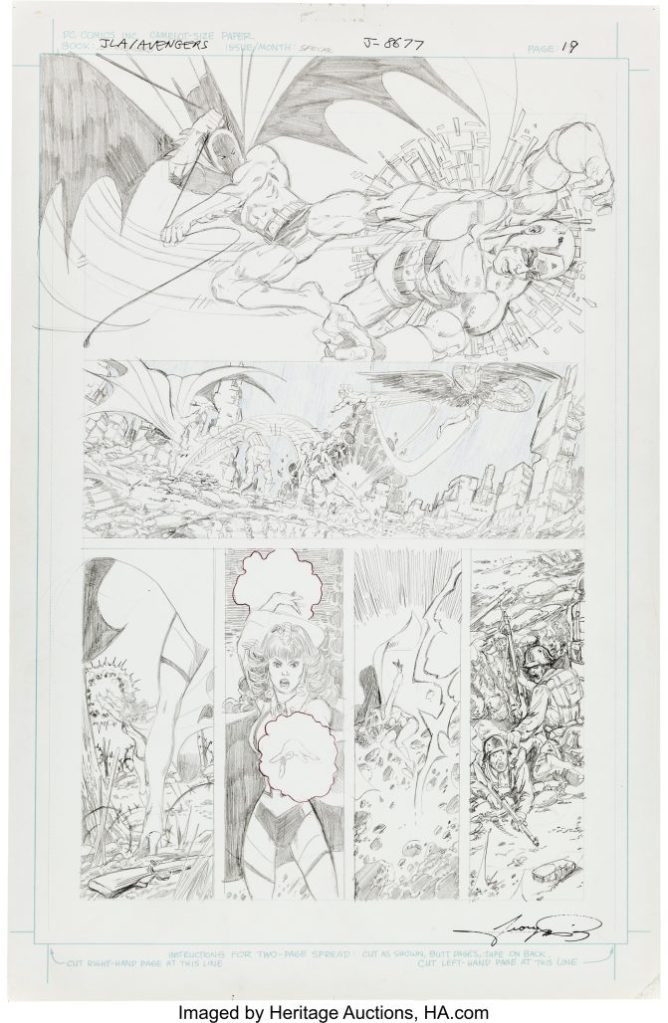
The question came up again this week, prompting a bunch of discussion (often blaming one person in specific for perceived slights): why did the announced and eagerly-anticipated 1983 crossover book starring the Avengers and the Justice League of America never see print and remain uncompleted? There are a bunch of fan rumor and innuendo and legends that have sprung up over the years. So today I’m going to share with you the most complete accounting of the project that I’ve ever become aware of.
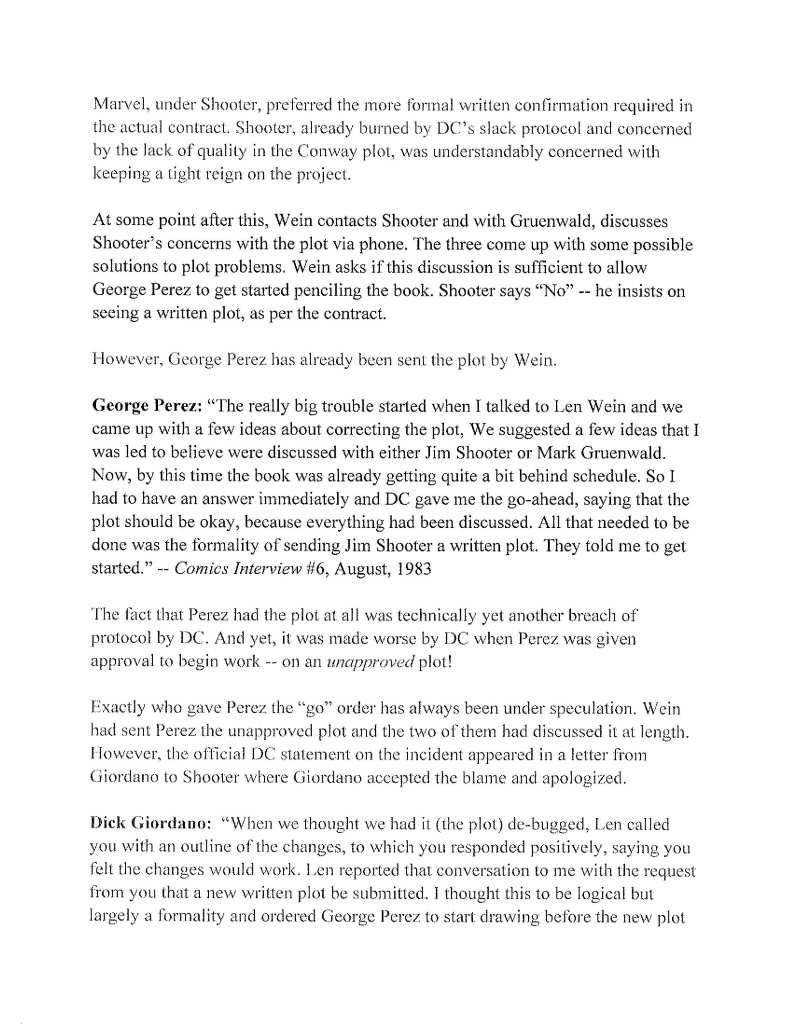
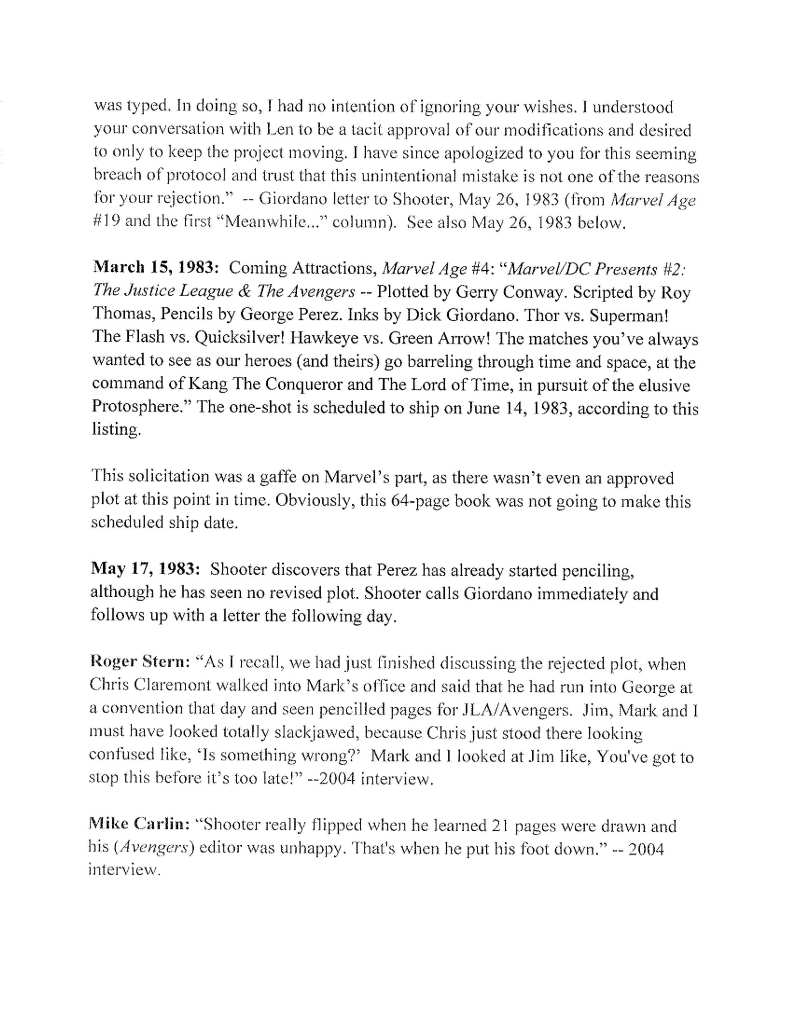
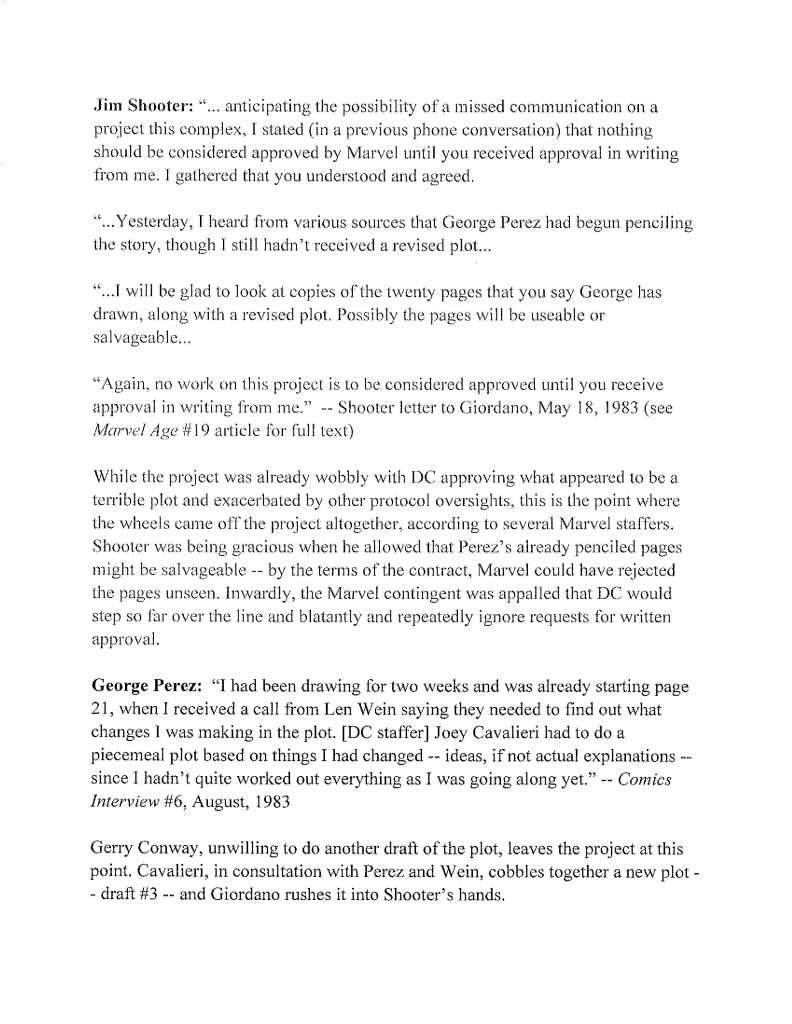
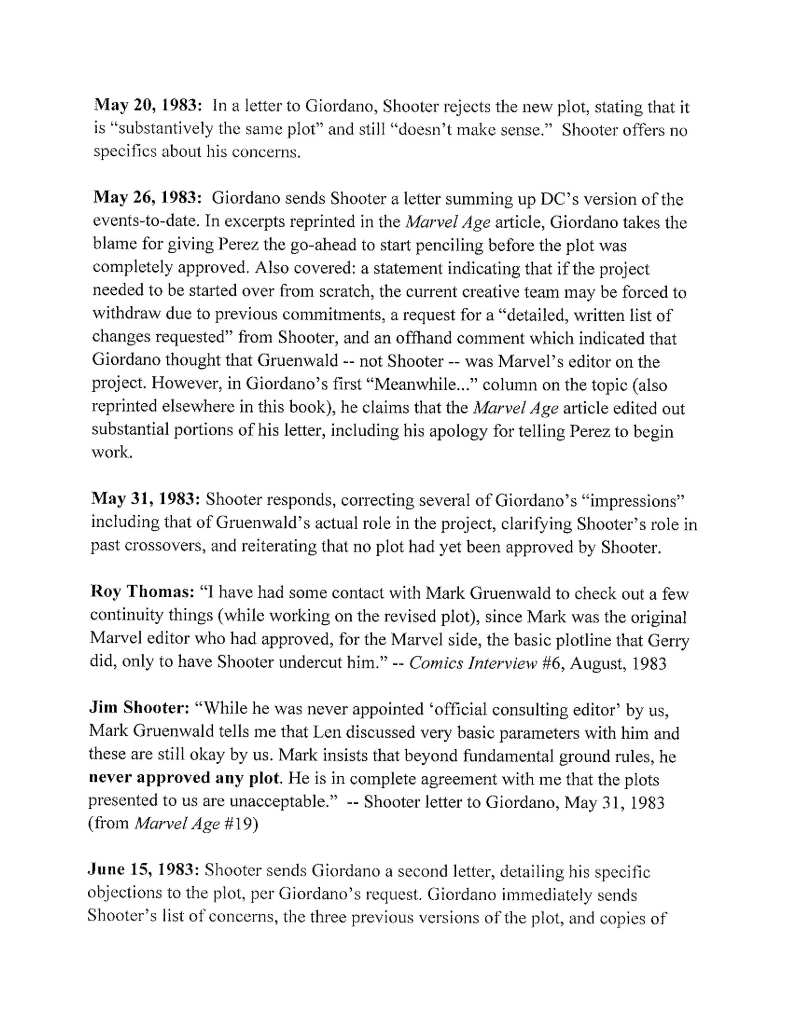
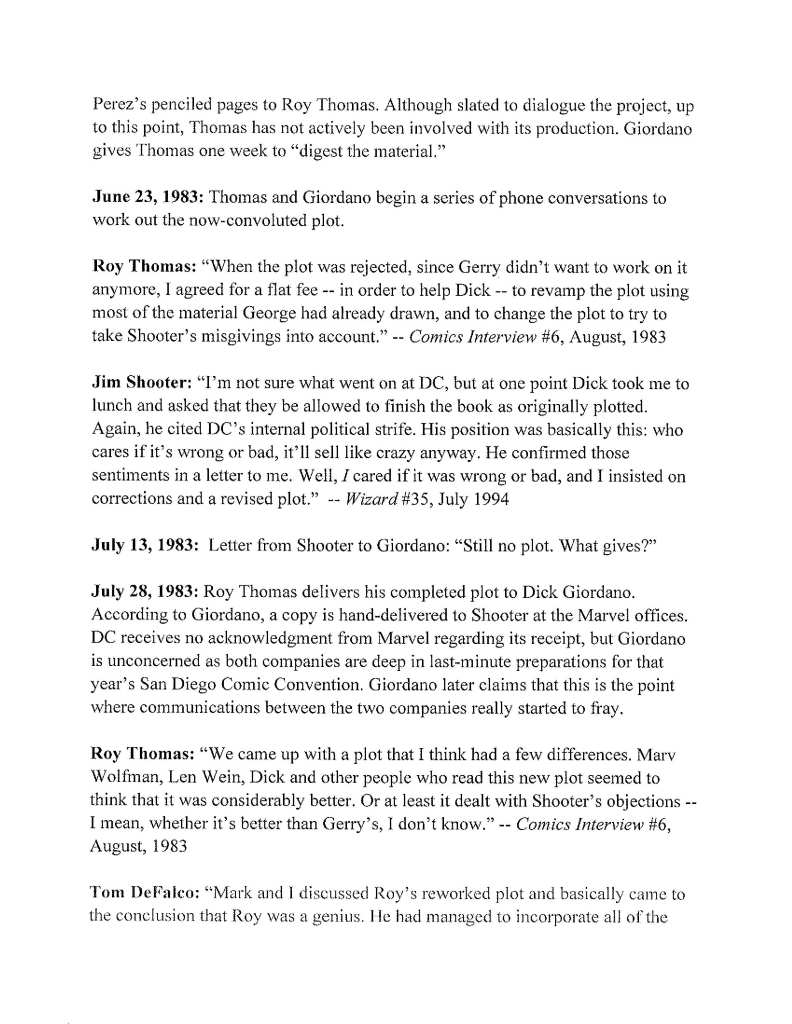
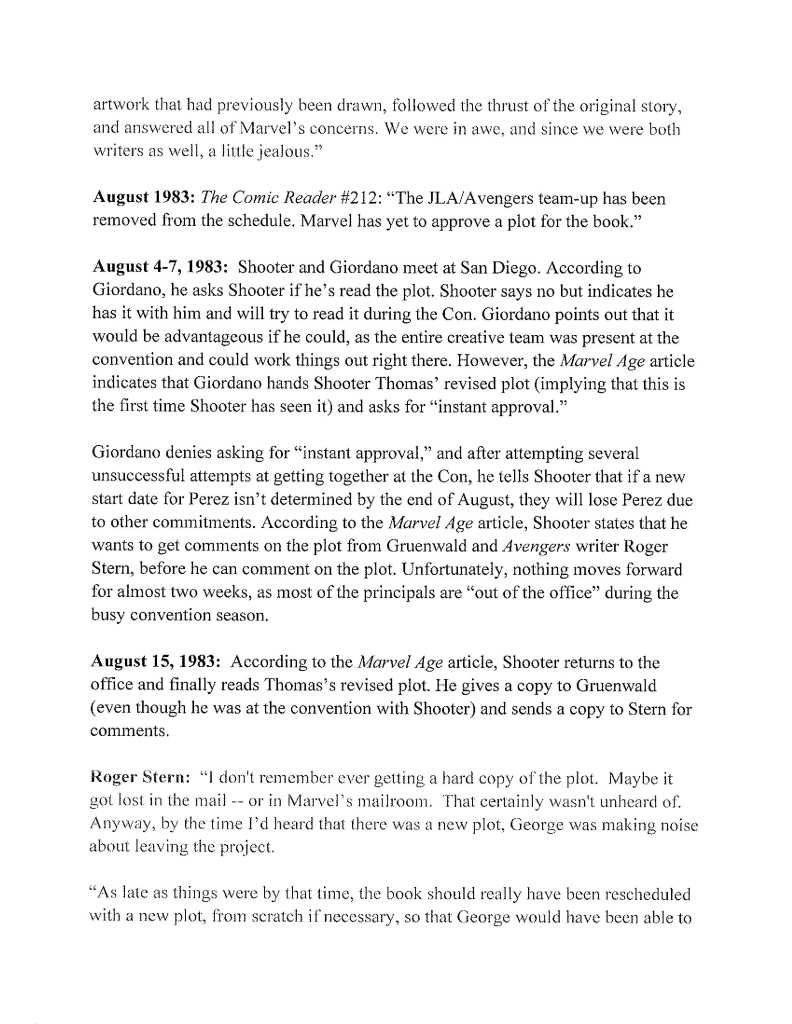
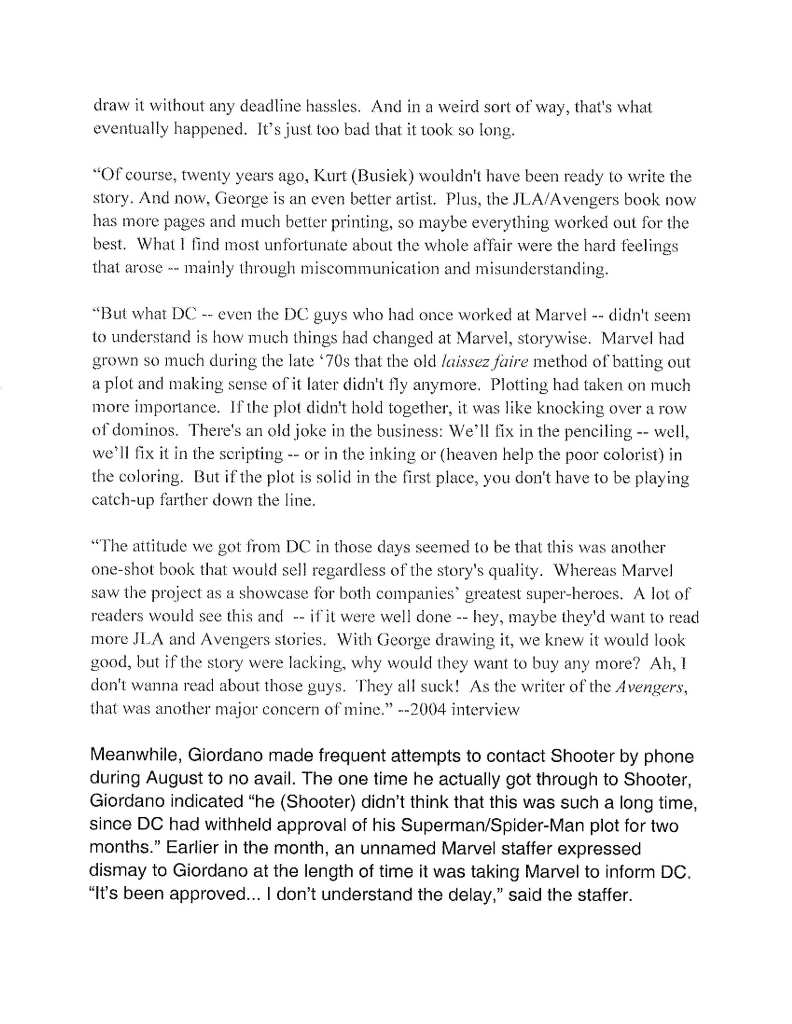
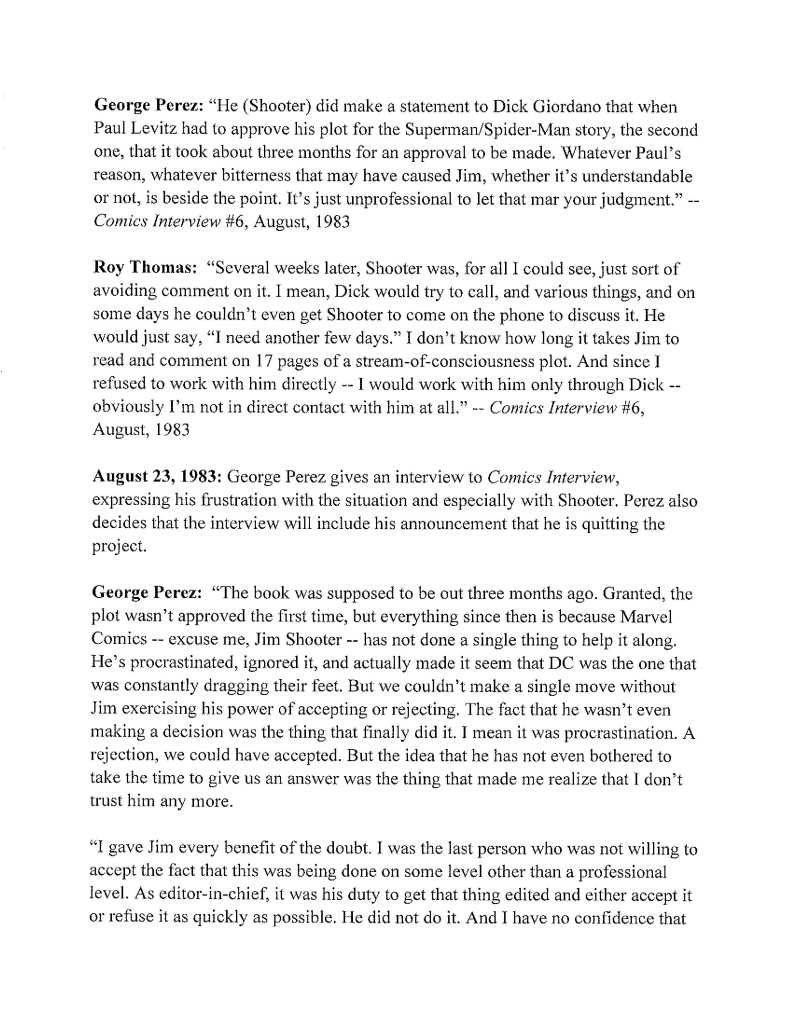
in 2004, for the Deluxe Hardcover edition of the later four-part JLA/AVENGERS crossover by Kurt Busiek and George Perez, former DC editor KC Carlson was commissioned to research and write a thorough journalistic piece concerning just what happened to that earlier project. Carlson interviewed most of the main participants involved with it, and using contemporary reporting and updates in fanzine and through official company channels, assembled a total oral history of that event. Ultimately, though, the article was rejected for inclusion in the oversized collection. The reported word that came back was that “It didn’t make anybody look good” and so was considered in appropriate to be in the book. Since then, its text has been printed online a couple of times–so I don’t have any qualms about sharing it with you here. These were the pages that would have run in that oversized collection had they been included.
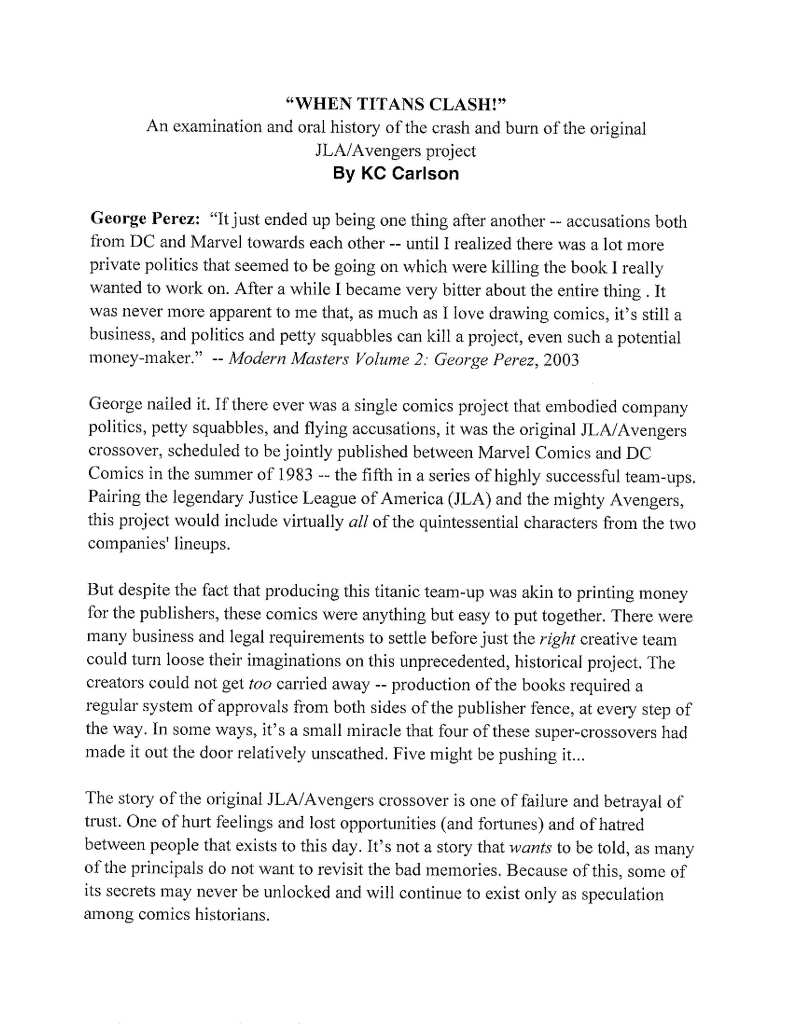
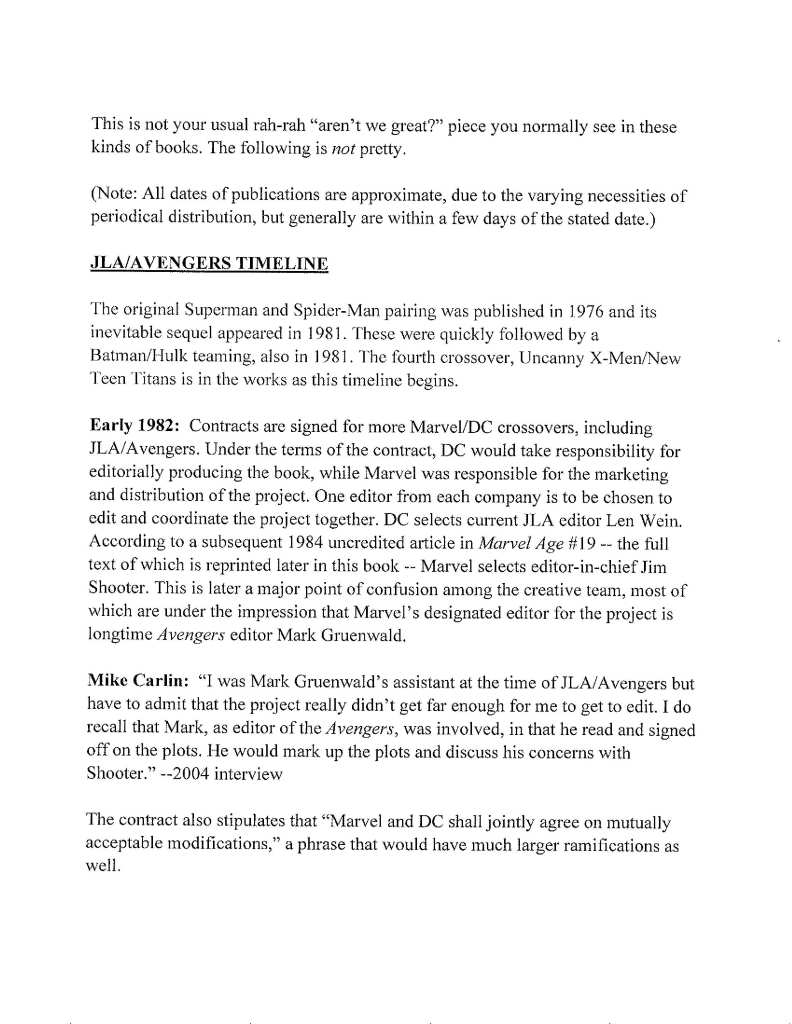
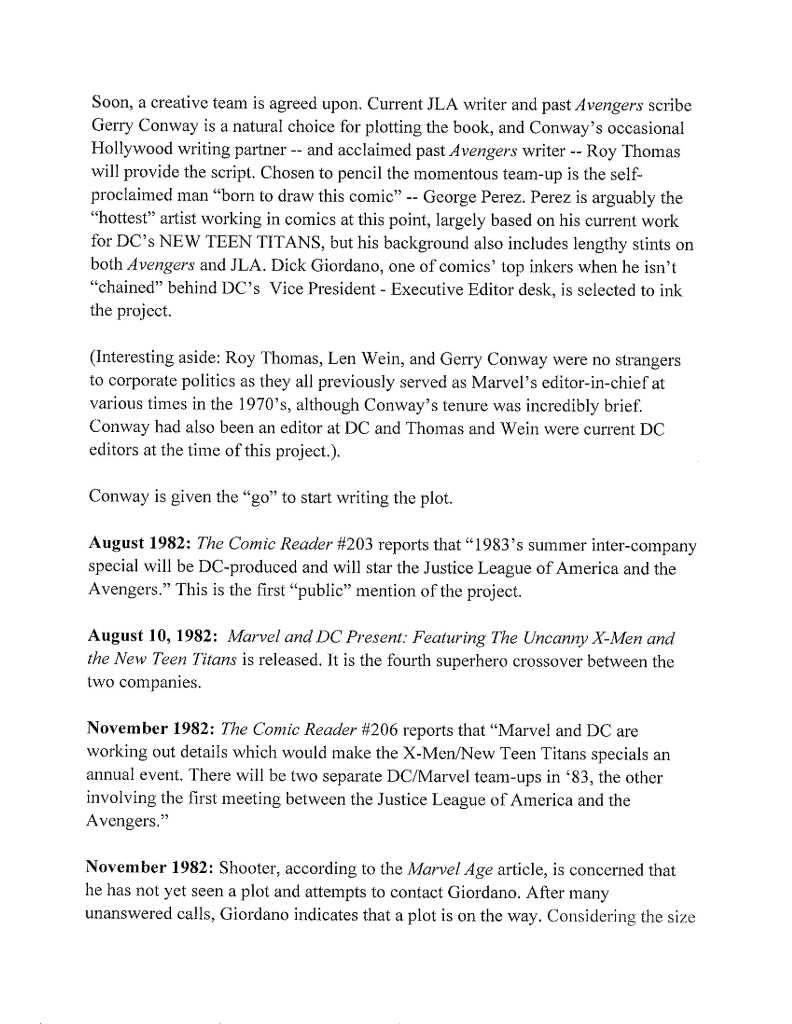
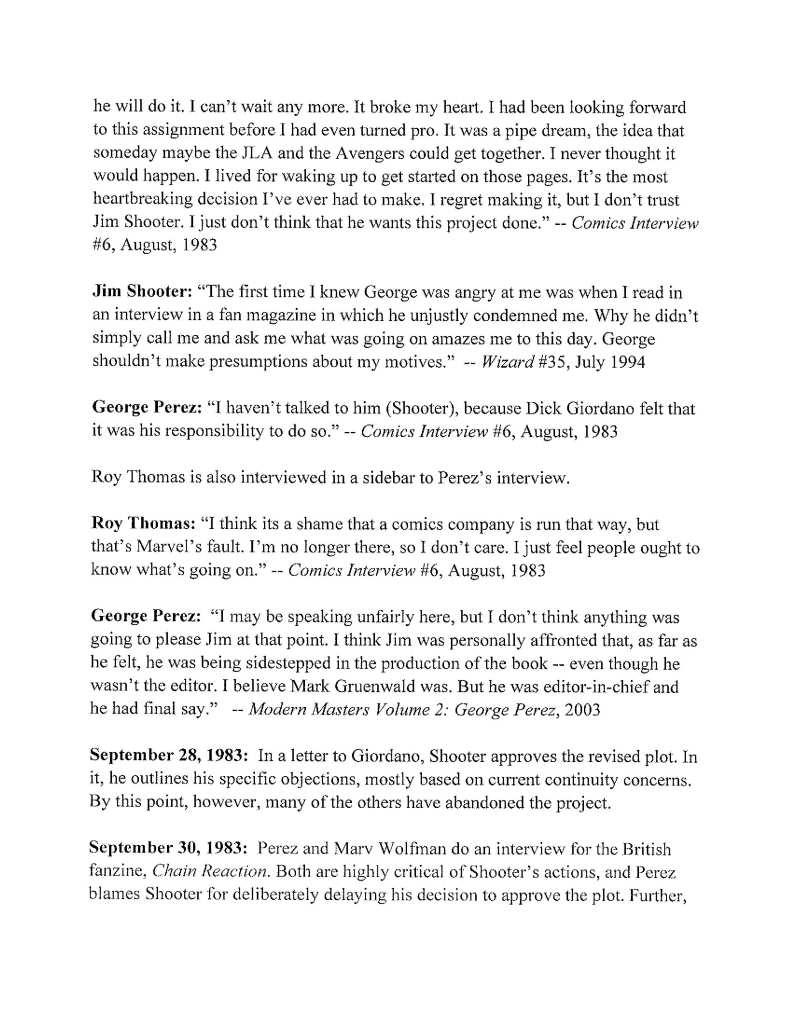

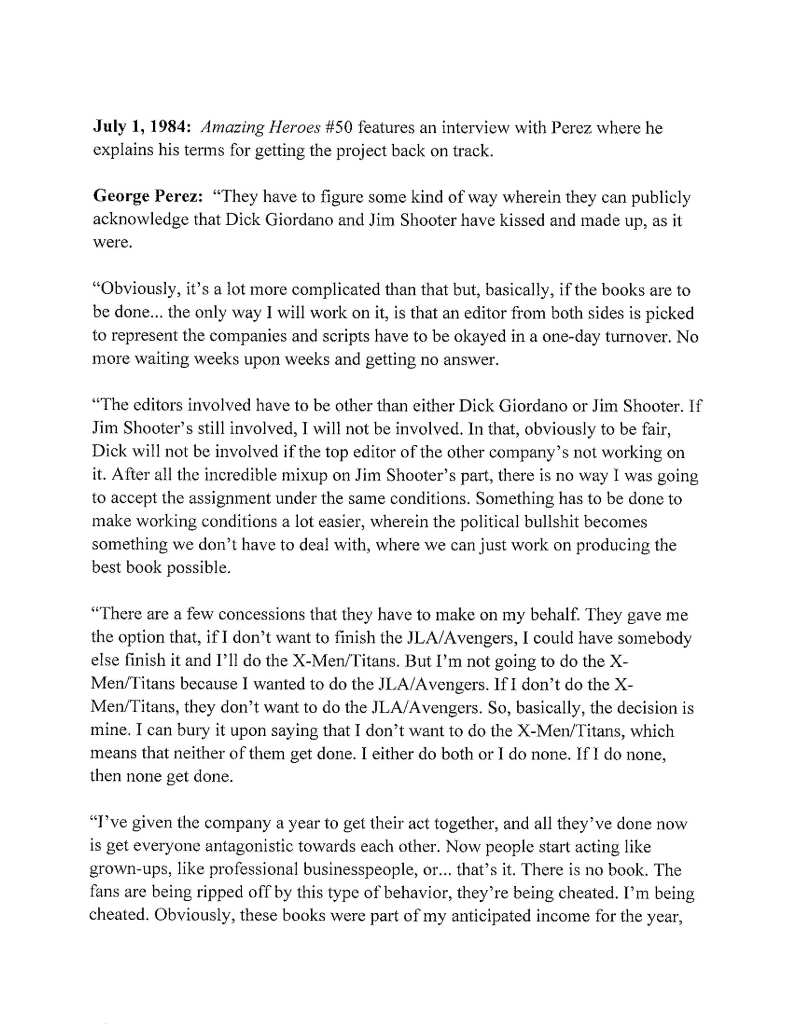


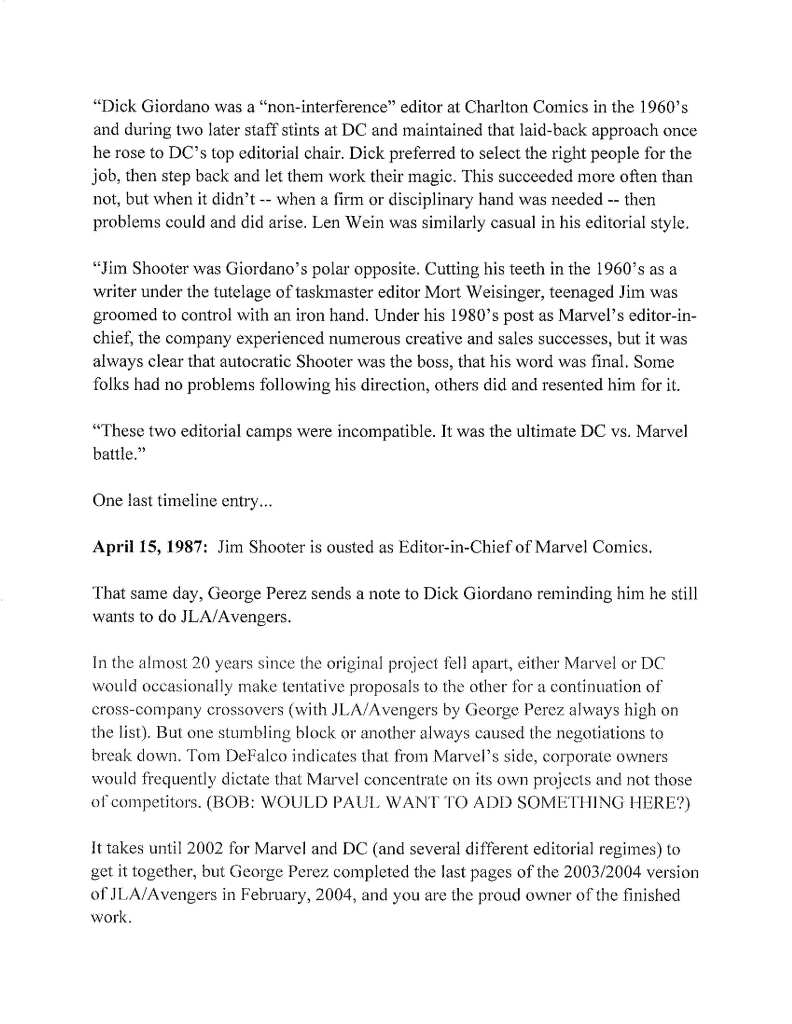

 The Tom Brevoort Experience
Interesting. And a great job of research by Carlson.
Shooter was ousted? I knew he was no longer top dog but (IIRC) assumed he’d moved on by choice.
LikeLike
Things had become toxic between Jim Shooter and Marvel president James Galton while Marvel was for sale in 1986. After New World Entertainment bought Marvel, Shooter sent them a letter denouncing Galton at length. It of course got back to Galton, and Galton sacked him.
LikeLike
That’s why you do that shit verbally and in person. Putting it in writing never ends well.
LikeLiked by 1 person
Thank you. I was right, I never heard that.
LikeLike
I’ve never read this story in whole at once before. I’ve always read pieces. Eury’s explanation seems perfect. Incompatible styles killed the project as much as (possibly. I’ve never read what Conway’s plot) the original story being lackluster. We did Busiek and Perez’s masterpiece finally but I’d have preferred that to have been a second Avengers/JLA crossover and gotten the first one as well. None of the previous crossovers were beyond serviceable anyways. Just them being crossovers was enough of a thrill at that time.
LikeLike
If the first one had happened, then I don’t think the one George and I did ever would have.
For one thing, without it being a famous “lost story,” something fans had wanted to see for years, I don’t think Marvel or DC would have felt any particular urgency to do it — they wouldn’t have any reason to keep taking stabs at putting it together until oe finally worked.
And for another, if George had already done one, I don’t think he’d have made himself available. He’d have thought, “I already did that,” and would have focused on other stuff.
So, as a fan, I was disappointed to lose that 1980s version. But as a pro, I’m happy I got to write the crossover when it actually happened.
LikeLiked by 4 people
Pretty sure everyone else is glad you got to write the crossover too.
LikeLiked by 1 person
That’s a fair point — this seems like the kind of thing that was only ever going to happen once. So I’m glad we got the version that we did, even if it meant waiting a couple decades.
LikeLike
That ending, though.
LikeLike
I was right that everybody should have been in the same room and worked out any bugs in the plot, instead of talking past each other or not talking at all. Had they all been in the same room and the plot holes been pointed out then perhaps someone or others might have made suggestions to plug those holes, come up with new ideas, create a better story.
LikeLike
A lot of the plot holes I’ve heard mentioned — Quicksilver can’t keep up with Flash — would indeed be simple to fix.
LikeLike
Especially since in the Lee-Kirby days from a standing start after an energy had been fired he out raced it to get his sister out of harms way [ The X-Men#6 ( July 1964 ) ]. So unless energy beams on Marvel Earth travels a lot slower than Quicksilver’s Official Handbook speed limit than I say keeping up with the Flash not much of a problem.
LikeLike
Easier said than done. At one point the whole creative team & all the editors were @ the San Diego comic convention, and despite Dick Giordano’s suggestion, they all didn’t meet to discuss it.
DC really did screw up by not sticking to the terms agreed on in the contract. They gave Shooter justifications to kill it.
With all dure respect to Gerry Conway’s legendary career, he seemed to have checked out by the time he was given this assignment.
LikeLike
Except that DC’s part in this not working out came after Jim Shooter not doing his part to make it all work out ( Didn’t help out that BOTH SIDES were CLUELESS about the CHANGES IN THE WAY BOTH COMPANIES DID things since the people who use to work at the other company left ): But Jim Shooter could have told DC what needed fixing so they could fix it ( Give suggestions, point them in the right direction, brainstorm things — plus tell DC to go through him at Marvel not anyone else ( Funny how his protocol went out the window when he did and end run around his boss James Galton to complain to his new boss ) ) — cause it didn’t look from what I read he wanted the project to get off the ground ( Cause I would have done all that ).
LikeLiked by 1 person
John–
Shooter rejected Conway’s story outright. He wanted DC to submit a different one. As he didn’t think Conway’s story was salvageable, why would he bother trying to troubleshoot it? But DC just wouldn’t let go of the thing. What’s so holy about Conway’s story, anyway? He’s a successful commercial writer who’s all but certainly had work rejected before. His world, much less DC’s, isn’t going to end if he’s told to come up with a new story, or have the project assigned to someone else. If Shooter had rejected multiple proposed stories, I could understand complaints that he was being difficult. But one? Shooter is not the unprofessionally obstinate party here.
As for Shooter and Galton, what do you think the protocol is for formally complaining about your boss? Going to your boss’s boss does seem the appropriate–and frankly, only–thing to do. And yes, one is going to put it in writing to avoid misunderstandings. That fact that New World was based in Los Angeles, not NYC, factors into that, too. It wasn’t like Shooter could just walk over to their office and knock on the door.
LikeLiked by 2 people
@RS Martin, actually Jim says in interviews he did often just walk up to Galton’s office. Or just call him. Did you see my comment on this thread from the interview Shooter gave to “Comic Book Historians”? He might mention it there.
LikeLike
I wasn’t talking about Galton. I was talking about New World. I have no doubt Shooter tried to address his grievances with Galton before going over his head, and no one with direct knowledge of the situation claims he didn’t..
LikeLiked by 1 person
@RS Martin, I missed that “boss’s boss”.
LikeLiked by 1 person
RSMartin, clearly no one at DC noticed the characters acting out of characters ( Forest for the Trees ) so pointing that out to them instead of making them guess. Granted I don’t know how much from the pages George drew is close to the original plot is, but I don’t see anything wrong with 2 Time Traveling Conquerors trying to manipulate their heroic foes while planning to betray them to get their prize ( one of them getting it ) or the heroes trying to stop both villains ( who they know can’t be trusted ). Plus from what I read in Comics Feature about Jim Shooter liking to back seat drive Marvel books ( Either Byrne or Claremont said Shooter was the one who wanted to despite the X-Men all being adults, bring back the School for Mutants in the series ) — I just don’t get why for something so important he wouldn’t have made a effort ( real one ) to get what he wanted by EVERYONE BRAINSTORMING. Last night I was thinking that ( Butterflies –time travel reference ) had we go the team-up back then would we have gotten the the superior multi-issue Avengers/JLA- JLA/Avengers we ended up with?
LikeLiked by 1 person
Only if the one that got done first didn’t involve Mister Perez and probably would have to have been a massive letdown to read to get the fan demand for a better one. It’s not like either team had the pull of Batman or Punisher.
LikeLike
John, I posted more comments from Shooter on this thread. He contradicts other statements in KC Carlson’s article.
Shooter also gives examples of story beats and characterizations he thought were wrong. I agreed with him.
I also agree with his insistence that DC followed the written contract. He had plot approval for Marvel.
I do think Jim Shooter dragged his feet intentionally in approving the revised written plot. By that time it was too late. George has other commitments.
LikeLike
Tim–
I didn’t read the transcript you posted of the CBH interview with Shooter. I’m of the view that the further firsthand accounts are from the events in question, the less reliable they are. Shooter wrote about what happened on his blog in a couple of posts back in 2011. I consider that the last word from his end. And my rule about his accounts of the 1980s on his blog is they’re about 2/3rds accurate. The trouble from a historian’s point-of-view is discerning what’s accurate and what isn’t.
I do think what Shooter says, even when it’s erroneous, is for the most part said in good faith. My big complaints about his accounts are those when he’s covering for, ahem, “questionable” behavior from Gil Kane and Neal Adams. But I’m not putting his accounts down overall. They just need to be checked against what other principals say. And believe me, those other principals are far from perfect as far as reliability goes.
With JLA/Avengers, I think the original sin was DC’s refusal to accept Shooter’s rejection of Conway’s story and not commissioning a new one. The wear-Shooter-down, and ultimately, done-deal tactics that Giordano and so forth engaged in were passive-aggressive bullying and reflected very poorly on them. The decision to have George Perez start drawing a rejected plot was sleazy, disgraceful, and predictably doomed the project. Dick Giordano is the villain of the piece, not Jim Shooter.
LikeLike
John–
I was trained very early on in my working life to be very careful about not evaluating the work of others in terms of what I would do in their place. People have different styles, and there’s always a better idea–and the biggest idiot may turn out have the best idea of anyone. One evaluates in terms of whether something is reasonable or not. If something goes off the rails, track the reasonable and unreasonable conduct before assigning fault.
Is rejecting a story, and expecting a new story to be submitted in its place reasonable? Yes.
Is ignoring a rejection and a request for a different story reasonable? No.
Is trying to wear the rejecting party down so they change their mind about the rejection, and so you won’t have to arrange for a different story to be submitted reasonable? No.
Is trying to reverse the rejection by turning the situation into a “done deal” reasonable? No.
You may feel the story shouldn’t have been rejected. But Shooter didn’t see it that way, and he got multiple outside opinions confirming him in his view. And those were genuine good-faith opinions by people who were pretty qualified to make them. Shooter bent over backward to be reasonable with that decision, even if you would have done otherwise. Rejecting material is an everyday occurrence in editorial work. It should not be treated as a big deal.
Giordano’s conduct is not something I would have tolerated a subordinate doing if I’d been made aware of it. It breeds bad feelings, and it more often than not backfires, as it did in this situation. If I had been subjected to it personally, it would be a good, long while before I worked with that person again, if I had a choice about it.
LikeLiked by 1 person
loved that issue of comics interview as a kid.
LikeLiked by 1 person
The project was doomed from the moment Shooter named himself Marvel’s editor.
LikeLike
Aw, c’mon, now…. I am not saying he’s blameless, but it takes two to tango, and that dance hall wasn’t empty, by any means.
LikeLiked by 5 people
As I’m not a fan of Shooter’s EIC work I put most of the blame on him but yes, this shares it around plenty.
LikeLike
Having a man like Giordano seem to disrespect him because of the differences in how they ran their ships could have gotten no other response out of Shooter and most likely anyone else in his position.
LikeLiked by 1 person
Thought Don Heck was chosen to replace Perez at some point, or was that just sarcasm, as Heck didn’t have Perez’s superstar status?
LikeLike
No, I think it was a legitimate idea that they floated, though obviously one that didn’t last terribly long. I doubt Heck ever heard about it.
LikeLike
If you take a drink each time how bad/unacceptable that plot was is mentioned in that report you’ll be dead before you finish reading it.
Not that personalities can’t still grind projects to a halt, but email has at least solved a number of inter-company correspondence issues that used to rely on faxes, mailed letters, phone calls and bike messengers. I doubt anyone who grew up with emails, texts and cell phones realizes how slow office stuff used to be.
As someone mentioned above… most of this seems like something that could have been hashed out over a lunch or 6.
In the end it all worked out for the best.
LikeLiked by 1 person
“Meatloaf AGAIN?” 😉 The “lost story” that never seems to go away. Seems each new generation that finds out about this editorial debacle keeps the topic going.
More from that Jim Shooter Biographical Interview by Alex Grand & Jim Thompson – Comic Book Historians. Some of Jim’s recollections here seem to vary from KC Carlson’s article. One example; saying he learned George had already drawn “23” pages (not 21) from Dick Giordano. KC’s story has Roger Stern saying they told Jim about George having drawn 21 pages before Jim approved the plot.
And Jim says Roy called him about the revised plot, but Roy said he refused to work directly with Jim.
Also, Jim saying he was the “Marvel-appointed editor” for JLA/Avengers is a little funny to me. I mean, did he “appoint” himself? 🙂 “Marvel-appointed” sounds like it was by committee, or someone else gave him permission. But he had final say.
Alex: “And then there was going to be a JLA – Avengers, and actually, I think, George Pérez was part of that, and he had actually done some pages, but there was like some miscommunications and also some questionable story choices that led you to nix the project. Is that right?”
Shooter: “Something like that. Basically, I was the Marvel appointed editor, DC was going to do the book. The plot due date came and went, and I started calling Dick Giordano. I’m saying, ‘Where’s the plot?’”
“He never would take the call. I’d get his secretary and she’d say, ‘I’ll take a message.’ Or ‘He’ll call you right back.’ Never called back. I’m calling and I’m calling, and I’m not getting anywhere. So it’s getting to be months. It’s late.”
“I’m like, ‘This is ridiculous’. I sent him a telegram. I said, ‘If you don’t call me, killing this project’. Then he calls me. And then he tells me, ‘Oh, well, we’ve already drawn 23 pages’. I said, ‘What?’ He said, ‘Yeah, George Pérez has drawn 23 pages’. I said, ‘I never saw a plot’.”
“’Oh, I didn’t know I had to send you the plot to you’.”
“I said, ‘Dick, we’ve been doing this several times… Procedure is pretty clear’. He said, ‘Well, we thought you’d approve it so we just did it’. I’m like, ‘What?… What?!’ And so, I said, ‘Send it to me. Send me the plot. Send me the Xeroxes. Let me see’.”
“So, he sends me the plot, he sends me Xeroxes, and I’m reading this thing. The drawings are beautiful. But there’s characters in there who are not supposed to be there. There’s things in there just completely wrong. There’s just… And I’m reading this plot, and this plot was horrible. I’m thinking, I got to check with somebody else, just to see if it’s just me.”
“I showed it to Roger Stern, I think, and even Mark Gruenwald, and Louise or Ann. It’s one of the two, and somebody else. There was a bunch of people. They were hanging around in the X-Men office, I walked in and I said, ‘I have copies of these. Can you guys read these, and just tell me, what do you think?’
“They’re falling off their chairs. They were laughing so hard. Like, ‘Shows us the real plot. What the hell is this?’”
Alex: “Like it was ridiculous.”
Shooter: “It was stupid. I’m like, ‘Gerry, oh my god, did he really write this? I don’t think so’. Or he either farmed it out, or did it in his sleep, or something. I don’t know.”
“So anyway, the things in there, Marvel characters were bad enough, he even screwed up in DC characters. They had Superman, for some reasons, was a time mastering king and they’re trying to capture this glowing ball, at the end of time. And the ball was going to be something good. I don’t know.”
“And, as a result of their fighting, the ball gets knocked back through time. It bounces from era to era. And we’re told that if that ball reaches the beginning of time, it will be a giant explosion and the whole universe will be destroyed.”
“And so, the Avengers and Justice League, somehow get together. And for reasons that I do not understand, the Avengers guys go to the DC universe, and the DC guys come to the Marvel Universe. So, the DC guys are going to fight Kang, and the Marvel guys are going to fight the Time Masters, and try to stop the bouncing ball.”
“And it’s also, one damn thing after another story. It’s like they fail here, they fail here, they fail here, you get the drift. They’re going to fail all of…”
Alex: “Wasn’t there some weird thing where Galactus was going to Krypton and then Superman moves Krypton onto the bottom of the planet list or something?”
Shooter: “Superman is in Galactus’ Worldship for some reason. He’s walking around and he sees this giant menu on the wall; a list of all the planets that Galactus has lined up to eat. Top one is Krypton. Remember he’s back in time. So, Superman rearranges the menu to put Krypton down the bottom. Put somebody else’s planet first on the list.”
Alex: “Which he would never do. Yeah.”
Shooter: “Not my Superman! But I thought you’d want to screw up your character that’s fine. Don’t screw mine up. But there were similar things like that. And the ending of the story is idiotic. The bouncing ball arrives at all the beginning of time, somehow, it does not explode… I don’t know.”
“In come the Avengers. In come the Justice League. Kang and Time Master have been taken care of by then. Anyway, for no reason stated, the Avengers and the Justice League start fighting each other. It was something to do about the ball, or something, fighting each other.”
“In the middle of the fight. Hawkeye, takes a pointy deadly arrow, and fires it at Green Arrow. Its intent to kill. Green Arrow takes a pointy deadly arrow, and fires it at Hawkeye, exactly the same moment. Okay, my Hawkeye doesn’t do that. I don’t care what their Green Arrow does.”
Jim: “Yeah, try to kill someone.”
Shooter: “The two arrows meet, point to point. Ricochet at a 90-degree angle. Science says you’re wrong. And these two arrows, hit the glowing ball, causing it to explode. And what it does is it puts everything back exactly the way it was at the beginning off the story.”
“I mean, like we did all this for nothing? Because the bouncing ball just put everything back the way it was anyway.”
Alex: “Yeah… And that was a lot of art that was actually drawn, that didn’t have to be drawn. Yeah.”
Shooter: “They did… I said, ‘No. Look, 23 pages, I’m sorry’. I said, ‘Here’s what you need to do. You need to write a real plot. Send it to me for approval. Start over’.
Alex: “Right. Right. Instead of the unanswered phone calls.”
Shooter: “He’s lying. He’s trying to pull a fait accompli on me, and he keeps saying, ‘Jim, all of this suck. They’re just stupid. You just put a bunch of characters in there and they fight’.”
“I said, ‘A, I wrote one and it wasn’t stupid. B, Chris and Walt did one, it was great. And C, Len’s was great and the art was terrific. It doesn’t have to be bad and I’m not going to let it be bad. I won’t let you piss all over our characters’. And so, he keeps ragging on me, telling…”
“So, he takes me out to lunch and trying to talk me into this. And I just, I said, ‘No.’ And I just started getting cold feet. Because these things made a lot of money, and I thought, if I just blow this off, I wonder what Galton’s going to say when we have a whole big bunch of money off the bottom line? I better ask him.”
“I went to his office, and I told him what was going on. And I was pretty sure. I mean, he’s a money guy. He had never read a comic book. He couldn’t care less. I thought, I was pretty sure he’s going to say just let him do it. And he says, ‘You think it really will damage our characters?’ And I said, ‘Yes’.”
“He said, ‘Stand your ground’. ‘Yes, Sir’.” [chuckle]
Alex: “Yeah. Based on the principle of the matter.”
Shooter: “Yeah. So, I saw I stood my ground. Roy tried to get involved. He was a friend of Gerry’s. Roy got the pages and the plot, and he called me. He said, ‘This plot is shit. But I think I can fix it’. Okay, you’re a better man than I am.”
“So, he rewrote the plot. And he figured out how to use almost all of the 23 pages, with maybe eight panels redrawn, and make it work. Happy continuity, Roy Thomas, man.”
“George gets all mad at me and he quits. So, then the DC people said, ‘Well, George quits, unless, you just let us do it.’ And I said, ‘Well, I’m sorry George. I guess you just have to get another artist’. He said, ‘Well, we’re going to get Don Heck’. They’re like threatening me with Don Heck.”
[chuckle]
“Because they clearly did not think he was a good artist. They thought that would back me down. I said, ‘All right. It’s fine, Don Heck’. And they’re like, ‘Hmm…’ Then a little about later, I get the call and they say, ‘We’re just going to pull the plug’. I said, ‘Fine’.” So, it was what they did. And Galton wasn’t mad at me, and besides, I was making so much money for him. At that point, I was still the fair-haired boy there.”
“So, that was it. And of course, the way they tell the story is that I was the megalomaniac, and control freak. And it was all about nothing. George, P.S., eventually found out what the real deal was. And George, I saw him at a convention a couple of years ago, comes over and hugs me.”
Alex: “Oh, that’s cool.”
Shooter: “And so, we’re all buddies again. I mean, like he had been told a whole bunch of lies about how evil Jim Shooter is. It’s all, you know, I’m just trying to make my books good. There’s no reason it has to be bad.”
LikeLike
*Not* a Shooter hater but he’s complicated and his time at Marvel was complicated. When he got the EIC gig, editorial was a mess. The company had just dodged bankruptcy.
But the record shows that he wasn’t strong with the necessary diplomacy. Whether that was the kind of guy he was or the Weisinger influence — Mort was a complete monster to his creatives— I don’t know and it doesn’t matter.
His opinions on storytelling was a problem.
But anyway, all that said, I do respect a lot of what he did at the time and, again, I’m not a complete hater.
But at the end of the day, I take a lot of his reminiscences with a grain or twelve of salt. And what you quoted fails a smell test in a lot of places.
LikeLiked by 1 person
There’s another quote in the same interview, where Jim Shooter says he tried to stress to writers & artists on a certain book, gotta check which, to keep issues as one-story, “one unit of entertainment”.
Then he says he told them that if they want to tell multipart stories, he could show them how to do that.
I’ve got to check again who the writers were, it’s in the interview. But they weren’t new writers. So I could see that statement irking some or all of them.
He might have been exaggerating for the 2 interviewers. They seemed to be talking a long time, & Jim may have gotten too comfortable..
Maybe he didn’t say it to a seasoned pro at all.
LikeLike
One of my biggest beefs with Shooter is his vision for comic art. He hated Colan and Don Newton’s art but look at a story he himself drew and you have to go WTF. The dullest comics story telling known to man (which he then took to his subsequent debacles).
LikeLiked by 1 person
I’m glad I didn’t name the writer(s) or the series until after I re-read that section of the Shooter interview. It was Roger Sten and John Byrne on “Captain America”. This would be around 1980 (their run together ended in 1981, I think). maybe the end of 1979 depending on when in 1980 their first Cap comics together came out. So I could see Shooter thinking they still had stuff to learn about making comics. It’s not like Shooter said this to someone like Archie Goodwin. 😉 Elsewhere in this interview Shooter heaps praise on Goodwin (“smartest guy in the world”).
Alex: “So then, what happened with Captain America? I had read somewhere that him and Stern wanted to do longer story arcs, and you had said that, ‘Look, based on the age readership, limit how many issues a story can go’. And then that created some conflict. Did that contribute to their run ending? Tell us about that.”
Shooter: “I think that they’re pretty good friends. John decided he didn’t like me after all. But Roger and I, still are, pretty good friends. And what I was finding is… One of my things I always preached was you buy one unit of entertainment.”
Alex: “Yes, okay.”
Shooter: “There better be a story in here or there better be enough story that you’re satisfied, that you think you’ve just spent your 50 cents wisely. And so, I was getting more and more people doing this kind of endless things. Chris, even on the X-Men, the stories are kind of never ended. So, that was one of the things we would argue about.”
“And I would say, ‘Look guys, one unit of entertainment. I’ll tell you how to do a continuing story. I can teach you that. There’s a way to do it. But you should do a lot of single-issue stories or short sequences, if you’re going to do a 12-issue thing. It better be like the Kree-Skrull War. It better be worth it’.”
“And so, I don’t know what story they wanted to do. I don’t even think it was discussion about a particular story, because I thought Roger was great. But maybe I said that I would like you guys to try to do some shorter one issue story. I guess that it didn’t suit one of them. Probably, John. Probably John wanted to do the longer stories, and if John wasn’t going to do it, Stern didn’t want to do it.”
LikeLike
A fun run aborted too soon.
LikeLiked by 1 person
i love both of those artists’ styles.
LikeLike
Jim Salicrup, the CAPTAIN AMERICA editor in 1980, on the circumstances of Stern and Byrne’s departure, and their proposed Red Skull story, from a 10/24/2012 email to me:
Jim [Shooter] may have forgotten what turned out to be a relatively short-lived policy, but I clearly remember Jim explaining it to me—he was hoping for one-part stories to create a reader-friendly Marvel Comics. If we had really great two-part stories, well, they better be great. And, if we wanted to do a three-part story, it was going to be the rare exception and it had to be as good as the “Galactus Trilogy,” by Stan Lee and Jack Kirby– that was Shooter’s specific example. I wasn’t as thrilled with this particular Cap story as I was with previous issues, and may’ve asked for it to be just a one-parter, and might’ve even offered to let it be a two-parter, but I didn’t want it to be three parts, especially with Jim’s suggested guidelines. Now, it’s also quite possible that I might’ve wanted to insert a fill-in issue as we sorted things out, but I honestly no longer remember.
Of course, it should also be noted that that I have nothing but respect and admiration for John Byrne, Jim Shooter, and Roger Stern, and continue to enjoy seeing work from all of them.
LikeLiked by 1 person
Well if that really is the way things went down, then why no one at DC cared about their characters acting out of characters is beyond me. As for Marvel characters that aren’t suppose to be there ( I guess Quicksilver who use to be joined at the hip to his sister would never ever want to visit her, right? As for the Inhumans on the moon, everyone travels air Lockjaw ). Like no Marvel or DC hero not a member of either team has never appeared in those books? I know Metamorpho appeared in Justice League of America look before this, Sargon too ( Doctor Strange has appeared in Avengers book long before this too, so it isn’t impossible or improbable that the character Jim is complaining about wouldn’t be there — Gerry was either carried away fanboying or he needed someone do their job and editor him ). Plus if they were going to have time reset then they needed to start with the World screwed up to begin with ( Like they did in Star Trek: Voyager ( Year of Hell part 1 & 2 ) or the second season of Picard or Stargate: SG-1 episode 2010 or the final episode of Star Trek: The Next Generation — if there are example before the Avengers – JLA crossover, I can’t remember it ).
LikeLiked by 1 person
Had the crossover been set for late 1984 or early 1985 and Gerry Conway wanted to go with Hawkeye & Green Arrow using lethal arrows then Felix Faust & Morgan Le Fey ( March 1984 Avengers foe ) or a Black Talon [ The Avengers#152 ( October 1976 ) ] who from the start should be every bit a sorcerer as Baron Mordo or Felix Faust and the object one of them is after is The Darkhold and the other DC Comics evil object counterpart ( revealing that the 2 evil objects close to each other generates a corrupting field on the human soul that results in non-mystical types trying to kill each other ( eventually mystical types too, just takes much longer ) ).
LikeLike
I wasn’t even trying to think of comic book example of Time Travel stories where characters forgot everything that happened but my brain was doing its thing cause after I went off line last night I remembered Per Degaton [ All-Star Comics#35 ( June-July 1947 ) — plus his JLA-All-Star Squadron 1982 crossover appearance ] and today Earth-1 Johnny Thunder [ Justice League of America#37-38 ( August-September 1965 ) using the Earth-2 Johnny Thunder’s Thunderbolt he changed the past and then wished it away resetting everything back to the way it was before he met his double ( Thunderbolt stopped E-2 Johnny from making the same mistake ) ] or Enchantress ( undoing the whole story with a spell ) [ The Avengers#10 ( November 1964 ) Immortus first appearance ]– so the JLA-Avengers 1983 crossover ending with none of the Heroes remembering they met is a tried and true comic book thing ( X-Men-Kulan Gath story happened long after but it too follows this time reset plot device ). If Jim Shooter wanted them to remember the way the Heroes during the Crisis on Infinite Earths remembered then a Green Lantern force field bubble around all the heroes is your best bet ( Not use to help Crisis heroes remember ).
LikeLike
Here is an example of Jim Shooter speaking out of both sides of his mouth when it comes to his complaint about Quicksilver who wasn’t a member of the Avengers at the time being included in the JLA/Avengers crossover: Thor to a leave of absence from go on his Odin Quest [ Thor#225 ( July 1974 )-263 ( September 1977 ) ] and yet Jim Shooter used him in The Avengers#162 ( August 1977 -against Ultron ), 165 ( November 1977 – against Count Nefaria ) & 170 ( April 1978- against Ultron again ) thanks to the Collector plucked Thor from time and space to help the Avengers and wiping his memory [ The Avengers#175 ( September 1978 – page 3 — I think they forgot to add The Avengers#159 ( May 1977 – against Graviton )]. I already gave the example of Doctor Strange [ The Avengers#61 ( February 1969 ) ] but there is Captain Marvel ( Mar-Vell ) [The Avengers#72 ( January 1970 ), 89-91 ( June-August 1971 ), 93-97 (November-March 1971-1972 ) Kree-Skrull War ] as examples of non-Avengers like Ant-Man II ( Scott Lang ) being in the crossover ( Clearly Gerry Conway wanted some heroes to be close matches to JLA members hench Quicksilver ( Flash ) & Ant-Man II ( Atom ) ) — see fanboying.
LikeLike
Thank you for sharing this fascinating piece of thorough journalism which absolutely SHOULD have been included in the book but, unsurprisingly, wasn’t because it cast the spotlight on the (sometimes) unpleasant aspects of the creative process where the egos of certain people in the upper echelons actually obstruct it! One person does appear to have been the main obstacle to the project ever seeing the light of day because of his insistence that the story “made sense,” as if ANY of the previous company collaborations had! The first, “Superman Vs. The Amazing Spider-Man,” had occured in a “what if?” world where both characters and their supporting casts had always existed together which took me by surprise at the time but, in retrospect, saved a lot of complex explanations and enabled the focus to be on telling a story about them, which was the important thing. And THAT was written by Gerry Conway who had clearly made whatever adjustments were required by both companies to satisfy their requirements. It was a wild, fun ride which surprised me because, as a staunch Marvel man, I hadn’t particularly WANTED to see Superman and Spider-Man interact, but bought it anyway and thoroughly enjoyed it, without being concerned about the whys and wherefores. The same applied to the subsequent team-ups of DC and Marvel characters. They were fun stories, designed to show off both companies superheroes. George Perez was a consummate professional artist who would have been quite capable of working out any plotting problems on the drawing board and it’s unforgivable that he wasn’t given the chance to! The JLA/Avengers story we eventually got, enjoyable though it is, owed so much to the “Crisis On Infinite Earths” story that it comes across as a retread, despite George producing such gorgeous artwork. It would have been much better if it had happened back when it was supposed to, in the more innocent world which DC and Marvel characters just happened to share and the emphasis was on fun instead of “one universe might eliminate another” which had already been done before…
LikeLiked by 1 person
Thanks for publishing this Tom, it is interesting reading. Good job by KC for writing it. I’m guessing DC didn’t want to tell Conway his plot stunk and to do a new one and they probably really didn’t want to tell him Shooter said that, perhaps due to past difficulties between the two of them. Also he already had a foot in the door working for TV/film and didn’t want to lose him.
I suspect by the end Shooter did want to kill it as Marvel was far ahead of DC in sales by 1983 and doing a book with good writing by Roy and beautiful George Perez artwork, both of which you could only find more of at DC, was not in Marvel’s interest. That’s why when he heard George say that if the project gets delayed much longer he’ll have to leave, Shooter then choose to delay the project.
I don’t know why DC didn’t want to do the project with a different artist, but I’m guessing they thought it would hurt George’s feelings to do that.
LikeLike
George had already drawn both teams in each of their own books. He was arguable one of the 2 most popular superhero artists working then.
Shooter had said DC told them the plot holes mattered little compared to the big sales. Story quality was less important than giving George enough time to do his best work. George said he’d try to repair plot gaffs in the drawing.
DC should’ve followed the process established in the contract each company agreed to.
Shooter could’ve replied much sooner than he did. So both leaders were culpable. But it started w/ DC.
LikeLiked by 1 person
As someone else noted, with the arguable exception of the first Superman/Spider-Man and definitely the X-Men/Titans book, the other team ups were kind of crappy.
LikeLiked by 1 person
Say what you will about Shooter… he certainly has both good points and bad points, but frankly the couple of you in the comments quick to jump on him seem to be ignoring that Tom DeFalco, Mike Carlin and Roger Stern, particularly, seem to corroborate an awful lot of what he said. The only real bugbear seems to be that everyone seemed to agree Roy’s attempt to fix the plot mostly worked and why cooler heads didn’t prevail from that point. I don’t think there’s any one great “villain” here save maybe Gerry Conway for apparently not giving his best to such an important project
LikeLiked by 1 person
Conway had at least as many misses as hits so it’s believable. Too bad Wolfman was occupied. Levitz would have done great as he’d been proving himself on Legion for some time.
LikeLike
As far as I can remember, the only time Levitz wrote the JLA was when he and Marty Pasko co-wrote the JLA/JSA crossover where they met the Legion of Super-Heroes (JLA #147-148). And I don’t think Wolfman had written the JLA at all during that time.
You may think that Conway was hit & miss as a writer (I personally enjoy his stuff more often than not), but he was absolutely the logical choice to write the JLA/Avengers crossover back then. He was current writer on the JLA, having been on the book since 1978. And he’d also written the Avengers a bit when he was at Marvel. The only other person who’d written both books at that time was Steve Englehart, and he wasn’t working in comics in the early 1980s.
Likewise, Roy Thomas was absolutely the logical choice to take over as the writer after Conway left the project. He’d had a long run as the Avengers writer over at Marvel, and he was a current DC employee. And I’m sure it also didn’t hurt that Thomas was friends and semiregular screenwriting partners with Gerry Conway, so he could talk to Gerry if need be.
LikeLike
Couple of general thoughts:
—It seems like the lawyers would have been all over this. Why didn’t Warrner Communications have a lawyer on this to ensure the milestones were met?
—Were there penalties under the contract for not producing “deliverables.”
—Did this generate litigation? Does the fact it didn’t indicate both parties had doubts this was doable?
—In 1983 Marvel was just before launching Secret Wars and DC was doing Superpowers and was just before launching Crisis on Infinite Earths (which George Perez was scheduled to draw). Who thought either company really had (anachronism) the band width to deal with this?
—Why were Claremount & Simonson (who had just done [1982] a very artistically and commercially successful cross-over) not involved in the planning? (Who were the editors who sheparded the project? It was one year before, the institutional knowledge should not have been lost.)
—It is funny how much Marvel had become a more buttoned-down, process-oriented company under Shooter and DC had become more of an “adhocracy” under Giordano. Maybe Julie Schwartz should have run this as his last big project for DC, as someone who understood Shooter’s process-oriented approach (Shooter had been influenced by Schwartz’s old friend, Mort Weissinger)?
—Either DC or Marvel could have salvaged this thing: 1) if the parties took the time to understand where the other was coming from; and 2) if either party (perhaps, particularly, Shooter it seems from this account) had thought it was worth fixing. Shooter clearly did his duty by not acting heroically to save this: 1) where he thought the thing would damage Marvel’s IP; particularly 2) where he thought the damage would be greater than the profits from publishing a deficient product.
—I think there is probably a good business book in Shooter’s career, is terms of his career as Marvel EIC, his attempt at a hostile takeover of Marvel and his launch (and loss) of both Valient and Defiant.
—His career is American Business from 1978 to 1995 in a nutshell.
LikeLike
I’ve never heard of there being any possible litigation over the JLA/Avengers project collapsing. Projects never seeing the light of day for a variety of reasons is just a fact of life in the comics business. This is more like a movie never getting made rather than a company failing to deliver the widgets it was manufacturing to a client.
If there was any kind of lawsuit over this, all it would do is air Marvel and DC’s dirty laundry more than it already had been, in both Shooter’s Marvel Age article and Giordano’s Meanwhile… column, as well in places like The Comics Journal. And there’d be no benefit to that for either company.
As to why Chris Claremont, Walt Simonson, or Louise Simonson weren’t involved with the planning of JLA/Avengers, why would they be? Chris and Louise worked on the X-Men books, not the Avengers. As I said below in response to Ben Herman, they tended to spread the wealth around on these books in terms of creative personnel.
Remember, they usually went with the logical choices for the creative teams on these intercompany crossovers, and folks who’d worked on BOTH of the characters if possible. Gerry Conway and Ross Andru were some of the only people who’d done BOTH Superman and Spider-Man in 1976, so they made sense to do the first crossover. Likewise, Len Wein was the only guy who’d written both Batman and the Hulk. Claremont wrote the X-Titans book because he was the X-Men writer, and Walter Simonson drew it because he wanted to draw Darkseid. (IIRC, I think John Byrne said he turned down the X-Titans book both because he didn’t like that it used Phoenix, and because he didn’t want to work with Claremont again.) Marv Wolfman and George Pérez were scheduled to do the sequel to the X-Titans book, as DC was going to produce that crossover.
(Incidentally, Marv Wolfman was originally going to write the second Superman/Spider-Man book, as he was the writer on The Amazing Spider-Man from #182–204 (1978-1980) and had written the odd Superman story in the ’70s, but when he left Marvel for DC, Jim Shooter took over as the writer.)
As to who the editors were on JLA/Avengers, according to Jim Shooter he was the editor on the Marvel side but he ceded the hands-on editing to Mark Gruenwald, the current editor on The Avengers. Len Wein was handling the DC side of things since he was the JLA editor, but Dick Giordano felt obligated to step in after Jim Shooter did, since he carried an equal amount of authority as Shooter.
I’d suggest reading Jim Shooter’s five-part series on the 1980s DC/Marvel crossovers over on his blog, where goes through the second Superman/Spider-Man, Batman/Hulk, X-Titans, and JLA/Avengers from his perspective. I don’t think it’s the absolute gospel, but it’s good to gain perspective on his POV.
http://jimshooter.com/2011/07/secret-origin-and-gooey-death-of.html/
LikeLiked by 1 person
Thanks for posting this, Tom. I read KC’s fine oral history recently at one of the other sites it was posted on, but it’s good to have it here, too.
Having finally read Gerry Conway’s original plot for the first time when you posted it here a while back, I remain perplexed that everyone just automatically assumes that his plot was horrible. Yes, it was obviously a first pass and it yadda yaddas certain things that needed more detail or justification. But none of those problems were insurmountable to my eye, especially since George Pérez had only drawn the first 21 pages. Most could easily be covered in dialogue, IMO.
Oh, Quicksilver is living on the Moon now? George drew him running into the panel, just having arrived from somewhere. Just say he had Lockjaw transport him back to Earth from the Moon. You could even make a joke about how Lockjaw’s not fully housebroken and Jarvis is dealing with a mess in the foyer.
Oh, Ant-Man Scott Lang isn’t an Avenger? No big deal. He’s aided the Avengers in the past (including in the first Taskmaster story that came out during Shooter’s tenure as EIC). Just say that he picked up a signal from one of Hank Pym’s old Ant-Man helmets and came over because it sounded like the Avengers needed some help.
Oh, so Hawkeye is married now? Fine. As far as I know, Mockingbird wasn’t scheduled to make any appearance in the story, so again, that’s something that could easily be covered with a quick mention in dialogue. “Man, I wish Bobbi could be here.” And then an editorial note saying “Hawkeye’s wife. – Ed.” Although I don’t remember any other DC/Marvel crossovers ever having any editorial notes like that, and honestly, I can’t imagine how it makes any difference whether or not Hawkeye is married now.
The Superman/Krypton/Galactus thing and the “Green Arrow & Hawkeye fire pointy arrows at each other, which are then deflected” bit are both things that played into the ending which George hadn’t drawn yet, so it would’ve been no big deal to change those elements.
Same with the Flash racing either Quicksilver or Captain Marvel. George hadn’t drawn that yet, so no problem to alter the scene with a rewrite. (I see Shooter’s point that it makes more sense to have CM race the Flash since she was faster than Quicksilver, but honestly, it’s just more FUN to see the two running guys going up against each other. Give Pietro a temporary power boost if you need to.)
And yes, Don Heck was the logical person to take over the book from Pérez, since he was the current artist for the JLA and had drawn the Avengers back in the Silver Age. No, he wasn’t the fan favorite that George Pérez was, but who was? I don’t see anyone else in DC’s freelancer pool stepping in. (Remember, DC was the one producing this crossover, so somebody like John Byrne would’ve been off the table at this point in time.)
I’m also very curious as to what Roy Thomas’ plot revision was how it brilliantly fixed all the problems that Shooter & company had. All I’ve heard about Thomas’ version is that he managed to incorporate most everything George Pérez drew (perhaps reordering some things here & there), and that he introduced an Aquaman/Sub-Mariner fight (Because if Thomas doesn’t use a Golden Age character SOMEWHERE in every comic he writes, horrible things happen to him and his family). And it’s curious that Marvel was apparently okay with Namor being shoehorned in, when they objected to other folks who weren’t current Avengers like Quicksilver and Ant-Man being included? Why the double standard for Gerry and Roy?
Yes, there is plenty of blame to go around. Giordano and Wein shouldn’t have just assumed Marvel’s plot approval was a mere formality and instructed Pérez to go ahead and start penciling the book. That was a breach of protocol, albeit probably an unintentional one. But honestly, I’ve got to blame Shooter the most for his initial snarky “Come on, forget this and give us a REAL plot” response and then dragging his feet for months in providing DC with a list of objections. Both of those moves wasted time and caused hurt feelings among the creative team. Seriously, if this project was as important to Marvel’s bottom line as Shooter says it was, take an afternoon or even an evening at home to type up your objections so the writer can revise the plot. Or suggest some fixes yourself.
I honestly think a lot of Shooter’s behavior here was petty revenge over the grief he got from DC over the Superman/Spider-Man crossover he wrote a couple of years before. I don’t think he’ll ever admit it, but I think that’s a lot of it.
But it’s a shame that the initial run of DC/Marvel crossovers ended because of this pissing match. Don’t forget that Marv Wolfman and George Pérez were planning to do a second New Teen Titans/X-Men book with Brother Blood and the Hellfire Club as the villains, and after that, who knows? Could John Byrne have done his Batman/Captain America story a decade earlier? Could someone else have done a fun Thor/Wonder Woman crossover with Marvel’s Norse gods going to war with DC’s Greek gods? The possibilities were endless, and it’s a shame that these books never happened just because a small group of people couldn’t work it out.
LikeLiked by 1 person
As to the Don Heck proposal (which of course ultimately went nowhere), I have to agree with you. I think that some people forget that at that point in time Heck was the only artist besides George Perez who had worked on both Avengers and Justice League, and he was currently amongst DC’s stable of artists. I don’t know who else at DC in the early 1980s would have been a good fit for a crossover between the two teams.
LikeLiked by 1 person
José Luis García-López could’ve stepped in and done a wonderful job, I’m sure. He did a lot of special projects for DC, and I’d love to see his version of Earth’s Mightiest Heroes. But I think JLGL would’ve been unlikely just for the simple reason that he’d already done the Batman/Hulk crossover that DC produced in ’82, and they seemed to want to spread the wealth around on these intercompany crossovers. I can’t think of many creators who worked on more than one. Conway, some editorial folks, and some of the background inkers like Terry Austin.
LikeLiked by 1 person
Agreed with jonnyquest037 that García-López could have done a wonderful job on JLA / Avengers. Also agreed that DC might have been reluctant to use him since he’d already drawn the Batman / Incredible Hulk book.
I can’t see Swan or Aparo drawing it. Both of them were good artists who preferred not to work on team books. Rich Buckler, maybe? He was at DC in the early 1980s. But if Buckler did it, well, would it have looked like Buckler, or like Jack Kirby or Neal Adams? And would it have been filled with swipes?
Yeah, there was a very narrow field of artists at the time who were around at DC to draw a JLA / Avengers crossover who A) would have actually been suited to it, B) would have even wanted to do the job and C) would have met with the approval of both DC and Marvel.
LikeLiked by 1 person
TRIVIA ( Gerry Conway — going back to the well ): So Gerry wanting to use 2 Time Lords ( Lord of Time & Kang ) is not the first he thought of doing so — Tomorrow Man ( Artur Zarrko ) vs. Kang [ Marvel Team-Up#9-11 (May-July 1973 ) script by Gerry Conway — Tomorrow Man asks Iron Man and Spider-Man for help against Kang. Human Torch, The Avengers ( Captain America, Iron Man, Quicksilver, Scarlet Witch, Thor & Vision ) & The Inhumans ( Black Bolt, Gorgon, Karnak & Triton ) ].
LikeLike
Michael Eury’s analysis always struck me as being right on the money. In the early 1980s the two companies had very different editorial styles that were ultimately incompatible. I agree that there was plenty of blame to go around on both sides.
LikeLiked by 1 person
Yeah, I think Michael nailed it. Shooter was a stickler for formulas and rules to the point of micromanaging, and Dick Giordano and Len Wein had more of a laissez-faire attitude, where they trusted their people to make good comics when left to their own devices and only stepped in when needed. And each side was surprised when the folks at the other company didn’t go about it in the way they were used to doing business.
LikeLike
Shooter has a reputation for micromanagement among many in the fan and creative community. The problem I have with the characterization is that it all seems based on anecdotal evidence. It’s not borne out by the production efficiency of the operations he oversaw. The clearest sign of a micromanager in an operation is that schedules aren’t being kept to. If there’s an editor who’s entered the comics business in the last 50-odd years who has a better record for keeping to schedule than Jim Shooter, I’d like to know who it is.
I wonder if the reason for the laissez-faire editorial approach favored by Giordano and others had something to do with their wanting to maximize their freelance moonlighting income. Given the amount of inking work Giordano did back then, I’m amazed he had any time for editorial responsibilities.
As for which approach is preferable, keep in mind that when Shooter took over Marvel editorial in 1978, Marvel and DC’s sales were comparable. By 1983, Marvel’s sales were close to four times DC’s, although the amount of material they were publishing was about the same. DC only published two ongoing titles that Marvel would not have cancelled for low sales. I fully understand why, shortly after all this occurred, Warner executives entered into talks with Marvel to shutter DC editorial operations and license the characters to Marvel.
LikeLiked by 1 person
Yeah, Shooter didn’t micromanage. He just managed but it wasn’t what the creatives were used to.
LikeLike
Re: Dick Giordano having time for inking in addition to his editorial/VP responsibilities, keep in mind that he was using assistants to do a lot of his inking work, and many jobs that appeared under Giordano’s byline at that time had Giordano’s work only on the main figures with the rest done by Frank McLaughlin or Mike DeCarlo.
I’m not saying that Jim Shooter micromanaged every single Marvel title back then, but as Editor-In-Chief, he certainly he showed no hesitation about stepping in and dictating story changes if he felt it was warranted. Witness Shooter demanding that Phoenix be punished for her crimes beyond having her powers removed when he saw the original version of X-Men #137, or all the changes that were imposed on Avengers #200 when it was realized the Ms. Marvel pregnancy storyline was similar to a just-published issue of What If?. I’m assuming Shooter kept an eye on the Marvel/DC crossovers in a similar manner, as they were major, high-profile projects with a lot of money on the line.
And now that I think of it, Shooter was also the one to step in and write the second Superman/Spider-Man book when the original writer Marv Wolfman left Marvel for DC in late 1979, probably because it was the most expeditious thing to do under the circumstances. (And it made sense too, since Shooter had written Superman in the 1960s.)
LikeLike
Thanks for releasing this account. Very thorough
LikeLike
JLA/Avengers of 1983, Marvel and DC should perhaps publish Pérez’s inked, colored, and lettered pages.
LikeLike