

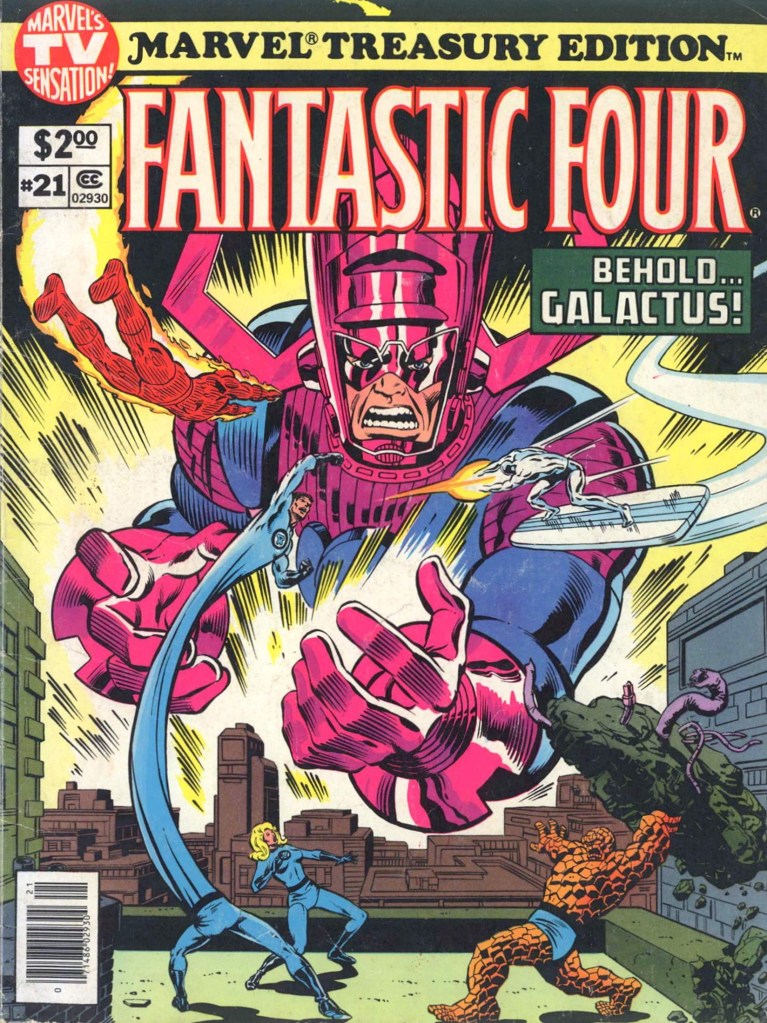
It was an exciting day when this Fantastic Four-themed MARVEL TREASURY EDITION showed up at my local 7-11. Because of their size, the Treasury Editions were racked with the general magazines rather than by the comic book spinner rack, meaning that you needed to know to go and look for them. As FANTASTIC FOUR was then my favorite comic book, and so I was delighted at the prospect of filling in some of the history that I’d missed with a collection of earlier stories. These quarterly Treasury Editions were about as close as we came in these days to Trade Paperback collections of older material. This cover, largely based on an interior splash page by John Buscema, was penciled by my future boss Bob Budiansky.
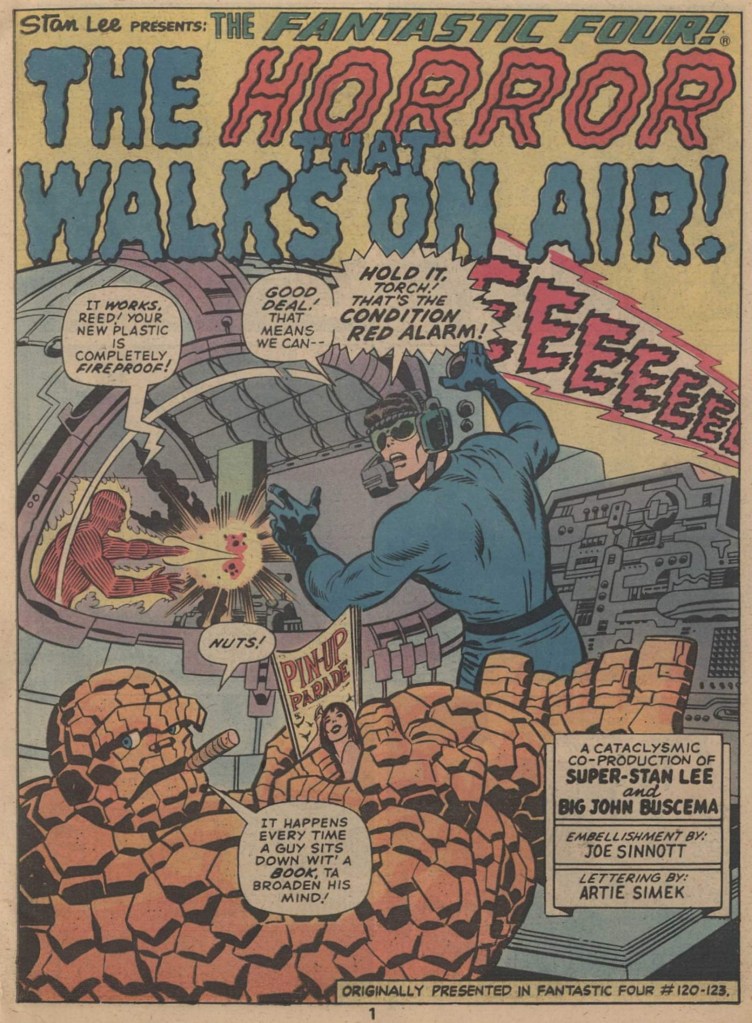
The book collected a four-part story from right at the end of Stan Lee’s tenure as the series’ scripter, after Jack Kirby had moved on to DC and the penciling chores had been turned over to John Buscema. Buscema’s versions of these characters were popular, and with FF’s iron man inker Joe Sinnott maintaining the sheen of the series, the book gained some new life after Kirby’s lackluster final year, even though not a lot of new things were going on. But these stories were decently crafted if nothing else, and I found them infinitely entertaining.
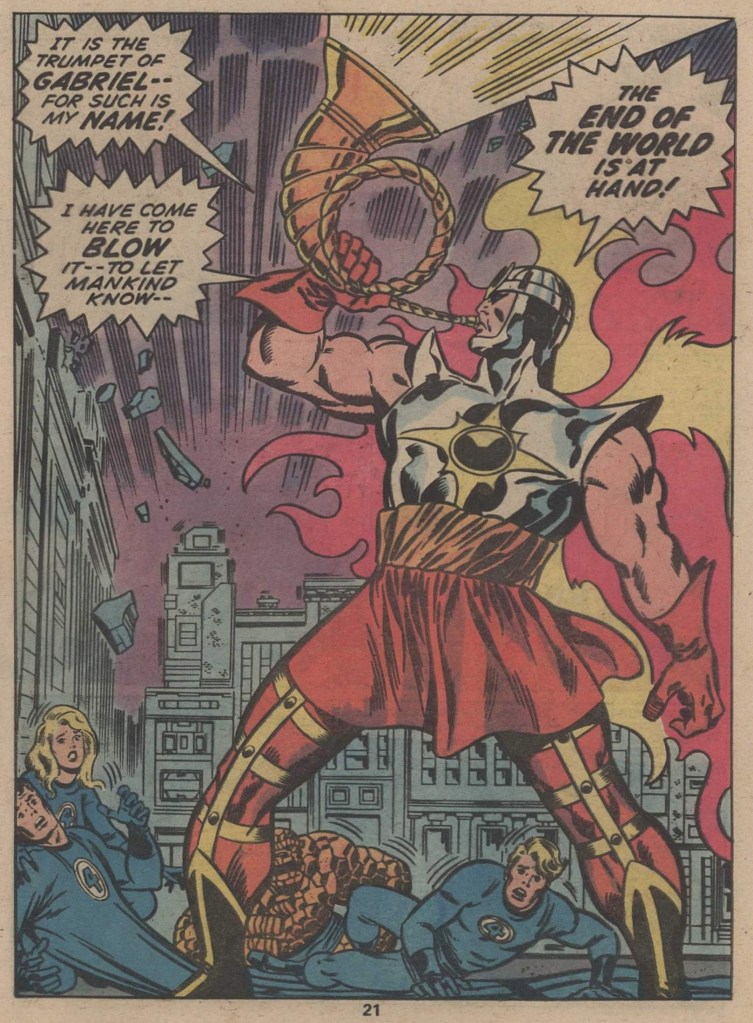
Reportedly, Stan was getting some help during his last year or so on the series following Kirby’s departure, and he turned to other folks to assist him in plotting the series, something he never seemed to like to do the nuts-and-bolts on. Supposedly, it was an uncredited Steve Englehart that came up with the plots for this four-parter. I’m spoiling plot points (not that the cover didn’t already do that) but this was only the third meeting between the Fantastic Four and Galactus, and the first in which the Big G had taken on a new herald to replace the now-emancipated Silver Surfer. In this case, the new herald was the silent Gabriel, the Air-Walker, who arrives on Earth to fear and panic. The FF spend an issue trying to communicate with him before he finally speaks, and pronounces the impending end of the world. It’s entirely a set-up issue, but it’s very effective in its presentation. Especially in the original printing, where the readership had no idea what grim menace was behind Gabriel’s warning.
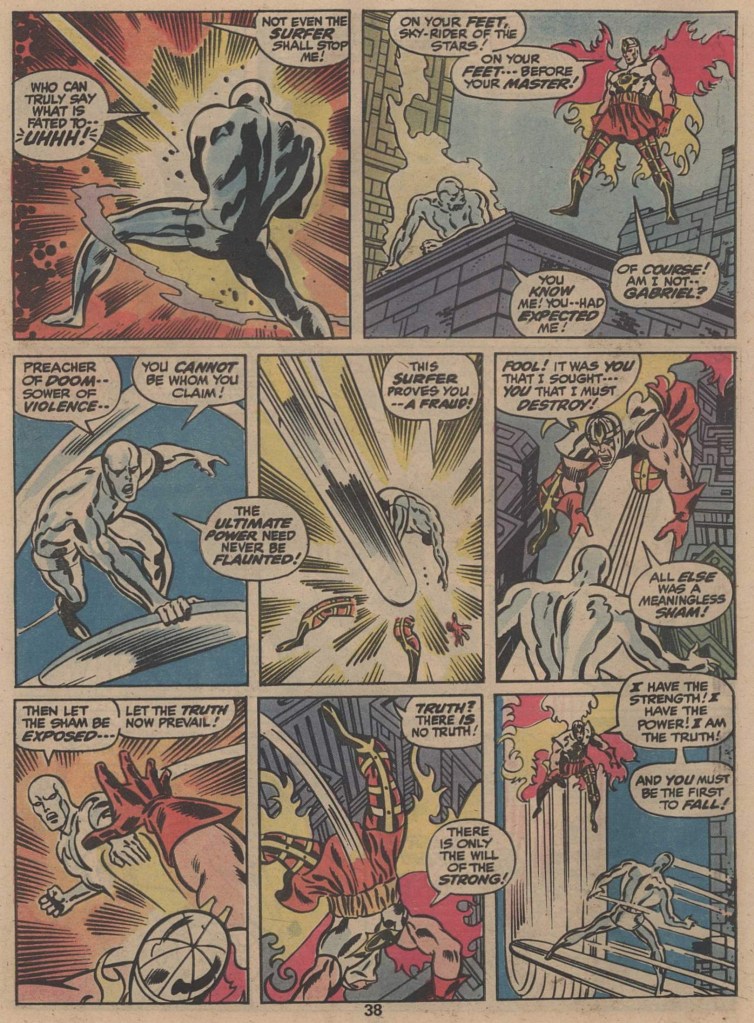
The FF spend the next issue trying to tackle the Air-Walker, but he’s not only impervious to their assorted efforts but he continues to race away from them by defying gravity, leading them to pursue him across the globe. Meanwhile, all of humanity is descending into chaos as a result of Gabriel’s proclamation of doom, and this maelstrom of activity catches the attention of the Silver Surfer. Still exiled to Earth by Galactus and shunned and feared by the human race, the Surfer was at his most weepy, but he chose to get involved anyway and confront Gabriel. Which was the whole point, as it turns out, as Gabriel recognizes the Surfer on sight and indicates that he’s the true objective of the Air-Walker’s crusade.
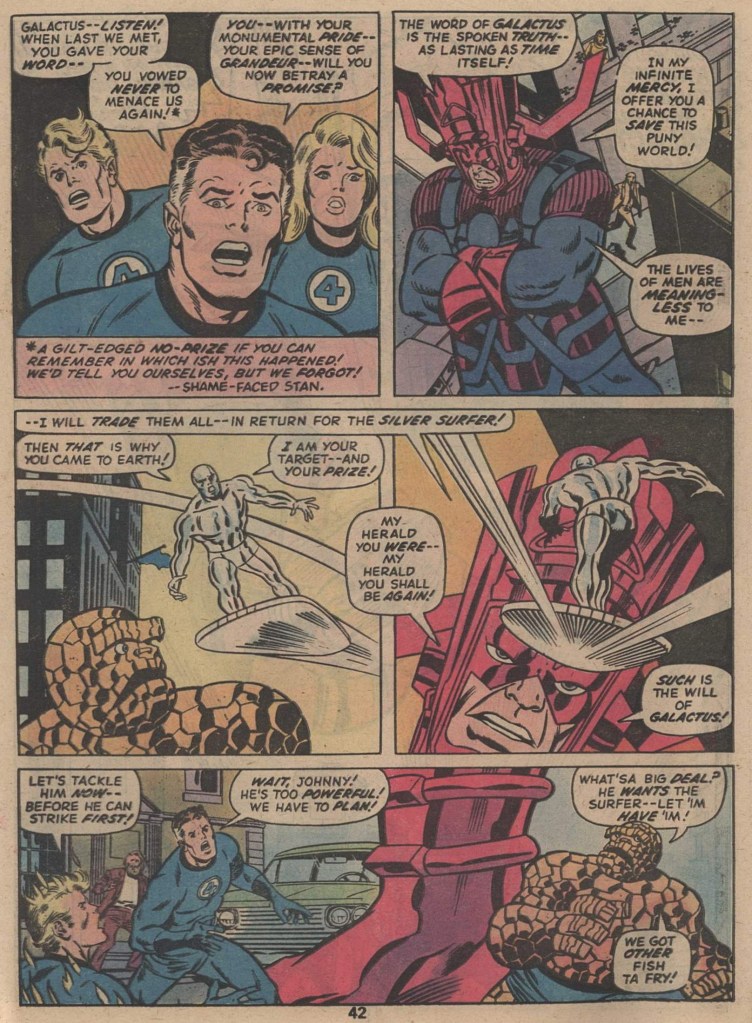
It turns out, though, in an underwhelming twist that kind of undercuts everything that’s come so far, that Gabriel is nothing but a crummy android, one that the Surfer is ultimately able to destroy. But this merely brings forward the true architect of what’s been transpiring: Galactus himself! He’d previously sworn not to consume the Earth, but he’s now prepared to break that vow–unless the Surfer returns to his service as herald once more. Having been stuck on Earth for so long and wanting nothing more than the freedom of the stars, you’d think this might be an easy choice for the Surfer. But he refuses Galactus’ offer, and so the FF are forced to physically engage with the planet-destroyer.
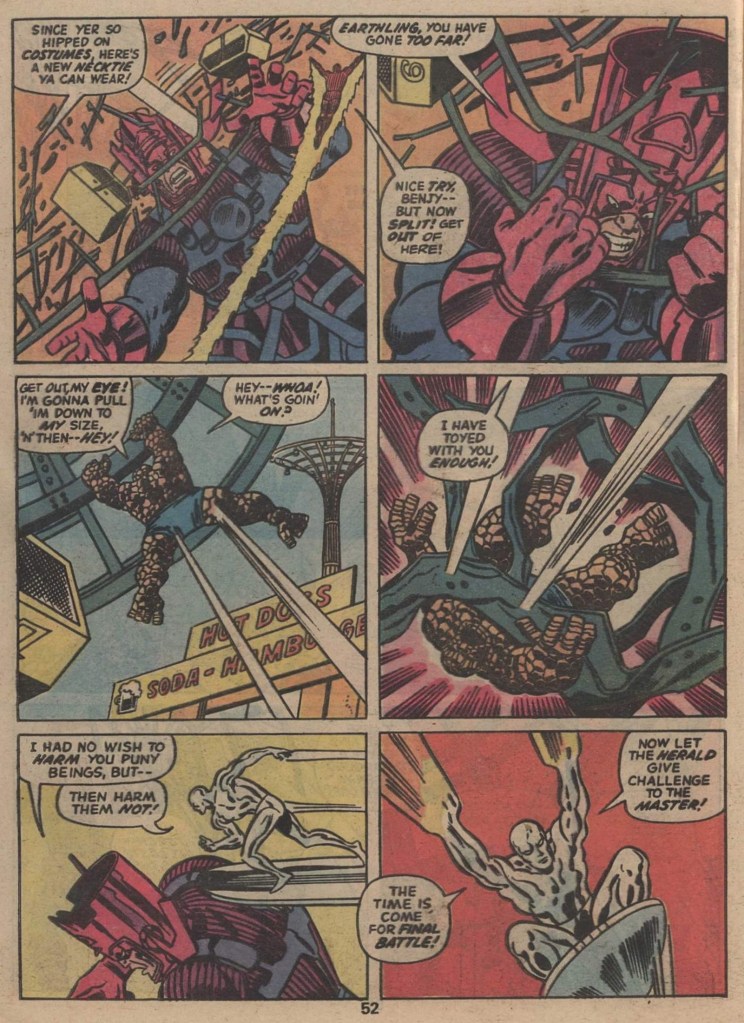
So there’s a series of big fights, and for the first time, Galactus begins to come across not as an all-powerful force of nature so much as a gigantic purple clod in a big helmet. The fight ranges over to Coney Island, where the Thing smashes a Ferris wheel atop Galactus, to no avail. But at a certain point, the Surfer realizes Galactus’ one weak point: his starship, which brought him to Earth. Because it’s outside of the barrier that Galactus erected to imprison the Surfer on Earth, he can’t reach it. So instead, Reed and Sue leave the others to delay Galactus and go after the ship themselves. Reed is able to work his way past Galactus’ defenses and take control of the ship. He lowers it into the atmosphere, and threatens to destroy it if Galactus doesn’t relent and withdraw–thus stranding him on Earth.
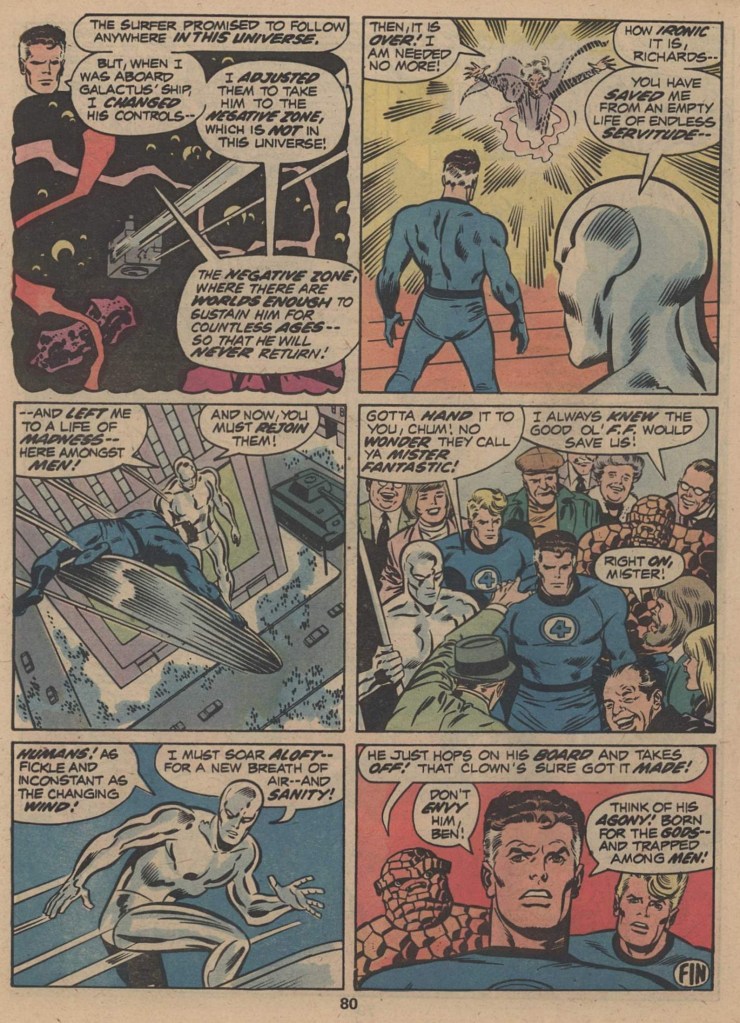
Galactus agrees to Reed’s terms so long as the Surfer goes with him, and the Surfer concedes to follow Galactus anywhere in the universe if he’ll spare the Earth. So Galactus leaves the planet and the Surfer moves to accompany him, but Reed tackles him, starting another fight. Meanwhile, the trigger-happy soldiers that have come to confront Galactus, seeing Mister Fantastic interfering with the Surfer’s departure, take a shot at Reed, seriously wounding him. Fortunately, the Surfer’s Power Cosmic is enough to sustain Reed’s life. And Reed reveals that he cheated–that while he was aboard Galactus’ ship, he altered the controls to send it somehow into the Negative Zone, where the world-devourer will find plenty to stave off his consuming hunger. So the status quo is maintained, and the Surfer gratefully jets off. It’s a perfectly fine four-part adventure, but it does seem to trivialize some of the mind-expanding concepts that Kirby had previously introduced.
 The Tom Brevoort Experience
I guess it could just be Stan Lee forgetting just what Galactus is suppose to be in the Marvel Universe or Galactus was starving like he was in Fantastic Four#243 ( June 1982 ) when he took a dive like I said before [ Cause he could have done to the FF in this reprint what he could have done to the FF & Avengers in FF#243 that he did to humble Terrax the Tamer in FF#211 ( October 1979 ) by turning him into a worm and I think dust before restoring him to Herald form ]. Just like he must have been low on power as a result of his battle with Ego the Living Planet [ Thor#161 ( February 1969 ) ] when Thor channel his strength through his hammer forcing Galactus to retreat in fear of his life.
LikeLike
Squirrel Girl postulated that Galactus attacks Earth not to eat it but because Earth’s heroes will generally find him and alternative source of energy. It’s likened to ordering take out.
LikeLike
The Official Handbook of the Marvel Universe Deluxe Edition#4 ( March 1985 ) –During these many millennia Galactus consumed only planets uninhabited by sentient lifeforms, except for Archeopia, and MANY CENTURIES PASSED BETWEEN HIS “FEEDINGS.” However, as ages passed, the intervals between feedings decreased considerably in length, and Galactus found himself needing to consume worlds inhabited by sentient races if he could find no other worlds possessing the energy he needs in time to sustain himself. No reason is given for the increase in “Feedings” but since Google says there is between 200 Billion to 2 trillion galaxies my theory is that while it appears that Galactus is ignoring those galaxies and fixated on the Milky Way ( once in a while the Andromeda Galaxy ) in reality Galactus is in multiple galaxies at the same time and that is why there is an increase in his “feedings” ( after all he is suppose to serve some kind a purpose and just hanging around the Milky Way clearly does not do that [ FF#262 ( January 1984 –Reed’s trial for saving Galactus ) ] — hence his need to be in multiple places at once and the need for the energy to do so.
LikeLike
This Stan Lee plot is similar ( Galactus trying to get the Silver Surfer back as his herald & threaten Earth too ) to a Lee-Kirby plot [ Fantastic Four#74-75 ( May – June 1968 ) — Punisher in FF#74 takes the Air-Walker’s place ]. Galactus agonized over his oath while struggling with his starvation.
LikeLike
My experience with the Treasury Editions was a little different.
I lived in Bradenton, Florida during the latter half of the 1970s. The only place to find the standard periodical comics were at 7-11’s and similar convenience stores, such as Shop ‘n’ Go. If you were a kid and you didn’t live by one–and I didn’t–you missed out for the most part. But the Treasury Editions, because they were racked with the magazines, could be found at all the supermarkets. My mom would leave me in their magazine sections while she did the shopping. I occupied myself mainly by reading Mad and Cracked, and the occasional Marvel or DC Treasury Edition, although I often felt like I was crashing a party when looking through the latter. But they were definitely my exposure to the Star Wars movie adaptation, and I distinctly remember the Superman vs. Muhammad Ali TE, among others.
It wasn’t until I moved to Sarasota in 1980, when I lived next door to a shopping plaza with a drugstore and bookstore that both carried the standard Marvel and DC periodical lines that I finally got into those.
LikeLiked by 2 people
Galactus already promised he would never attack Earth again. That he’s back for round three means he’s an oathbreaking shit and not at all above good and evil. And should never be trusted—Reed saving his life was a stupid move.
2)I do love the scene in X-Men where a newly arrived Shi’ar ship is sneering at our primitive tech then discovers “Galactus has attacked four times. They drove him off.” Suddenly the Shi’ar decide to take it slow.
LikeLike
“That he’s back for round three means he’s an oathbreaking shit and not at all above good and evil.”
No, it means the younger scriptwriters couldn’t get better ideas approved. and they resorted to nostalgia that undermined its source.
Here’s a truth. The references I first saw with Galactus circa 1980 had me thinking Galactus was a disease or plague of some sort. It wasn’t until What If #27 (What If Phoenix Had Not Died) that I realized Galactus was a character.
LikeLike
I had equally odd ideas as a kid: when the first splash page I’d seen showed most of the characters dead I assumed they’d died in an earlier story. Yet there they were alive …
Lee and Kirby broke the hymen by having Galactus come back. A later Thor story by them has Galactus getting huffy because the planet he wants to eat is attacking him — don’t they realize he’s only doing what he must? It’s not like he hates them or anything! So why the outrage?
LikeLiked by 1 person
“I had equally odd ideas as a kid”
I don’t know that they’re odd ideas. They’re reasonable responses to being made to draw inferences from context. The Shooter era was pretty good about making sure those inferences were accurate, but occasionally the ball was dropped.
I don’t get “why the outrage,” though. Galactus is an existential threat. Of course he’s going to be demonized by the inhabitants of a planet he targets. I don’t know which writer you’re referring to, but that’s bad work. Galactus would certainly recognize why people would be antagonistic to him.
LikeLike
It was Lee and Kirby, in THor.
LikeLike
Actually in Fantastic Four#50 ( May 1966 ) he was talking about the energies he needs to survive and that Earth wasn’t worth the fight. Probably why he threaten Earth with a planetoid ( asteroid ) in FF#75 ( June 1968 ) in order to get Reed, Ben & Johnny to give up the Surfer’s location. So if Galactus never threaten to eat Earth in FF#120-123 ( March-June 1972 ) then technically he isn’t breaking his oath.
LikeLike
He’s quite conscious in his second appearance that he’s not honoring the spirit of his promise as he keeps insisting loudly that his hands are tied, he needs food, it’s not his fault etc.
LikeLike
The MVP here for me is John Buscema. The dynamic power of hhs skills is on full display. Great figures, dramatic poses, expressive faces.
LikeLike
On page 5 of Fantastic Four#72 ( March 1968 ) the Silver Surfer creates a giant tidal wave and on page 13 of Fantastic Four#121 ( April 1972 ) the Air-Walker creates a giant tidal wave. I guess Stan Lee forgot all about the Sonic Shark Missile used to drain the Surfer of most of is Power Cosmic might[ FF#72 ]— yep a binder back then with a list of the Silver Surfer’s powers, characters connected to him & weapons used against him would have come in handy.
LikeLike