

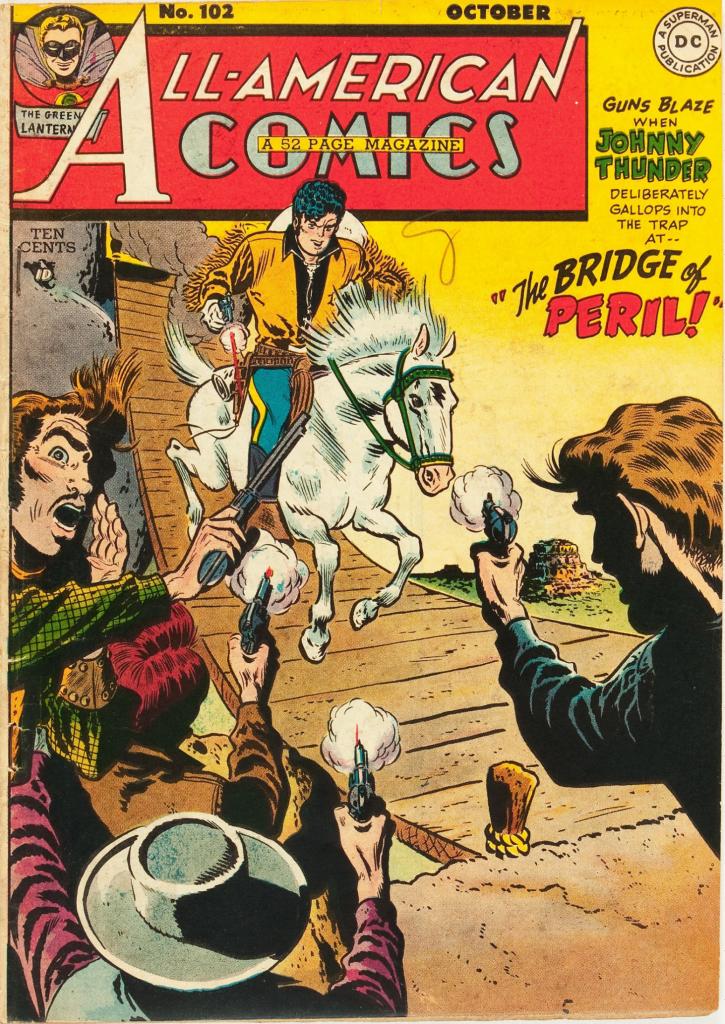
Even before FLASH COMICS met its end, other members of the Justice Society of America were experiencing their final solo adventures of the Golden Age. Green Lantern was luckier than some–his solo series lasted for a couple of months after his spot in ALL-AMERICAN COMICS had been taken over by western hero Johnny Thunder. But his colleague Dr Mid-Nite wasn’t so lucky. Apart from his appearances in ALL-STAR COMICS as a member of the Justice Society, Dr Mid-Nite’s final bow was in this final super hero-themed issue of ALL-AMERICAN COMICS.
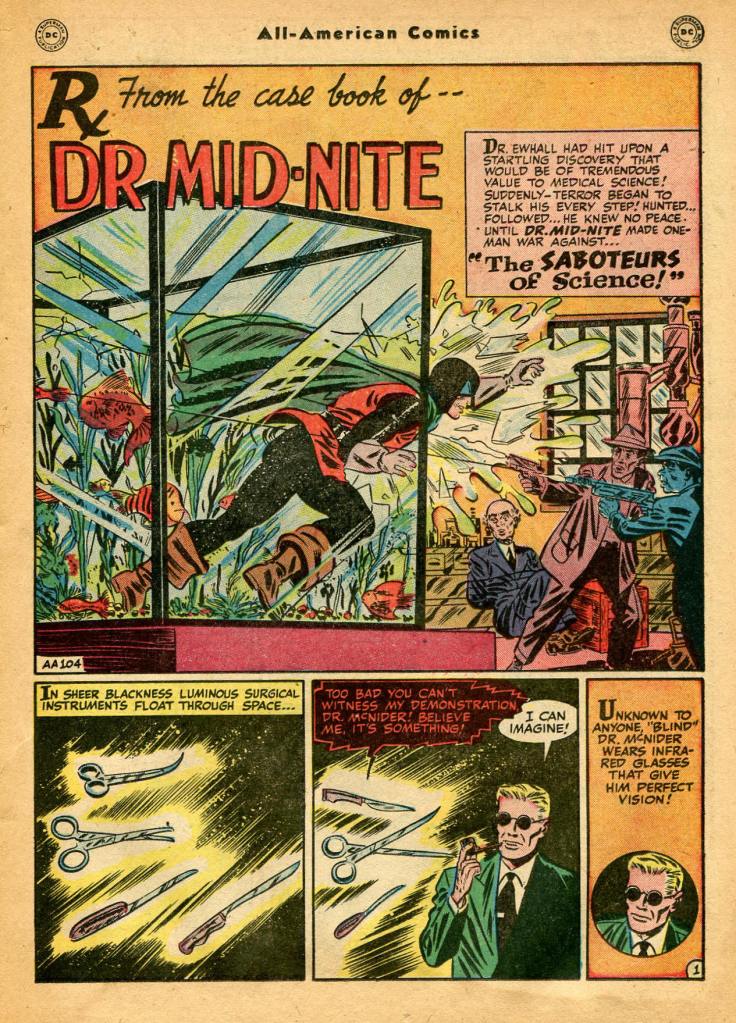
The author of this tale has been lost to time, but the artwork was produced by the team of Arthur Peddy and Bernard Sachs.
There were a couple of in-production Dr Mid-Nite stories that had been completed and didn’t see print. Some of these eventually wound up in 1970s DC books. A notation on the splash page of this story indicates that it had been commissioned for the never-happened ALL-AMERICAN COMICS #104.
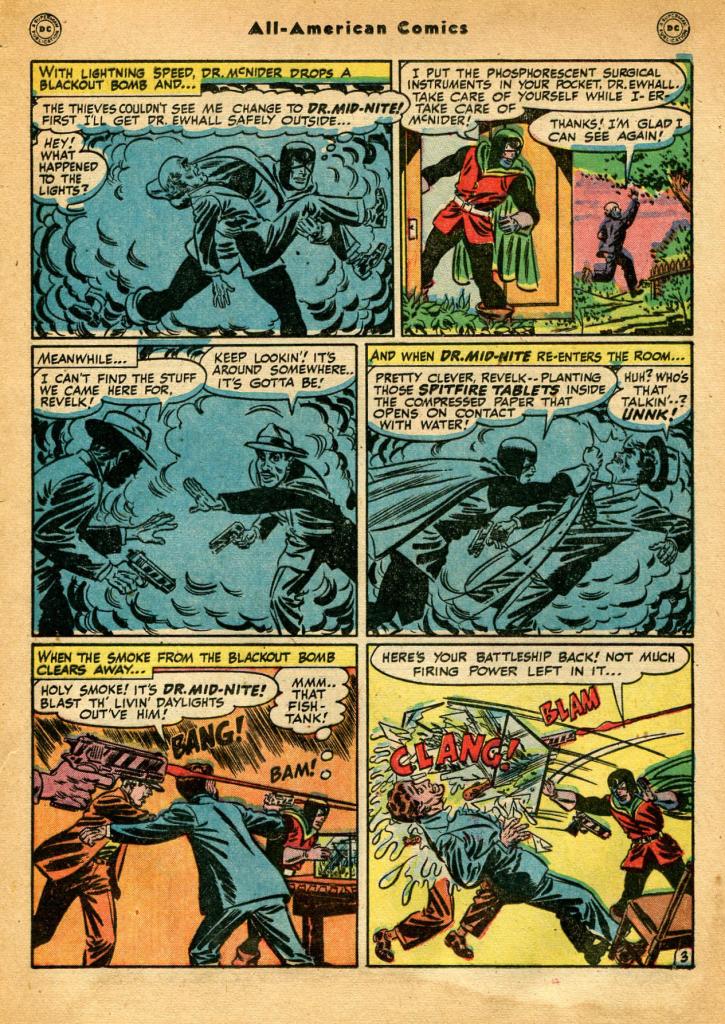
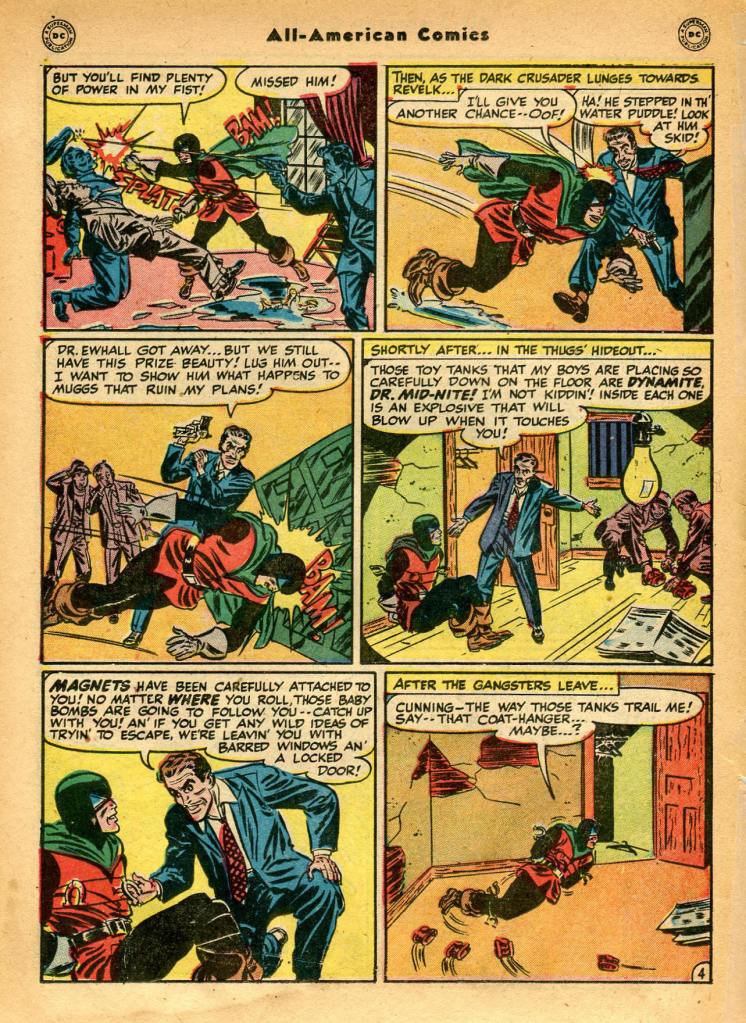
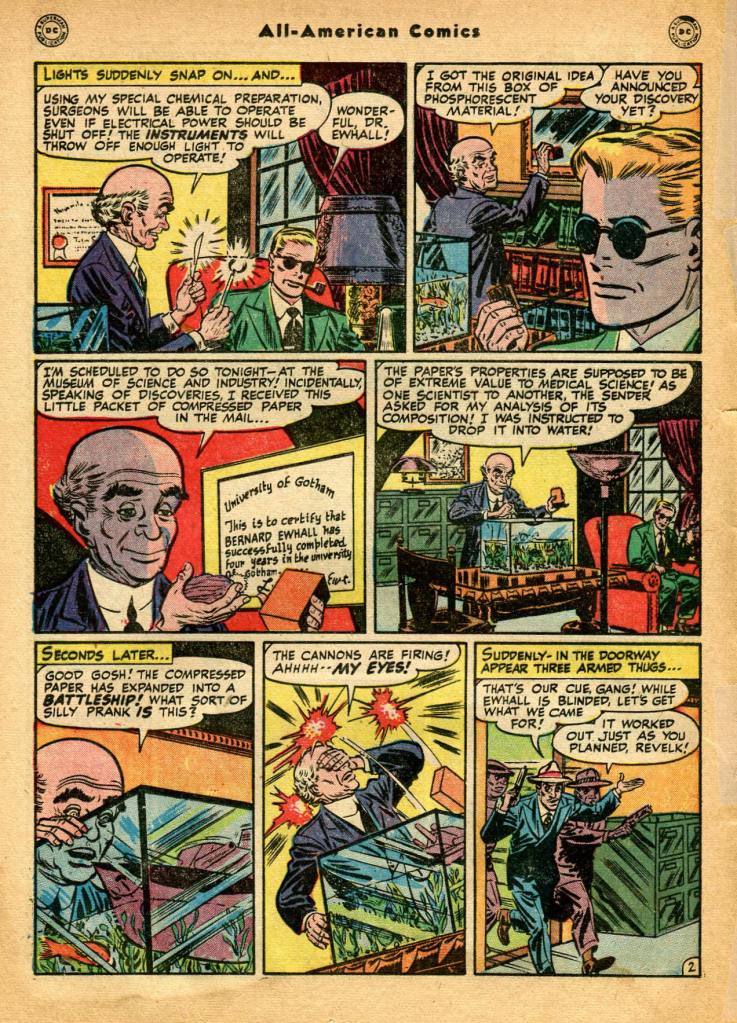
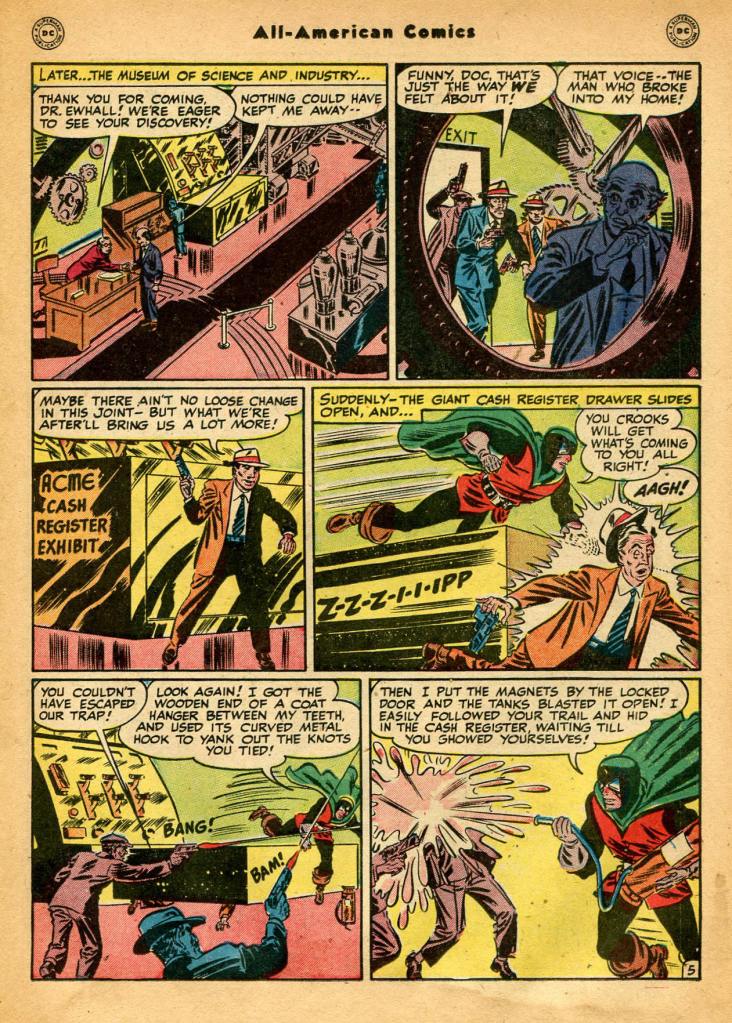
The super hero stories in the All-American Comics releases of this period had become incredibly formulaic affairs. In each story, you could depend upon the hero being incapacitate, put into some (typically needlessly complicated) dire situation, then having to free himself before wrapping up whatever that month’s menace happened to be.
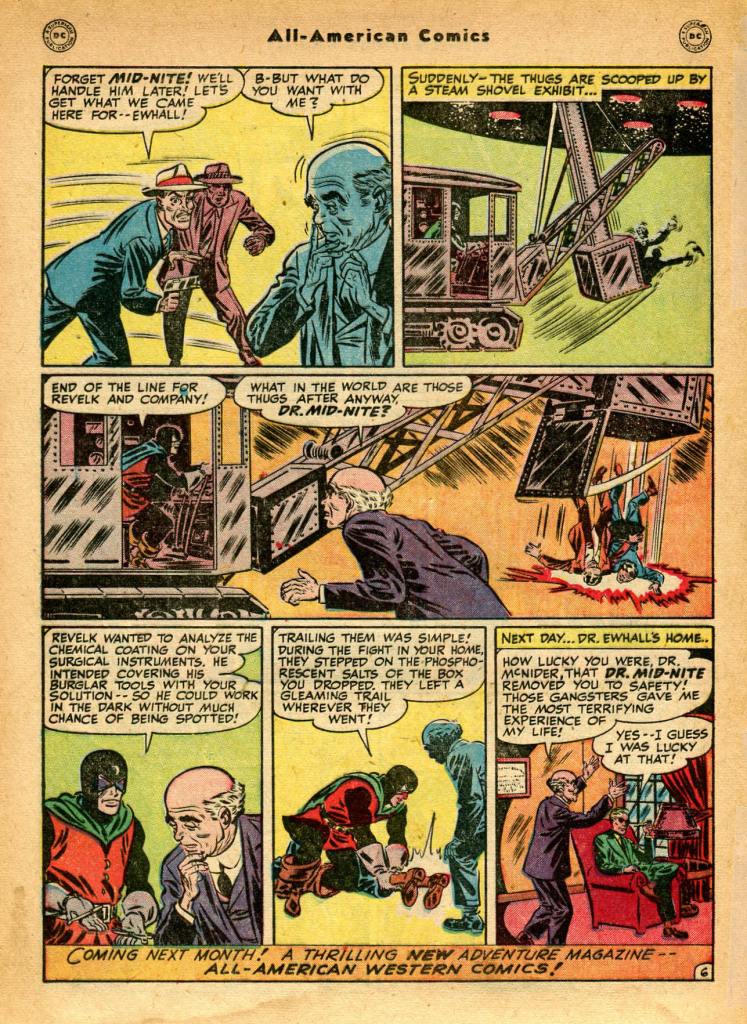
The final caption on this last page heralds the future for poor ol’ Dr Mid-Nite. Next month, ALL-AMERICAN COMICS would transition into ALL-AMERICAN WESTERN, and it wouldn’t have a place any longer for modern day costumed crusaders, sightless or otherwise.
 The Tom Brevoort Experience
That “here’s how I escaped,” in big word balloons, really should have been shown on the page. But, well, 6-page story while DC was refocusing on other things…
LikeLike
I think the crook’s mistake was using horseshoe magnets….they inadvertently gave Dr. M good luck.
Along with the GA Sandman, Hawkman, Hourman, and Atom… I always liked this guy.
LikeLiked by 2 people
So I was curious to see if Doctor Mid-Nite was the only Golden Age blind superhero and started with an obvious name – Blackout II ( Jack Wayne, American reporter )[ Cat-Man Comics#10 ( May 1942 ) ( Holyoke ) ] — 15 appearances 1942-1944, created by Robert Brice & ? ] the Gestapo tortured and blinded him, but he escapes their clutches and links up with the German underground, one of whose doctors gives him special glasses that allow him to see ( Jess Nevins’ Encyclopedia of Golden Age Superheroes ).
LikeLike
Here is another golden age blind superhero who appears in a prophetically named series: NIGHTRO [ Daredevil Comics#2 ( August 1941 ) ( Lev Gleason ) ] Hugh Goddard is a young scientist who discovers some radium in Alaska but is left to die in the snow by a crooked assistant. He suffers from snow blindness but is rescued by “kindly Eskimos ( or as the call themselves Inuit ( The People )” and returns to the mainland. He’s not totally blind, though: he suffers from a “peculiar affliction” which allows him to see through “poloroid glass”, including seeing in the dark.
LikeLike
I forgot that like that never picked up Daredevil cartoon where he fought crime with his dog Lightning, that golden age blind hero Nightro also fought crime with his dog Blackie.
LikeLike
Is that Matt Murdock on page 2, panel 2?
Just kidding, but there is a passing resemblance.
Nothing new under the sun, especially in the comics field!
LikeLike
I was expecting it to be a plot point somehow that the main baddie’s name was “clever” spelled backwards, but the only thing we get out of it is that one word balloon which says “Pretty clever, Revelk”.
LikeLike
The splash panel of Dr Mid-Nite bursting out of the fishtank makes me wonder if that was an original idea for the story that was dropped.
I’m a fan of Hourman’s golden age era, and his final year of stories (as early as 1942) strictly followed the elaborate-deathtrap-and-escape formula too. Maybe he was more of a trendsetter, and the other heroes followed his lead… 🙂
LikeLike
I wonder if Peddy & Sachs did the cover? Or if it was Alex Toth? He drew several covers featuring cowboy Johnny Thunder. But they may have been later than this one.
LikeLike
Looking at the cover (and the “Western Bad Guys ” issue of All-Star); Yeah, it might be Arthur Peddy. GCD credits it to Toth.
GCD credits Toth also for several early Johnny Thunder covers.
My impression is Toth, in the late 1940s/early 1950s, had a rep like the (also uncredited Carl Barks had at Dell: “the good artist.”
If he drew it (or appeared to draw it) it sold. Possibly why, he got put on Johnny Thunder and Streak/Rex (and taken off superheroes like GL and JSA) fairly soon.
LikeLiked by 1 person
Hey, thanks, John! 🙏😉
LikeLike
This did not seem like a John Broome story.
Of course, by that I mean it does not seem like a John Broome Western or Science Fiction or “Big Town” story from the 1950s or one of his superhero story from the 1969s.
This comes from before Julius (“Be Original”) Schwartz had helped him to become spmeone who Schwartz thought was the most original writer he had working for him..
Even in the 1940s, Broome could do clever stuff (“The Fate of a Nation” over in All-Star or several of his Flash and Green Lantern solo stories.) The Hawkman stories he did (e.g,., “The Human Fly Gang” from Flash Comics #100) was an ok story, that gave Joe Kubert interesting things to draw, but did not create the kind of interesting and well realized bad guys that he did in the Flash and Green Lantern in the 1960s.
The above story seems less well executed than Broome usually did even in that period, (Almost like his credited Green Arrow and Robin stories, so it is possible he wrote it.)
I can’t say that I have seen a Golden Age Dr. Midnight story that I really liked. “The Talking Shadows,” which was reprinted in Detective Comics # 445 and is credited to Broome (to the degree I remember it) really isn’t a story and is more of an incident.
I think I understood why Broome was so willing to dive into the Flash and GL revival, but did not jump into the Flash or Atom revivals (and, along with the rest of the industry) never pushed to update Dr. Mid-Nite.
(Part of the problem is that I never understood as a kid what Dr. Mid-night (or the original Atom) could do. Did the atom have super powers and at what point did not make senses to me before All-Star comics in the early 1980s.)
LikeLike
Should have been:” “I think I understood why Broome was so willing to dive into the Flash and GL revival, but did not jump into the Hawkman or Atom revivals”
LikeLike