


PETER PARKER, THE SPECTACULAR SPIDER-MAN was in the middle of a very good run of stories mainly revolving around the true identity of a mysterious new foe for the wall-crawler, the creepy Carrion. It was clear based upon the assorted clues dropped into the narrative that Carrion was somebody who knew an awful lot about Spider-Man, including his true identity. And even though my working knowledge of Spidey’s history was relatively limited at this point, I was invested in finding out what the answer was. All throughout the story, I was into the book–little realizing that writer Bill Mantlo’s intended reveal had been scuppered right at the point where Mantlo was about to make his big reveal, necessitating an emergency pivot.

But that ultimate reveal was still an issue away at this point, and its explanation would have to wait for two months. But it’s worth saying up front that Mantlo intended for Carrion to have been a resurrected Norman Osborn, the Green Goblin, hence his costume’s echoes of the Goblin’s own gear. Tony Isabella has revealed that Mantlo had once told him that Carrion was intended to be the clone of Peter Parker, but that seems like it was maybe Mantlo’s first pivot-point when the Goblin became unusable as the villain’s alter ego (thanks to protests from AMAZING SPIDER-MAN writer and editor Marv Wolfman.) Anyway, that’s how I square it all. By this issue, it’s clear that the decision to veto Mantlo’s original idea had taken place, and so Bill begins to shift his set of clues and evidence towards the character who will turn out to be the actual alter ego of Carrion. But I’ll save that reveal for the days ahead.
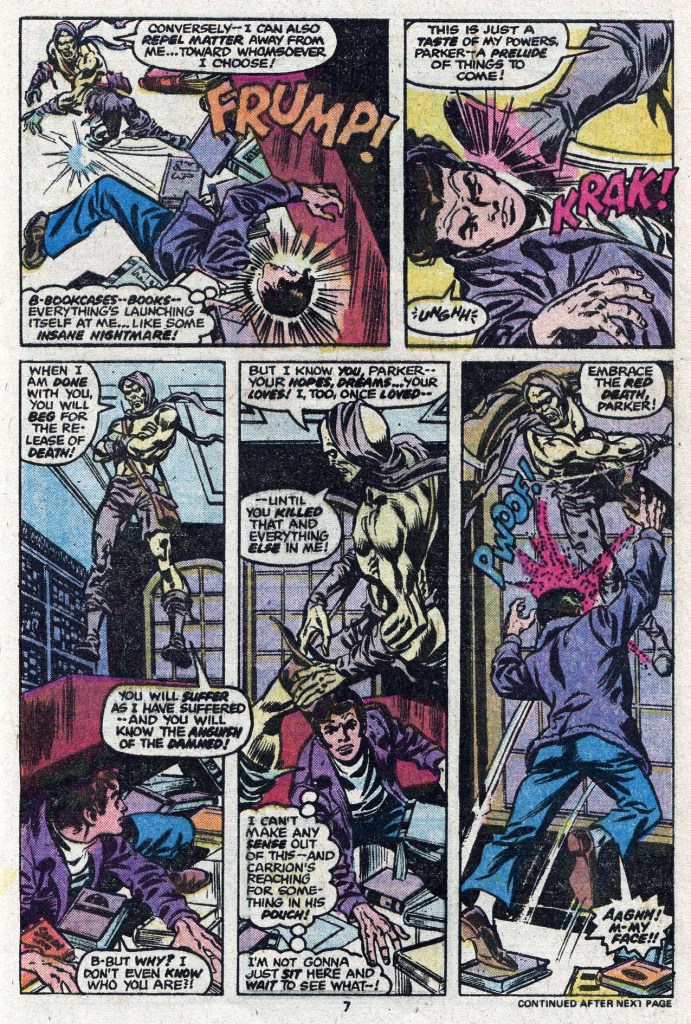
At the end of last issue, Carrion ceased taunting Peter Parker from afar and instead attacked him directly in the Empire State University library. Even Pete’s buddy Hector Ayala, better known as the White Tiger, was unable to get him out of this jam. And as this issue opens, Carrion presses his attach while Holly, Hector’s girlfriend, attempts to rouse her unconscious boyfriend and Peter grapples with whether he’s going to need to divulge his secret identity in order to save everybody. It’s a very classic super hero 101 dilemma, but delivered well here.

After a bit of tussling, Carrion withdraws for really no good reason at all, and Peter is unable to prevent his escape. Hector revives and is able to convey the injured Peter to the campus medical station, where he gets some treatment for his exhaustion and injuries. But Peter still has no idea who Carrion really is of why he’s prosecuting this line of attack against him, labeling Parker a murderer. As Pete leaves the infirmary, he bumps into one of his undergrad student, Randy Vale. Randy only has a small role to play in this adventure–he’s an underling of Carrion’s here–but he’ll come to be an important piece in later years as Carrion’s backstory was revised and revised and revised again as the events of the first Spider-Man clone saga were endlessly reworked.
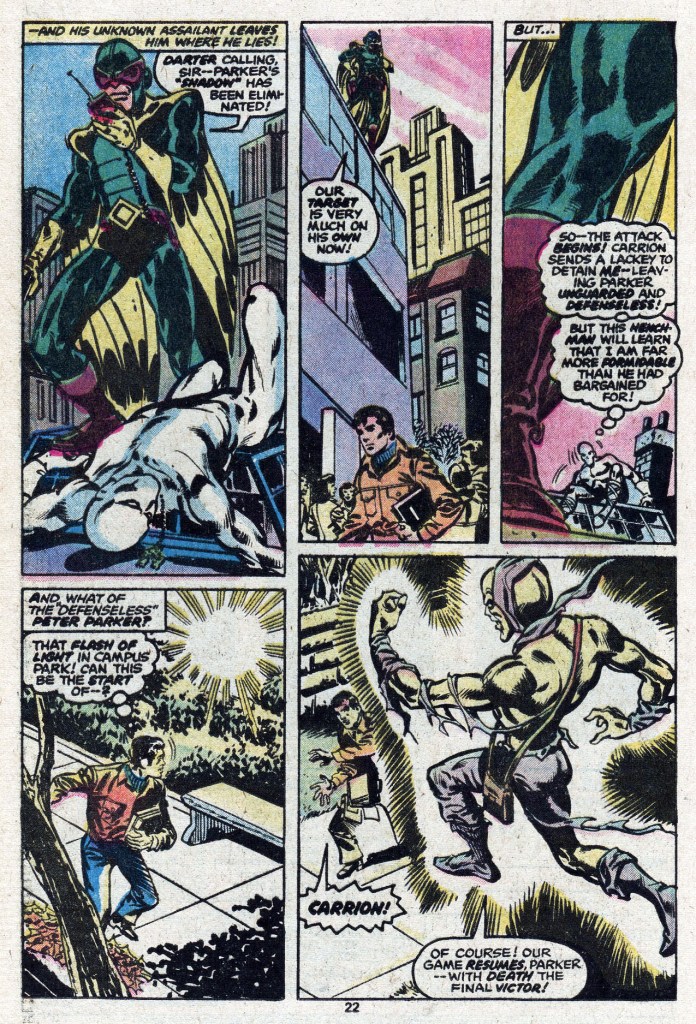
Anyhow, Carrion fits out Vale in a costume that lets him glide across the sky and that’s equipped with a bunch of weapons, and calling himself Darter, he swiftly takes out the unsuspecting White Tiger, who has been keeping a surreptitious eye on Peter Parker like a guardian angel, assuming that Carrion will strike again. And of course, the Tiger is right, This time, Carrion confronts Peter right out in the open in broad daylight on the E.S. U. campus. At this point, Parker races off to put on his Spider-Man costume, and Carrion pretty much lets him do it. One can only assume that the villain is aware that, despite the title of the series, the audience is here to see the web-slinger in action, not merely his collegian alter ego.

And fight Spidey and Carrion do, but it’s a one-sided battle with Carrion constantly having the upper hand, using his powers to vanish at a moment’s notice like a phantom. What’s more, Spidey’s spider-sense doesn’t register Carrion as a threat, a situation that confuses Peter even more. (This is one of the many earlier interpretations as to how the spider-sense functioned before it got codified into reacting to direct danger to Peter regardless of its source.) So this is a clue–and the wall-crawler continues to taunt Carrion, hoping to get some additional information out of him that will reveal who his foe truly is. And ultimately, he does.
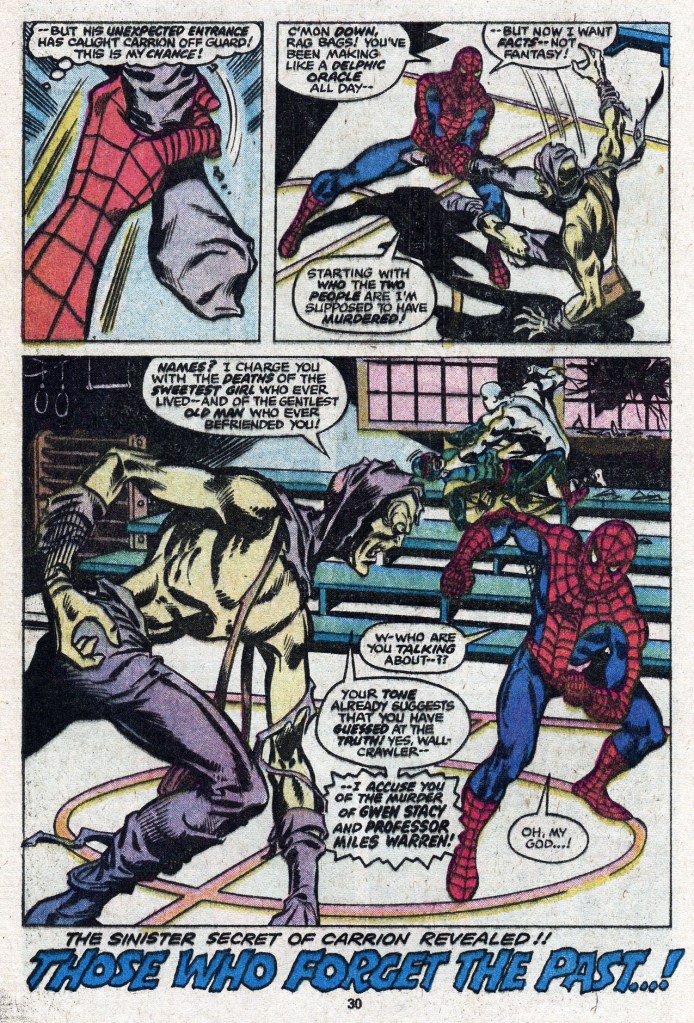
And he gets it in spades–enough for any Spider-Man fan of the period who was up on their lore to instantly realize who and what Spidey was dealing with. Sadly, this didn’t include myself. I hadn’t yet read the infamous Spider-Man clone storyline at this point, and so while I knew who Gwen Stacy was and what happened to her, I wasn’t really familiar with Professor Miles Warren. So this reveal went right over my head, for all that it struck enough of a bullseye with Spidey to be considered the cliffhanger of the issue. But I’d find out a whole lot more next time.
 The Tom Brevoort Experience
Carrion’s first true identity would have prevented the whole Clone Saga so that would have been a godsend we never knew we’d gotten. Trouble is, we still got Ben turned eeevil through no agency of his own recently. Denied true identity number two would have prevented a character becoming almost as annoyingly overused as DC’s Joker. I stopped following Spider-Titles after being massively turned off by McFarlane’s art so I don’t know what barnacles got put on Carrion later and feel no urge to educate myself on Wikipedia.
LikeLiked by 1 person
IIRC Carrion was created by a defective “clone virus” that infected a classmate of Peter’s. This was during the timeframe when it was decided (correctly IMHO) that it was ridiculous that a college professor at the low rent diploma mill of ESU to be able to clone someone. This was also when it was thought that the Spider-Man clone was actually the Jackal’s lab assistant who was infected with a successful version of the virus. Ditto Gwen Stacy.
LikeLiked by 1 person
I don’t think ESU was intended to be a low-rent school, just Marvel’s version of NYU.
LikeLiked by 1 person
NYU isn’t low rent? 😉 Just low grade sarcasm on my part. But, however good ESU was the likelihood of cloning happening there was remote at best. Even in the comics of the time it was pretty much super rare super science. They had to later make him a student of the High Revolutionary to make it at least semi plausible in retrospect.
LikeLike
IIRC, when the Inhuman/Deviant hybrid Maelstrom was introduced, they established that he had shared his advanced genetics research with a number of people, including Arnim Zola, Miles Warren, Magneto, and the Enclave who created Him/Warlock. A typically Gruenwaldian move to explain why all these far-flung scientists were suddenly super-genetics experts.
LikeLiked by 2 people
A Gruenwald story that was mostly just a fix? Luckily I was close to my fainting couch when I read this! 😉
LikeLike
To me Gruenwald’s explanation just opens up another can of worms. It’s like not being able to suspend disbelief that Dr. Frankenstein could create life in the 18th century so he must have gotten help from an advanced being.
Why can’t they just be unrelated super-genetic experts that create something that either comes with a high price or backfires as evil science tends to do? The MU is a universe where it’s not unusual for a scientist to create an aging ray in his basement, or for a biochemist to also be a genius at entomology, robotics and AI. Miles Warren making clones isn’t that bizarre… since he’s one on a list of scientists who comes in contact with Spider-man. Farley Stillwell, Spencer Smythe, Norman Osborn, Curt Connors, and Miles Warren not only make fantastic discoveries… they probably all shop at the same grocery store and run into each other at the bank.
LikeLiked by 2 people
It’s that whole “Everybody must know everybody” things. It’s kind of like in sitcoms when everybody keeps running into one another in NYC, like there are no other people there and no one ever leaves the block they live on.
LikeLiked by 1 person
I found “no mere college professor could master cloning!” to be ludicrous special pleading.
LikeLike
The idea that Spider-Man’s spider-sense doesn’t react to Carrion is to my mind a hint that Carrion’s the Parker clone, not Norman. His spider-sense reacted to Norman plenty.
I don’t think the original story ever established whether it reacted to the clone, but it’s an obvious conceptual bit — it wouldn’t react to himself.
LikeLiked by 2 people
I seem to recall someone making the prediction in a letter’s page that Carrion was Green Goblin Bart Hamilton. In the end… the Miles Warren reveal works as well as any with the Goblin pouch and costume shreds working as a misdirect.
LikeLike
Tom on the subject of working knowledge of a character’s history being relatively limited, that was me during “The Great Darkness Saga” [ Legion of Super-Heroes#290-294 ( August-December 1982 ) ] and my greatly limited knowledge of Darkseid ( I only had Marvel and DC Present Featuring the Uncanny X-Men and the New Teen Titans#1 ( 1982 ) and I think in a cartoon — but the character left little impression in me, The Great Darkness Saga changed that ) and during the X-Men’s first encounters with the Hellfire Club the hint that Jason Wyngarde’s shadow cast on the wall by the headlights of the car the X-Men were leaving in was the shadow of Mastermind [ The X-Men#130 ( February 1980 ) last page ] left me in the dark at just who it was Cyclops saw that his mind didn’t register at the time ( Granted I only had 2 books with Mastermind in them, neither of which showed his powers – The Defenders#16 ( October 1974 ) & The Champions#17 ( January 1978 ) ).
LikeLike
So if Carrion was originally suppose to be the original Green Goblin ( Having that bag pointed to that more than it does a Spider-Man clone or the Jackal ), was he suppose to be a sentient zombie or failed attempt at resurrection by science? I don’t know if Carrion ever exposed Peter/Spider-Men to any gases, but the original Green Goblin created a gas to neutralize Spider-Man’s extrasensory “spider-sense” for a limited period of time ( Official Handbook Deluxe Edition — The Amazing Spider-Man#39 ( August 1966 ) )
LikeLike
I think Carrion was one of Mantlo’s better villains and for that reason I’m glad he was not some clone of the Green Goblin, though thanks to this essay I can see the similarities.
LikeLike
As a reader I was unaware of the background drama concerning Carrion. There was no Internet at the time to clue into such matters. I did like the villain, however, and agree with you that Bill Mantlo and company were really hitting their stride on the title.
LikeLiked by 1 person
Honestly, I think having Carrion turn out to be a Miles Warren clone-gone-wrong works a lot better than him being the literal ghost of Norman Osborn. Spidey’s certainly had his brushes with the supernatural over the years, but “mad science” is much more in keeping with his general milieu.
LikeLiked by 2 people
IMHO another Excellent Pollard Cover. He was very busy at Marvel 1978-1980 he produced and produced well! IMHO not given proper due for his work during that time.
LikeLiked by 1 person
This was definitely some of Mantlo’s better work — and “Carrion, My Wayward Son” remains one of my favorite pun titles.
Even Stan and Steve tended to handwave the logic of spider-sense. In Spidey’s first teamup with the Torch, for instance, Peter’s able to sense the villain’s hideouts even though they’re unoccupied. In another story he detects two thieves who aren’t a threat to him and aren’t planning anything criminal (they’ve just finished a job).
LikeLike