


1986 was the year in which the wider world began to become familiar with the concept that comic books could be vehicles for more serious and thoughtful ideas than merely slam-bang adventure stories for children. The twin juggernauts of Frank Miller’s THE DARK KNIGHT RETURNS and Moor and Gibbons’ WATCHMEN along with the release of Art Spiegelman’s MAUS put comic books for adults on the feature pages of newspapers coast to coast. This was also a goal that comic book fandom had long been lusting after, at least in the abstract. And so, a lot of publishers attempted to take the lessons evidenced by Millar and Moore and the others and to produce similarly grown-up works about men in tights. They weren’t all equally successful or even much remembered after all this time.
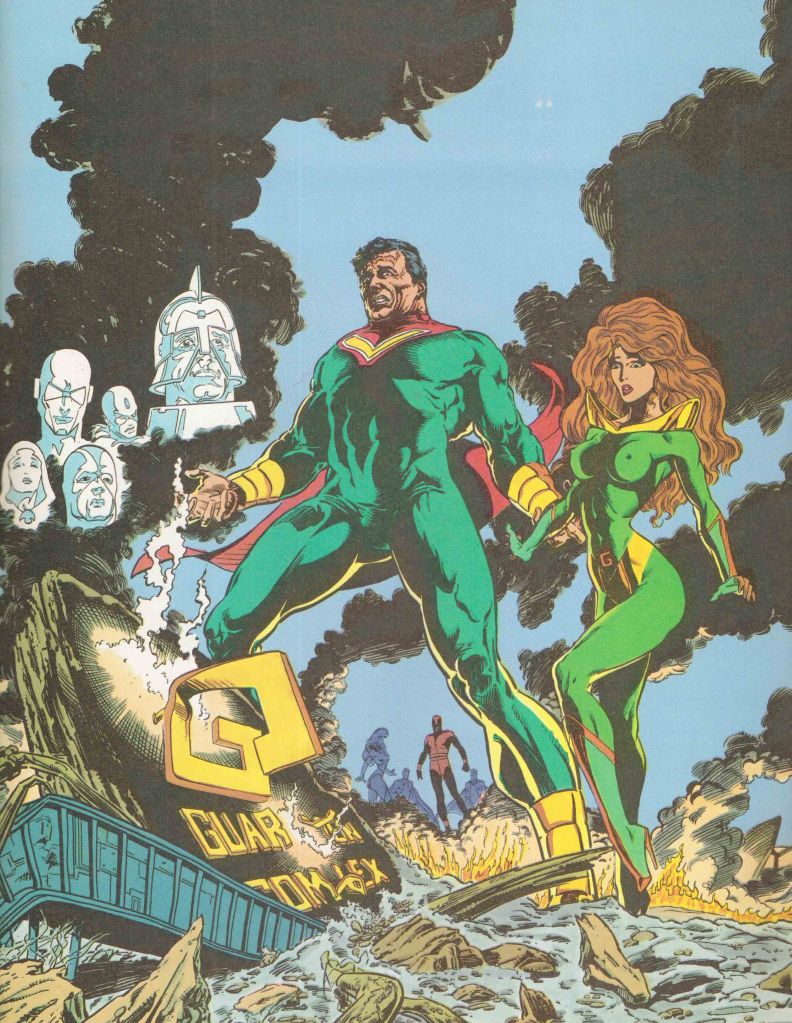
Pied Piper Press wasn’t in operation for long. It was one of a group of interlocking companies/imprints that were associated with publisher David Campiti. As far as I can work out, the only comic book material it published was the HERO ALLIANCE kickoff graphic novel. Apparently, the feature had first run in a pair of comic books issues by SIRIUS, but I couldn’t locate even images of the books in question. But underneath an especially ugly uncredited painted cover (based on a somewhat-better interior illustration), the squarebound volume, released in the European Album format, introduced an entirely new super hero universe, one that was intended to showcase a more adult-oriented approach to the material. Unfortunately, this wound up meaning a lot of unnecessary cheesecake on the parts of the female characters, mostly. I’m told that the material for this Graphic Novel had been repurposed from the two Sirius issues, which may help to explain why four artists were involved: a young Ron Lim, Mikey Witherby, Bart Sears and Rick Bryant. Despite the diversity of hands involved, the package mostly hangs together relatively well stylistically. The series was created by Kevin Juaire, who co-wrote this first release with David Campiti.
ADDITION: Kurt Busiek pointed out the signature on that painted cover on the lower left, revealing the perpetrator to be one R.T. Schneider

Despite its shortcomings, HERO ALLIANCE did presage a number of ideas and themes that would be further developed by creators to come. The central storyline of this initial offering centers around Victor, an older Superman-like figure whose mentor, the Golden Guardsman, disappeared years ago, and who finds himself ethically at odds with the new modern brand of costumed hero that is more interested in self-promotion and media fame than in doing the job properly. If this sounds a bit like KINGDOM COME to anybody, that’s because it’s very much in the same realm, albeit not executed at anywhere near the level of Mark Waid and Alex Ross. Still, the ideas in it made it an interesting release when it came out in 1986.

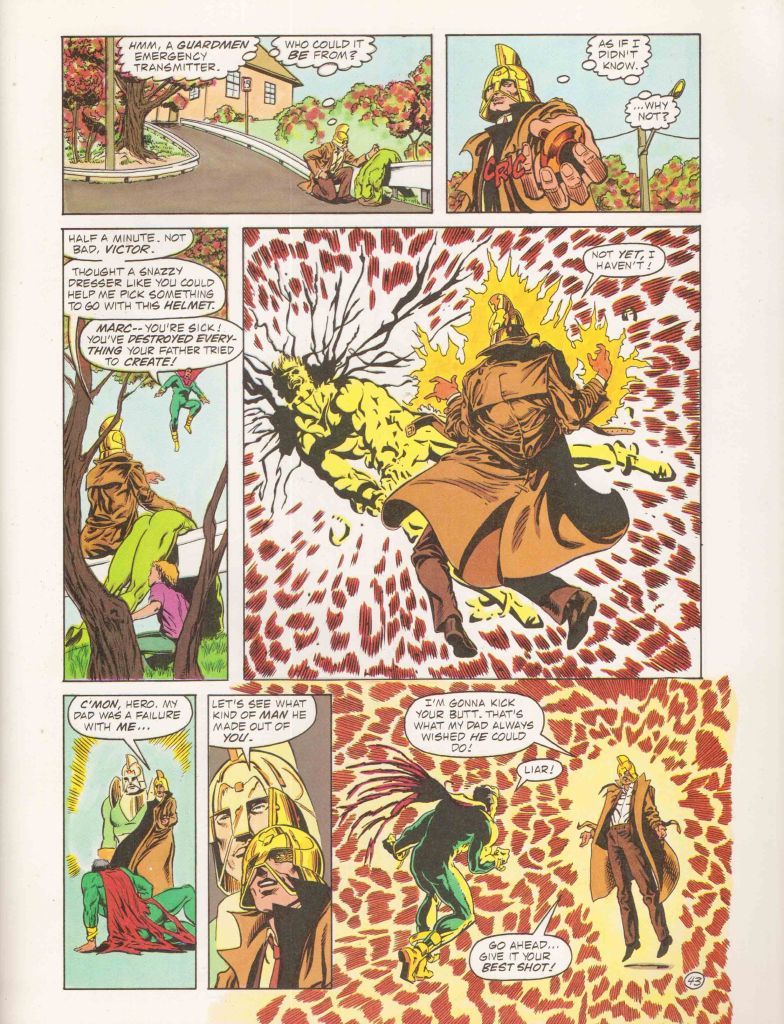
Victor walks away from the Guardmen, and so he wasn’t present when some time later, their headquarters was attacked and destroyed by their enemy Sepulcre, killing the entire team. Realizing the need for an organization that can help provide leadership and guidance for the new generations of super heroes who are cropping up, Victor is inspired to set up the Hero Alliance–not a team in the classic sense, but more of a support group that can help to pass on the classic ideas of herodom to a new generation. So very much what the Justice Society would be doing in the years ahead. Closer to home, Victor winds up having to battle the son of the Golden Guardsman, who is corrupt and selfish and who uses his father’s old power helmet to augment his already-formidable abilities. The creators were clearly looking at Moore’s Kid Marvelman in their depiction of the character, but their take was a lot flatter and less nuanced than what had been done previously.

The cast of characters in HERO ALLIANCE were an odd lot who nonetheless had a couple of interesting ideas to them. In his civilian life, Victor is a Jack LaLaine figure, Vic Torrence, who runs a chain of highly-successful gymnasiums and hosts fitness programs. The daughter of the Golden Guardsman, Kris, takes up her father’s costume and identity in order to stop her criminal brother and to make sure her father’s reputation isn’t tarnished. Predatorr is a non-powered hero who winds up bruised and battered after every mission, taking almost as much punishment as the criminals he ruthlessly targets. Tawny Winters uses her empathic abilities to become an actress and supermodel, and she becomes a part of the Alliance despite having no desire to act as a costumed hero. There’s also a telekinetic hero, Hover, who lost the use of his legs in a fateful battle, and Rage, the StarCorps Man, a Green lantern figure who was granted his powers by aliens and who suffers the same amount of pain that he uses them to dish out, which turns him into a masochistic pain addict the further he goes.

After the release of the Graphic Novel and the end of Pied Piper Press, the series switched over to David Campiti’s INNOVATION imprint. The graphic Novel was expanded upon and put out as three regular comic book-sized issues, and thereafter HERO ALLIANCE became a regular title. It ran for 17 issues plus a few specials and a crossover with the JUSTICE MACHINE along the way, before finally sputtering out of gas in the early 1990s. By that point, the competition of alternative takes on super hero properties had grown much fiercer and more cluttered, and HERO ALLIANCE just didn’t have the quality in its execution to appeal to audiences that then had more alternative choices to sample.
Which is kind of a shame, as HERO ALLIANCE always had a lot of potential to it. I quite enjoyed the graphic novel when it first came out, and I read the follow-up series for most of its run. But the version that existed inside my mind was always a bit better and more polished and more intelligent than what was on the page. Despite a solid start, the book never lived up to that promised potential, and it became just another in the horde of short-lived independent super hero series of the era.

 The Tom Brevoort Experience
That cover’s by R.T. Schneider, whoever that might be. They signed it in the lower left.
LikeLike
I had some of those Innovation monthly issues. Early Bart Sears. I think Bendis wrote some stuff for them. I was looking for anything new that might be good. And I wasn’t thrilled with the material coming out at the time for the character who typified that archetype. There was potential in “Hero Alliance”, but it wasn’t fully realized. Victor rarely gets mentioned when people post images of other Superman analogs. Moore pretty much perfected it with his “Supreme” run.
LikeLike
I don’t believe the Sirius issues were ever published. They were advertised, it there were some behind the scenes problems before they were published and that material was repackaged as this graphic novel.
LikeLike
I remember reading the graphic novel. (Though, not much about it besides that the central character was Superman-esque.) I don’t think I ever saw or knew about the followup ongoing series.
LikeLiked by 1 person
My favorite indie super-heroes of the 1980s were First Comics Nexus and The Badger. Both were written by Mike Baron with art by Steve Rude on the former and Jeff Butler on the latter. This was before I found out about his politics but nothing’s perfect …
LikeLiked by 1 person
Also a longtime Nexus fan, or really, a Steve Rude fan. Steve Rude drew my profile pic.
LikeLike
ADDENDUM: By “his” I meant Mike Baron.
LikeLiked by 1 person
I don’t remember seeing this when it came out but all I can’t notice anything about that cover except the bad anatomy on the female figure.
LikeLike
I do remember following the regular series, mostly for the novelty of a superhero “universe” different than Marvel and DC. One odd bit of plot I remember is a character theorizing that the “hornier” the female character got, the more powerful she became. So yeah, it was that level of “mature” comic 🙂
LikeLiked by 1 person
On the other hand, the series did have multiple powered female characters, which put it ahead of many other books of the time.
I remember & recommend a short story in which the three women go out for a night on the town and deal with the typical dangers of urban life: stopping a mugging outside a cinema, preventing a kid from running in front of a truck, keeping a kid from following a stranger into the subway… and their appearance at the police station is so exciting, even the forensic scientists leave their labs (barely missing the lightning striking their chemicals). All in a good days work 🙂
LikeLiked by 1 person