

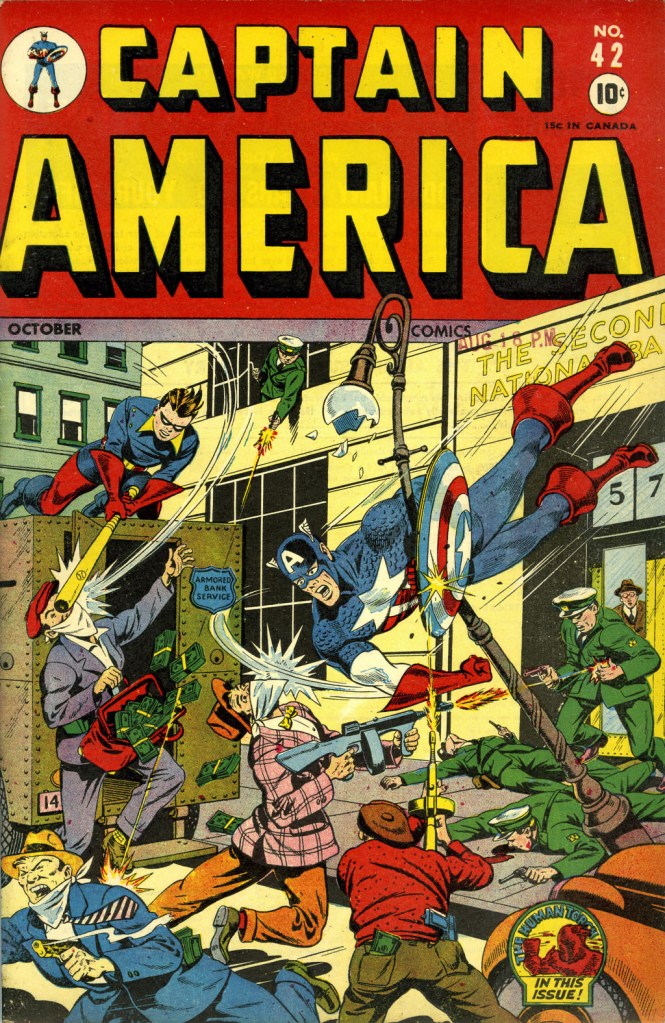
I’d heard about this story for years–I think that I first read about it in the first volume of the Steranko History of Comics when I was a kid. But I’d never been able to locate nor read it–until now. And so, I’m going to share the same opportunity with you all. It’s the Captain America story in which the stalwart Sentinel of Liberty, aided by his young pal Bucky, wipes out an invading force of literally a million Japanese soldiers. Mind you, the entirety of the Japanese army at that time was somewhere maybe around three million, so Cap and Bucky herein annihilate a full third of Japan’s fighting force. But, hey, it was wartime, and the wanton slaughter of the enemy was considered downright patriotic.
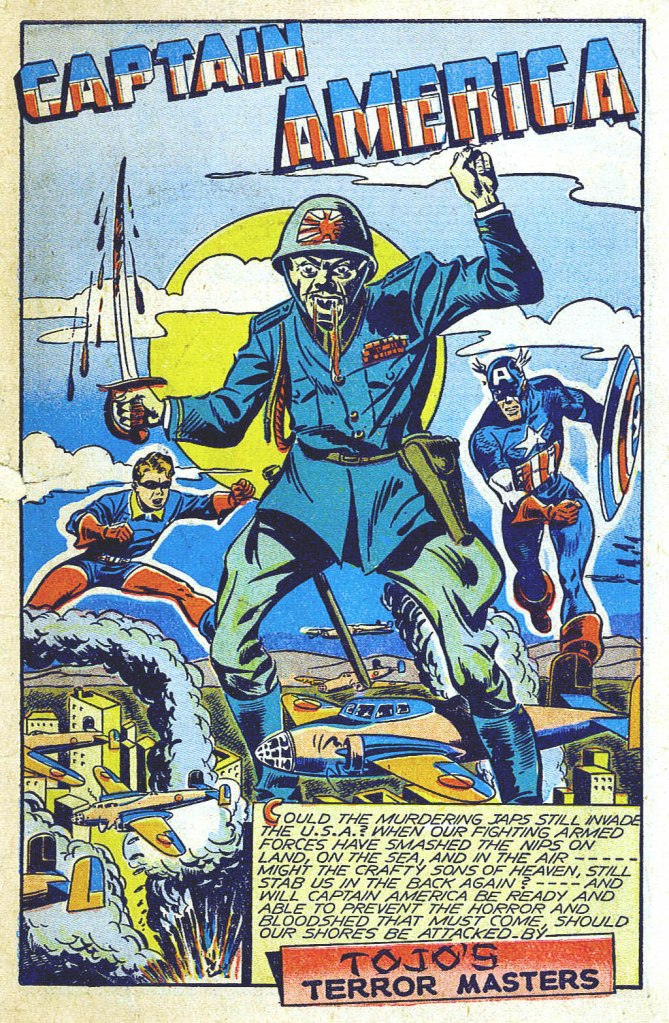
I should mention right off the bat this this story, which was released in CAPTAIN AMERICA COMICS #42 in 1944, is incredibly racist in its depictions of the Japanese. We’re at the height of wartime propaganda here, and so the enemy is shown to be literal inhuman monsters, gross racial caricatures, so that our side won’t feel bad about killing them. It’s pretty off-putting stuff to modern eyes, but at the time it was released, while Timely Comics, CAPTAIN AMERICA’s publisher, often went further than some other comic book companies in doing this, they were far from alone. Golden Age comics are rife with stereotypical depictions of all sorts of ethnic groups that haven’t stood teh test of time very well.

The author of this story has been lost to time, but the Grand Comic Database lists Vince Alascia as the artist of this tale.
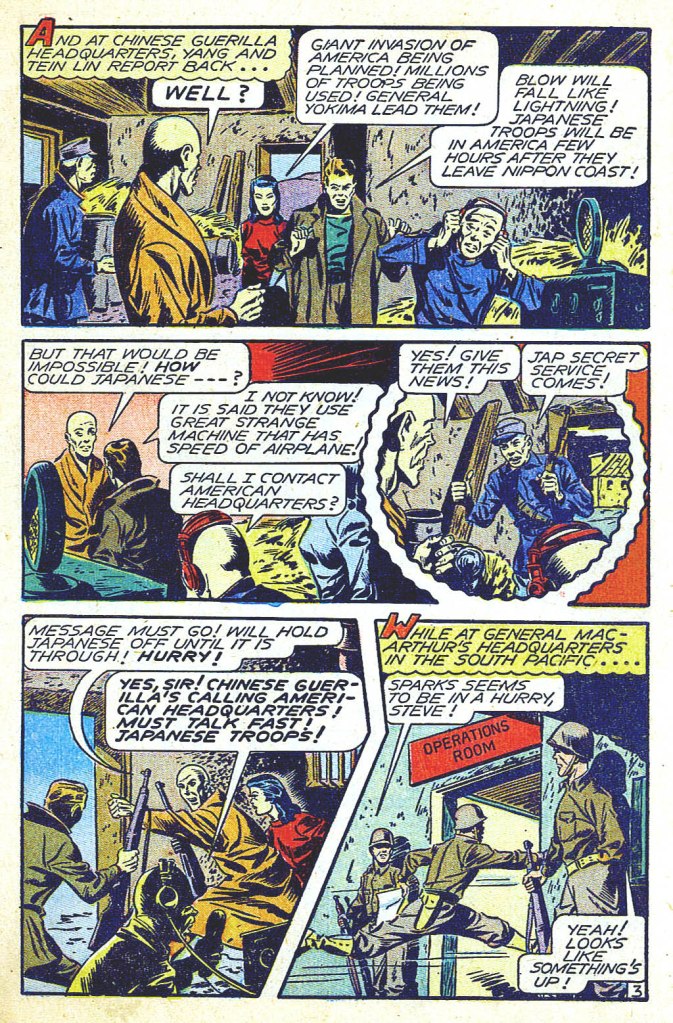
The allied Chinese are still colored in teh same sickly yellow color, but they’re drawn more conventionally handsome than their Japanese counterparts.

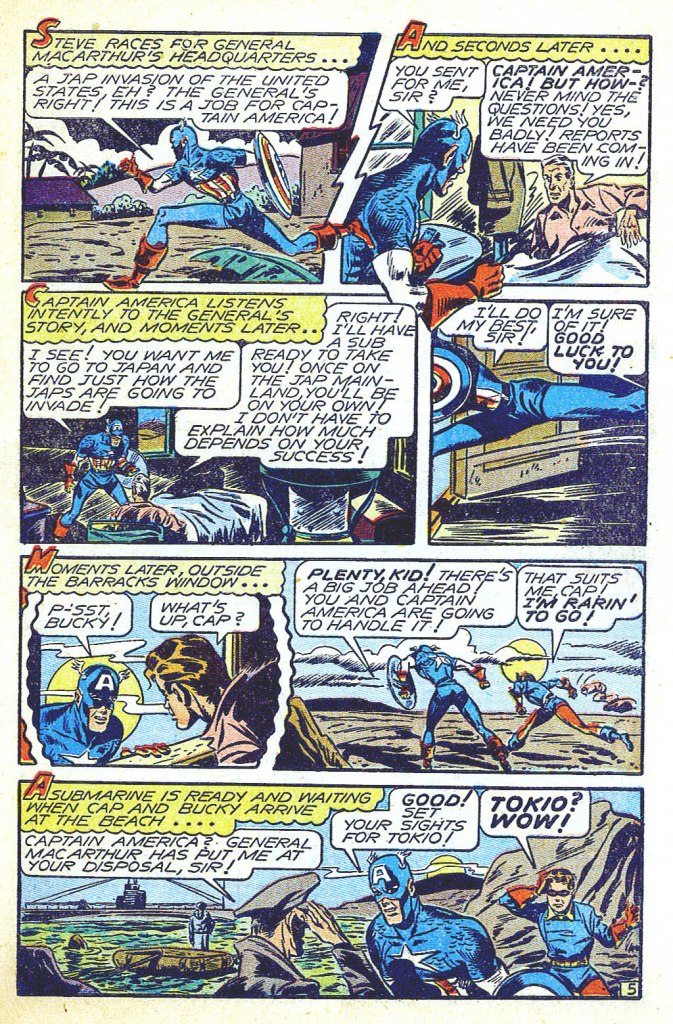
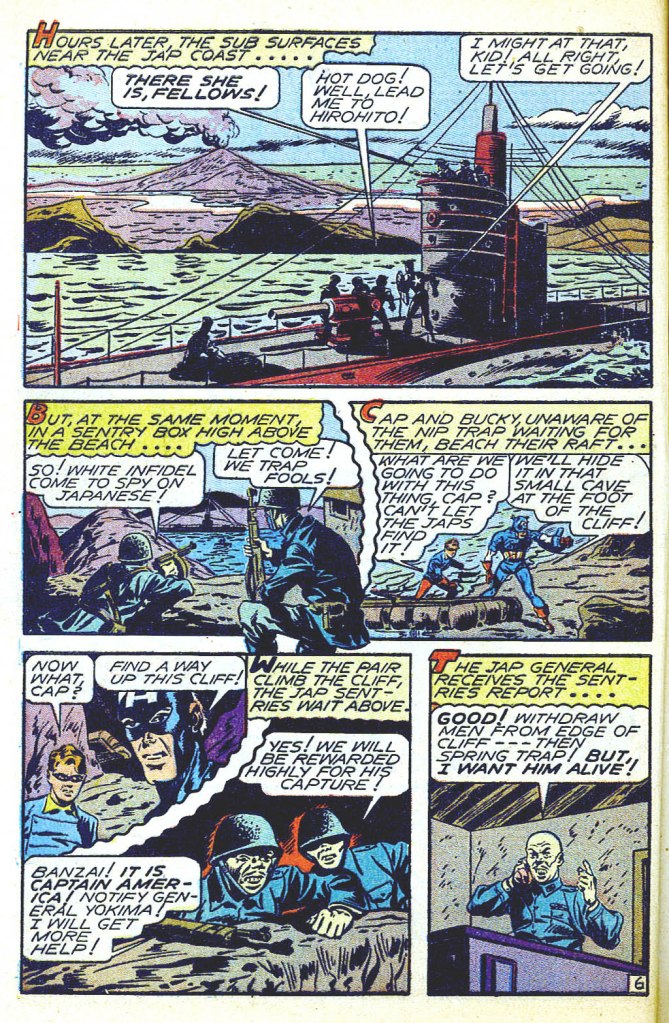
Cap and Bucky are able to slip past enemy lines and stroll up on the beach in Japan almost on a whim here. That has to be as spectacular a feat in itself as anything else the pair accomplished during the war.
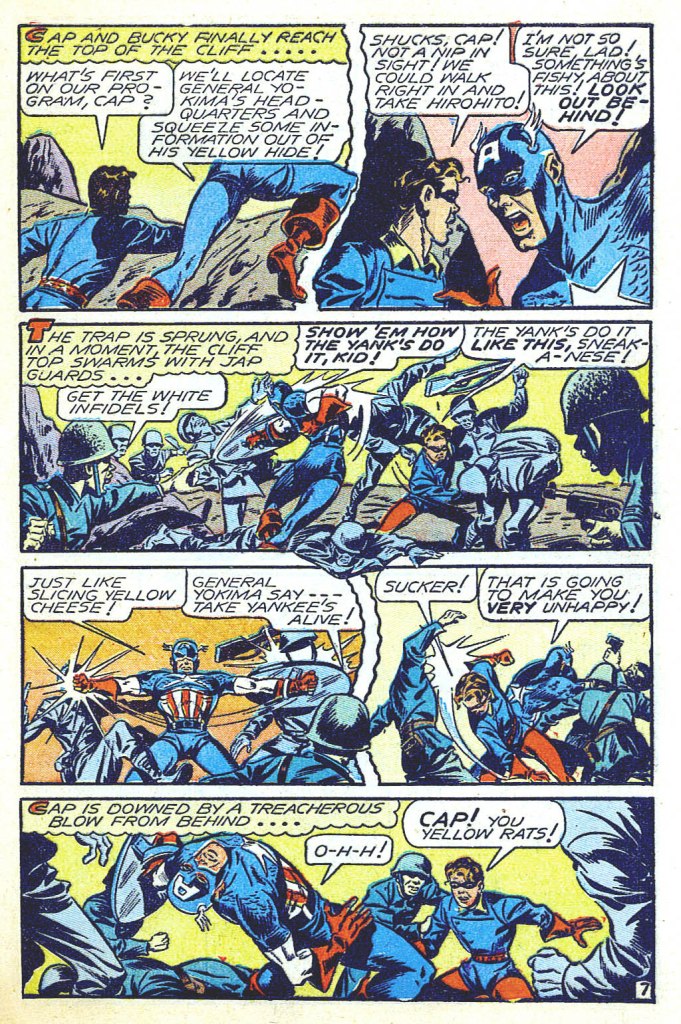
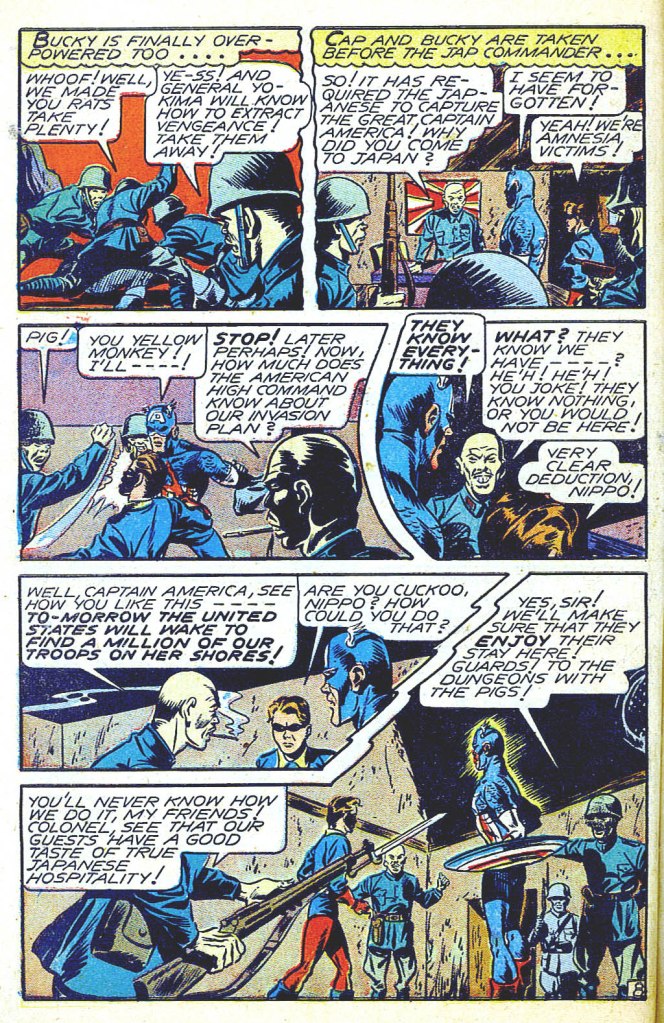
“You yellow monkey!” –ouch!

It doesn’t really make a whole lot of sense that the Japanese let the captive Captain America keep his shield. But that’s comics for you!
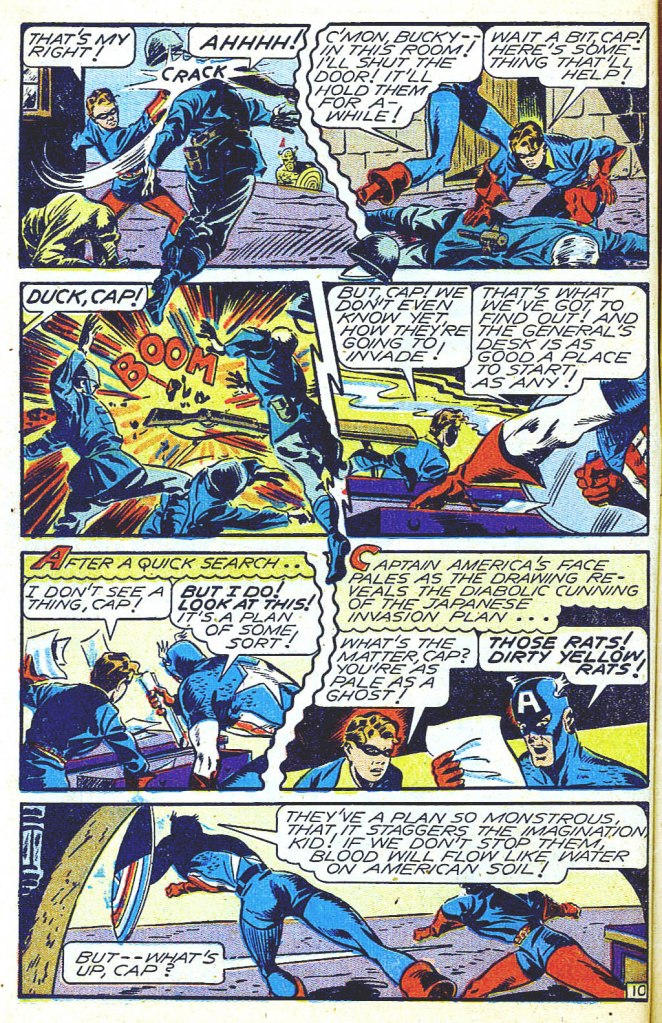
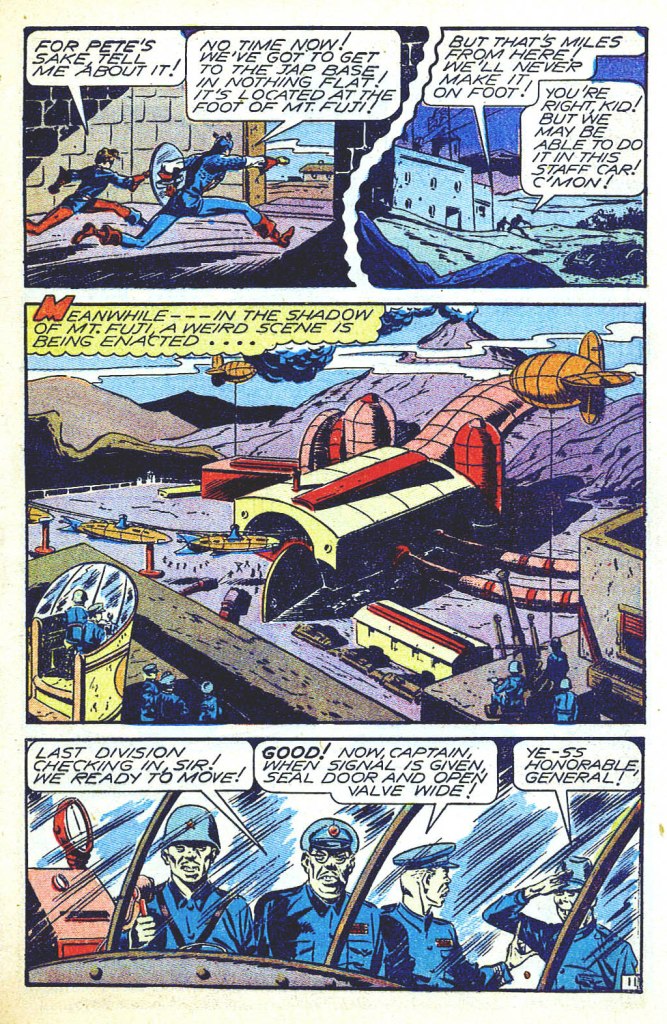
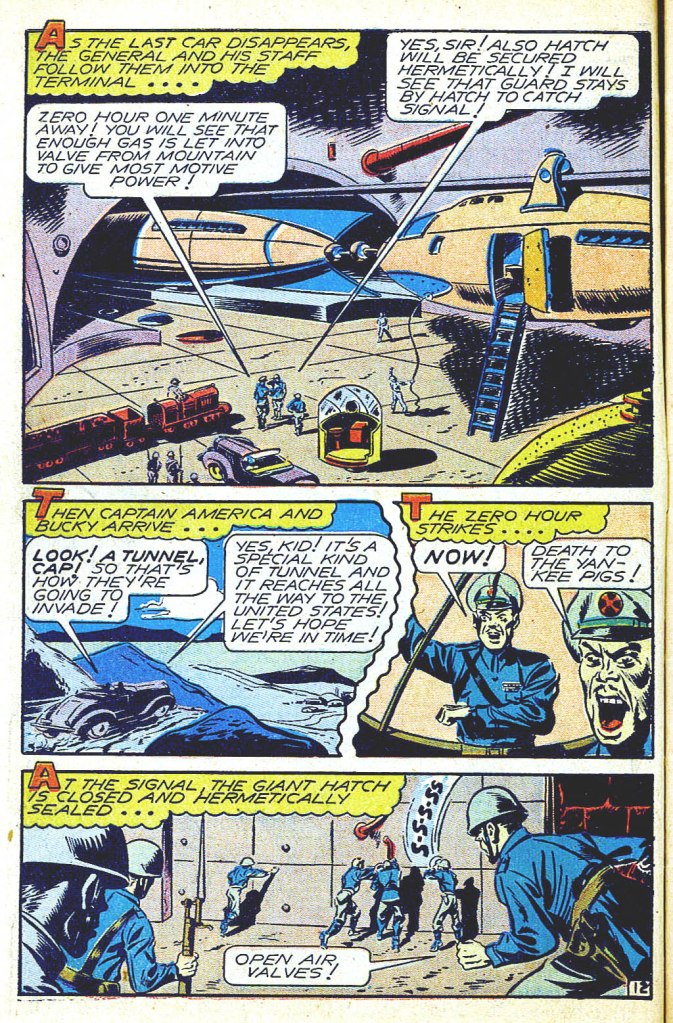
That’s right! The Japanese has built a tunnel that stretches all the way from the Japanese mainland to the United States! Just think if they’d put the necessary manpower and equipment necessary to do this directly into the war effort! Comics!


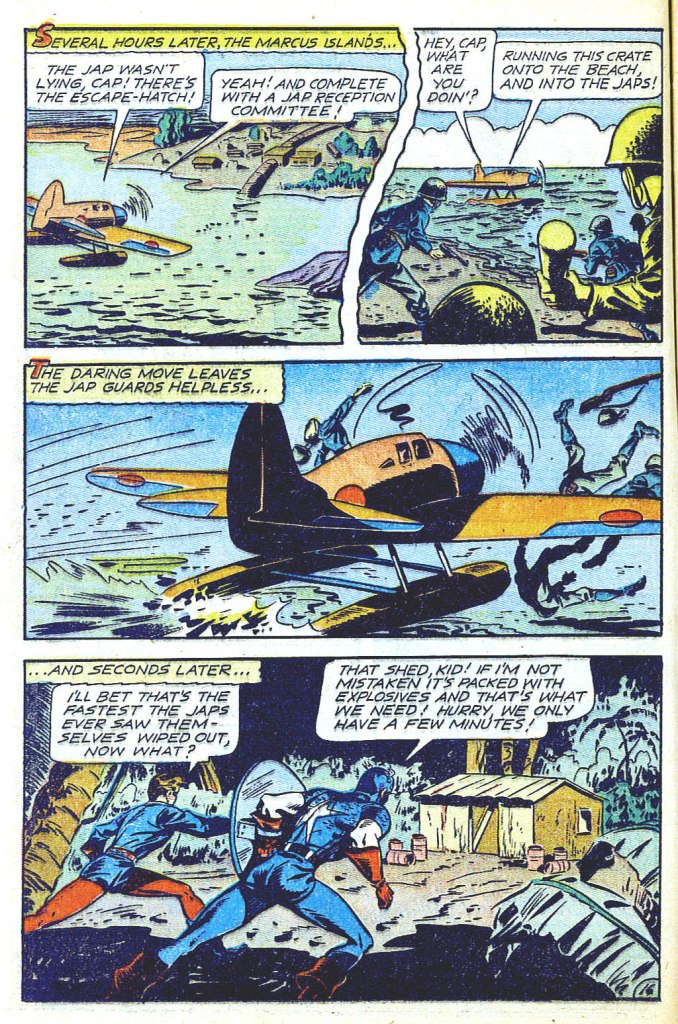
Cap’s move here with the plane is pretty brutal in and of itself. This is definitely not the version of the character we’ve come to know over the past 60 years.
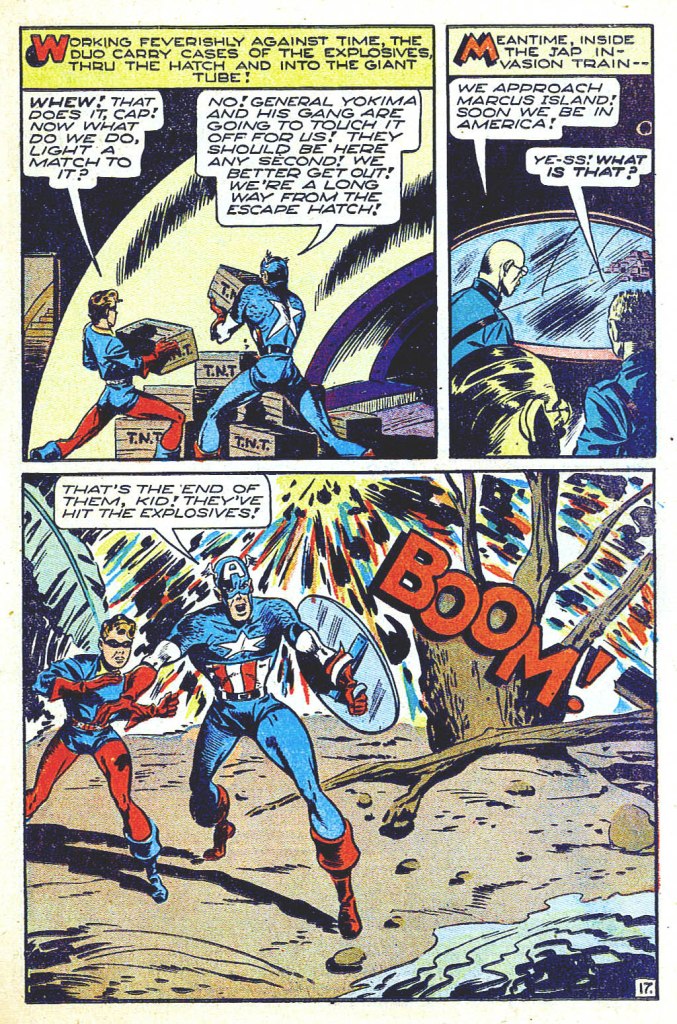
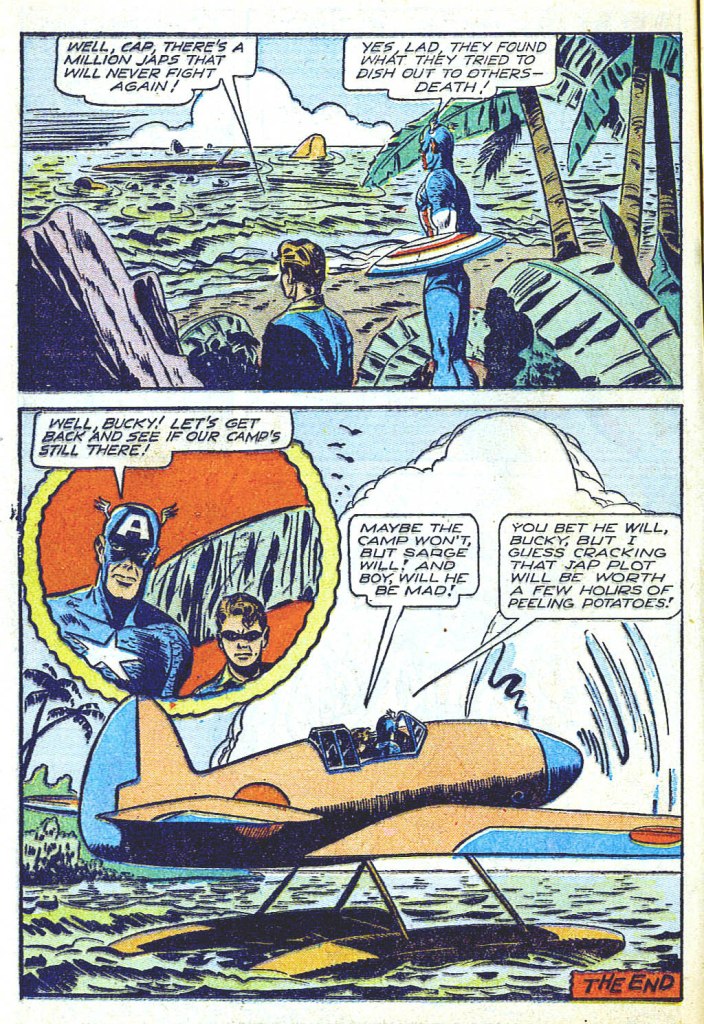
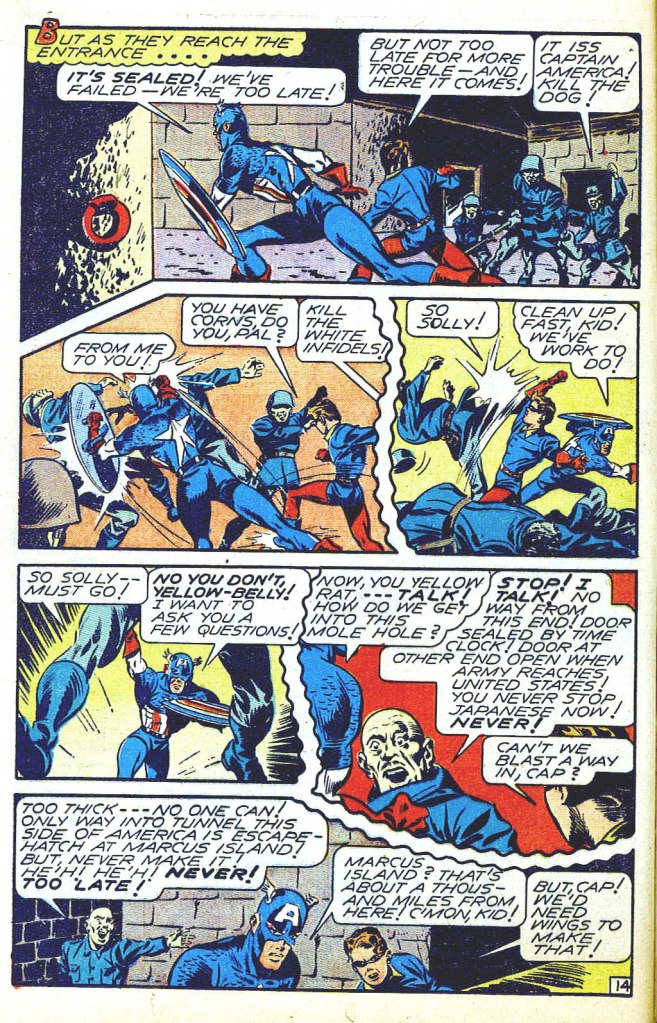
So, yeah, there are one million Japanese troops inside that tunnel, and captain America and Bucky bring it down atop them, killing them all. And then they fly off, worrying about how their Sergeant is going to react to them having been AWOL once again. Admittedly, it’s an understated genocide, but a genocide nonetheless if we take the comic and its numbers at its word.
 The Tom Brevoort Experience
I had to pass a Speech class in junior college to graduate, terrified of speaking in public but I did 3 on things I liked so I did one on the history of comics and showed the racial stereotypes and really brutal propaganda of WWII, got a B, prof. said the work was an A but my delivery was a C.
LikeLiked by 1 person
The page 1 title – “Tojo’s Terror Masters” is another example of something I notice in WII comics, that Japanese Prime Minister Hideki Tojo was so infamous at the time, in contrast to how he’s virtually unknown nowadays. Infame is fleeting.
On page 10, panel 3, we’re shown on-panel Bucky directly killing three Japanese with a grenade. And Bucky is even more amazing than Cap. He’s doing all this stuff without the benefit of super-soldier serum, or even a shield. I’ve long thought Bucky as a character was actually one of the more realistic kid sidekicks in some ways, as in the real world plenty of young teens or even pre-teens do become soldiers when there’s a war. But on the other hand, they’re usually shooting with rifles, not doing acrobatic hand-to-hand combat.
It’s good for the plot that the Japanese general continues the proud villain tradition of gloatingly taunting the hero about the secret plan, who presumably won’t live to tell about it.
And can Cap (and Bucky?) speak and read Japanese? I suppose I can believe that.
I don’t think the word “genocide” is accurate here. Those are all uniformed enemy troops actively engaged in a combat operation. Collapsing or flooding tunnels, even or perhaps especially with enemies in them, is a legitimate military tactic. I believe what Cap does would be 100% legal under the Geneva Convention.
LikeLike
You are correct on the Geneva Convention: Not one civilian was among any of those Imperial Japanese troops Captain America & Bucky killed, nor were any of them surrendering at the time ( Not that hey had a chance to ). But I wonder what the body count would be up to when you add the OTHER INVASION TUNNEL WW2 STORIES: Nazi Invasion Tunnels to England – [ Marvel Mystery Comics#16 ( February 1941 ) Sub-Mariner story – Herr Kopf, Heinrich, Wilhelm ] & [ All-Winners Comics#3 ( Winter 1941-42 ) Destroyer story “The Secret Tunnel of Death!” – Dr. Dragon ] & [ Captain America Comics#36 ( March 1944 ) Captain America 5th story “The General of Death” — General von Savage ] & [ Sgt. Fury & His Howling Commandos#13 ( December 1964 ) ]. Imperial Japanese Invasion Tunnel, Singapore to Australia – [ All-Winners Comics#12 ( Spring 1944 ) Sub-Mariner Story “Smash the Tunnel of Terror!” — Captain Krashyu ]. Nazi & Imperial Japanese Invasion Tunnel to Alaska [ Marvel Mystery Comics#17 ( March 1941 ) Human Torch & Sub-Mariner story ].
LikeLike
The panel shapes in this story, which seem derived from the kind of thing Simon & Kirby were doing in the early CAP issues, made me think of a story Mark Evanier’s told.
Back when Jack Kirby was doing THE HUNGER DOGS, someone at DC asked him to vary the panel shapes, take a different approach to them. I imagine the DC editor was simply thinking of changing up the usual windowpane approach to page layout, where all the panels tended to be the same size and shape, and doing it more like, say, Frank Miller, George Pérez and Keith Giffen were doing, those days.
But Kirby didn’t know that, so he did a lot of oddball panel shapes that seemed like a latter-day take on the kind of oddball shapes he was doing back in the Forties. And he didn’t like the result, and I don’t imagine DC liked the result, but he was doing what they asked, even if it was a likely failure of communication.
Still, if you’re going to hire Jack Kirby to do a grand finale to the Fourth World saga, I have to figure you should just let him do it the way he wants. You’re hiring him to be Jack Kirby, not to be George Pérez or Frank Miller.
LikeLiked by 1 person
The “racial stereotypes” would, of course, not be acceptable today but this was 1944 and given the appalling horrors perpetrated by the Japanese and German nations AT THE TIME the portrayal of them in stories like this was understandable. There’s no point being embarrassed by such historical depictions because allied readers were scared and worried that those people would win and their way of life would be gone forever! These comics are historical documents and not representations of how people feel 80 years later. I think everyone understands that and can empathise with how the creators and readers felt at the time without transposing that onto the present day.
LikeLike
Oh, totally understandable – unless you were one of the Japanese-Americans stuck in an internment camp. But it’s okay -and understandable- for full-blooded Americans, I guess, just like the Red Scare of the 50s was totally understandable, and Operation Wetback, and the Gay Panic of the ’80s, the current trans scare, and Operation Wetback 2 planned for 2025…
I think if everyone understands the power of propaganda instead – like this comic – we’d have far less of all of that.
LikeLiked by 1 person
Yes, if the Axis powers had understood the power of propaganda they might have avoided the unfavorable image that history has of them. They were fighting for human rights and, had they won the war, we would now be living in a truly free society.
LikeLike
And 20 years later, US comics would be depicting the *Chinese* as savages (and Commies to boot) whilst the Japanese were now treated in the same clumsily benign manner as the Chinese here..!
LikeLike
When the early 60s Marvel comics were reprinted in the Uk weeklies from 1972, cold war references to the “Reds”, commies etc were replaced with a fictional nation called Bodavia and the Bodavians. And the Red Ghost (from early FF) became the Mad Ghost , not to be confused with the Mad Thinker.
LikeLiked by 1 person
“Mad Ghost” is actually a pretty cool name …
LikeLiked by 1 person
It also suggests a visual many times cooler than Red Ghost got. With the sliding timescale Red Ghost no longer works anyways unless you costume in only shades of red.
LikeLiked by 1 person
Captain Griggs [ Captain Savage and his Battlefield Raiders#12 ( March 1969 ) see profile at marvunapp.com ] of the U.S.S. Sea Wolf could be identified as the unnamed submarine captain on Page 5 panel 7 ( Sure his hair looks black but explained away as shadow or since there is shadow on his face maybe Captain Simon Savage [ Sgt. Fury and his Howling Commandos#10 ( September 1964 ) ] if Captain Griggs was injured ).
LikeLike
Vince Alascia”s career arc is kind of odd given this story; he did a lot of work on Charlton’s Fighting Army and Fighting Marines back in the 1950s-1970s.
LikeLike