

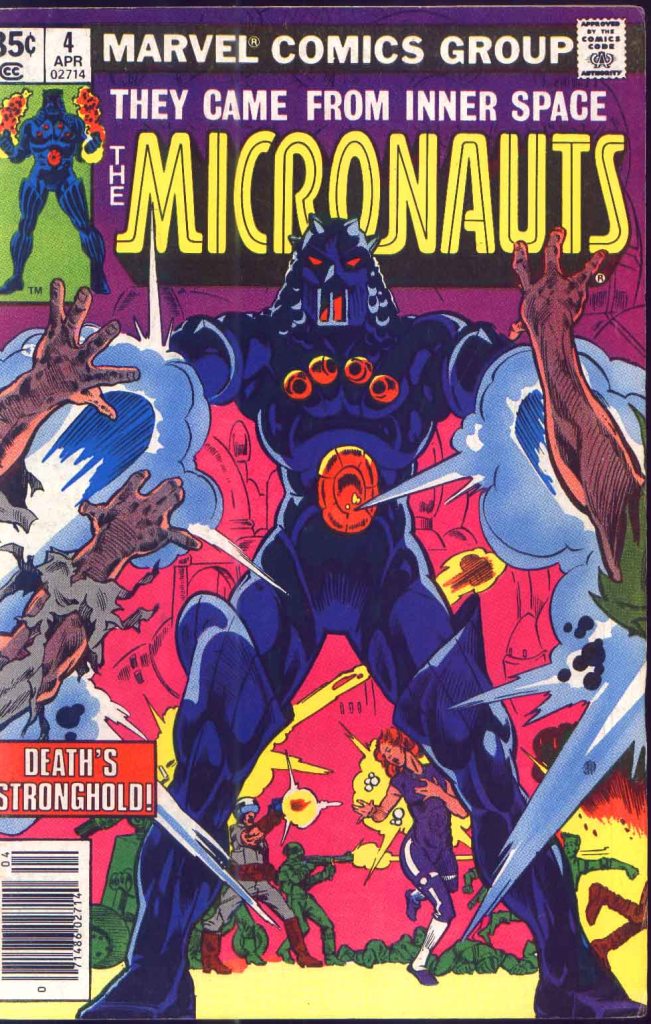
This issue of MICRONAUTS was purchased by my younger brother Ken. I’m pretty certain that it was bought at the same far-off supermarket where I’d previously gotten SHOGUN WARRIORS #3. And I also have no doubt that he gravitated to this particular book because Baron Karza looked like Darth Vader–which was kind of the point. My brother was a big STAR WARS fan at the time, so that connection, even if merely visual, was enough to reel him in. For whatever reason, newer titles such as MICRONAUTS and SHOGUN WARRIORS didn’t seem to show up at the 7-11 where I bought my new comics.
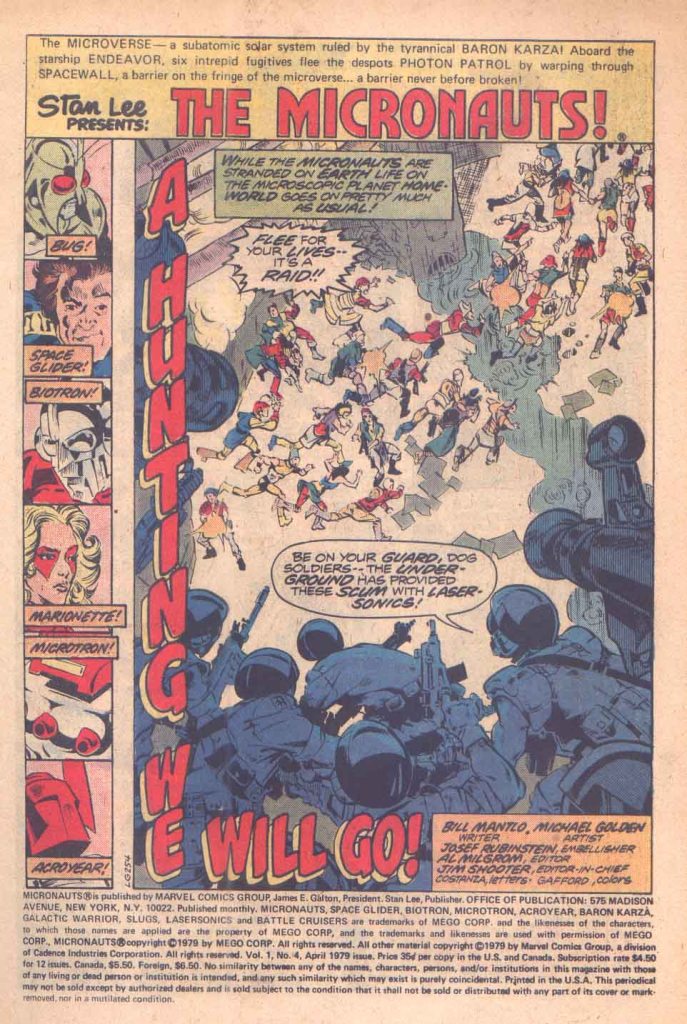
And make no mistake about it, writer Bill Mantlo was absolutely channeling the spirit and flavor of STAR WARS into MICRONAUTS, as a look at that cast list will attest. What is Marionette other than another variation on Princess Leia? The two droids, Biotron and Microtron clearly evoke C-3P0 and R2-D2. And even Bug feels like something that would have shown up in the Cantina sequence. And this is all on top of the villain, Baron Karza, sharing a number of characteristics with Darth Vader. Plus, Commander Rann is guided by the embodiment of the Enigma Force (a really good name). Mantlo wasn’t exactly being subtle here, but subtlety was seldom his way. And so when he was inspired to pitch Marvel on picking up the license for the MICRONAUTS toy line, he worked out a storyline that was designed to make it popular and to connect with a young audience in 1978.
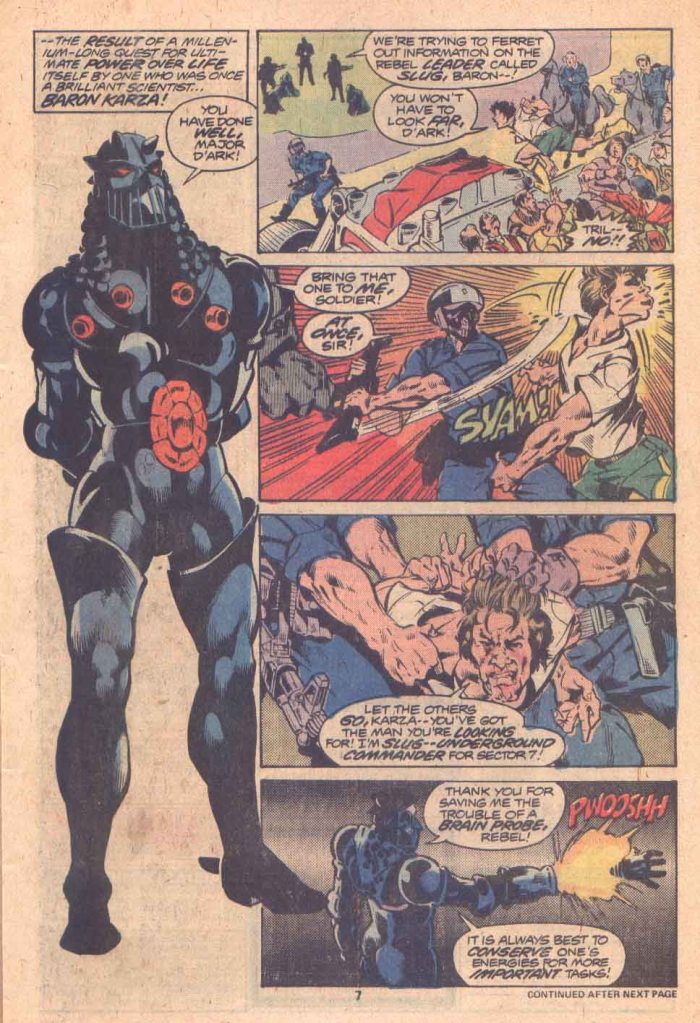
The real star of the first year of MICRONAUTS, though, was artist Michael Golden. Golden had been floating around the industry for some time, doing the occasional story here and there, and usually working on back-up or filler features, particularly at DC. MICRONAUTS was, as far as I can tell, his first real lengthy headlining job. (The couple of issues of MISTER MIRACLE that he did not quite counting, as the run was truncated.) His style was something of a revelation, and he became a huge influence for a wave of new artists who would enter the business in the coming years, combining the shadowy work of someone like Gene Colan with Neal Adams-inspired figurework and classic storytelling. Golden’s work didn’t always grab me as a young reader, but it’s hard to dismiss its quality.
The set-up for MICRONAUTS was that much of the action took place within a subatomic universe, one ruled by Baron Karza with an iron fist. Space Glider, an astronaut who’d returned home from a decades-long voyage through the galaxy to find his homeworld now the hub of this tyrannical galactic force becomes the head of a rebel cell, accompanied by Princess Mari, AKA Marionette, the deposed Prince Acroyear, the thief Bug and the two robots, Biotron and Microtron. Together on board Space Glider’s ship, the Endeavor, they break through the dimensional barrier, winding up in the macro universe–our world. The thing is, there, they are scaled to the size of toys, so it’s a Planet of Giants to them. And they’re pursued by Karza’s forces, of course, who also see an opportunity to advance into this other world and subjugate it.
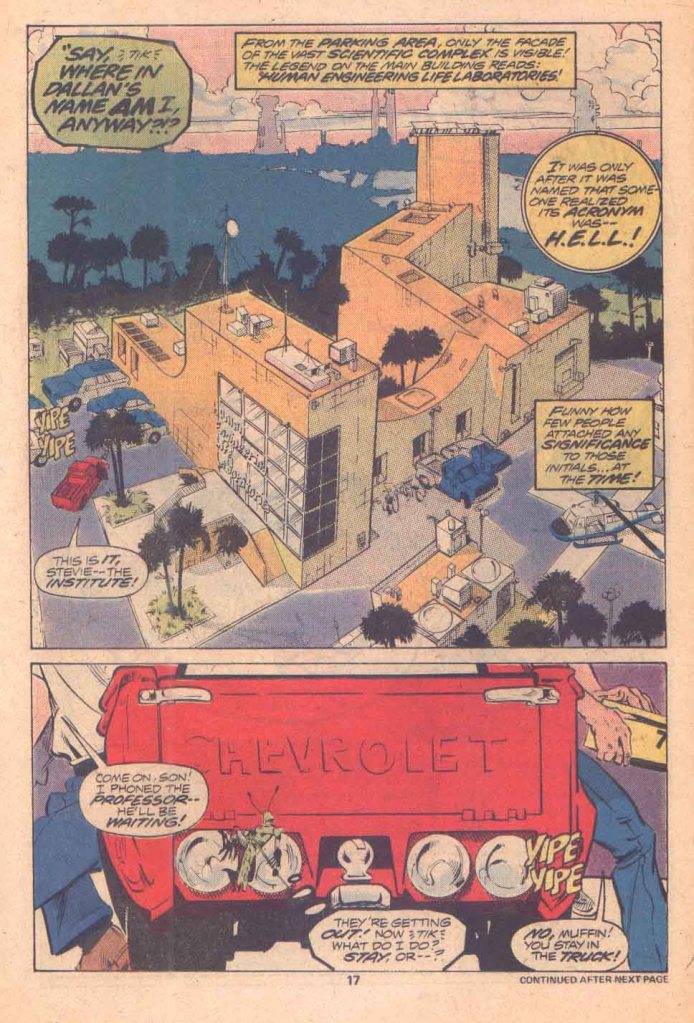
MICRONAUTS also pulled just a tiny bit of inspiration from Jack Kirby’s Fourth World epic, in that there were certain concepts and ideas that were writ large. One of those–a thing you probably couldn’t have gotten away with in later years–was the Human Engineering/Life Laboratory, or H.E.L.L. for short. It’s run by Professor Prometheus, once the co-pilot on the space missions flown by Ray Coffin, the father of Steve Coffin, the kid whom the Micronauts first encounter upon entering the full-grown world. Yeah, these are all Jack Kirby-style names, indicating something about the characters’ outlook or philosophies, though again, Mantlo wasn’t as subtle or as nuanced about it as Kirby was.
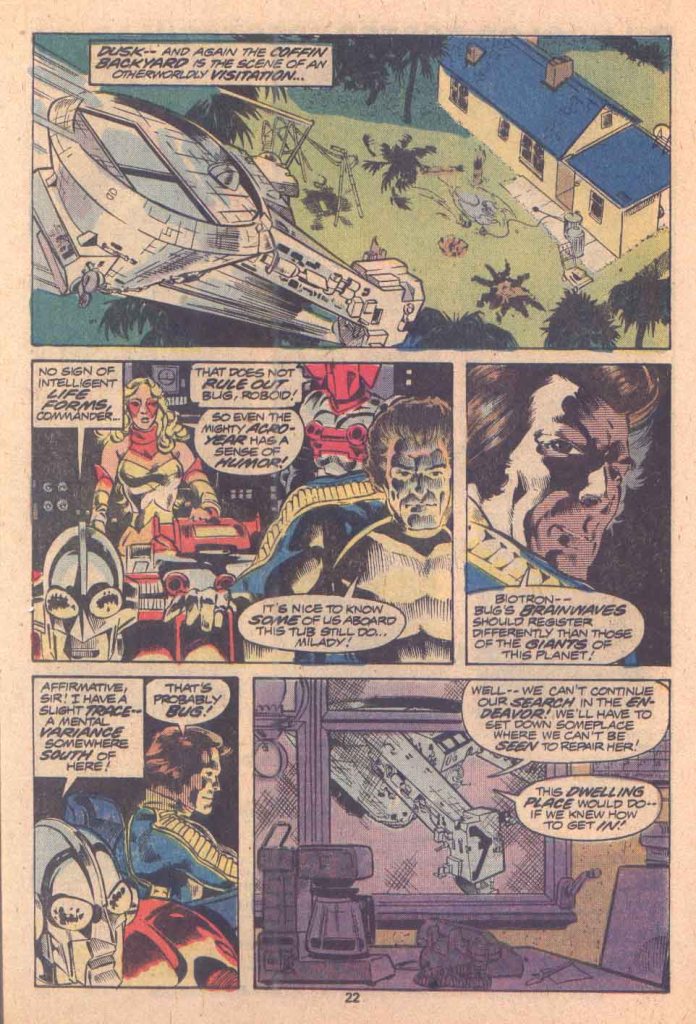
The entire production was pretty on-point for what it was trying to be. That said, it really didn’t hook me, for all that occasionally other comic book fans would rave about it. But I wasn’t really a STAR WARS kid, for all that I’d seen and enjoyed the one-and-only film. But for an audience who craved more of the same, MICRONAUTS was a fine substitute, and even a bit more fulfilling than the new STAR WARS stories that comic had begun to feature after concluding its adaptation of the movie. Mantlo, at least, knew exactly what he was trying to do, whereas the STAR WARS comic’s creators were playing in somebody else’s universe, and with only a vague sense as to where sequels might be taking the characters. so it always seemed just a little bit tentative, and also drew from other earlier inspirations as the people creating it came from a previous generation.
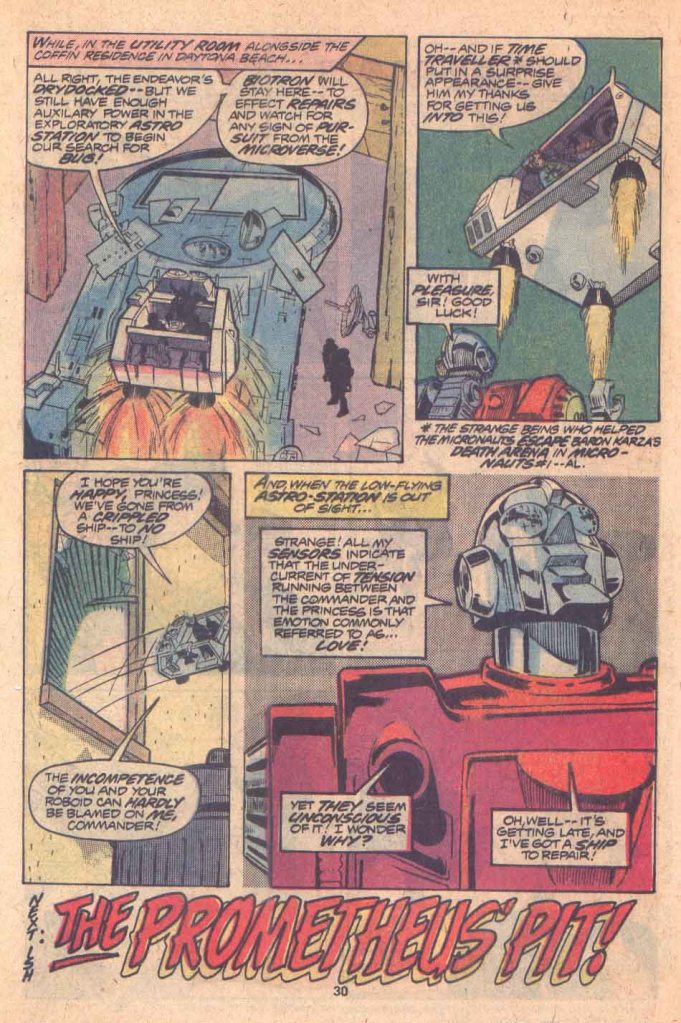
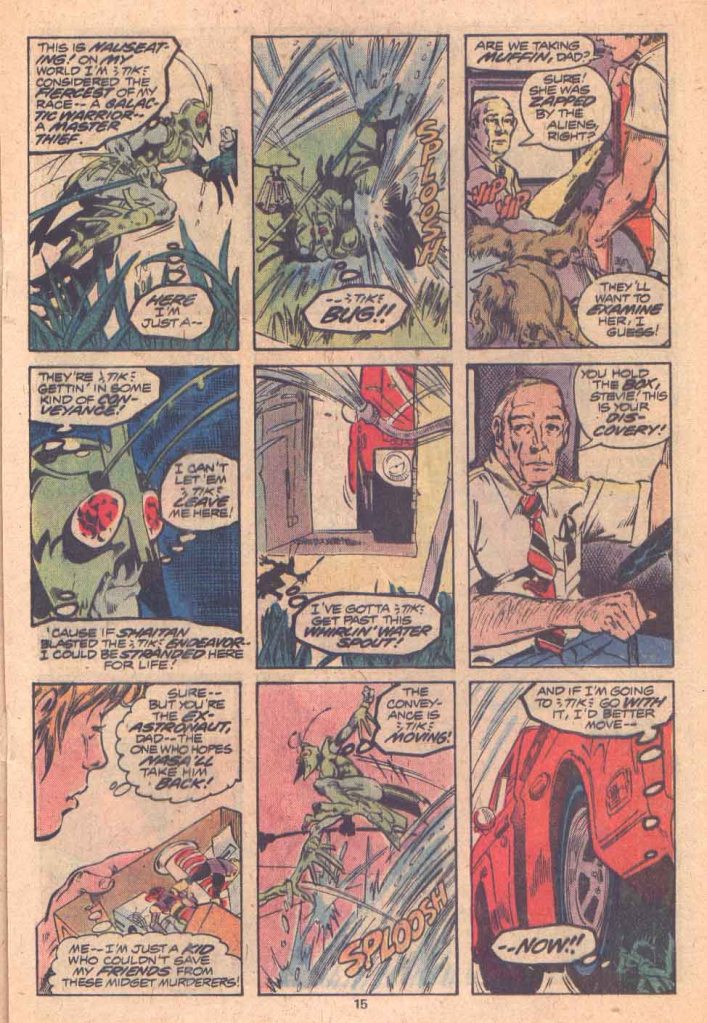
The other thing about this issue is that, for all that a lot of events go down inside of it, nothing much really happens. The titular Micronauts end up breaching the Coffin household in search of their lost companion Bug, who has himself hitched a ride on Ray Coffin’s vehicle as Ray and his son Steve bring the toy-sized Wing-Fighters they’ve recovered after their first encounter with Karza’s forces to H.E.L.L. in the hope that Professor Prometheus can confirm that they are of extraterrestrial origin. Meanwhile, in the microverse, Baron Karza continues to pacify the population and show off the fact that he’s a bad guy. It’s all fine, and it’s well-drawn, but it doesn’t evidence a heck of a lot of forward motion. I didn’t wind up reading MICRONAUTS on the regular for another year or so, by which time Golden was gone and the initial conflict had been resolved, and as he did on his other toy tie-in series ROM, Mantlo began having the Micronauts interact more directly with the greater Marvel Universe. That made the series more interesting to me.

On the other hand, features like this schematic of the Endeavor were undeniably cool. That said, the enormous text block recapping the mythos that had already been laid out four issues in was like homework. It was tough to get through and tough to retain. But pages such as this one helped set the stage for what eventually became the Official Handbook of the Marvel Universe a couple of years down the line.
 The Tom Brevoort Experience
Love that Marvel is finally reprinting this series but a bit angry that they are doing Epic Collections after I have commited to buying the omnibuses. Would have been better if they were announced after all of the omnibuses had shipped.
LikeLike
They’re doing Epic Collections?
Excellent news! I find omnibi too bulky to read comfortably, so I was hoping for smaller packages. I hope they do them for ROM as well.
LikeLiked by 1 person
Micronauts popped up on the the Epic list on Wikipedia recently as well as the Marvel Fandom Wiki, with a ship date of 07/24. I assume it was announced at Comic Con but I notice it is not yet listed on Amazon. No word on Rom anywhere I’ve seen.
I’m with you on omnibuses being hard to read but I thought I was only going to have one shot at collections at either series.
My other complaint is that the Micronauts/X-Men mini was not included.
LikeLike
Turns out the first ROM Epic Collection is already listed on Amazon for next April.
For the Micronauts, it would have been nice to get a volume of just the Golden issues, but that’s too short for an Epic. Maybe if the sales are good they’ll eventually do it as some sort of special oversized hardcover.
LikeLiked by 1 person
I can understand your frustration—but I think the truth is likely that they only decided to publish them as Epics *because* the Omnibi sold well.
Or to put it another way—if it weren’t for the people who bought the Omnibi, the Epics likely wouldn’t have happened.
(Totally understand the frustration though!)
LikeLiked by 1 person
Tom when you wrote Planet of Giants I Google it and got a Doctor Who episode ( October 31, 1964 ) and not the series that I was thinking of ( even if I remembered the name wrong ): Land of The Giants ( 1968 sci-fi series – 2 seasons )– I wonder if this series inspired The Micronauts series. I was hooked the moment I saw Michael Golden’s art and enjoyed the writing too.
LikeLiked by 1 person
I remember when I got Micronauts#16-17 ( April-May 1980 ) and feeling disappointed because Michael Golden drew the Psycho-Man in his original & cool armour on the cover but Howard Chaykin ( finished by Al Milgrom ) put him in an altered version the all green armour ( Block on one hand & electrode on the other hand. Both arms able to elongate ) Jack Kirby gave him [ FF#77 ( August 1968 ) ]. Plus not Michael Golden. I found this out 1 or 2 years ago when I Googled the Micronauts toys: The Micronauts toyline was based on and licensed from the Microman toyline created by Japanese-Based toy company Takara in 1974.
LikeLike
What came first, the chicken or the egg? Do we know if the Japanese toymaker created Baron Karza as a riff on Darth Vader, or, did Mantlo look at the toy and go, “Oh, this guy could be my Darth Vader for my Microverse?”
LikeLike
Both the Baron Karza and Force Commander toys were repaints of a Japanese toy based on the anime Steel Jeeg with new head sculpts. It was the toy line that created Baron Katz’s and he was pretty clearly designed to be the line’s Darth Bader figure even before there was a comic,
LikeLike
Having the Micronauts be toy-sized in our world was pretty brilliant, I thought. It let Mantlo have it both ways — the heroes could have regular sci-fi adventures in the Microverse, and “Land of the Giants” type shenanigans on Earth.
LikeLike
And played off the series name well.
LikeLike
Gotta figure the “Endeavor” pinup was, in true Marvel fashion, Golden’s design drawing for the ship, repurposed as a print feature.
LikeLike
was wondering if it was Golden or maybe Elliot, since Tom mentioned it being a precursor to the Handbook.
LikeLiked by 1 person
Looks like Golden to me. I don’t think Eliot was doing technical drawings for Marvel that early — I don’t think he was even working at Marvel yet. He started in late 1978/early ’79, and this came out in late ’78, so it would have gone off to press a couple of months earlier than that.
I will note that “endeavor” is a synonym for “enterprise.”
LikeLiked by 1 person
Looks like Endeavour was used in Star Trek too ( British spelling ): The U.S.S. Endeavour ( NCC-71805 – Nebula class ) appears in Star Trek: The Next Generation ( September 23 1991 — https://trekipedia/file/U.S.S._Endeavour_NCC-71805 ) and a 23rd Century U.S.S. Endeavour ( NCC-1895 – Constitution II-class ) appears on a Starship Mission Assignments chart on the bridge of the USS Bozeman ( TNG: “Cause and Effect” ) & named in Star Trek VI: The Undiscovered Country ( https://memory-alpha.fandom.com/wiki/USS_Endeavour_(NCC-1895) ).
LikeLike
The convenient stores near me didn’t carry Micronauts comics, either. My 1st contact was with the toys. I’d’ve been 6 at the time. I wouldn’t know of, or see the comics ’til the early ’80’s, when the toys were either packed up or given away. I remember being surprised that Biotron was about the same height as the rest of the comics cast. The toy was huge compared to the Space Traveler & Acroyear figures. The Space Traveler could fit inside a clear plastic, 5-sided piece that clicked into place in the middle of Biotron’s torso. And his boots could be used as flying cars, or something. Space Treveler & Acroyear came in different colors. I had a clear plastic Space Traveler, while a friend had a blue one. They each had the same silver colored head.
Karza seemed totally different from the others, like from a separate toy line. I think his torso could be separated from his legs (held together wit magnets?), and clicked onto a horses body, like a centaur. I had no idea what the line’s fictional backstory was, what the relationships between the characters were. By the time I did see the comics, the art didn’t really interest me. I’m unsure who’ve been drawing it then. Maybe Pat Broderick. I had no idea who Marionette or Bug were.
What’s another word for “Endeavor”? Undertaking. (Too morbid; sounds like a space-faring mortuary.) Pursuit. Weird if you’re in pursuit while you in a ship of the same name. Hmm. U.S.S… Uh, Captain… Kir… Hey, there was the ’60’s surf band, the Ventures. And the late ’70’s Scottish punk band, the Exploited (from “exploit”, a synonym for adventure, or even enterprise).
LikeLike
You guess was 100% correct. The regular Micronauts figures were from Takara’s Microman line, which eventually evolved into the Transformers. Karza (& Force Commander) were repaints of a Kotetsu Jeeg figure, with newly sculpted heads. The cool alien figures with glow in the dark brains were unique to Mego.
The more you know…
LikeLiked by 1 person
Thanks, Mr. Em. Did you ever work for MI6? 😉
LikeLike
“[Golden’s] style was something of a revelation, and he became a huge influence for a wave of new artists who would enter the business in the coming years, combining the shadowy work of someone like Gene Colan with Neal Adams-inspired figurework and classic storytelling.”
I don’t believe Golden was much influenced, if at all, by Colan and/or Adams. He had a career as a commercial artist before coming to comics, and by his own account, he wasn’t acquainted with superhero material until just before he approached Marvel and DC for work. If I had to identify a key influence, I would say Bernie Wrightson, but minus the Frazetta figure-drawing precision.
LikeLiked by 1 person