


DOCTOR STRANGE was a series that had a hard time retaining me as a reader throughout the late 1970s. I really liked the very early Stan Lee/Steve Ditko stories once I got to read them, but the modern day adventures of the character held little appeal for me. They were a lot more phantasmagoric, a lot more plugged into then-modern alternative thinking and being quasi-psychedelic. Much more fantasy of a fanciful sort than I cared for. I sort of found it all a bore. But every once in a while, I would still dip my toe back into teh water to see if I found it to my liking. This issue, #34, was one of those attempts. Spoiler alert: it didn’t make me a regular buyer of the book.
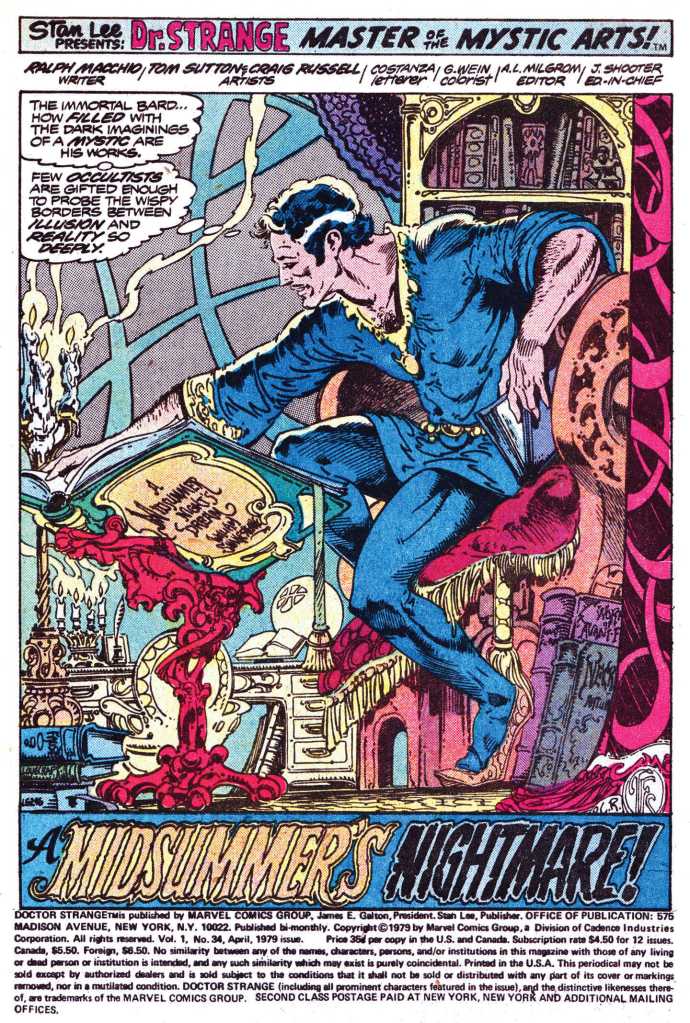
This particular issue was written by Ralph Macchio, the latest person to step in to triage on the title, a situation that seems to have been ongoing ever since Steve Englehart departed a year and a half previously. A bunch of different people had stepped in to write the series since then, some of them very good, but none of them had the staying power to truly take over on the regular. In this, Ralph was no different. The artwork was by Tom Sutton inked by the florid line of P. Craig Russell. I found this combination a bit too fussy and rococo for my liking, though I can’t say that it in any way looked bad.
So I’m really not certain why I chose to pick up this issue, as there isn’t anything about its outward appearance that might have motivated me to do so. My best guess is that I encountered it at some location where my choices were very limited in terms of available comics that I hadn’t already purchased, and so selected it as the best available option. But that’s only a guess.
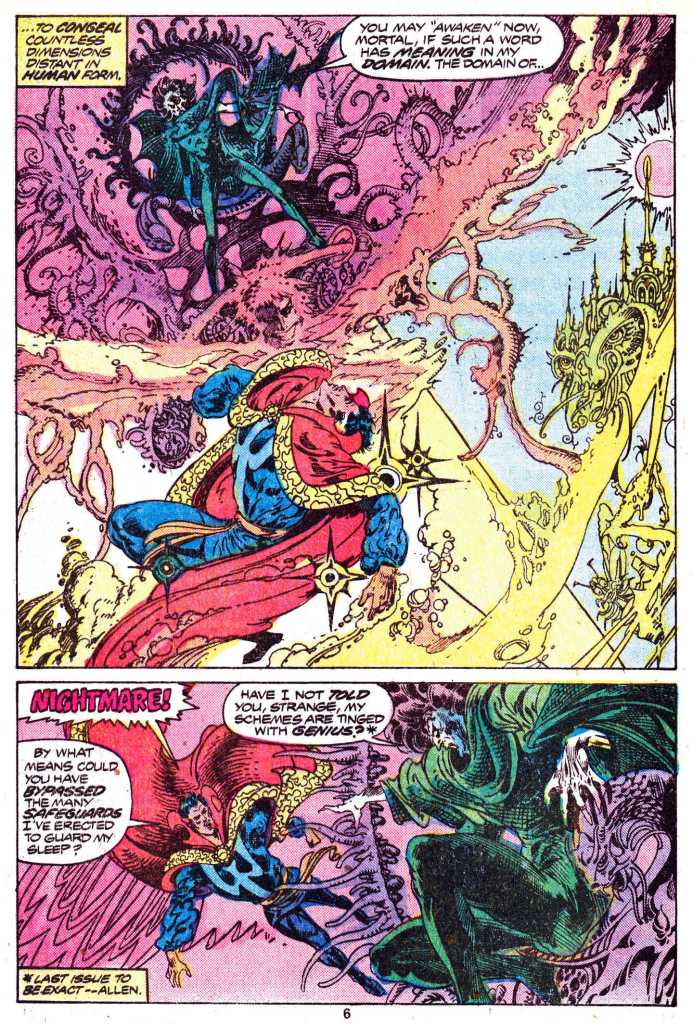
The plot here is very straightforward, almost a Doctor Strange 101 sort of story. In the opening, Strange retires to bed after spending the evening reading A Midsummer Night’s Dream. In his slumber, he is spirited away to the realm of his eternal enemy Nightmare, who has for some reason thrown in with another relatively obscure foe of the sorcerer, Cyrus Black. Nightmare spends a few pages showing how ineffectual Strange’s spells are against him within his native domain, and then Cyrus Black frees the captive sorcerer so that he can display the same imperviousness to Strange’s attacks.
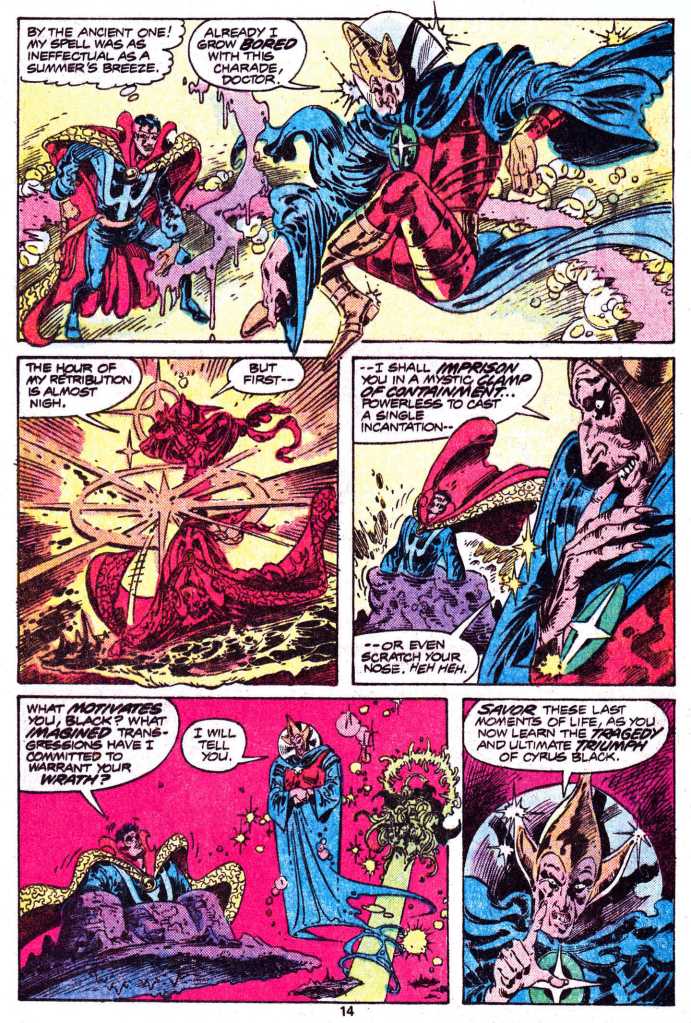
What follows is a long-winded and copy-heavy two pages laying out Cyrus Black’s history with Dr. strange and his gripe against him. It all seems to boil down to Strange having bested him in a contest for teh Wand of Watoomb back when both were just adepts, and thereafter having the temerity not to die when Black came to kill him in an old DEFENDERS story. Imagine that, but with about 200 more words. Black is now using a rodent as a familiar, and this is how he and Nightmare were able to breach the defenses of Strange’s Sanctum in order to abduct him. Nightmare has been training Black in unrecorded magicks, and now the enchanter is sure that he’s ready to wipe out his hated nemesis once and for all.
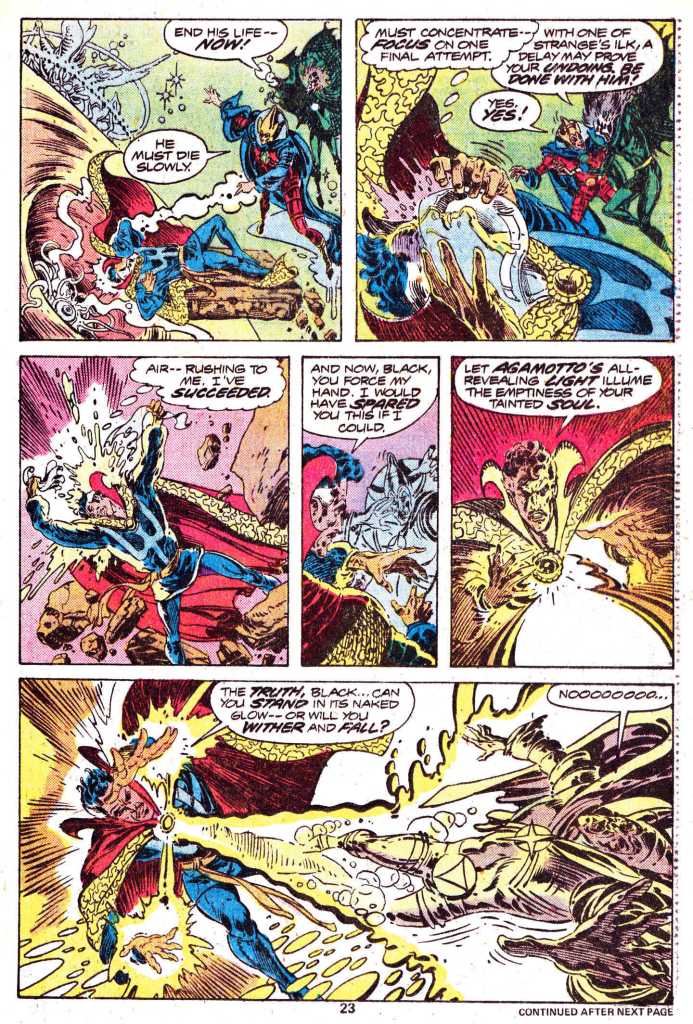
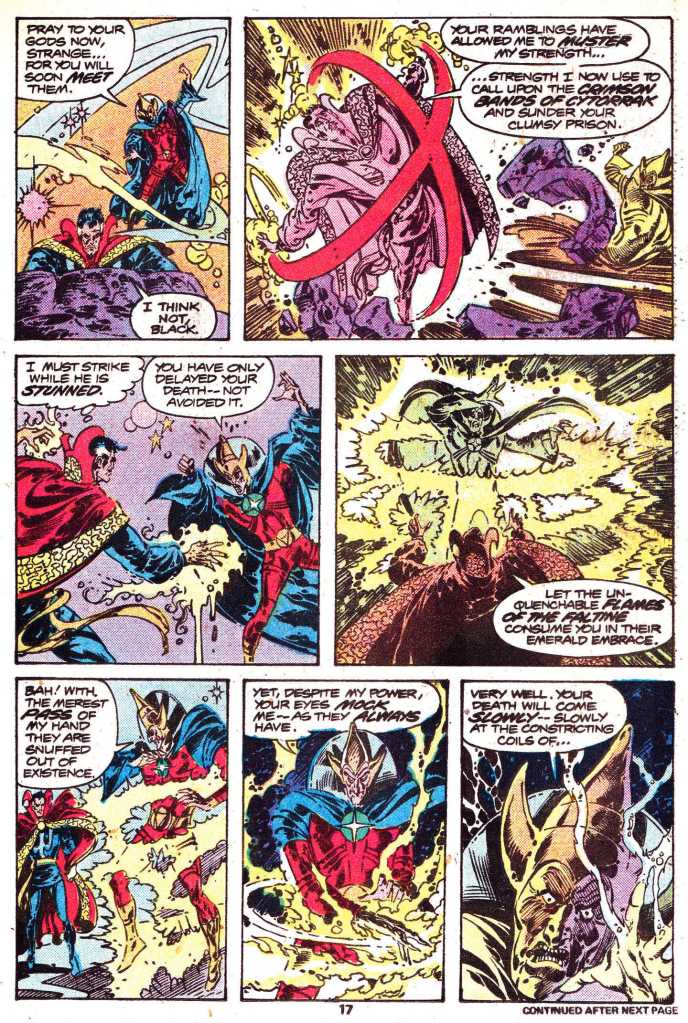
What follows is an extended multi-page sorcerous duel between the two, with Nightmare stepping back and acting primarily as an observer. This conflict is a good example of one of the things I didn’t like in Doctor Strange stories: it seems as though each of teh combatants can do (or not do) anything that the plot calls for, without any sense as to how and why. Why do some spells land and others don’t? No real reason except that’s the manner in which it’s written. When anybody can do anything, it’s difficult to get invested in the stakes, as you never know quite what they are or how serious they ought to be taken. Eventually, Strange gets the drop on Black, bathing him in the light of his Amulet and revealing that he’s nothing more than a shade animated by his own sorcery–a fact that even he is apparently unaware of.
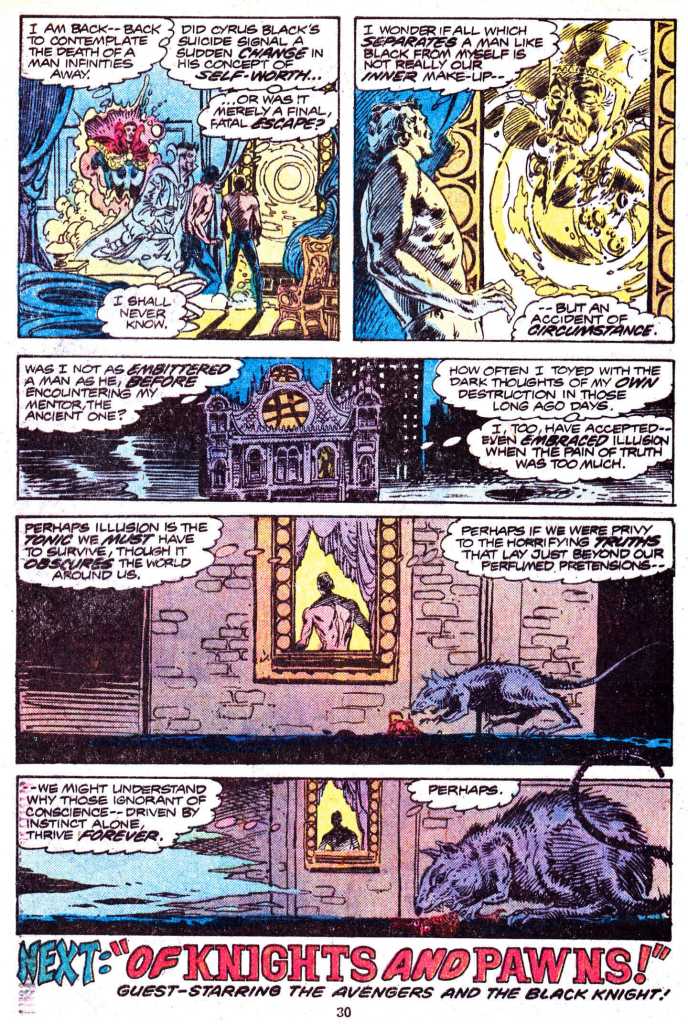
Nightmare urges Black to unleash a spell of Dissolution, and the sorcerer does–but, startled by the revelation as to his true nature, he casts the spell upon himself, committing suicide. With his victory over Strange ruined, Nightmare permits the sorcerer to return to the waking world, where he contemplates the fact that he and Black are not so different. And, of course, we get a final panel glimpse of Black’s rat-familiar, giving the sense that in some way, the nefarious wizard may still live on. It’s a perfectly fine story, and the sort of thing that I suppose the readers of this series were looking for at the time. But to me, while it was entertaining, it wasn’t captivating enough to bring me back the following month. It was simply another throwaway magical conflict.
 The Tom Brevoort Experience
That’s some very fine drawing, inking, & coloring. It doesn’t get much better than that.
LikeLike
DOCTOR STRANGE was at its peak in the visionary hands of writer Steve Englehart, whose stories and characterizations I found enthralling as a young teen. No series succeeds without a visionary writer, and that was the fate of DOCTOR STRANGE post-Englehart until Roger Stern showed up years later.
LikeLike
I was never a fan of Sutton but Russel made the art soar for me. The story? Yes, totally forgettable.
LikeLike
Tom Sutton: Me neither. Marvel Premiere#61 ( August 1981 ) was my first introduction to both Tom Sutton’s art and Star-Lord ( Peter Quill ).
LikeLike
Wow. I’m a fan of both but I’ve never seen Russell ink Sutton. Looks great to me.
I’ve always found Sutton’s Marvel work very appealing on whatever book he was working on. He evokes an odd expressive energy like Bill Everett at his best. Just a good fit on something weird.
Solo Doc Strange was always a hard sell for me unless Ditko, Colan, or Brunner was doing it. I would have picked this up though if it had caught my eye.
LikeLiked by 1 person
I believed I picked this up back in the day. Forgettable story with beautiful art.
LikeLike
Your comment, at least for me, encapsulates the era perfectly.
My first Dr Strange was this issue love to look at it but never could get into it. #35 had a Cap and Iron Man appearance is which they and Doc discussed the Black Knight who was a statue (thus more interesting), From the era that scene for me is the only one that stands out.
LikeLiked by 1 person
I wouldn’t say Russell’s inks were particularly florid — rather that Sutton’s pencils were, and Russell was very faithful to them, while making the art crisper and cleaner than Sutton would have himself. It’s a nice look, but Sutton was never the clearest of pencilers.
I also don’t think this was what readers of the time were looking for — from my perspective, as one of those readers, the series was in a slump, having lost its way when Englehart abruptly departed (as you mention), falling back to bi-monthly after Englehart and Colan had gotten it up to monthly status, and didn’t really find a sense of direction again until the brief Claremont/Colan run that’d start a few issues down the line, and then found a stronger one when Roger Stern took over as regular writer again. Unless there’s something going on aside from the magic battles, it doesn’t really gel, to my mind — as you note, those battles tend toward the formless, so the stories need personality, inter character drama, a clear structure building toward something. Englehart was very good at that, and Claremont brought in new characters who grounded the series again (and Roger built on them), but in-between Steve and Chris writers kept treading water as they handed off the strip to the next guy or did “cosmic” storylines that didn’t have much “reality” to ground them and give a sense of perspective. The book never did get back to monthly status for the rest of the run, but I don’t think this period was anyone’s favorite — not even Ralph and Roger’s, as the main writers trading off or collaborating on it.
I always did like Cyrus Black, though. I’m not sure why; he was never more than a generic foe. But I think the name suggests that there could be more too him. It’s a very real-world name, for all that it has an old-fashioned flavor, and it’d have been easy to build Cyrus out into a more real-seeming character, with a context and ambitions that were more than the generic villainy he got.
LikeLiked by 2 people
Apparently you weren’t the only one who liked Cyrus Black because yesterday when I looked him up at marvunapp.com ( probably because I had a vague memory of seeing him in a modern Handbook ) I discovered that the Eye of Agamotto appeared to Cyrus Black as it considered him a possible replacement for Dr. Strange as Sorcerer Supreme ( I wonder if it appeared to Modred the Mystic too. A sorcerer I liked from the moment I first saw him in Marvel Two-in-One#33 ( November 1977 ) — I must have missed his backstory because I was blindsided when he turned up as a bad guy in Avengers#185-187 ( July-September 1979 ) under Chthon’s control — which I hated ).
LikeLike
Wasn’t everyone blindsided by Modred’s heel turn? He’d appeared in a very well done spotlight issue somewhere and while I knew he’d probably end up in limbo afterward, I really liked heroic Modred and wanted to see more of him. I have felt let down every time he shows up as a villain since, especially since I don’t think it’s ever been explained.
LikeLike
John:
“A sorcerer I liked from the moment I first saw him in Marvel Two-in-One #33 ( November 1977 ) — I must have missed his backstory…”
That was his third appearance, after the two-parter in MARVEL CHILLERS 1-2. And the “heel-turn” in AVENGERS 185 was his fourth.
Steve:
“I have felt let down every time he shows up as a villain since, especially since I don’t think it’s ever been explained.”
I expect Modred’s heel-turn happened simply because his name was so similar to Mordred, one of the better-known villains of literature and legend. That, and when Roger Stern and Steven Grant were plotting that story, and needed a sorcerer to do Chthon’s bidding, they reached for one they remembered rather than making up someone new.
LikeLiked by 1 person
Nightmare: When I got the Avengers, Thor & Captain America: Official Index to the Marvel Universe ( 2010 ) series and read the issue that had Captain America Comics#15 ( June 1942 ) in it and saw the list of characters for The Imp and his villain – Morpheus and Nightmare ( his burro ), I thought about Nightmare and his horse in his first appearance[ Strange Tales#110 ( July 1963 ) ]. Plus I know on the site that Marvel & DC Fandoms originated on that I saw a similar golden age ( Public Domain Super Heroes )dream being on a horse.
LikeLike
His name is Mr. Slumber ( Morpheus Slumber ) [ Triple Threat Comics#1 ( Winter 1945 ) Duke of Darkness story ( Holyoke/Gerona Publications ) https://pdsh.fandom.com/wiki/Mr._Slumber ] – a ghost able to torture the living to death with unspeakable nightmares. He rode a ghostly green horse and was accompanied by various demons he referred to as his “nightmares”.
LikeLike
At least in theory, I like the idea of features from this time being defined by a particular style of visuals. I enjoyed this feature somewhat later on from the OP one. At that point, “rococo” art was the norm for the book, which the bi-monthly scheduling made possible, and which I suspect wasn’t a coincidence. First up was the initial year scripted by Roger Stern, featuring Marshall Rogers pencils inked by Terry Austin with unusually extravagant coloring by Rogers and Bob Sharen. Next up was the Brent Anderson inventory story with framing pages drawn by Paul Smith, followed by the Michael Golden issue that was the finest of the series. Stern continued with stores cartooned by Paul Smith, Bret Belvins, and other fine stylists. Marvel during this time got fairly ruthless re: sales and cancellations, but DOCTOR STRANGE held on despite its low-end numbers. I’m glad its editorial champions prevailed as long as they did.
LikeLike