

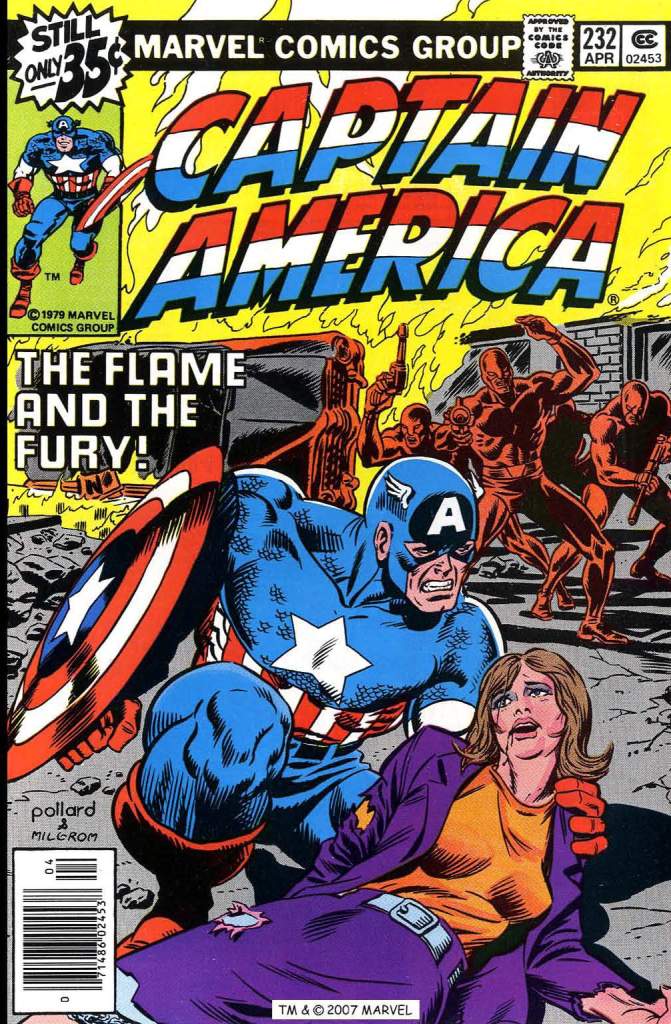
I didn’t know it at the time, but CAPTAIN AMERICA was in the midst of what would turn out to be a six-issue epic story. These things weren’t typically announced ahead of time. Rather, stories sometimes ended in a To Be Continued and eventually, they ended and you knew how long they would be. In certain instances, such as THOR in the mid-1960s, each story would lead directly into the next story in such a way that three years would go by without any discernable break in the Thunder God’s adventures. This six-parter would include a plot element that would make it a lot more fascinating to me once we’d reached its end, but at this early stage, I wasn’t all that enamored of what I was reading. Still, it was enough to keep me coming back month after month.
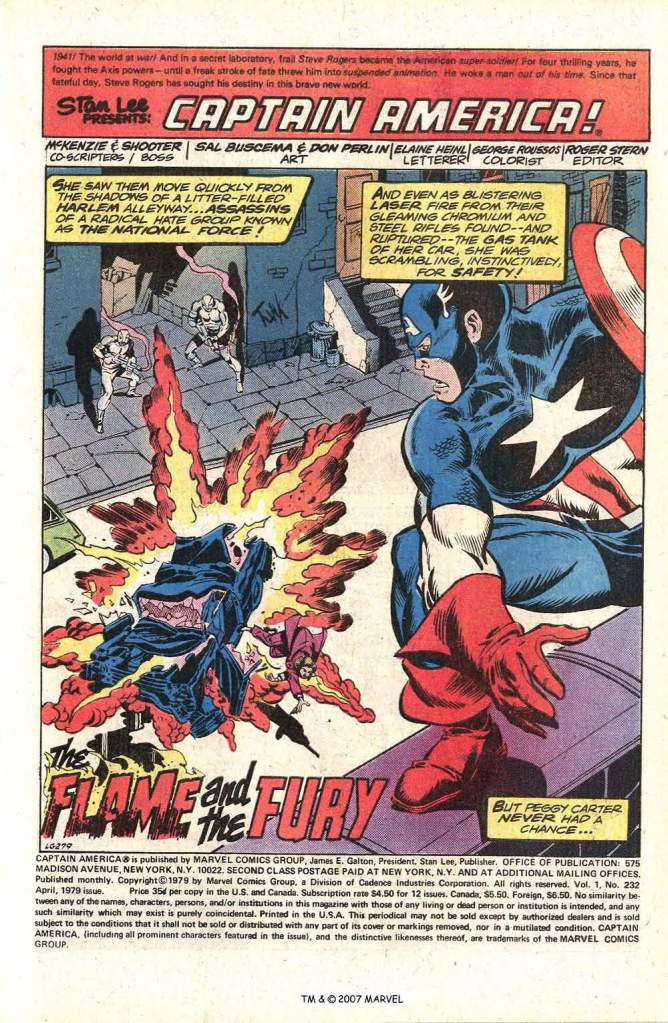
This particular issue was co-scripted by Editor in Chief Jim Shooter, which is slightly odd. I must imagine that Roger McKenzie ran into some problem and that Shooter had to step in to complete the work in order to get the book to make its print date. I can’t say that, as a reader, I discerned any change-over in the style of the writing, so Shooter completed his part in a manner consistent with that of McKenzie. (By that same token, I don’t know that I could have picked McKenzie’s work out of a line-up. He seemed to script in a very standard-for-the-period Marvel style.)
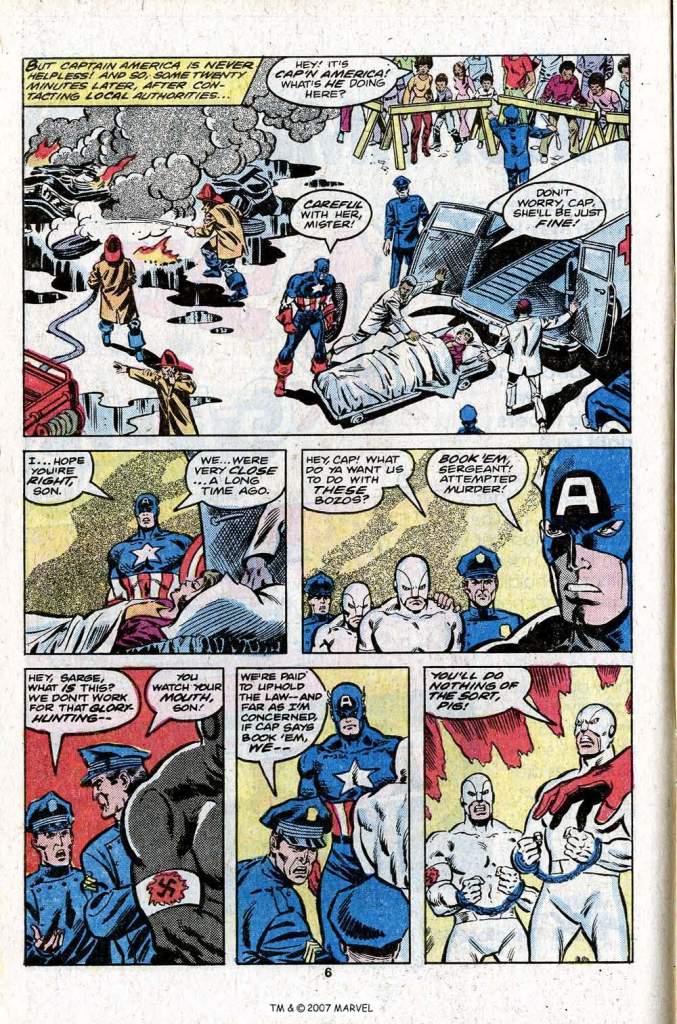
Last issue, Captain America and Peggy Carter had been working to investigate and bring down a Neo-Nazi organization of white supremacists called the National Force. But their cover blown, some of the Force’s troops followed Peggy home and exploded her car with her in it. Cap has arrived just in time to witness this, and he races to the vehicle to see if Peggy might still be alive. She is, but Cap needs to get her to medical attention urgently. Unfortunately, those National Force goons aren’t about to let him do that. Fortunately, he’s Captain America, so he beats the snot out of them in about a page and a half. Rather than being taken into custody, the captured National Force members self-immolate themselves in the manner of suicide bombers, killing themselves in a flare of flame.
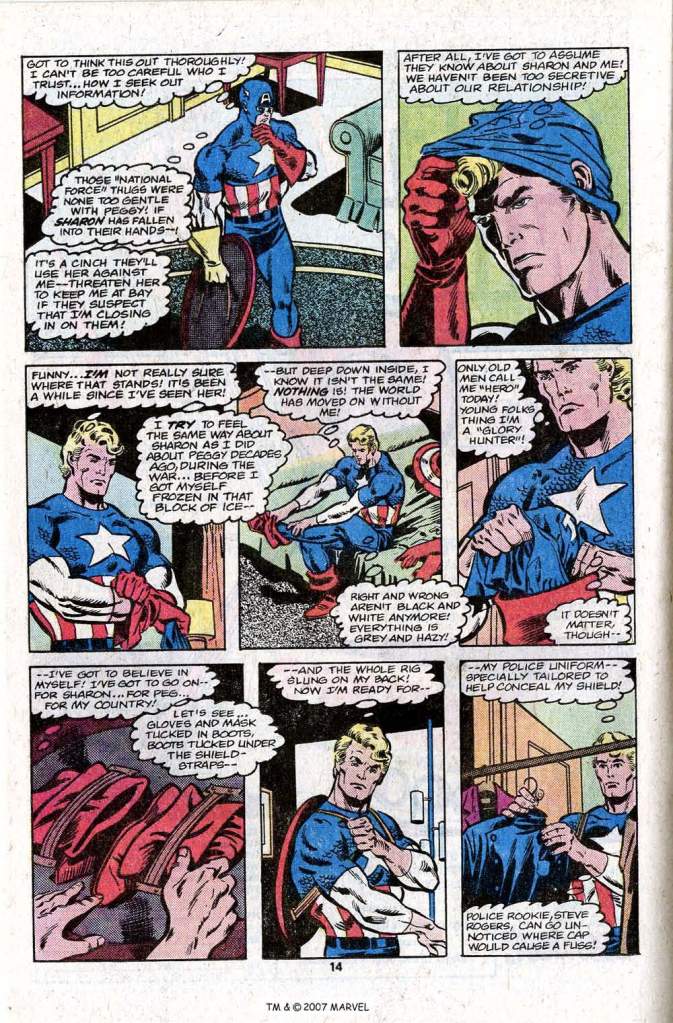
Once Peggy is taken away by the Emergency Medical Technicians, Cap heads back to his brownstone apartment to regroup. He needs to get more insider intel on the National Force and its grand Director if he’s going to be able to dismantle the group, but it’s too dangerous to others for them to be seen giving information to Captain America. So the Avenger instead dons his old Police Officer uniform from when he’d been employed for a while as a rookie cop, and hits the streets. There’s a bit in here where Cap mentions that his police uniform is specially tailored so as to conceal his shield, which he wears on his back. That’s a hell of a tailor you’ve got there, Cap! This is all in the service of attempting to explain earlier Jack Kirby issues stories where the King would have Cap’s shield somehow fitting underneath his street clothes. It’s as good an explanation as any.
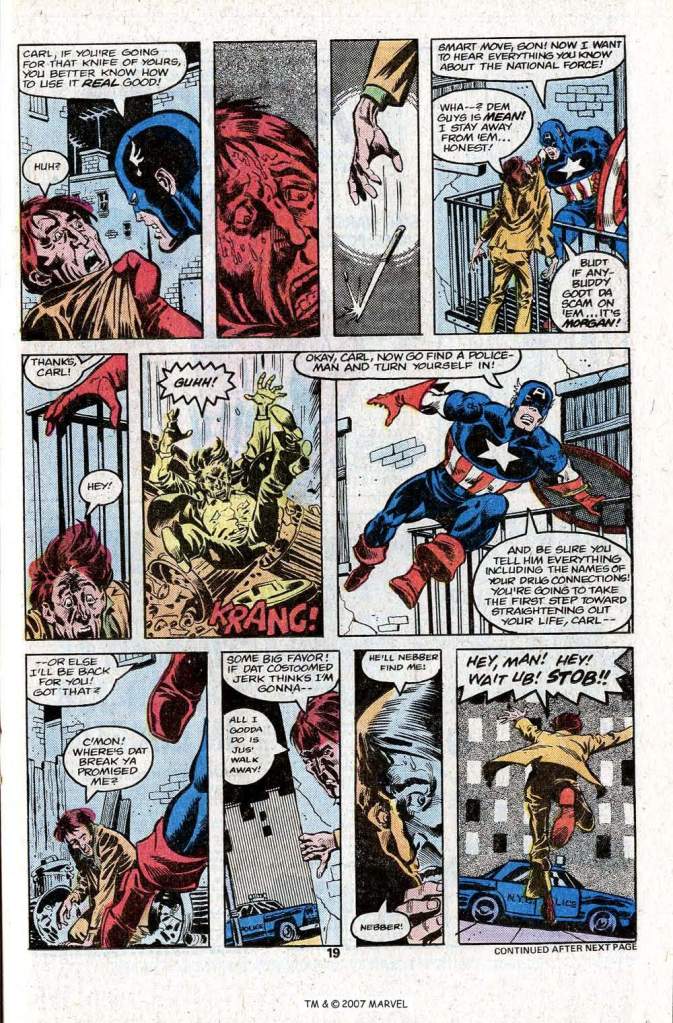
Sadly, though, Cap’s meeting with his ally the Police Commissioner doesn’t net him any new intel. The Commissioner tells Cap that he’s been ordered by higher-ups to lay off of the National Force–they must have somebody powerful and connected on their payroll. Undaunted, Cap seeks out information on the street, roughing up addict Carl “Pigsticker” Peel in a humorous sequence. Pigsticker tells Cap that he steers clear of the National Front, but that the person who’s sure to have information on their activities is Morgan, the Harlem gang leader who has been a regular fixture in this series for several years, and who usually crossed swords with the Falcon. After Cap leaves, telling Carl to turn himself in, he considers reneging on his promise–but in the end, his fear of the Star-Spangled Avenger drives him to seek out a police cruiser and to turn himself in.
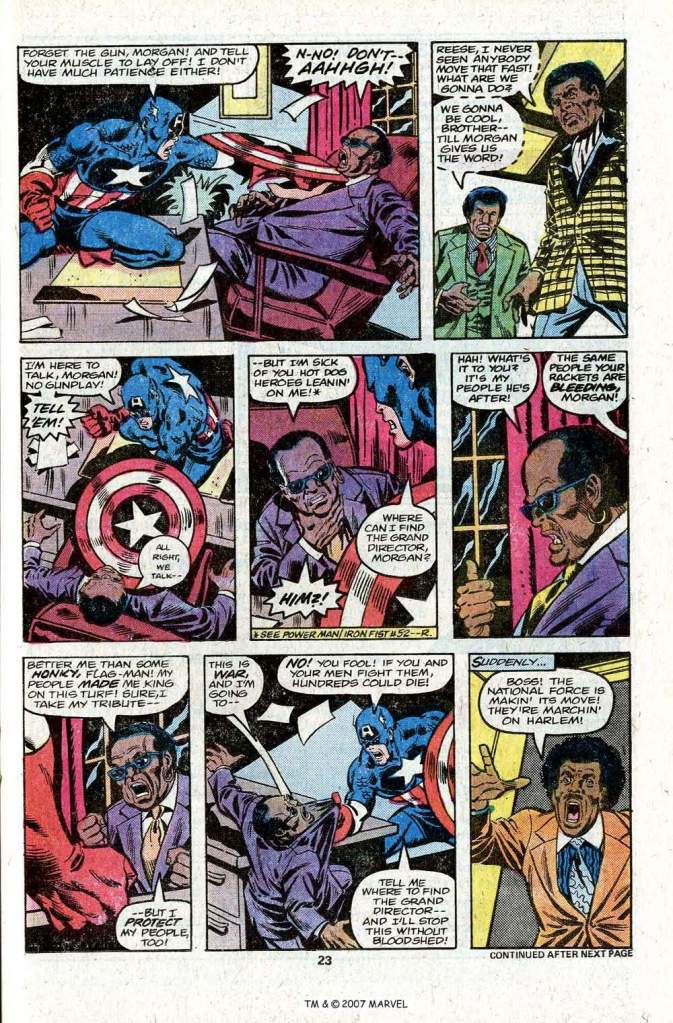
It’s another intimidation sequence as Cap arrives at Morgan’s crib, fights his way past the crime-lord’s guards and then assaults the leader himself, demanding a lead on the National Force. Morgan’s got no love for the National Force either, and he’s preparing for a throwdown with the Force who are making strides into the territory he controls. No sooner has Cap gotten this out of him than one of Morgan’s goons rushes in to tell the boss that the National Force is even now marching on Harlem in numbers, clearly looking for a showdown. Unlike Pigsticker, Morgan pays no heed to Cap’s warnings to stand down and let him handle it, and he calls for a full-on attack on the National Force by his mob once the Avenger has departed.
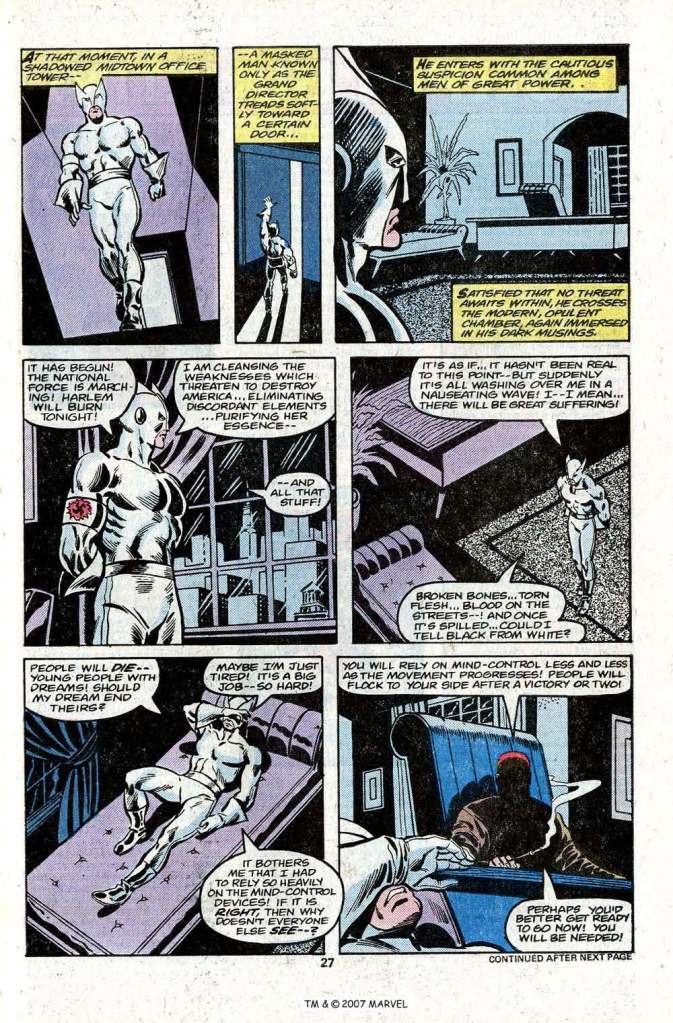
We cut away for a page at this point to show the National Force’s Grand Director reporting in to a shadowy master. The Director reports that everything is going according to plan, but that he’s beginning to feel misgivings about the people who will be hurt and the blood that will soon be shed. The mastermind tells the Director that they’ll need to rely on mind control devices less and less as more people flock to the cause of the National Force as they become more powerful–and it’s pretty clear in context that the Director himself is under the sway of similar mind-bending himself. Also, the identity of the shadowed puppeteer is relatively obvious if one is familiar with past Captain America stories–but we’ll get to him in due time.
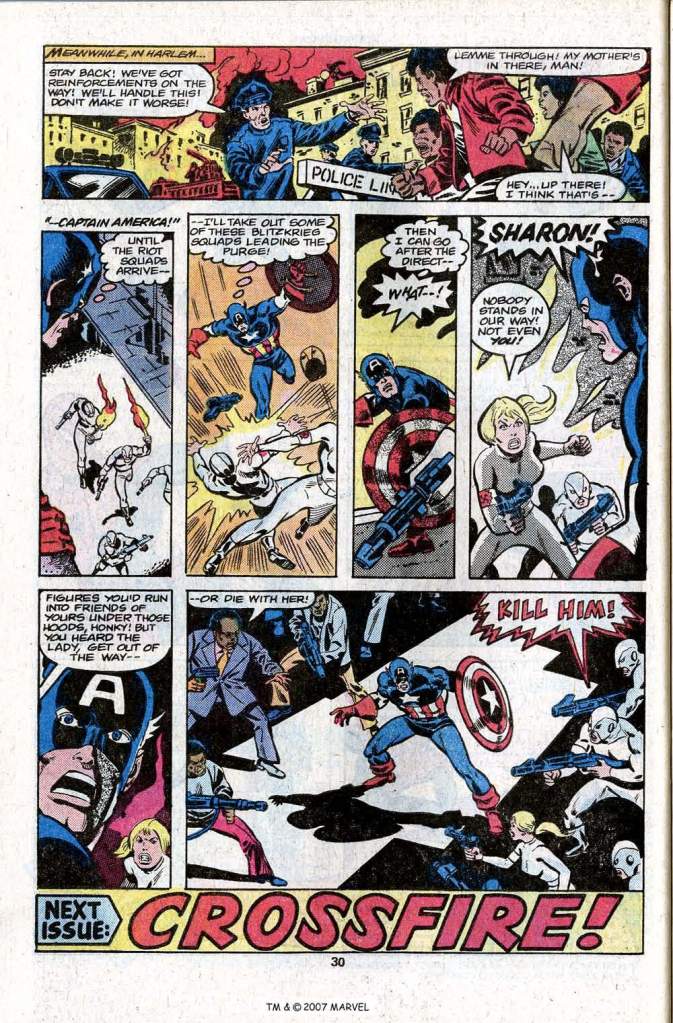
And in the issue’s final page, Cap arrives on the street of Harlem, which are on fire as the National Force is attacking everything indiscriminately. Cap throws himself into the fray, but he’s shocked to discover that one of the attackers is Sharon Carter, Peggy’s sister and his girlfriend. She had gone undercover into the National Force on behalf of SHIELD, but she seems to have fallen prey to their mind control techniques, and she threatens to perforate Cap if he doesn’t step aside. At that moment, Morgan and his gunmen show up, and the entire situation is about to explode in bloody violence. To Be Continued! As an issue, it’s mostly about moving the players into position–Cap doesn’t really get to do much apart from roughing up a couple of guys as he tries to get to where he needs to be. But it does have a certain moral intensity that remains relevant even today.
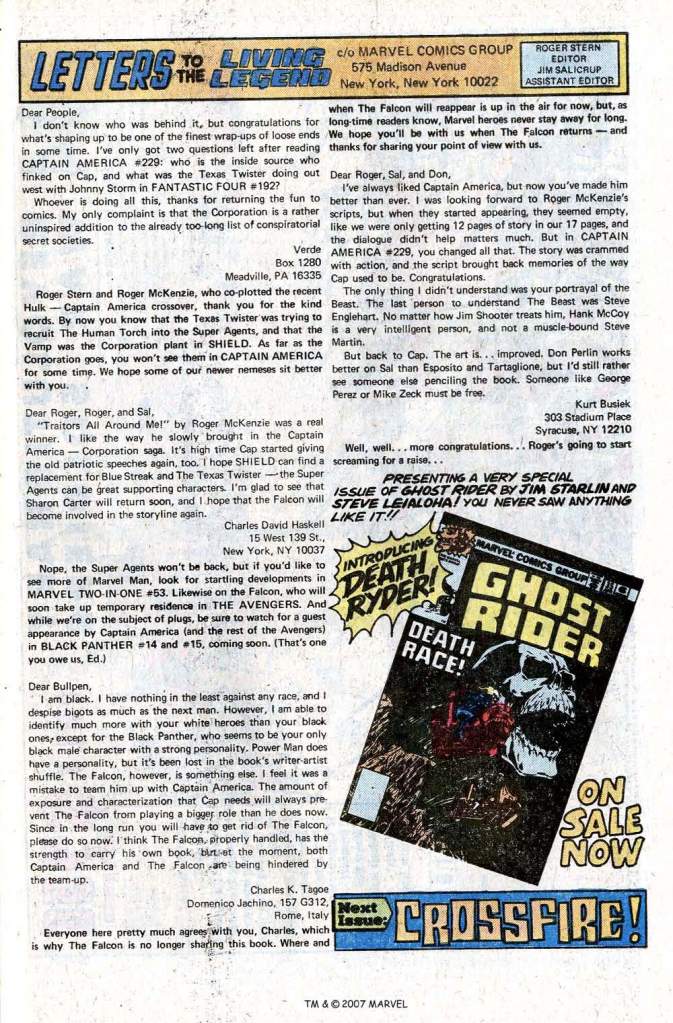
The Letters to a Living Legend in this issue included a missive from future Marvel writer Kurt Busiek. He thought that Roger McKenzie’s run was improving , but he took issue with the recent characterization of the Beast, who had popped up for a few pages in an earlier issue. There was also a house ad for GHOST RIDER which made this particular issue seem particularly special. In all likelihood, the real reason for that ad is that the book wasn’t getting enough publishable correspondence to fill the page. But it still put that issue on my radar and may have contributed to my decision to buy it in a few days’ time.
 The Tom Brevoort Experience
They did a good job though with the mystery mastermind. I believed it was Red Skull based on that page.
We’re also coming up on the tragic death that felt both like an afterthought in the way it was presented and one of the few that I think should have been left undone.
LikeLike
I’ll agree on the After Thought, but I kind of like Sharon Carter ( She is a much better choice than those civilians he dated after her death ). Her After Thought death is like Toro’s suicide ( as I call it ) in Sub-Mariner#14 ( June 1969 ) where after he was brainwashed/hypnotized into thinking he was the Original Human Torch, Toro did what Johnny Storm & Jim Hammond never did — defeated the Sub-Mariner and could have killed him. Yet when he gets his memories back he forgets how to disable a rocketship and capture a non-powered villain? Toro’s death, Thunderbird ( John Proudstar )’s death were all stupid ( Like Banshee couldn’t have knocked his ass of that plane and caught him or Storm catch him. Plus the reason for killing him off — so similar to Wolverine, then upgrade his strength ( Class 100 ) and speed cause the Avengers had more than one upper strength hero on their team ).
LikeLiked by 2 people
SPOILERS: The Grand Director ( Atlas Age Captain America ) what a waste of a character, cause he should have been turned into Captain America’s COMMISSION [ Captain America#332-333 ( August-September 1987 ) – Mark Gruenwald ] replacement instead of creating John Walker ( Super-Patriot ). He should now be U.S. Agent not John Walker. Same way Atlas Age Bucky ( Jack Monroe ) was cured [ Captain America#281 ( May 1983 ) ] it could have been revealed the Commission or SHIELD saved him and cured him. Turned him into the Black Ops Captain America the Commission clearly wanted Steve Rogers to be.
LikeLike
To bad someone doesn’t bring back Victorius ( Victor Conrad, A.I.M. scientist ) [ Marvel Two-in-One#42-43 ( August-September 1978 ) — he must have had hand-to-hand combat training before he took his Super-Soldier Serum otherwise his serum’s enhancements wouldn’t have helped him against Cap’s years of experience — he was holding his own until he decided to go for the Cosmic Cube ].
LikeLiked by 1 person
Waiting somewhat impatiently for this issue and those around it to be reprinted in an Epic Collection, completing Cap’s pre Heroes Reborn run in that format.
LikeLiked by 2 people
Mike Zeck? George Pérez? 18-year-old Kurt had good taste, at least.
I remember thinking Sal Buscema’s work was kind of uninspired in this stretch, and he’d been the first artist I ever thought of as my “favorite.” The inkers sure didn’t help. And maybe he didn’t care for the stories. His work on HULK seemed to be just fine at this point, though he often had disappointing inkers there, too.
LikeLiked by 3 people
A product of its time. The dialog was stilted, & since 2 writers are credited, I can’t single one out. I’ve read better from Roger in his other work. I was really tired of people calling younger guys “son”. I’m glad that’s fallen by the wayside. But in 1979, why are cops still dressed like it’s 1959? I remember in the mid-late 80’s older artists were still drawing fashions on by-standers, cops, & nurses, like it the 60’s. It took some of new artists emerging then to draw people as they currently dressed. Notably Rick Leonardi, Art Adams, Paul Smith, Bill Sienkiewicz (of course). Heck, even in the “Civil War” tie-in’s (2007-2008?), hospital nurses were drawn wearing all white, knee-length dresses & those hats they hadn’t worn in decades.
I do like Perlin’s inks over Sal’s (and other artists’) drawings. Adds some depth & toughness. I haven’t always loved his drawing, but he had his moments. Young Kurt with the dead-on letter column prediction of Mike Zeck’s ascension on Cap. Well, more like suggestion, but still dead-on. The balls we fans have to judge the pros. 😉 I’m sure Kurt’s gotten his share during his long career.
The Harlem crime boss Morgan. Mike W. Barr used a similar character in Gotham (Morgan Jones?) in the 80’s. The dialog for those guys here seems a bit forced, but then some of it is still being said out there, in real life. Sadly, I could see a racist confrontation like this one happening today. But if Marvel showed it, they might get blasted for being “woke”. Eff ’em. Fighting injustice & Fascism is a big part of what Cap’s about. I’ve liked JMS’s run, though some of the more esoteric elements go over my head. But it seems tragically crazy we still have Nazis around for Cap to fight.
LikeLiked by 1 person
I believe this the the first actual Peggy Carter cover.
232 remains a good read and sadly the content is still relevant today.
LikeLiked by 1 person