

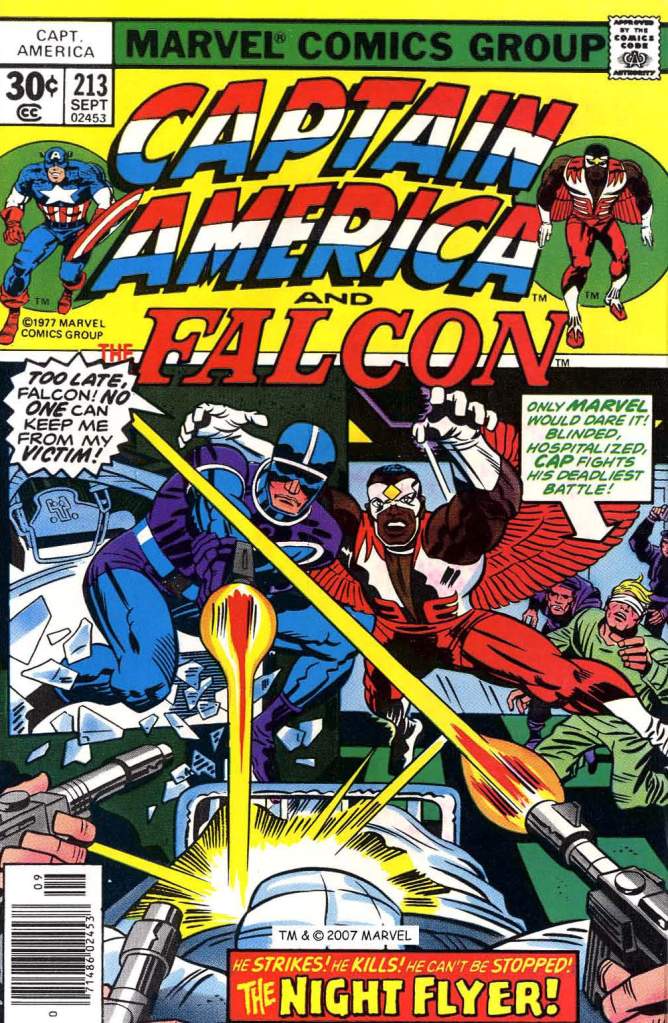
This issue of CAPTAIN AMERICA was the last book that was in the SUPERHERO GIFT PACK that I was given for Christmas in 1978. It was another issue from right at the end of writer/artist Jack Kirby’s individualistic run, one that read and played unlike anything else in the Marvel line. As always, Jack’s work had power and created memorable moments and images that stuck with you, but his dialogue rhythms and unique caption style had his copy difficult to parse, at least as compared to sort of mindless chatty banter than most other Marvel books of this period evidenced. So the graphics attracted me, but it wasn’t until years later that I began to truly vibe with the copy.
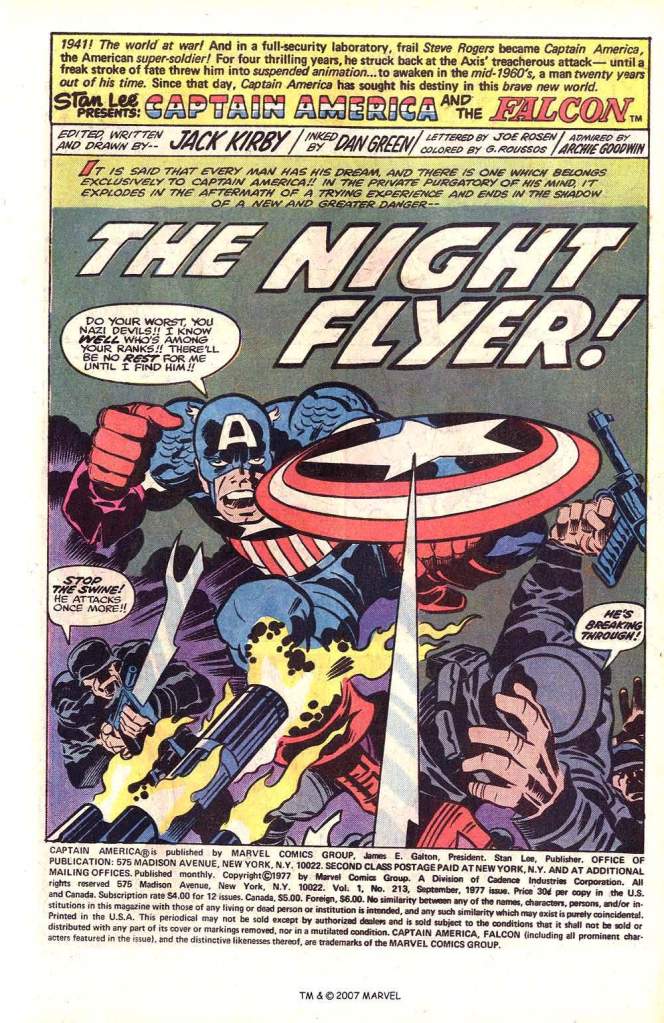
This issue opens with a multi-page dream sequence in which a recuperating Steve Rogers imagines himself in a final, fateful conflict with his eternal enemy the Red Skull. This was almost certainly done because it’s the only sequence with Captain America in costume and in action that we get in this issue. Last time, Cap’s eyes had been raked by a bestial opponent, rendering him sightless, at least until his body had a chance to heal itself. So for most of this issue, Steve Rogers is in civilian attire and not in the best of shape to be mixing it up with the likes of the Red Skull. I will say that blinding a super hero is a really good cliffhanger situation to put that character through, and Kirby doesn’t shy away from it, even if Cap neve truly seems resigned to his situation.
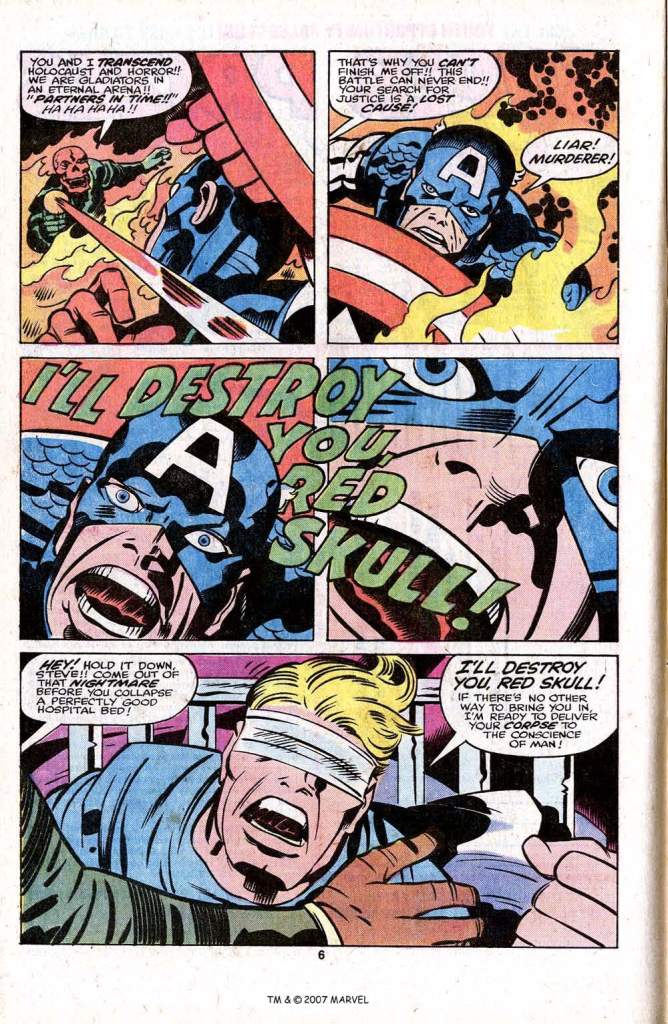
As his nightmare reaches peak intensity, Cap certainly seems ready to outright kill the Red Skull if that’s what it takes to stop him. This seems uncharacteristic for a super hero of this era, particularly Cap, but it very much spoke to the PTSD experienced by those who had gone off to combat and returned with recurring Night Terrors, as Kirby himself often experienced. Upon awakening, Cap shares a few moments with Sam Wilson, his partner the Falcon, in which a bunch of bookkeeping for the series is taken care of. Donna Maria, for example, is mentioned but not seen–and she won’t be seen again during this run, so this is all the closure that she gets. As their conversation continues, SHIELD guys bring in a roommate for Cap. He’s a nameless “defector” who has agreed to hand over information to SHIELD, and so his life is in imminent peril. The last assassination attempt almost took his life, which is why SHIELD is keeping him in protective custody.
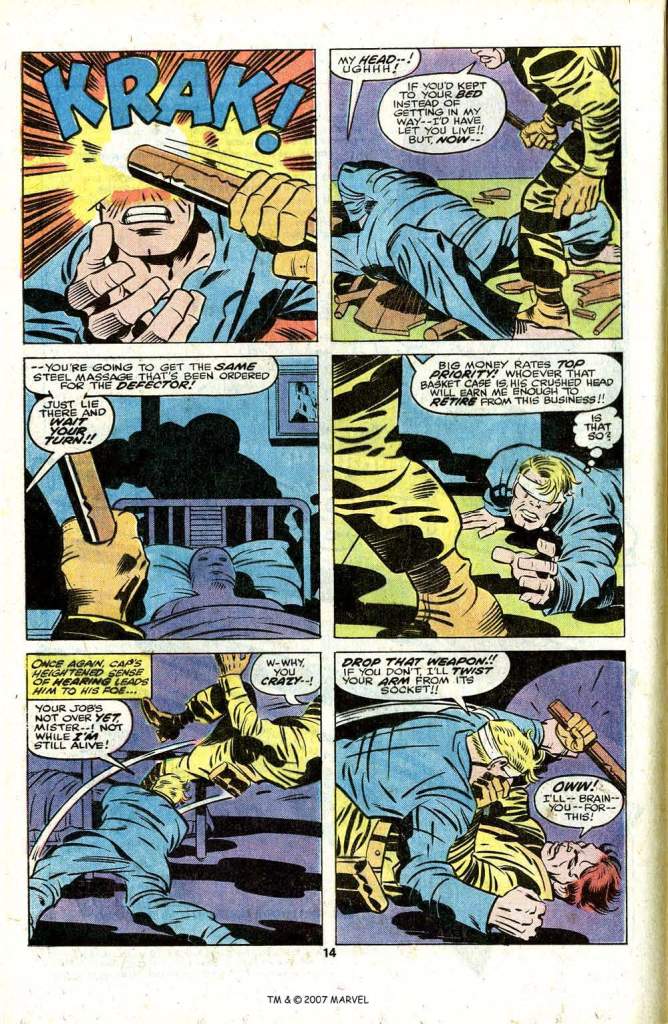
That evening, as you’ve no doubt anticipated, Steve is awoken after hearing another person in the room. It’s an assassin, attempting to collect the ripe bounty on the Defector’s head. Despite being blind, Steve hurls himself at the attacker and begins to battle him. Yes, he can’t see, but the room is dark, so the killer doesn’t have an easy time of things either. The fray goes back and forth until, in a moment of desperation, Cap smashes the guy through a window, where he falls to his presumed death. Cap wasn’t kidding about icing the Red Skull a few pages earlier. But Cap and SHIELD realize that this isn’t going to be the end of it, that other killers will come. Steve tells the SHIELD boys to alert the Falcon.
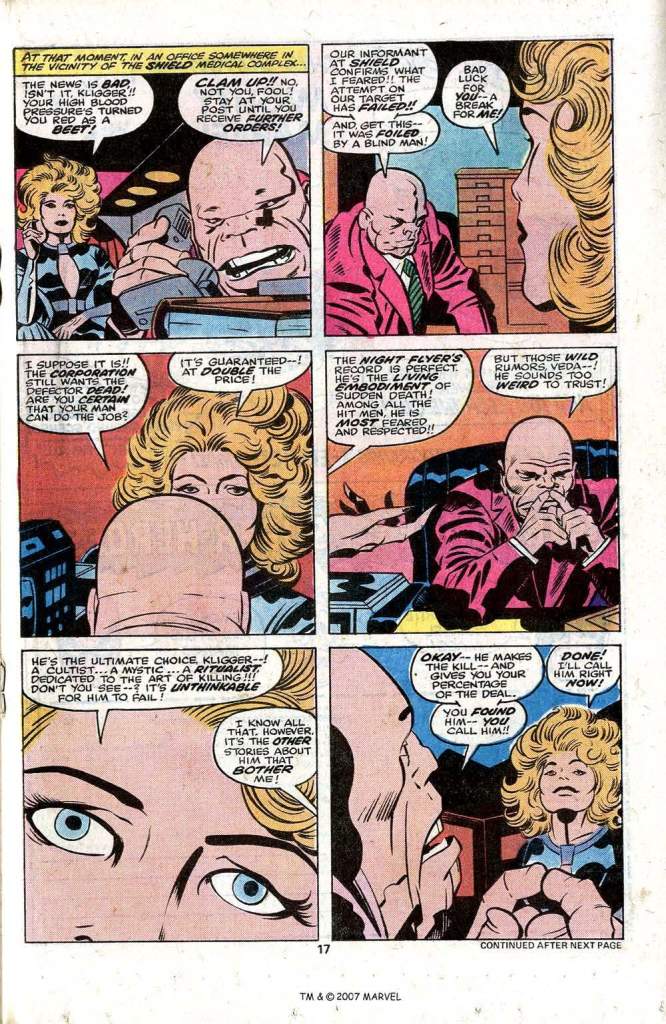
The scene then cuts elsewhere, and we are introduced to Kligger and Veda, two operatives of the Corporation, a criminal enterprise that is set up like its namesake. Kirby used them both in CAPTAIN AMERICA and in MACHINE MAN, and they were later picked up by the creators who followed Jack on these books. Discussing the failure of their operative to kill the Defector, Veda suggests that they employ the services of the Night Flyer, who is not only the most respected assassin in the business but also a cultist who is dedicated to killing as a holy art. He styles himself the perfect man, and so he never fails to complete an assignment, no matter how difficult.
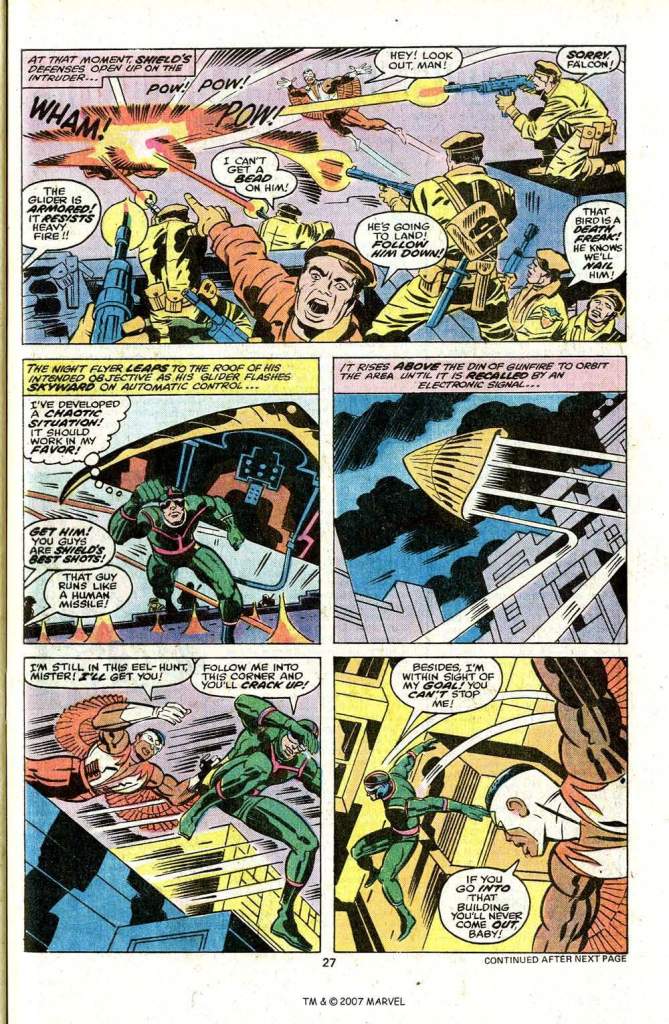
The Night Flyer is one of those ideas of Jack’s that is simultaneously cool and goofy. I don’t know that his green color scheme does him any favors–the blue one he’s got on the cover would likely have made him felt a bit more menacing and dangerous, if not pop as well on the page. To infiltrate SHIELD Medical, he soars in on a shell-proof high-tech hang glider. The Falcon intercepts him in midair, but isn’t able to slow his approach. Nor are the heavily -armed SHIELD troops that are dispatched to bring him down. The Night Flyer implacably penetrates the building, with the Falcon in hot pursuit. But Sam Wilson is unable to stop him, nor prevent him from emptying a pistol into the bedridden body of the Defector.
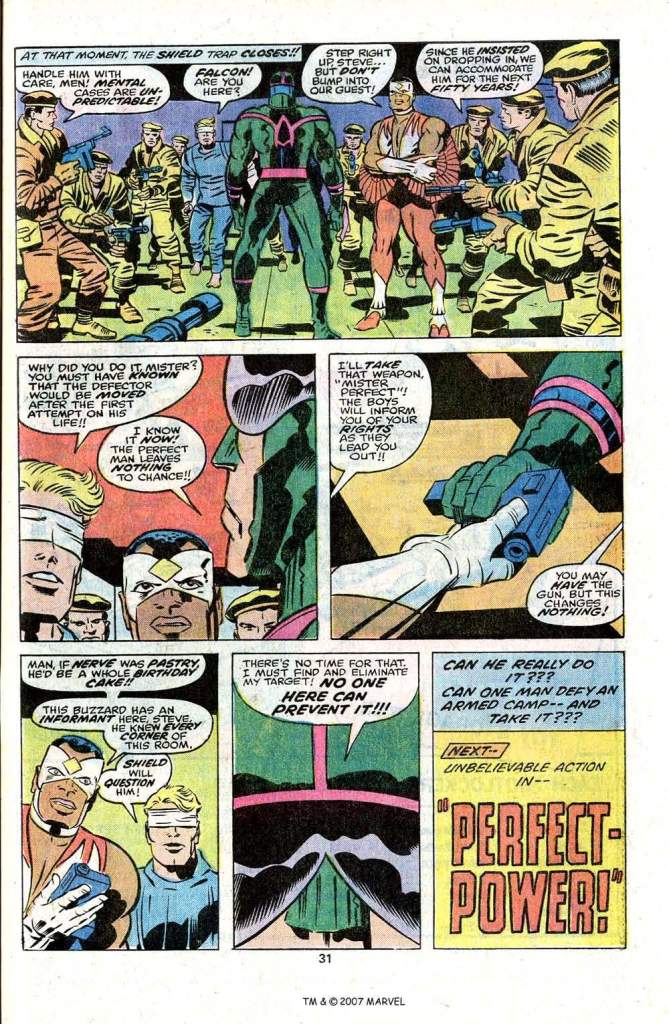
Fortunately, this entire set-up has ben a decoy, and the body in that bed isn’t the Defector at all. Encircled on all sides, the Night Flyer has no choice but to surrender, but he acknowledges that he suspected that this was a snare all along, and that it doesn’t matter. He’s still going to eliminate his target and nobody is going to prevent him from doing so. To Be Continued! Jack had only one issue left in his run at this point–I’m not certain when he would have been made aware that his time on the series was coming to an end, but I’d speculate that it was before or during the time that he was working on this issue.
 The Tom Brevoort Experience
Whether or not one likes the story, the panels and pictures alone speak of Jack’s genius. I love the opening splash page — what a composition. Even when he has talking heads, the drama is intense. I’ll take Jack Kirby — even when he may not be at his best — over any comic artist working these days. Jack drew for comics. Today’s artists draw for the movie storyboard. Yawnsville.
LikeLiked by 3 people
The CORPORATION: If a modern writer wanted to, here is The Corporation’s possible Timely Comics’ first appearance [ Mystic Comics#5 ( March 1941 ) Black Marvel story – page 12 panel 5 – from a dying gunman,”… There’s a COMBINE of CROOKS bein’ formed. Just like a big CORPORATION!” ] now compare that to Machine Man#7 ( October 1978 ) last page panel 6 from Dr. Peter Spalding,’…We’re dealing with a powerful, highly organized CRIMINAL COMBINE!”
LikeLiked by 1 person
SPOILERS: The Incredible Hulk#264 ( October 1981 ) was my intro to the Night Flyer where the Corruptor claimed to have resurrected him and when the Hulk destroyed his glider page 18 panel 1 described the Night Flyer’s flesh as synthetic tissue as his body became an ashen heap again. Which would suggest he was some kind of Android in that Hulk issue, but in CA#213 he could have been either an extremely well trained assassin from a young age or a genetically engineered human ( hence his talk about perfection ) and the power surge from his glider getting destroyed by SHIELD in the next issue could have caused the same damage and death to the Night Flyer. The Corporation hired him so he wasn’t one of theirs, so was he the Enclave’s or Arnim Zola’s or Brand Corporation’s or the Thinker’s or Doc’s ( see Savage She-Hulk#25 — her only interesting foe, a 100 year old geneticist ) or ?
LikeLiked by 1 person
“I’LL DESTROY YOU, RED SKULL!!”
Years before Kirk’s “KAHHHHHN!”
😉
LikeLiked by 1 person
Oh, if only Jack had worked with a dialoger!
LikeLike
I’ve read worse by writers who got steady gigs.
LikeLiked by 1 person
Agreed, but enough about Fabian Nicieza. I just think he would have benefited from just plotting and pencilling or stronger editing.
LikeLike
I’m not thinking of Fabian, who’s done some stuff I’ve liked.
LikeLike
In this regard I am always thinking of him. His X-Men was particularly weak. Not to mention he enjoys picking fights with fans online.
LikeLike
Sorry to hear that. Hasn’t been my experience w/ him.
LikeLike
Lucky you. Like 5 years ago I had had enough of him coming at me like a rabid fanboy on every one of my posts (and not ones directed at him in any way) and finally told him to either knock it off or block me. Three guesses which one he picked.
LikeLiked by 1 person
I think the dialogue in this issue is pretty great. I love when the first assassin tells his bed-ridden victim, “Just lie there and wait your turn!” And the way Jack builds suspense and curiosity about the Night Flier by showing us that even a tough character like Kligger finds him unnerving. And of course, Falcon’s funny line at the end, “Man, if nerve was pastry, he’d be a whole birthday cake!” (Jack seemed to really like Falcon, he often got the best one-liners).
LikeLiked by 3 people
He did some fine dialogue,
I was Particularly struck, by some things from The New Gods. For example, ‘the sequence where Izaya the Inheritor become Highfather in New Gods # 7.
The art, the captions and the (rather stark) dialogue combine to create one of the best depiction of PTSD I have ever seen in any medium. (At at least some level, it is likely Kirby, an Infantry Scout who saw combat in the Ardennes campaign with Patton’s 3d Army, suffered from PTSD.)
Kirby seemed to see the art, the dialogue and the captions as one seamless whole.
Maybe an editor could have helped.
Another pair of eyes can help writers see “where the need to kill their darlings.” (Or, as with Fitzgerald’s reading A Farewell to Arms at Hemingway’s request prior to his submitting it, telling someone the things they should emphasize.)
LikeLiked by 2 people
Cap might have dreamed about killing the Red Skull, but at least he never tried to commit genocide because he thought his then girlfriend is dumping him [ Fantastic Four#99 ( June 1970 ) — The Human Torch ( Johnny Storm ) over Crystal ( Who was in Attilan to aid Blackbolt who was stricken during a radiation experiment ) ] — so he starts creating a giant fireball ( Reed’s heat-absorption rod neutralized it ). Then he throws one at Reed & Ben which Sue’s forcefield stops. As for Captain America, his bloodlust ended long before Captain America#370 ( May 1990 ) when he found the Red Skull helpless ( as a result of Magneto leaving him with only 10 gallons of water in Captain America#367 ( February 1990 ) ) in Skull House — and Cap left him there. He didn’t even try to bring him in ( Sure he was in a damaged clone body of Captain America and not the Skull’s original body and that body( a.k.a. Red Skull ) was reported dead — but if the Red Skull ever released video of that, it would damage Cap’s reputation).
LikeLike
Interesting this issue seems to have been brought in house, with Dan Green inking & Rosen lettering, rather than the usual Royer job.
LikeLike
Someone commented online once that Kirby creates characters who go to extremes — Desaad as pure sadism, Darkseid as absolute control, etc. The Night Flyer as a guy who wants to be absolutely failure free fits with that.
LikeLiked by 1 person
Dan Green was a very good inker.
However, he seemed not to do quite as well at translating Kirby’s pencils (which depended heavily on shading and textures) into the medium of inks.
I have seen interviews with Kirby where he said he appreciated Sinnott being so careful about this “translation” process.
Kirby’s last few covers before he left Marvel were inked by people like Cockrum, Byrne, Simonson & Layton.. The last three seemed to appreciate this “translation” process.
LikeLiked by 2 people
I had this comic as a kid and literally read it sitting in a backyard treehouse, as God intended. It’s the perfect blend of monsters, mayhem, and adventure, and holds up perfectly fifty years later.
LikeLiked by 1 person