

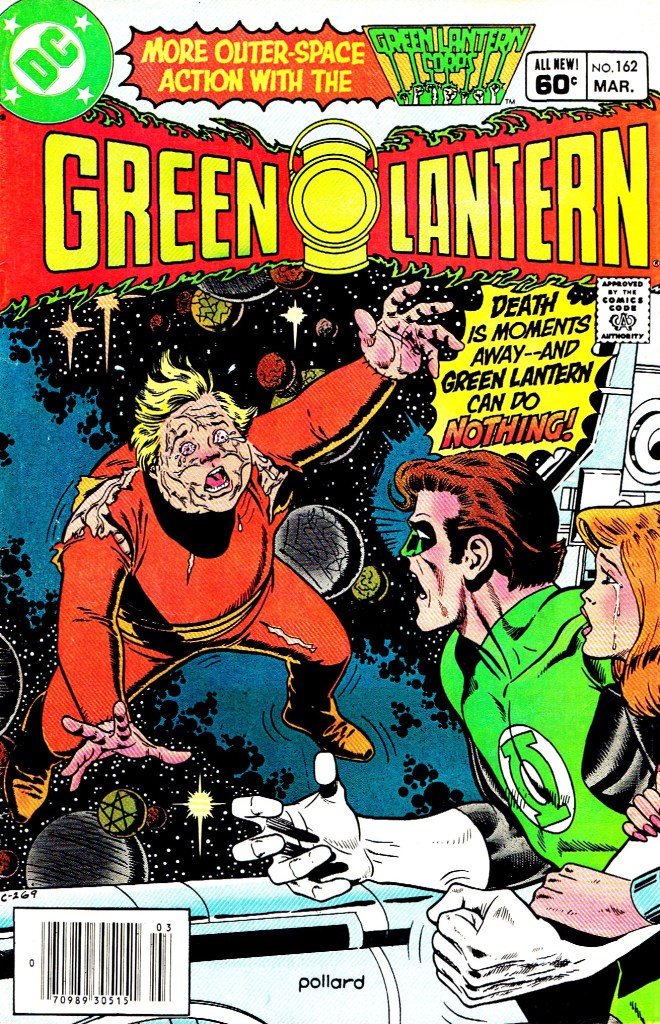
Green Lantern had been my second-favorite super hero going back to my youth, when I found him occupying the back pages of THE FLASH. Once he got his own series again, I followed it regularly right from the jump. And I was particularly enamored of Marv Wolfman’s run on the character which had wrapped up not long before this. But still, all of this was not enough to prevent me from adding GREEN LANTERN to my slash list when it became apparent that I needed to cut back on my regular comic book purchases. Nostalgia only went so far.
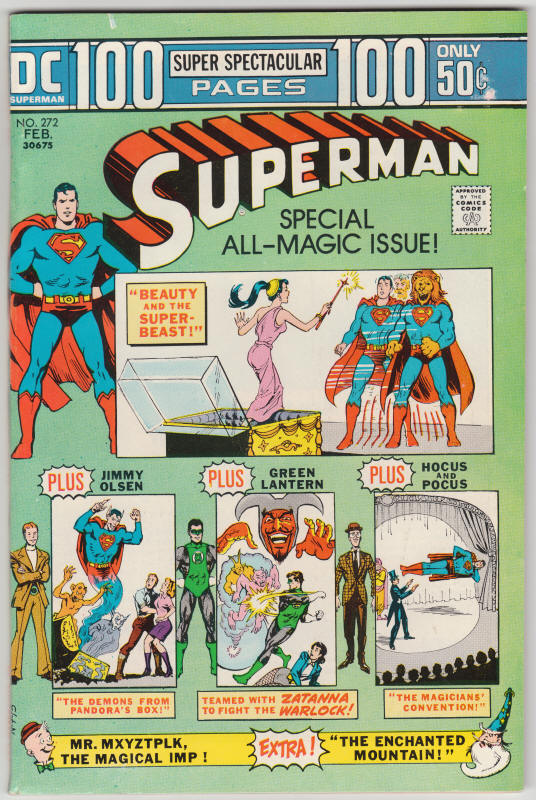
I’m reasonably certain that I first encountered the character in this 100-Page issue of SUPERMAN, which reprinted a classic tale in which the Emerald Crusader teamed up with Zatanna on her quest to locate her missing father Zatara, who had been a character in DC’s past. But from there, it was his solo series in THE FLASH as well as his appearances in JUSTICE LEAGUE OF AMERICA that carried the ball. I suppose that part of the reason I liked him was that Barry Allen liked him–the pair would team up semi-regularly–so that felt like a good endorsement. Plus, most Green Lantern stories were edited by Julie Schwartz and reflected the same sensibilities that I liked in FLASH.
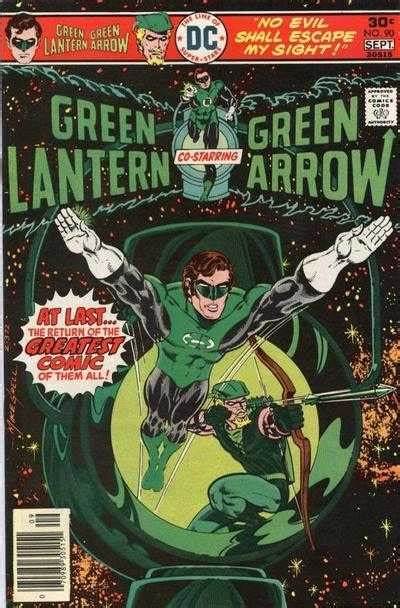
Eventually, after a pair of successful DC SPECIAL reprint issues, Green Lantern was awarded his own series again. But somewhat to my dismay, the book co-starred Green Arrow (and by extension Black Canary) in the manner that the final relevancy issues of his prior series had. I didn’t have anything particular against Green Arrow, but it became swiftly apparent that writer Denny O’Neil was way more comfortable in Ollie’s world than in Hals, and so the Arrow tended to dominate a lot of the action. But I bought the book steadily regardless. And eventually, I was rewarded when Green Arrow was left behind and the series became simply GREEN LANTERN again, for the first time in about a decade.
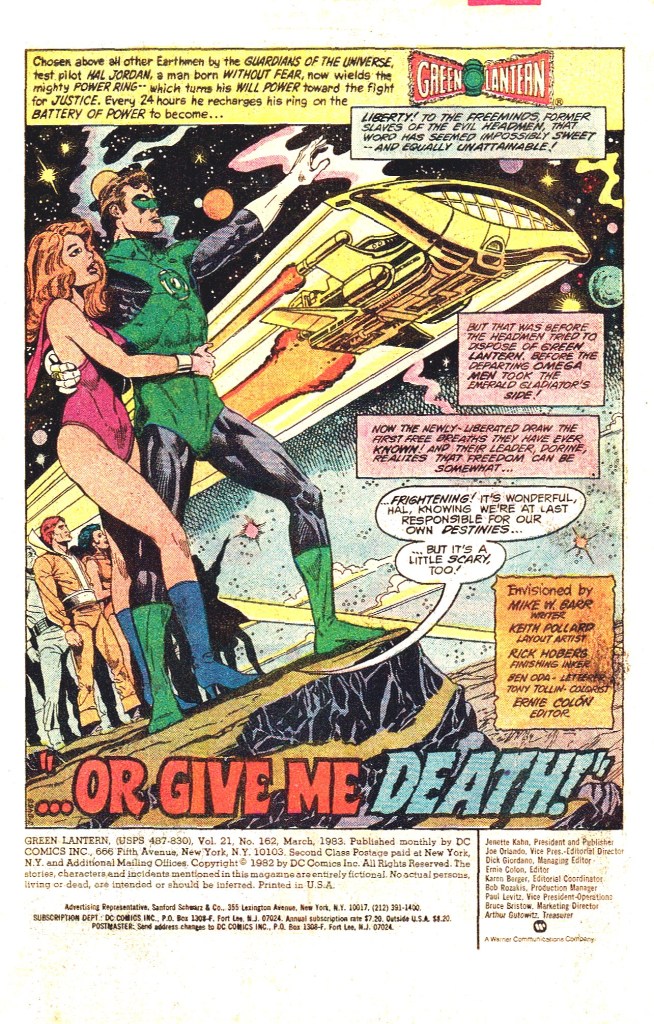
However, in the aftermath of Marv Wolfman’s departure as writer, the book started to go off the rails a little bit. For one thing, the creative team became unstable and haphazard, with different creators jumping into teh mix. Also, Marv had begun a storyline in which Hal Jordan was exiled from Earth for a year by his bosses the Guardians of the Universe, which meant that all of the stories were at a bit of a remove from any familiar locales or people. Editorship had passed to Ernie Colon, a talented creator who seemed to have a hard time managing the titles he was given. There were problems all over the place, and this issue of GREEN LANTERN, my last, is a good example of that.
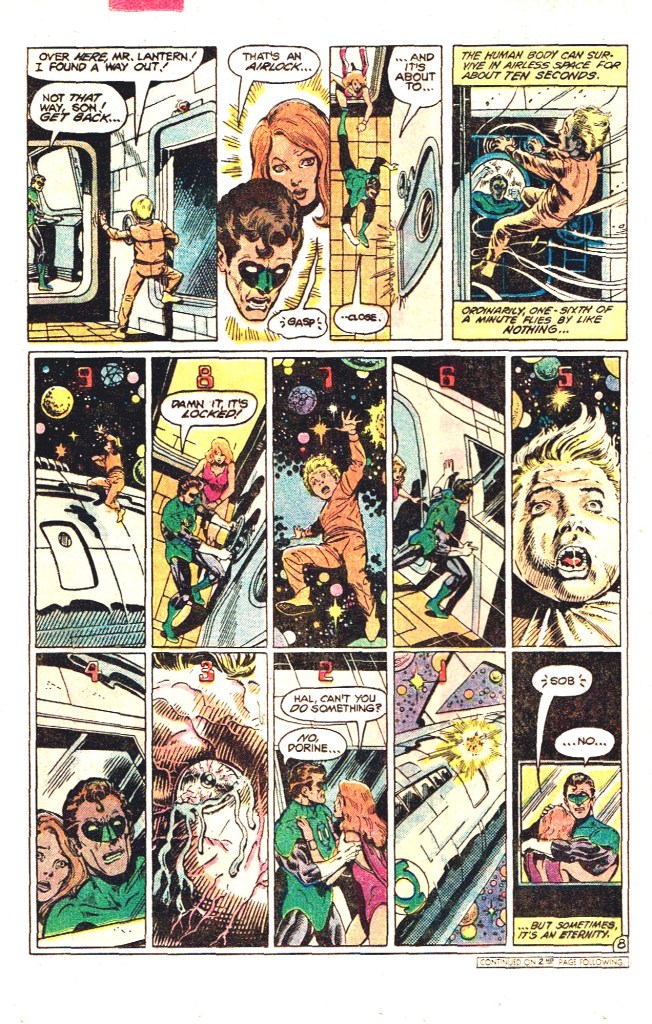
This particular issue is best remembered for its gruesome cover and the similarly gruesome scene partway through the story, in which a young kid is pushed out of an airlock and explodes on the vacuum of space while a powerless Green Lantern watches helplessly. It’s frankly astounding that the Comics Code okayed this sequence and that cover, and there was a bit of controversy amongst fandom at its appropriateness when it was first published. It’s definitely not the payoff that you wanted to the situation depicted on the cover.
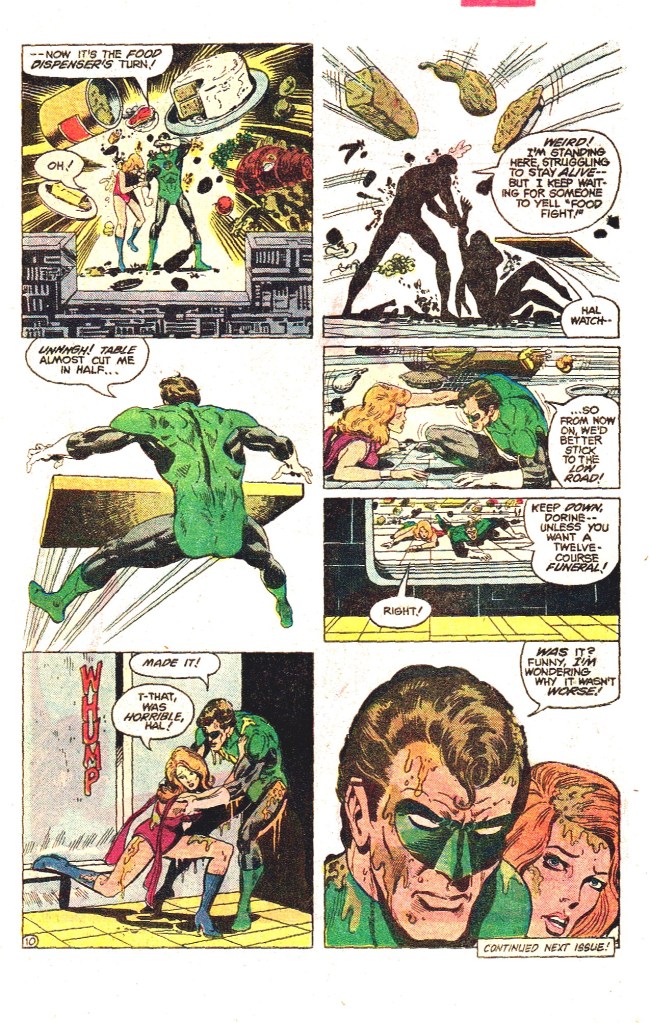
What’s more, the story stops in mid-stride, and it’s apparent that the creative team didn’t get their work done for this issue as they needed to, requiring some emergency triage. Whether that was on them or an outgrowth of Colon’s haphazard management style, I could not tell you. In order to compensate, Colon ran two installments of the Tales of the Green Lantern Corps back-up series rather than just one. But it’s impossible to disguise this abrupt ending.
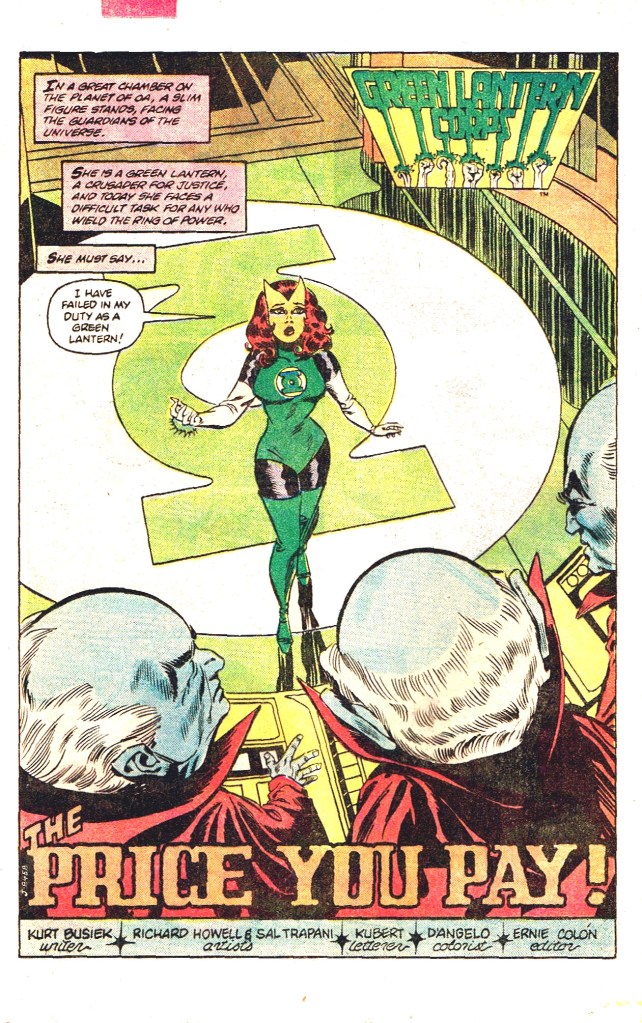
The first of those two TALES stories turned out to be the first published story by Kurt Busiek, who would go on to other things in the future. It was illustrated by his close friend Richard Howell, and it tells the tale of a young Lantern who saves the inhabitants of a particular planet despite their overt desire not to be saved, and in doing so causes a collapse of their entire society. In the end, the Guardians judge that she has lost the right to wield her ring and that she must give up her role as a Green Lantern, and the final question of the story is whether she was right or not to take such action in that it did result in the saving of a planet full of people. A nice little story.
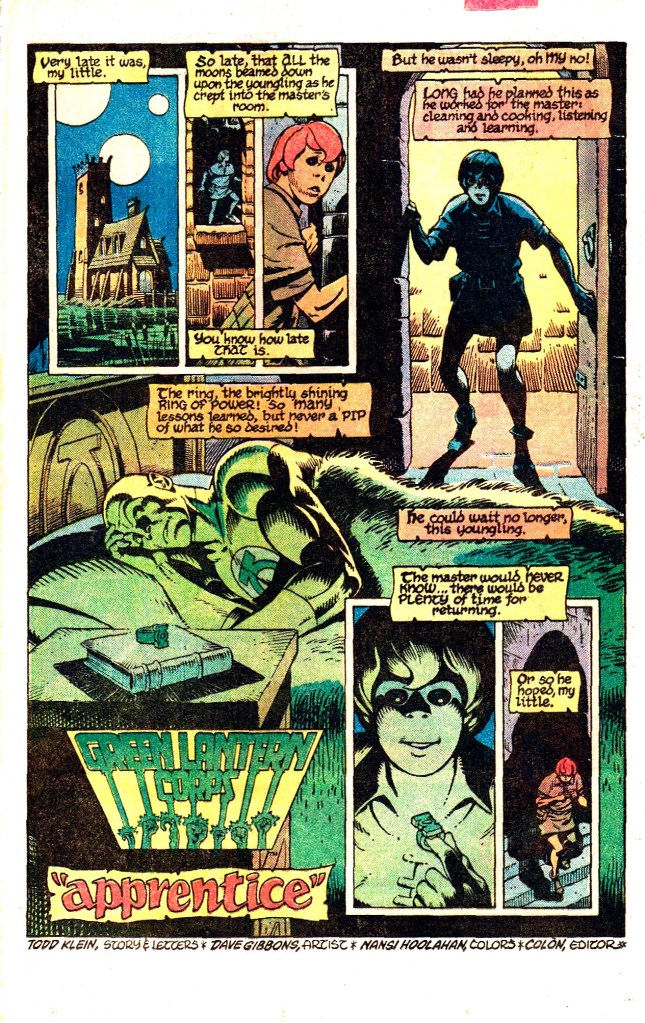
The second TALES back-up was written by Todd Klein and illustrated by British artist Dave Gibbons, who would take over the lead feature a short time in the future. It was a well-told story of the apprentice to an alien Green Lantern who steals his master’s Power Ring for what amounts to a joyride and gets into trouble with it, trouble that only his master can get him out of. So it’s basically the Sorcerer’s Apprentice, but with Green Lanterns, which is fine. The real star here is Gibbons’ artwork, which creates a convincing sense of environment and which also makes the more comedic elements of this story play while not completely undercutting the drama.
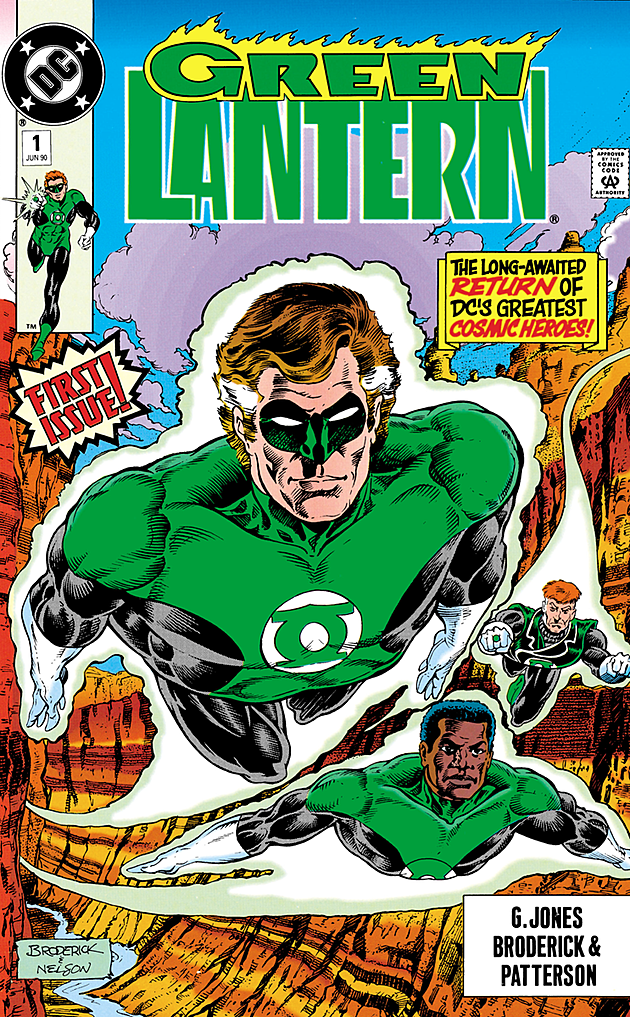
So for the most part, that was it for me and Green Lantern for the next couple of years. I did check in once in a while along the way, though. I bought Steve Englehart’s first issue as writer, #188, but wasn’t compelled to keep going with it. And I picked up #200 for obvious reasons, as a centennial issue was seldom to be missed. I also dropped in for the book’s last, #224, which was wrapped up by fill-in hands, as I recall. From there, I followed the character in ACTION COMICS WEEKLY, but that series was all over the map, with wholesale changes in direction and creative team happening with alarming regularity. I did read both EMERALD DAWN limited series, though I didn’t really love them all that much. I didn’t need for Hal Jordan to have a flaw like drunk driving defining his supposedly-fearless character. So the point where I came back to the series regularly was this new launch, which took place after all of that. For some reason, there was a feeling that making Hal older would somehow be appealing to people, and so he started sporting white temples. He also shared the book with his fellow Lanterns John Stewart and Guy Gardner, at least up to the point where each of them were spun off into their own titles.
 The Tom Brevoort Experience
I enjoyed the Wolfman and Barr runs more than you did. I stuck with Hal up through Emerald Twilight … no, must not Hulk Out!
I hated Emerald Dawn. Not only the drunk driving but I got a sense of “Yeah, you’ve seen the Guardians before, boring aren’t they?” from the creative team (a purely subjective assessment, obviously).
LikeLike
Secrets Behind the Comics Revealed:
DC has twice informed me that they’ll be reprinting Richard’s and my story in a collection, and both times they have printed Todd & Dave’s story instead. I’m convinced that this is a result of there being two Tales of the GLC backups in the issue, and they just grab the wrong one.
But then, having done so, they send Richard and me the royalties.
I’ve tried multiple times to tell them they’re sending the money to the wrong people, and they dutifully take down the information and then keep sending the money to the wrong people. I even tried once to stave off the error — telling the editor of the second would-be reprint that he wanted to make sure to get the story from the middle of the issue, not the final story in the issue. Did no good.
I let Todd and Dave know, in case they could do any good from their end. Todd said I could buy him a drink sometime to even up. Considering the amount the story has generated over the years, at this point I may owe him two drinks.
Dave will have to collect from Richard some other way, but I gather that as long as WATCHMEN keeps selling, he won’t be hard up for the loss.
LikeLiked by 5 people
Was that story written with a sequel in mind, as many of the Takes of the Green Lantern Corps stories seemed to be?
LikeLike
No, it was just a one-off springboard. I pitched Ernie about 16 ideas and he picked that one.
I think Geoff Johns used Liana in a story much later, so there’s an untold story there where she gets her ring back. But I had no ongoing plans for her.
LikeLiked by 1 person
It’s cool she was used again, years later.
LikeLike
I only bought Green Lantern because I always bought Green Lantern. I’ve never particularly liked the character, a fact that crystalized when Kyle replaced him. I stuck around despite Oliver Queen being my most hated DC character and never, ever enjoying Grell’s work outside of Warlord.
LikeLike
You didn’t like the character, or Grell’s art on it, but you kept buying the book? Why buy it at all? No offense, just surprised by your comment. Batman’s my fave character, but I’ve skipped years of his stories because of their low quality. I refuse to reward poor stuff with buying it.
LikeLiked by 1 person
Completism, OCD, and anal retentiveness.
LikeLiked by 1 person
i salute & admire your honesty!
LikeLike
I always jumped in and out of Green Lantern, probably because I found Hal an uninteresting character outside of the test pilot/sci-fi era of the Silver Age that I enjoyed as reprints. A big exception: the Len Wein/Dave Gibbons run that replaced Hal with John Stewart for a long stretch. Those stories are why John is my favorite Lantern to this day.
LikeLiked by 1 person
Wow, that Keith Pollard and Rick Hoberg art looks great! I’d buy that combination monthly. Perfect for Hal’s GL. Dang. Mike’s script, at least from these glimpses, is below his usual “Barr”. (Eye-roll, please.) But I’d have returned for the next issue if Keith & Rick were back (which they were, and it also looked great). And Mike’s story ended well enough, w/ another yellow-colored danger Hal had to figure a way out of. But the kid’s death is still a serious tragedy that ruins the rest of the story.
Back to the days of Ben Oda’s lettering! I remember the editorial wishing him well after a long and productive stint at DC. I used to see his work in most of the comics I read. And Anthony Tollin’s colors. His late wife was the legendary color artist Adrienne Roy.
I never knew Todd Klein was a published writer! Now I know a little more of what Neil Gaiman might have meant when he referred to Todd as more than just a letterer. Maybe Todd gave Neil story feedback on “The Sandman”.
I liked Hal OK. I liked John as much or more. I especially liked John in the JL. Representation matters, and he was no “token”- he earned his place. But I disliked most of the GL comics I read. Guy was a jerk, but I put up with him in JLI, since they made him the butt of their jokes, and I’d buy Adam Hughes’ JLA, regardless of who wore the GL ring.
I disliked “Emerald Dawn”. And then this relaunch included above was a bust for me, because I’m not into Pat Broderick’s style (elongated and overly detailed figures & faces). And I hate “solo” books that are actually filled with multiple characters of the same name, and with the same powers. That seems to be the case with most books by Marvel and DC today, and I won’t buy those. OK, Rafa Sandoval makes it hard not to buy his Superman stuff, but it should be called “Superman Family”. Same for the amazing Jorge Jiminez on “Batman”.
The best use of a GL for me was Grant Morrisson’s take on Kyle in Grant’s JLA. I wasn’t into Kyle before then. But like every other character in JLA, except for Peter David’s Aquaman (and maybe Mark Waid’s Wally as the Flash), Grant wrote them better than they were in their own books.
Then there was Darwyn Cooke’s ode to the character in the writer/artist’s opus, “New Frontier”.
LikeLiked by 1 person
I really liked Broderick’s on Firestorm. Also on Micronauts. But it is very stylistic.
LikeLiked by 1 person
I like Pat Broderick’s work on Firestorm & Micronauts too. As well as the Legion of Super-Heroes [ The Legion of Super-Heroes#284-286 ] he did just before Keith Giffen took over as artist.
LikeLiked by 2 people
I forgot he worked on LoSH too, will have to take a look.
LikeLiked by 1 person
“Stylistic” is generous, but also true. Neal Adams used to say something like an artist’s style was how far they were from naturalistic fundamentals. Or the liberties they took with it. Or their flaws and weaknesses. You can have a distinct style but still draw naturalistic proportions, and balanced figures. Or appropriately disproportionately large hands on someone like the Hulk. And the art can be more “cartoony” or more naturalistic, but still be balanced & proportioned.
Pat drew really oblong faces, with extra long, pointy noses. All his “hero torsos” looked the same, with the same pronounced sternums that came to a centralized point above the abdomen. I liked his initial stuff on “Captain Atom”, but got tired of it, focusing more on the profound distortions than the storytelling. And he did better stuff in the 70’s on Captain Mar-Vell. But I really disliked his Batman in the 80’s (except one issue, I think of “Detective Comics”, inked by Klaus Janson- the more extreme elements were evened out, the excessively detailed rendering replaced by appropriate lighting and shadow). It was if Pat was basing his anatomy drawing on other artists’ interpretations (like Neal’s, as one example), instead of modelling it on real human bodies.
Artists’ styles partly come from filtering the visual info they take in, through how they reproduce it by hand. Better to model your facsimile on real people, than on someone else’s facsimile. Even when an artist like Mazzucchelli simplified his linework, omitted a lot of interior details in his faces & figures, they were still fundamentally sound. They had naturalistic proportions & perspective, in different, dynamic poses. Without a whole lot of lines, you could still see Bruce Wayne looked very naturalistic, even resembling Gregory Peck.
Stuart Immonen and Olivier Coipel have very distinct styles. But their figures look closer to what real human bodies look like. Pepe Laraz, too. And Dan Mora, Jorge Jiminez. They all have their own individual flare. But the fundamentals are there.
LikeLiked by 1 person
Hmm, it’s been awhile but it sounds like maybe his art got worse over time? I believe Firestorm would have happened before Captain Atom. Captain Atom would have definitely been after Micronauts. I can’t say that I liked a lot of the art on Captain Atom. It was exciting at the time, and probably better than what else was around. But I remember looking at the comic a few years later and not finding the art to be as good as I remembered.
wondering why I thought it was so great. Similar with Ron Lim on Silver Surfer. I think I got so caught up in the story, that the art seemed really good at the time.
I think there are also artist out there who can draw anatomy really well, but end up with very boring figures. That’s part of what made Neal so great, he knew when to break the rules when necessary.
LikeLiked by 1 person
How did Ernie Colon get that editorship anyway? It just seemed so random. For this issue I remember what a mismatch he was in the assignment more than anything else (sorry Kurt! Took a little while more for you to pop up on everyone’s radar). And it’s too bad you missed out on Englehart’s takeover on the book back then — it was a great ride (prob my favorite Crisis crossover series), but the post-Crisis book change to the Corps just didn’t work for me so I dropped it.
LikeLiked by 2 people
I don’t know the backstory on Ernie Colon’s record as an editor. But I loved much of his art that I’ve seen. I wish more artists were editors today (or more editors w/ art backgrounds), but since royalties, artist make a better income from art. Pre-royalties, editors like Giordano, Orlando, Infantino, Kubert, and others (Carl Potts, Mark Chiarello) had insights that were lacked by editors who weren’t artists.
I’ve read interviews w/ artists who talk about feedback they get from non-artist editors who ask for the pettiest redraws. Those editors sometimes weren’t even published writers, and seemed clueless as to the process and amount of work that goes into it.
Plus the composition aspect; what to look for in drawing & storytelling fundamentals. It isn’t always about imitating the latest trend.
LikeLiked by 1 person
That reminds me of a story I heard from the late, great Marshall Rogers when I met him at a convention years ago. There was a particular editor he worked for who was always asking for minor, unnecessary (in Rogers’ opinion) changes in everything he turned in. So he started deliberately putting in a few blatant “mistakes” in each assignment for the editor to find…as long as there was something he could point to and say “fix this”, he was satisfied, and would leave the rest of the art alone.
LikeLiked by 2 people
Put me down as a big fan of Ernie Colon the artist as well. That’s some flexibility when you can hop from Richie Rich comics (and some of the best stories there too — Colon even teamed up with Jacobson again for that incredible 9/11 Report graphic novel) to something like Amethyst or Arak. I heard that after art jobs dried up he spent the rest of his days working as a janitor. Pretty tough to hear when that happens to anyone out of necessity.
LikeLiked by 2 people
@J. Kevin Carrier, wise man, that Marshall Rogers. 🙏
LikeLiked by 1 person
@Joe Cab. Sad to think if Colon had to stop making out to pay bills. I was surprised to see him drawing “Damage Control”.
His graceful style was excellent on that Cosmic Boy mini in the mid/late 80s, post-CoIE. I dislike that suit w/ the pink sleeves & “leggings”. But I liked Colon’s figures & faces. I’d’ve given him GL, Flash, any of the DC Big 7 solo books, even if it were fill-ins.
I could see him drawing X-Factor around that time, too. An elegant version of Angel. Ernie’s style wasn’t drastically different from Sal Buscema’s. Maybe with slightly more finesse.
LikeLike
Woah! Should’ve been “to stop making ART to Iay bills”! Yikes. 😳
LikeLiked by 1 person
I didn’t follow Warren or Richie Rich, so my introduction to Colon was The Grim Ghost and the first issue of Tiger-Man at Atlas in about 1974.
I thought his art was excellent (but perhaps a bit idiosyncratic for mainstream comics).
Did his being hired have anything to do with Ross Andru stepping down and wanting to get another artist editor?
LikeLiked by 1 person
“Did his being hired have anything to do with Ross Andru stepping down and wanting to get another artist editor?”
Andru stayed around as a DC editor until 1984, after Ernie was gone. Though he was only editing a couple of books. I think he and Kubert were there in part because it was valuable to DC to have them in-house to do covers and other design work, even though their editorial load was light.
I’m not sure what kind of deal Murray Boltinoff was there under, since for a long time he was editing just one book, and didn’t seem to be bringing in any new talent. But maybe it was just a kind of semi-retirement, where he was paid less than a busier editor but it was enough to keep him going.
I think Jenette Kahn wanted to refresh DC’s talent pool in part by hiring writers who were more contemporary and could bring in friends (Len Wein certainly helped there) and artists who had an eye for more energetic, modern talent. I know she hired Ernie on a deal where they agreed to try it for a year and see how it went.
In later years, Ernie was fond of pointing out that he was an editor for one year, two weeks and three days, adding that the extra two weeks was to line up a replacement. I don’t know whether it was he or DC who decided it wasn’t working out. Maybe both.
LikeLiked by 1 person
I also enjoyed Green Lantern in those FLASH back-up stories, and in JLA. But I never could get into his solo series. I think part of it was that his powers are so vague and overwhelming, that it’s hard to challenge him. You see the writers constantly struggling to put some kind of restraint on his ring, so he doesn’t just solve everything in two panels: Everything is suddenly yellow, the ring gets taken away, or something messes with Hal’s concentration (My favorite example is that FLASH back-up where Hal can’t work his ring correctly because he ate some bad mushrooms). If the story can only be interesting if the hero’s powers are turned off, that’s a pretty fundamental problem.
Admittedly, I haven’t read a GL story in a long time, so maybe they’ve finally found a way around it, or changed the circumstances so it’s no longer an issue (and please tell me they’ve gotten rid of the Guardians — a self-appointed cabal with no accountability, forcing their concept of law and justice on the whole galaxy, is problematic any way you slice it).
LikeLiked by 1 person
Authority figures like the Guardians, Professor X, and Niles Calder were all created when our society had much more of a reverence for such things. Modern stories involving my examples show all three as portrayed much, much less heroically in tune with how society’s views on that kind of character has changed.
LikeLiked by 1 person
Excellent comment, Steve. This had never occurred to me.
LikeLiked by 1 person
I never bought the small number of issues of Green Lantern ( 1960-1986 ) series that I have the year they came out. They were all back issues for me. As for Green Lantern#162, no way that was the first time Hal Jordan let his power ring’s charge get dangerously low or out of power ( Making him equally as responsible for that alien kid’s death as his ship’s “HAL 9000” ) but he gets to keep his power ring while Kurt Busiek character in The Price You Pay! looses hers. I looked it up on DC fandom to see when a Power Ring first provided information to a ring bearer but no such luck, but the fact that Kurt Busiek’s character never looked any information up on the planet or inhabitants ( cultural information – you would think if a people don’t want you to save them, then there must be a reason? ) is why she lost her ring.
LikeLiked by 1 person
I read this when I was a college kid and this had just come out. I had the thought that the situation was similar to that in Tom Godwin’s Science Fiction Hall of Fame 1954 Science Fiction short story The Cold Equations, although the story was less interesting.
I liked Mike W. Barr’s work but he seemed not to have liked the situation that Marv Wolfman left him with when he left to write the Superman feature in Action Comics. His first two issues and the fill-in by Gil Kane went well but seemed to drift off.
I thought Kurt’s Busick’ & Rich Howell’s story was the best of the three. The female GL always looked like a Murphy Anderson character to me, but now having seen Hawkman # 2, I wonder if she is supposed to be one of the aliens in the cover story? If so, the ancient alien in the cover story for Hawkman #1 looked like a Xudarian, so fair play.
It always seemed to me that Wolfman was trying to get back and update the John Broome version of GL after 10 years of Denny O’Neil. I licked it His attempt to make the Gardner Fox created Goldface a major GL bad guy went a lot better than attempts to do similar thigs by other fans turned writers (Mike Friedrich;s attempt to make The Masked Marauder a major foe for Iron Man, for example.)
I thought Steve Englehart had handled GL very well in JLA, but his GL/GL Corps run was kind of inconsistent.
I liked what Jones did with GL (and I enjoyed his Martian Manhunter miniseries). I hope the man finds peace.
LikeLiked by 2 people
I’ll always remember the issue where Englehart took all the looney tune, short sighted things done to Carol Ferris and made them all fit as if it were a cohesive, planned timeline. Staton’s faithful redrawing of those pieces of past continuity was masterful as well. It’s just a shame Johns used that story as the basis for making the Predator the Star Sapphire Corps’ avatar. Talk about tone deaf. Sheesh!
LikeLiked by 2 people
“The female GL always looked like a Murphy Anderson character to me, but now having seen Hawkman # 2, I wonder if she is supposed to be one of the aliens in the cover story?”
She isn’t.
More secrets behind the comics revealed — she’s Leonard Starr’s Mary Perkins from ON STAGE, with Marvel Girl’s mask growing out of her face.
LikeLiked by 2 people
TU. it is an eye catching design . . . .
LikeLike
Count me as another reader who liked Englehart on GL, probably better than anyone short of John Broome. I was surprised when I found that the recent Grant Morrison run was at best formulaic, at worst, excessive a la FINAL CRISIS.
Those who’ve liked Colon’s “idiosyncratic” artwork might keep an eye out for his graphic novel THE MEDUSA CHAIN. Not a great work, but it had a distinctive story and didn’t feel quite like anything else from DC at the time.
LikeLike
Englehart talked a few times about being influenced by Broome, one was in an interview at the time he took over Green Lantern..
LikeLike
I could never quite accet those white temples on Hal. On the one hand, I think it’s positive that he is positioned as an older man than the other Green Lanterns on Earth, John and Guy. But the white temples also make him look older than Clark and Bruce. It’s a personal view, but Hal can’t be any older than Clark and Bruce.
LikeLiked by 1 person