

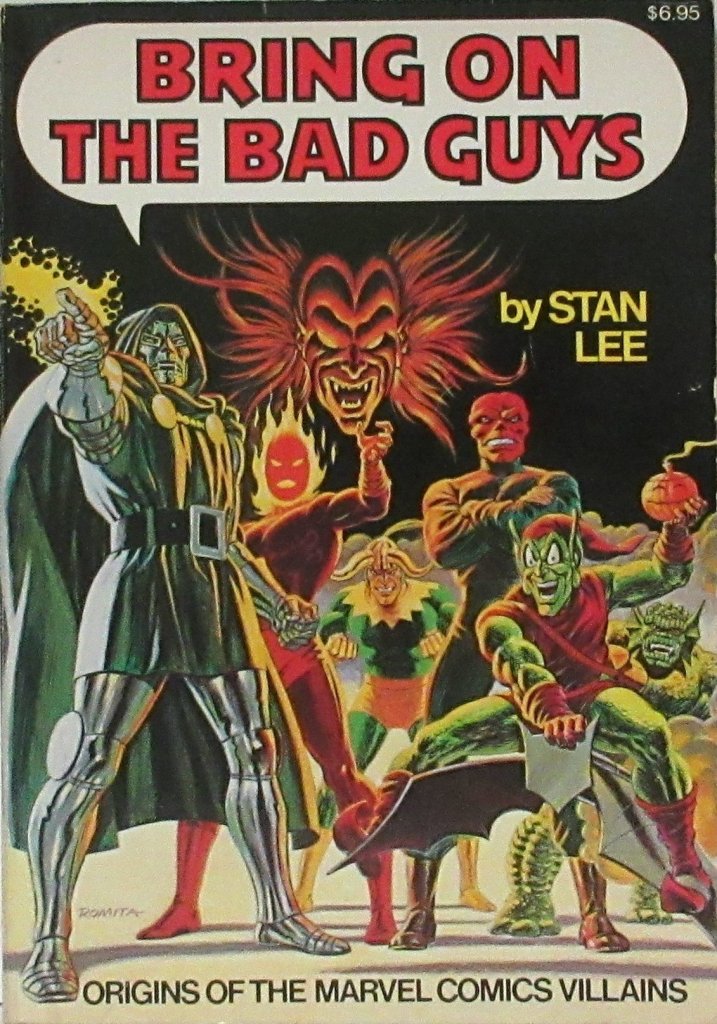
As I talked about yesterday, for Christmas 1978 I was given the four existing volumes in the Marvel Origins trade paperback collection that up to that point existed. I had read SON OF ORIGINS OF MARVEL COMICS at my local library, but I was happy to have my own copy to go back to and review. But once ORIGINS had been consumed, I made my way into the next book I hadn’t yet read, which was this one. And I have to say, that title is a thing of beauty, at once corny and memorable, a perfect encapsulation of the early Marvel style. I was also especially knocked out by this volume’s painted John Romita cover. All of the covers in this series looked good, but this was the one that was the most spectacular.
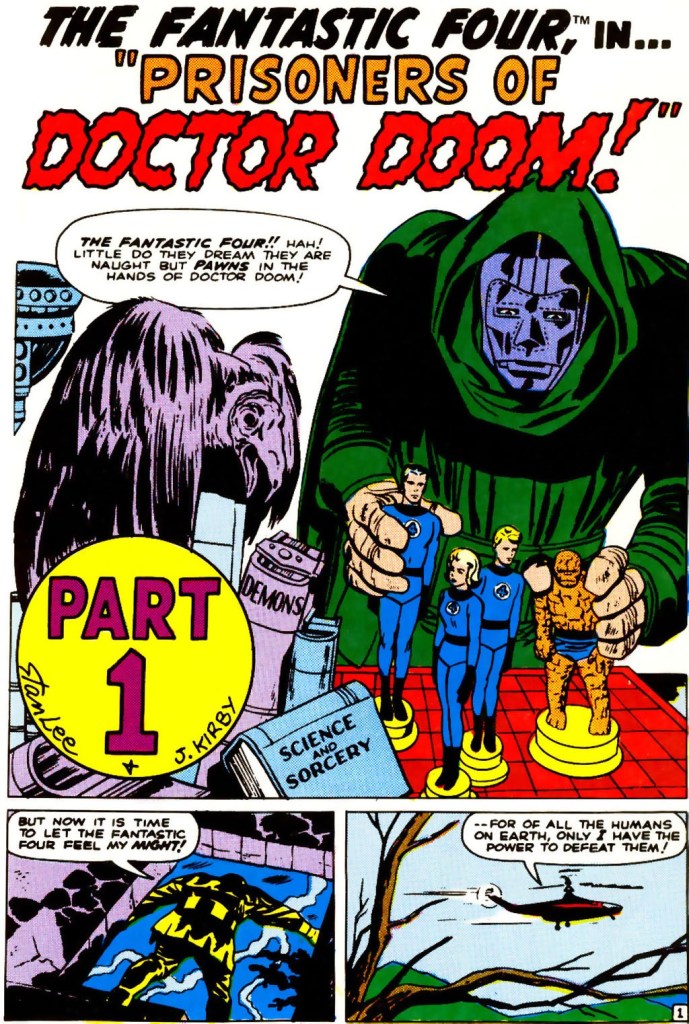
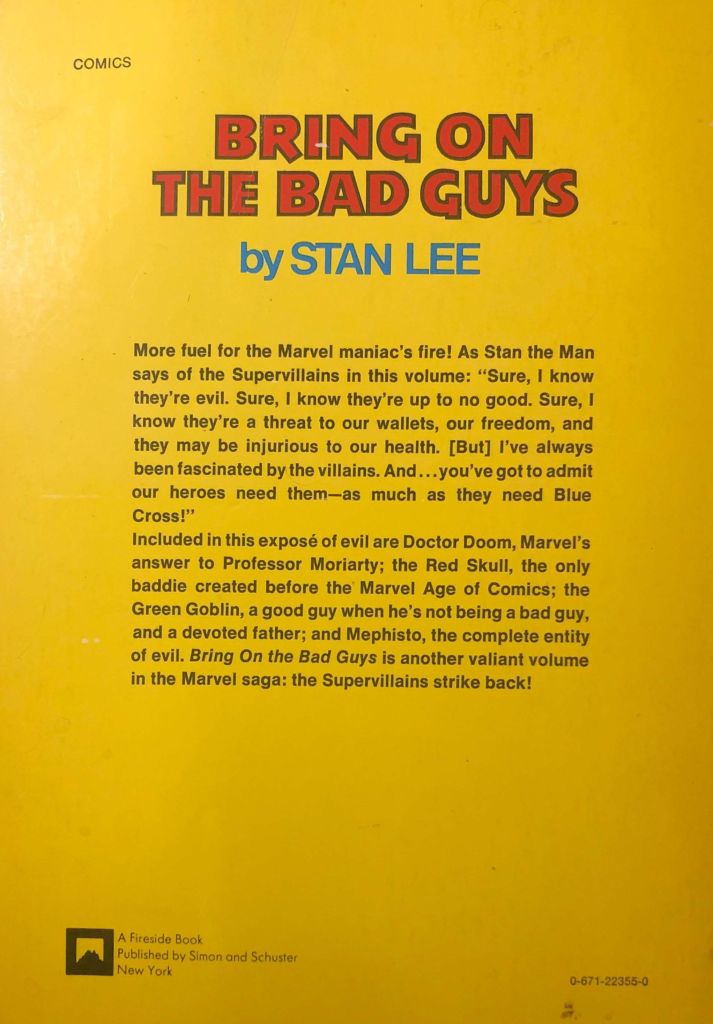
BRING ON THE BAD GUYS was once again a compendium of early Marvel stories, but this particular volume had a bit more range to it, as the subject matter didn’t confine itself to first issues. Consequently, it showed off the assorted strips in a more finished, more fully conceived form. The opening segment spotlighted the greatest of all Marvel villains, Doctor Doom. I had already read his first appearance in the FANTASTIC FOUR POCKET BOOKS edition that reprinted the first six issues of FANTASTIC FOUR, but it was nice to see it at full size. Additionally, the later “Origin of Doctor Doom” was also collected here, straight from FANTASTIC FOUR ANNUAL #2 in 1964. Jack Kirby’s work shined here, especially as inked by the uncredited Joe Sinnott in the first story. The second tale was perhaps more polished from Kirby’s standpoint, but inker Chic Stone approached it with an attractive, thick-lined open style that didn’t showcase the same finesse as Sinnott.
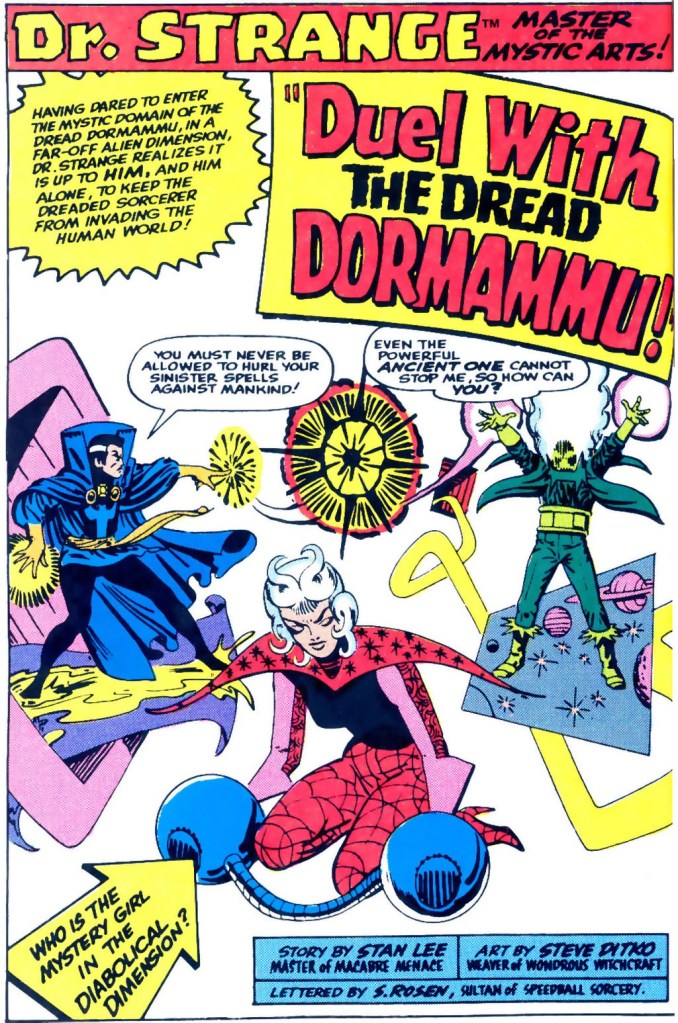
Next up was the two-part Doctor Strange story from STRANGE TALES that introduced the otherworldly menace of Dormammu. I had a problem with this story right from the jump. The plot goes: contacted by his old enemy Dormammu, the Ancient One dispatches Doctor Strange to Dormammu’s Dark Dimension in the hopes of staving off an invasion. This, Doc does–and when he returns to the Ancient One’s citadel, his master rewards him for his heroism by giving him a new cloak and an even more powerful amulet. Now, this was part of an attempt to change up the character visually to make him look more like a typical super hero and hopefully increase his popularity. But right from the start, my question was: if Dormammu was this unstoppable threat that had even crippled up the Ancient One in their last encounter, wouldn’t you give your pupil the much better gear before sending him off to face almost certain death? Or did the Ancient One not want to risk the cloak and amulet should Strange get killed? I don’t know–but it bugged me.
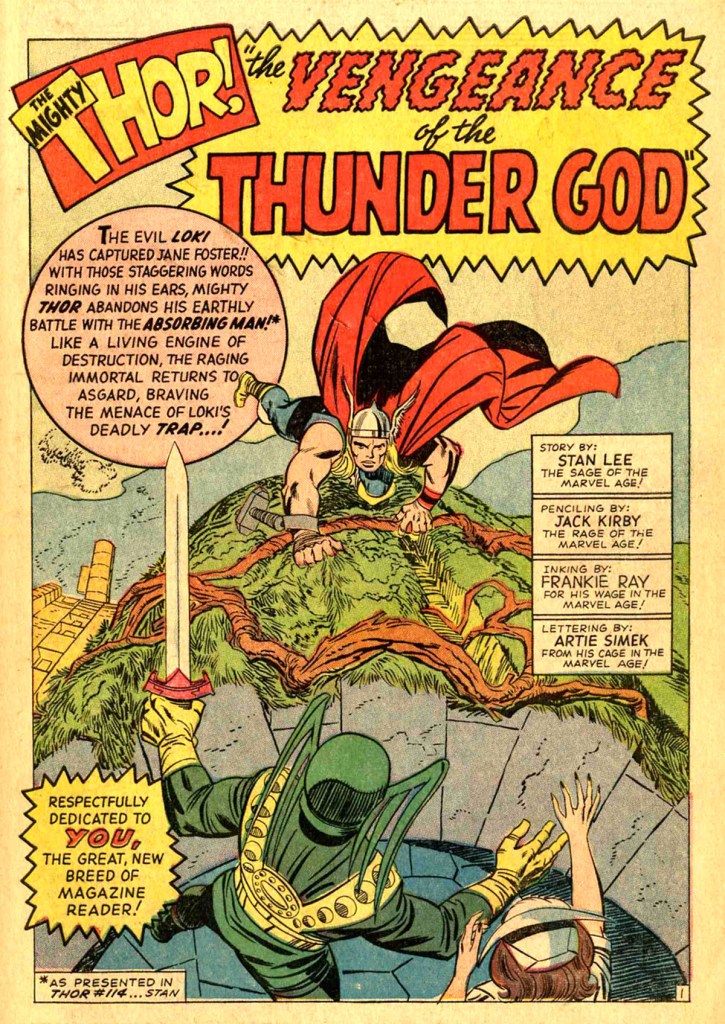
Third up was Thor, and a character who’s become a lot more popular over the past decade or so thanks to his appearance in film and on television: Loki. This was the early, classic depiction of the God of Evil, though, who wasn’t even slightly nuanced. He was overtly a schemer and a no-goodnick, and he was such a prevalent problem that at certain points you wondered by All-Father Odin kept letting him back into the house. This chapter opens with a trio of Tales of Asgard back-ups that lay out Loki’s origins and beginnings, as inked by Vince Colletta. And they are rough. I know there are some who like Colletta’s inking over Kirby, especially on THOR, but I’m not one of them. Fortunately, the full-length story that follows was delineated by Frank Giacoia, probably Kirby’s most faithful inker in the Marvel Age, though he didn’t work over him all that often.
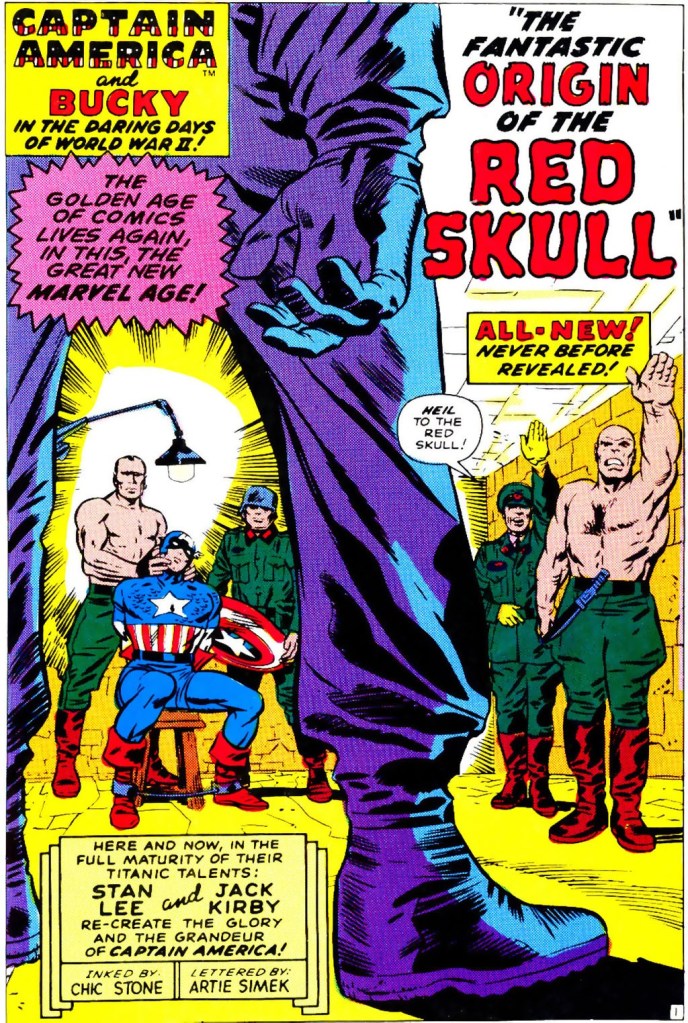
Next, we were into a trio of stories spotlighting the beginnings of the Red Skull from TALES OF SUSPENSE. The issue before these stories, Kirby and Lee had reintroduced the character by adapting his first story from the 1940s in CAPTAIN AMERICA COMICS #1.
But there were facets of the character that the pair wanted to change and update. And so they immediately declare that the Red Skull featured in that story was an impostor, and bring on stage the more formidable genuine article. The inking was handled by Chic Stone and Frank Giacoia in turn, resulting in some lovely pages–even though the Skull himself falls away as a concern by the final chapter. He and Captain America would clash many more times over the years.
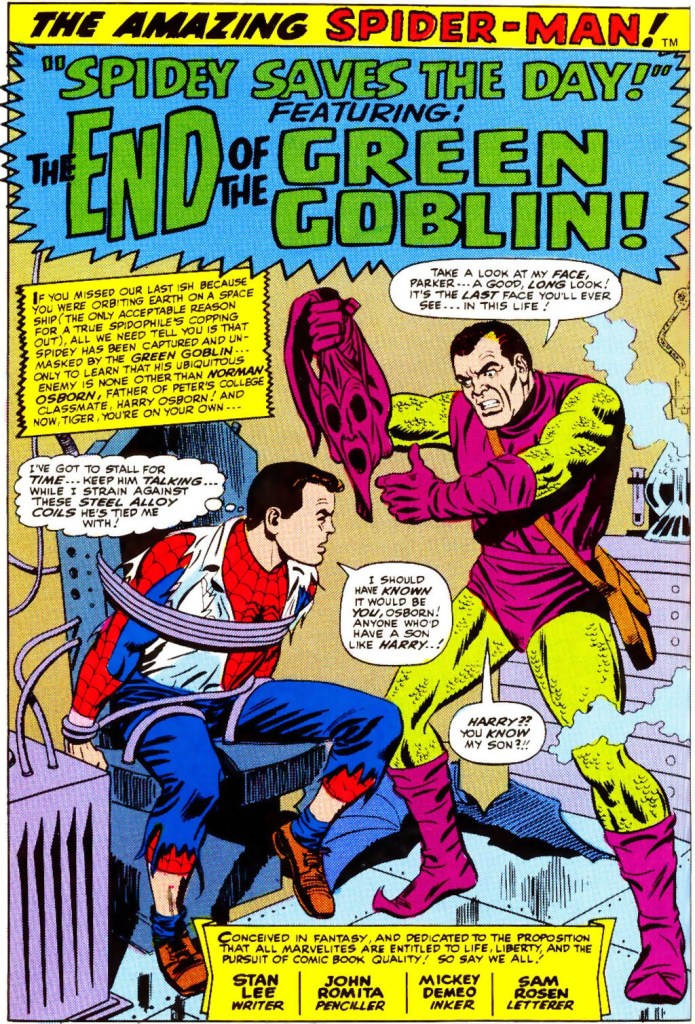
The next story was a Spider-Man epic featuring the origin of the Green Goblin, the web-slinger’s most mysterious foe in those early days. He’d been running around in the strip for several years, his true identity and purpose concealed from the readers, who made a guessing game out of trying to figure out his identity. But it wasn’t really a fair challenge, as the Goblin’s son Harry Osborn wouldn’t be introduced until well after the Goblin had become a well-established figure, and Norman Osborn himself only turned up two issues before the big reveal (though Steve Ditko had been sneaking a figure who looked like him into the backgrounds of scenes set at Jonah Jameson’s club for months in preparation of the revelation.) This was only the second Spider-Man story drawn by incoming artist John Romita, but you couldn’t tell that by looking at it. Romita would define the wall-crawler’s look during his most popular periods in the 1960s and 1970s, when the series was Marvel’s biggest seller. Even the weak inks of Mike Esposito can’t prevent Romita’s skill from shining through here.
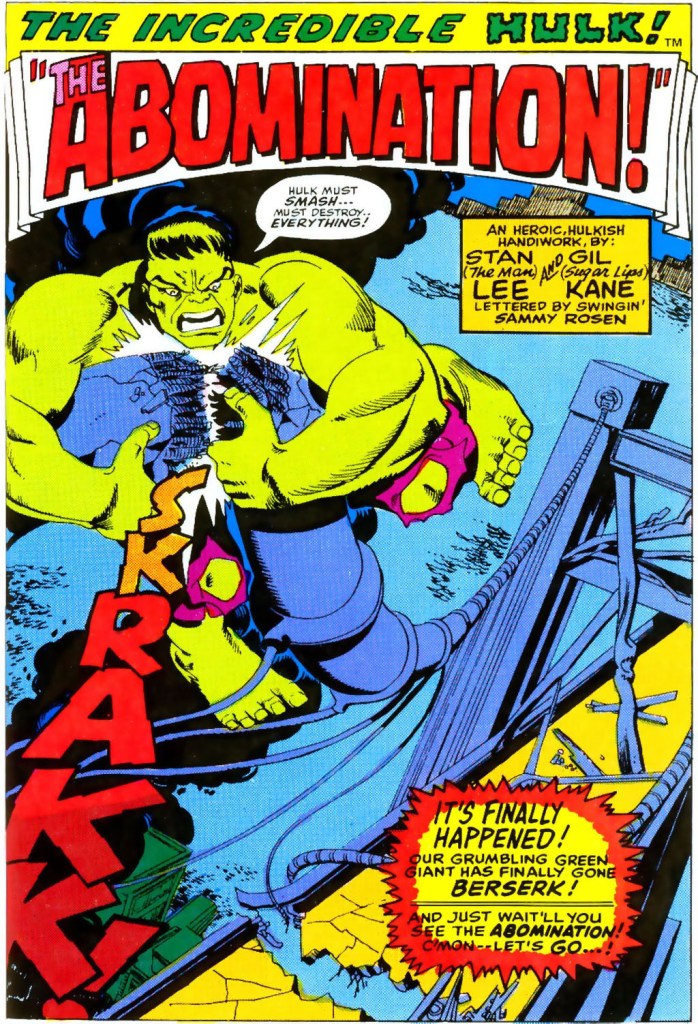
The next piece was a relatively rare collaboration between Lee and artist Gil Kane, an emigree from rival DC/National. After it had gotten off the ground, the Hulk strip notoriously had a difficult time keeping an artist on it, with the result that more pencilers worked on it throughout the 1960s than any other strip. Kane was one of the better ones, and he relished the opportunity to channel some of the dynamism of Jack Kirby into his work, a look that was frowned upon over at his old DC homestead. This two-parter from TALES TO ASTONISH introduces the Abomination, who is essentially a bigger, more monstrous and more powerful version of the title character. Kane swipes a bunch of compositions in these two stories from an early Jack Kirby battle between the Thing and the Hulk. But he makes them his own. There really wasn’t much to the Abomination as a character, but as you’d expect, it’s the intellect of scientist Bruce Banner as much as the rampaging power of his alter ego that finally wins the day.
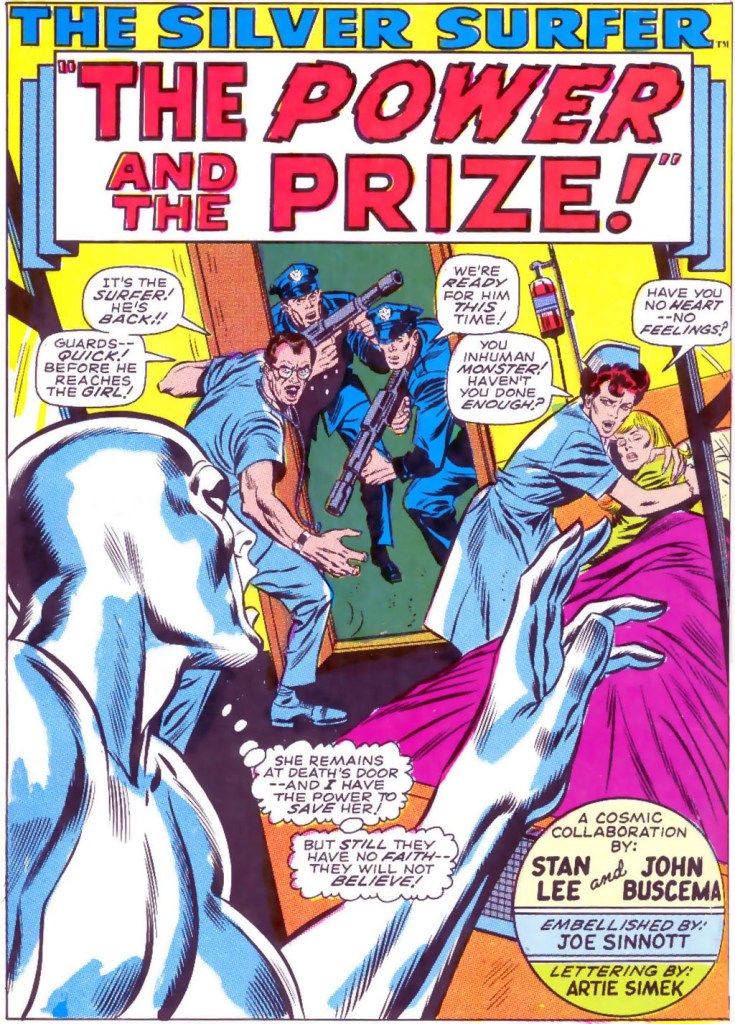
And the volume ends with an extra-long story starring the Silver Surfer and introducing his arch-foe, the demonic Mephisto. Lee had adopted the Surfer as something of a pet character after Jack Kirby had brought him on stage in an issue of FANTASTIC FOUR, and Lee saw the SURFER series as an opportunity to do something more literate and sophisticated with the medium. In this effort, he was aided by John Buscema, one of the finest draftsmen who ever worked in comics. The story is beautifully rendered, but it gets a bit hung up on Lee’s Summer of Love-influenced pontifications about man’s inhumanity to man and how everybody should just come together in peace and brotherhood. At 11 years old, this wasn’t quite what I wanted from my super hero comics, though the quality of the presentation kept me on board and reading.
So this was another fine collection of vintage Marvel tales, and utterly entertaining. Like the others, it was a book I went back to again and again.
 The Tom Brevoort Experience
Rereading the Silver Age I’m struck not only by Romita’s sense of design but he seems to handle the Marvel method well — none of the padding I sense with other artists. Which i believe he credited to drawing romance comics and having to give more heft to the scenes in the scripts.
LikeLiked by 1 person
I have this volume. I’ve just noticed , on the Capt. America opening page as shown, the Salutes to the Red Skull are with the left hand, while the Hitler salute was done with the right hand.
I think this may have been deliberate and consistent in the early comics?
LikeLiked by 1 person
The “KKK salute” is done with the left hand. But I presume WWII vets would be aware of the left vs right detail. Maybe it’s some sort of Comics Code quirk, where using the left rather than the right makes it technically not a Nazi symbol? Though it’s odd that the Skull would accept what from his perspective would be an improper salute. But maybe he decided not to be a stickler for protocol (“Ehh, close enough, it’s hard to get good minions, and it’s the thought that counts – if he’s giving honor to me, no point in calling him a dummkopf for doing it wrong”).
Interestingly, the guy with his other hand on his belt echoes a gesture often done by Hitler. I doubt anything there was an error.
LikeLiked by 2 people
I had thought maybe the tweaks to the salute were to avoid explicit Nazi references perhaps for some overseas markets – Germany has had a law against the public display of certain Nazi imagery from the 1950s, but was still allowed for “artistic, education or research” uses, so I imagine comics would be allowed, and obviously the swastika was used the comics quite a lot.
LikeLike
I got this one as a X-Mas gift too, in 1976, IIRC, and all these stories were entirely new to me, although I was familiar with all the baddies except for Mephisto. It would be another decade or so before I got a reprint of ASM 39, showing how the Green Goblin discovered Spider-Man’s alter ego and captured him. Funny how both the Spidey & Cap stories start with the heroes tied down to a chair and forced to listen to their foes relate their backstories. I also eventually got Fantastic Four Annual #2, and relatively cheap but still in good condition. It was intriguing that aside from brief cameos by a pre-FF Reed & Ben, the Fantastic Four don’t take part in the story at all, maybe a first for Marvel. Of course, they were in the 1st story in the mag, wherein they first learn that Dr. Doom is the dictator of his little pocket kingdom somewhere in central Europe, presumably on the western side of the Iron Curtain, although that hardly matters any more in current continuity since the old Cold War ended over 30 years ago now and presumably the FF’s own origin has been shifted a few decades forward from 1961 and Reed & Ben no longer World War II veterans as the current Marvel gang don’t really want them and Vic to all be roughly a century old now as they’d otherwise be.
Artistically, in my estimation, John Buscema did a stellar job on the Silver Surfer. Whatever the pitfalls of the story itself, the art was magnificent. My exposure to Ditko’s art was still fairly limited and his style didn’t initially appeal to me, although I later came to love his runs on Spider-Man and Dr. Strange, and I did enjoy these early Dormammu stories.
Overall, a fun collection of stories.
LikeLiked by 1 person
Buscema’s art was possibly at one of his heights with the SS. Curiously though despite that and for for such a supposedly significant character, his own mag didn’t last that long as we know.
The Mephisto dynamic worked partly because he is obviously a kind of devilish figure while SS is more angelic (plus the great art) but having also read the latter one off Lee-Kirby SS story online for the first time recently, the constant moralising can get a bit weary after a while. It’s almost as if SS worked better in short doses, as a peripheral character rather than a main player.
LikeLiked by 3 people
That was a major pitfall of the way Stan Lee wrote the Silver Surfer. Englehart took a different approach when he wrote the Surfer in his next ongoing series and that proved much more successful.
LikeLiked by 2 people
Ah, thanks, I may check those out online sometime. There’s probably been a been a lot of character development after I stopped reading comics by around the late 70s.
LikeLiked by 1 person
The BAD GUYS volume is probably the best of the ORIGINS series. That Surfer/Mephisto story alone puts it way ahead of the pack — it really blew my mind when I read this volume as a youngster. But really, all of the entries here are really strong.
I was disappointed that they never did a second BAD GUYS collection, although in retrospect, I’m not sure what would’ve gone into it. They covered a lot of the biggest guys in the first book. Galactus and Magneto, perhaps. Doctor Octopus? MODOK? Probably best to leave out the Mandarin…
LikeLiked by 1 person
I had all these books too. On the Red Skull, the weirdest thing I noticed was that Hitler’s one-on-one, customized formation program for bringing out his evil potential focused on military drill!
LikeLike
If I remember the story, Hitler objected to Schmitt just being taught to drill like an ordinary Nazi and wanted more, to match Schmitt’s inherent malice and evil. But it has been years since I read this,
LikeLiked by 1 person
I never had these, but remember seeing ads and wanting them. The painted cover by Romita Sr is very interesting. I don’t know if this is the first time that’s happened, but it adds some dimension to the figures and makes them appear more real. Reminds me of the first time I saw some of Jeff Butler’s painted marvel heroes. I imagine back then though, it blew kids minds as we didn’t have much superheroes in the way of other media. Well, I guess there was Spidey occasionally on Electric Company.
LikeLike