


As I’ve mentioned often in the past, growing up, I was never all that much of a fan of Batman. I didn’t dislike the Masked Manhunter, it was more a question of liking a particular flavor of him. I first encountered the Caped Crusader in daily reruns of the 1966 live action television show, and like most other kids of that age, I took them entirely seriously. I also occasionally read comics starring Batman, and I found that I really liked the “New Look” era stories that Julie Schwartz had started to produce in an attempt to save the series. I also had a certain fascination with the stories of the 1940s and 1950s. What turned me off were the stories of the 1970s, a time where a strong attempt was being made to steer the character back towards his dark roots. That version of Batman never clicked with me, and so while I’d read a lot of books that he headlined over the years, I never really counted myself as a fan.

The first issue of BATMAN that I ever bought was #255, just about 100 issues prior. It featured Neal Adams’ last mainstream Batman story for decades, an acknowledged classic today. But that story didn’t make much of an impression on by six-year-old self. What did stick in my mind was “The First Batman”, which revealed new details about the Masked Manhunter’s origin and revealed that his father Thomas Wayne had once worn a bat-themed costume to an eventful Halloween function. And I also sort of dug a story in which Batman seemingly reveals his secret identity as Bruce Wayne to Batgirl, tricking her into thinking that it’s all a ruse. Both of these stories had a feeling that was closer to the TV reruns, and so I enjoyed them all the more. Plus, in general, I found myself often drawn to the comics of the 1960s, both at DC and then eventually Marvel. For whatever reason, those hit my sweet spot.

So I read BATMAN on and off over the years. The character was still ubiquitous, appearing in multiple titles every month, so there really would have been no avoiding him. By issue #316, I was then earning enough money through my Pennysaver route that I could afford to buy as many comics as I wanted, and so I began picking up BATMAN regularly. This was right when editor Paul Levitz and writer Len Wein were beginning to treat BATMAN and DETECTVE COMICS as almost a biweekly series, with storylines bouncing from one to the other and back again. That felt more like the Marvel approach, and I was more into it as a consequence. I started reading both titles regularly.
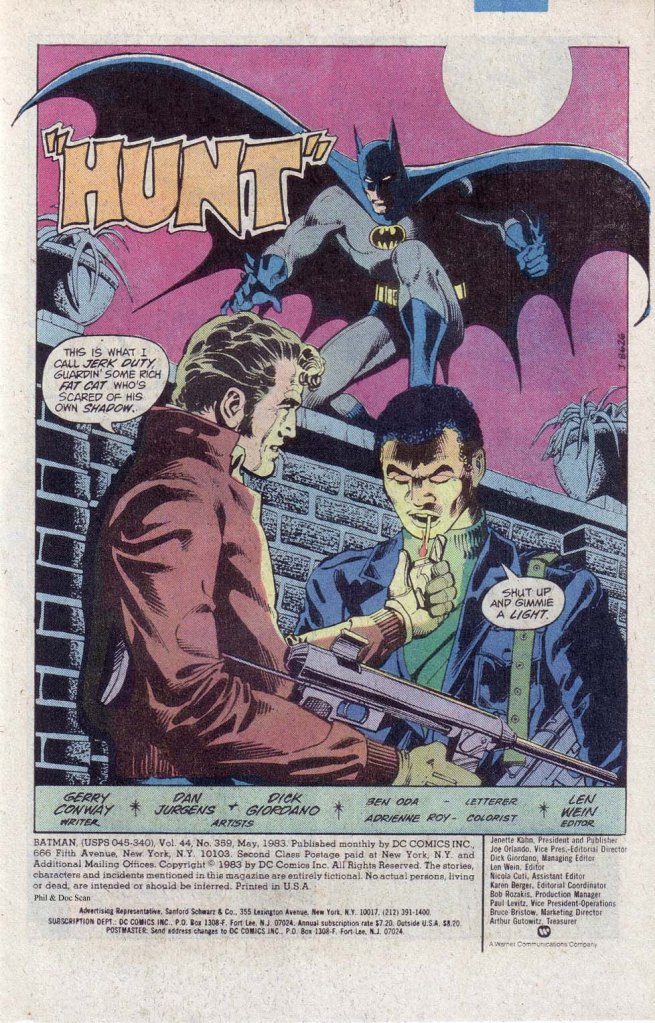
So when my finances were eventually pushed to the breaking point a few years later and I needed to cut back on the books I was buying, it was a pretty easy thing to let BATMAN go. By that time, Wein had succeeded Levitz as the book’s editor, and he and writer Gerry Conway were preparing for a major shift in conjunction with the extremely popular NEW TEEN TITANS series: They were going to transition Dick Grayson into being his own young adult hero, Nightwing, and introduce a new young kid, Jason Todd, who would take his place at Batman’s side as Robin. This storyline ran for a couple of month in both BATMAN and DETECTIVE, culminating in an anniversary issue.

As a part of this storyline, Conway had introduced a new villain, one that he hoped could be a new ongoing part of Batman’s rogues gallery. This was Killer Croc, who was a physically powerful crocodile-man who had grown up as a circus attraction and who had designs on taking over the Gotham underworld. This early version of Croc was more intelligent and less overtly savage than the character would become over time. He reminds me today of nothing so much as Bane, another character who was introduced to give Batman an overwhelmingly physical challenge rather than a mental one. Croc spent a couple of issues pounding Batman into paste on a regular basis, to teh point where the Dark Knight starts to wonder if he’s losing his edge or holding back–if he’s actually afraid of Croc. I don’t know that Conway ever completely sells this idea, but it was a game try.

It’s pretty clear what Conway is intending to do with Jason Todd almost from the jump as well. He’s introduced as the son of a husband-and-wife team of aerialists, the same set-up that Dick Grayson had when he first appeared. They’re working at the same circus that Croc was at, and so they’re drawn into events and are clearly going to be killed off in order to motivate Todd to don the Robin costume and fight crime. This early version of Todd was, frankly, a bit of a nothing, an affable, almost goody-goody kid rather than the more hardened streetwise persona he was cast into following CRISIS ON INFINITE EARTHS. He wasn’t at all appealing to me, apart from freeing Dick Grayson from teh need to wear short pants in his Titans adventures.

It’s all decently-crafted comics, but that wasn’t going to be enough to keep me around when money got tight. Plus, I’d never quite bought into teh fantasy of Batman. I wasn’t a particularly athletic kid, and so I knew right from the start that I could never be Batman or Robin. I was going to need a magic ring from outer space or a scientific accident if I was ever going to become a super hero. So the very thing that makes Batman appeal to so many other readers was the thing that turned me off to him: his humanity and vulnerability.
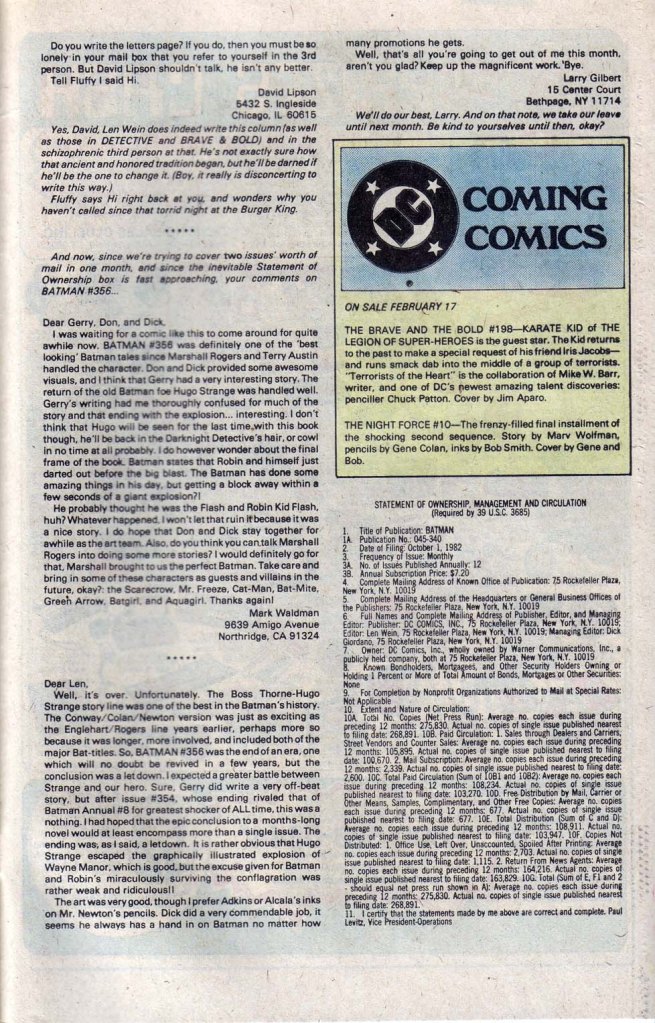
This last issue I bought happened to contain that year’s Statement of Ownership, which shows us that the title was shifting 103,270 copies each issue on a print run of 268,891, giving the book an efficiency rating of just over 38%, not a tremendous figure at all. It is sometimes difficult to recall just how long BATMAN remained as a mid-list series, It wasn’t really until the one-two punch of DARK KNIGHT RETURNS and the 1989 BATMAN film that made him consistently a top seller.

With almost perfect synchronicity, I came back to the series when I began getting copies for free in my Marvel bundle each week. Though I would have picked up this particular stretch of issues anyway, as I had done with occasional ones in the time in-between, including #400 of course. But this book was part of a crossover with NEW TEEN TITANS, a title that I had never dropped and to which I was still devoted all these years later. What’s more, it was a storyline designed to introduce a new Robin, in this case Tim Drake, who was created to fill the role after fans rebelled against Jason Todd and he was eventually killed off in a promotional phone-in campaign. Tim’s Robin proved to have more staying power, and the character inhabited the role for the remainder of the 1990s.
 The Tom Brevoort Experience
The Bronze Age darker stuff was where I really got hooked on Batman. Though I didn’t become a devoted fan until the Englehart run and gave up when Doug Moench took over from Conway.
I enjoyed Jason when he first appeared. The efforts to reboot him never clicked with me — I’d have been okay with him staying dead.
“The First Batman” is an excellent little story, and stayed canon all the way to Crisis as far as I know. It says a lot about times past that I don’t believe they referenced his origin again until Batman 200. I can’t imagine such a long stretch these days.
LikeLiked by 3 people
I came in late during the Wein editorial era as a regular reader. I had sporadic issues of all three Bat-monthlies since 1976 (including B&B, and sometimes additional “World’s Finest”), but by ’83 I had my own $ to follow comics regularly, and Batman had been my # 1 fave since seeing the reruns of the ’66 TV show around ’75. I wasn’t quite a teenager in ’83, and I fell right back into the familiar Bat-mythos. I think Moench was the writer, & I count myself lucky to have witnessed the last few years of Gene Colan’s association with the character. Tom Mandrake was on “Batman.
I missed Don Newton’s legendary run, except maybe for a few of his last, unfortunately inked by the overpowering Alfredo Alcala. It seemed more suitable for a horror series. A fine artist in his own right, he smothered what I would later come to appreciate from Don’s work. I’ve since read most of Newton’s Bat-work, & I highly regard it as some of the best, when inked by someone with a compatible, lighter touch, like Dan Adkins. I didn’t like the Conway issues I read as an adult.
I also didn’t really enjoy Batman Years 2 & 3. DKR in ’86 changed the game. And Batman: Year One” in ’87 kept the bar very high. In the issues right after “B:Y1”. the monthly books seemed to snap back, regressing away from the innovations made by Miller, Janson, Mazzucchelli, etc. It seemed to take another couple of years before the character could really make good on the success of those radically reimagined contained stories. And I give most of the credit to Norm Breyfogle’s dynamic & unique style. And then by the 90’s, DC had opened more opportunities for the best in the industry to produce Batman stories. Whether it was a miniseries, or a series within one of the monthlies (Dark Knight, Dark City), or one shots/specials, or the new “Legends of the Dark Knight” anthology.
LikeLiked by 2 people
My own permanent jumping off point was Deeny O’Neil’s making Batman as editor to be what he envisioned. I was never a fan of O’Neil’s writing, whether his gothic Batman or his faux socially aware stuff. I think his Question was my favorite of his writing but I disliked the art too much for the book to stand a chance with me. Moench’s Batman will always be my Batman. I know others wrote him similarly and I liked their work but I felt Moench did it best personally.
Jason Todd? yes, it was a mistake to start him off as a Dick Grayson clone (remember how he was a ginger that dyed his hair to become Robin?) and also a mistake to do a jarring reboot to be a complete asshole. I feel that made it impossible for Jason to be a successful replacement for Dick. Thank god Winick and later Lobdell found a way to make the Post0Crisis mistakes work as they transitioned the character into the Red Hood.
LikeLiked by 2 people
Funny, reruns of the 1960s Batman tv series turned me off Batman. I think it was Batman and the Outsiders series that made me like him and a fan of Jim Aparo. Plus Batman characters like KGBeast, NKVDemon and a couple of years ago the HUSH storyline ( Really enjoyed that year long story and Jim Lee’s art. I swear as I was readying the part when Harley Quinn showed up the voice of the WB Batman cartoon Harley Quinn was in my head as I read her dialogue ).
LikeLiked by 2 people
My younger brother was a big Batman fan, but I don’t think we actually had that many Batman comics as kids. After Dark Knight Returns though, we started buying almost everything Batman. As mentioned, DKR didn’t mean that the regular Batman series suddenly became better. I remember liking some stuff that came out but also finding a lot that I wasn’t crazy about. Still, we kept buying and hoping.
LikeLiked by 3 people
Batmania! 😅
LikeLike
The best version of Jason Todd was the Mike W. Barr and Alan Davis run on Detective Comics in 1986-87. They really understood the character.
LikeLiked by 2 people
Batman #359 was one of the first US comics I bought myself (as opposed to gifts/loans from family & friends) and Killer Croc creeped me out as a kid. As homicidal as the Joker could be, you generally got the sense he’d rather throw Batman into some elaborate deathtrap instead of getting his own lavender-gloved hands bloody. With Croc, no such guarantee existed!
LikeLiked by 3 people
This is right before I jumped on to Batman/Detective. I think the promise of a new Robin and a respected Marvel writer (Doug Moench) brought me in.
LikeLiked by 2 people
If memory serves me correctly, I discovered Batman with the TV series with Adam West. I was happy watching this series. Then I met another Batman with the cartoon Superfriends. I liked him too. A little further on I discovered Batman from the comic books of the 1970s and 1980s. I fell in love with him. I like all versions of Batman, but it was this Batman that turned me into a Batman fan and not a casual fan.
I understand that it’s not Tom’s favorite version and that of everyone who didn’t buy the comic books at the time… but that Batman captivated me. I owe it to Denny O’Neal, Neal Adams and their successors. So I’m not a huge fan of Gerry Conway or Killer Croc, and I certainly believe Jason Todd’s second origin is much better fleshed out, but this issue still appeals to me as part of that tradition. For me, the period between O’Neil’s run and the publication of The Dark Knight Returns was the greatest creative upsurge in Batman comic books.
A reminder that the character was all too human, but that humans may not be very “normal.”
Ah, The First Batman is a great story. It should always be part of the Batman canon.
LikeLiked by 2 people
Like you, the comics Batman was & is way more important to me than the versions in other media. The comic book Batman is the original (& best, to me). The rest are adaptations. I like letting my imagination filling in the rest of the blanks, such as sound.
I’d think Wein’s editorial era contains some great gems, definitely on the art side. But most of my fave Batman stories came afterwards. DKR opened up more than a Batcave worth of possibilities. Writers like Miller, Morrisson, Puckett, Wagner took stories to higher levels. And the art has often been breathtaking.
The quality of the art that was a rarer treat by the likes of Wein & Levitz & Giordano editorial eras, by Newton, Colan, Janson, Wrightson, Kaluta, Golden, Von Eeden, & a very few others during Wein’s era, has become more frequent since, w/ a bat-boat load of artists aspiring to that level of art from the mid-1980’s on. Mazzucchelli, A.Davis, Bolland, Freeman, Breyfogle, A.Adams, Leonardi, K. Nowlan, M.Wagner, Weeks, B.Timm, D.Cooke, JH Williams, M.Martin, J.Lee, A,Kubert, Capullo, Mann, Jiminez, Mora.
For me, “Batman: Year One” just exceeded anything before it. I realize DKR was the sea change, but “B:Y1” is the highest standard that the other best Batman stories are measured against.
LikeLiked by 1 person