

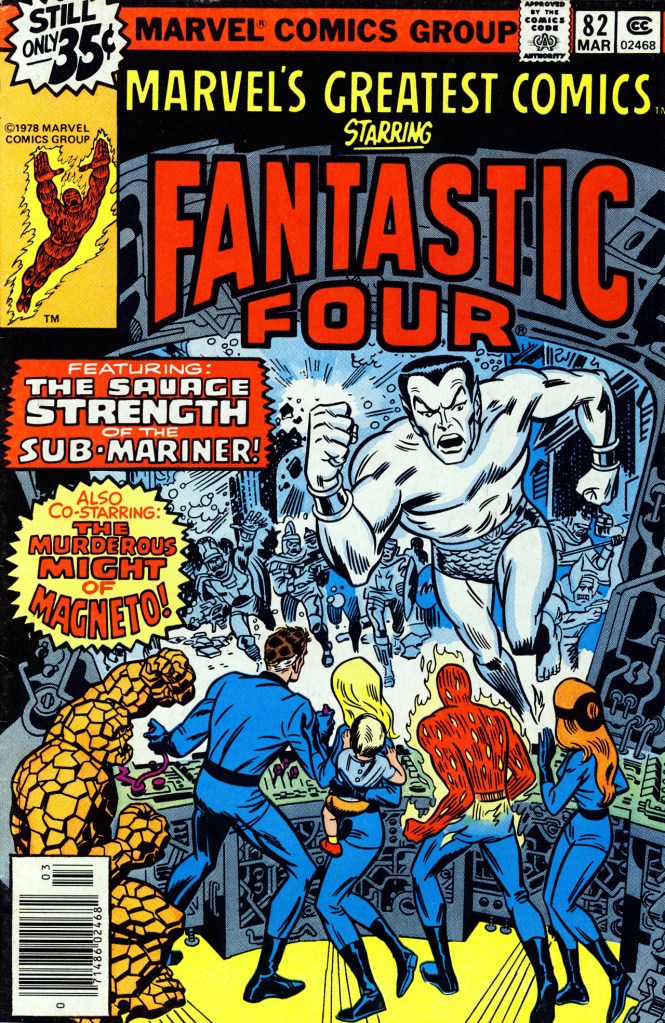
This next issue of MARVEL’S GREATEST COMICS, #82, presented a bit of a problem for me. MGC reprinted earlier issues of FANTASTIC FOUR from the past, and consequently was very much a must buy title for me at the time. But by the point when this issue hit the stands, I already owned a copy of the issue it reprinted, FANTASTIC FOUR #102. So I wouldn’t be getting a whole lot of entertainment for my 35 cent investment. On the other hand, skipping the issue would mean having a hole in my run, an unthinkable occurrence to an eleven-year-old hardcore fan. What to do? In the end, prompted presumably by the fact that I was able to afford it, I went ahead and bought the issue and kept my collection intact.
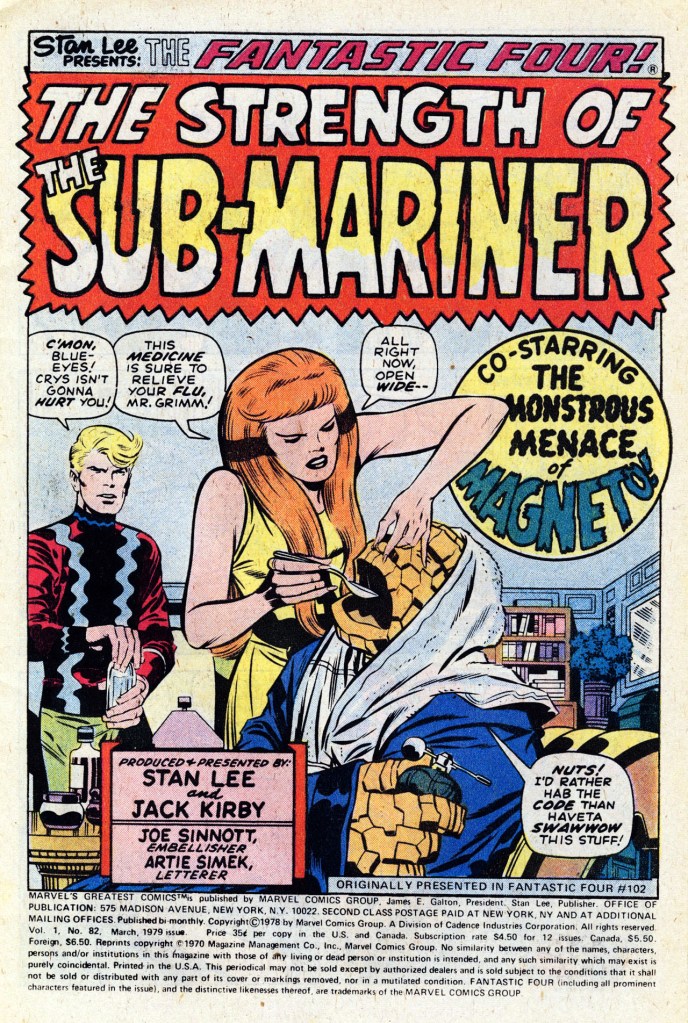
I wrote about the actual issue when I got it a few years back at the link below
And I can’t say that I actually sat down and read this reprint as I would have if it had been new to me. The most I would have done was to flip through it. I definitely compared it to the original to work out what pages had been cut out–Marvel’s reprint titles of this era had fewer pages to work with than the stories they were reprinting, so each one had to be truncated by a page or two.

Famously, this was the last FANTASTIC FOUR story plotted and penciled by Jack Kirby before he left Marvel to go work on his Fourth World epic for rival publisher DC. Kirby had become increasingly unhappy at Marvel where his creative accomplishments were not properly acknowledged (and worse, typically ascribed to Stan Lee completely) and he had no assurance of long-term employment. Additionally, he’d come to lose narrative control of a number of his concepts, including the Silver Surfer and Him, and that vexed him on a completely different level. While looking for somewhere else to ply his trade, Kirby had become determined not to give Marvel any more characters of value, though he couldn’t help himself from time to time. So he was largely floating on his assignments, doing good work still, but without the creative electricity that used to be a hallmark of his output.

In not wanting to come up with new stuff, Kirby was instead forced to go back to already-established characters and do new stories with them–characters such as the Sub-Mariner and Magneto, who are both featured in this story. Additionally, Kirby drew story inspiration from the media he was consuming in the day, and so the Fantastic Four found themselves trapped in a quaint town in the manner of the Prisoner, the Thing was forced to battle in a galactic arena in the style of Star Trek, and the Mafia (represented, as always in Marvel comics, as The Maggia) attempted to rub out the FF and take control of their headquarters. Some of these stories were fun, and they were always visually exciting and filled with snappy dialogue. But they weren’t what the series had been even a couple of years previously.

Where Jack’s work still excelled was in its visual presentation. The size of the original art paper had been reduced a couple of years earlier, and Kirby, used to drawing twice up like all of the other artists of his era, took a little while to acclimate to the new dimensions. But one thing the new size allowed was for Kirby to be able to see the entire page as he composed. Consequently, rather than focusing on a tier of panels at a time, as he had typically done, Jack was able to conceive and design across the entire page at once. He still kept his panel compositions strictly rectilinear, but within them, the shapes in one panel had a dynamic with those in the ones above and below them as well as to the sides. Slick inker Joe Sinnott had also found a nice equilibrium over Kirby’s work. Whereas once he imposed more of his own style into the finished product, he had by this time pulled back a bit, letting more of the genuine Kirby shine through while giving the work an attractive modern sheen and polish. Kirby and Sinnott were an excellent combination.

So what was this story about? Briefly, the Sub-Mariner, while on a scouting expedition to Antarctica, comes across the unconscious body of Magneto where he fell after battling the X-Men in a recent story. Namor conducts the Master of Magnetism back to Atlantis to recuperate, and there Magneto works out how to use Atlantean super-science to increase the strength and range of his magnetic powers. He tests his abilities from afar on Manhattan, getting the attention of the Fantastic Four. Reed traces the source of the recent difficulties back to Atlantis, and in a fit of anger, Ben Grimm launches a counter-attack missile at the city. It’s meant to be a harmless concussion missile, a warning shot, but Namor doesn’t know this, so he treats it as a sneak attack from the surface world. So Magneto is now pulling the strings, manipulating Namor and Atlantis into attacking humanity and the Fantastic Four, with him set to benefit from the conflict.

According to the folks who were there at this time, this was the last story Kirby sent into Marvel before calling up Stan Lee and resigning from the organization, much to Lee’s surprise. Marvel had made it a policy recently to try to make each issue a self-contained story, but they’d gotten enough of a backlash to the approach that Lee quietly reversed the decision. And so it is that this issue of FANTASTIC FOUR ends in a cliffhanger. It’s anybody’s guess what Kirby’s follow-up to this issue would have been, but it was left to Lee, replacement artist John Romita and folks in the Bullpen such as Roy Thomas and Gerry Conway to come up with a continuation. So this story is very much the end of an era, the first salvo of the shift from the Silver Age of Comics into the new Bronze Age. That transition wouldn’t be completed for another year or so, but this issue (and the concurrent issue of THOR, also by Kirby) was the beginning of that end.
 The Tom Brevoort Experience
Kirby’s work looked great, here. Iconic & mythic. Loved that splash, Page 14. That slippery-looking serpent statue (I see the influence of Kirby pages like this on the great Steve Rude). Kirby does 1 of my fave Namors. He just looks powerful. I like Kirby’s showing Reed to be pretty vigorous & sturdy looking, too. This was maintained by other artists, especially J.Buscema. I’m guessing, but I think Reed lost that strong build under Byrne. To me I think it was a loss for the character. And another deviation from Kirby’s original.
Other immediate reaction thoughts are about Subby & Mags. Two “anti-heroes”, though I think Mags was a villain for longer & more often than Namor. But I can see why they could be some-time allies. Or in this case, while Magnus was still in his villain role, manipulating Namor. Both have reasons to resent homo sapiens, despite each sharing certain amounts of DNA with mere humans.
I can’t recall the continuity around the time of the Cabal (2008?). Namor had the distinction of being a member of both the Illuminati & then the Cabal. Maybe Magnus was too into his “good guy” or anti-hero phase to join the Cabal. Or maybe he was “dead” at that time. I think Emma Frost was in the Cabal. Magnus certainly would’ve fit in, at some point in his life. He was on the “inner-circle” of the “Acts of Vengeance” villains.
Namor was, to me, glaringly absent from 1984-85’s “Secret Wars” (as were Dr. Strange & several others). He’s one of Marvel’s oldest & most illustrious, if not consistently successful characters. Prominent in the 1st three Ages of American comics. He could’ve fought on either side, at least temporarily. Ultimately either staying w/ Cap’s team, or allying with the X-Men & Magneto.
I like the connections Namor & Magus share. And their differences are also interesting. It’s one of those interactions that could be an event in itself. Dr. Doom is on that level, too. But Magnus & Namor are actually inherently more powerful than Von Doom. I’d think he’d be jealous of those two.
Thanks for the rainy day refuge, Tom.
LikeLike