


As I’ve mentioned before, I was never a huge fan of the Hulk during my initial foray into the Marvel Universe. And in fact, it was my younger brother Ken who started buying issues of his comic before I did–though I read those issues and eventually ended up with them, and kept carrying on buying new ones as they came out. Like GHOST RIDER, I mostly read INCREDIBLE HULK out of rote, it being a title that I bought because I could afford it and it was a title that I bought. That all said, right here at around the moment that I stepped off the series, longtime writer Bill Mantlo began to do some interesting things with it. But I wouldn’t read those until years later.
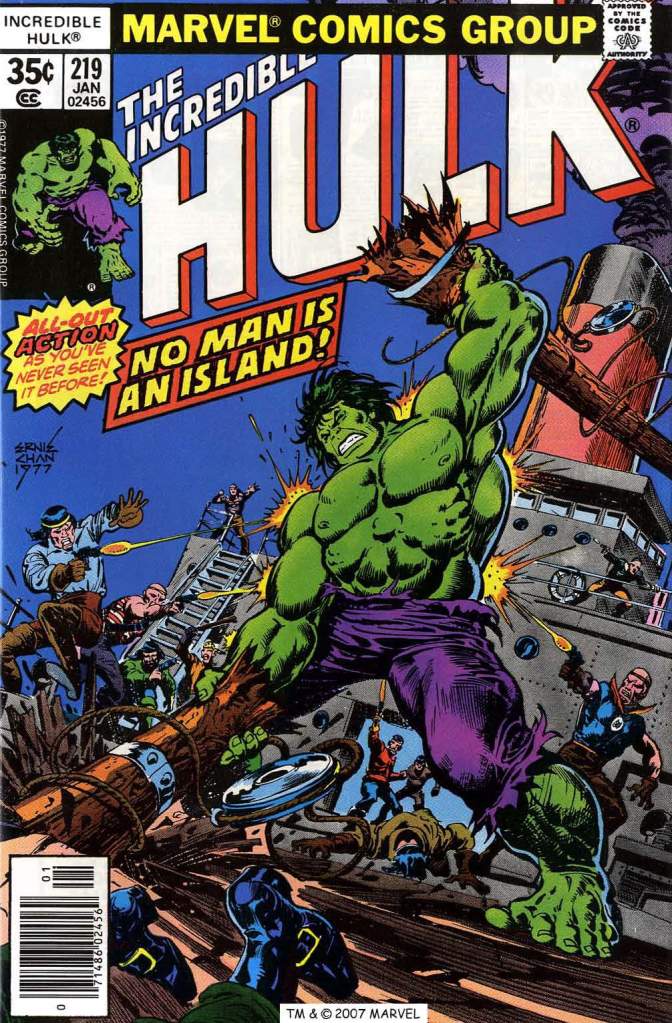
Our first issue of INCREDIBLE HULK was this one, #219, and its purchase was absolutely driven by my brother’s interest in the live action CBS television series. I always found the character’s status quo a bit limiting (although it may simply have been my tastes which were limited.) I wanted super heroes, and the Hulk was more of a monster, rampaging across the globe, hoping to be left alone, and drawn into adventures that involved a lot of punching of other monsters and aliens and a few recurring villains. It was difficult to respect the Leader as a genius when he regularly couldn’t outsmart the Hulk. He was sort of like the Wile E. Coyote of Marvel bad guys in that way. Also, the fact that the Hulk was so mobile made it tough for him to keep and maintain a supporting cast, so that was a limiting factor as well.
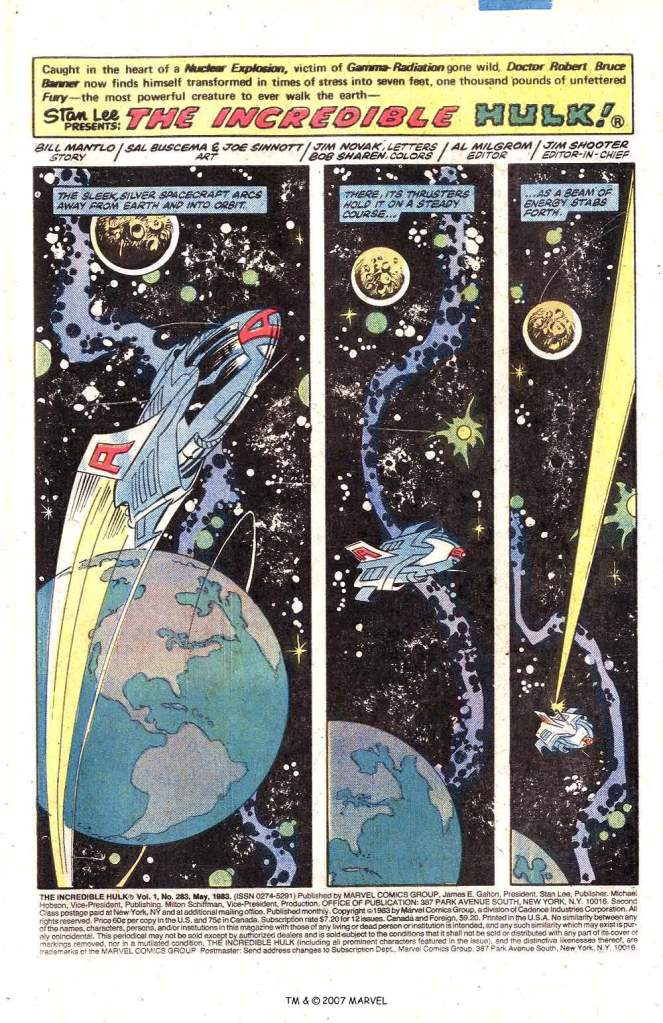
Bill Mantlo had been writing INCREDIBLE HULK for a number of years by this point. I get the sense that Bill wound up with the assignment largely because nobody else especially wanted it. That tended to be the way Mantlo got books. And like he did with ROM and Micronauts, he tackled the assignment with all of the energy he could muster. He was paired with artist Sal Buscema, who said in later years that INCREDIBLE HULK was his favorite assignment, as he related to the big dumb brute. Buscema was a straightforward meat-and-potatoes artist, but he could do power, and that was a necessity on a series such as this one. The book was both consistent and entertaining, despite the limitations of its lead character. Mantlo had the Hulk embark on a journey around the world, introducing (often stereotypical) super heroes of other nations. Bill’s results may have been mixed in terms of their sensitivity, but his heart was in the right place.
I don’t know whether the idea was Mantlo’s alone or whether it came up in conversation with editor in chief Jim Shooter, who at this time was looking to shake up the Marvel characters, but Mantlo went all in on a classic idea that had been tried once or twice in the past: he gave the Hulk the mind of Bruce Banner. Except this time, rather than being a status quo that was undone at the end of one or two issues, it instead lingered as the series’ new set-up. Banner received a pardon from the President for all of the Hulk’s past crimes and set about building a life for himself–albeit one in which he was a seven-foot-tall green monster. This also meant that the Hulk’s wandering days were over and he could also have a sensible conversation with other people in the cast, a definite improvement from my point of view.
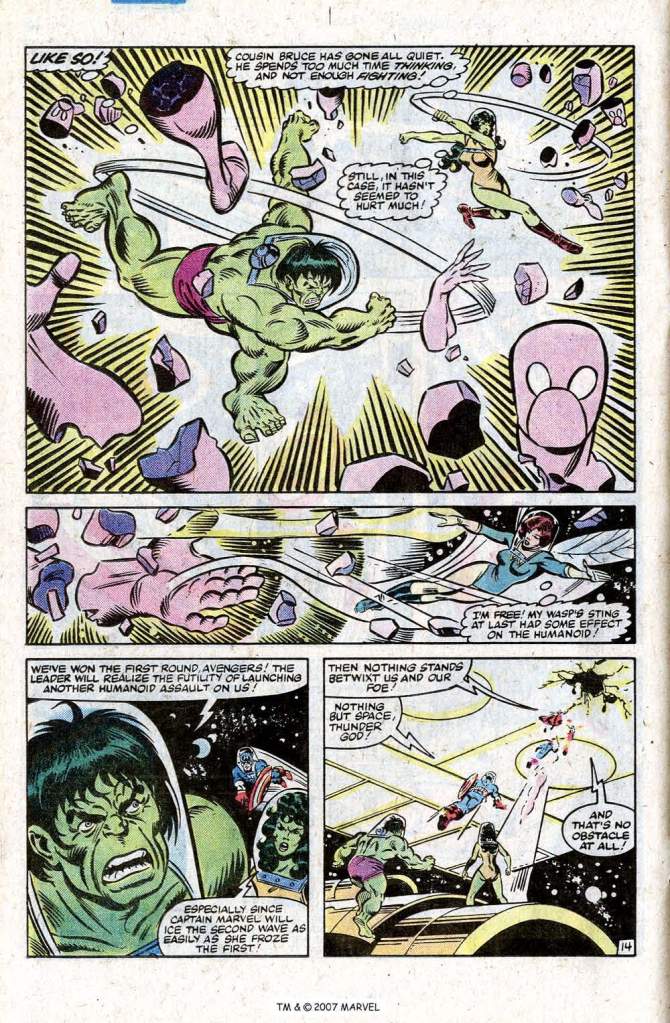
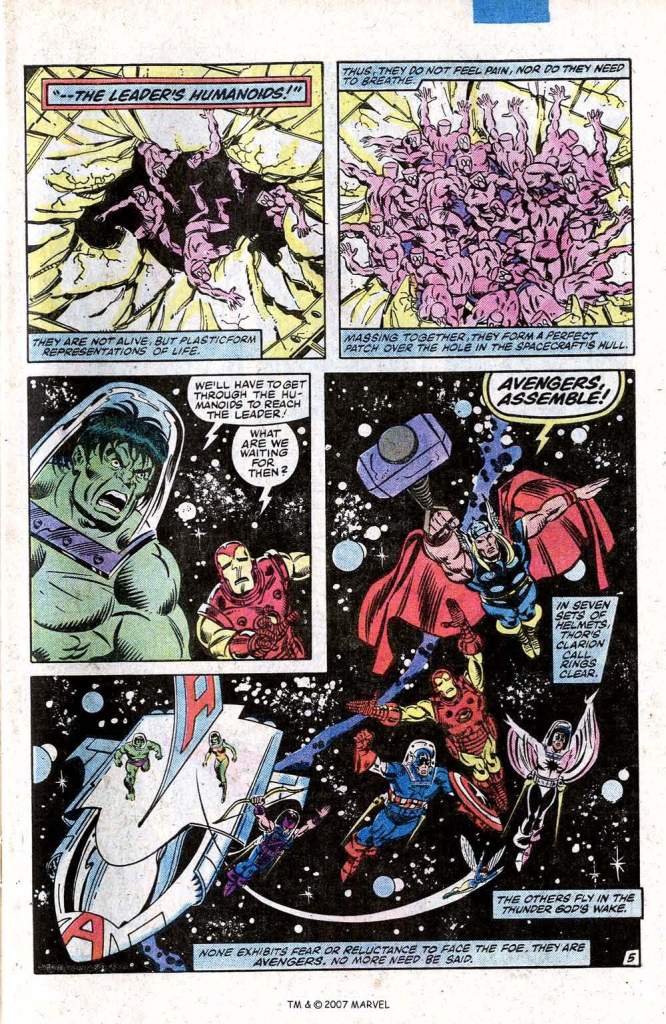
In this particular issue, the Hulk has allied himself with the current line-up of the mighty Avengers in an effort to track down his recurring foe the Leader before the gamma genius can unleash some new plot upon the world. The Avengers are, in fact, featured so heavily in this issue that it reads more like an issue of their comic than the Hulk’s–possibly Mantlo was having a good time getting to write them. The heroes head up to the leader’s orbital base, where they’re confronted by a horde of his virtually-indestructible Humanoids that they need to fight their way past. INCREDIBLE HULK was always good for massive action sequences–they were pretty much the book’s bread and butter–and things are no different here.
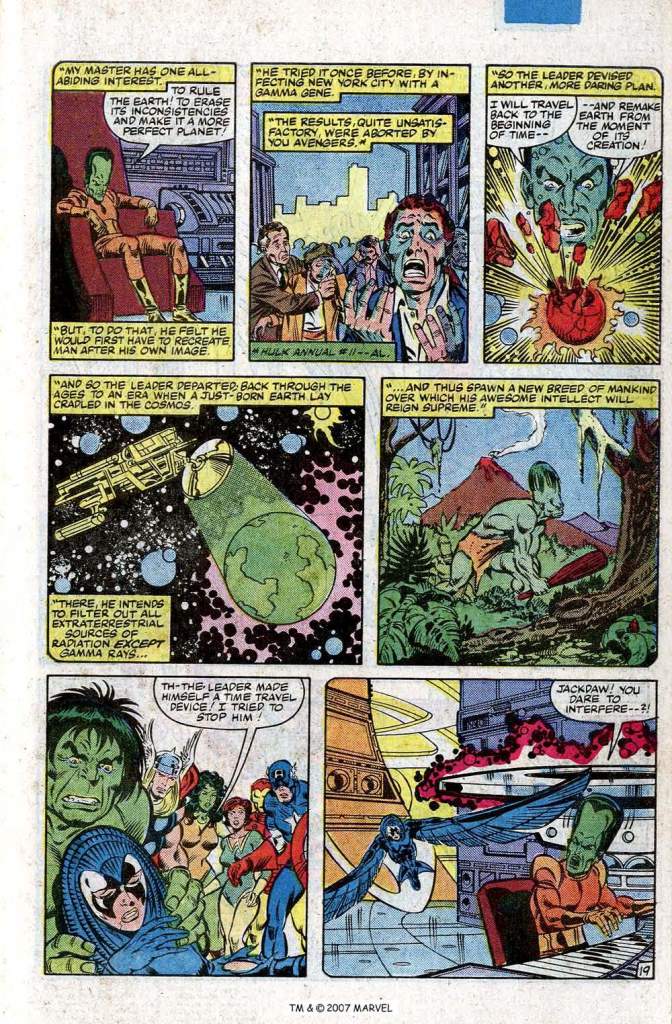
Making their way into the satellite, the Avengers and the Hulk are greeted by Omnivac, the Leader’s semi-sentient computer system. It offers them hospitality, indicating that the Leader himself is indisposed. But the heroes, in particular the Hulk, aren’t about to just sit around, and when the Leader’s minion Jackdaw shows up, having been brutally beaten, they’ve had enough. It’s at this point that Omnivac plays a message from the Leader indicating his intentions. He’s built a time machine and intends to go back to the dawn of humanity and expose these proto-humans to gamma radiation, turning the whole of society into beings such as himself. And in order to prevent the Avengers from stopping him, he’s going to scatter them throughout the timestream. And sure enough, the Avengers suddenly vanish, leaving the Hulk and She-Hulk mystified. They theorize that their own gamma radiations cancelled out whatever the Leader tried to use to send them into the past–hey, it makes as much sense as anything–and determine that they need to pursue the Leader into history and prevent him from making changes. To Be Continued!
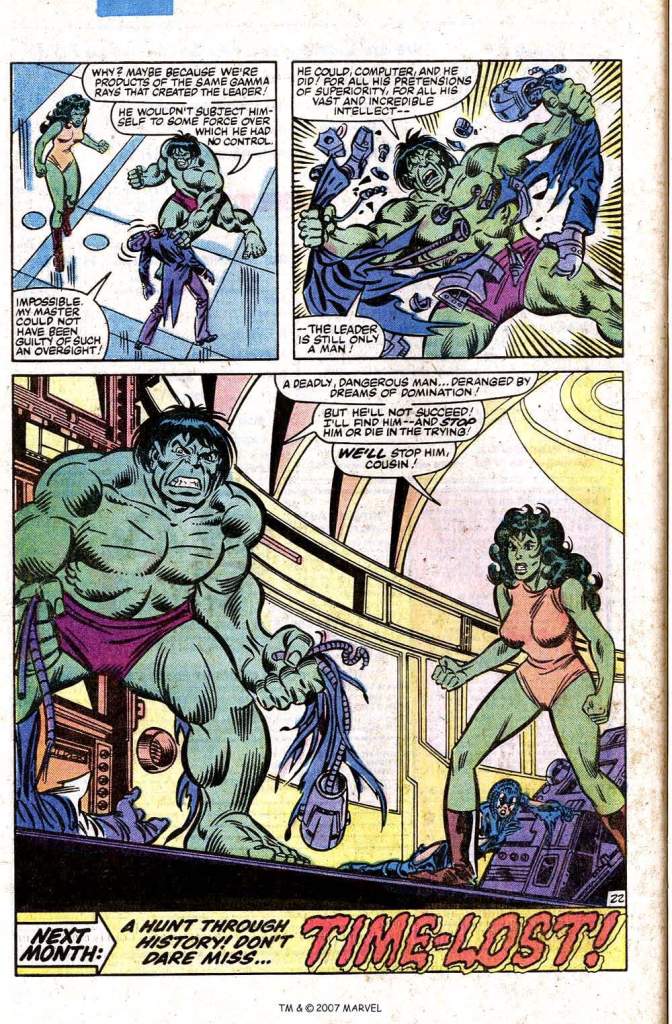
All in all, this was another solid issue in a run of solid issues, and things were looking up. But that wasn’t enough to keep the book on my buy-list when the financial need to cull it back became a reality. So I dropped it with this issue. I did pop back in for John Byrne’s short run from #314-319–Byrne could always get me to check out what he was doing, even though I increasingly didn’t like some aspect of the stories he was telling. Byrne’s replacement when he ran into pushback from his editors was Al Milgrom, and Al’s work wasn’t enough to get me to stick around. I didn’t think all that much about INCREDIBLE HULK thereafter for another year or so.
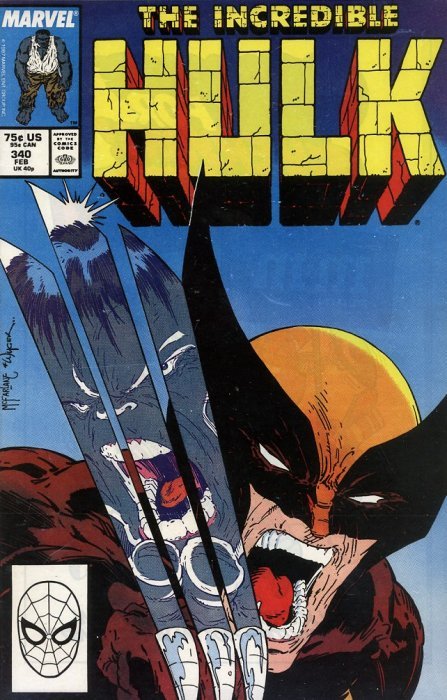
It was this issue, #340, that brought me back. I had been hearing through the grapevine of my other comics-reading buddies that some good things were happening on the title. Like with Walt Simonson’s THOR, it took me a while to clue in–but seeing this classic cover made me take teh leap. I was already something of a fan of Todd McFarlane’s work based on the crazy page layouts he used on INFINITY INC., though Jim Shooter’s Marvel didn’t permit that level of potentially-unclear storytelling to fly. And the new writer, Peter David, had a good handle on the material and a charming sensibility to his writing, capable of being simultaneously sincere and heartfelt as well as humorous. He tended to fill his scripts with meta humor, which doesn’t appeal to me all that much today, but which hit the spot perfectly in 1987. And so I quickly tracked down all of the back issues in the run, and was back to following the series going forward.
 The Tom Brevoort Experience
I was in and out of this series and though I picked up Incredible Hulk#244 ( February 1980 — It the Living Colossus ) it was the next issue that hooked me and kept me until Joe Sinnott’s inking on Sal Buscema ‘s art slowly drove me from the series. John Byrne, George Perez & John Romita, Jr.’s art could survive Joe Sinnnott’s inking but it just robbed to much from Sal’s. Now I felt ripped off during John Byrne’s run because I wanted to see a John Byrne Hulk- Juggernaut fight or Hulk-Rhino fight or Hulk-Leader story ( He never didn’t use Superman normal foes, but he robbed me of a Sub-Mariner -Tiger Shark fight ( Tiger Shark is another character I like from the first time I saw him ) or Namor’s other traditional foes — not that I have a problem with new foes, I don’t. It’s just this was John Byrne and he never drew those characters in action ). Granted he did set the stage for the return of the Grey Hulk ( Fun fact, in one panel of the Hulk’s first appearance he was green ). Was there for Todd McFarlane and Dale Keown, while in-and-out of the series based on if I like the artist.
LikeLike
“I was already something of a fan of Todd McFarlane’s work based on the crazy page layouts he used on INFINITY INC., though Jim Shooter’s Marvel didn’t permit that level of potentially-unclear storytelling to fly.”
Todd McFarlane has disagreed with this, at least relative to himself and Shooter. In late 2012, McFarlane gave an interview to comicbookresources.com where he stated he had gotten blowback from Bob Harras about his layout approach. Harras said he was relating Shooter’s view on layouts. Shortly afterward, McFarlane took the opportunity to ask Shooter about it directly. Shooter looked at McFarlane’s art and told him there was no problem with doing flamboyant layouts in general or with McFarlane’s work specifically. The problem was doing BAD flamboyant layouts. Shooter showed examples, and the problems were not the sort of things McFarlane had done. Per McFarlane, Harras sat there red-faced during the entire meeting.
The interview is no longer online due to the reorganization of the comicbookresources site, but it was discussed on a tcj.com thread at the time.
LikeLiked by 1 person
I really enjoyed this particular “intelligent Hulk” arc, as well as the follow-up stories set in the Crossroads. For me, the Byrne run was the jumping off point. Like Tom, I was drawn back to the book by that cool Wolverine cover and was impressed enough to stick around.
LikeLike
We never read many Hulk comics, as we enjoyed other characters way more. We did get a few of the Byrne issues, but missed most of them the first time around and I was really bummed that Byrne left before finishing the storyline. We found out about McFarlane Hulk after it had already skyrocketed, so I had to wait till reprints until I could actually afford it. I really liked the way he drew the Hulk, some of the other characters, not as much.
LikeLike
I never got into Intelligent Hulk until Peter David proved it could work.
John Byrne summed up the problem with the Leader: How does a guy who is to brains what Hulk is to brawn keep losing? Part of that, I imagine, is that it’s easy to write a guy whose 1000 times stronger than you, not so easy if they’re 1000 times smarter.
LikeLiked by 1 person
Except not all the Hulk’s encounters with the Leader were the result of the Hulk defeating him: The Leader defeated himself when he put the Globe of Ultimate Knowledge [ Tales To Astonish# ( December 1965 ) ], Bruce Banner who some how got the Hulk to remember his plan defeated the Leader’s Hulk-Killer [ Tales to Astonish#87 ( January 1967 ) ], the U.S. Army defeated the 500 Foot Tall Humanoid with their Sunday Punch Missile [ Tales to Astonish#71 ( September 1965 ) ] and the Rhino in Incredible Hulk#124 ( February 1970 ) for examples on top of my head.
LikeLike
IIRC Byrne meant nobody should be able to beat him so easily, not just the Hulk — that he should go down a lot harder than, say, a Doc Ock or Von Doom.
LikeLike
Yeah but didn’t the Thinker call it the X-Factor? That unknown element he didn’t plan for or see coming? Incredible Hulk Annual#11 ( 1982 ) is another example of this: During the Leader’s Green Flu plan he mutated Bruce Banner’s friend Dr. Rikky Keegan into a female version of the Leader which led to his own downfall when she turned on him after learning he had no interest in help Bruce, so she used her greater intelligence and powers than the Leader to sabotage his plans or Jim Wilson sabotaging the U.S. Military’s Brain-Wave Booster that the Leader was using ( with General Ross’ blessing ) to manifest simulacra of Hulk foes to battle the Hulk [ Incredible Hulk II#139 ( May 1971 ) ] — the sabotage caused the Leader to manifest 5 Hulks which led to a catatonic state of paralysis for the Leader or Incredible Hulk II#147 ( January 1972 ) where the x-factor in the Leader’s plan was Doc Samson who stepped in front of the gamma rays the Leader’s mentally controlled merged/amalgamated Humanoid was firing at the Hulk in an attempt to overdose him only it caused a feedback that blew up the Leader’s lab. So clearly John Byrne didn’t take that into account. Plus remember the Leader is wasn’t a genius ( unlike Dr. Rikky Keegan ) when he was mutated, which is why other than planning for his “death” he doesn’t plan for other x-factors ( kind of reminds me of DC villain I.Q. whose ego won’t let him seen any flaws in his plans or math, which is also Dr. Doom’s weakness ). But I get what you mean. One more thought: The Leader not the Wizard ( how many times has his butt ended up in prison? ) should have been a member of that group of villains during ACTS OF VENGEANCE ( Yellow Claw and any other Major Player who has never been in and out of prison ).
LikeLike
Tom, I wish I had remembered this ( In this Issue Thor Says ):”Thou dost say that yon creatures are grown as cultures, Iron Man” –Page 6 panel 4. In Tales to Astonish#62 ( December 1964 ) 2nd story ( Hulk ) the first Humanoid ( not clearly seen ) is in a tube filled with some kind of liquid ( being grown? ) and in Tales to Astonish#63 ( January 1965 ) the Humanoid demonstrated some of the things Flexo the Rubber Man [ Mystic Comics#1 ( March 1940 ) 1st story – Dr. Joel Williams ( blond ) & Dr. Joshua Williams ( black hair ) ] did in his first appearance ( bending a metal bar, bullets going harmlessly through it and some stretching ).
LikeLike