

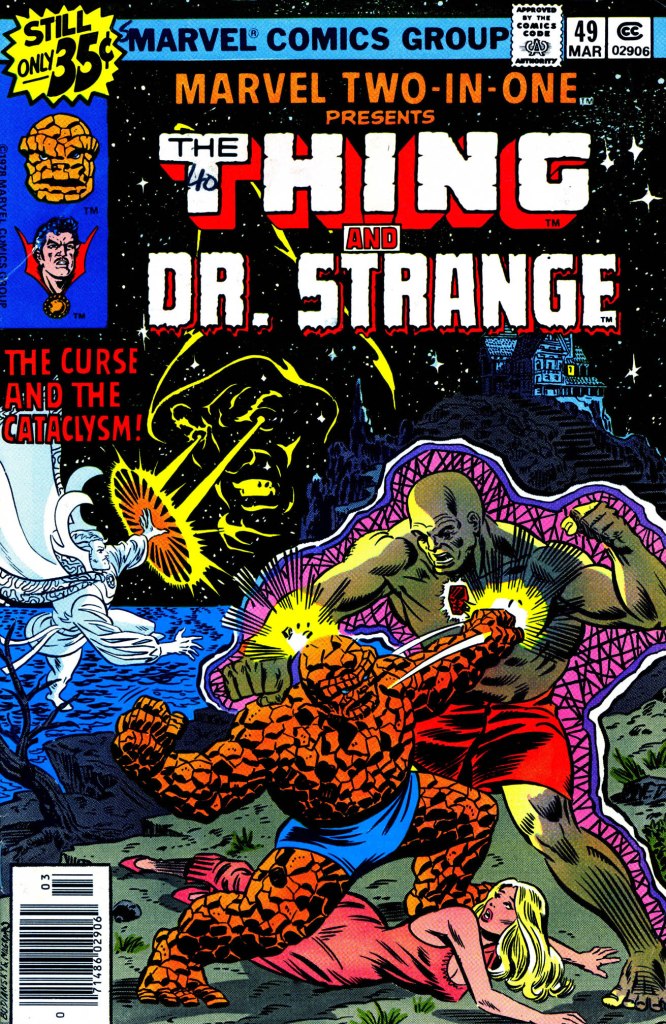
MARVEL TWO-IN-ONE #49 was another junky, lifeless issue of what had become a largely junky, lifeless series. There was improvement just around the corner, though, and while I didn’t know that at the time, my critical standards at the age of twelve were pretty meager. I liked the Thing and the Fantastic Four, and so I bought the book without fail every month, simple as that. And every once in a while, there’d be an issue that I really liked. This one, though, was not that issue. I didn’t dislike it per se, but I found it almost completely forgettable. Before looking at it again for this piece, I could have told you very little about what the actual story was about.
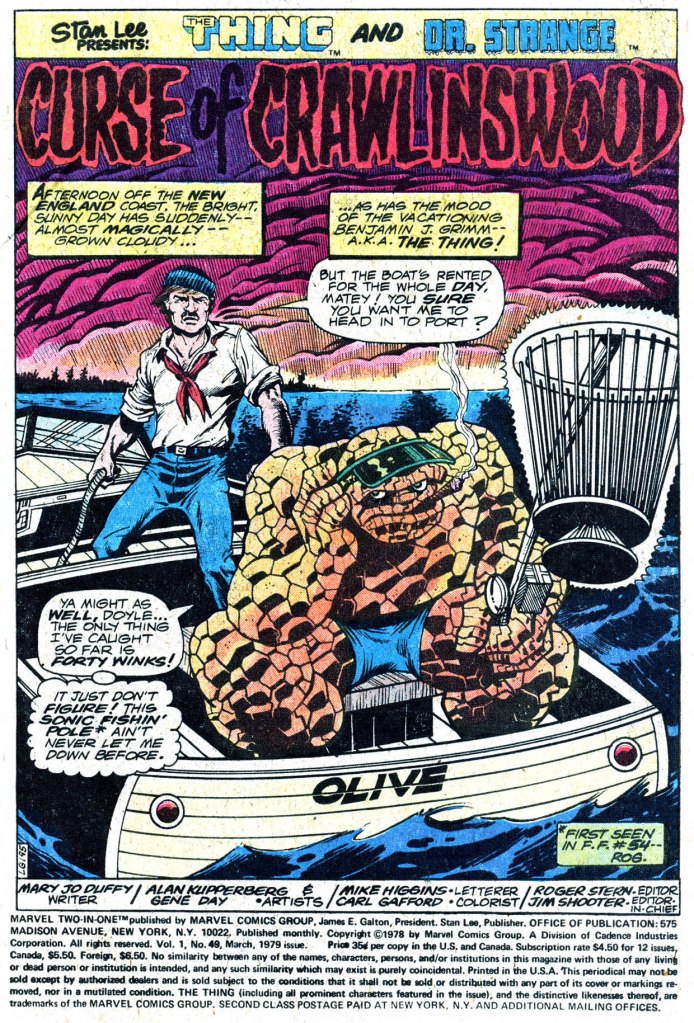
The one thing I did remember was the Thing’s bananas Jack Kirby fishing rod, which had been a gift from the Black Panther acquired back in FANTASTIC FOUR #54. I’d never read that issue, but it was distinct enough that it lodged in my head. What I didn’t get right away was that the sailor who has ferried Ben out for a day of fishing on the coast is meant to be Popeye–the name of his boat, Olive, and the fact that Ben calls him Doyle (“Popeye” Doyle had been Gene Hackman’s character in the film the French Connection) get the idea across even without the sailor having huge forearms or a corncob pipe.
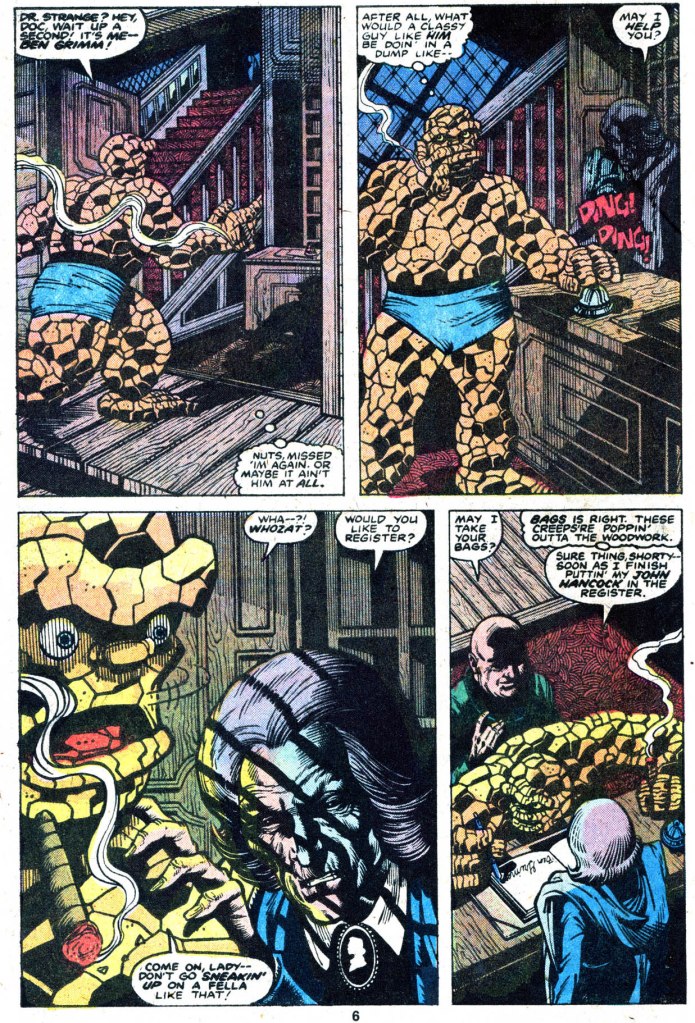
Ben is up in New England, in the creepy cottage town of Crawlinswood–a name to conjure with if ever there was one. He’s forced to register in an old hotel right out of central casting. It’s run by an old woman who is the spitting image of Grimm’s associate Agatha Harkness, but apparently there’s no relationship between the two. Also at the inn is Doctor Strange, who thinks to himself that the Thing has unknowingly responded to the psychic call he put forth to gather allies, as there is something nefarious going on that requires the attention of the Master of the Mystic Arts. Doc would have summoned one of the heroes he was closer to, such as the Defenders, but this is the Thing’s title and he respects that.
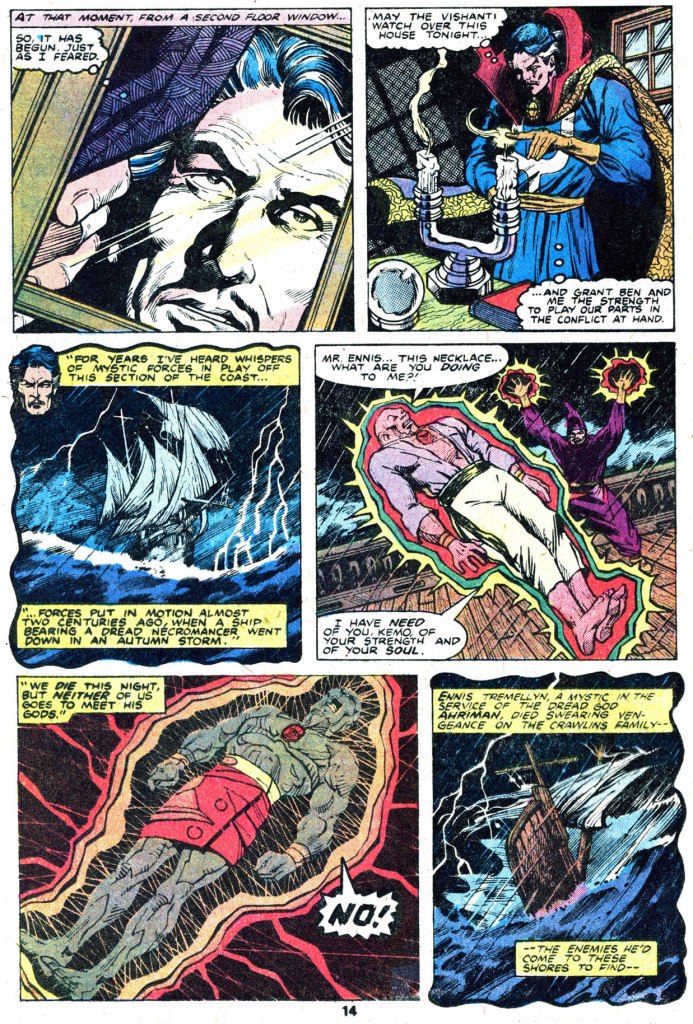
I should give a mention of the creative team here. This self-contained story was written by Jo Duffy, a longtime letterhack who had recently come on staff as an Assistant Editor and who would go on to make her mark writing POWER MAN AND IRON FIST. The penciling is by Alan Kupperberg, and it’s as rubbery and stilted as his work typically was. The saving grace were the excellent inks of Gene Day, who elevated these pages, giving them nice texture and a sense of environment that Kupperberg simply wasn’t capable of producing on his own. Day died at a young age, and I suspect it was a real loss to the industry, as his work was routinely superlative on everything he did.
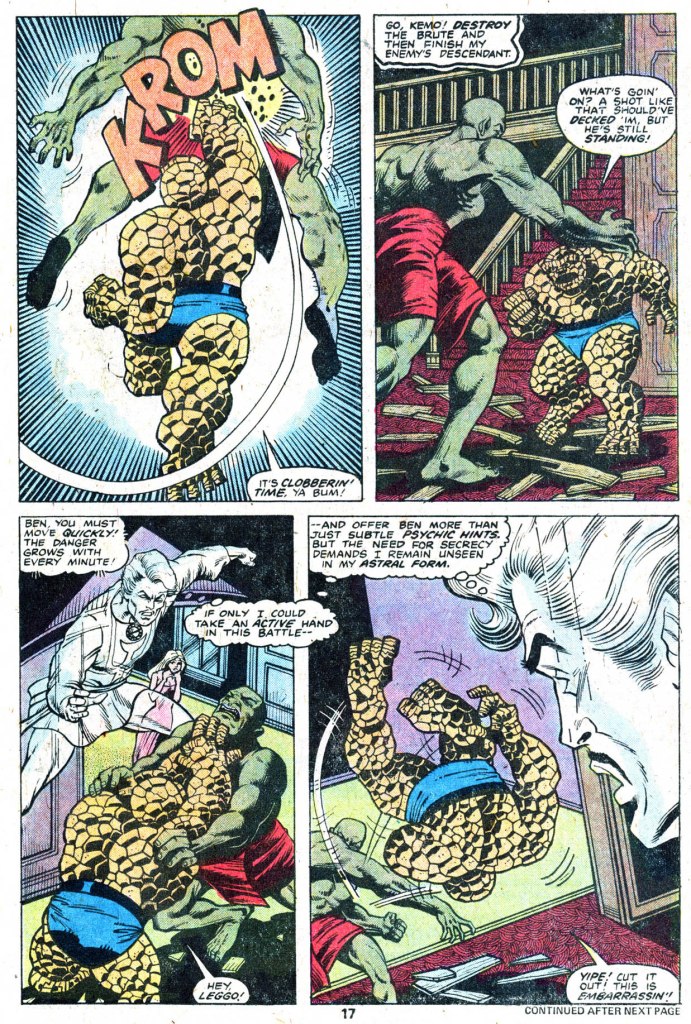
Strange is forced to remain out of sight in his room in order to keep his presence hidden, but he’s able to advise and guide Ben to a limited degree in his astral form. Years ago, the necromancer Ellis Tremellyn, perished while in pursuit of his enemies, the Crawlins family. Now, years later, the planets are in alignment, and Ellis can strike at the descendants of his enemies, using the reanimated and petrified body of Kemo, a Polynesian sailor who had gone down with him as a silent operative. As night falls, Kemo rises in an attempt to kill off Jane Crawlins, but the Thing is there to get in the way. But Kemo is driven by sorcery, and is able to stand up to the mightiest blows the Thing can throw at him.
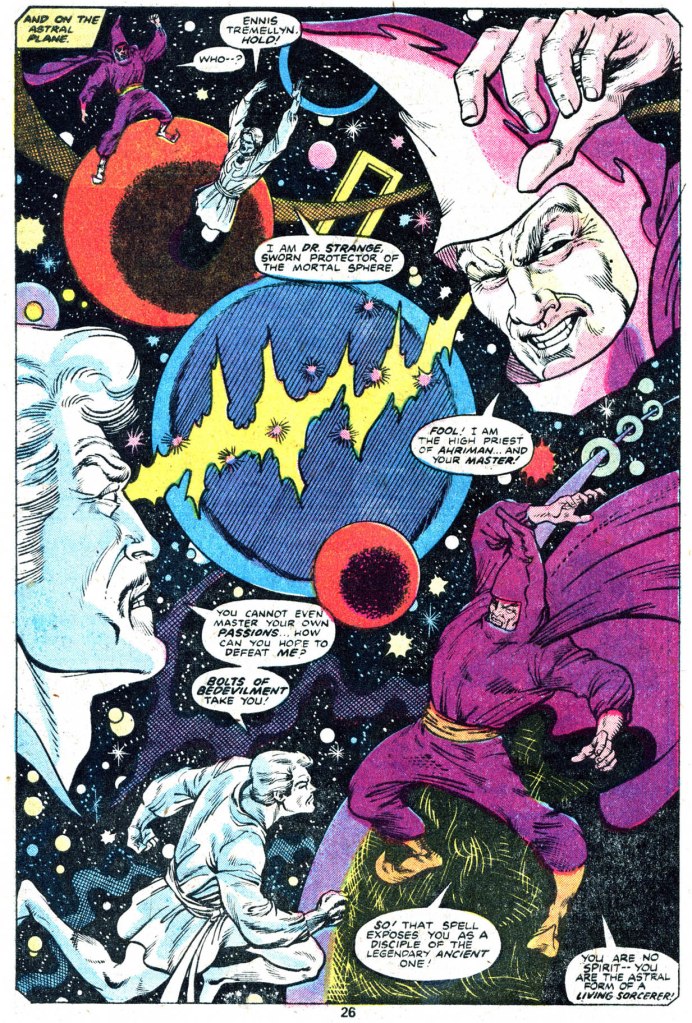
Leaving the Thing to handle the physical conflict and to keep Jane Crawlins safe, Strange journeys in his ectoplasmic form to the astral plane to confront the spirit of Ellis Tremellyn directly. Strange, though, is weaker in his spirit form, though still adept enough to be able to hold Ellis at bay. But as they battle, Ellis discerns Strange’s true nature, and sends a psychic instruction to his zombie slave Kemo. He is to abandon Jane Crawlins and instead slay the man in a certain room of the hotel–Strange’s physical body. If that should die, so too would Strange’s astral form ultimately perish.
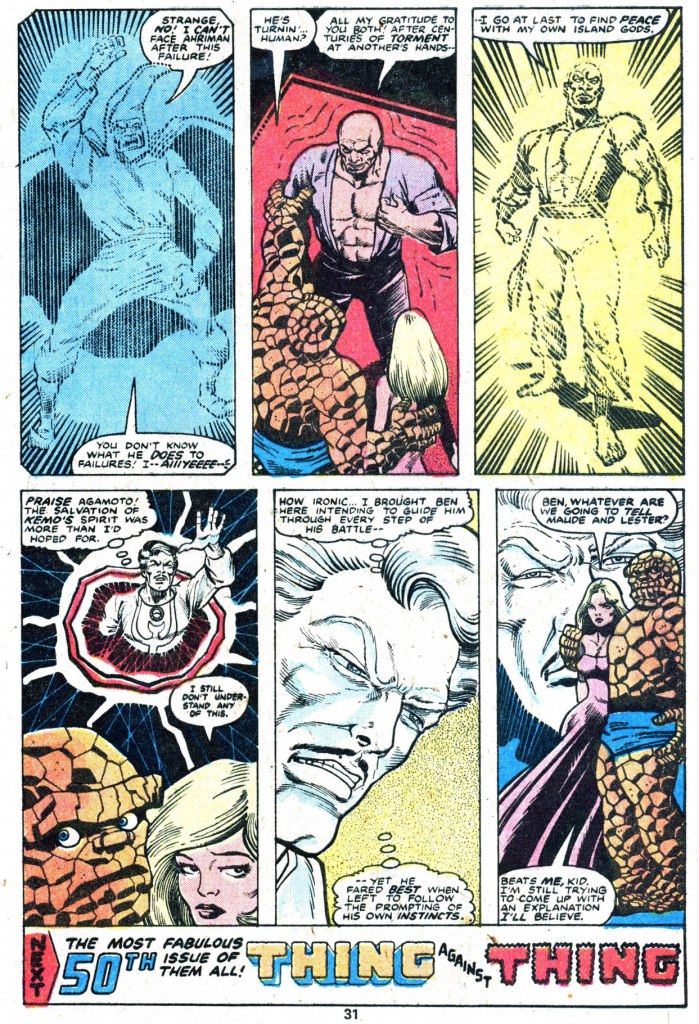
Ben, though, has been around the block a few times, and he’s worked out that it must be the gem embedded in Kemo’s chest that’s animating him, so he proceeds to crush it. This has a backlash effect on Ellis, and as the planetary alignment move on, he is drawn away to face the retribution of his hellish masters. As a result, Keno is freed from Eliis’ control, and he thanks Ben for his actions before also disappearing into teh afterlife. And the issue wraps up with the Thing having only the slightest ideas as to what had been going on, while Doctor Strange is satisfied with the resolution and is content to let sleeping dogs lie. The end. It’s a perfect fine story, but utterly unmemorable, with a villain and a set of circumstances that just didn’t stick to my ribs in any way.

The Ever-Lovin’ Blue-Eyed Letters Page this month included a letter from future Eclipse editor Cat Yronwode, who was a regular correspondent to the Marvel titles at this time.
 The Tom Brevoort Experience
“The saving grace were the excellent inks of Gene Day”
Mileage varies on that point. I look at these pages and see panels that were constipated with detail because of the inks. Less is more might have been a good dictum for Mr. Day, who, despite my criticism, was quite talented. Perhaps Alex Toth would have been a better role model than Wallace Wood.
LikeLike
Crawlinswood had to be a variation on “Collinswood” from the Dark Shadows TV show even if the story had no connection
LikeLike
Crawlinswood and Crawlinsport both, yes. And Jane is drawn to look something like DS actress Nancy Barrett.
It’s also possible that Ennis Tremellyn is a reference to the Gothic novel MISTRESS OF MELLYN by Victoria Holt, which featured a Connan TreMellyn.
And to add to the pop-culture references, that sailor named Doyle is Alan Kupperberg’s best attempt at a Gene Hackman likeness.
LikeLiked by 2 people
I was just going to say that the sailor had a bit of a Gene Hackman likeness as well.
LikeLike
I didn’t think even Gene Day could save this one. His inking is as nice as ever, but the underlying pencils are so mushy the art still disappoints.
This was, by the way, Jo Duffy’s first full writing job at Marvel. She also dialogued a DAREDEVIL that came out the same week, which you recently profiled, but this was her first full issue.
LikeLiked by 2 people
I took a liking to that aura put around Kemo on the cover and elsewhere in the story. I put the same aura around a bunch of wizards and monsters in my own fantasy sketches thereafter. Gene Day was a treasure; not sure what the problem was Shooter had with him later on Master of Kung Fu. That art was gorgeous.
LikeLiked by 1 person
It was, but it wasn’t very straightforward, which is what Jim thought Marvel books needed to be.
Also, to be fair, MASTER OF KUNG FU was one of Marvel’s lowest-selling books at the time — when I was starting on POWER MAN/IRON FIST, around that time, I saw a sales listing, and I think MOKF was the only book selling worse than PM/IF.
So it made sense to try to do _something_ different with the book, even if what Jim wanted to do wasn’t the right something.
LikeLiked by 1 person
Day’s approach on MOKF–Steranko-style layouts–was counter to Shooter’s preferences. Shooter was willing to accept that for about a year. But sales, which had been hovering around the cancellation threshold, didn’t go up. So Shooter got assertive about his reservations.
LikeLike
If sales were slipping, I would have put that on Moench, not Day, as Moench had definitely begun to repeat himself near the end of his run. I mean, how many times can you cook up a good excuse to go back to Mordillo’s Island and fight Brynocki?
LikeLike
“I mean, how many times can you cook up a good excuse to go back to Mordillo’s Island and fight Brynocki?”
Monthly! Or more!
Brynocki should have been the lead character — change the rifle to TOMB OF BRYNOCKI and watch the sales climb!
LikeLiked by 2 people
As long as we’re talking MOKF, I might as well share one of my goofier blogposts on him here: https://crustymud.paradoxcomics.com/kung-foolin/
LikeLike
I happened to read this one in the last few months, and I’ve already nearly forgotten the whole thing, aside from the Collinswood reference. The “Popeye” reference that others have pointed out gives me something of a “huh”reaction, like “okay, but why was that supposed to be clever?”
Also keeping the teamed-up heroes separate didn’t nothing for character interaction, even if it solved Duffy’s problem about how to keep two very different heroes on separate planes.
LikeLiked by 1 person
I’ve seen some of the original art for this issue on comicartfans.com and Day’s inks I feel truly shine.
LikeLike