

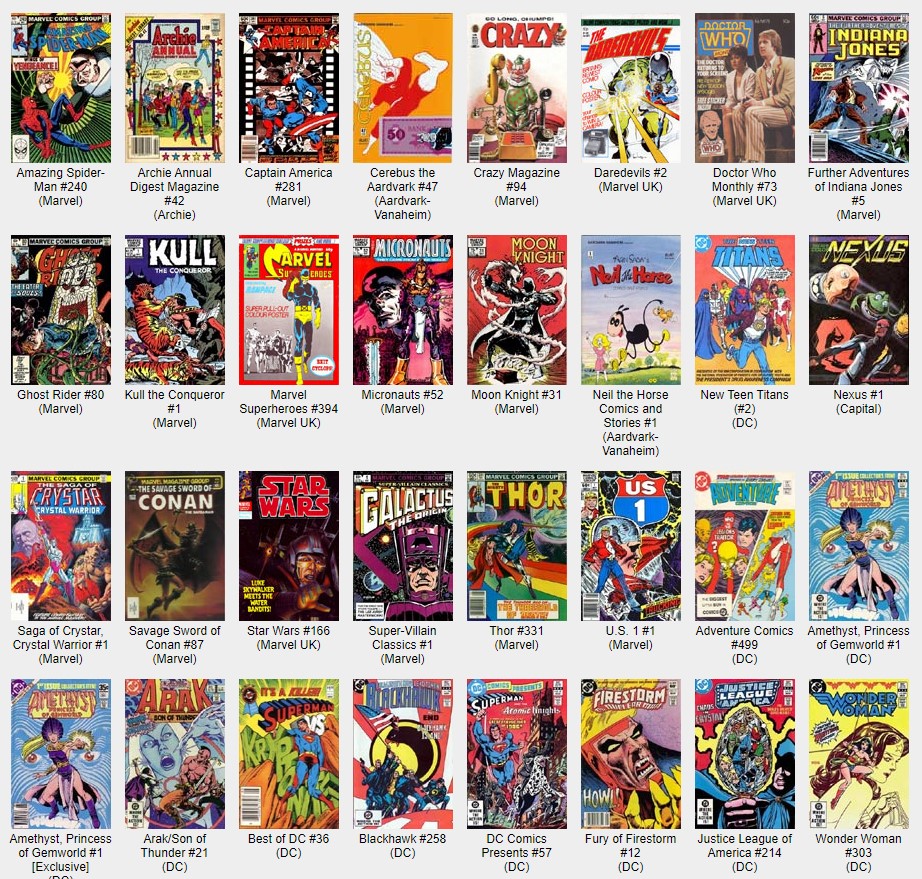
My home life was upended majorly in November of 1981 when my father’s job at the Chase Manhattan Bank transferred him from working in New York to setting up a new operation in Delaware. This meant that the family had to move, and the transition played havoc with my comic book buying. Where I had been situated on Long Island, there were multiple places that one could easily buy comics, all within biking distance. But we’d be moving into a new development in Delaware, one remote from any such outlets without a car. Additionally, I had been affording my comic book buying habits with a twice-a-week Pennysaver delivery route. But in Delaware, I had no ready source of income apart from the dollar-a-day that I was still being given for school lunches (and that I never used for that purpose.) So I had a bit of a dilemma.
At the outset, I signed up for a mail order subscription service from Geppi’s Comic World, the outfit that eventually grew into Diamond Distributors. But this had its own problems. Because of my finances, I would only receive a shipment once a month, with every single comic published throughout the month in it. Consequently, it would make me itchy whenever we happened to be out in the world doing errands and I’d see some new issues on the racks, issues that I couldn’t buy then. Additionally, those shipments were send C.O.D., Cash-On-Delivery, which meant on those random days when the delivery guy turned up on the doorstep, I need to absolutely have every single cent that I needed. I sweated that process out every month, though I never hit a one where I didn’t somehow manage it, even if it took swiping loose change off my father’s dresser.
This was also the period in which the Direct Sales marketplace began to really open up, with all sorts of new would-be publishers coming into the field with their own characters and series. It was terribly exciting–especially because I’d started to grow a bit bored of the regular Marvel and DC output. DC was still largely out of step with the times, putting out a lot of books that were clearly aimed at a younger readership than I then was. And Jim Shooter had come in as Marvel’s EIC and was attempting to employ better storytelling across the line. In practice, though, this meant that a lot of the Marvel books felt less visually exciting. They had more words per panel and more panels per page, and the artwork often felt like a secondary consideration.
I also had a my attention diverted as I discovered Japanese anime in the form of the daily series STAR BLAZERS. Wanting to know more about it, I eventually made contact with the early fandom, where I was put into contact with other similar fans as well as dealers who were selling both imported books and on occasion video tapes of other similar programs that had aired overseas. This all drained time and especially money from my comic book buying,
Everything came to a head around February of 1983. My expenses had been consistently exceeding my income and I couldn’t keep up with everything any longer, at least not until a few years later when I was able to get my driver’s license and thereafter a job. So I painfully sat down to go over my buying list and figure out what I could cut out without missing it too badly.
I wound up dropping something like 90% of the titles I was regularly reading.
This isn’t atypical. Most comic book readers tend to shift away from the medium at a certain point in their teenage years as other things become more important to them. I never stopped being a comic book buyer and reader, but this was definitely a moment where the cord tying me to the field was cut a little bit. Eventually, over time, I’d come back to just about every series that I’d dropped (the ones that were still being published, at any rate.)
So this all made me think: in the ongoing Brevoort History of Comics, we’re not going to get to February of 1983 for years and years yet–we’re only part of the way into 1979 as of this writing. So as a new feature here, I’m going to look at the final titles of all of the books I dropped in and around February 1983 to see what I make of them today. To make teh picture complete, I’ll also be including a link to the first issue of the series that I bought regularly, and showcasing the first issue that I came back with. So, goodbye, and then hello. Hence, the name of this feature.
 The Tom Brevoort Experience
Star Blazers wasn’t my first anime but it was definitely the first to get me hooked.
LikeLike
Mine neither. I had watched Gigantor and Speed Racer obsessively at three years old, and Battle of the Planets was a favorite series in the 1970s. But Star Blazers was more the pure experience, with its serialized nature and genuine drams.
LikeLiked by 1 person
My first anime was Kimba The White Lion, which Disney ripped off for Lion King.
LikeLiked by 1 person
What a great idea for a feature! Thanks, Tom. Looking forward to it!
LikeLiked by 2 people
I didn’t have a single “moment of reckoning” like you did, but I was definitely feeling the mainstream comics ennui around that time, and the allure of new publishers. ’83-’84 was also when I started college, and there was a small but well-stocked comics shop right across the street from the University of Cincinnati that also had a lot to with my horizons getting broader (R.I.P., Phantasy Emporium).
Star Blazers really knocked my socks off, but it didn’t end up kickstarting a general interest in anime, mainly because I had no idea where or how to find more of it. It wasn’t until Cartoon Network started running blocks of anime late at night c. 2000 that I really started to see much of it.
LikeLike
Hey, I frequented the Phantasy Emporium in 83-84 too! Took the bus down Vine from Roger Bacon after school every week and pestered the heck out of George and Jeff. Good ol’ crabby George and Jeff.
LikeLike
I can sympathize with moving to a new location that was remote and made it even more difficult to find comics. We eventually started mail ordering from Westfield Comics, and at last could get our hands on all the comics we would normally miss out on. I think that was around ’85, which marked another explosion in comics.
Looking forward to your 1983 posts! 😀
LikeLiked by 1 person