

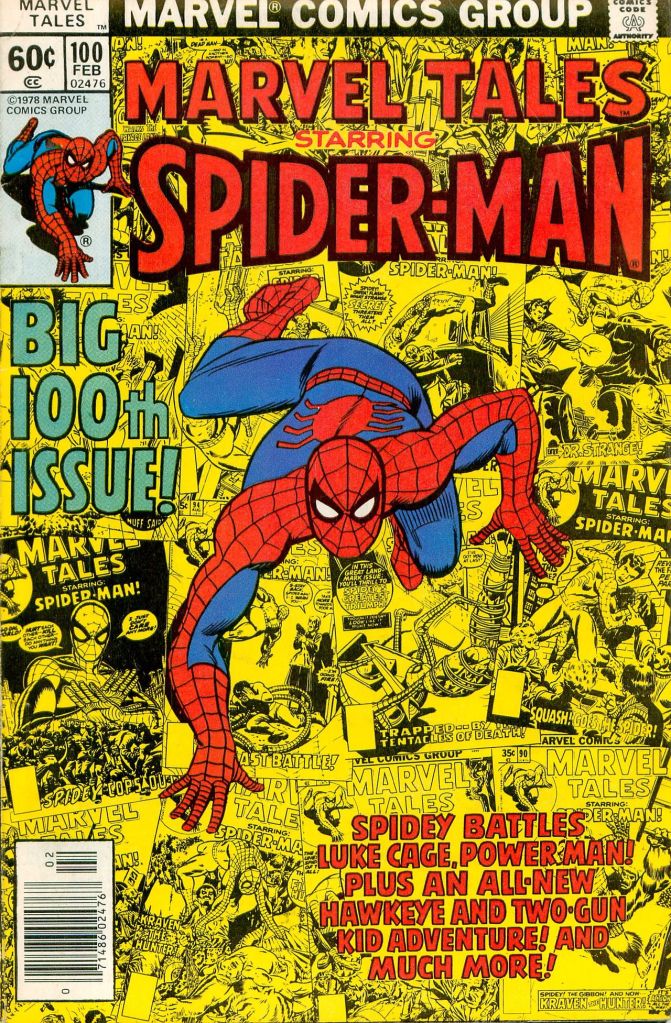
Despite the fact that it was a reprint title, MARVEL TALES didn’t miss the opportunity to go oversized for its 100th issue, a trend that had started with the centennial issues that Marvel and DC were putting out. It’s kind of a mixed bag, in that one of the secondary features doesn’t have any relation to the lead character, Spider-Man. But it was still entertaining, even if it cost more coin than was typically the case. I of course liked this cover with its glimpses of earlier issues, many of which I’d never seen before even though they weren’t especially old.

In the lead position was the regular reprint of an issue of AMAZING SPIDER-MAN from only a few years before. This was the issue directly after the deaths of the Green Goblin and Gwen Stacy, when the series was venturing into unknown territory. And it’s a cracker of a story. It was penciled by Gil Kane and inked by John Romita, but there’s a bit more to the story than that. Apparently, most of the pencils got lost in the mail, so Romita had to ink the book on vellum over copies. In doing so, he performed major surgery on a number of the pages, changing characters and compositions when it suited him. The end result is a really good looking story, but I can’t imagine that Kane was very pleased with it.

For example, here’s what that splash page looked like when Kane penciled it.

Otherwise, the story by Gerry Conway is a blatant plug for the House of Ideas’ new character, Luke Cage, Hero for Hire. But despite that fact, it works really well. Having chosen (of course) to blame Spider-Man for the death of his friend Norman Osborn–some mysterious figure stripped off Norman’s Green Goblin costume before his body was found, maintaining the secret of his criminal dual identity–Daily Bugle Publisher J. Jonah Jameson needs an agent to bring the wall-crawler to justice. Hearing about the new hero in town, and the fact that he offered competitive rates, Jameson recruited Cage to bring in Spider-Man.

The rest of the issue is primarily a pair of extended fight sequences between the well-matched web-slinger and Cage. And they’re great, with Kane’s layouts at their most dynamic and energetic and Romita bringing his polish and sheen to the finished art. If Cage looked this good in his own magazine, it doubtless would have been more of a success. The fights start out as just business but get personal as they go along–Spider-Man is still grief-stricken and looking for somebody to take his mad out on, and Cage is offended when the wall-crawler calls him a mercenary (momentarily forgetting that when he started out in the game, Spidey too tried to cash in on his powers.) So both characters come across sympathetically and pop off the page nicely.
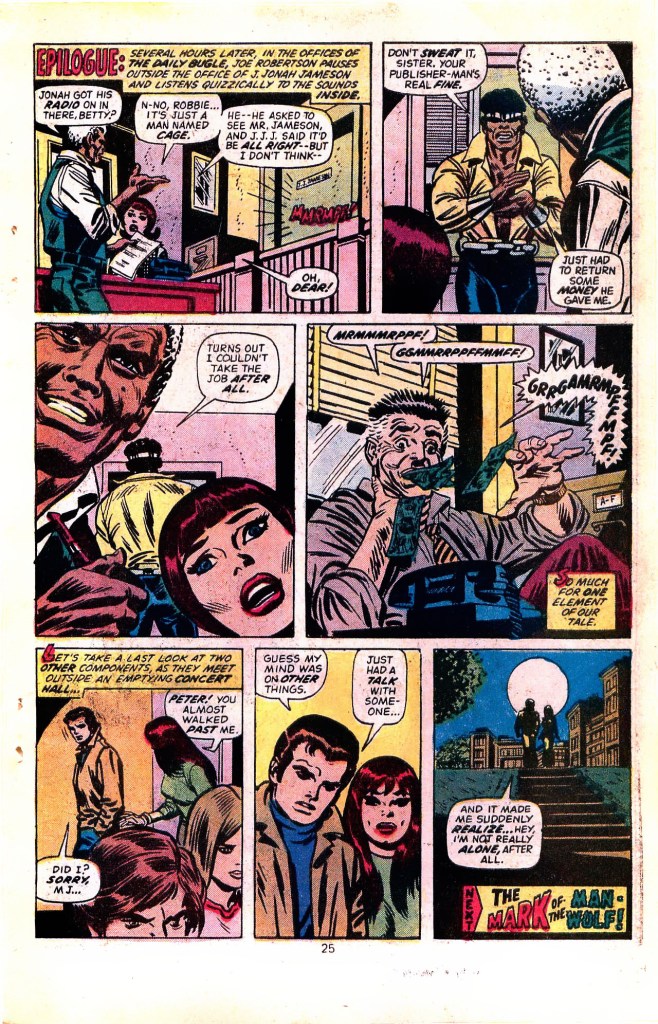
Along the way there’s some interpersonal material sprinkled in. Pete’s roommate Harry Osborn is eying him menacingly, and Mary Jane is cozying up to Peter now that Gwen is no longer an impediment. But the real focus is on Cage vs Spidey, with their big personalities taking center stage. Eventually, the web-slinger gets Cage webbed up and is able to talk with him less aggressively, explaining what happened with Osborn and Gwen. And in a fun epilogue, Cage returns Jonah’s money to him by force-feeding it to him.

The next thing in the issue was a six-page adventure of Hawkeye and the Two-Gun Kid out west. There, they run afoul of Killgrave the Purple Man, who can bend people to his will and who turns the duo against one another. The Purple Man was kind of a piker in these days, so Hawk and Two-Gun overcome him in half a dozen pages. The story was written by Scott Edelman and was one of a number of short fill-in stories that he produced during this period, to be dropped into titles that were running behind schedule. I don’t know why this one was selected to be in MARVEL TALES #100 apart from the fact that the artwork by Mike Nasser and Terry Austin is really nice and that it didn’t really have an obvious home given its stars.

The rest of the book was given over to a series of pages culled from the first AMAZING SPIDER-MAN ANNUAL laying out assorted facts about Spider-Man and how his powers and equipment worked. Not all of them were reprinted here, but enough to give a good sense of the character. This likely was the first place that I saw them, and they were another welcome look at the formative work of creators Stan Lee and Steve Ditko on the character.
 The Tom Brevoort Experience
I bought this as a back issue quite a number of years after it first came out. I must dig it out and re-read it as I don’t remember much about it.
LikeLiked by 1 person
I’m guessing the Hawkeye/Two-Gun tale must have been a stock story, not originally intended for Marvel Tales. Perhaps it was commissioned as a potential fill-in for Team-Up or Two-in-One?
LikeLike
Just six pages? Never mind. I guess you could still use it to fill up space if a story ran short. They may have also used it here just because the premise was bound to become obsolete in a short time—Hawkeye wasn’t going to be bouncing around the West with Two-Gun forever.
LikeLike
I’m still disappointed they never did anything much with Clint and Matt. Wasn’t this the only story between his moving to the future then going back? Back then the market could have better supported a solo (duo?) book with Hawkeye and Two Gun. At the very least there was no shortage of teams to add them too.
LikeLiked by 1 person
They also appeared together in an issue of Ghost Rider—#27, with the Manticore. Then they were grabbed by the Collector during the Korvac saga. So they didn’t do a whole lot with the pair before returning Two-Gun to his own time, but they did a few things here and there. Better than nothin’, I guess. It also just occurred to me that this story could have been intended for an Avengers annual.
LikeLike
So he was “Cage” initially, not “Power Man”? Was the superheroic alias added to try & entice more readers? This story did look great. I’m of a certain age where this was the vintage, definitive look, even though it was published “before my time”. Iv was treated to the explosive, exploratory styles in the1980’s that were built off the bedrock of this earlier period. Great to see these pages. Dynamic & fundamentally solid stuff. Romita really did add some polish.
Cool to see some early Mike Nasser/Netzer work, & inked by Terry Austin. These pages are strong. I didn’t know the 2-Gun Kid was brought into the present day. I had a few 2-Gun Kid comics. The mask reminded me of the Lone Ranger. But then Tom posted that Avengers Korvac issue, drawn by Dave Wenzel (spelling ?), & 2GK was included w/ the rest of the heroes on the Page One splash.
Good to see Ditko’s classic, clean rendering from back in the day.
LikeLike
Cage was originally “Luke Cage, Hero for Hire.” He adopted the Power Man alias in #17 — IIRC both in-story and in the creators’ minds it was to give him a more heroic name.
LikeLiked by 1 person
Without checking I’m pretty sure Cage appeared in S-M to hype his brand new series, originally called HERO FOR HIRE. It was like two years later that Marvel changed the title to POWER MAN. A few issues later, a letter writer told Marvel that he didn’t like the renaming and an respondent claimed the title instantly sold better with the new title. That sounded like rather a canned response to me.
LikeLiked by 1 person
Yes, “Hero for Hire” #1-#16, then “Power Man”. But the cover also has “Luke Cage” very prominent at the top.
https://www.comics.org/series/2051/
“Power Man” does sound like a better marketing title to me.
LikeLiked by 1 person
Hero for Hire sounded much more intriguing back in the day, when heroes didn’t do it for the money.
LikeLike
That Artie Simek lettering trick of changing the letter sizes for emphasis always works for me. I wish more letterers did that- it really added to the story.
LikeLiked by 1 person
One of the pages not reprinted here has Cage calling the thugs he’s fighting “motherless freaking scum!” As a tween I assumed this to be authentic street dialog and not the obvious euphemism my adult self recognizes it to be.
LikeLike
I asked editor Roger Stern about this, may years ago. He replied, “Back around 1976, Marvel editorial started commissioning a number of short back-up-sized stories—partly to audition new talent and partly to help ease some deadline crunches. Scott, Mike, and Terry (Austin) had produced that Hawkeye and Two-Gun story and it was sitting on the shelf, when the decision came down in 1978 to make Marvel Tales #100 a double-sized issue. I had more or less been in charge of the reprint line when I first came to work at Marvel, and at that time I was still overseeing Marvel Tales. Anyway, I decided to plug the story in there, before it became too dated. Plus, I really liked the idea of publishing a new story in what was otherwise a reprint comic. I remember it as being a nice little story, and placing it there helped make the hundredth issue of Marvel Tales something special.”
LikeLike