


YELLOW CLAW was one of the strangest series published by Marvel, then Atlas, in the 1950s. it feels like a throwback to an earlier time, an era when “yellow peril” adventure stories about Dr. Fu Manchu and his many knock-offs were big business in the pulp magazines of the day. Having done a little bit of research on the subject, there’s little I can come up with concerning why this series might have been launched in 1956. There was no resurgence of interest in the earlier yellow peril material, no new novel or film project that put it back onto the popular culture scene. So it may simply be that, with the formation of the Comics Code and the subsequent collapse of the comic book industry, publisher Martin Goodman was simply looking for any new thing that might rack up sales. In any event, the first issue was written by Al Feldstein, formerly of EC Comics and just before he was hired back to helm MAD Magazine, and illustrated by workhorse Atlas artist Joe Maneely. But a change was in the offing for the second issue.

His own ventures having collapsed in the wake of the Code’s implementation and having split from his longtime partner Joe Simon, Jack Kirby returned to Martin Goodman’s firm for the first time since his departure in 1941 looking for work. For the remaining three issues of YELLOW CLAW, Kirby would both write and draw the series, producing multiple short stories for every issue (each story was approximately 5 pages in length, very short) and shifting the series more in the direction of science fiction fantasy, though the yellow peril aspects nevertheless remained. But it was a little laboratory in which Kirby could play around with stories concerning all sorts of ideas that he’d gleaned from the scientific magazines that he’d read. Miniaturized armies, colossal living statues, paralytic fog, living shadows–Kirby did five-page adventures about all of these, and more. But one idea he explored he’d go on to derive a lot more use from in the future.

This second issue of YELLOW CLAW included this story, “Concentrate on Chaos”, which introduced a sextet of telekinetic mutants whom the Yellow Claw presses into his service. These mutants, born with superhuman abilities that set them apart from the common man, are a harbinger of the future, an indicator of what mankind may one day evolve into. In the end, FBI agent and lead hero Jimmy Woo learns that the Yellow Claw is forcing the mutants to do his bidding by keeping them under hypnosis. With the aid of the Claw’s niece Suwan, Jimmy is able to break the spell, and the mutants abandon the Claw, disappearing back to their old lives. The story is thin due to the short run time, but Kirby was clearly onto something here.

Kirby both penciled and inked this story, with some help from his wife Roz, and he wrote it as well. It showcases a lot of visual panache as well as the textured inking style that was preferred by the Simon and Kirby team.
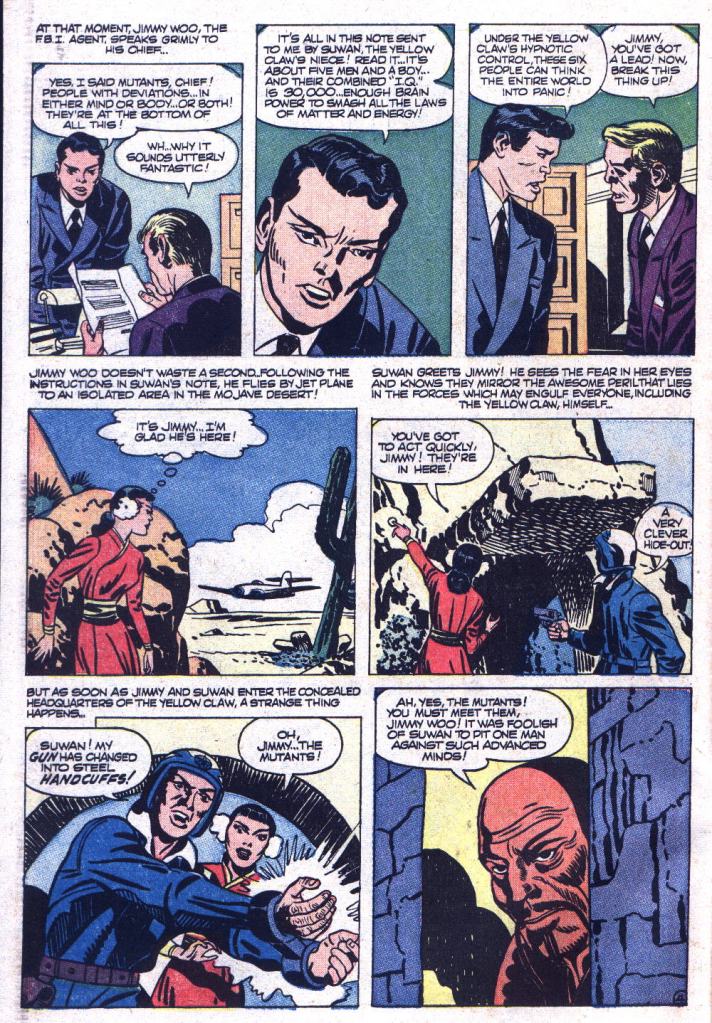
Obviously, the themes of this short story are ones that Kirby came back to in later years, when he and Stan Lee introduced the X-Men at the start of the Marvel Age.
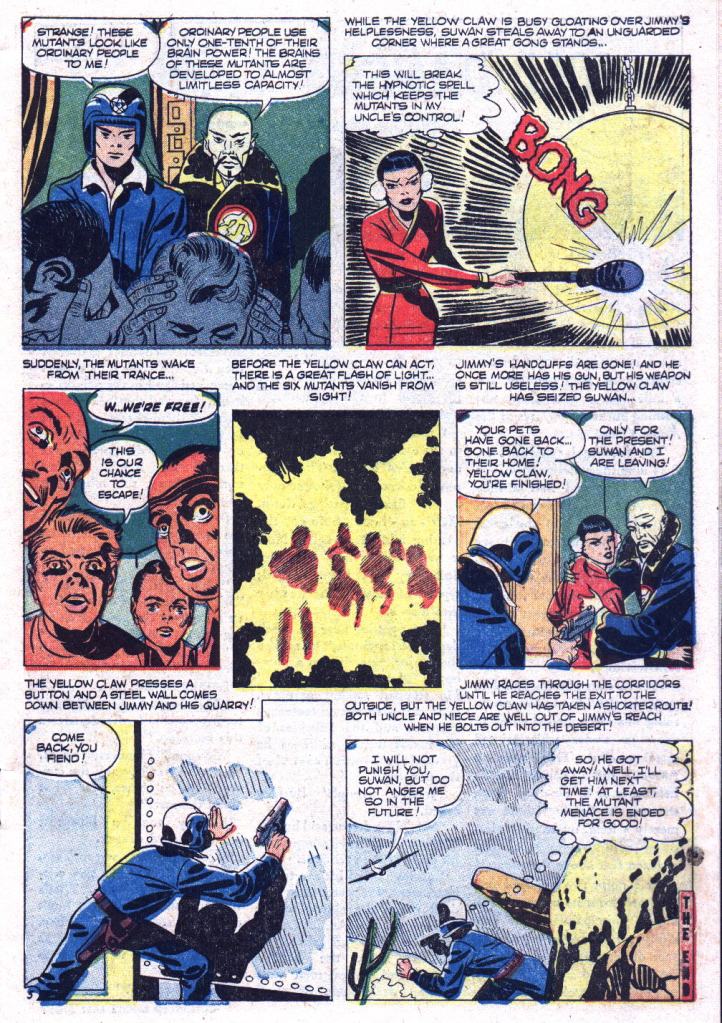
Eventually, decades later, John Byrne brought these mutants back in the pages of X-MEN: THE HIDDEN YEARS, where he names them The Promise and they recruit Tad Carter, the flying mutant who was introduced by Stan Lee and Steve Ditko in a story in AMAZING ADULT FANTASY #14. Which is some pretty heavy retroactive continuity lifting. Apart from that, these characters haven’t been seen since.
 The Tom Brevoort Experience
There was a Fu Manchu TV series in the US in 1956, so maybe Goodman (or someone else) thought it might be a hit, and arranged for a Fu-like series to launch shortly before the TV series hit the airwaves. And then it didn’t do promising numbers, so Goodman canceled it as soon as the TV series was over.
Or maybe it was an extension of Marvel-Atlas’s fervid anti-Communism of the era (and for years thereafter). Someone up there thought anti-Communist stories were a good bet.
LikeLiked by 3 people
Jim Steranko revived the Yellow Claw, Jimmy Woo and Suwan in Nick Fury Agent Of SHIELD, in a story line which lasted about seven issues in Strange Tales – a considerable part of his run on Fury.
LikeLiked by 2 people
Since Martin Goodman was far more known for jumping on trends than was Stan Lee, I would concur that YELLOW CLAW probably had its genesis from Goodman hearing news about the syndicated series ADVENTURES OF FU MANCHU. In fact, since the cover date for YELLOW CLAW #1 was October 1956, that issue probably hit stands at least two months before the first episode of ADVENTURES aired in September ’56. The comic book outlasted the series (not counting reruns), published into early 1957 some time after ADVENTURES broadcast its last new episode back in November.
Now, what might have boosted the Fu Manchu TV show? One short novelette with Fu Manchu had been published in 1952– I don’t recall where– but it didn’t see book publication in Rohmer’s lifetime, only getting collected by Daw in 1973 with three ultra-short uncollected Fu stories in WRATH OF FU MANCHU. For most readers, Fu’s last novel had been in 1947 or 1948, and the next to last full novel would show up one year after the series appeared, in 1957– UNLESS that novel got serialized in periodical form somewhere first. A lot of Fu novels were serialized before book publication, but I’ve no evidence that happened with the 1957 novel. Still, the news of a new novel with the devil-doctor might have sparked the TV show, though, as with the comic, it’s hard to coat-tail on a phenomenon if your imitation comes out FIRST.
There might have been an uptick in Asian villains in pop media of the early fifties thanks to the Korean War, but I’m not aware of any major influential challengers to the legacy of the devil doctor– EXCEPT for Sax Rohmer’s second best known character, Sumuru. She had first appeared in a late forties radio serial, but according to one online review, Rohmer’s five novelizations of the character’s exploits did very well for paperback publisher Gold Medal in the early fifties:
Sax Rohmer’s Nude in Mink (released as Sins of Sumuru in the UK) was published in May 1950. It was Gold Medal’s seventh overall title, and their third fiction novel. Like the Fu Manchu series, it featured a series villain, Sumuru, that was molded to be a female version of her male predecessor. In the first two months, Nude in Mink went through three printings—at 200,000 copies per print run (assuming it followed Gold Medal’s usual publishing pattern), that means 600,000 copies in just 60 days. According to The Page of Fu Manchu, it would go through another printing in October 1950, followed by a fifth printing in October 1951 and then a sixth in July 1953. Not bad for a novel that was salvaged from a BBC radio serial from 1945–1946. It would also spawn several sequels: Sumuru (1951), The Fire Goddess (1952), Return of Sumuru (1954), and Sinister Madonna (1956)
http://www.pulp-serenade.com/2020/08/nude-in-mink-by-sax-rohmer-1950.html
I don’t know exactly how “Asian” Sumuru is since I’ve read only one of the novels, but her success might have sparked Rohmer to execute his last few Fu-stories, and that might have convinced TV producers that there was gold in them thar Asian mastermind hills. And of course in the mid to late fifties, syndicated TV was coming out with a lot of pulpy adaptations– Sheena, Jungle Jim, Zorro, Flash Gordon– so Fu Manchu fit into that overall spirit of pulp-revival.
And that’s my theory; don’t wear it out.
LikeLiked by 1 person
“In fact, since the cover date for YELLOW CLAW #1 was October 1956, that issue probably hit stands at least two months before the first episode of ADVENTURES aired in September ’56.”
It came out in June.
“The comic book outlasted the series (not counting reruns), published into early 1957 some time after ADVENTURES broadcast its last new episode back in November.”
Last issue was in December.
kdb
LikeLiked by 1 person
I’m not sure the Yellow Claw requires any exploration — the “sinister oriental” trope may not have been cutting edge but it ever went waway. I bought reprints of Fu Mancbu in the 1970s; Christopher Lee played him on screen in the 1960s. After Japan became serious economic competition for the US, we got an updated version of the Yellow Peril novel where them outselling American car companies was Pearl Harbor 2, their revenge for losing the war (Michael Crichton’s Rising Sun makes this point, and recycles a lot of pre-WW II cliches about the danges of doing business with the Japanese and their fiendish oriental cunning)! And Clive Cussler’s Flood Tide (1997) has the very yellow-peril premise of the Chinese bad guy plotting to flood the West Coast with immigrants and turn it into a beachhead. Michae
Which is not to say the book wasn’t triggered by the Fu Manchu show or the Red Menace, but I don’t feel Goodman was tacking against the wind by trying something like this.
LikeLike
Despite the dated aspects, this is a great-looking story and hey, that Kirby/Kirby inking team is terrific! The big panel on page 3 and the middle tier of panels on page 4 (very Milton Caniff) are particularly nice.
LikeLike
I assumed that since the cover date for YC #4 was Aoril ’57, it was on stands in the early months of ’57. Four months ahead of the actual newsstand date seems atypical, though I don’t doubt it could’ve happened that way, particularly since that was the last issue.
LikeLike
What I love about Jack Kirby’s Yellow Claw stories is that they pre-dates The X-Files ( 1993 ) & Fringe ( 2008 ). Jimmy Woo isn’t the only Atlas Agent FBI agent with X-Files/Fringe Division like stories, Peter Dennis [ World of Mystery#3 ( October 1956 ) 3rd story “The Mystery Man” ( Steve Ditko artist ) — encounter extradimensional Markham Moros ], Steve Manners [ Adventures into Terror#4 ( June 1951 ) 1st story “The Brain!” — encountered the disembodied Nazi head The Brain ( Otto von Schmittsder ) ] and 2 unnamed FBI agents [ Strange Tales#30 ( July 1954 ) 1st story — “Science Fiction” –Bruce Baron editor at a science fiction magazine Many Worlds vs Mr. Charles a shape-changing reptilian Saturnian ( and unknown to him, Bruce’s wife Carol is one )] — perhaps they all work branch/division/section of the FBI.
LikeLiked by 1 person
FORGOT: Peter Dennis & Steve Manners have profiles at marvunapp.com under Markham Moros & The Brain ( You might want to marvunapp.com/brain for the Brain ). Plus see the profile of Ted Lestron [ Journey into Mystery#52 ( May 1959 ) 2nd story ] & the Men With Atomic Brains ( telepathy, telekinesis, levitation, teleportation and passing through solid walls ) – 5 seen in the story but only 4 seen with Ted Lestron on the last page.
LikeLike
Here is another possible X-Files/Fringe Division like FBI agent ( called a government agent in the story ) : Bruce Jaeger arrested “Lois Dale” a SKRULL looking Uranian ( shape-changer — no Skrull chin like Princess Anelle during the Kree-Skrull War except you can see “Lois”‘ big ears ) kidnapping people to live on Uranus [ Marvel Tales#148 ( July 1956 ) 1st story — “Where Did They Go?” ].
LikeLike
Marvel Boy ( Bob Grayson ) [ Astonishing#5 ( August 1951 ) 5th story — “The Deadly Decision!” – mentioned on page 4 panel 1. On page 6 panel 5 FBI special agent Morgan & one other agent seen ] had a FBI agent friend named Dan O’Brien, he was probably who Jimmy Woo contacted to recruit Marvel Boy into the G-Men ( or in What If?#9 ( June 1978 ) the 1950s Avengers ).
LikeLike
Since no one has mentioned it yet (unless I missed something): nice cover by John Severin!
LikeLike