


I have to confess that I found the next three issues of JUSTICE LEAGUE OF AMERICA pretty dull and forgettable. Which is unfortunate, as this was the last storyline edited by Julie Schwartz in this series that he’d brought back in the extremely early 1960s. As with THE FLASH, which Julie exited this month, his time with the JLA was drawing to a close, unbeknownst to me. His workload was being scaled back, which makes sense given both his age and the fact that the comic book field was changing. But I must admit that, like THE FLASH, JUSTICE LEAGUE OF AMERICA never felt quite the same way to me as a reader, and for years I didn’t quite understand why, what had changed.

As with most issues of the title in the time I’d been reading it, this one was drawn by Dick Dillin and inked by Frank McLaughlin. Consistency was the name of the game here, even if McLaughlin’s inking wasn’t as flattering to Dillin’s pencils as some others had been, particularly Dick Giordano. But in these days when there were no incentives for artists based on circulation, if you found an artist who didn’t mind doing team books (which were harder to draw thanks to the sheer number of characters each issue required) then you kept them on team books. Dillin had been drawing a defacto team series in BLACKHAWK throughout the 1950s and early 1960s, and when that book ran its course, he stepped right over to JLA. The look of his work defines these characters and this series for me in the context of the 1970s when I was a young reader.

The writing assignment has settled out as well. After a number of years in which you’d get a different writer practically every issue, Steve Englehart came on board to do a well-remembered run. After Steve left, Gerry Conway took over, and remained in the chair virtually until the end of the series, with only brief times away from it. Gerry’s JLA wasn’t quite as polished as Steve’s–he wasn’t as interested in the character interplay as Englehart had been, and he wound up plugging more into editor Schwartz’s plot-centric approach more regularly. But Gerry was still a Marvel guy, and so he didn’t abandon characterization, it was often simply secondary to the plots. And those plots often tended to be a bit wild. It seemed occasionally as though Gerry was having difficulty coming up with situations that required an entire League of super heroes to cope with. In this issue, he drafts two situations in order to be able to split his enormous cast, a tactic he’d use frequently.
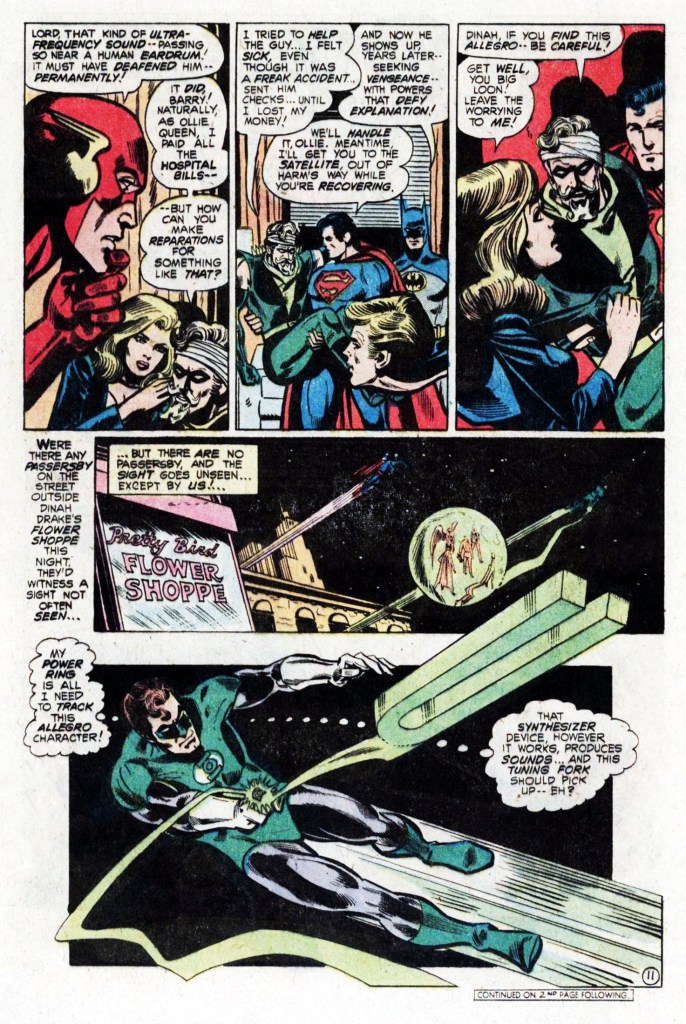
The issue opens with Green Arrow returning from a League meeting to the apartment that he shares atop Dinah Lance’s flower shop, where he’s attacked by a sound-based assailant. This is Anton Allegro, and he’s actually come looking for revenge on Oliver Queen, but he’s only too happy to kick Green Arrow around. Outmatched, the archer is left for dead. Elsewhere, the League is confronting Zatara concerning his recent actions–ensorcelling his daughter Zatanna to make her forget her mother and attacking the Red Tornado when the android tried to locate him. But before they can reach any sort of answer, the JLA Satellite receives a distress call from Black Canary concerning what has befallen Green Arrow, and much of the team beams down in response.
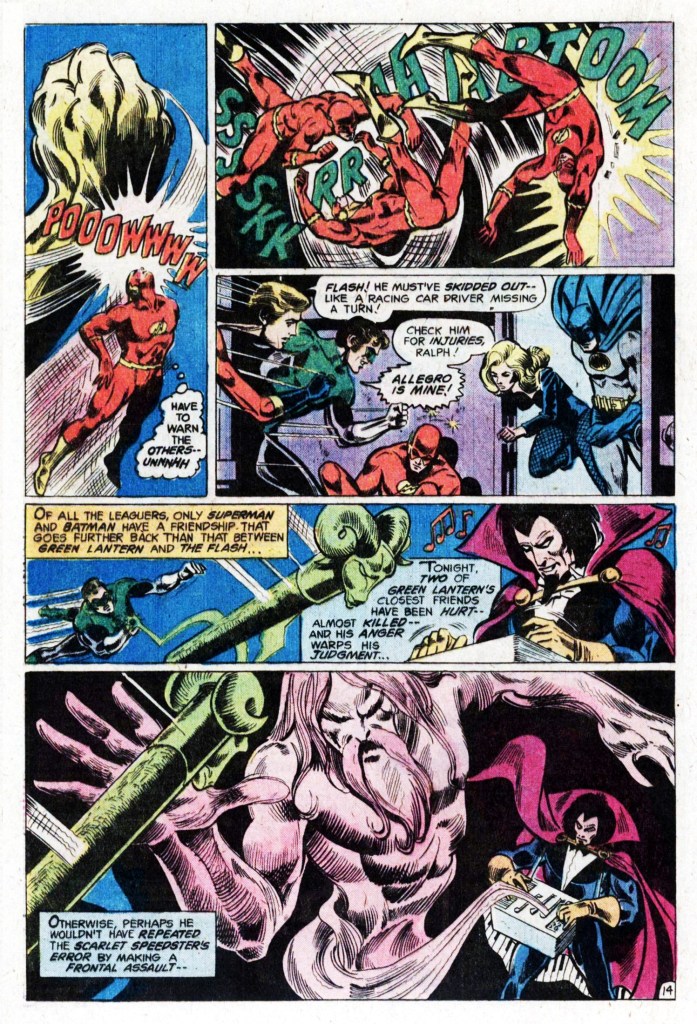
It turns out that Green Arrow knows his assailant, and once he’s recovered his wits, he can tell the shameful story to his partners. Years ago, in the days before he lost his fortune, Oliver Queen was visited by Allegro, who wanted him to invest in his creation, a synthesizer that could make sound solid. Ollie turned the man down–and shortly thereafter, when Green Arrow was battling some criminals, bystander Allegro was caught by a misdirected sonic arrow and had his hearing destroyed. So he’s got some pretty good reasons for going after Queen and the other men who drove him into poverty and despair now that he’s completed his device. The Flash, Green Lantern, Batman and Black Canary track Allegro to the home of his former manager, where he’s determined to kill the man with his sonic apparitions.

Back on the League’s Satellite Headquarters where green Arrow is recuperating and Red Tornado is on monitor duty, Zatanna uses her sorcery to try to get answers from her father Zatara. She learns from him that while her mother Sindella had supposedly died in a car crash in Zatanna’s youth, the truth was more complicated than that. Sindella was an extradimensional sorceress who had been hunted by her own people, and whose spirit was eventually captured and returned to her native realm. When Zatara attempted to conjure forth his wife’s spirit, he was blown back–though she implored him to live on, and to one day save her. Learning this, Zatanna is determined to finish the job that Zatara started and free her mother–but her sorcery is no more able to breach the dimensional gap than his was.

Back on Earth, Superman arrives to find that the rest of the League has been defeated by Allegro, though they’ve driven him off. But Allegro’s next target is his ex-wife, and batman isn’t sure that even Superman won’t be vulnerable to Allegro’s contraption. So as a precaution, the pair make a stop off at the Fortress of Solitude before engaging Allegro at his ex-wife’s home. As predicted, Superman does prove to be susceptible to Allegro’s powers, but the pair have replaced the ex-wife with a robot duplicate constructed at the Fortress, so they’ve at least saved her life. But Allegro himself is still at large–and that’s where this story is To Be Continued!
 The Tom Brevoort Experience
Speaking of Dick Dillin and team books, I remember a story from Mark Evanier: when Dick Dillin passed, Mr. Evanier called Mike Sekowsky to relate the news, to which he responded, “Yeah, that book would kill anybody.”
LikeLiked by 1 person
Dick Dillin was the JLA for me too. I liked his work everywhere it turned up but it was JLA he was the king of. Before finding out about his untimely passing, I remember being disappointed that even an artist of George Perez’s caliber was drawing the book instead of him.
LikeLiked by 2 people
That is a great friggin’ cover. Rich Buckler & Dick Giordano were one of my favorite art teams. So many great covers together.
I remember this one from the house ad in a handful of other comics.I had. Tom showed that ad in a recent BHOC.
Dynamic layout. Kinetic figures & poses. Explosive. Great shot of GL.
I was too young to have read Englehart’s run. I’m curious about the level of character interaction Tom mentioned.
LikeLike
Seek it out. The one where he uses the definition of a league as a base for the story is my favorite.
LikeLiked by 1 person