

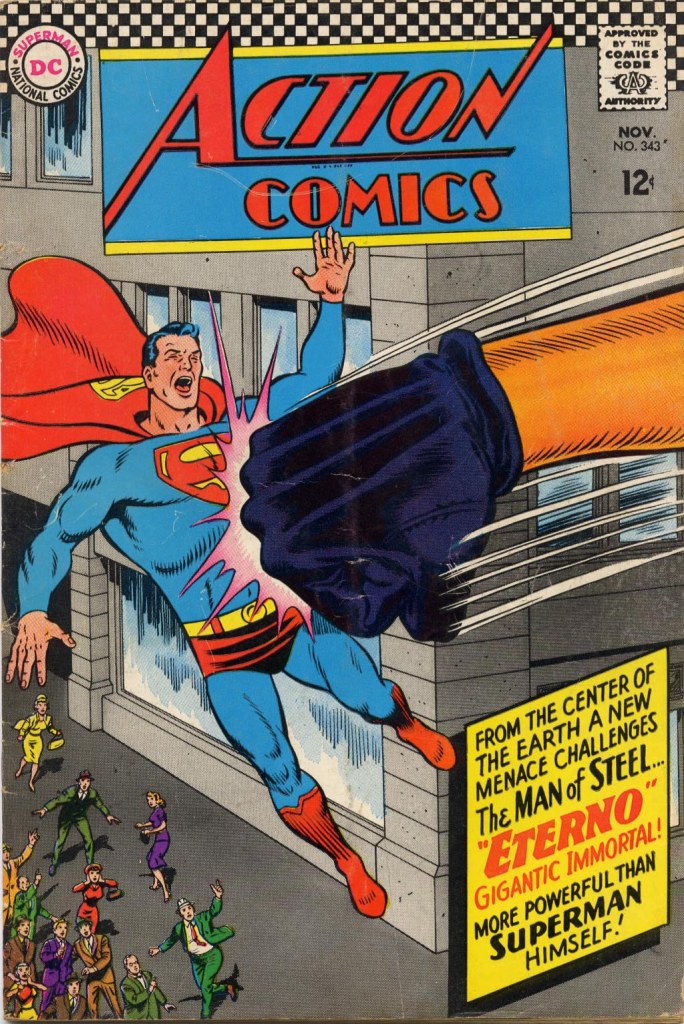
Well, from the looks of this cover image, we’re about to get a bit more action in this issue of ACTION COMICS. I’m not 100% certain who would have been responsible for it. The actual cover art was done by Curt Swan and George Klein, but they likely would have been working from a sketch provided by somebody else. At around this time, Carmine Infantino was brought in to help improve the impact of DC’s covers, so this may have been laid out by him. But just as likely, it’s the concept of writer Jim Shooter, who used to draw out his stories rather than simply writing a script for them. I think this latter option is the most likely. It’s a bit of an atypical cover for DC during this period.
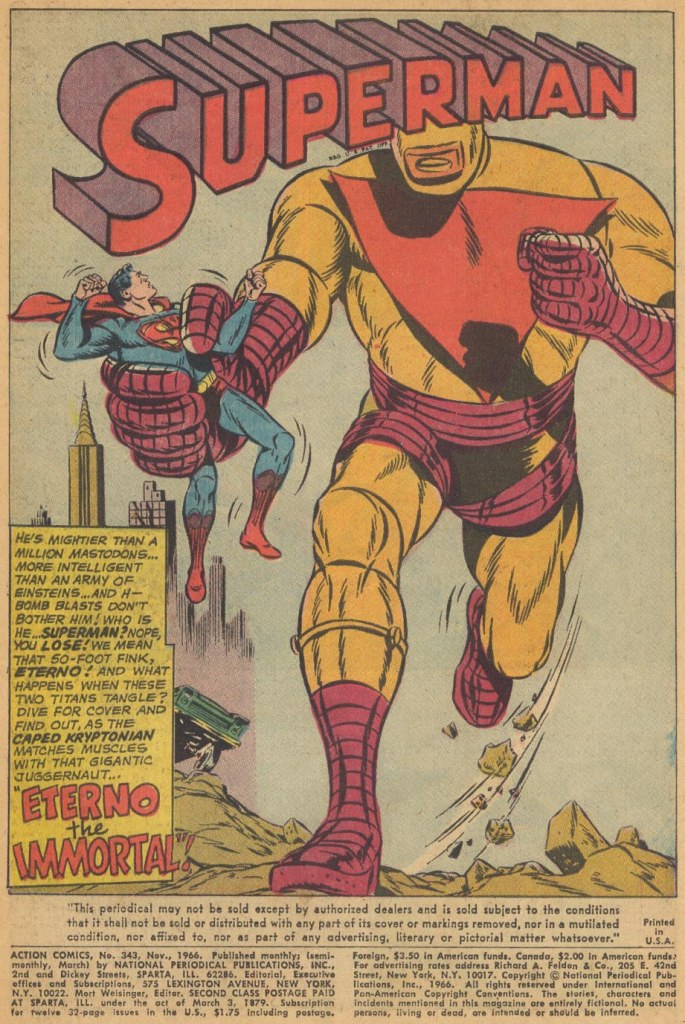
Jim Shooter has become something of a divisive figure in comic book circles, simultaneously praised for his many accomplishments and excoriated for his assorted failings. But one thing that you absolutely have to give him is his talent was vast. He broke in as a writer at DC when he was only 13 years of age (editor Mort Weisinger didn’t realize that Shooter was that young when he bought his first few stories) and he spent five years of his youth being verbally abused by the editor as he continued to work for him, selling stories to help out his impoverished family. One of Shooter’s complaints about the Legion of Super Heroes, the first series that he took over, was its lack of physical action, so he set about to bring in some characters who would buck that trend, notably Karate Kid. Here on superman, it appears he felt the same way, that the Man of Steel wasn’t being faced with foes who could stand up to him and give him a tussle. Thus, the introduction of Eterno the Immortal.
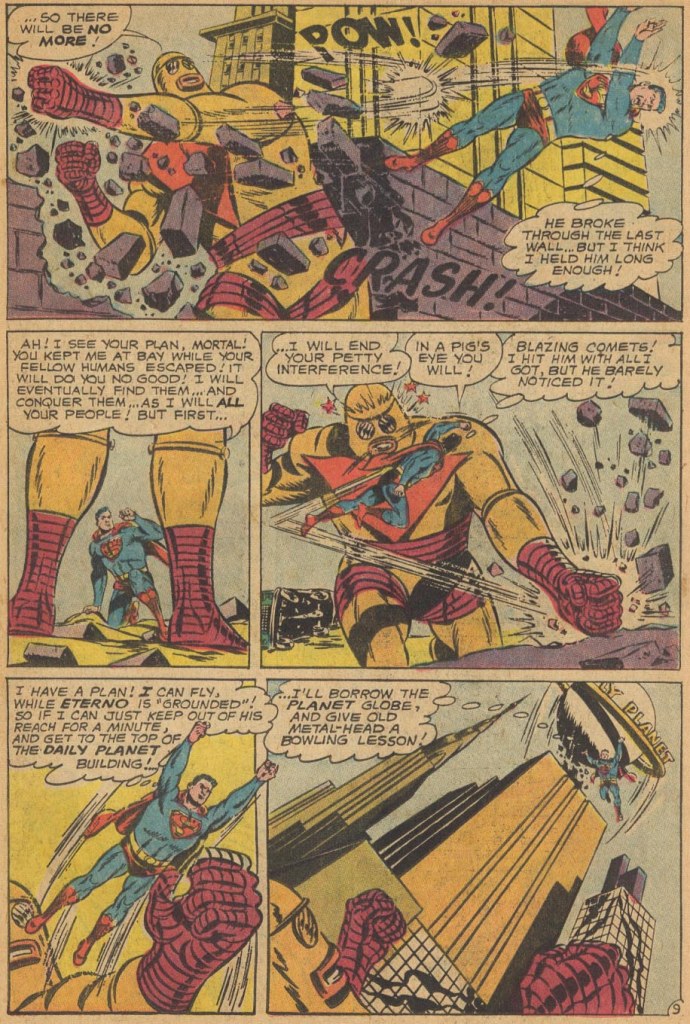
Eterno is half-android, half-robot, standing 50 feet tall and created to be indestructible by the Xan, a pre-human society that once inhabited the Earth. When the civilization of Xan was threatened, Eterno was dispatched to the center of the Earth to bring back the rare element that could save it, but the stuff paralyzed Eterno and so the Xan people were wiped out and forgotten. In the present, having become aware of this history, the Superman Revenge Squad, a consortium of space-villains all of whom had been undone by the Man of Steel over the years, decide to free Eterno and use him to destroy their enemy Superman. And indeed, upon reaching the surface once more, Eterno does battle Superman physically–there’s a lot more action in this story that we’ve been used to, albeit action that’s drawn by Wayne Boring, who had been the principle Superman artist of the late 1940s and most of the ’50s. Boring’s style was a bit old-fashioned looking, and so his action sequences here are a bit stiff and unconvincing.
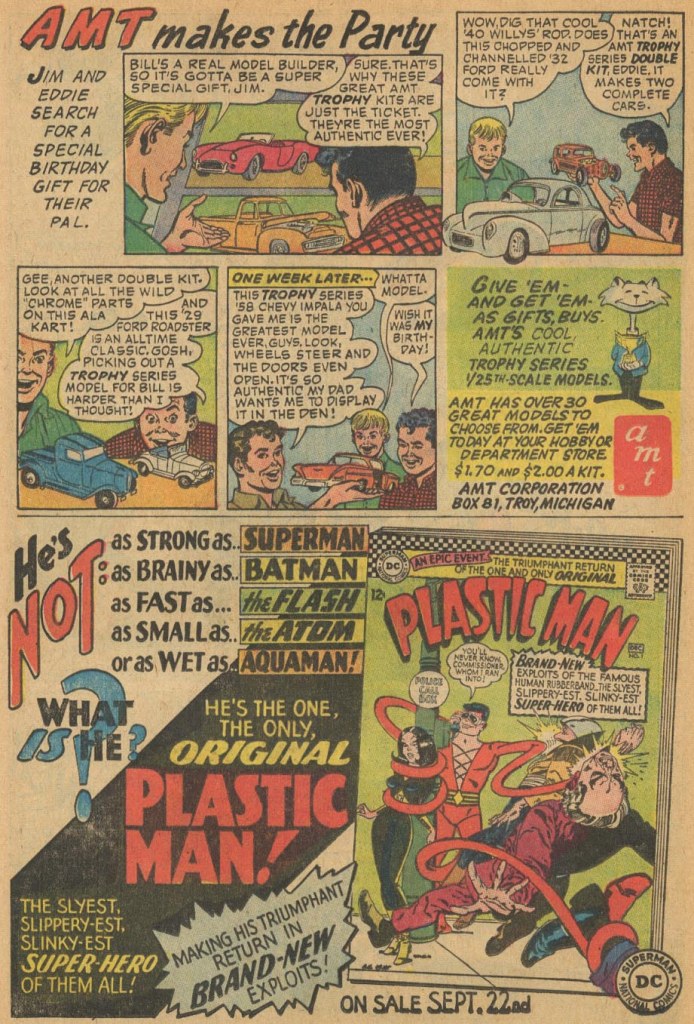
Hey! It’s a House Ad, this one for the all-new series reviving one of the most popular super heroes of the Golden Age of Comics, Plastic Man! This Gil Kane cover sure makes it seem like a lot of fun, too–it’s too bad that the actual book wasn’t half as entertaining. A bit of a misfire all around, and one that was only done to secure DC’s trademark to the character after he’d been used in a recent ad campaign by an agency that assumed he was then in the public domain.

Superman is on the ropes, Eterno is legitimately more powerful that he is. And then, one of the dopey Revenge Squad members makes an unforgivable error. Having ducked down to the city so that they can better observe Superman’s demise, the Squadder accidentally turns on the ship’s loudspeaker, broadcasting where Eterno can hear it that he’s only a pawn in their revenge scheme. Unhappy at this revelation, Eterno turns his mighty powers against the Revenge Squad ship, knocking it from the sky. But the Revenge Squad has weapons powered by the same rare element that paralyzed Eterno for all those years in the first place, and they use them to kill the giant. Unfortunately, he’s standing right over their ship when they do this, and he falls over, crushing both it and the Revenge Squad at the same time. Superman confirms that there are no survivors–and that’s it! Story over!

The Supergirl back-up story in this issue was another of those unannounced reprints that Mort was using to pad his back pages so that he didn’t have to work so hard. This one’s seven years old at this point, and is reprinted from an issue of SUPERMAN’S PAL, JIMMY OLSEN. It was also set during the days when Supergirl’s existence was a secret. It was written by Otto Binder and illustrated by Curt Swan, so it was good work. But in a regular issue of a regular comic book, I can’t help but feel cheated by its inclusion.
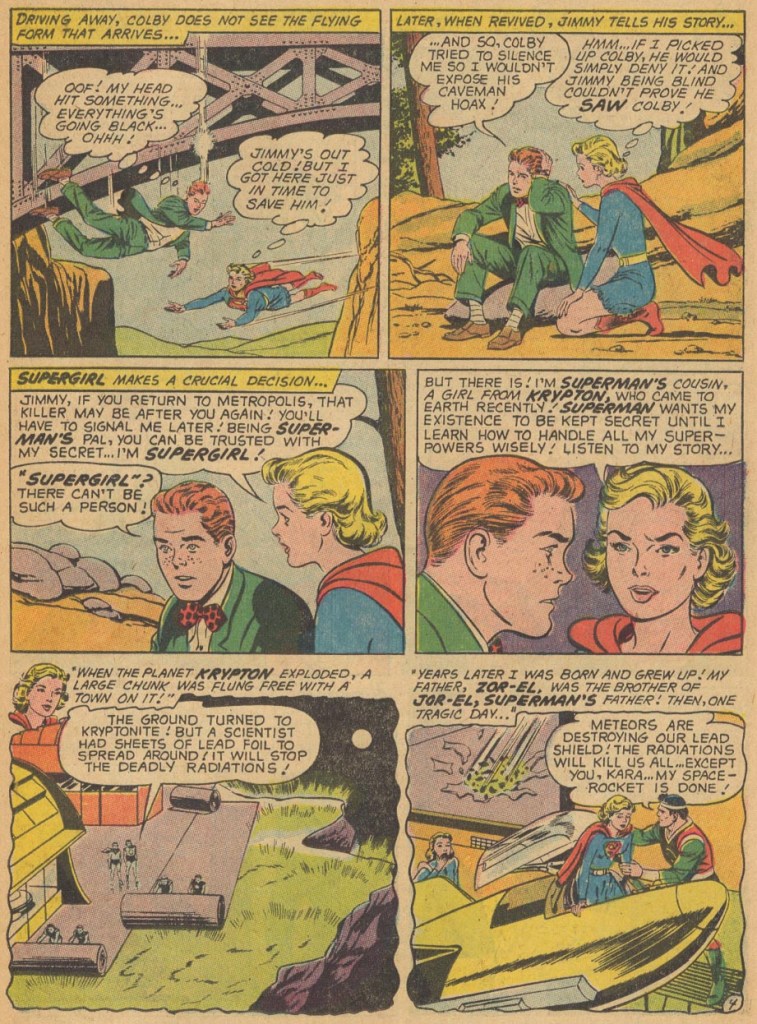
The entire story revolves around a simple premise: Jimmy is rendered sightless after an accident, and falls prey to a con man that he’s about to expose. With Superman away on a space mission, the secret Supergirl comes to Jimmy’s rescue. But Jimmy refuses to believe that Supergirl is who she says she is. Frankly, he’s aggressively obtuse on this point. So the bulk of the story is spent with Supergirl attempting to prove her super-powers to the blinded Olsen and him coming up with more and more preposterous ways in which the feats could have been staged or faked.
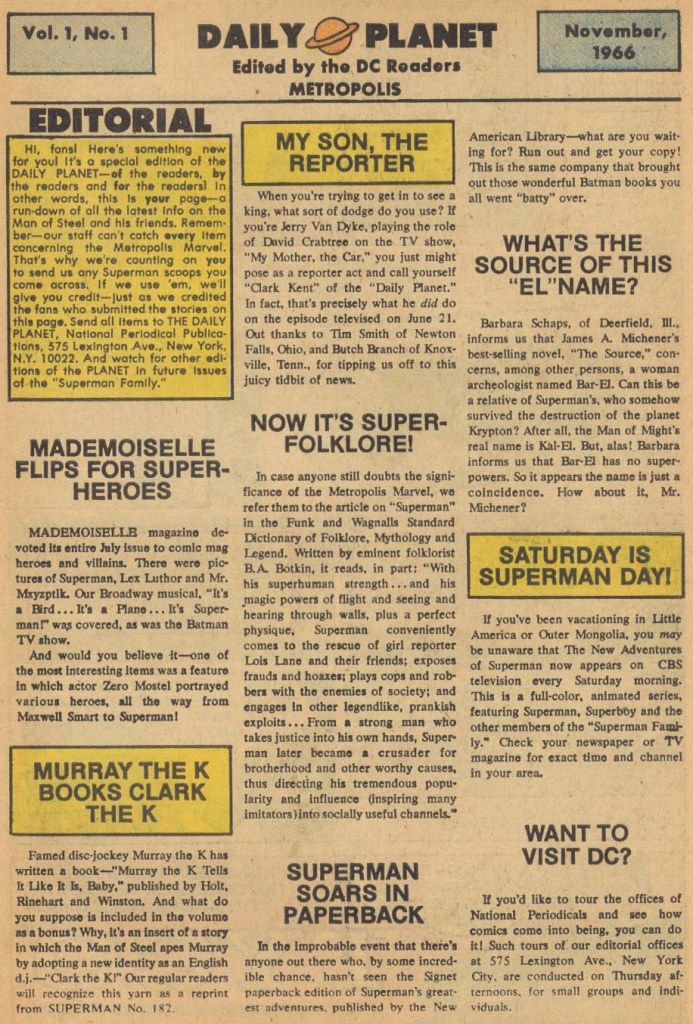
This issue also includes the first and quite possibly only edition of the Daily Planet in this era. it was pretty obviously intended as a DC answer to Marvel’s Bullpen Bulletins, but it wasn’t published frequently enough to really get the necessary traction. If I had to guess, I’d bet that assistant editor E. Nelson Bridwell was responsible for it, though Mort may have asked for certain things to be plugged in this inaugural edition. But it’s clear that the text is trying really hard to ape Lee’s style of casual and hip patter–and failing.
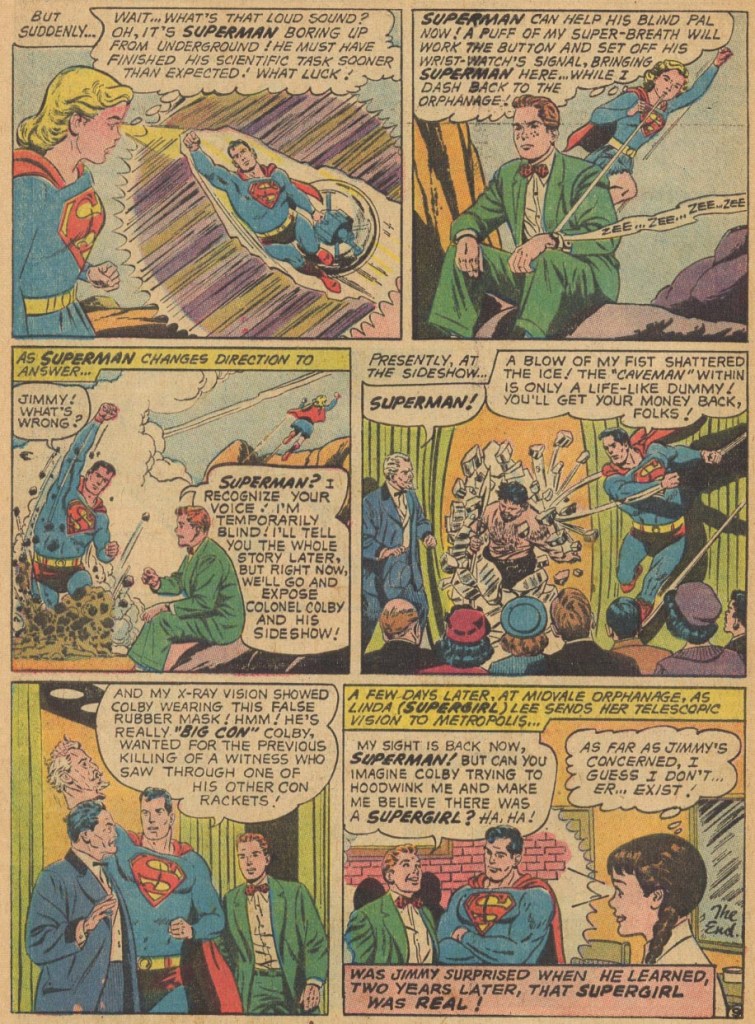
Supergirl can’t seem to catch a break, as effort after effort on her part is foiled and Jimmy remains completely unconvinced. Eventually, enough time has passed where Superman is now done with his space assignment, and he returns to Earth and picks up where Supergirl left off, corralling Jimmy’s assailant and keeping him out of harm until his sight comes back. And then the two share a laugh at the idea that there could ever be a Supergirl, while Kara watches. It’s about four pages of incident stretched to nine pages of story, but it’s all executed in that prime Weisinger style, so it has its charms.
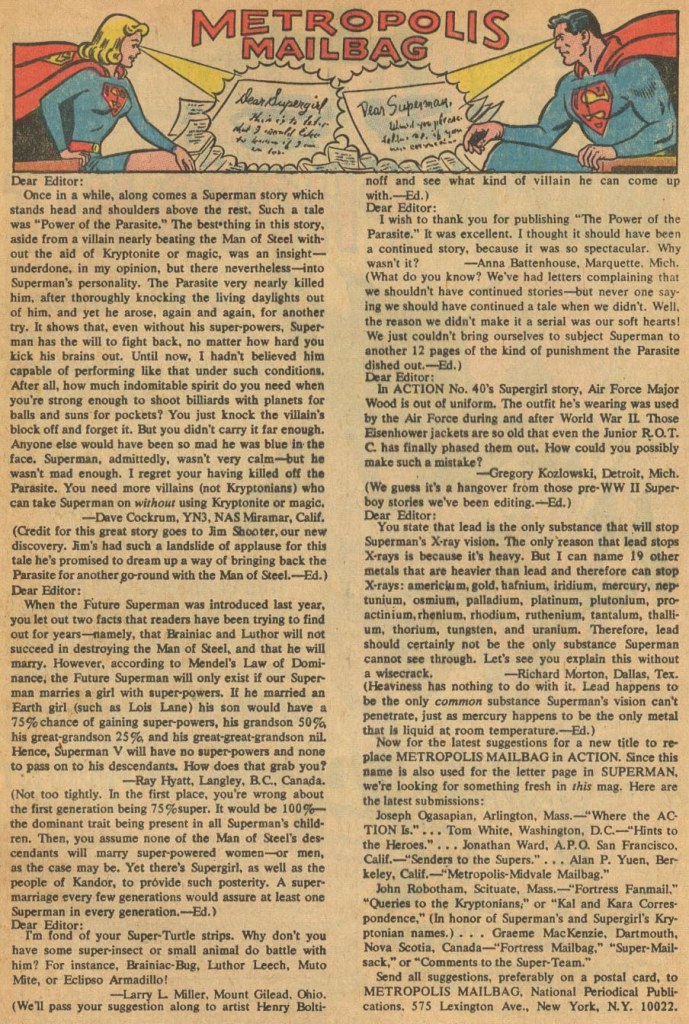
The Metropolis Mailbag letters page brings up the rear, and it oopens with a letter from future Legion of Spuer Heroes and X-Men artist Dave Cockrum. Dave was a regular letter writer at this time, and he also sold a few cover concepts to editor Julie Schwartz for titles such as HAWKMAN. Here, Dave’s got praise for the first appearance of Jim Shooter’s earlier villainous creation, the Parasite, who was created to deal with the same deficit as Eterno was–that Superman’s enemies couldn’t give him a physical fight.
 The Tom Brevoort Experience
Um… wouldn’t a “half-android half-robot” be called… an android?
LikeLiked by 1 person
Say what you want about Shooter, but he was a real breath of fresh air for the somewhat stodgy and formulaic Superman books of the era.
LikeLike
I think Jimmy’s skepticism is reasonable. Overall, Supergirl tells a pretty crazy tale even by DC universe standards, and there’s plenty of reasons someone might want to hoax him (that’s the plot of many of his stories). It’d be funny if he started quizzing her about Krypton (which he knows a lot about) to presumably call her bluff, and she couldn’t answer anything correctly.
Jimmy: “Say hello in Kryptonese” (symbols) “Well, you’ve studied, but that’s not how it’s pronounced”
Kara: “That’s an Argo City accent!”
Jimmy: “How was the planet’s leader determined?”
Kara: “I don’t know, I never cared about politics”
Jimmy: “Name some of Krypton’s greatest athletes”
Kara: “I told you, I was on chunk of rock, and I didn’t follow sports anyway!”
LikeLike
Whatever the pros and cons of Shooter’s later career, his work in this era was amazing. Though even when I was a kid, Boring didn’t work for me, though I doubt I was aware of it (I didn’t think much about comics art usually).
LikeLike
Re: robots and androids– one of the Luthor stories distinguished them by composition. One was made of all metallic parts, while the other was made of artificial parts that looked like human organs. Or so I recall.
It would have been interesting to hear how Shooter pitched the story to Weisinger without stating outright, “Hey, we need to go after Marvel’s action-loving audience.” Weisinger would have known from the pitch that was a more action oriented story than he usually preferred, but I theorize that he was willing to try it within limited parameters. That may be why the story rushes to a quick wrapup, getting the big Kirbyesque robot out of the way in case readers turned thumbs down.
SUPERMAN for the same cover-date of November 1966 is a full fledged action opus by Shooter and Swan, and Shooter is very ingenious in finding ways to challenge the hero’s multitude of powers. But IMO Weisinger preferred gimmicks to action, and even some of the later Shooter stories are lumbered with goofy gimmicks.
LikeLike
There used to be a definitive difference between androids and robots. A robot could resemble a human but only surface deep. An android was an artificial human where the biological processes were performed by non-biological constructs. In a similar way to the way lingual drift occurs, popular media has diminished that difference pretty much completely. I put most of the ‘blame’ on Star Trek: The Next Generation. Data was not an android by the classic definition but his robotic innards became most people’s idea of what an android is. It bothered me years ago but now I just see it as something that happened and let it go.
LikeLike