


Here we go, yet another issue of ACTION COMICS that’s practically devoid of any action at all. Instead, editor Mort Weisinger continued to ply his very successful trade of creating fairy tales for young children revolving around the Man of Steel and his cast of characters. By this point, it was 1966, as commemorated by the “Go-Go Checks” that adorn the top of this cover, an element that was added so as to make it easier for readers to locate the good DC comics among everything else that was cluttering up the racks during the Batmania-sparked super hero gold rush. They were a pretty unattractive idea, but DC stuck with them for about 18 months all told, and they do no mark an era of change for the company.
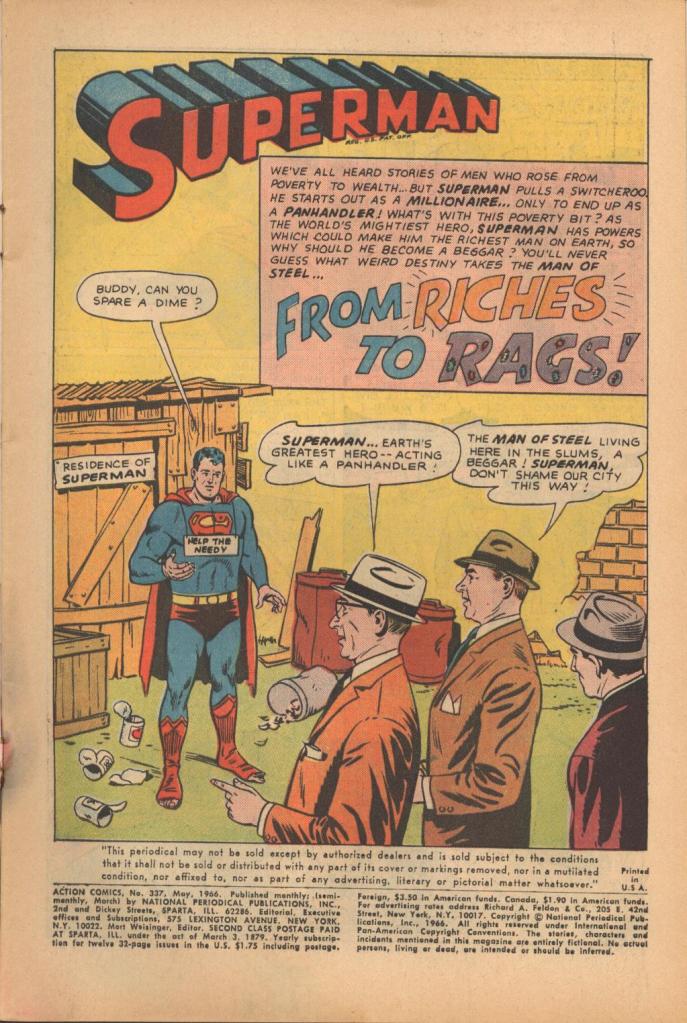
For one thing, the size of the original art board that was used was reduced. This was an observation from artist Murphy Anderson. He realized that if the originals were reduced to this size, four pages could be shot at the same time on a standard printing bed rather than the current two, resulting in a significant savings. The difficulty with this shift was that now artists who had gone their whole careers drawing pages twice up had to contend with a canvas that was a lot smaller. As a result, the open beauty of many of the DC books became more cluttered and crowded. What’s more, the lettering was proportionately a bit larger, which meant that it took up more space. It took a while for many of these artists to adapt to the new specs, and sone of them never really did.
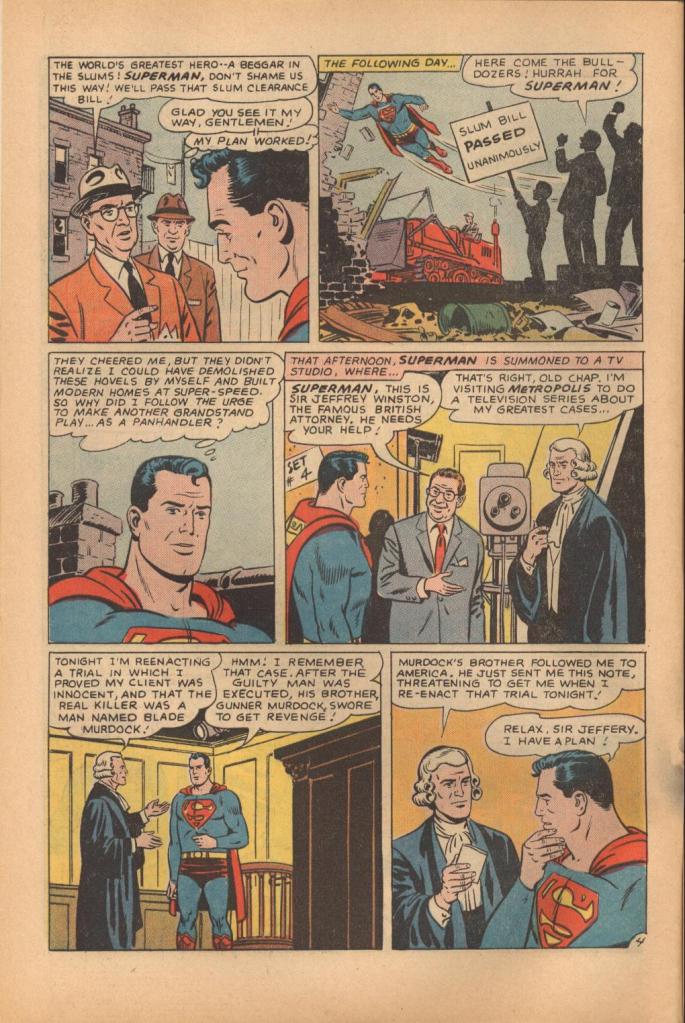
The lead story in this issue was written by Leo Dorfman and drawn by Al Plastino, and it’s a mystery story with a completely unsatisfying resolution. As Superman goes about his duties, for no reason that he can fathom, he is compelled to take on a variety of roles: as a rich millionaire, a panhandler, a Barrister in England, an Indian brave, and so on. While the Man of Steel does question why he’s doing such ridiculous things (but never seems to bring up the possible involvement of Mr. Mxyzptlk) he isn’t especially troubled by them, nor do they get in the way of him doing his job. So it’s a mystery, but one with seemingly very low stakes.

A pause here to spotlight a Hose Ad that runs early in the book, which promotes the next SUPERBOY 80-Page Giant. These Giants were a solid money-maker for DC in this era before they were paying anything to the creators on reprints–effectively, it all but eliminated any A & E costs on the books, and their larger size and page count brought in a strong profit margin, which is why the company pursued books in similar formats for so long. Once reprints started to be paid for, that margin began to steadily shrink, resulting in these sorts of books going away in the 1970s.
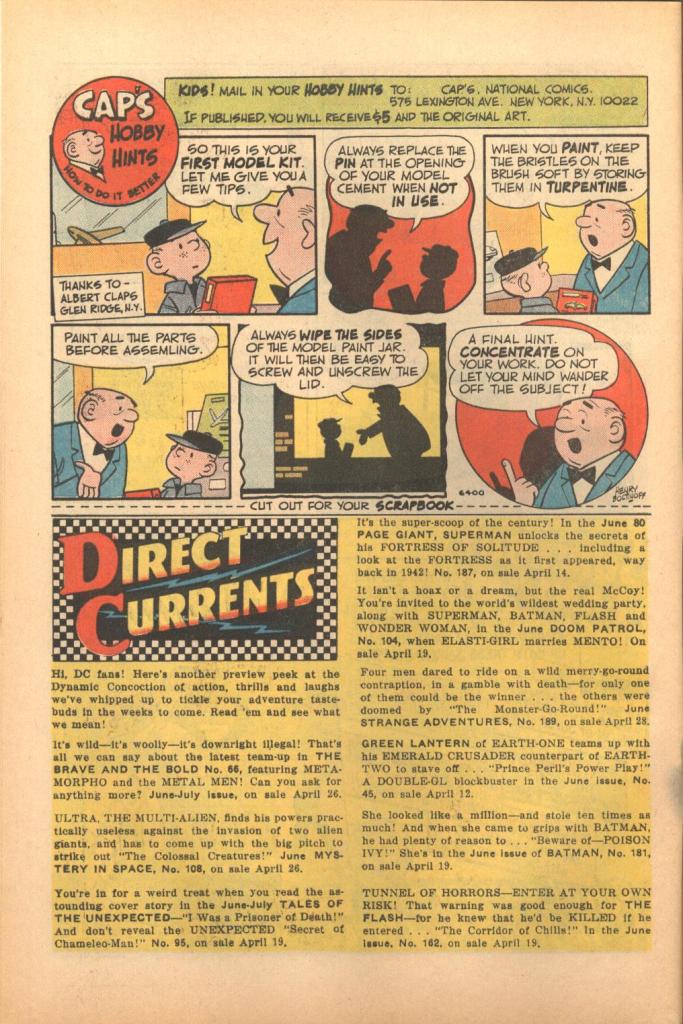
Also at this point came the Direct Currents checklist, a DC adaptation of the Mighty Marvel Checklist that Stan Lee had been running for months which showcased other titles then on sale. This one gives a decent sense of the range of material that DC was publishing at this point. While there are certainly super hero titles, there are also mystery books and science fiction series as well.

Anyway, as the Superman story wraps up, it turns out that the reappearance of a comet whose radiations he was bathed in as a child has caused Superman to act out the various job descriptions in the classic “Rich Man, Poor Man” nursery rhyme, which Ma Kent had been reciting to him when the comet first appeared. And that’s it. Superman doesn’t have to do anything to affect the ending, the comet eventually continues on its journey and the Man of Steel is cured. Hardly the bombshell revelation promised by the cover copy. It’s a fun story, but about as far away from an action spectacular as it’s possible to be. By contrast, at this same time this issue was on the stands, the Fantastic Four were wrapping up the Galactus Trilogy, and Spider-Man had completed the Master Planner trilogy. DC and Superman in particular was beginning to feel a bit out of step.

The back-up was another Supergirl story, this one written by the always-clever Otto Binder and drawn by the Maid of Might’s omnipresent artist Jim Mooney. It opens with Supergirl having agreed to test a new female-oriented spacesuit for NASA. But upon doing so, her space capsule winds up pulled into a Warp Stream (like a Gulf Stream current on Earth, we are told) that whisks it away to some far-off galaxy. What’s worse, the planetary system she winds up in has a green sun, which means that she possesses no super-powers there.
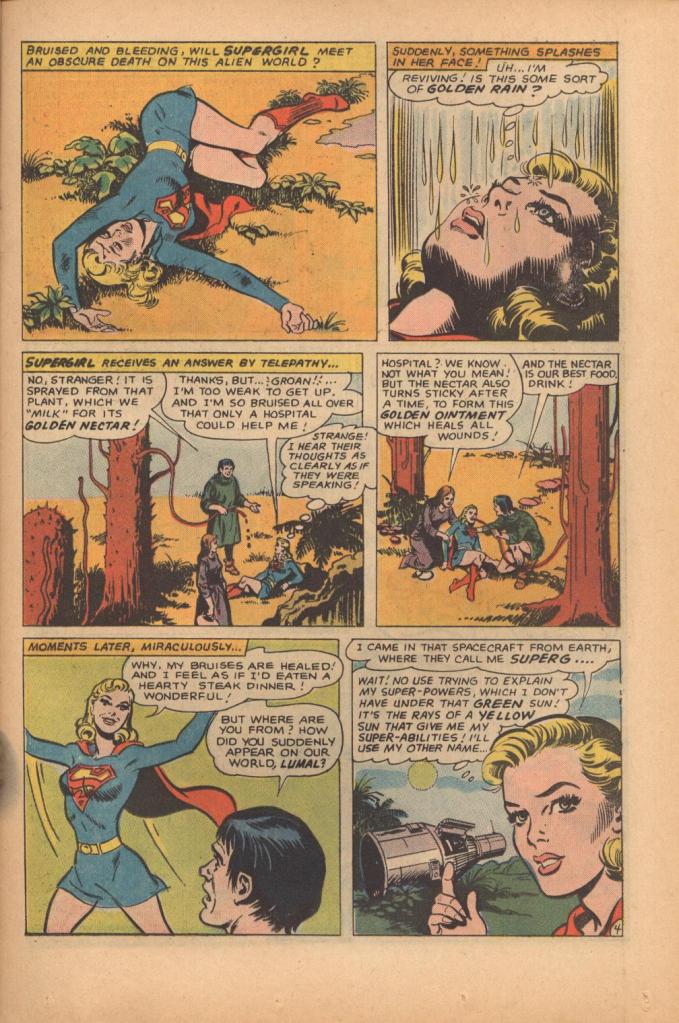
This story contains one of the most circulated images in the history of the comic book internet, the top right panel above in which Supergirl is awakened after crash-landing on the planet by a “golden rain”, which means something a bit different than intended in certain circles. She is helped by one of the locals, who shows her around the area. It’s a low-technology civilization in which some of the creatures living there have developed super-powers, such as the Evil-Eyed people who shoot fire from their eyes and have set themselves up as overlords. It’s more of a fantasy realm than a science fiction one, and it has a distinct feeling of Oz to it.
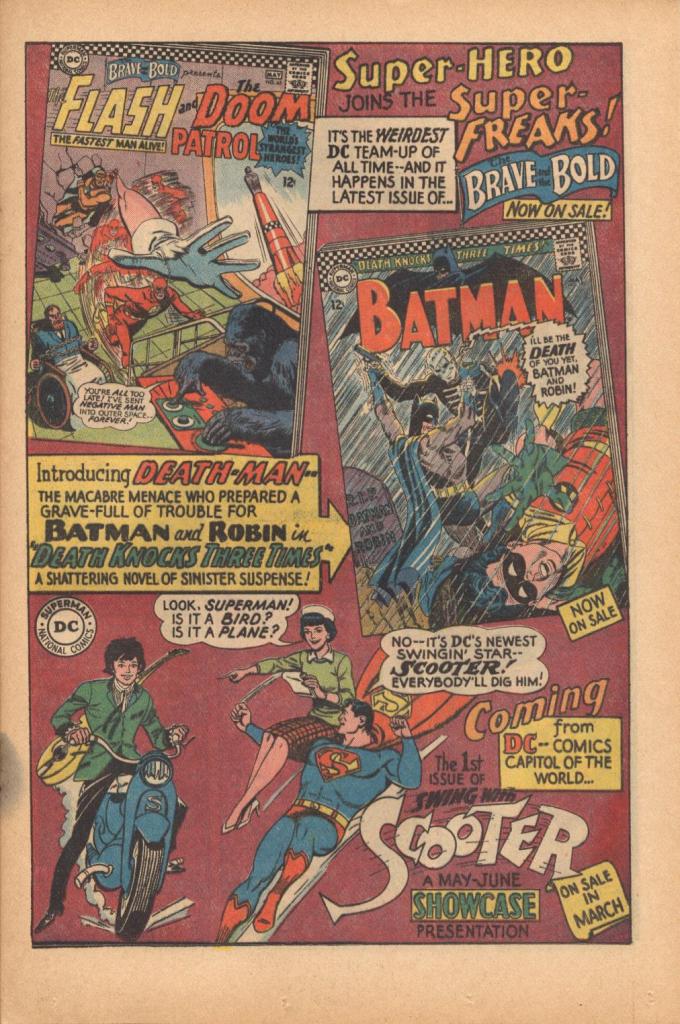
Another pause here for a House Ad, this one spotlighting THE BRAVE AND THE BOLD featuring the odd pairing of the Flash and the Doom Patrol, an issue of BATMAN that had one of the highest circulations in the title’s history thanks to it coming out shortly after the television show debuted and everybody went Bat-crazy, and the British Invasion-influenced teen humor series SCOOTER

In order to get back home, Supergirl needs to collect a radioactive mineral to restart her ship’s engines. In braving the assorted perils that lay between her position and the deposit, she is forced to improvise parallels to her super-powers in order to defeat enemies and bypass dangers. In so doing, she effectively becomes viewed a Supergirl even under a Green Sun by the planet’s inhabitants, which is the point of the story. Of course, the Girl of Steel gets home safe and sound by the end. If anything, this story has twice as much action as the Superman lead story, but it isn’t really action in terms of battles or fighting, which is how that metric is often measured.
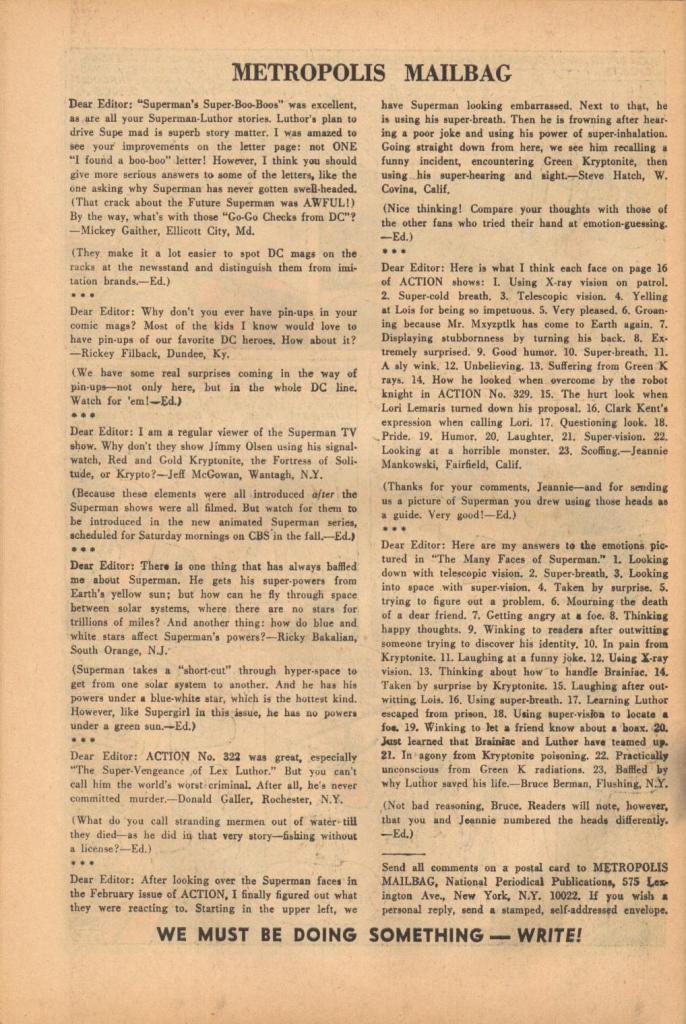
Finally, the Metropolis Mailbag letters page is back to filling a full page after having often been truncated in recent months. Either Mort of assistant editor E. Nelson Bridwell (likely the latter) explains the purpose of the cover Go-Go Checks to the first correspondent.
 The Tom Brevoort Experience
“Alias Negative Man” was a fun story, however unexpected the pairing. Haney did a better job getting the feel of the DP than he did with other team-ups.
LikeLiked by 1 person
I read this when it was reprinted in a SUPERMAN digest circa 1980 or so.
LikeLike