


I bought this issue of AVENGERS on one of my regular weekly Thursday trips to my neighborhood’s local 7-11, whose spinner rack was my primary source of new comics at this time. Having wrapped up the Korvac Saga a few months earlier, AVENGERS was pretty clearly in a scheduling hole, and so editor Jim Shooter took steps to get the series back on schedule by dropping in a series of fill-in stories. I didn’t know this as a reader at the time, of course, but it’s obvious in hindsight. So this issue was the first half of a two-parter that provided the requisite adventure and color but which moved none of the ongoing subplot situations forward an iota.
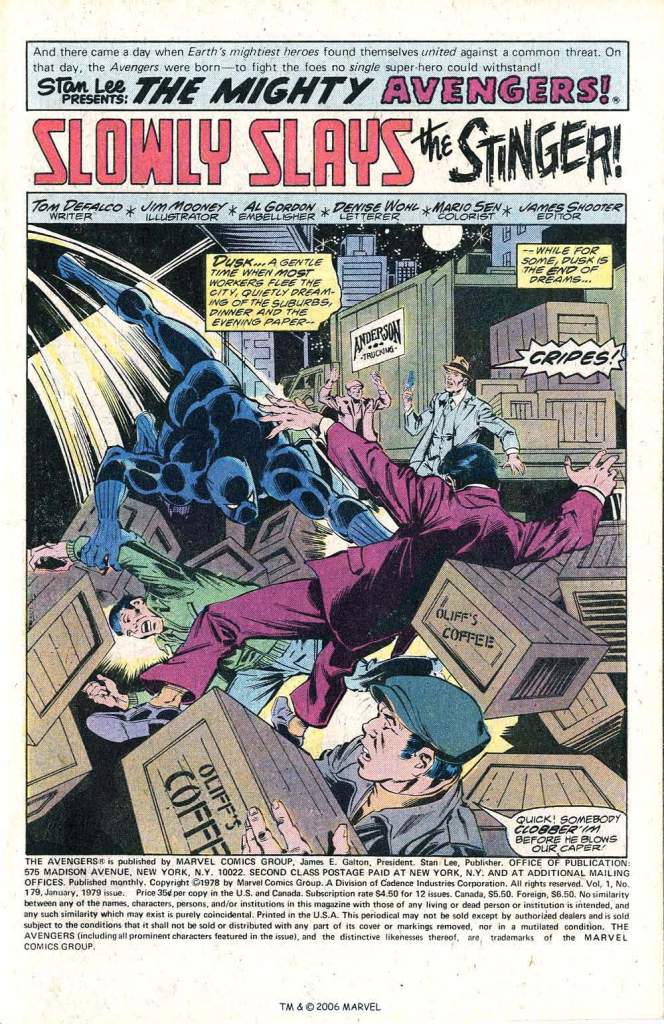
This issue represented, i believe, the first published Marvel work by the man who would one day succeed Shooter as Marvel’s EIC, Tom DeFalco. Tom had started out working on staff at Archie Comics, where among other things, he helped to inaugurate their highly-profitable digest line. Beginning to spread out within the industry after leaving staff at Archie, Tom had done some writing work for both Charlton and DC–he was regularly writing both the Jimmy Olsen and Lois Lane strips in SUPERMAN FAMILY. But a chance meeting with Shooter wound up with him being asked to do something for Marvel, and after he’d crafted a short Vision story that was used as a tryout plot for new artists attempting to break in, he was given these two issues of AVENGERS to fill. This isn’t the most mind-blowing story ever produced, but it runs the bases perfectly well, and evidences a vein of Tom’s love for the early Stan Lee-scribed Marvel comics on which he’d grown up.
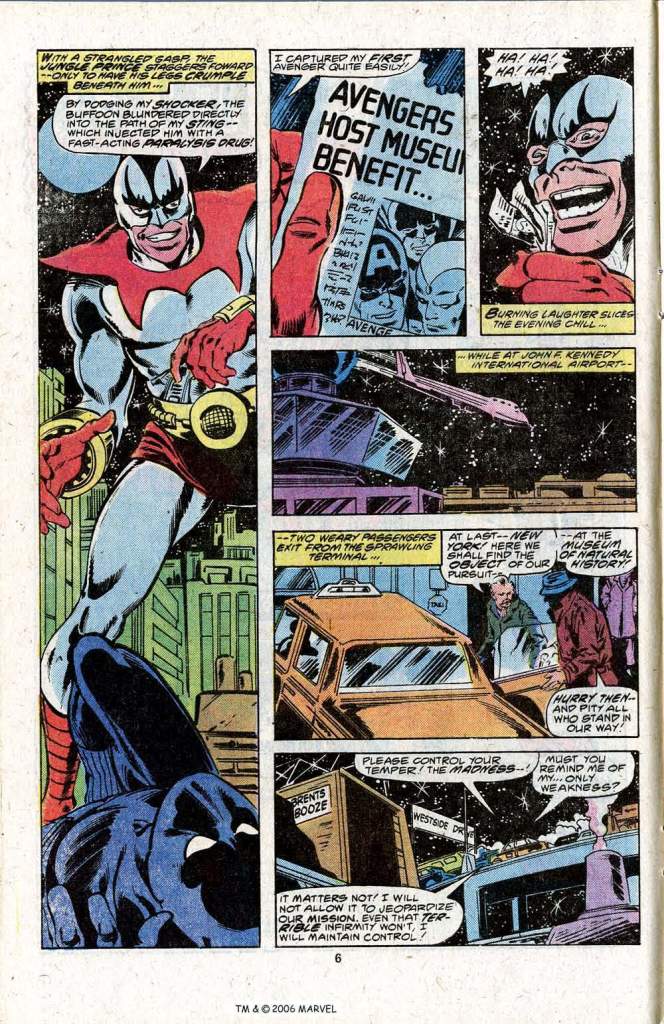
The artwork for the issue was penciled by Jim Mooney, an artist whose career extended back to the Golden Age of Comics and who was a close friend of Stan Lee’s. Jim was at this point kicking around Marvel doing assorted fill-ins and second tier assignments, usually in the orbit of Spider-Man, as he’d inked John Romita on AMAZING SPIDER-MAN for a few successful years. His work here is clean and direct, though nothing terribly special. It gets the job done and tells the story. His character designs for the new antagonists in this issue, the Stinger and Bloodhawk, both feel just a little bit odd. But not everybody at this time could be Dave Cockrum.
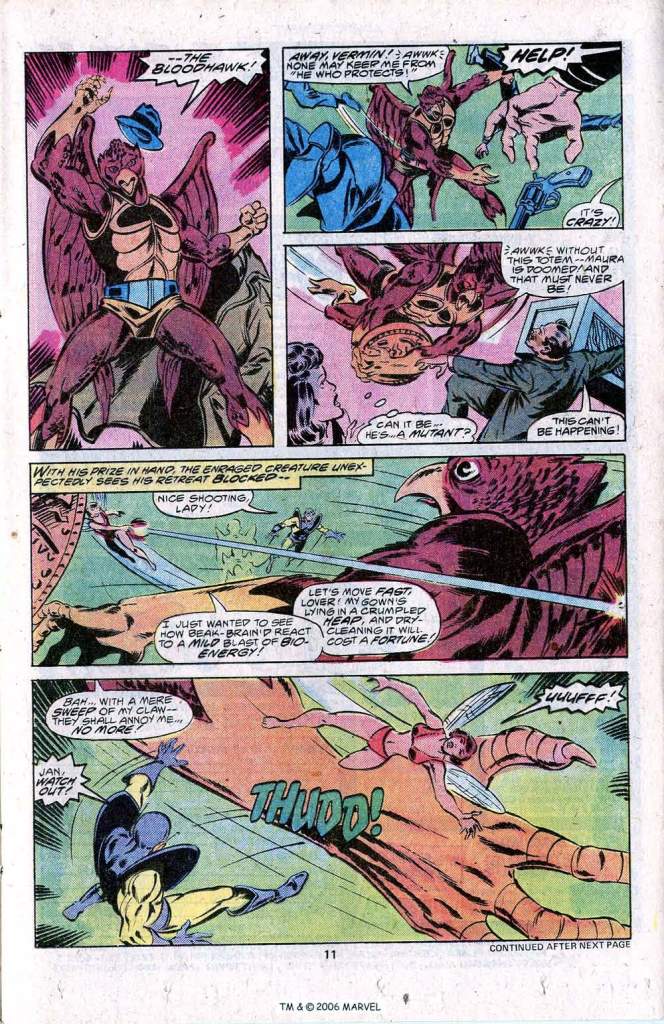
The story opens with the Black Panther cleaning up on a gang of crooks who are in the process of pulling a truck heist. The Panther shows off his skills before he’s confronted by a newcomer in a white costume. This figure introduces himself as the Stinger, the man who intends to destroy the Avengers. T’Challa dodges the Stinger’s first attack but falls afoul to his paralytic sting. With one Avenger captured, the Stinger indicates that he intends to strike at the others at a museum benefit they’ll be attending that night. that evening, teh stinge sets up an ambush for the Avengers outside the museum, waiting for them to be departing and off-guard before he begins his assault. But his plans are impacted by what occurs inside the building. At a certain point, a trenchcoat-wearing man loudly enters the main hallway claiming that one of the key exhibits was stolen from his land and his people. Doffing his overcoat, he is revealed as a half-man, half-bird hybrid that calls himself The Bloodhawk.
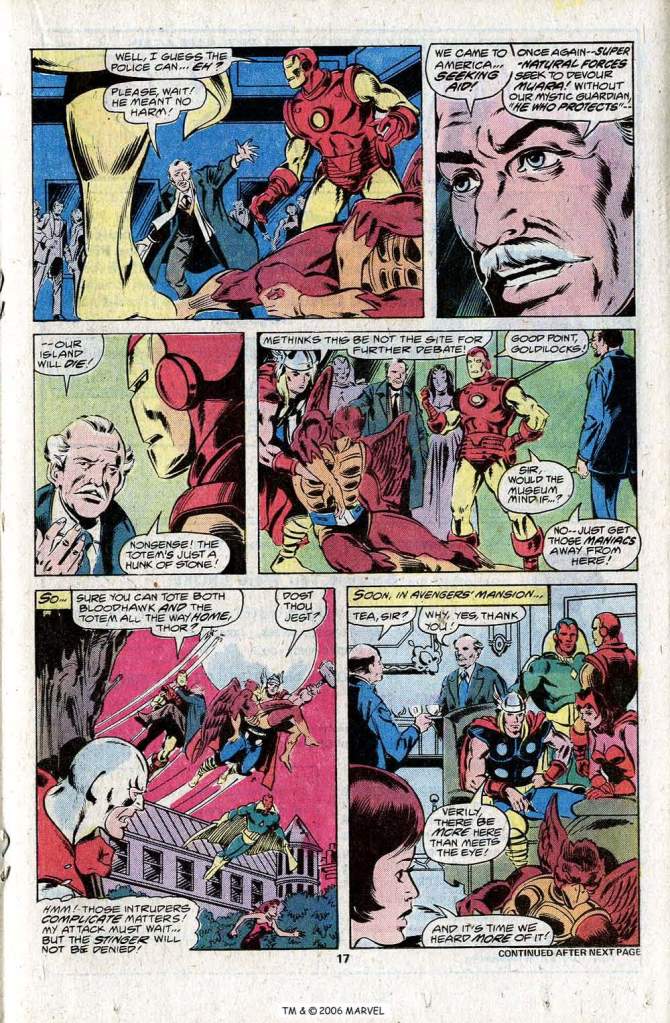
The Bloodhawk is fast and powerful, but even so, he’s no match for a full-on squad of Avengers, and he’s swiftly downed. But his aged teacher steps forward to plead for his student, saying that Bloodhawk meant no harm. There is an ancient curse on their homeland of Muara, one that can only be contained with the relic that Bloodhawk sought. In order to better discuss the situation and help all who need to be helped, the Avengers retire with Bloodhawk and his mentor back to their Mansion headquarters–bypassing the Stinger’s ambush incidentally by doing so. They also get permission to take the disputed artifact with them from the Museum, which seems a bit unlikely. Undaunted by his foiled plan, the white-clad villain pursues his quarry back to their base. I don’t think we’re ever given much of a reason for just why the Stinger wants to destroy the Avengers–what did they ever do to him? But it was enough in this era that he was a bad guy with a mad-on, and so as a young reader I really didn’t question it.
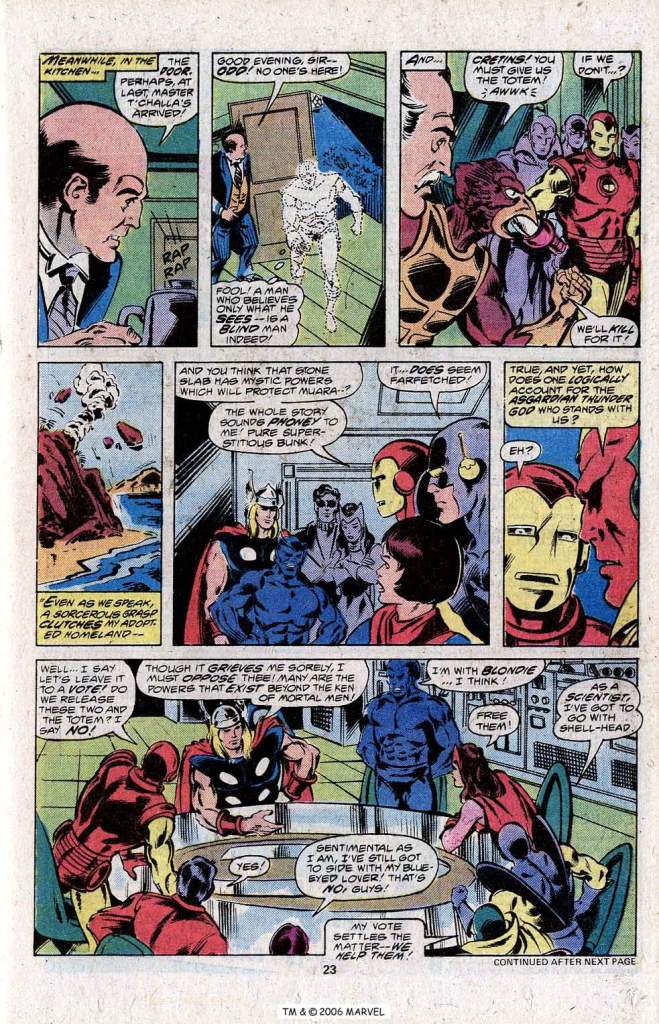
A full compliment of Avengers is convened to hear Bloodhawk’s story. He was born a mutant after his scientist father experimented on his pregnant mother hoping to “expand humanity’s evolutionary boundaries.” The young Bloodhawk was ostracized, of course, and prone to fits of madness when he got too worked up, but his teacher attempted to raise and provide for him over the years. The Avengers are divided as to whether they believe the teacher’s subsequent story about mystic catastrophe spreading across his homeland of Maura, but the group splits its forces to look into the matter–Thor, Iron Man, the Beast and the Vision take a Quinjet back to Maura with Bloodhawk. This gives the Stinger the perfect moment to strike. He’s able to enter Avengers Mansion while cloaked, and he’s able to bring down Yellowjacket, the Wasp, the Scarlet Witch and Wonder Man (to say nothing of Jarvis) almost before they realize that he’s there.
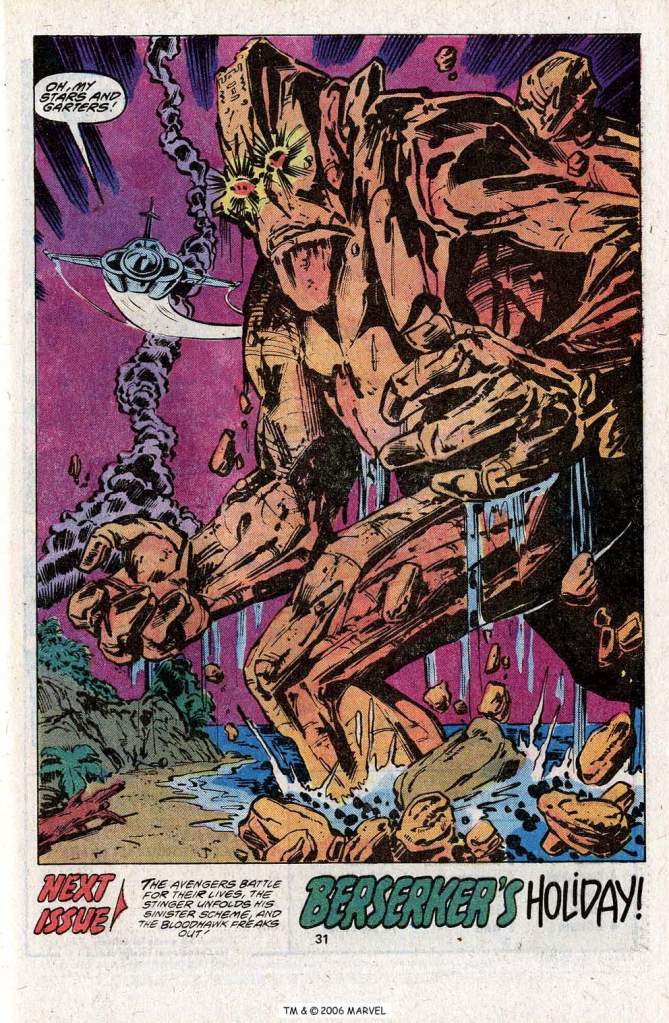
Meanwhile, arriving in Maura, the Avengers fly to the location of the sacred temple said to contain the evil spirits that are plaguing the land. They intend to replace the missing artifact at its crest, thus closing the portal. But before they can do this, they are stunned to see the entire temple rise up out of the Earth. It isn’t just a temple at all, it’s the head of a huge monstrous stone creature. And this is teh menace this second group of Avengers is going to need to contend with next month–because this is where the book is To Be Continued!

Another month brought another Bullpen Bulletins page, and you can really get a sense from the reporting here just how hard Stan Lee and the company were working to move their core business away from super hero comic books. While there’s some chatter about the Marvel Universe and the people who make it, much of the page is taken up plugging PIZZAZZ, the adaptations of JAWS II and SGT. PEPPER’S LONELY HEARTS CLUB BAND and the second KISS special. There’s also a tease of the BATTLESTAR: GALACTICA adaptation, though precious little can be said about it. Marvel was working hard to attach itself so something, anything, that could help to drag it out of the hole it had gotten itself into, and which only the unprecedented profits from their STAR WARS comic book kept them afloat from. I had no idea from the outside, of course, but this was a critical moment for Marvel–one that the advent of the Direct Sales marketplace of comic book specialty stores would get the company out of shortly.
 The Tom Brevoort Experience
This was one of the first avengers story I have ever read. Is not great even for fill-in standards. But my inner 6 year old child still waits for the comeback of bloodhawk
LikeLike
Me, I don’t care much for Bloodhawk, but I’d like to see the Stinger again. He looks like he got his costume the same place Hawk and Dove got theirs…
LikeLike
The Stinger probably is drinking in some Roadside Bar Yelling the barman that he deserves some respect because he almost defeated the Avengers, Thor included.
LikeLike
I’m a little surprised that Rob Leifeld doesn’t have a Bloodhawk published somewhere. Just has that tinny ring to the name…
No offense to Mr. Mooney. The design does remind me of the Ani-Men, & maybeceven a little of Cockrum’s space pirates in X-Men. Cosair’s gang.
LikeLike
The notion that the direct market saved Marvel’s fortunes is a commonplace of comics lore, but it’s not borne out by the data. The company’s newsstand sales substantially recovered in the late 1970s, when the DM’s percentage of sales appears to have been in the single digits. (According to Mile High Comics proprietor Chuck Rozanski, Marvel executives told him that in 1982 the DM even then only accounted for about 20% of the company’s sales.) In the 1977-1978 sales year, only two titles with reported sales did better than 200,000 paid circulation per issue. In 1978-1979, it was five titles, and in 1979-1980, it was up to eight, with a ninth–X-Men–selling over 200k an issue by the sales-year’s end. The company’s editorial operations, which had been in perpetual danger of being shuttered since late 1975, were in the clear by the fall of 1979. Per Jim Shooter, while the DM’s percentage of overall sales increased throughout his tenure as editor-in-chief, the unit sales in the newsstand market never declined.
I think this erroneous bit of lore is attributable to Paul Levitz, whose statements have treated DC’s circumstances of the time as being typical of the entire business. They weren’t. Unlike Marvel, DC’s sales continued to decline in the late ’70s and 1980s. After the 1978-1979 sales year, no DC title publicly reported sales of more than 200k an issue. Levitz told me that by 1983, DC had stopped taking newsstand sales into account with their publishing decisions. This wouldn’t have been true of Marvel, who as late as the 1986-1987 sales year–Shooter’s last–saw two of their three top-selling titles–Transformers and G. I. Joe–doing the majority of their sales with newsstand accounts.
I’ve linked to these posts before, but for those interested in more sales info between 1969-1989, here’s a link to my post about the 1979-1980 sales year. Links to posts for other sales years during those two decades are at the post’s bottom.
https://rsmwriter.blogspot.com/2023/01/comics-sales-1979-1980.html
LikeLike
“AVENGERS was pretty clearly in a scheduling hole, and so editor Jim Shooter took steps to get the series back on schedule by dropping in a series of fill-in stories.”
While Jim’s credited as editor on this issue, I’d think this is because the story was prepared months earlier, before Marvel started crediting individual editors — which they started on AVENGERS with issue 174. But Roger Stern was the series editor at the time, and is credited as such on the letters page. Of course, it’s possible Jim solo-edited these two issues as a way to work directly with Tom on the story, but given Jim’s schedule at the time I wouldn’t bet on it. Still, possible.
“This issue represented, i believe, the first published Marvel work by the man who would one day succeed Shooter as Marvel’s EIC, Tom DeFalco.”
Close. Tom’s first Marvel work was published in CRAZY in late 1976, and he had a batch more CRAZY pieces in 1977-1978. His first main-line superhero comics work at Marvel was about 6 months before this AVENGERS issue, a dialogue job over a Roger Slifer plot in MARVEL TWO-IN-ONE 40.
But this is the first published Marvel main-line story he plotted and scripted.
LikeLiked by 2 people