

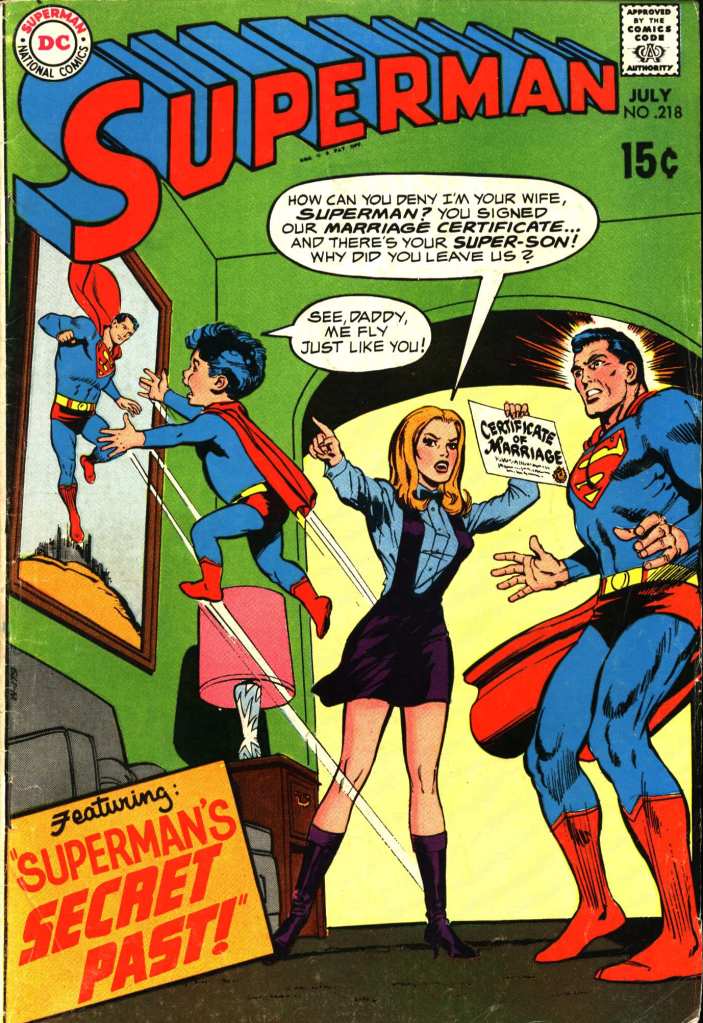
This issue of SUPERMAN was another book that I got from my friend David Steckel, who had nothing but scorn for DC’s output. I, on the other hand, was a stalwart fan of the Man of Steel. Except that there was something a little bit weird about this issue of SUPERMAN as opposed to all of the others I had read. It looked the same on the outside and inside, with Curt Swan delivering the visuals. But the ethos of the story was different and strange, and the “rules” under which the series seemed to operate weren’t in place in the same way. It was “wrong” in the manner that WORLD’S FINEST COMICS and BRAVE AND THE BOLD were wrong–the same characters, but handled in a different manner fundamentally. I didn’t yet realize that this was because this issue was edited not by the ever-reliable Julie Schwartz but rather his predecessor, Mort Weisinger.
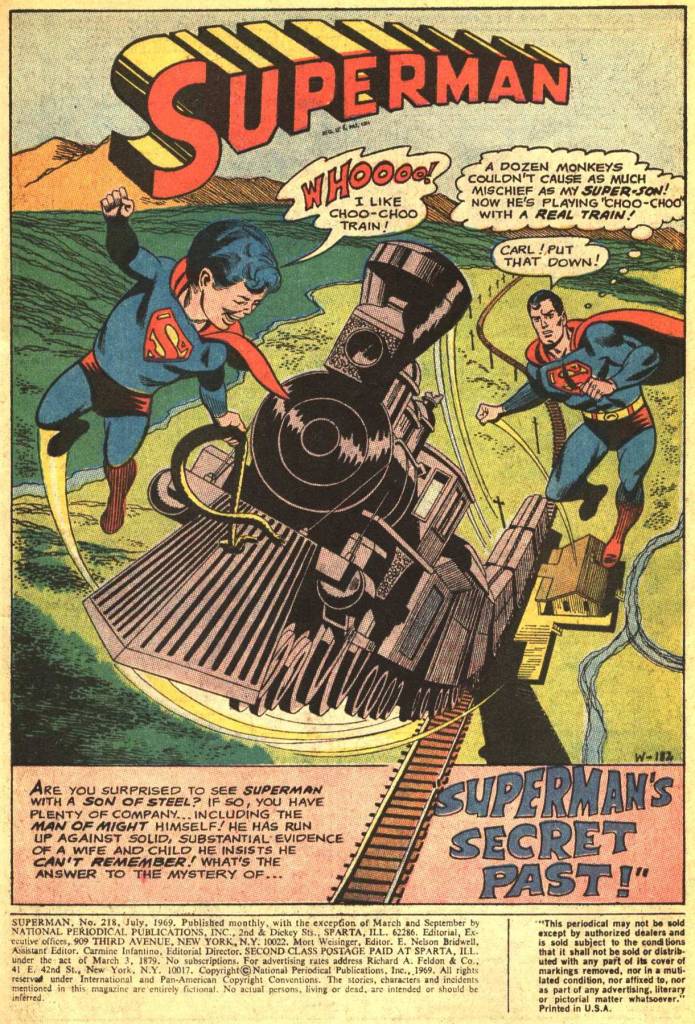
At the time that this issue originally saw print, Mort Weisinger had been guiding the destiny of his Kryptonian hero in one form or another for almost thirty years. Mort typically aimed his stories at the younger end of the audience, creating storybook fables with emotional stakes that were pitched at a kid’s level. His output wasn’t all that well respected at the time by older comic book fans, but Mort didn’t give a damn–his Superman books outsold everything else in the field, a reflection of the Man of Tomorrow’s popularity across all media. But by the time that this issue was produced, changes in the field were beginning to chip away at Mort’s dominance. His books started to feel out of step–and especially once Carmine Infantino was brought in to be DC’s new Editorial Director, you could feel Mort sort of giving up and phoning things in a lot more, leaving the bulk of the block-and-tackle of much of his workload to his long-suffering assistant editor E. Nelson Bridwell.
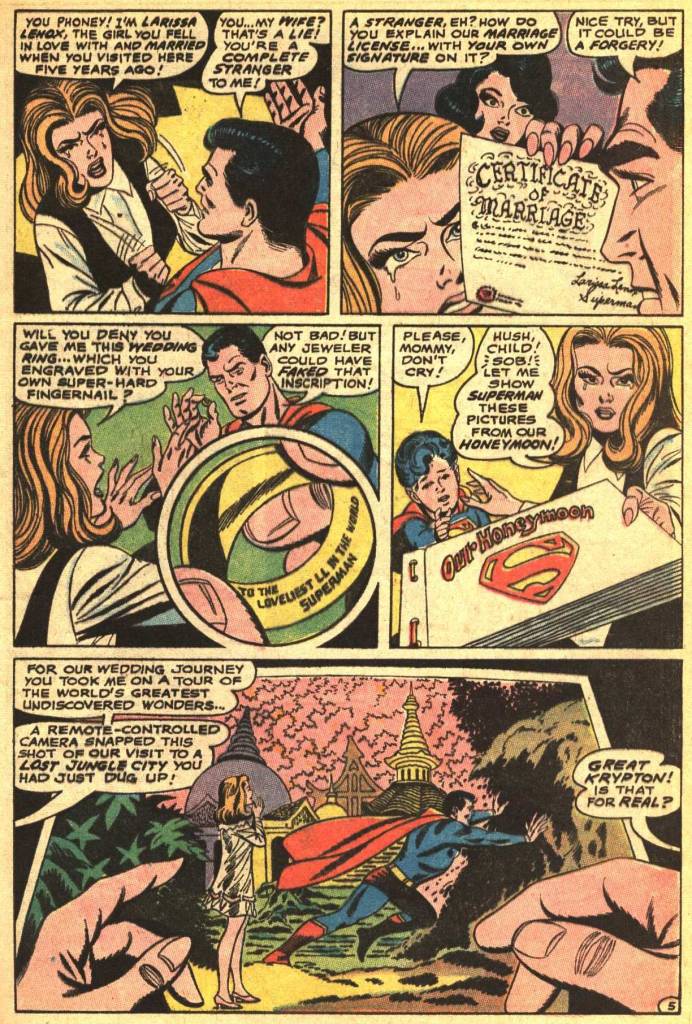
The field was changing as well, propelled in different directions both by the rise of the newfangled Marvel Comics which stressed action and operatic drama, and the Batman television show, which emphasized campy fun. Mort and Carmine attempted to adjust what they were doing in order to address these changes somewhat, but somehow in doing so they traded away much of what had made Mort’s titles so entertaining and engaging in the first place. As the artwork became more quasi-realistic, the influence of Neal Adams, the stories became more discordant, as they were almost always insanely implausible and the more realistic approach fought their fairy tale qualities. And in trying to emulate Stan Lee’s type of patter, the older DC writers such as Leo Dorfman, who wrote this opening story, couldn’t quite match Stan’s light tone, and often had the heroes delivering lines that made them seem like jerks or bullies or raging narcissists. This wasn’t really a good period for the Superman titles overall, despite often having some nice art and some real grabber covers. Despite the lovely packaging, the product didn’t deliver, and so sales softened.
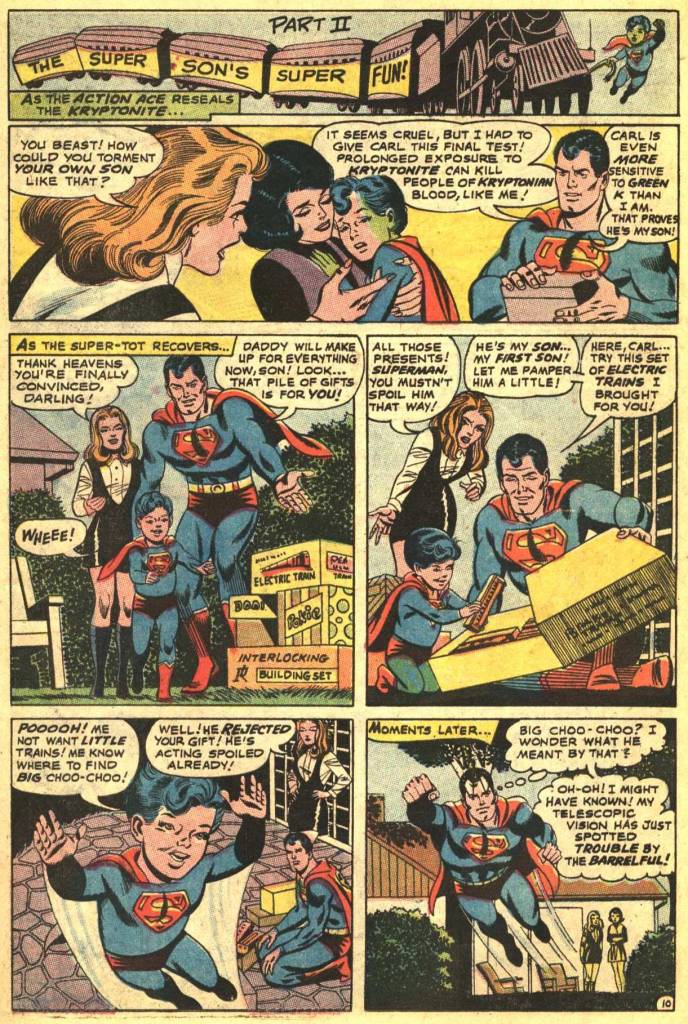
This particular story revolves around Superman meeting Larissa Lenox and her son Carl–a son who has all the powers of the Man of Steel himself. It’s because Carl is wearing a junior Superman costume that the Man of Tomorrow notices him in the first place, and when he and Lois Lane bring the errant Carl back to the Lenox home, Larissa shocks them by claiming to be Superman’s secret wife. She produces photographic proof of their union as well as a marriage certificate, and clearly her child has powers he could only get by being half-Kryptonian. Larissa can’t explain why Superman doesn’t remember them, but he’d had them living in remote Lake City, their existence a secret so that Superman’s enemies wouldn’t find out about Kal-El’s family and strike at him through them. Superman is skeptical enough that he retrieves some kryptonite from his Fortress and exposes Carl to it surreptitiously, in order to prove that he isn’t faking. Which is a hell of a nasty thing to do to a young kid, but that’s the Superman of this era.
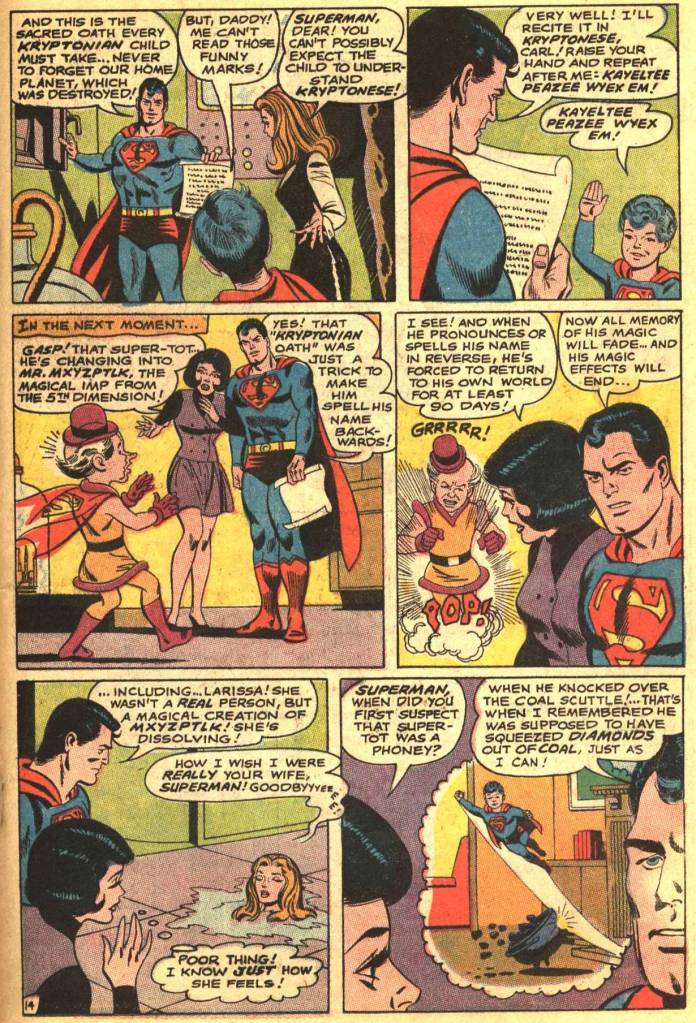
Convinced of the authenticity of his lost wife and Son, Superman spends several pages cleaning up after his boy, who goes on a playful rampage across the countryside. Eventually, he takes Larissa, Carl and Lois to his Fortress, intending to perform a solemn Kryptonian ceremony in the presence of the Bottle City of Kandor that will make his union with Larissa official. But Superman has figured out what is going on, and amidst the Kryptonian Oath he asks Carl to recite is Mr. Mxyzptlk’s name spelled backwards. Carl is Mxyzptlk, and Larissa a product of his fifth dimensional magic. Turns out that Kryptonite that Superman exposed Carl to was fake–see, he wasn’t such a jerk after all! And that proved that carl wasn’t what he appeared to be. Now with Mxyzptlk sent back home, the effects of his magic wear off and Larissa melts away into nothingness. And that’s the story. No threat, no jeopardy, nobody to save that wasn’t imperiled by his actions in the first place, and Superman being swooned over by people who constantly tell us that he’s the world’s greatest hero while not showing him doing anything that might earn him that title. The disconnect in this book is profound, and it bugged me even though I couldn’t then have put my finger on what was wrong.
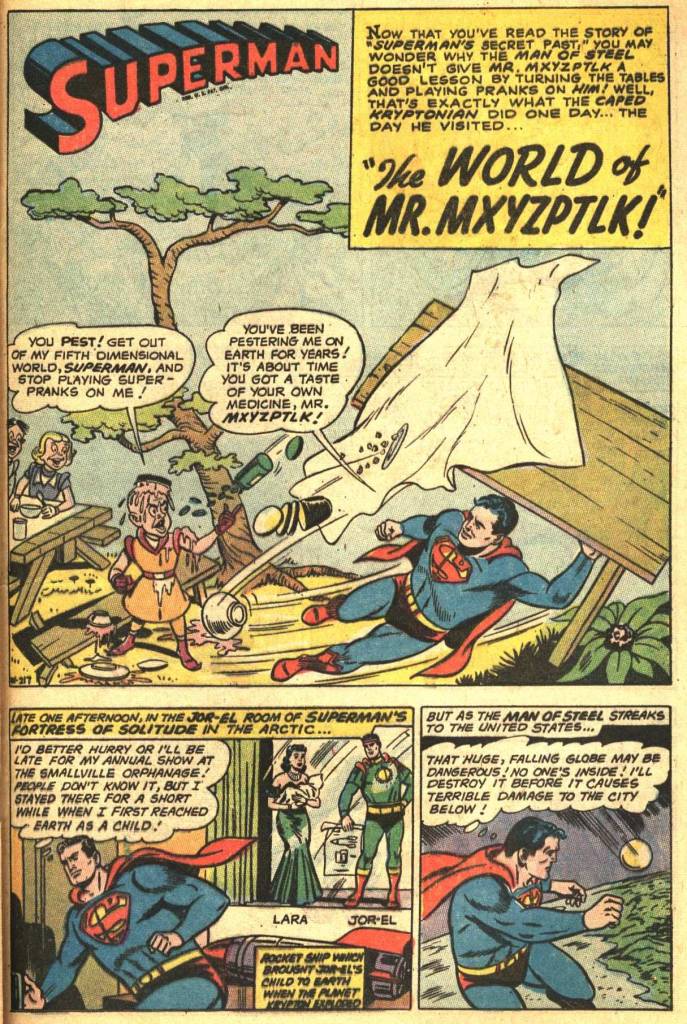
When I speak about Mort having gotten lazy, what I’m talking about is what filled up the back half of the issue. It was a reprint of a Superman story originally published eight years earlier. Mort had been filling his back-pages more and more with reprints, often of stories that didn’t even have much to do with the magazine they would be appearing in. Here at least–and I credit this to Nelson Bridwell despite their being no evidence of his hand–the second story also features Mr Mxyzptlk and so had some relationship to the tale we’ve just completed. I liked reprints as a matter of course, but especially right at this moment, where the cover price had increased from 12 cents to 15 cents, I have to imagine that I’d feel pretty good and taken reading Mort’s titles and finding that they were only half new.
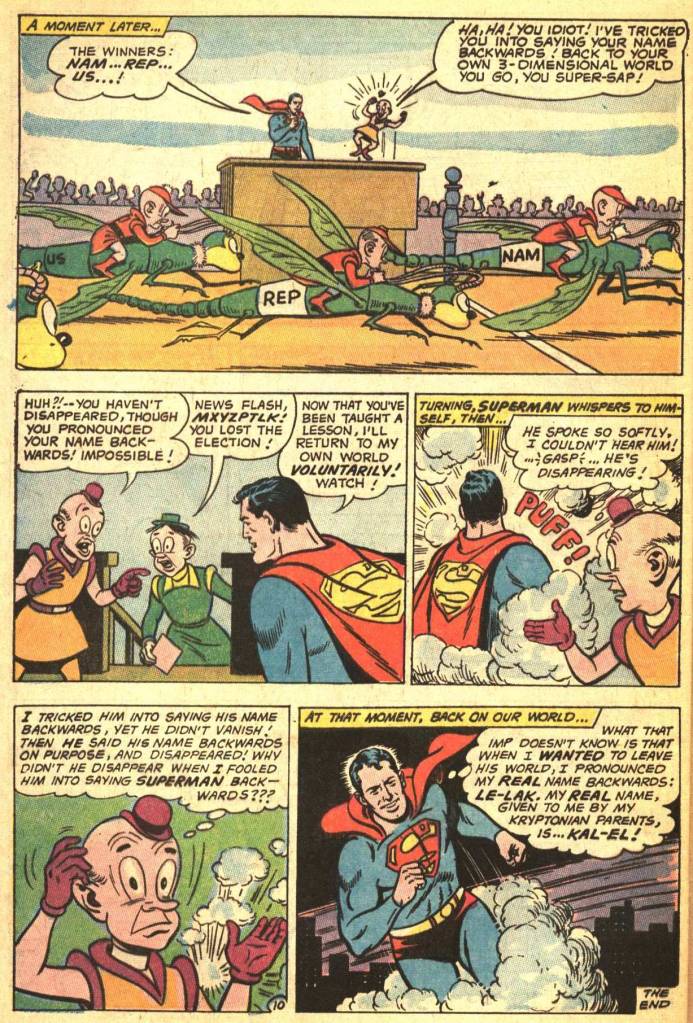
That said, this older yarn is the most entertaining thing in the issue. It was written by the Man of Steel’s creator, Jerry Siegel, and illustrated by Al Plastino. In it, after a particularly vexing encounter with Mr. Mxyzptlk, Superman decides to follow him back to the fifth dimension and give him a taste of his own medicine. So he pranks Mxy mercilessly, ruining the imp’s attempts to be elected mayor. Mxyzptlk tries and fails repeatedly to get Superman to say his name backwards, thus returning him to the third dimension, but Superman is simply too clever for him. Finally, though, he succeeds–and is horrified to realize that Superman hasn’t gone anywhere, he’s still in the fifth dimension unaffected! By this point, Superman reckons that Mxy has had enough, and he whispers something unheard by the imp and vanishes. Because obviously Superman is not the guy’s real name–rather it is Kal-El. So the word Superman had to utter in order to return home was Le-Lak.
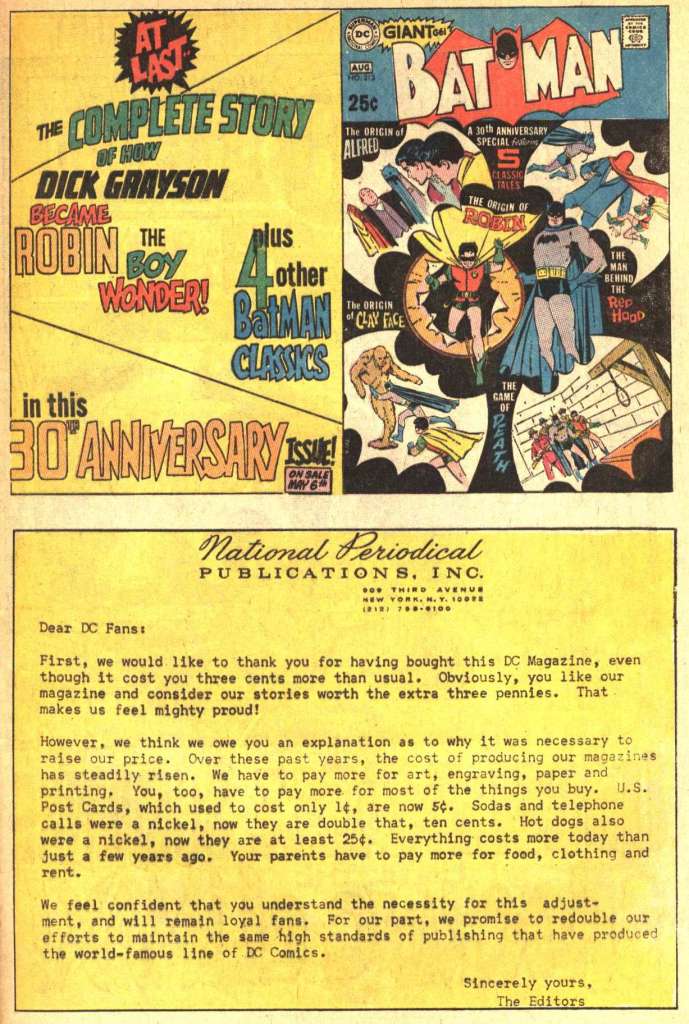
The issue closes with this page, with is noteworthy both for the half-page House Ad promoting the latest BATMAN Giant which focuses on the life and career of Robin, as well as a half-page editorial column explaining the cover price increase. It’s a real study in contrasts as opposed to how Stan Lee handled situations like this. It comes across as dry and lifeless and corporate. It’s perfectly fine, but it doesn’t really do anything to assuage the audience or get them to feel as though they can live without those extra three cents.
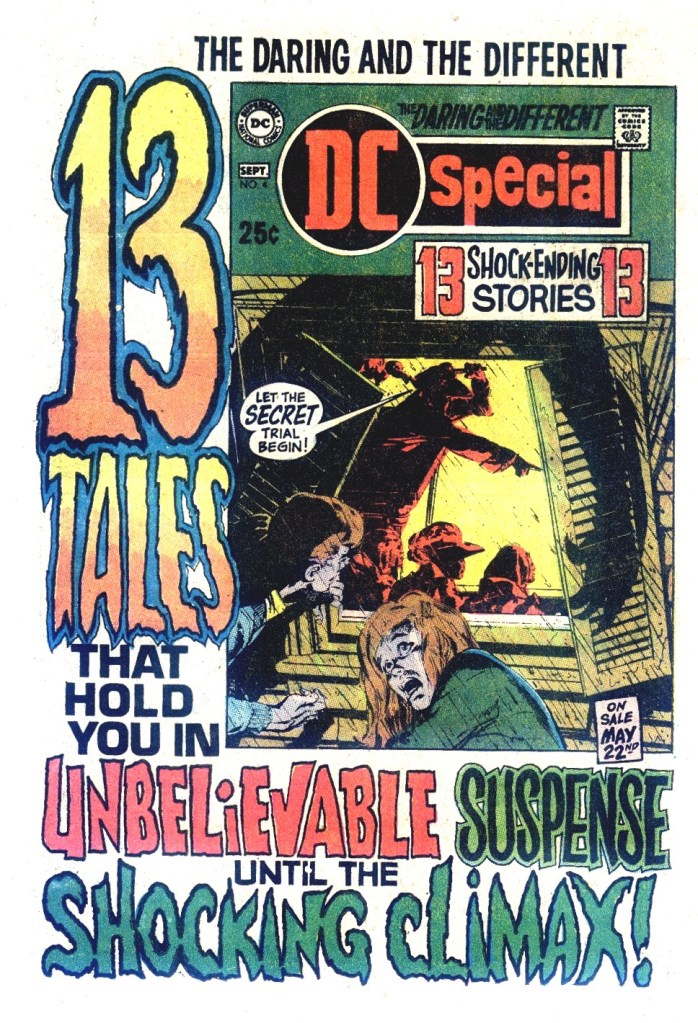
And there’s one more House Ad following that, one that relies even more heavily than usual on text and typography to make its sales pitch. It works, and looks way more modern than anything in the preceding 31 pages, Of course, this would be another book where the packaging concealed disappointment between the covers, as it’s knockout Neal Adams cover was wrapped around a bunch of relatively sedate reprints from the 1950s. More than anything at this moment, the lesson that DC needed to learn was that content mattered. It wasn’t just a compelling cover or a shocking concept that got people buying and returning to buy more comics, it was a satisfaction with what they read when they did so. this was an area in which Marvel was kicking the hell out of the competition at this time, even if ever single Marvel book wasn’t always a winner either.
 The Tom Brevoort Experience
Imagine this now with photoshop, CGI and deep fakes ! ________________________________
LikeLike
I remember how angry I was when comic prices went from 12 cents to 15 cents being that I grew up buying the 12 cent comic book. I think that’s when I started getting away from regularly buying comics. That and the fact that I was growing up.
LikeLike
I read somewhere that the reason so many of Mort’s comics had reprints was that, after 1964, he was editing all of the seven Superman “Family” books and just didn’t have the time to edit all of them, hence the reprints.
LikeLike