


As we’ve spoken about before, STRANGE TALES had become something of an afterthought in the Marvel line, a title where new prospective writers and artists could be tried out with limited risk. But after 22 issues of this, sales on the book seem to have slid enough for editor Stan Lee to look to make a change, as he often did when presented with such a situation. In this case, he decided to add the Thing, who had turned out to be the most popular member of the Fantastic Four, as a regular co-star in the Human Torch strip. This made it a sort of junior Fantastic Four vehicle, albeit one where it never seemed as though anybody involved was putting forth a whole lot of creativity. And really, the factor that was missing the most was Jack Kirby, who made each issue of FANTASTIC FOUR with the same characters an event not-to-be-missed. That wasn’t really the case with STRANGE TALES.

After a momentary hope that the Torch’s creator Carl Burgos was going to return to the fold to shepherd the Torch strip, Lee was forced to put it back into the hands of Dick Ayers when Burgos proved either unsuitable or intractable. Ayers was a solid artist, but he didn’t possess the visual imagination and skill of Jack Kirby, and so his pages are a bit more stiff and lifeless. and with Ayers handling the majority of the storytelling in the art (the book was produced in the Marvel method, where Lee and Ayers would discuss a story and then Ayers would draw the whole thing up without any written plot or outline) there was only so much lifting Lee could do in the dialogue. This strange bit on the first page where the Thing lifts up a wall of the Torch’s house without demolishing the place feels like a good example of the disconnect. The action doesn’t really make a whole lot of sense, but at this point, all Lee can really do is to roll with it.

The story in this issue attempts to redesign and rehabilitate the image of one of the great lame-o villains of the early Marvel days: Paste-Pot Pete. Attired in an artist’s get-up complete with a beret, this paste-gun-wielding criminal had fought the Torch on a couple of occasions already in what should have been a mismatch for the ages. Here, Pete’s old design is discarded in favor of a new one, one that appears to have been inspired by an old Jack Kirby one-off science fiction story from the pre-Marvel days. His look was only half of the problem with Pete, the other half was his dopey name. But it’d take a few more stories until he’d give that up and rechristen himself the Trapster. Anyway, this bozo is out of prison for having assisted the Avengers in their recent struggle against Baron Zemo. And despite the fact that he’s never been able to conquer his for the Torch even with partners, here Pete decides that his best course of action would be to attack the Thing first, and use him to lure the Torch into a trap. The poor sucker.
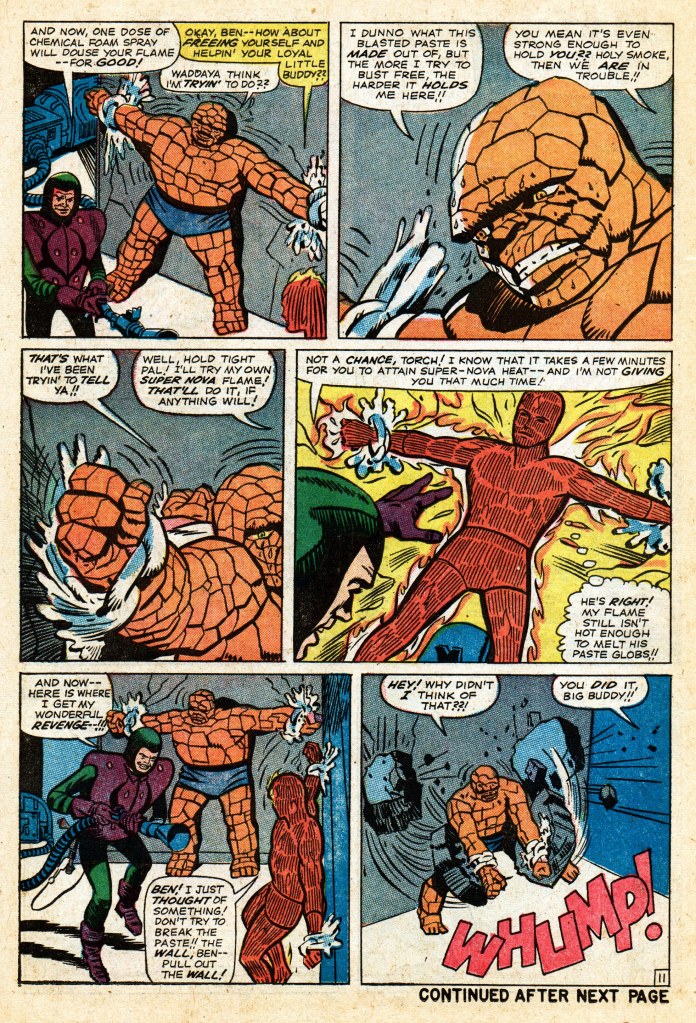
But this is an action-adventure story, and it wouldn’t be much fun if the Thing simply reduced Pete to a grease stain on Page Six. So instead, Pete does wind up getting the upper hand on the FF’s powerhouse, eventually pasting him into immobility on a wall in his headquarters. He’s then able to send a signal to the Torch, whom he’s able to incapacitate as well with his “asbestos paste”. Asbestos was treated as a kind of miracle fireproof substance in these days, the Torch’s equivalent to Kryptonite. And so both heroes are now stuck to the wall, with Pete preparing to finish them off. There are probably a dozen ways the FF members can liberate themselves and put Pete on the ropes here, but the Thing goes for the simplest one: destroying the wall he’s attached to rather than the paste that’s holding him. And now, because we’re getting short on pages, the tables have turned.

The prospect of facing an unfettered thing is really not a pleasant one to Paste-Pot Pete, despite his new attire, and he swiftly surrenders. And in the wrap-up, the Torch squares accounts with his girlfriend Dorrie Evans, whom he had to race away from in order to answer Ben’s distress call. It’s all pretty by-the-numbers stuff, and lacking the essential qualities that made FANTASTIC FOUR such a compelling read. Put simply, it’s dumb. The Torch and Thing stories would continue to be dumb all the way to the end of their run, veering into almost a self-parody of the Marvel style. This was definitely not any sort of high water mark for either character.
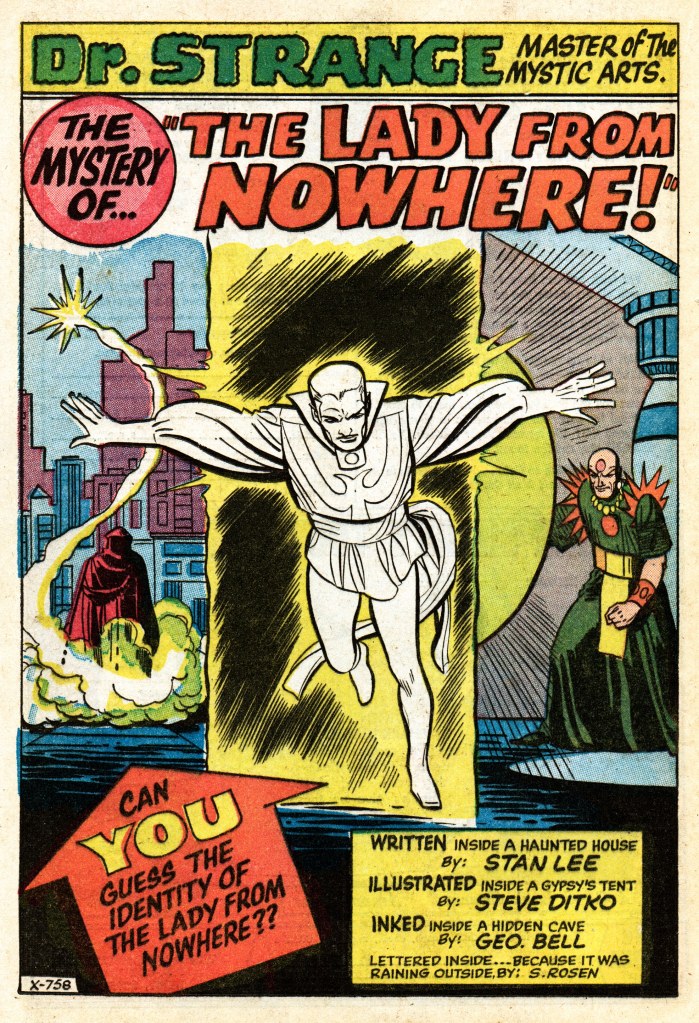
Fortunately, STRANGE TALES still had a series that held strong appeal, even if the story in this particular issue wasn’t one of its strongest. Doctor Strange had been improving by leaps and bounds over the months, driven mainly by the exotic artwork of Steve Ditko, who managed to make the spells and mystical environments feel plausible. Unfortunately, on this issue and a few others, Ditko’s pencils were inked by George Roussos (operating under his pen name of George Bell so that his employers at DC wouldn’t realize that he was moonlighting). Roussos had been known as “Inky” back in his BATMAN days, and his heavy brush line sacrificed a lot of the subtlety of Ditko’s work on this story. It isn’t a great combination.

A pause, as usual, for this stellar house ad plugging two Marvel Annuals of the day, the first AMAZING SPIDER-MAN one (entirely drawn by Ditko, and likely the reason why Roussos had to be drafted into service to ink this Doctor Strange job) and MARVEL TALES #1 which featured the origin stories of six of the newfangled Marvel heroes in the manner of DC’s SECRET ORIGINS ANNUAL some years earlier. These were both some particularly good Annuals of the sort that gave the Annual format its cache in days to come.

The gist of this story is that Doctor Strange finds an enchanted woman wandering around the streets of Greenwich Village. In an attempt to learn her identity and break the spell that keeps her mesmerized, he sends his astral form back in time to where she came from, where he battles a sinister sorcerer, Zota. but even in his spirit form, Dr. Strange is more than a match for this piker, and he returns to the present to reveal the woman’s identity and send her home: she is Cleopatra, Queen of the Nile! This was probably a more dramatic revelation at the time, when the CLEOPATRA film starring Elizabeth Taylor was the most expensive film ever shot, and in the newspapers constantly. Sixty years later, though, it’s a bit of an anticlimax.

And one more house ad before we wrap, this one showing what was going on in FANTASTIC FOUR at the same time this Torch-and-Thing story came out. It also promotes the latest Marvel hero series, DAREDEVIL, which got off to a rocky start, and would only be stabilized when Wally Wood took over the art and plotting on it with issue #5.
 The Tom Brevoort Experience
Another problem with the Torch/Thing series was that it was completely static. No subplots, no supporting-cast development — there was Dorrie, but she was as empty as a DC romantic interest of the time. In this issue, she gets mad at the Torch but by the end of the issue it’s all back to status quo.
If this had happened in SPIDER-MAN, we’d have seen a little drama that lasted several issues, and by the time it ended there’d be others going on. But the Torch/Thing series had virtually no supporting cast (even Alicia didn’t appear much), no ongoing dilemmas — an ongoing rival for Dorrie, or another girl to compete with Dorrie, a truculent local cop, a mysterious wealthy recluse who might be trying to take over the town — anything would have helped.
Part of that had to be that the creative team was so unstable, but Stan and crew never seemed to try to give the strip a sense of development. So the feature stayed inert and died that way.
LikeLiked by 1 person
The Dr. Strange story in this issue always struck me as a Stan Lee plot, not a Steve Ditko one. I know Ditko started plotting all the Dr. Strange stories himself somewhere in here, certainly by the start of the long serial that would be his swan song with the character (&, I’d half-argue, the first genuine graphic novel), & probably by the introduction of Dormammu ( several pre-serial stories set up elements of the serial, & in retrospect read like they were planned that way, but that remains supposition). I hadn’t thought about the Roussos/Bell inks (never the best combo) as being due to the addition of the Amazing Spider-Man Annual to Ditko’s schedule, but that would also explain a Stan Lee plot for the issue too, if Ditko had already assumed those chores by this point…
LikeLiked by 1 person
It could also be that Stan specifically asked for this one, because he wanted to hop on the Cleopatra bandwagon. He did another Cleo story in the Iron Man series, so he seemed to think there was juice in the idea.
LikeLiked by 1 person
I wouldn’t consider that unlikely. There are elements of the plotting that feel more like Ditko, though I could see him massaging the concept as he penciled it, too, since Stan’s plots tended to be on the slender side, esp. with “trusted” artists, & “Dr. Strange helps get a mysterious kidnapped woman back to her own time, & she turns out to be Cleopatra” is skimpy enough for a Stan plot at the time. Either way, yeah, given the Iron Man story, the inclusion of Cleopatra sounds (& always sounded to me) like something Stan would’ve cooked up…
LikeLiked by 1 person
Similarly, when Dr. Strange fought Loki, I’d figure Ditko didn’t come up with that idea himself. Stan likely wanted to do some cross-promoting, so he gave Ditko the story concept and Ditko fleshed it out.
LikeLiked by 1 person
Like I said, that seems to have often been Stan’s “plotting” style at the time, with the artists that he trusted. Pretty sure on at least one occasion, maybe more, he “plotted” FF by telling Kirby “Bring back Dr. Doom.” So plotting Dr. Strange with “Have him fight Loki. Loki’s magic.” is far from an unlikely Stan Lee “plot.”
LikeLiked by 1 person
It never occurred to me before, but maybe George Roussos inked a dozen Ditko stories in 1963-1964 because Ditko specifically asked for him. Ditko was a devotee of Jerry Robinson and Mort Meskin, and George had worked with them both and understood that approach. So maybe Ditko felt that as long as he needed an inker, he’d rather have Meskin’s inker than anyone else.
Certainly, while George’s inks are much thicker and blockier than Ditko’s own, and lose a lot of Ditko’s subtlety, they capture Ditko’s overall intent better than other inkers who inked Ditko in the Silver Age, like Ayers and Colletta.
LikeLiked by 1 person
That would figure, yes. But “Bell” was simply just never a good fit for him – he had a bad habit of adding angles to Ditko’s rounder figures, & not always in complementary places. But I suppose if your choices are Ayers, Colletta or Bell… well… no contest…
LikeLike
The Granite Bandit ( Corelli — has a granite gun that covers people in a granite like substance ) [ Marvel Mystery Comics#89 ( December 1948 ) Human Torch & Sun Girl story “The Case of the Granite Bandit!” – vs. Mike ] is the closest golden age villain to Past-Pot-Pete ( Even has a look close to Paste-Pot-Pete’s original look ( The cover gives him a different look ) ). Page 5 panel 3 the Daily Comet newspaper calls him The Granite Bandit ( “Granite Bandit Strikes Again” & Fiffiny Jewelry C.O. Robbed By Granite Bandit!” ).
LikeLike