

Around this time, the television series BATTLESTAR GALACTICA debuted on ABC, their attempt to cash in on the enormous popularity of STAR WARS with a weekly TV show in the same science fantasy vein. This was a big deal to most any kid during this time. As I mentioned earlier, my new friend David Steckel became a tremendous fan of the show. Me, though–to no great surprise, I wasn’t really into it. Like STAR WARS, it didn’t quite electrify my imagination the way it did for so many other kids of my generation. The person in my family who went crazy for it was my younger brother Ken. So we were still a GALACTICA household, it just wasn’t driven by my interest.
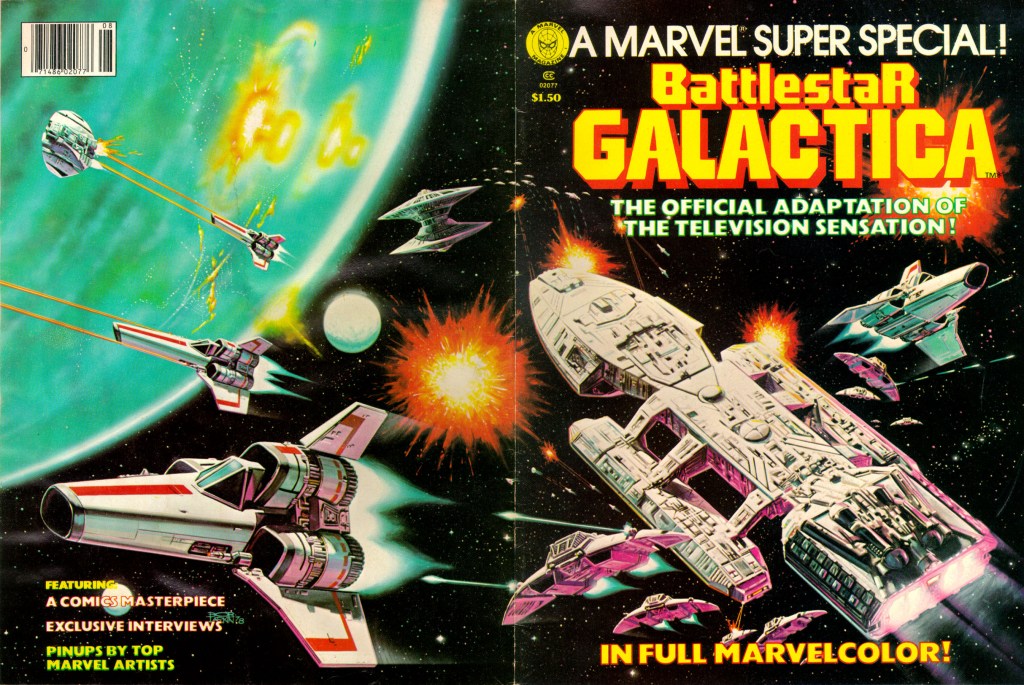
So when we came across a BATTLESTAR GALACTICA Treasury Edition in a shopping trip to the local mall, my brother simply had to have it. And get it he did–though, like his other comics, it eventually found its way to me once his momentary interest in the form lapsed. MARVEL SUPER SPECIAL #8 was the authorized adaptation of the series pilot episode, released even a hair before the show debuted, just like STAR WARS. Marvel had made a ton of bank on the STAR WARS adaptation and was clearly hoping that the phenomenon would repeat itself here. Accordingly, they issued BATTLESTAR GALACTICA in a bunch of different formats–as a color magazine, in the Treasury Edition that my brother bought, and as the first three issues of an ongoing BATTLESTAR GALACTICA comic book. These scans come from the magazine edition, though they’re markedly the same as the Treasury version apart from the cover, which was a similar painting by Rick Bryant rather than Bob Larkin.
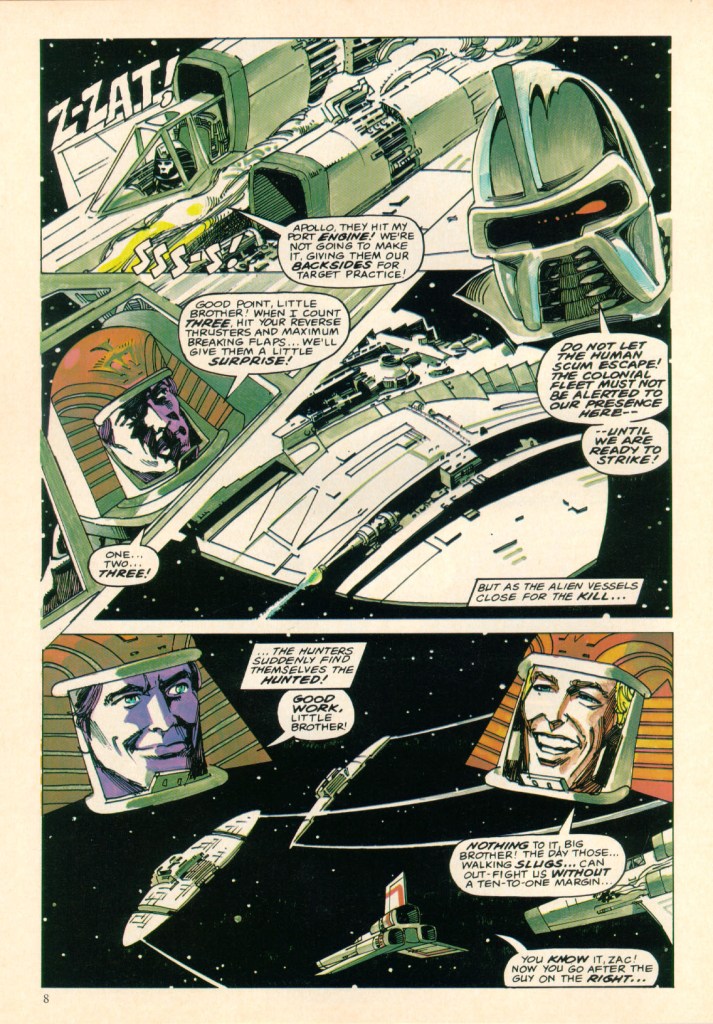
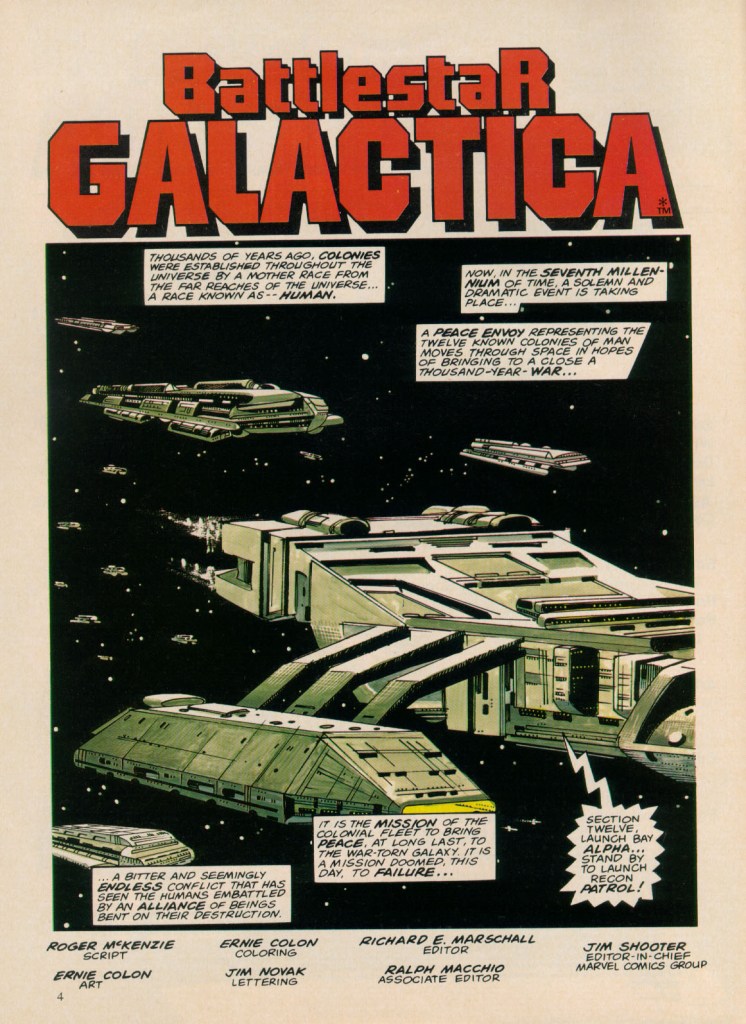
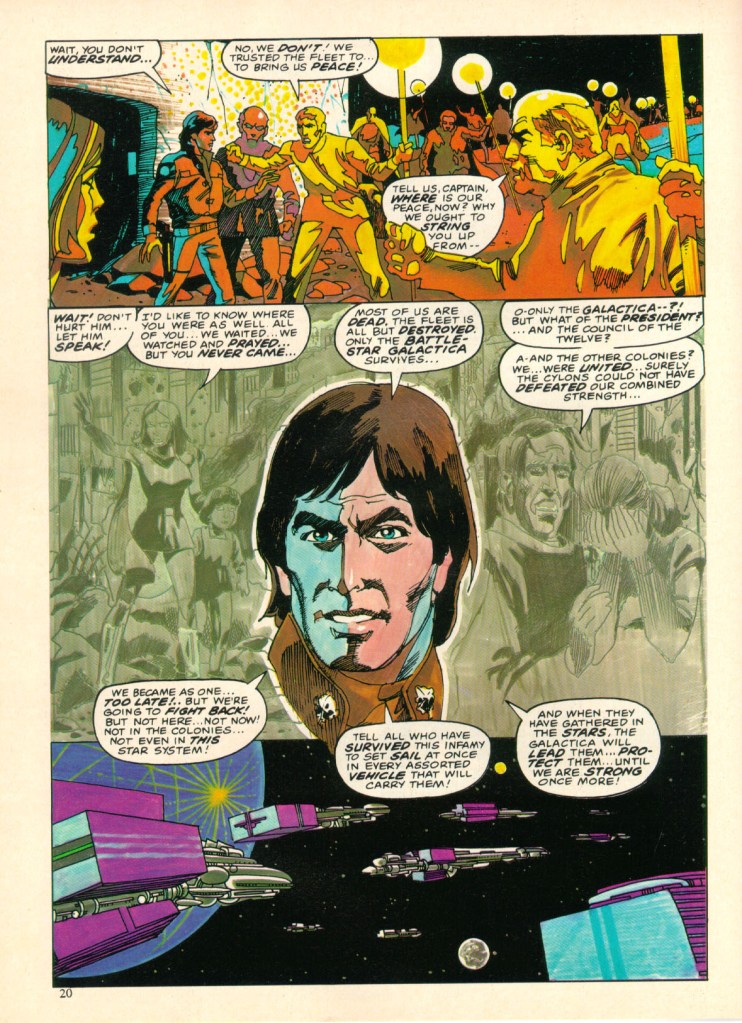
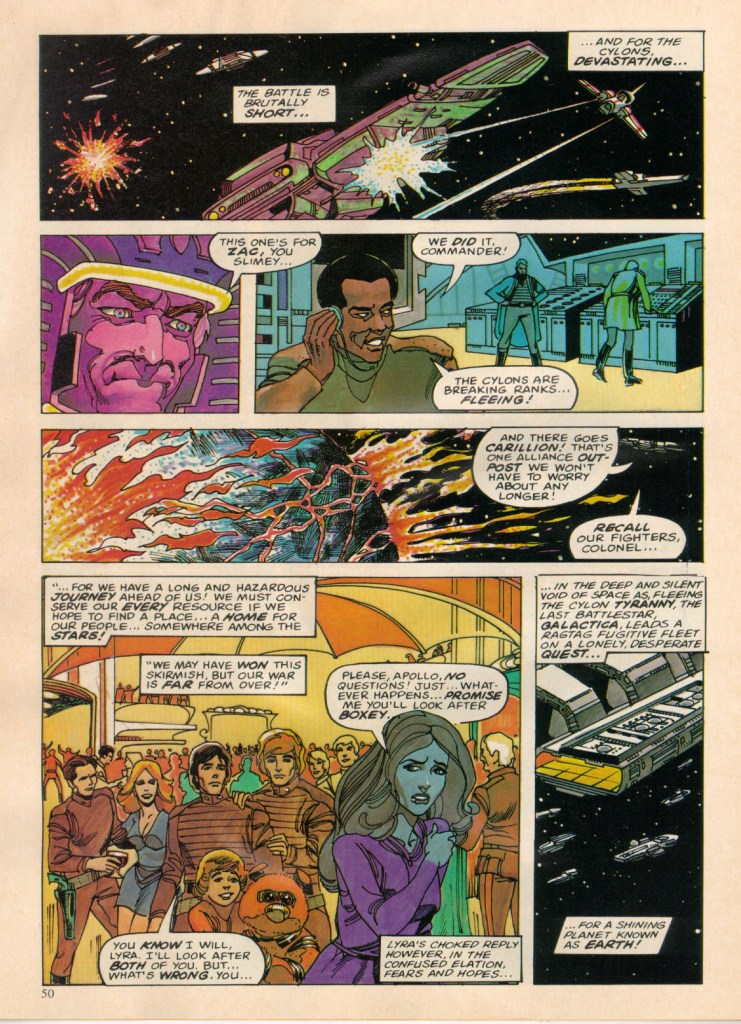
The teleplay was adapted by Roger McKenzie and the art and color was produced by Ernie Colon. And it has to be said, this is a great-looking book, but also very much a relic of its time. Colon got to use full process color on this job rather than the limited palate of regular comic books, and he went all out with it. The approach is very stylized and feels more like a job you might have seen in an issue of HEAVY METAL rather than a Marvel publication. It was interesting to look at, but I can remember not really liking it. Colon’s cartoonish renderings of the different characters/actors didn’t capture enough of a likeness for me, and his non-rectilinear page layouts weren’t my thing either. I can’t remember my brother having any similar complaints, though.
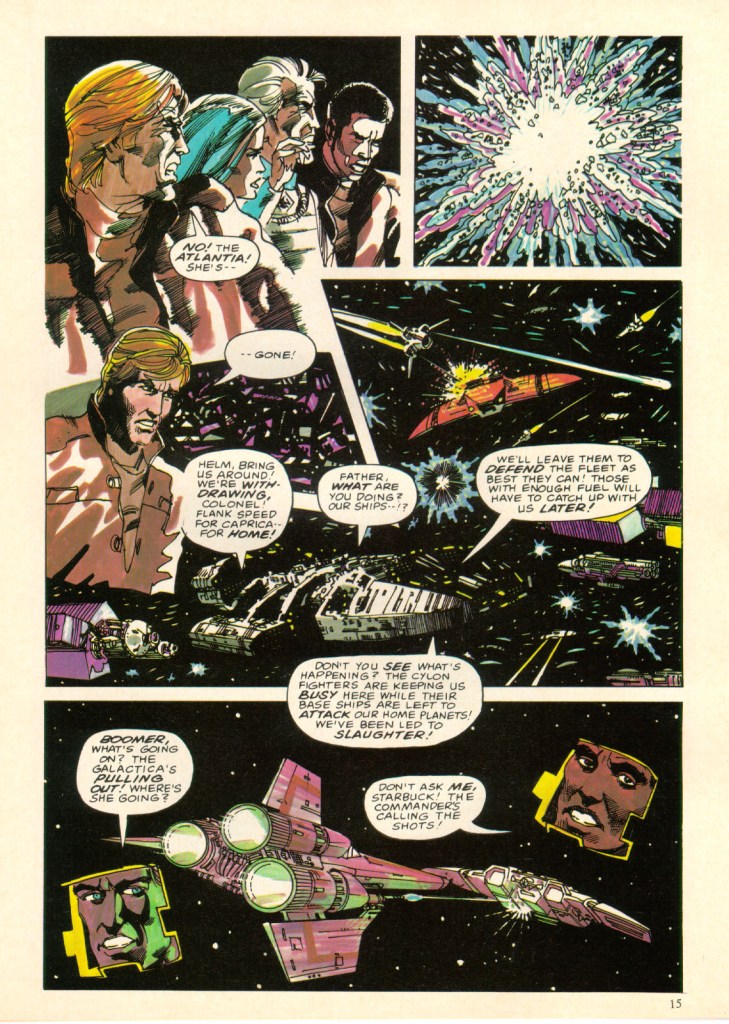
The story is familiar to anyone who watched either the original BATTLESTAR GALACTICA during its run or the later reboot from the early 2000s. Set entirely away from Earth amidst twelve human colonies that have been in conflict for many years, the story opens with a peace envoy hoping to broker a ceasefire with humanity’s implacable enemy, the robotic Cylons. But all is not as it seems–the peace summit is a trap and the Cylons ambush the assembled fleet while also striking at the twelve colonies simultaneously. The human race is reduced to just a relatively few survivors, all of whom set off in whatever ships they can get their hands on to flee their attackers. At the end of the battle, only one capital ship remains: the Battlestar Galactica under the command of Adama.
Along the way we meet a variety of characters, many of whom have names influenced by mythology. Adama’s son is Apollo, one of the best Colonial fighter pilots in the fleet alongside his cocky friend Starbuck and his more level-headed fellow pilot Boomer. Adam’s daughter Athena works as a member of the Galactica’s bridge crew. And Lyra is one of the refugees from Caprica, along with her son Boxie and his robot dog Muffit. The influence of STAR WARS is all over it. Once the refugee ships have gathered around the Galactica, the decision is made to flee this area of space and go in search of a mythical thirteenth colony of humanity, one that had been long forgotten and even thought a legend: Earth. So that’s the set-up. The ragtag convoy of spaceships is defended only by the Galactica and her outnumbered and outgunned crew as they search for this new home.
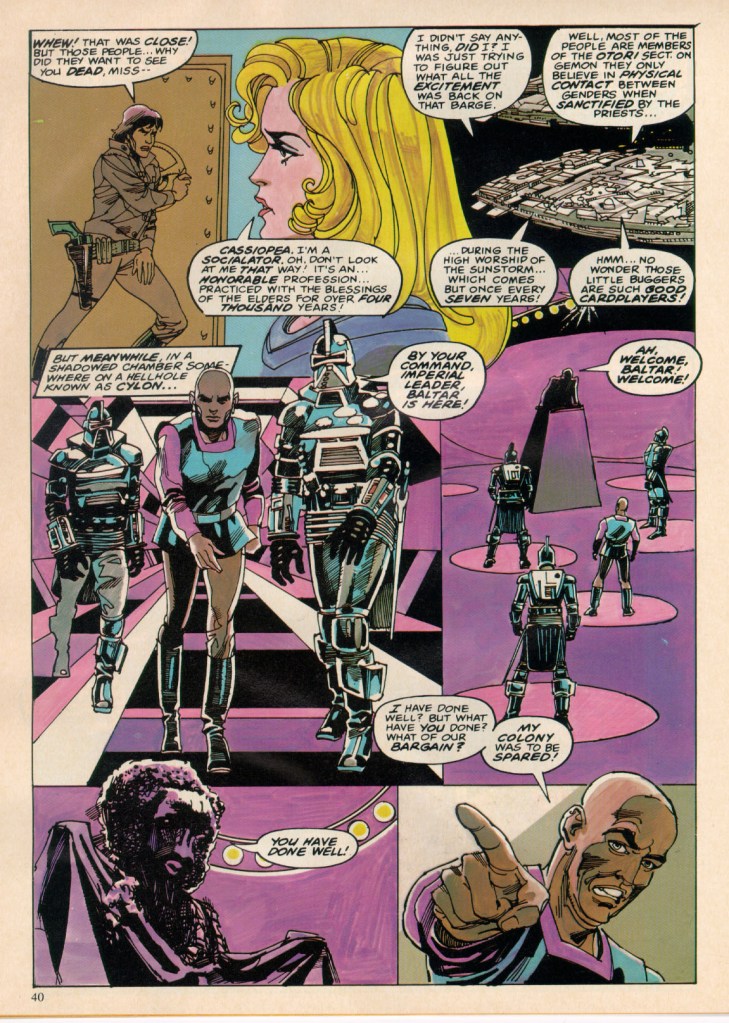
In addition to the forty-page adaptation, the book was also packed with a variety of other features, including an interview with special effects genius John Dykstra, the assorted ships and hardware used by both sides, a brief history of the Cylon race (which is especially spotty as not very much had yet been worked out about the backstory.) and a number of very pretty painted pin-up images, any of which might have been used as a cover. There was an effort with these Marvel Magazines to make them feel more like legitimate magazines rather than simply oversized comic books.
BATTLESTAR GALACTICA the television series didn’t turn out to be quite the ratings blockbuster that ABC was hoping for. What’s more, it was expensive to produce on a weekly schedule, with its many special effects shots. After the three-issue reprinting of the pilot adaptation, Marvel continued onward from issue #4 with new stories set within the continuity of the series, many of which were quite good, featuring artwork by Walt Simonson. But no amount of effort on the comic book could prevent the demise of the series (which limped on and returned, retooled, as BATTLESTAR GALACTICA 1980 some months later) which in turn guaranteed the end of the comic series. Another STAR WARS this wasn’t for Marvel.
 The Tom Brevoort Experience
Nice to know they’re somebody else in my generation who also didn’t like Galactica and didn’t find Star Wars a life changing experience.
LikeLiked by 2 people
I skipped Star Wars in theatres due to my allergy for all things over-hyped and have to this day never seen it in one sitting. Battlestar Galactica and Buck Rogers were okay. I enjoyed them while they aired and didn’t miss them when they were gone.
LikeLiked by 1 person
I didn’t see SW until the next summer at a drive in. Still don’t know what all the fuss was about. It was good but not life changing but I’ve yet to see any movie that was. I liked Buck Rogers but even then I knew it was pretty campy. I rewatched it via MeTV and it was a little unbearable! 😉
LikeLiked by 1 person
I bought it (the magazine) because I saw it and the title sounded, well, thrilling… but having no idea about the television series – it hadn’t made it to the UK at this point – it actually made for a difficult reading experience. Not quite what I’d hoped for when I parted with my money.
However, I later got into the programme when it was shown on Sunday afternoons in my region; I thoroughly enjoyed the revamped version as well in the early 2000’s.
What I do remember, though, and the first thing that sprung into my head when I saw your I blog today, was the artist’s name: “Ernie Colon”. For some reason that has stuck with me for over forty years and whenever I come across his work I always remember the Battlestar Galactica Marvel Special… and how I was so easily taken in by a macho / martial sounding title.
LikeLiked by 2 people
“Colon’s cartoonish renderings of the different characters/actors didn’t capture enough of a likeness for me”
It seems Colon didn’t have access to stills of all the supporting actors at the time, which explains why some characters’s faces had to be redrawn (by Colon) when the adaptation was reprinted in issues #1 to #3 of the regular monthly comic book.
I have a copy of the original Treasury Edition, which is printed on regular newsprint. The colors there don’t look as good as the ones shown in your scans of the magazine version (which I’m seeing here for the first time).
LikeLiked by 1 person
This wouldn’t have appealed to me when it came out because I wasn’t into Battlestar Galactica, but looking at it now I really like the coloring. As you say it’s of its time, but it’s appealing. It looks like the coloring was done with alcohol markers and drum scanned.
LikeLiked by 1 person
That’s a good looking comic. Those process colors look terrific. Ernie Colon is a pretty great science fiction and adventure type comics artist, although not great at superheroes. His “Medusa Chain” is a pretty fun OGN from the days of the 48 page magazine sized graphic novel. He was also my favorite Richie Rich artist, a fact I realized while reading “Amethyst Princess of Gem World”.
Star Wars was pretty life changing for 12 year old me. Galactica was just dumber Star Wars. I did watch the series (and Galctica 80) while they were on as I would watch any science fiction show no matter how bad it was. The best part of Galactica we’re the special effects. Which were repeated as
nauseous after the pilot.
LikeLiked by 1 person
I like the colours on this also. It actually reminds me of the Star Wars: Dark Empire series from the early 90s, where Cam Kennedy used different shades of the same colour or maybe 2 or 3 differenct colours on a page in a kind of water colour style. I can’t describe it any better, I’m not an artist.
LikeLiked by 1 person
Oh man, we were ready for Battlestar Galactica! But as it went on it really got boring. Esp, as we weren’t getting any new vfx battles. The reuse of vfx footage really got grating. I found Saturday morning’s Jason of Star Command (as part of Tarzan and the Super 7) far more fun and exciting!
LikeLike
Bears, beets, Battlestar Galactica.
LikeLiked by 1 person
I did like the original Battlestar. I was under 10. The characters were ciol archetypes. My grandmother had watched Lorne Greene on “Bonanza”. She couldn’t understand what the geck he was doing in a blue cloak aboard a spaceship. She ccoukd pronounce “Galactica”. Came out out as “Galak-seeya”.
I do like Ernie Colon’s art. Always have. He was an editor at DC at some point. He had a clean line to his art. Karl Kesel’s inks looked especially good over it.
LikeLike
The Super Special version was based on an earlier draft of the Galactica pilot episode. The character “Lyra” became Serina (played by Jane Seymour) in the final version, and the Super Special also retained an element cut from the final version of the Lyra/Serina character dying from radiation sickness which is why Apollo was given charge of her son Boxey. Ultimately Seymour was coaxed into coming back for the second episode “Lost Planet Of The Gods” in which Serina marries Apollo (Richard Hatch) but is killed at episode’s end (but makes Apollo’s stepfather bond to Boxey much more effective).
When Marvel made Galactica a regular monthly series, the pilot episode was redone for issues #1-3 and the script and art was redone to adjust for how the program actually aired with Lyra now properly called Serina etc. Other changes were made too and the results were much superior. “Lost Planet Of The Gods” was adapted for issues #4-5 and then the series struck out on its own for nearly two years before being cancelled (outlasting the series and its awful “Galactica 1980” reimagining by a couple months). Unfortunately, Marvel wasn’t allowed to adapt subsequent episodes or bring in the characters and situations introduced later in the series like Lloyd Bridges Commander Cain, Anne Lockhart’s Sheba and the demonic Count Iblis as played by Patrick Macnee and that made the overall effort suffer considerably. The property was better handled by Max Press in the early 90s story wise (not so much art).
LikeLiked by 1 person
I wouldn’t describe Ernie Colon’s art here as cartoony… it seems to be more influenced by fashion adverts of the era.
LikeLike