

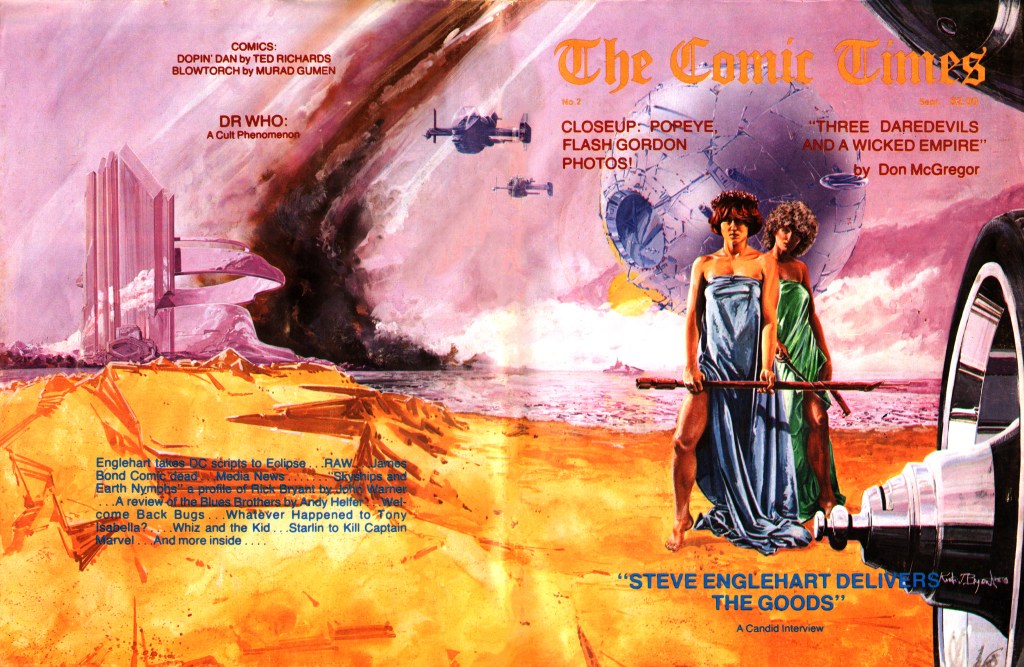
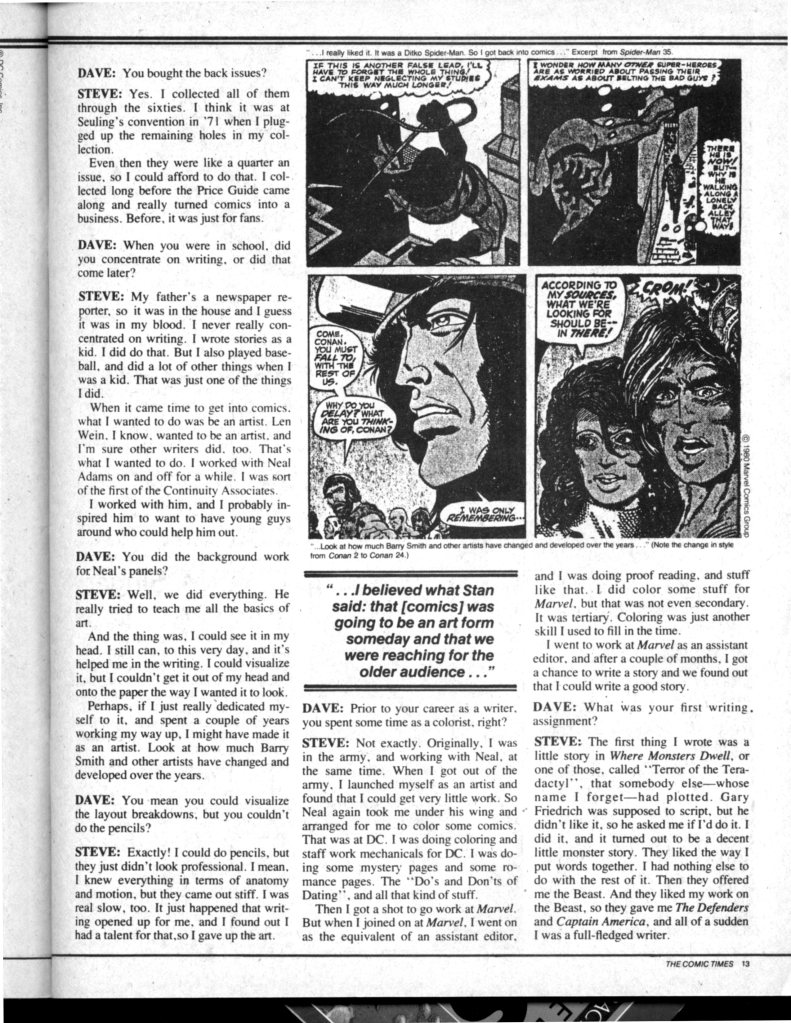
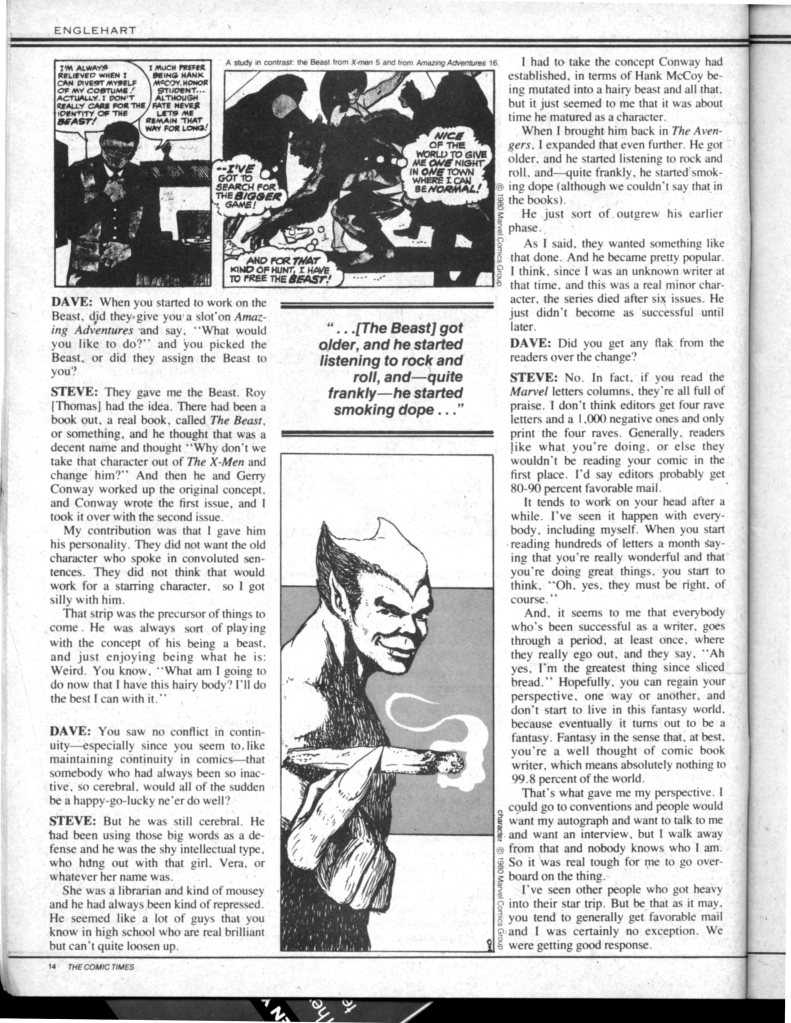
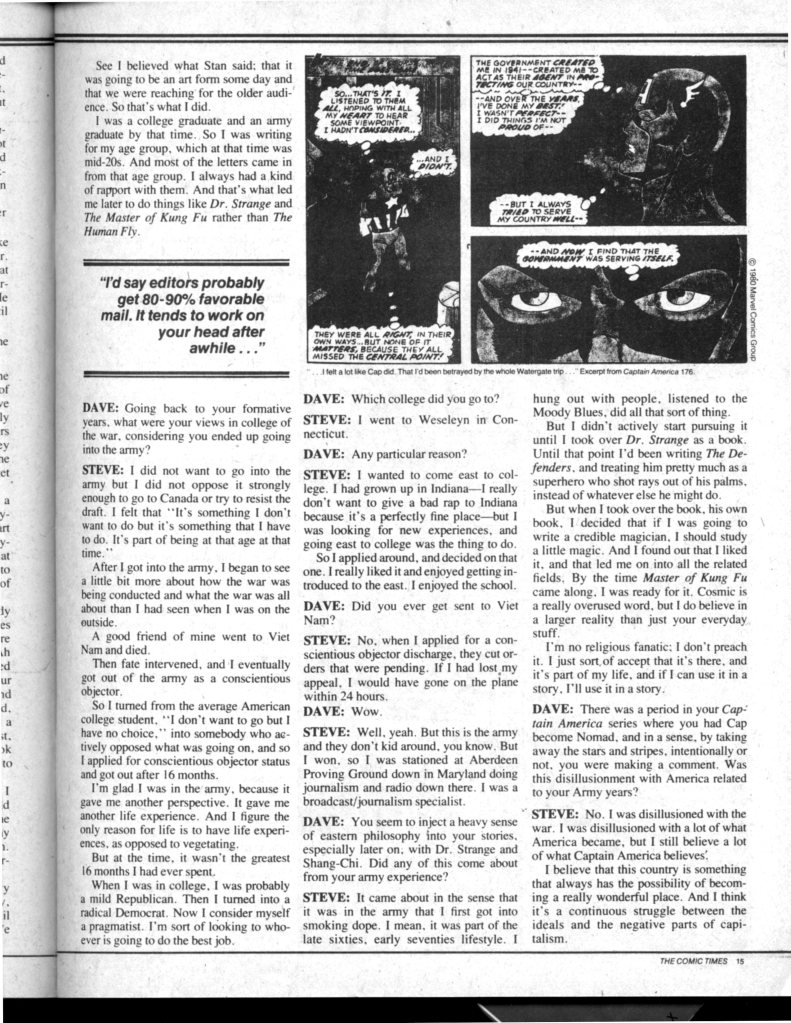
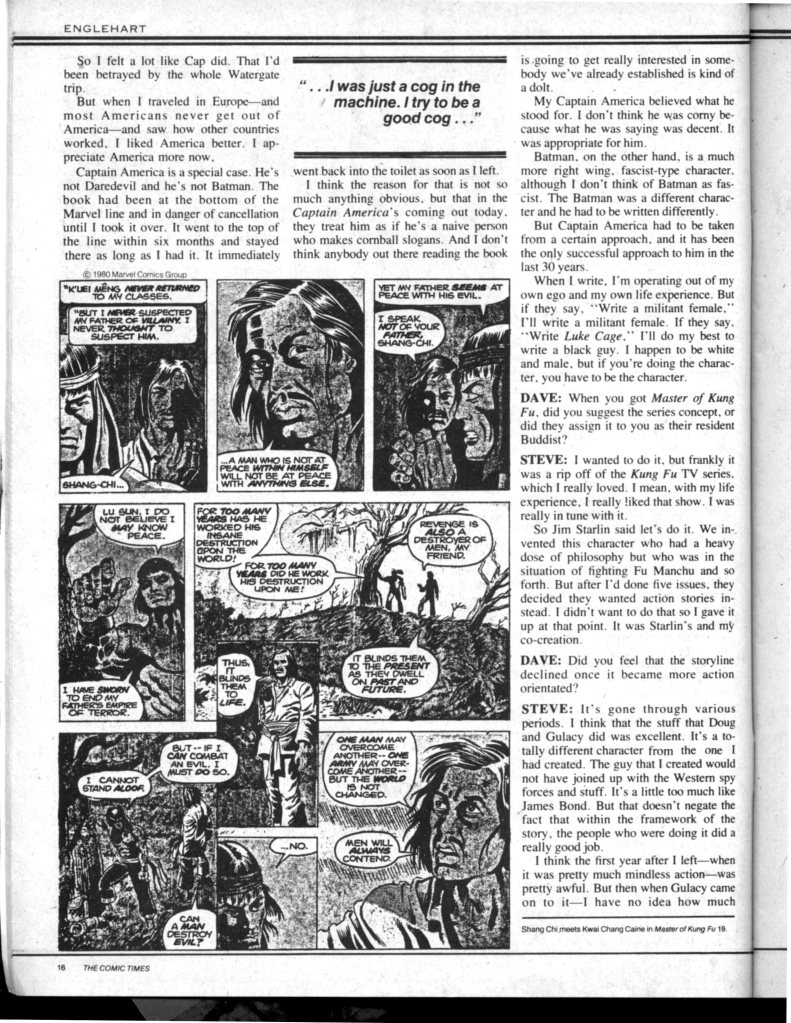
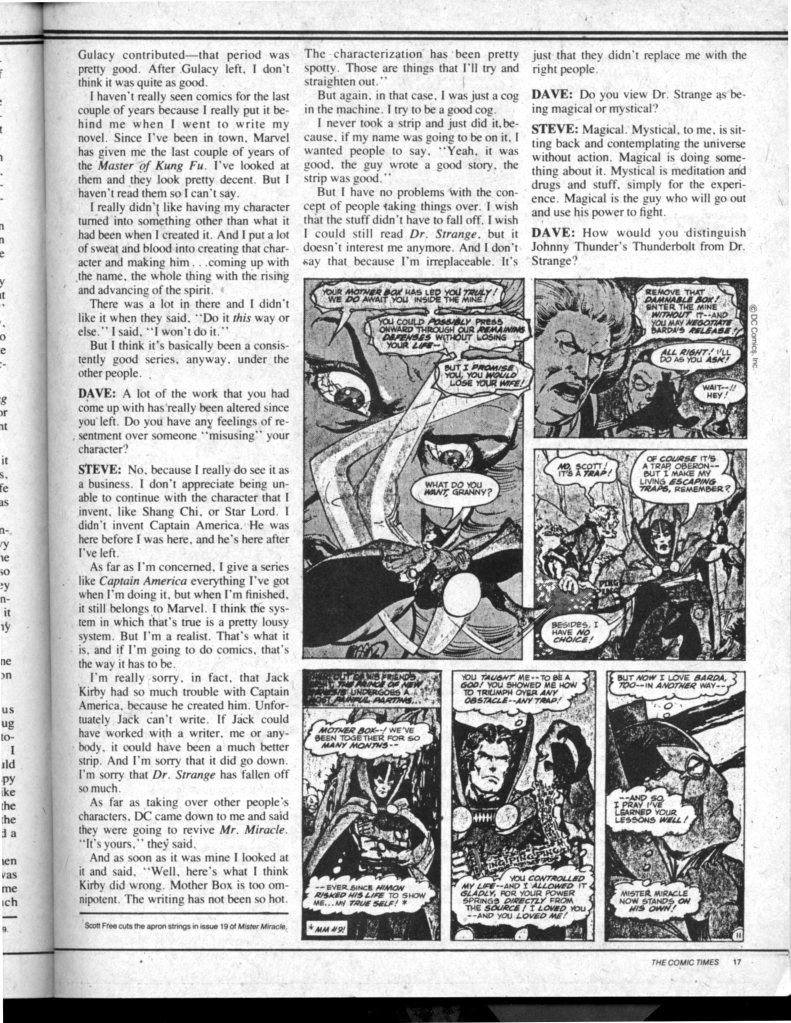
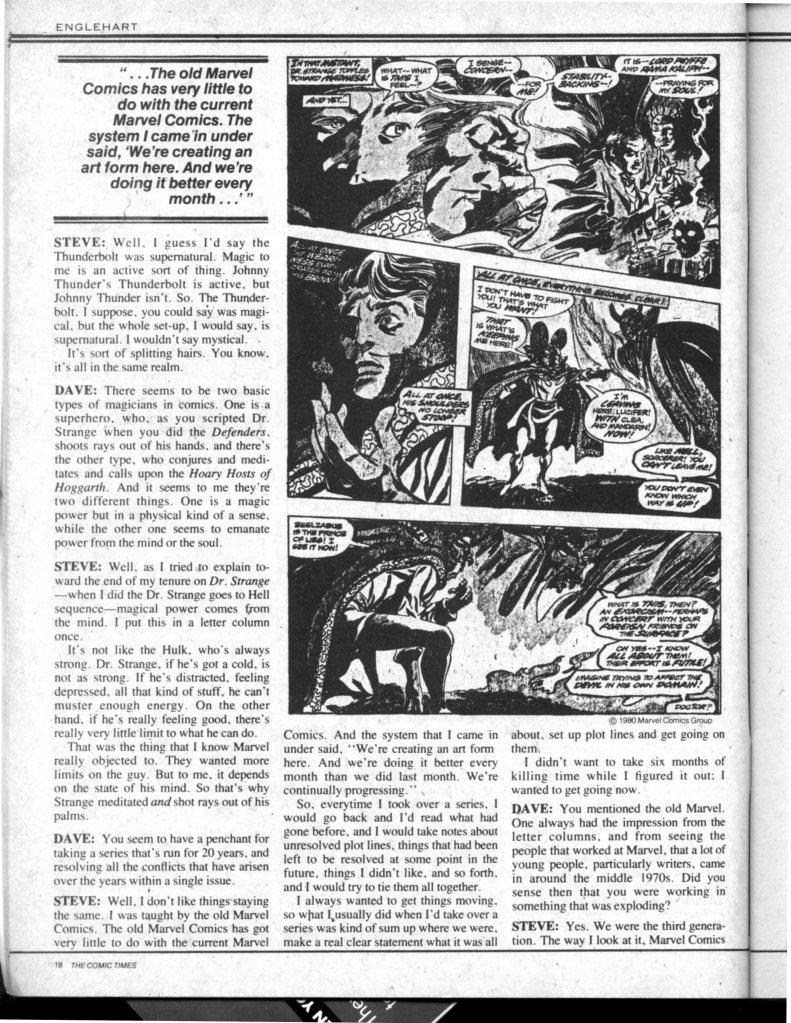
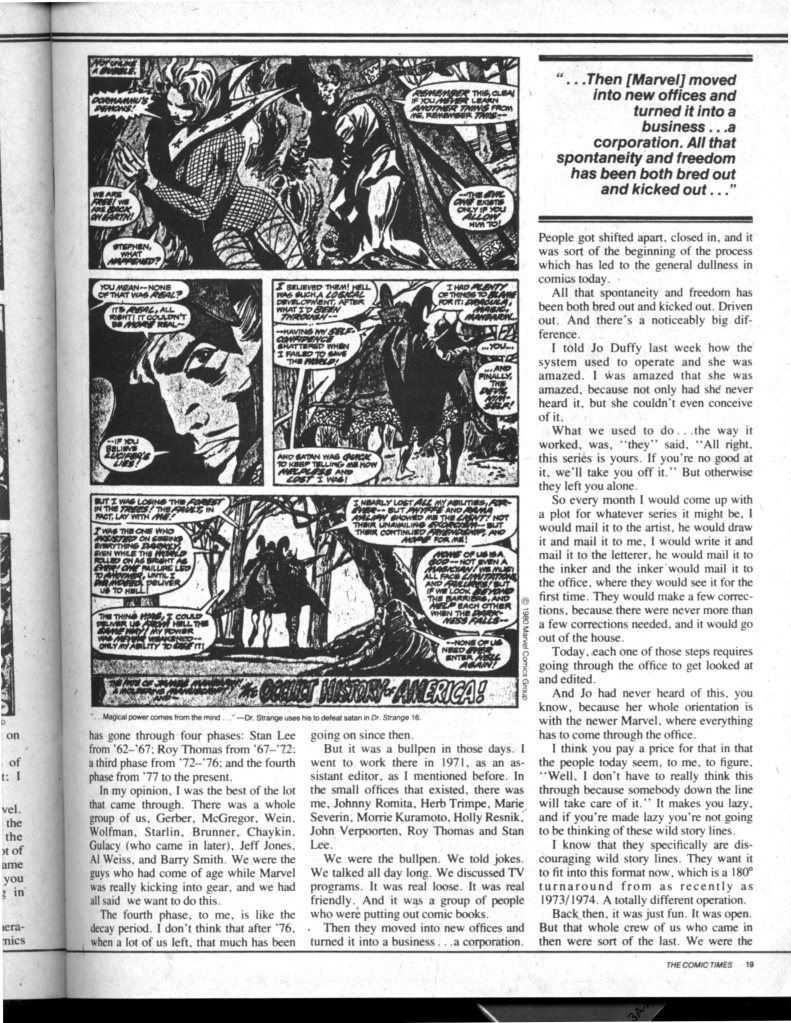
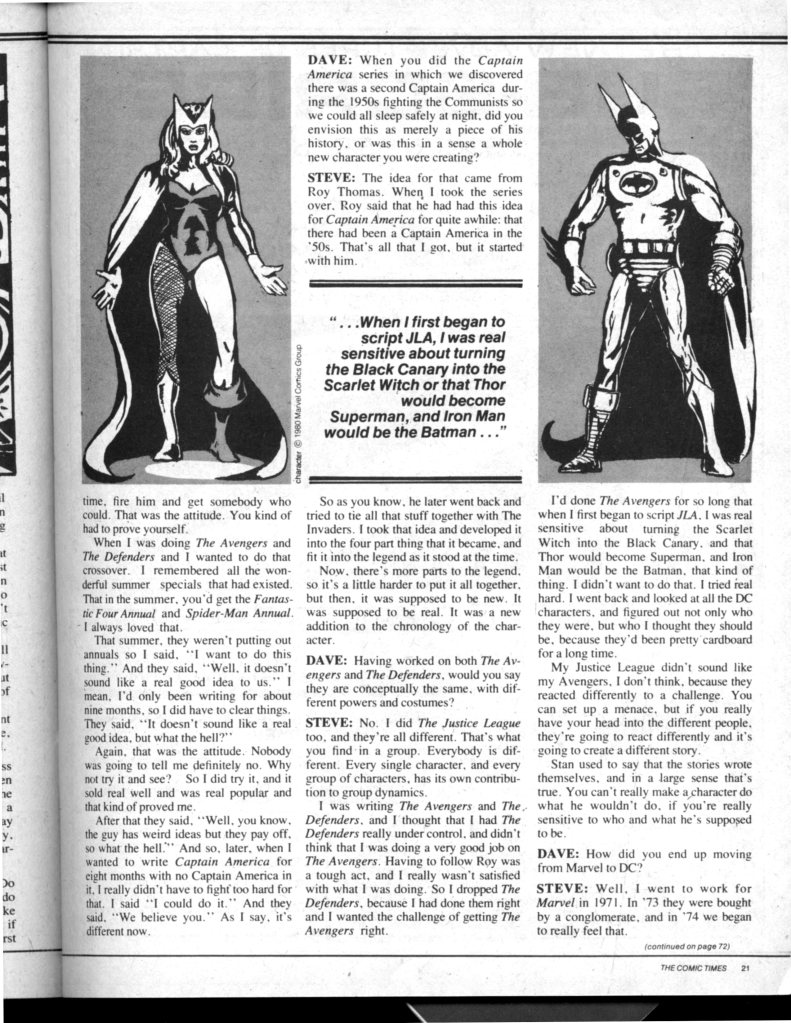
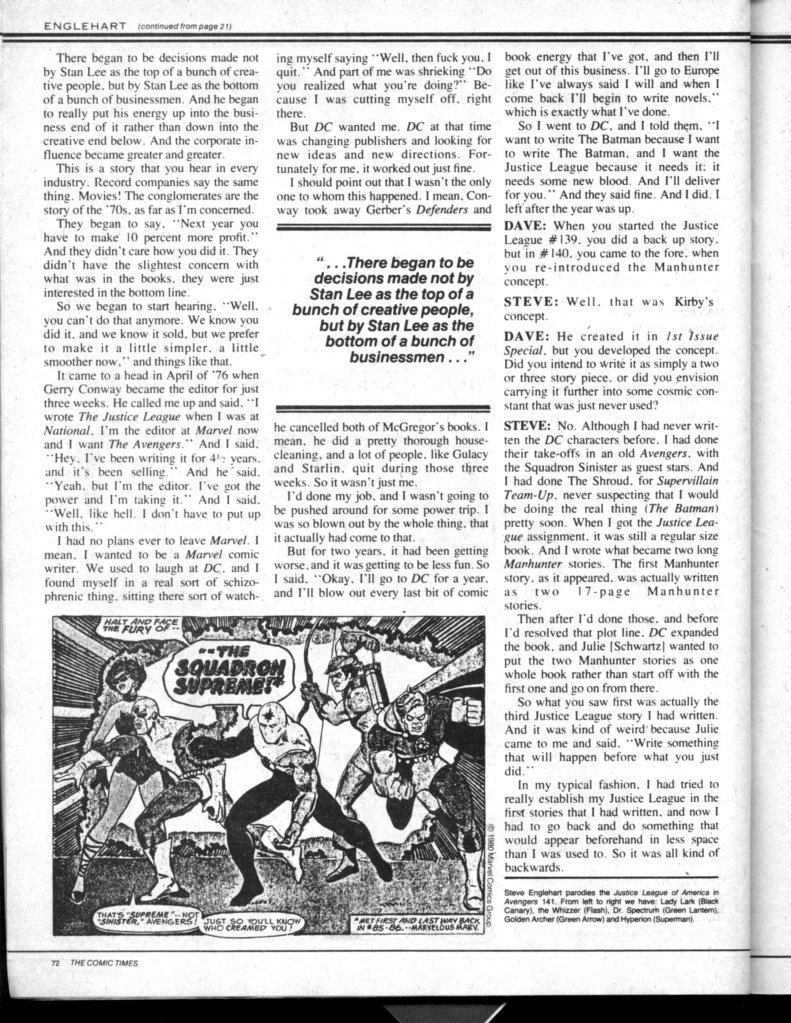
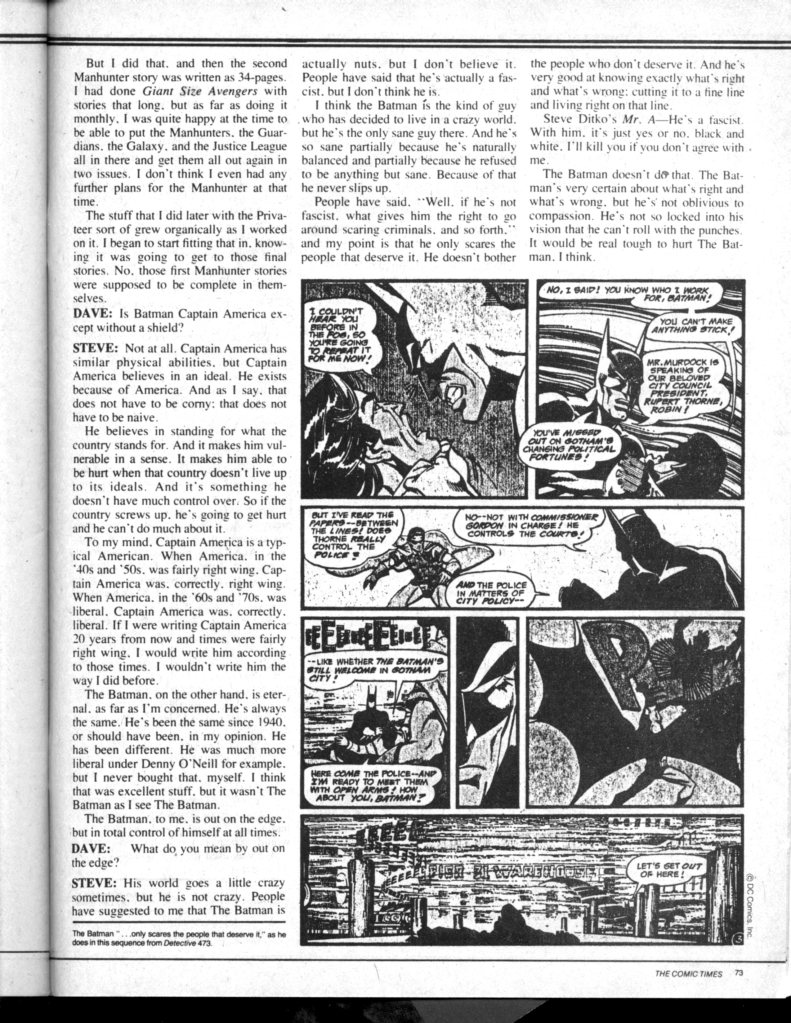
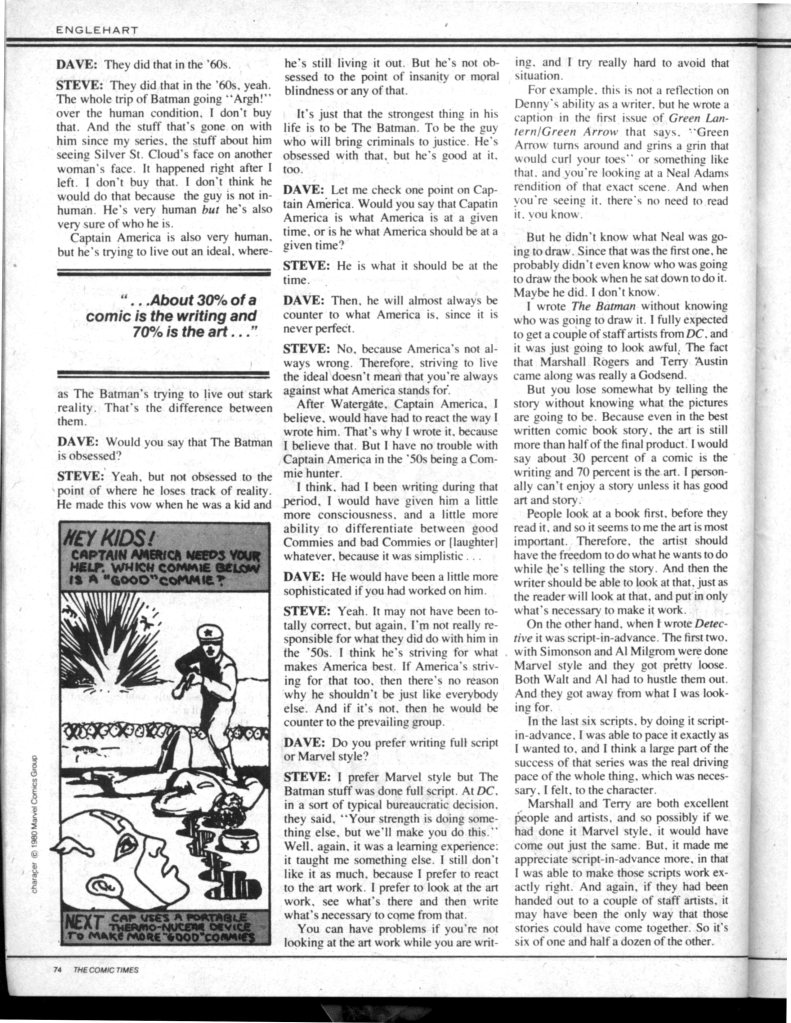
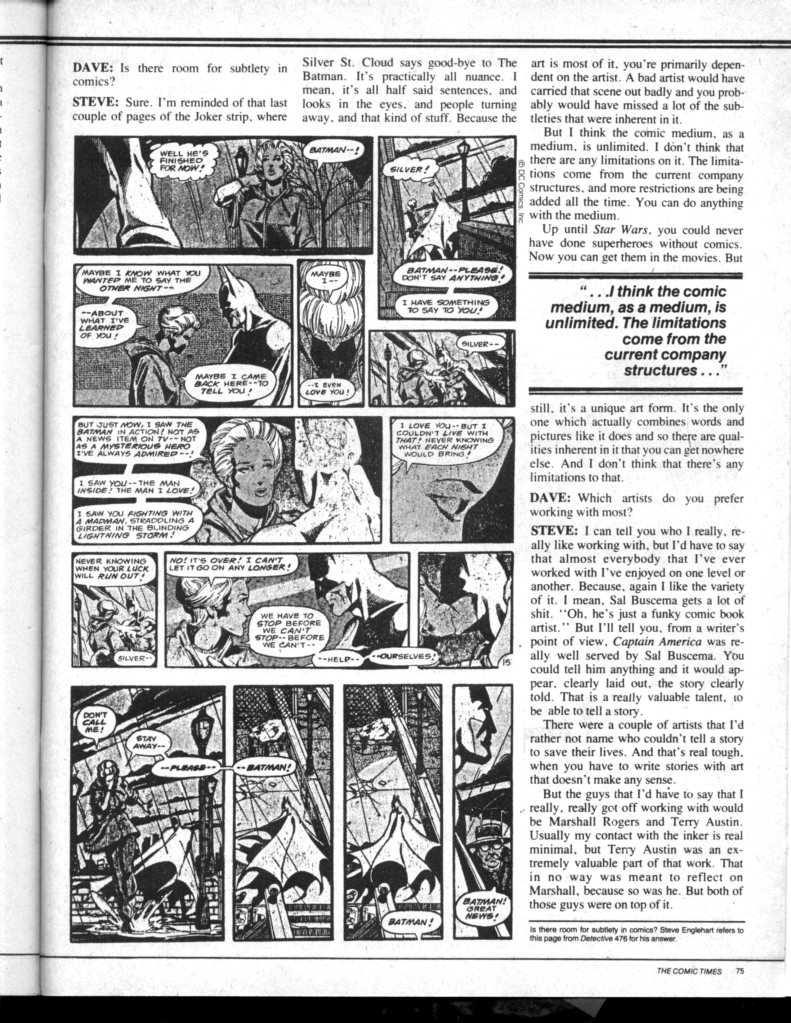
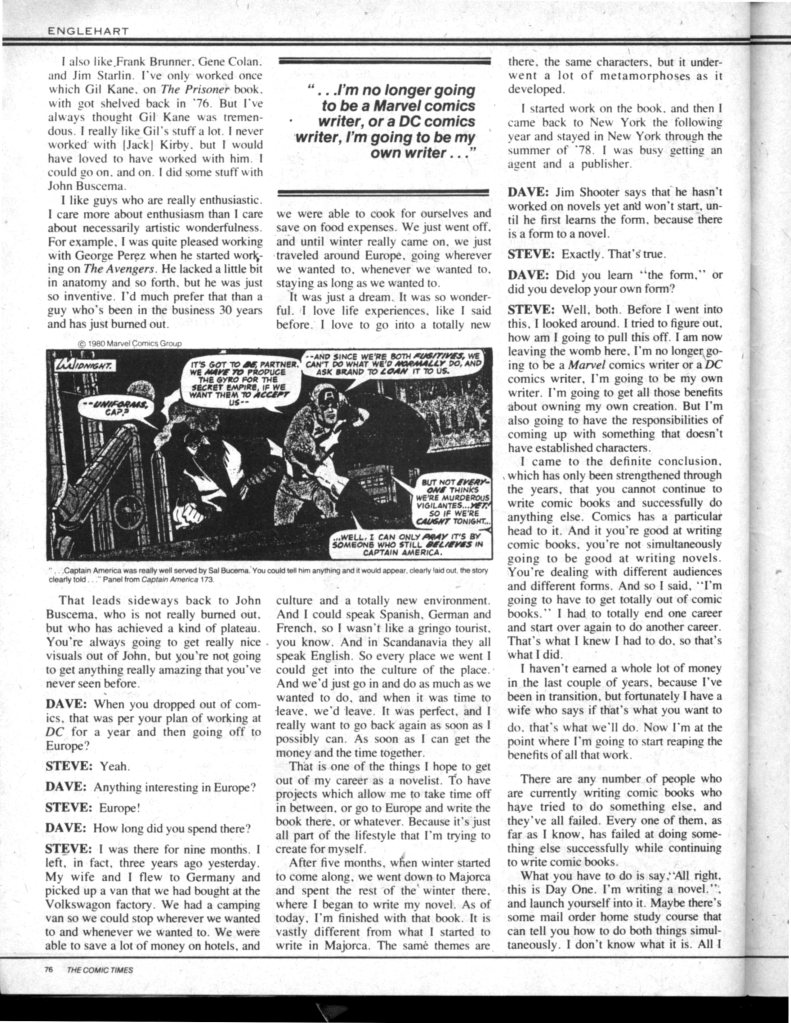
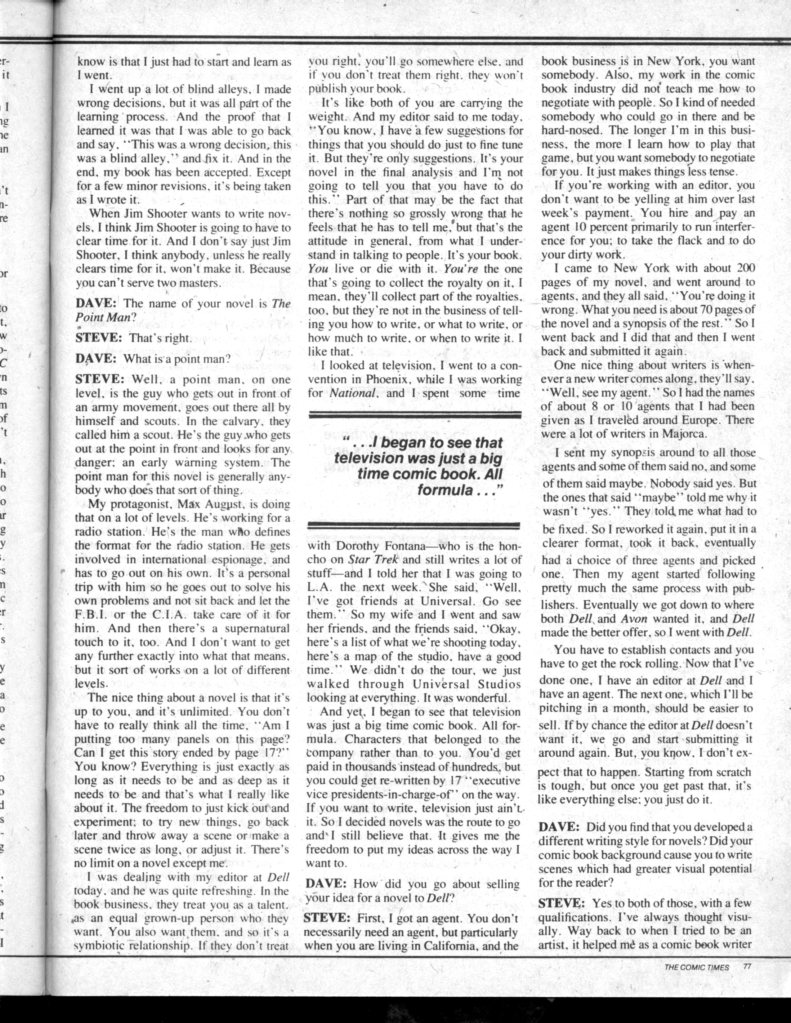
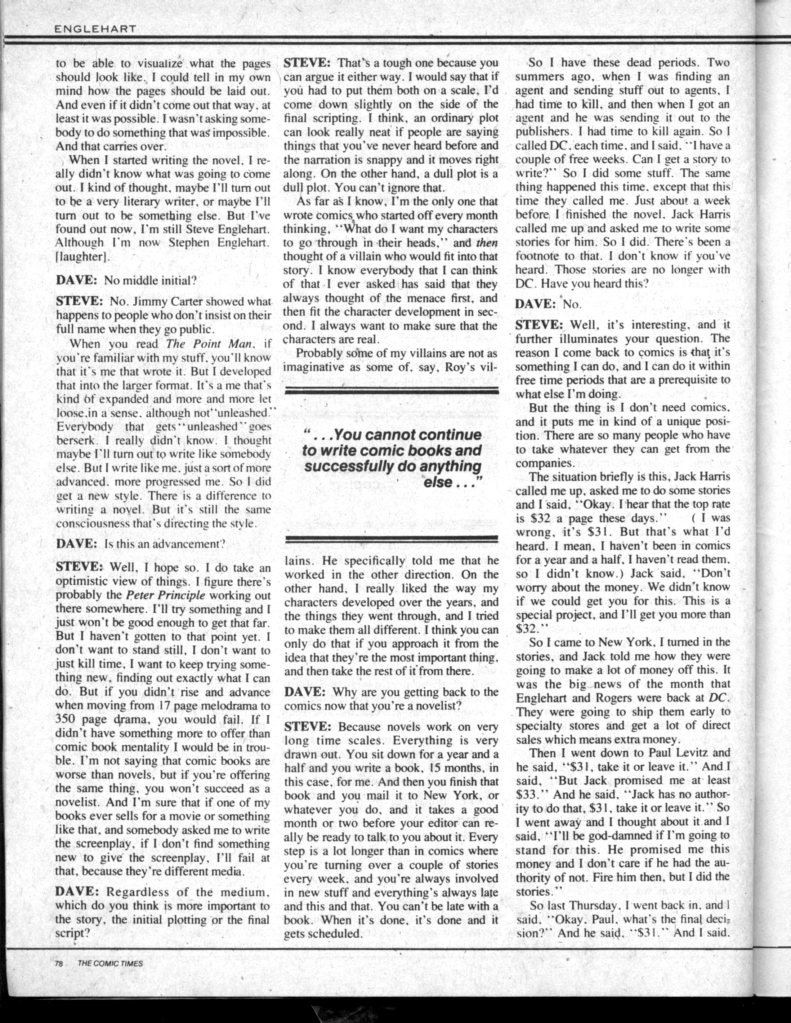
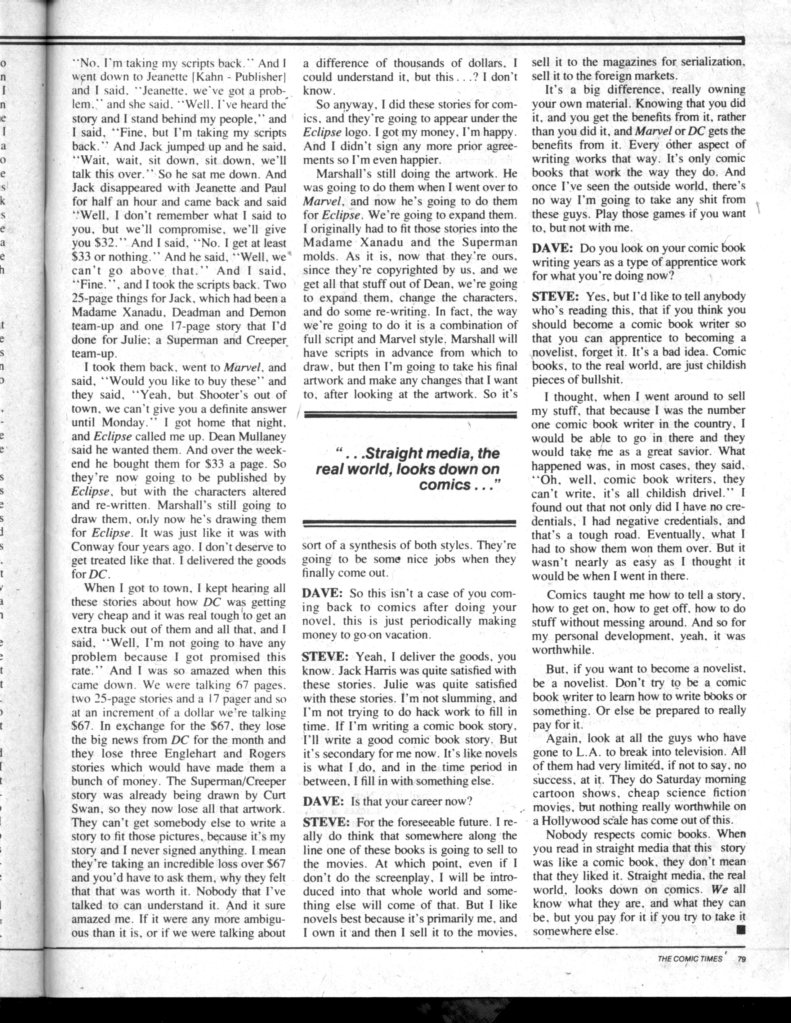
As the Direct Market opened up in the late 1970s and early 1980s, in addition to a sudden surge in prospective comic book publishers there also came an increased number of comic book fanzines. These publications tended to have better production values as a whole than the cheap mimeographed publications of years past, but most of them didn’t last for very long. Quality ran the gamut, often in the same release, with amateurish work sitting next to features of greater value. In particular, there are a wealth of lost or forgotten interviews with mainstay creators in the field that appeared in these largely-forgotten publications. So here, we’re going to look at an interview that writer Steve Englehart gave to The Comic Times in 1980, as conducted by David Singer, who himself would go on to notoriety as the person who launched a revival of the T.H.U.N.D.E.R. Agents believing the property to be in the public domain. I talked about this in somewhat greater length here:
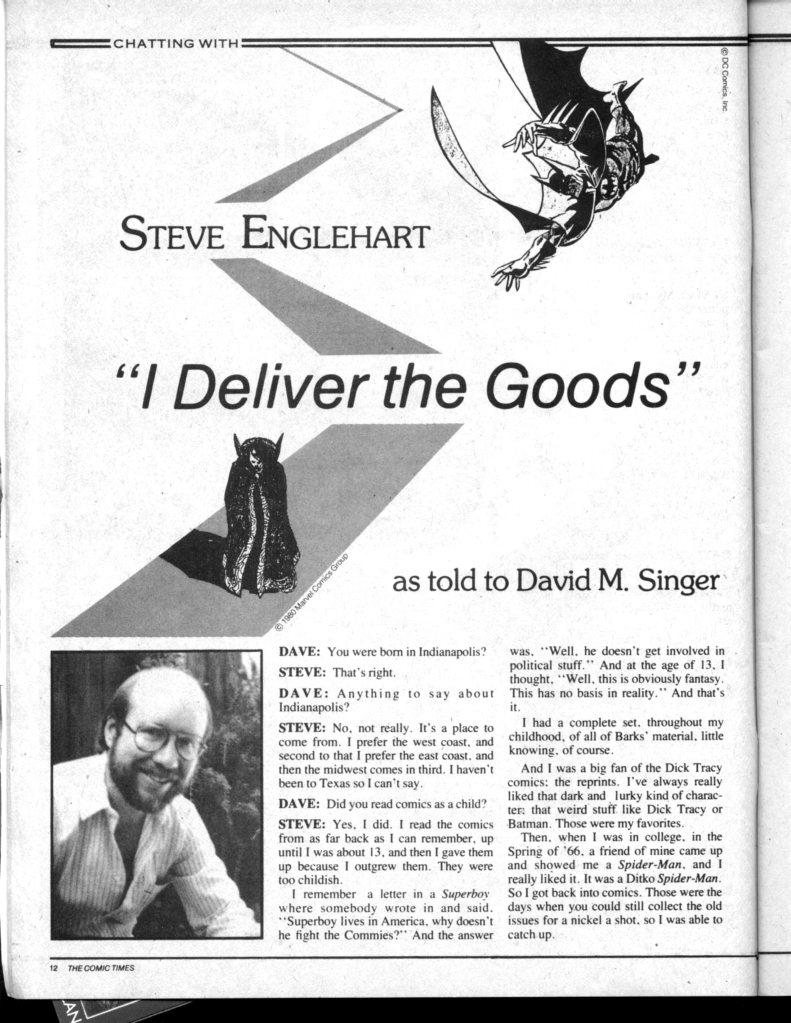
At the time this interview had been conducted, Englehart was just getting back into comics after a couple of years away, during which time he wrote his first novel, THE POINT MAN. But frictions with his employers at DC caused him to take some of his unpublished scripts and retool them for new characters he created, offering them through the small press creator-owned publisher Eclipse.
 The Tom Brevoort Experience
I don’t think I ever saw this when it was coming out. Thanks for running it.
LikeLike
I think I still have this issue. Remember the interview well. Englehart was largely responsible for sparking my revived comics interest in the mid-70s, Over the years I tried to buy everything he wrote.
LikeLike
I have one fact-check with the interview, which I offer in part because I’ve seen this particular false claim repeated elsewhere. On page 16, Englehart says,
“The book [Captain America] had been at the bottom of the Marvel line and in danger of cancellation until I took it over. It went to the top of the line within six months and stayed there as long as I had it. It immediately went back into the toilet as soon as I left.”
Nope.
The beginning of Englehart’s run on Captain America corresponds pretty neatly with the beginning of the 1972-1973 sales year. His departure came near the end of the 1974-1975 sales year. These are the per-issue average sales for Captain American from the sales year before his run through the sales year after his run, taken from USPS Statement of Ownership filings.
1971-1972: 178,193
1972-1973: 175,738
1973-1974: 183,344
1974-1975: 180,156
1975-1976: 165,247
As can be seen, the sales differences were fairly negligible. Englehart’s first sales year was consistent with the year before. His second sales year saw a 4% increase over his first. His third was consistent with the second. The year after he left, the sales dropped by about 9%, but the other reported Marvel titles saw similar declines.
At no point were Captain America’s sales at “the top of the line.” It was outsold by Amazing Spider-Man, Fantastic Four, Thor, and Incredible Hulk for all three years Englehart was on the title. Avengers outsold Captain America for the first two years of his run. It had comparable sales for the third. (The sales of Marvel titles that debuted in 1968 or later were not being reported at this time.) There wasn’t one year in which Amazing Spider-Man, Marvel’s reported top seller, wasn’t outselling Captain America by at least 50%.
I’m not sure where Englehart was getting his information. This was several years before Marvel and DC began paying sales royalties or their equivalent, and creative people started receiving sales statements. I doubt the company was going out of its way to provide the creative people with sales figures. Reporting increased sales to a creative was a guaranteed way to get a creative asking for a raise. The Statement of Ownership reports were probably the only source of sales information. They don’t support what Englehart claims at all.
LikeLike
In fairness to Steve, when he’s speaking about this more definitively and not ad hold off the cuff he will clarify that Cap’s sales jumped to the top of the heap on a percentage basis—i.e. the percentage of the print run that was selling through and not being returned for credit. Another title may have been selling more copies, but they were having to print a lot more copies to do so. Titles with the best percentage performance were consequentially the most profitable. I have no idea how long Cap remained in that position, but I have little doubt that Steve improved the performance and profitability of that series.
LikeLike
Here are some things for Mr. Englehart to consider when he gets around to responding.
The average per-issue sell-through of Captain America for the 1971-1972 sales year–the one before Englehart took over– was 51%. That sounds like a pretty healthy sell-through. It’s my understanding that 50% is what is generally expected of a publication. A title wouldn’t be in sales trouble until the sell-through was in the low 30s. But hey, let’s say for the sake of argument that 51% was flirting with cancellation.
What was the sell-through on other titles that year? Amazing Spider-Man’s sell-through was 50.5, Fantastic Four’s was 53.6, Incredible Hulk’s was 54.9, Avengers’ was 54.3, Daredevil’s was 55.6. I couldn’t locate the info for Thor. Conan the Barbarian, Master of Kung Fu, Tomb of Dracula, Marvel Team-Up, and Marvel Two-in-One–probably the most noteworthy other sales performers–all debuted after 1968 and were not having their sales publicly reported until the late 1970s.
Now from what Englehart is saying–assuming he’s talking about sell-through–is that Amazing Spider-Man was more in danger of cancellation than Captain America when he took the latter over. Amazing Spider-Man was in danger of cancellation. Yeah. Right. Truth be told, I don’t think any of the titles I have sales data for were in danger of cancellation. Not with sell-throughs over 50%. And since the percentages were all within the same five-point range, I don’t think it’s even worthwhile to rank the titles. They were all doing comparably well relative to their print runs.
Let’s move on to the 1972-1973 sales year, Englehart’s first on Captain America. His run encompasses all but maybe one issue of that year. The average per-issue sell-through was 54.9. It’s an improvement. What was that deadbeat seller Amazing Spider-Man doing? It was 50.3. Fantastic Four–48.7. Incredible Hulk–49. Thor–can’t locate info. Avengers–51.3. Daredevil–49.4. Other titles–no info until 1979. Now it does appear Captain America was number one in terms of sell-through based on available information. But. The sell-through increase was all of four percent. That’s not a lot. Also, the unit sales dropped, which means the book lost readers. The person who deserves the credit for this success, such as it was, was not Steve Englehart. it was Marvel’s sales manager, who made more efficient decisions re: the size of the print runs. And even that was luck.
Now for 1973-1974, the one year Englehart’s Captain America saw its readership increase. The sell-through was 51.6. Amazing Spider-Man–54.7. Fantastic Four–50.9. Incredible Hulk–54.8. Thor–53.2. Avengers–54.8. Daredevil–52.1. So much for that number one ranking in terms of sell-through. It looks like the other books got their sell-through mojo back, to the extent that they lost it. That number-one ranking the previous year was a fluke, and given that the title lost readers, it’s nothing to be bragging about.
On to 1974-1975, Englehart’s third and last year on the book. Captain America–50.8, Amazing Spider-Man–53.1, Fantastic Four–50.4, Incredible Hulk–53.5, Thor–50.8, Avengers–not reported, Daredevil–51.3. Cap was losing readers. It was losing sell-through, which was worse than it was the year before Englehart took over. It also doesn’t appear to have been gaining ground in the sell-through rankings.
With the 1975-1976 sales year, the one after Englehart left Cap, the sell-through dropped to 48. Amazing Spider-Man–49.2, Fantastic Four–46.2, Incredible Hulk 46.9, Thor–49.3, Avengers 46.9, Daredevil–44.4. Well, if the sell-through of Captain America minus Englehart was in the toilet, it appears several other titles were in the septic tank. My first guess looking at this is that Marvel unexpectedly lost vendors and the print runs weren’t adjusted. The drops appear to be a line-wide issue. And again, the sell-throughs are all in a five-point range, I don’t think Cap’s drop was an editorial issue such as a writer leaving.
In closing, the statement I quoted from the interview is wrong on most points, even when seen through a sell-through perspective. Englehart appears to have been technically right on one point. But it’s an over-the-top description that most readers of the interview would not have understood. Worse, it painted a deceitful portrait of the popularity of his work, all in the service of self-aggrandizement.
Perhaps when I hear what Mr. Englehart has to say in defense of his remarks, I ‘ll change my mind. I hope that will be the case.
LikeLike
Well, if memory serves, Englehart’s first issue of Cap hit the stands in June of 1972, so he did not have a full year that year. Possibly, the sales went up a lot between the first 6 issues and the last 6 issues.
He also had less tan a full year in 1973-’74, where Mike Friedrich filled in for several issues when Englehart got married.
Englehart left Cap in February or March of 1975.
LikeLike
The sales years reflected in the Statements of Ownership roughly reflect what was published between April and the following March.
LikeLike