

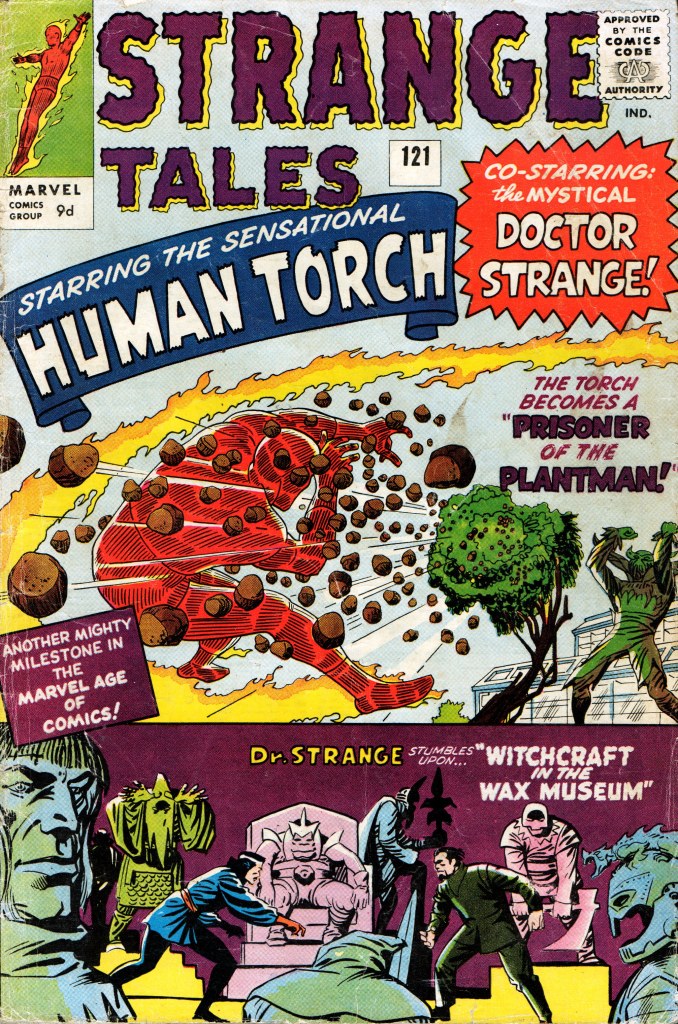
It must have been becoming clear to editor Stan Lee that the quirky back-up strip that he’d let artist Steve Ditko introduce was growing in popularity among the readership. So while it would still be several months before Doctor Strange would headline a STRANGE TALES cover all on his own, he had gone from carrying a burst blurb to a small vignette to occupying a third of the image area, squeezing the Human Torch lead feature into smaller and more awkward spaces. And it’s no wonder, really–while the Torch was more popular than Doctor Strange overall, this was due to his involvement in FANTASTIC FOUR. His series here in STRANGE TALES was decidedly weak sauce much of the time.
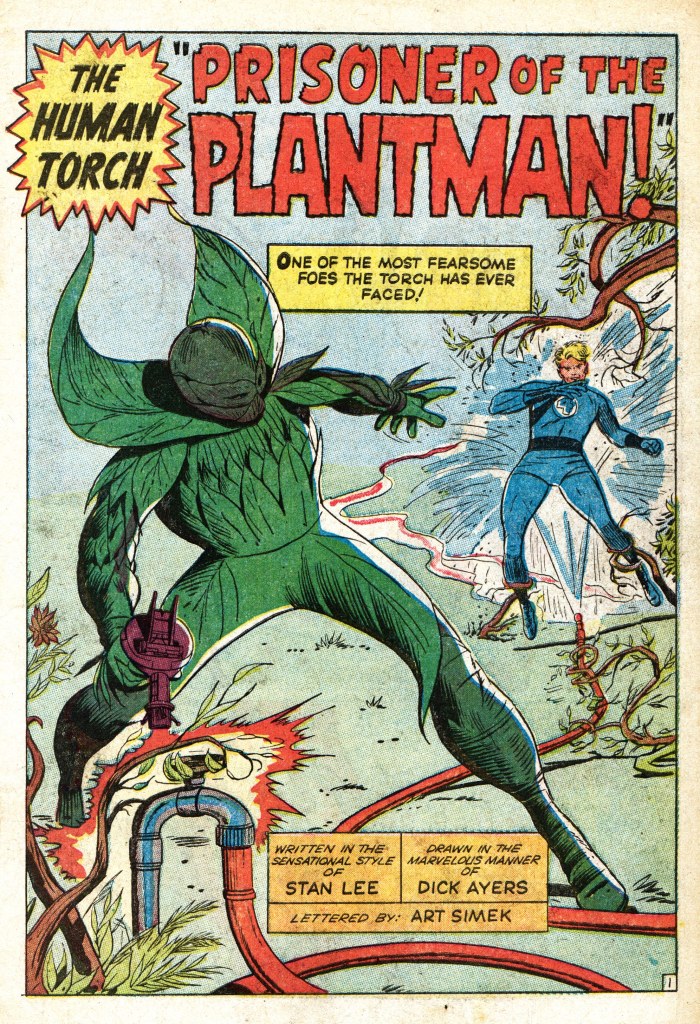
By this point in time. Lee had largely dispensed with the idea of recruiting other writers to take over some of these super hero strips, a process that he’d been experimenting with for several months. But none of the old timers that he tapped could really channel the flavor of the kinds of stories he was going for, and so Stan wound up scripting pretty much the entire line himself. In this story, he and artist Dick Ayers reintroduce and redesign the Plantman, a villain who had debuted in the Torch strip some time earlier under the writing of Jerry Siegel (then using the pseudonym of Joe Carter.)
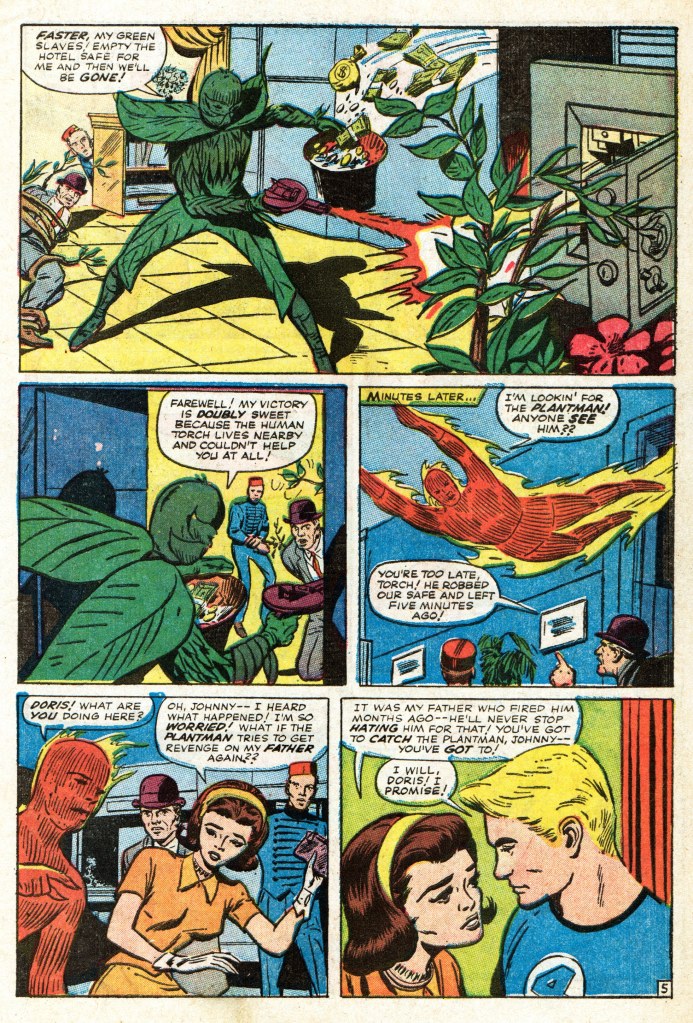
For all that, this story really isn’t any step up from the first Plantman outing. It’s exceedingly dumb in some places. The Plantman now has a full-on super villain costume rather than simply wearing a slouch hat and a trench coat, but it’s not really a costume that’ll invite fear or respect. In the opening to this story, the Plantman surprises Johnny Storm had his home in Glendale, his plants dousing the young hero in water so that he cannot flame on. Then the Plantman locks Johnny in a closet and proceeds to rip off a nearby hotel, delighted that the nearby Torch can do nothing to stop him. Johnny is just as embarrassed and enraged by this as you might expect, and he asks his fellow Fantastic Four members to stay out of the coming fight–he wants to defeat the Plantman decisively on his own.
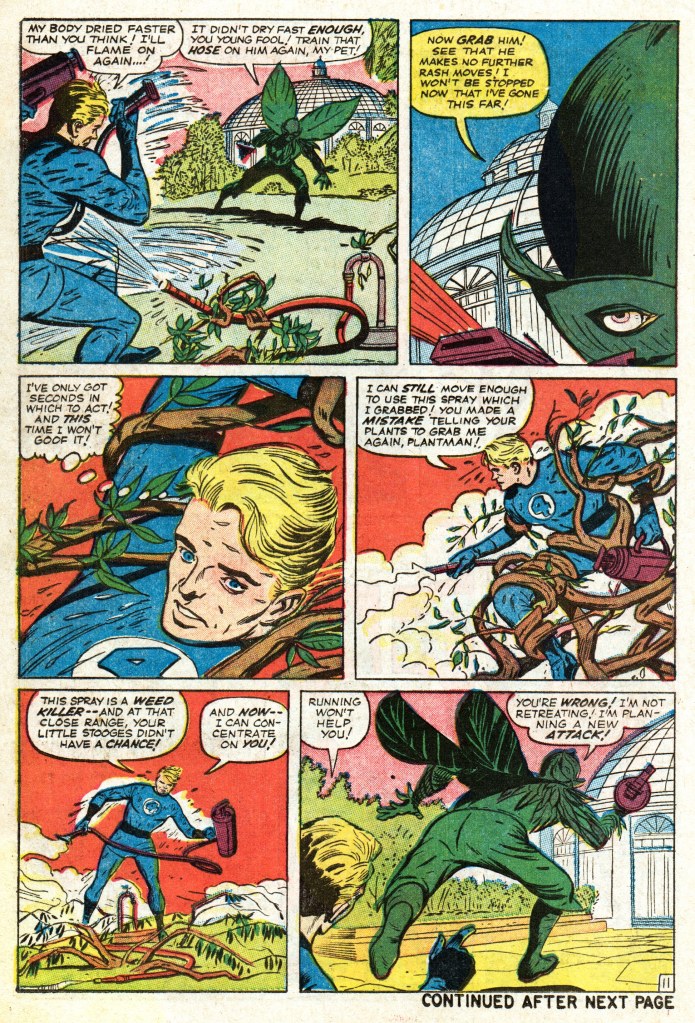
A few days later, the Torch receives a challenge from the Plantman. He wants to duel Johnny at teh Botanical gardens in New York City. Despite knowing that the venue for their fight will give the Plantman the advantage, the Torch races off hotly to confront his foe. Once there, the Plantman gets the upper hand on Johnny easily, pelting him with waterlogged plant spores and turning a garden hose on him to drench his flame. Beaten by a garden hose and locked in a closet–this is definitely not the finest adventure Johnny Storm has been a part of. It doesn’t really help that when it comes to fight choreography, Dick Ayers isn’t all that imaginative–it isn’t a strength of his in the way it is for Kirby and Ditko and others. So the fight itself is pretty dull visually, too.
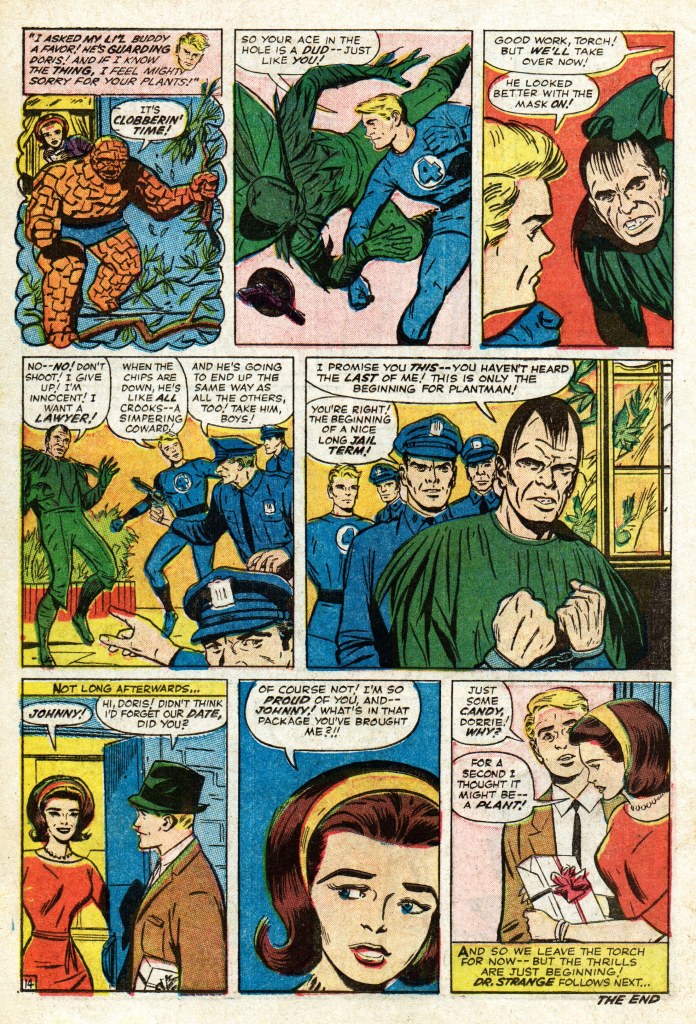
In the end, the Torch wins by, well, winning pretty much. He doesn’t really do anything clever or interesting, he just comes out on top because he’s the good guy. Right before teh end, Plantman tries to get Johnny to relent, telling him that a deadly plant has been left with his girlfriend Dorrie Evans that will kill her should the Plantman not call it off. But knowing that the Plantman had a grudge against Dorrie’s father, the Torch asked the Thing to stay with her, and he effortlessly eliminated the homicidal plant. And that’s a wrap on this one! It’s a good thing that Doctor Strange was catching on, because I can’t imagine many readers coming back month after month for work of this nature. This is simply not good at all.
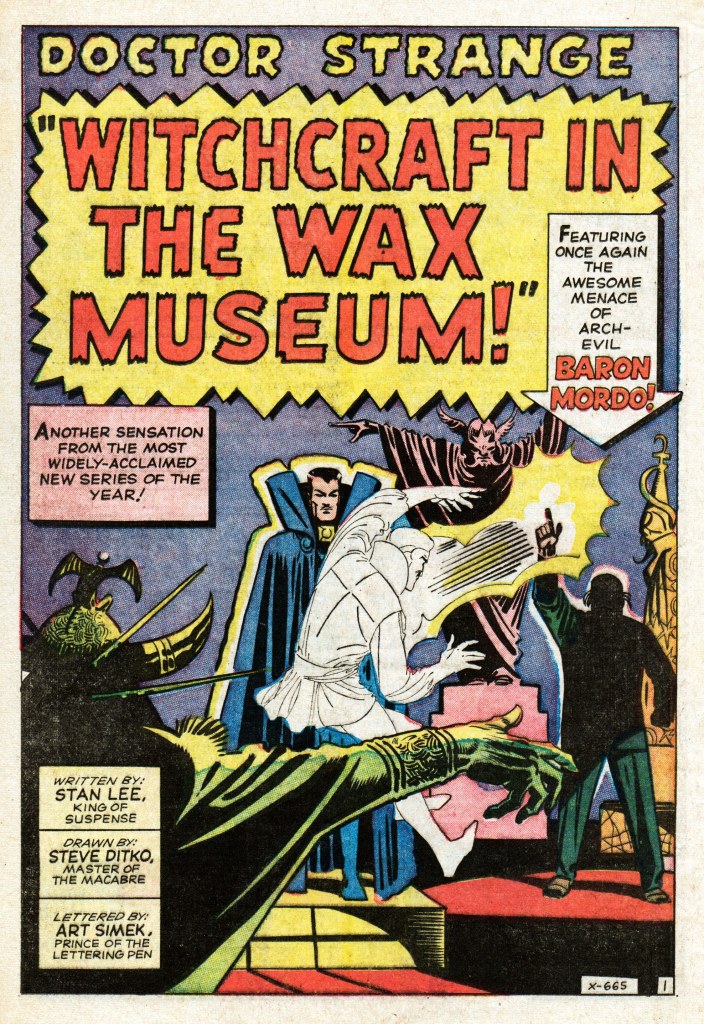
Speaking of Doctor Strange, the story in this issue is one of Ditko’s moodiest. It was the first Doctor Strange story that I ever read when it was reprinted in the pages of an issue of GIANT-SIZE DEFENDERS in the mid-1970s.
At nine pages, it was Ditko’s moody and expressive artwork that was the real draw to this story. It opens with Strange receiving a telephone call for help. In order to get to the scene more quickly, he chooses to travel in his ectoplasmic form, leaving his mortal body behind. But arriving, he discovers that the call was a lure to draw him away from his Sanctum–and when he returns, he finds that his physical body is now missing!

A pause here not just because of this house advertisement for AVENGERS #5 but because this page also gives us the Statement of Ownership, allowing us to get a glimpse into just how well STRANGE TALES was performing at around this time. It shows that the book was selling 190,820 copies on a print run of 317,493, giving it an efficiency percentage of 60%, a higher ration than most of the titles whose Statements we’ve looked at, especially during the 1970s. So STRANGE TALES was in healthy shape at this moment.
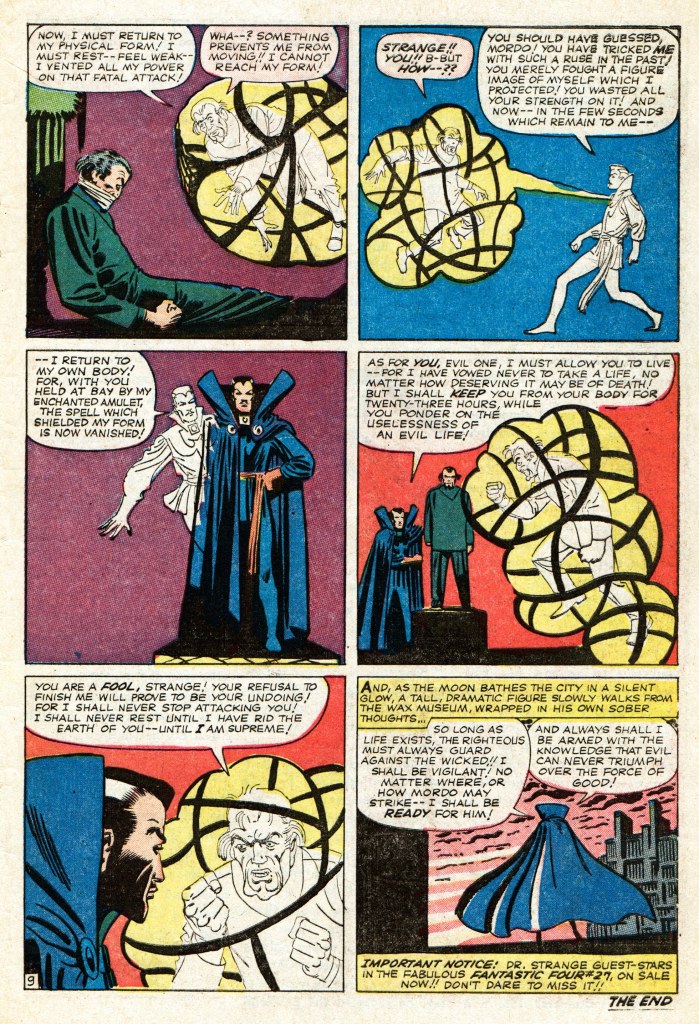
Strange is able to follow the trail of his human form to a nearby wax museum, where it has been set up to look like an exhibit. But it’s surrounded by a spell that prevents Strange from re-entering it–and if he’s separated from his human form for 24 hours, he will die. The perpetrator is of course Baron Mordo, but Strange is able to trick him into entering his ectoplasmic state as well, then venting all of his power on an illusion that Strange has created. (Lee accidentally has Mordo refer to Strange as Doctor Doom once during this fight.) With Mordo exhausted, Strange is able to easily restrain him, then break the spell shielding his body and retake it before the time limit is up.
 The Tom Brevoort Experience
I never became a Doctor Strange fan either, but I love most if not all of the Ditko Dr. Strange stories… especially when he kicks it up a notch after Dormammu appears and he upgrades Doc’s costume and powers. That begins a 14 issue stretch in this run which might have been way ahead of anything else on the stands at the time in terms of action and plotting.
I likewise read this Dr. Strange story first in GS Defenders #4… which is a great book in it’s own right.
LikeLike
The big problem with early Plant Man is that the original concept limited him to making ordinary plants use their limited resources, hitting the Torch with acorns and dew and such. At some point his plant-hoodoo could actually alter plants into dangerous mutations, which made him reasonably formidable.
Doris Evans was no prize, either in this story or any other. Her schtick was that she was always busting Johnny’s chops for flaming on, and had to be mollified even when he used his powers to defend others. But when it’s her father in danger, it’s, “Oh, Johnny, you must flame on to protect MY daddy.” Compared to her, Jerry Siegel’s other chop-busting lady, Rose Troy from THE WEB, was generally consistent. She always wanted her husband to protect her husband from his own folly, first by nagging him to quit crusading, and finally, at the end of the series, training herself to be a costumed hero so that she could function as his backup, though without telling him who she was. But one can’t imagine Doris Evans showing that much gumption.
LikeLike
There was only one time I liked Plantman, and that was in his first appearance. Wait! I can explain! It was mostly because I liked the lameness of the villain and his Green Shadow outfit. Probably also because Jerry Siegel scripted, and I could never dislike a Siegel story.
LikeLike