

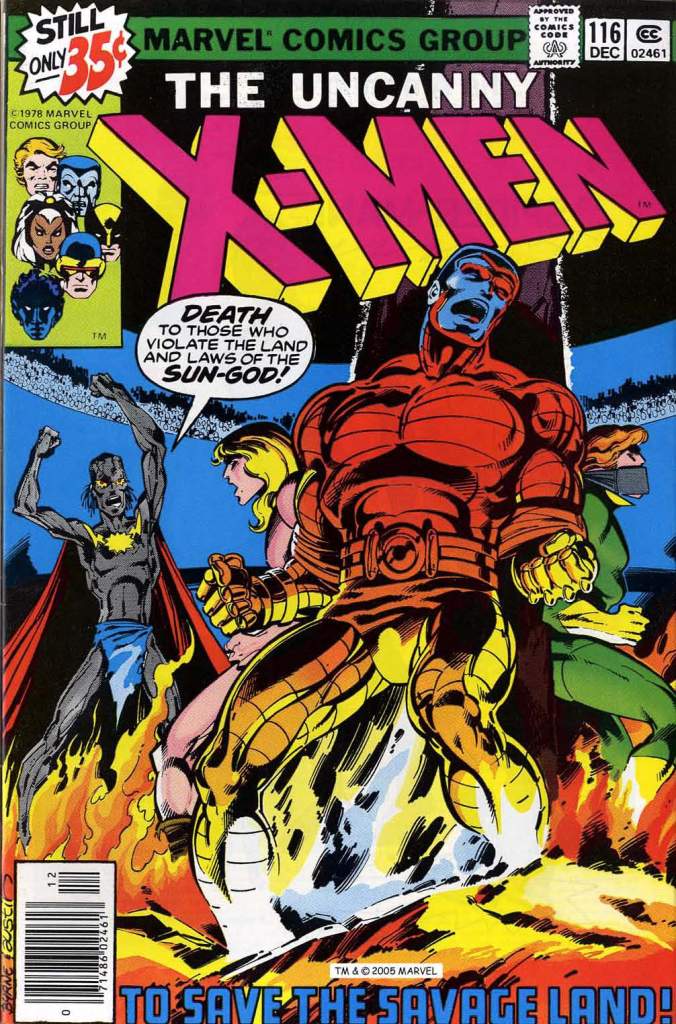
The release of this issue of X-MEN represented something of an existential crisis for me. You see, I had somehow missed the previous issue, #115, which was unthinkable to me. What’s more, I had dutifully gone to the 7-11 every single week on Thursday in-between when #114 came out and when #116 dropped. I wasn’t all that sophisticated about it, but I reasoned that if I was there every single week when the new comics came out, it would be impossible for me to miss an issue. But it had happened anyway. This increased my sense of dread over the non-appearance of FANTASTIC FOUR #200–a dread that would be proven out when #201 showed up a week or so later. I suspect that FF #200 and X-MEN #115 were both part of the same shipment that never came to my 7-11, but no other title was thus impacted that I noticed. Eventually, a few years later, I broke my own self-imposed rule about not paying any more than $4.99 for a single comic book by purchasing that elusive #115 from Port Comics for a fiver. X-MEN issues tended to accrue in value swiftly in these days, when demand far outstripped the supply of the earliest issues of the all-new team.
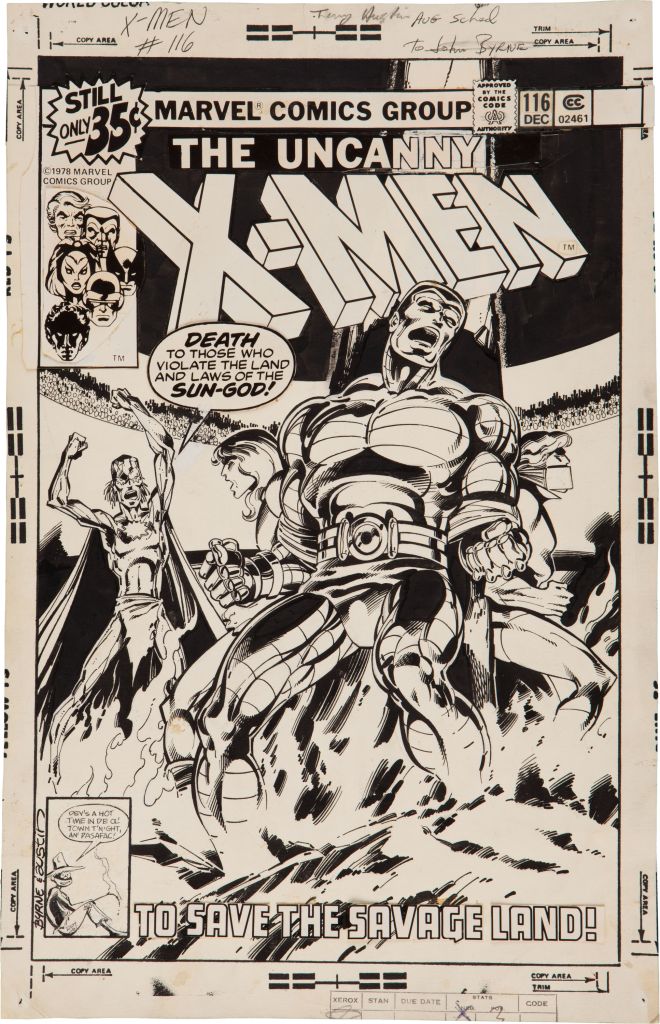
I also feel obligated to report on a very sad artifact of the era. On the original art for this cover, somebody has drawn in a racial caricature in the UPC box, making an ill-considered joke. In more recent years, John Byrne has insisted that this wasn’t done by him, and it may not have been. But it was most likely either him or Terry Austin, who inked this cover. While it could have been added later on in the Bullpen, there really wouldn’t have been any reason for anybody to do so at that point. The Marvel offices were hardly racially sensitive even when I first got there in 1989, and reportedly in the 1970s it wasn’t uncommon to find such images adorning the Bullpen walls and other such places. Sad, but that’s the way it was.
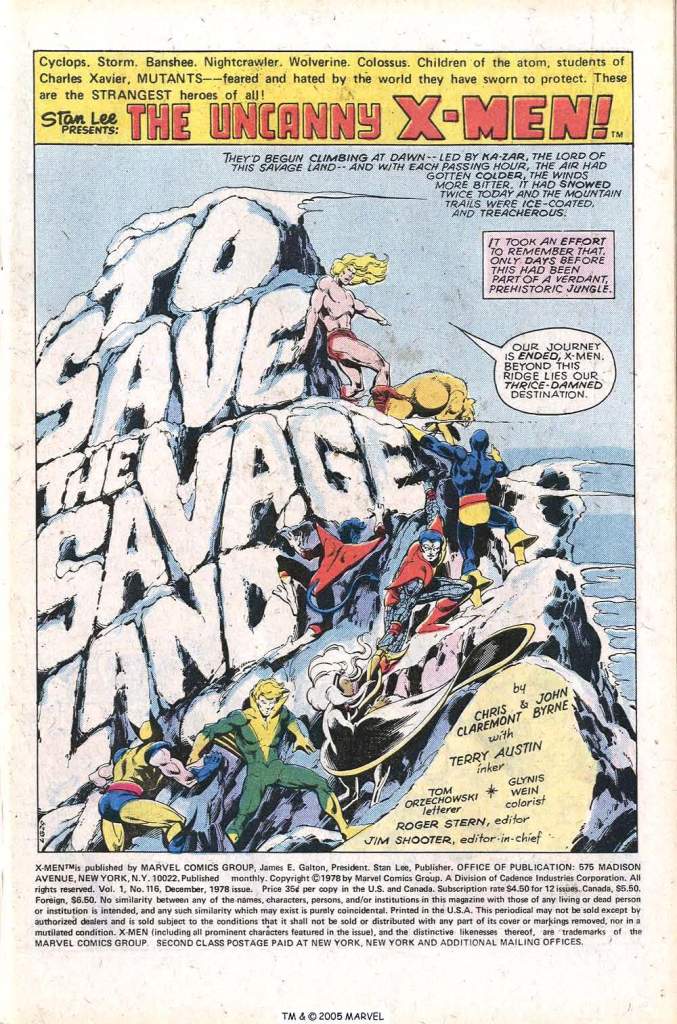
In any event, I needed to get caught up to where the storyline was and what had happened in the interim. When I had last left off , the X-Men were in the Savage Land, believed killed in battle with Magneto by the outside world including their own teammates, and about to be attacked by their old foe Sauron. Here, an issue later, there’s a new threat posed by Garokk, the Petrified Man and his High Priestess Zaladane, who are inadvertently shrinking the Savage Land as a part of their machinations. The X-Men and Ka-Zar head off to deal with this situation
It has to be said, X-MEN was the best, most modern looking comic book on the stands in 1978, and in terms of its focus on characterization in the midst of action, it had no equal. Nothing else was really even close. That was due to the synthesis of talents between the three primary creators, Chris Claremont, John Byrne and Terry Austin. Byrne was still a bit of a newcomer, but that meant that he was willing to work harder in these days to prove what he could do. He also possessed a strong sense of storytelling and dynamics, both of which were put to good use. In Terry Austin, he found a sympathetic inker who slicked up his line and gave the series a polished sheen that was inevitably attractive. Terry was an artist in his own right, and so added additional detail to John’s images wherever it might have been needed. And Claremont focused primarily on character dynamics, the interior lives of the characters. So while Byrne’s images drove the plot forward, Chris would find spots to incorporate some internal reflection that told you more about who the characters were. The new X-Men had only been around for a short time at this point, and so the details of their lives and pasts and personalities were still being formed.
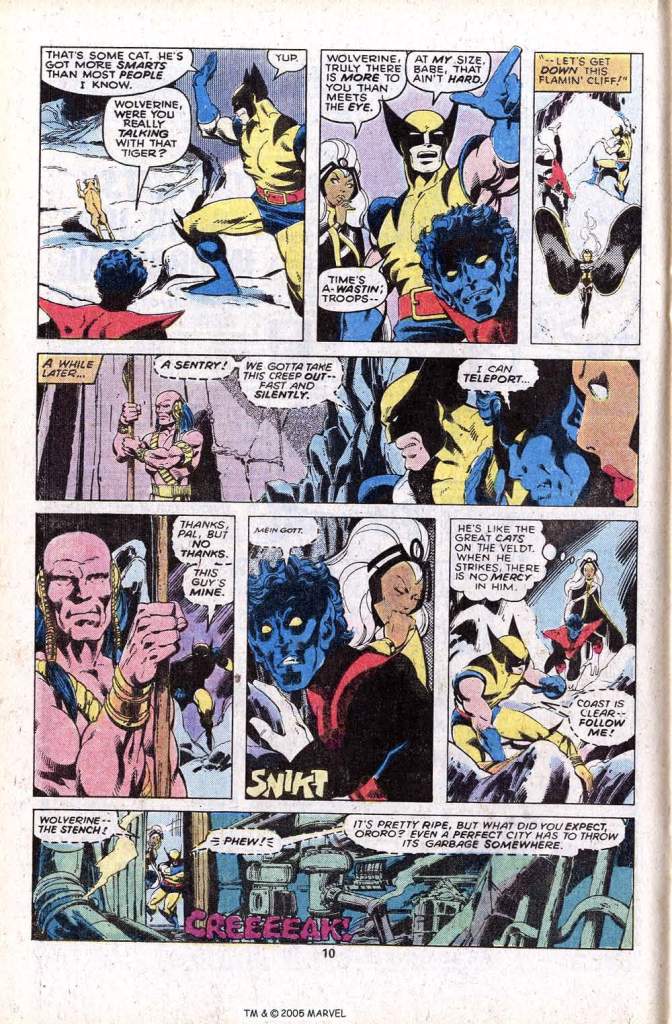
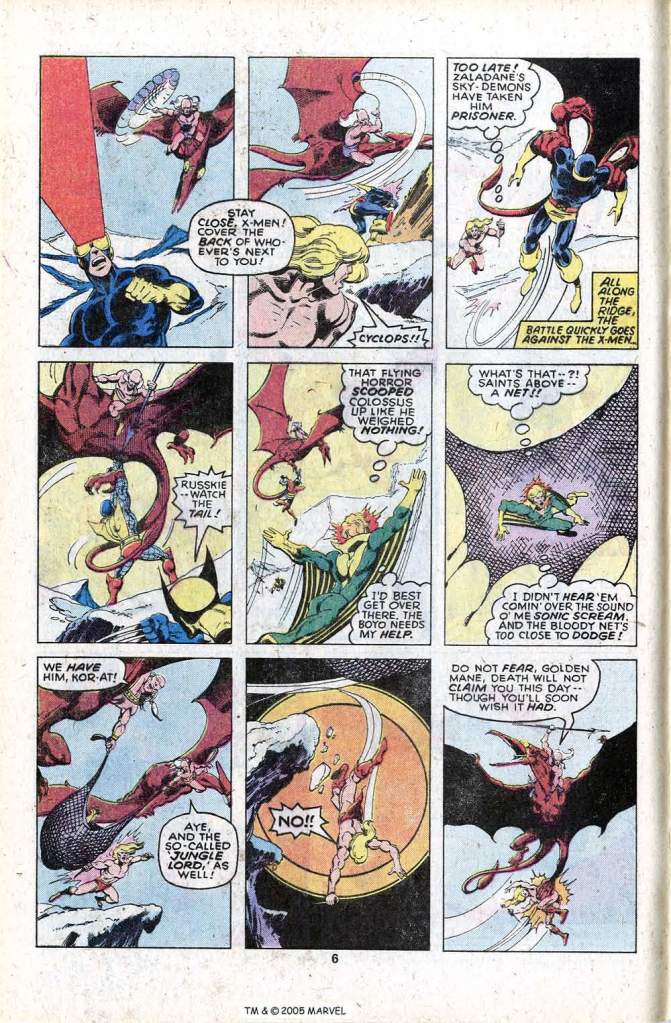
En route, the X-Men are attacked by pterodactyls sent by Garokk and Zaladane, and a bunch of them are carried off. This leaves Wolverine, Storm and Nightcrawler to sneak into the villain’s citadel and attempt a rescue. The page above caused a stir when it first saw print. In 1978, super heroes as a rule didn’t kill people–the audience was still largely considered children. When questioned about it, Chris Claremont indicated that this bit wasn’t in his plot, it was added by John, and Chris denied having written the sound effect in Panel 5 that indicates that Wolverine has popped his claws and finished that poor hapless guard–and it’s entirely possible that the addition was made by editor Roger Stern. Either way, there was a bit of blowback in fan circles and in the office of editor in chief Jim Shooter, who didn’t think that super heroes should behave in this manner. In this instance, he’s actually right, in that while the guard is working with the bad guys, he’s not doing anything to threaten the lives of Wolverine and his fellows. So this is a straight up murder, for all that you might try to argue a wartime posture and so forth. The question of whether Wolverine would be allowed to actually kill people would develop between this team and Shooter over the course of the next few months.
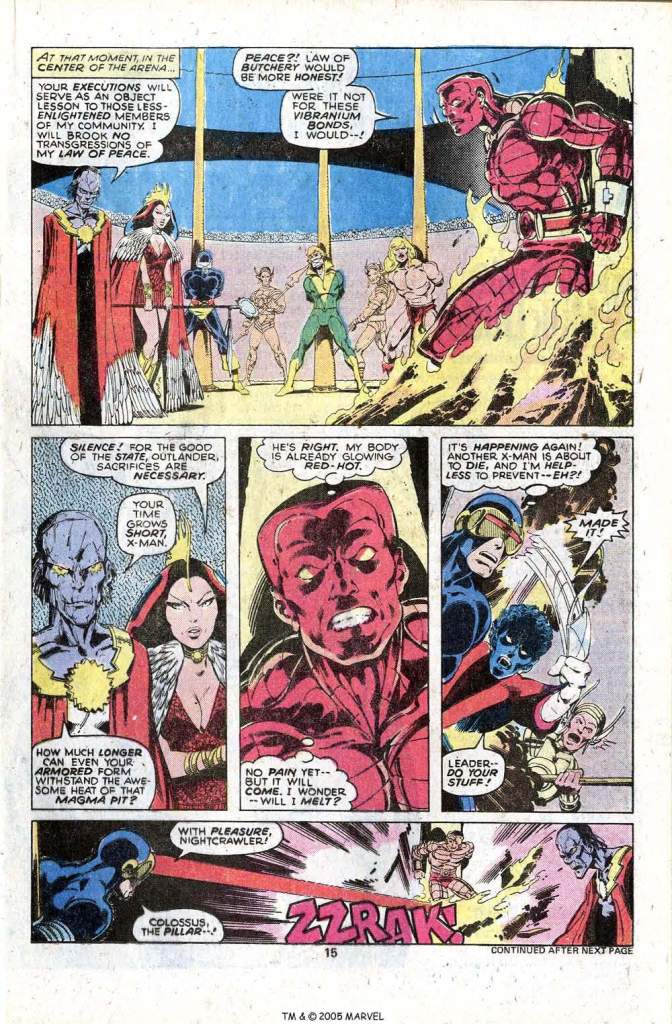
In the center of the arena, Garokk and Zaladane are planning to sacrifice the captures X-Men, exposing Colossus to underground magma that heats him up to dangerous temperatures. But the cavalry arrives in the form of the other X-Men trio, who burst in and move to free their fellows. This leads into another crazy free-for-all in which Byrne gets to show off his skills at choreography while simultaneously fitting an awful lot of information onto each page. In this era of 17-page stories, this was a necessity, and the only artist who was ever better than it that John was is George Perez.
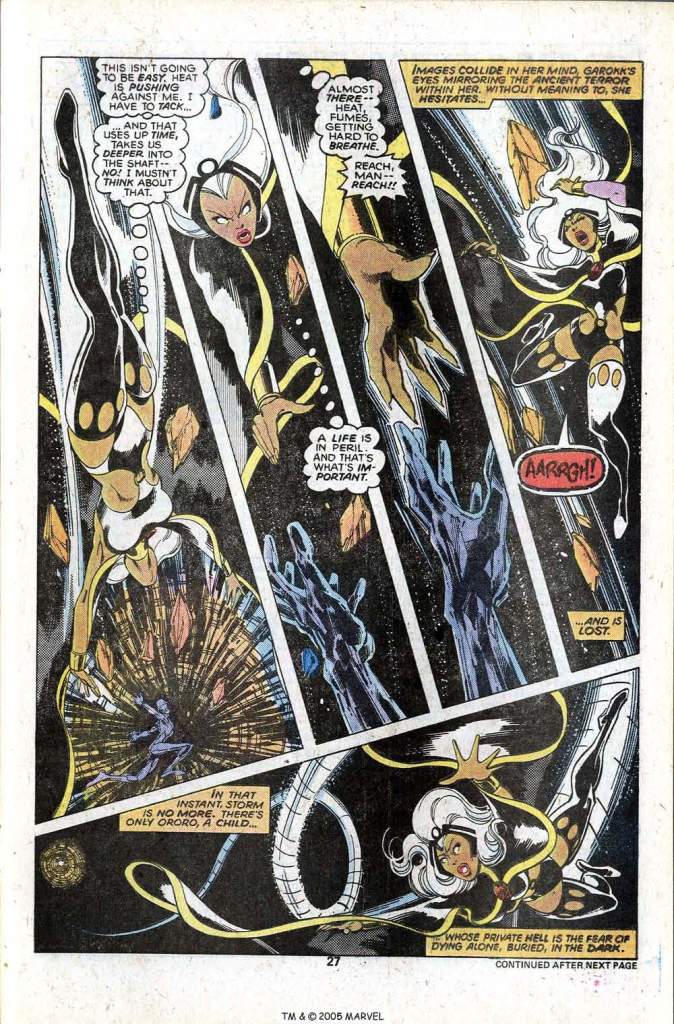
The fight ends with Cyclops chasing Garokk to the top of the dome. This structure acts as a geothermal tap which is what generates the warm area that sustains the Savage Land. Garokk wants to absorb its power for himself, and he winds up facing of with Cyclops in a duel of energy beams. As Garokk draws more power from the citadel, the place begins to shake and break up, and the two combatants are hurled groundward while everybody else races for cover. Banshee is able to snatch Cyclops out of the sky in time to save him, and Storm attempts to do the same for Garokk. But as the rubble closes in around her, she’s struck by a bout of her claustrophobia and is unable to grab onto Garokk before he is lost in the collapse. More than just a typical villain death of the sort that closes out a lot of Marvel stories of this era, this personal failure weighs on Storm in the close of the issue.
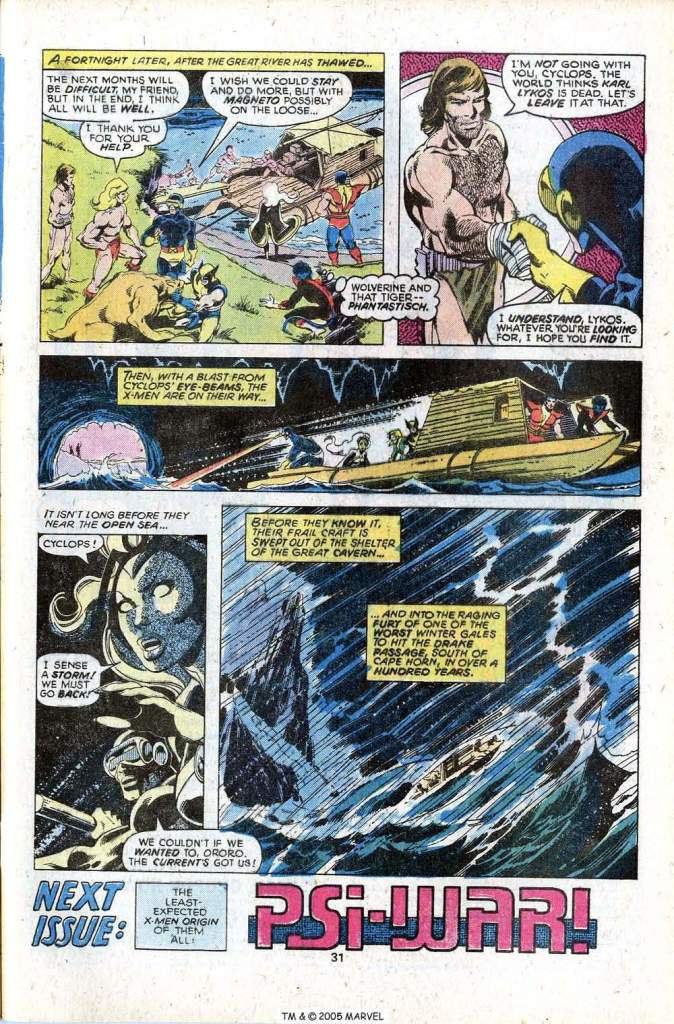
With the adventure at a close, the X-Men part ways with Ka-Zar–and with Karl Lykos, the man who is secretly Sauron, who appears to have been cured of his need to drain mutants for life-sustaining energy last issue. The team sets off on a raft they’ve constructed, attempting to get back to civilization and home. But within a few panels, they’re caught up in a wild storm that threatens to destroy their boat and cast them into the cold and remorseless ocean. To Be Continued! The wider world hadn’t caught on to the series just yet, but in 1978, X-MEN was the book to be reading.
 The Tom Brevoort Experience
When did you see the original artwork to the cover, and thus the caricature, for #115, Tom?
LikeLike
I wouldn’t have seen it until it came in not the market probably in the 1990s or 2000s. Are you implying that somebody who owned the piece before then did it? It’s not impossible, but I find that scenario very unlikely.
LikeLike
Tom,
No, I am simply wondering how and when you saw the caricature on the cover that you mentioned.
LikeLike
I couldn’t tell you for certain, only that it would have been when the page was on the market. But I reproduce an image right there in that piece that I grabbed whenever I saw it.
LikeLike
The character touching three sides of the box would have created a small hassle for the production staff in the stat room when the bar code was applied. It would have needed to be whited out at some point and since the rest of the trade dress if there I would think the character was added after the cover art went through production. But I could be wrong.
LikeLike
I loved the leadership role that Wolverine took in this issue.
LikeLike
My abiding memory of this issue is being confused by plot elements relating to events that had previously occurred in the Savage Land. IIRC, Chris Claremont would apologise for this in a later letter page.
LikeLike
He did. I reread the issue relatively recently. And I had the same reaction — very little of this mythos engaged me. Though having read some of Ka-Zar’s early appearances even more recently, it’s striking how the setting has changed — there’s no suggestion in the early Silver Age of any civilization in the Savage Land.
LikeLike
Anything that Byrne touched in that period was gold. X-Men was far and away comicdom’s best title then, only matched (briefly) by the Englehart-Rogers-Austin Detectives.
LikeLike
Congrats on the new X-Gig, Tom! Can’t wait to see where you steer the ship 🙂
LikeLike