

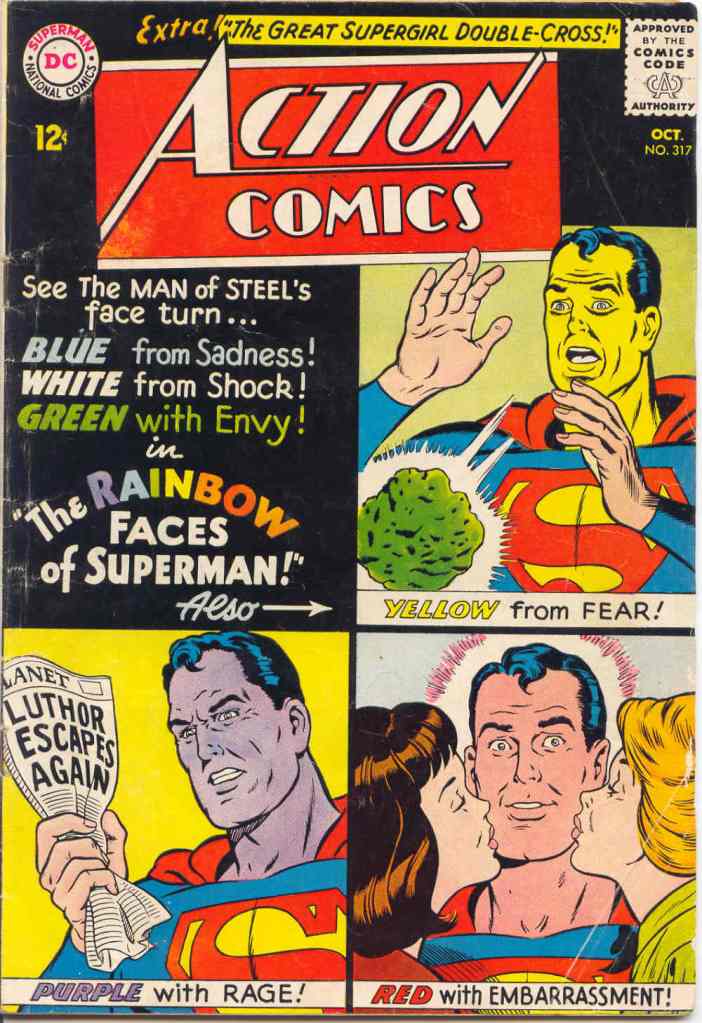
We’re getting down to the end in my summations of my Windfall Comics purchase of 1988, which means that we’re going to start to see the same titles show up again and again, issue after issue. These were the books which were a part of that purchase in some bulk, the ones whose demand on the back issue market at that time was slim. Given the huge circulation of the Mort Weisinger Superman titles and the fact that there was only limited interest in them as back issues in the 1980s, you can see where this is going. I got a lot of issues of these books for my money.

Going to start off this time out with this public service announcement strip that ran on the inside cover, courtesy of DC editor Jack Schiff. These community service pages were a passion project of Schiff’s by all accounts, and they were included in virtually every DC title as filler pages for years and years. This particular one was illustrated by Sheldon Moldoff. And it’s a good example of how well-intentioned DC/National Comics was, yet how out of step they were at the same time to the lives of their target demographic. No genuine teenager was using slang of this sort outside of television and the movies, and it served to blunt the message a little bit, as it was clearly coming from people who were like your parents, rather than like you.
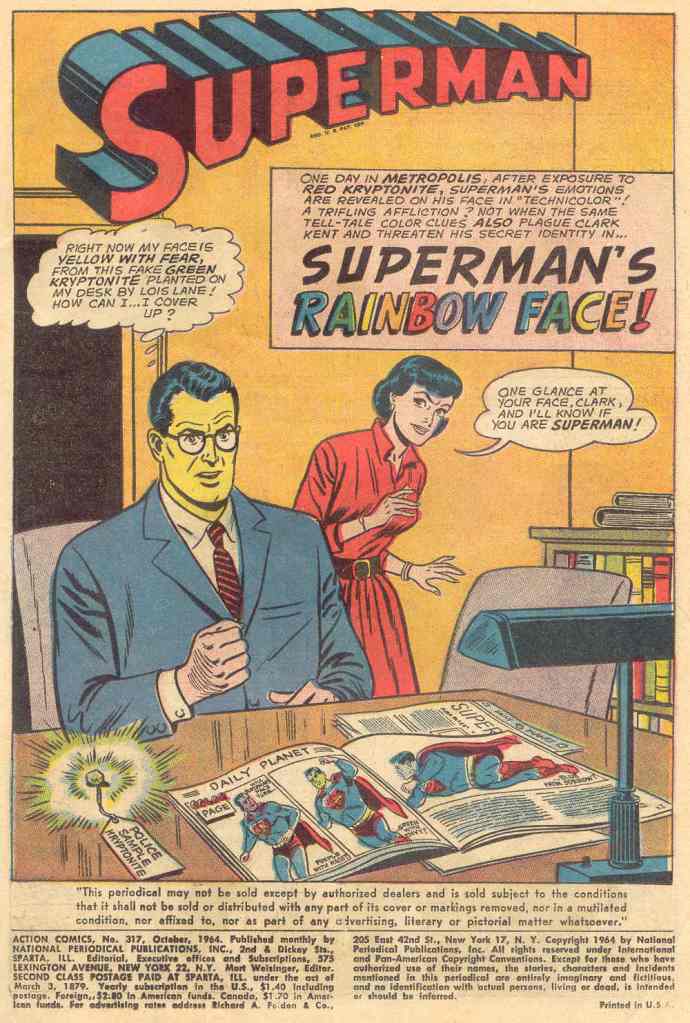
By this time, shrinking page counts had caused ACTION COMICS to be split pretty much equally between the lead superman feature and the Supergirl back-up story. In essence, they were the co-owners of what amounted to a split book–except that Superman typically got all of the covers spots, with rare exception. “Superman’s Rainbow Face” was written by Otto Binder with artwork by Al Plastino. It’s a typically gimmicky exploit typical of the strip at this juncture. The Comics Code had seen to it that Superman couldn’t do anything genuinely thrilling, and so editor Weisinger along with his creators worked around those limitations, giving the Man of Steel puzzle situations to solve and strange transformations to cope with. And each story was told in storybook fashion, with each panel comprising a complete idea separate from the one before and after it. It was basic storytelling, but done so well that even the youngest readers could follow the stories.
The conflict in this story isn’t really physical at all. Nobody is really in jeopardy from any of it, apart from Superman’s secret identity as Clark Kent. The story opens with Superman returning to Earth after taking care of an errant meteor storm in space. But one of the meteors must have contained some Red Kryptonite, the element that causes Superman’s body to mutate in strange and unpredictable ways. In this instance, his face becomes like a mood ring, changing color brightly as he experiences strong emotions. Lois Lane sees Superman’s face turn red when he’s mobbed by female admirers and she learns of his exposure. This is, of course, the perfect time for her to confirm her long-held suspicion that Superman secretly poses as Clark Kent.
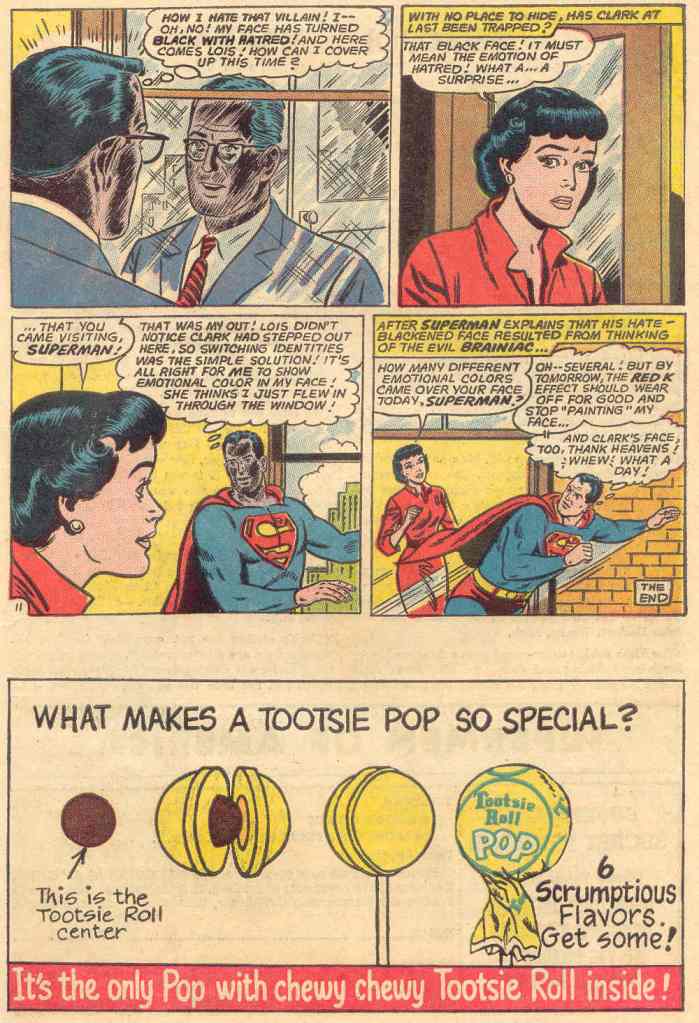
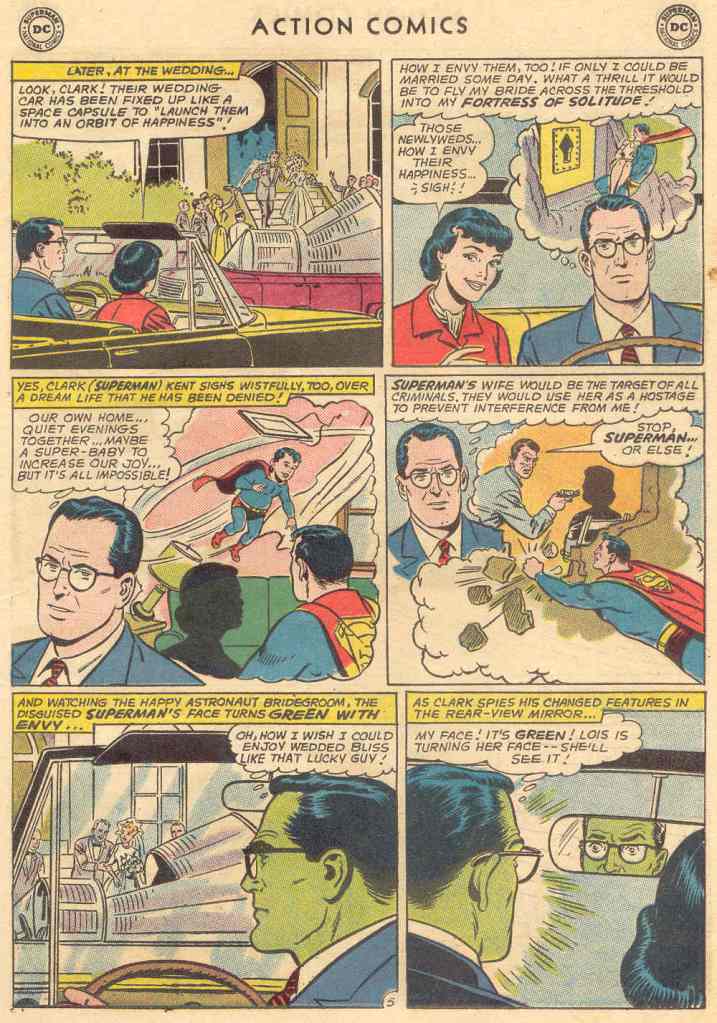
The rest of the story is nothing more than circumstances creating situations in which Clark’s face changes to a different color and he needs to use his super-powers cleverly and quickly to divert Lois’s suspicions. By the end of the story, the effect hasn’t even worn off totally yet–but having cycled through all of the basic colors once, writer Otto Binder chooses to call it a day at that point. It’s a fun story for what it is, although there are some serious strains on credibility as Superman arranges for circumstances to cover his transformations, such as moving an entire “Green Lantern” Inn (no relation) next to the car he and Lois are riding in so that she thinks his green face is being caused by reflected light from its signature lantern.
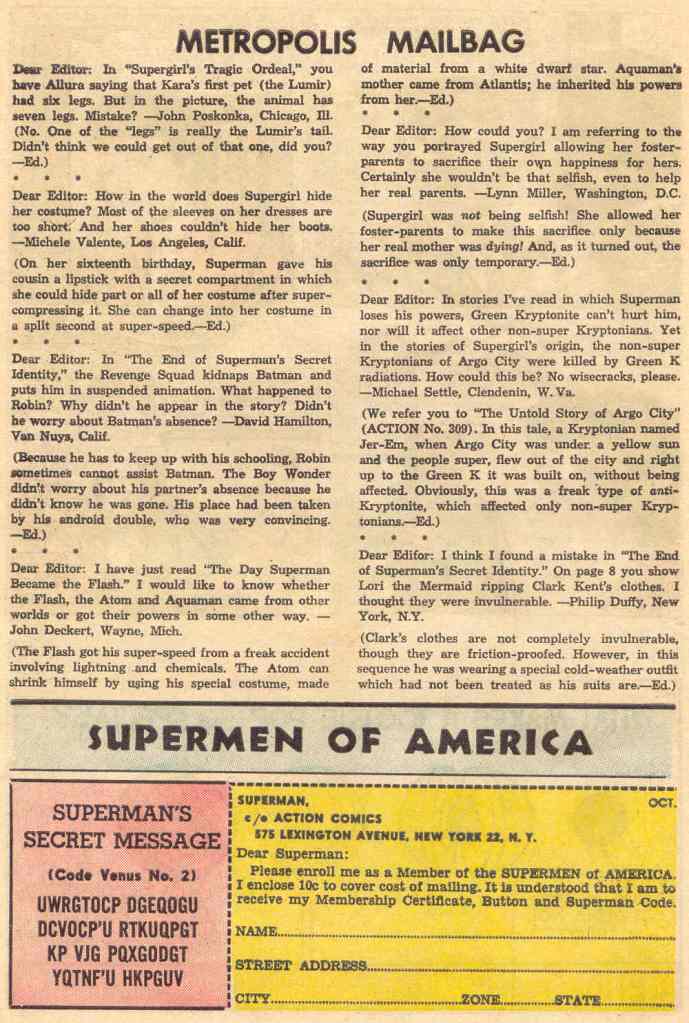
The Metropolis Mailbag letters page is a bit truncated this time out so that a plug for the newly-reactivated Supermen of America can be included as well. This Superman fan club had been running on and off for two decades by this point, though membership didn’t really amount to much more than receiving a cool membership kit of items, including Superman’s Code-Wheel through which you could figure out the secret messages in the comics. These were usually plugs for what would happen in the next issue.
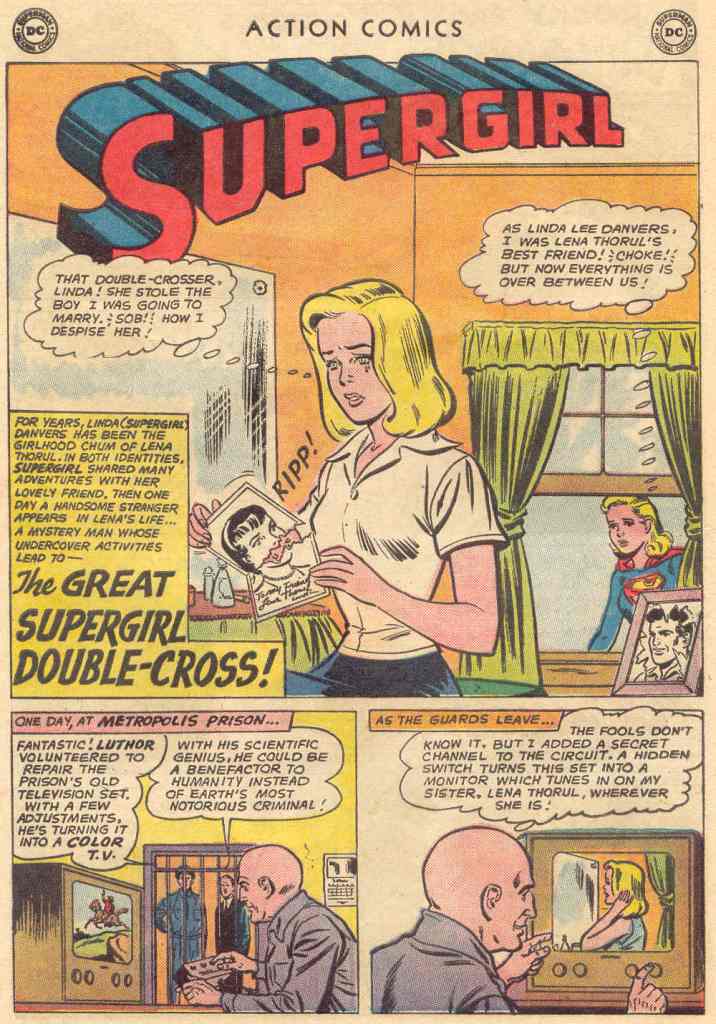
Unlike the lead Superman feature, the Supergirl back-up series operated more like a soap opera. While most individual installments were complete in and of themselves, they continued with long-running subplots and emotional situations. As a result, it was a bit more satisfying to continuing readers, more in the mold of what Marvel was developing at the same time. The story in this issue was written by Leo Dorfman and drawn by Jim Mooney, and it features Lena Thorul heavily. Lena was Lex Luthor’s secret sister who also possesses ESP powers. She wasn’t a bad person, though, and Lex’s parents had changed the family name so that she would never know that she was related to the nefarious criminal Lex Luthor.

In this story, Lena’s got a new beau, Jeff Colby. But Supergirl discovers that he’s secretly an enemy spy working to pillage the defense secrets of our nation. Elsewhere, Luthor had modified the prison television so that he can watch his sister remotely–not at all creepy–and he’s also aghast by who her new boyfriend is. With Lena and Jeff getting serious and planning their wedding, Supergirl knows that there’s only one thing to do: she’ll have to break them up before they can be wed so that Lena will be spared the pain when Jeff is arrested for his crimes. Now, she doesn’t immediately arrest Jeff herself, nor does she tell Lena about any of this. Because either of those moves would eliminate any possible misunderstanding, of course. Instead, she uses a hypnotic jewel and a robot stand-in to make it seem like Jeff is falling for her in her Linda Danvers identity and throwing over Lena.
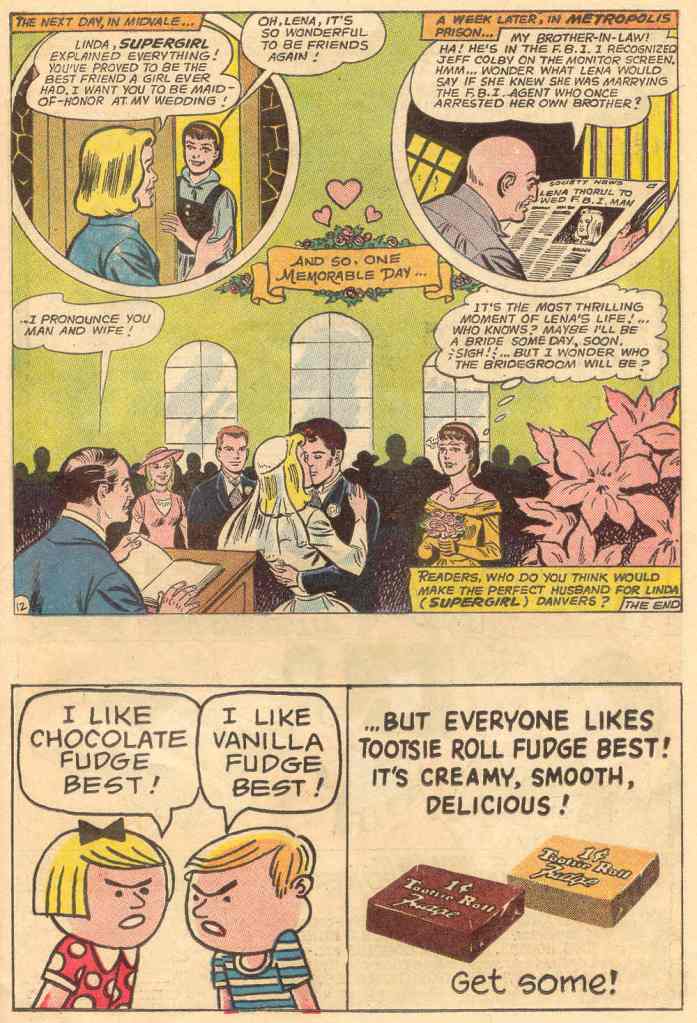
It turns out in the end that Jeff isn’t a spy, rather he’s secretly been working undercover for the F.B.I. to take down the spy ring. Luthor recognized him as a prominent F.B.I. agent on his TV screen, that’s why he was aghast that his sister was marrying him. But it provided misdirection to help keep the problem of the situation seeming real for the readers. In the end, Supergirl admits her ruse to Lena and patches up their friendship. And in the end, Lena and Jeff are legitimately married, which somehow feels like a big shift to the status quo in this instance, even though it doesn’t affect any of the principle characters.
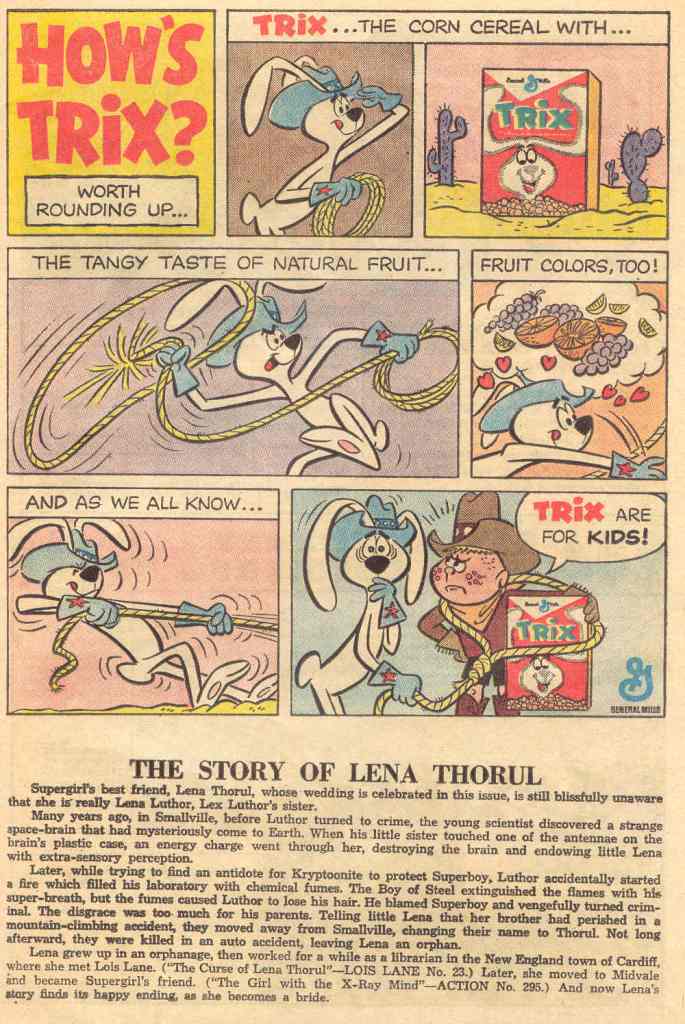
Interestingly, there isn’t a house ad to be found anywhere in this issue. But there are lots of paid ads, which would seem to explain it. The one thing that there is is this short write-up on the history of Lena Thorul, used to fill space beneath a 2/3 page ad for the breakfast cereal Trix.
 The Tom Brevoort Experience
About this time, I had grown bored with Superman, but I still picked-up Action, purely because of what you point out. Yes, there were a lot of soap opera emotional tropes, but I didn’t know that yet. What I knew is that Supergirl’s stories had consequences; there was real change in the characters – even in Linda/Kara. Even my family got involved. My little sister, at age 5, was determined that she would teach our new baby brother to say “Supergirl” as his first word.
LikeLike
And did she?
LikeLike
Sadly, no. Jimmy didn’t say a first word and was almost one when he said, not one word, but a whole freaking sentence. (“Where is that old moon?”) My family never did anything the normal way.
LikeLike
And in addition to Superman’s faces, it looks like Lois got a Kurt Schaffenburger face job.
LikeLike
Bill, Who wouldn’t?
LikeLike
Bill, who wouldn’t want want a new face from Kurt Schaffenberger
LikeLike
Argh! Double posts, thanks to a tiny screen and a dysfunctional brain!
LikeLike
This may have been the first Superman comic I ever got, though I’d seen him already in Justice League. It feels a lot like something Binder might have written for Captain Marvel.
LikeLike