


There was very little that could happen in a comic book at this point in 1978 that was more exciting to me than the prospect of a Thing vs Hulk fight. There had been a number of them previously over the years, but I hadn’t yet read any of those earlier stories, though I was aware of them and their influence in determining who was the big dog monster character of the Marvel Universe. As I was firmly in the Thing’s corner on this question, I was always interested n any occasion when Ben Grimm and the Green Goliath would go toe-to-toe with one another. Accordingly, when this issue of MARVEL TWO-IN-ONE appeared at my 7-11, I was pretty enthused. Unfortunately, the book really didn’t live up to my expectations.
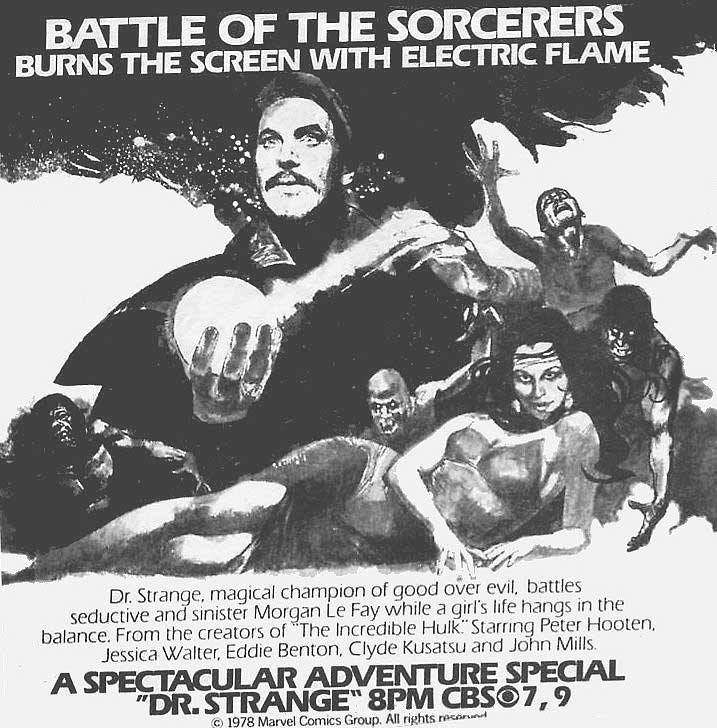
But before we get to that, a quick diversion for another Earth-shattering event that impacted on my world at this moment. One evening, my father came home from work with a color television set, the very first our family ever owned. Color TVs were still fairly expensive in the late 1970s and a luxury item we were forced to do without. As luck would have it, this was the same day that CBS was going to be broadcasting their television movie adaptation of DOCTOR STRANGE, so it was the first program that I got to see on TV in color. And I thought it was great–I still think it was the best of all of Marvel’s 1970s-era television efforts, for all that it’s cheesy and low-rent as hell.
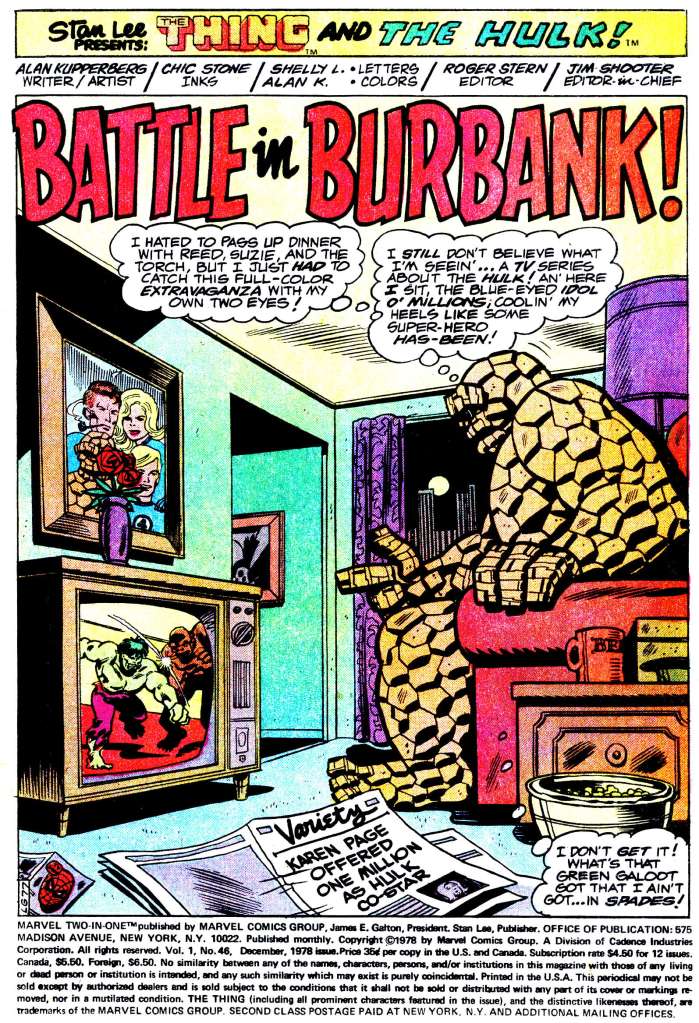
Anyway, back to MARVEL TWO-IN-ON, which I read a few days earlier. The big weak spot for me with this issue was that it was both written and drawn by Alan Kupperberg. I’ve spoken previously about how I didn’t like Kupperberg’s artwork, how his rubbery and unconvincing figures and lackluster page compositions left me cold. Turns out that I didn’t like him any better as a writer. But at this time, and for the previous six months or so, MARVEL TWO-IN-ONE had been a title in freefall, running whatever material new editor Roger Stern could get completed by whomever was around. It was a truly lousy tile during this period, and only my strong attachment to the Fantastic Four kept me hanging on and coming back for more.
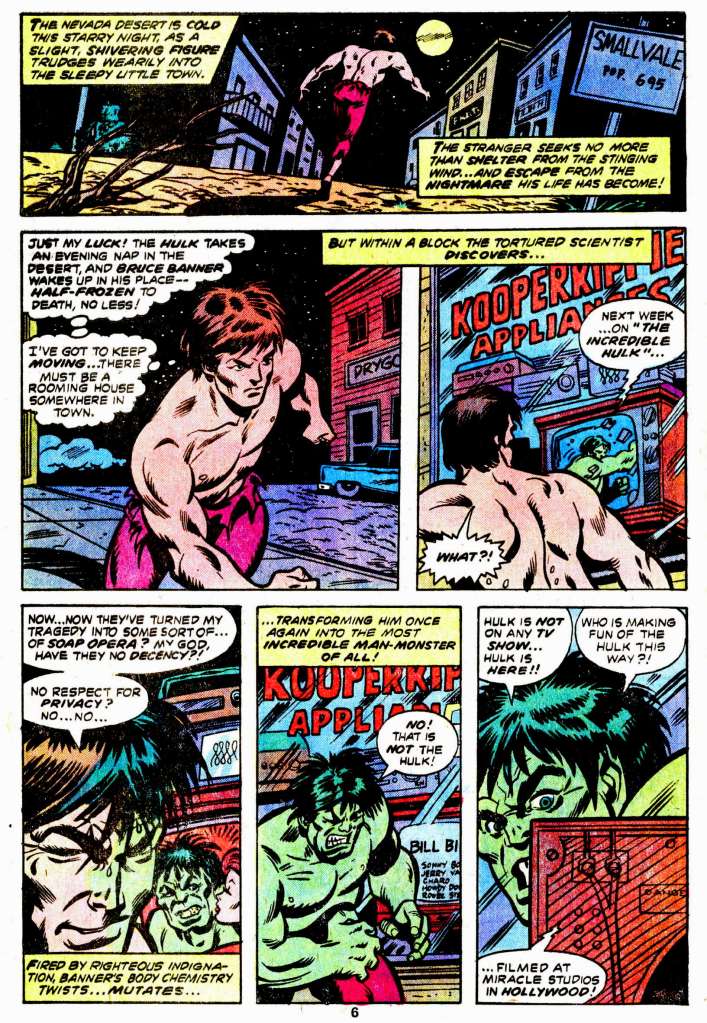
The entire story in this issue is a bit of a broad joke concerning the CBS INCREIBLE HULK television show, which had been picked up for a full season after a pair of pilot films. As the issue opens, Ben Grimm is perturbed to discover that a similar television series has been made within the Marvel Universe, starring a version of his old sparring partner, the Hulk. Jealous about the situation, Ben wings his way towards the west coast, intent on putting himself forward as the subject of a similar series. Meanwhile, a trio of ne’er-do-wells who had recently been fired from the studio for stealing and attempting toe peddle production secrets have an idea about their next score. They read that Karen Page (Daredevil’s old girlfriend who had gone to Hollywood to make it as an actress) had been offered a million dollars to co-star in this Hulk series (which is somehow both airing so that the Thing can see it, but early enough in production to where the female lead hasn’t been cast yet). The three goons figure they can abduct Karen and force the Studio to pay a ransom for her safe return.
Meanwhile, somebody else who’s upset about this new Incredible Hulk television series is the actual Bruce Banner, who apparently knew nothing about it until happening across a broadcast. How that works from a legal perspective (to say nothing of a security perspective) goes unaddressed. As you’d expect, when Banner gets upset, he transforms into his bestial alter ego, who is similarly not amused–so much so that he too heads for Hollywood with the intention of smashing those responsible. Accordingly, all three factions cross paths at their intended mutual destination, and fireworks go off. The Thing meets with a producer who was named after future Marvel painter Joe Jusko, who tries to calm Ben Grimm down and address his demands.
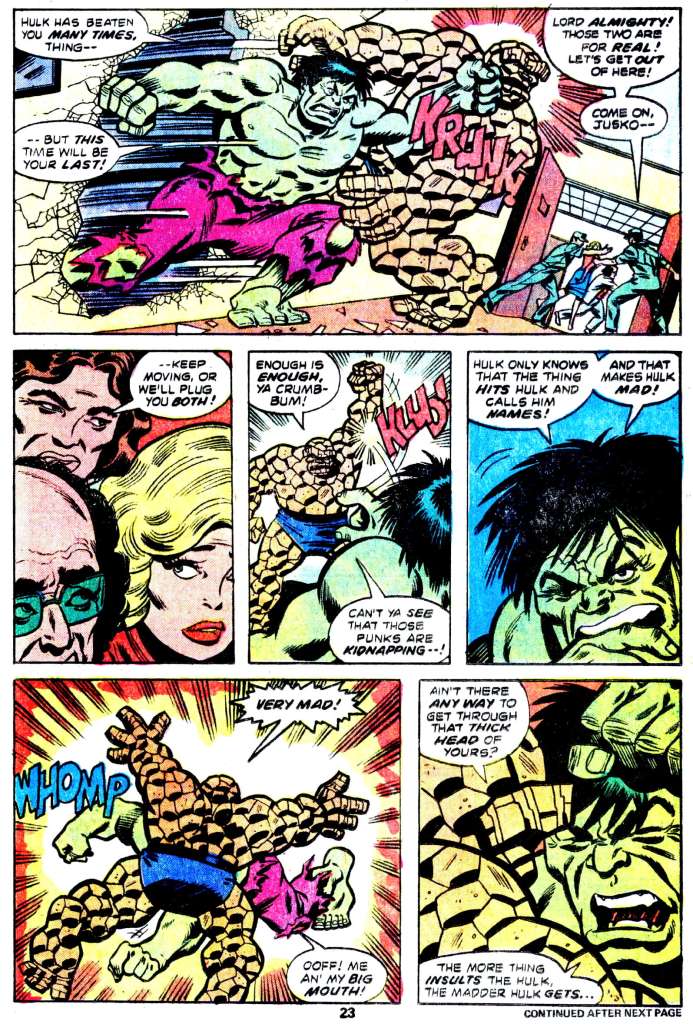
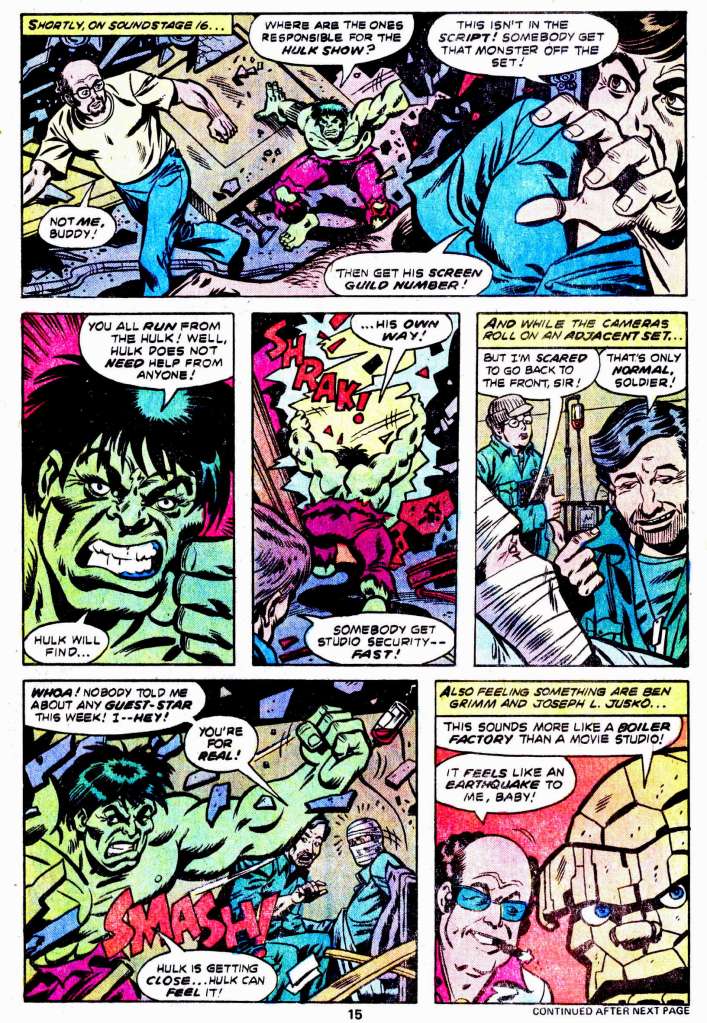
As the Thing converses with Producer Jusko, the Hulk comes crashing his way in through a wall, and mayhem ensues. Using the brawl as cover for their own activities, the three goons put the snatch on both Karen Page and Joe Jusko, whom she is waiting to see to sign her contract to star in his Hulk series. The fight between the Thing and the Hulk doesn’t have a whole lot of weight to it–this entire story is played very much as a goof, a comedy–careening through the sets of other series that are shooting, including M.A.S.H.

The Thing becomes aware of the attempted kidnapping, but the enraged Hulk keeps waylaying him and preventing him from doing anything about it, try as he might to break away from his larger, stronger foe. Eventually, the chase/escape leads all involved to the set of a toga drama, and the Hulk brings the entire soundstage crashing down on everyone’s heads in a re-enactment of the feat of Samson. As the dust clears, Studio security shows up to take the bad guys into custody–and Jusko begins to attempt to negotiate with the Hulk in an attempt to quiet his rage.
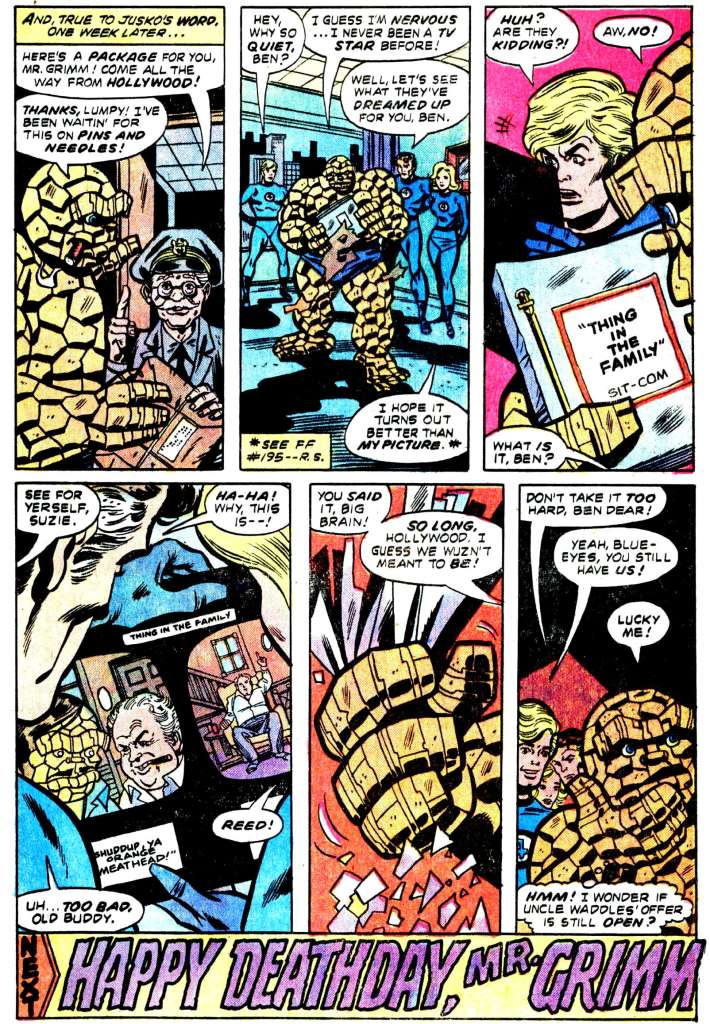
In the end, Jusko convinces the Hulk that he’ll be treated properly in his television incarnation, and the Hulk leaps away, warning the producer not to make him look stupid on TV again or he’ll be back to smash. Also departing is Karen Page, who’s had enough of this craziness, million dollars or no million dollars. (She may have wished she stayed once we got back to her a few years later, where Frank Miller turned her into a strung-out addict who failed as an actress and had her sell out Daredevil’s true identity for a fix.) The Thing is also promised a project that he can be a part in–and so the story ends with the delivery of teh Studio’s pitch for the new show, “Thing In The Family”, a blatant knock-off of the popular Norman Lear sitcom with the Thing in the Rob Reiner role. While I got most of the so-called jokes, I didn’t really find any of this at all funny, so the issue was a bit of a bust for me. But that didn’t stop my brother Ken from buying his own copy a few weeks later, as he was still pretty entranced by the Hulk TV series at this time.
 The Tom Brevoort Experience
At this point, Joe was more of a current Marvel painter, since he’d had two covers in print earlier that year — a MARVEL PREVIEW with Star-Lord and a HULK Magazine.
But he’d certainly go on to do much more.
LikeLike
This leaves me and my then-three-years-old daughter as the only two people who enjoyed this issue. But by then, a wacky Hulk vs Thing was long overdue since it had been almost a decade since “Thung Vs Bulk!”
LikeLike
The only good thing was the cover. I can’t find Cockrum’s signature but there are enough tells I don’t need it. Was it inked by Romita?
LikeLiked by 1 person
It’s Keith Pollard inked by Bob Layton, but it does look like a Cockrum sketch, and those hands in the foreground were probably just like that in the rough, I’d guess.
LikeLiked by 1 person
I was a huge Hulk fan, a huge Thing fan, and a huge MTIO fan. I found this issue incredibly, fantastically disappointing. One of my least favorite MTIO issues.
LikeLike
This story could have been so much better. It was a missed opportunity for so many potential jokes about Marvel’s deal-making. Remember, in-universe the FF has “people” who deal with their licensing. Ben should be talking to one of them, and then for the fight the Hulk can go to the same office to smash (which is tighter plotting, since it’s reasonable the same person might handle various meta-human stuff).
As to the lack of wisdom of doing projects which might anger a rampaging monster with poor impulse control, isn’t that business as usual in Hollywood? One missed joke was an agent saying dealing with the Hulk was easier than with [insert petulant celebrity]. And that’s probably kind of true too! There’s a lot of raging jerks in that business, and the Hulk isn’t especially mean or at all trying to cheat anyone.
LikeLike
I love the Dr. Strange TV movie.
I suppose the thinking was that since Hulk’s a federal fugitive Bruce Banner was hardly in a position to sue them for using his likeness.
LikeLike
And maybe that was why they renamed him David for the show- distance him from the real (in the comics) person.
LikeLike
I’ve read it’s because Kenneth Johnson didn’t like the name Bruce.
LikeLike
https://ukjarry.blogspot.com/2008/07/156-incredible-hulk-parody.html
“Mad Magazine” January 1979
Banner: “As a matter of fact, my name is “Bruce” in the Comic Book version! But the Producers felt it wasn’t a masculine enough name for TV!”
TV in the background: “And Jenner wins the Decathlon!! BRUCE is the WORLD’S GREATEST ATHLETE!!”
LikeLike
I mean, in the Marvel Universe version of the show, not the real-world version. Maybe they felt that the Hulk wasn’t likely to sue them, but Bruce Banner might, so they changed the character’s name to David. (Just [over] thinking in-universe here.)
LikeLike
Let’s be grateful ol’ Jade Jaws didn’t say “Hulk M*A*S*H!”
LikeLike