

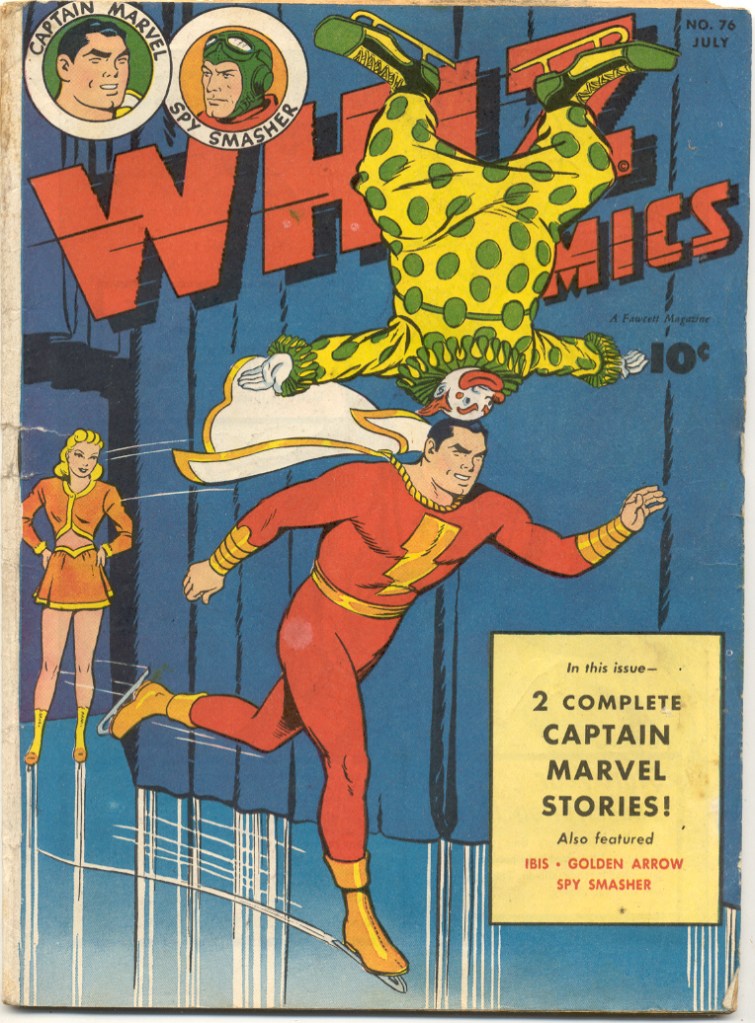
Spy Smasher was introduced in the first issue of Fawcett’s WHIZ COMICS (numbered as #2 so as to account for an ashcan edition created solely to secure copyright to the title.) The brainchild of Bill Parker and C.C. Beck, he became one of the most popular characters in the Fawcett publishing line, appearing in his own self-titled series as well as WHIZ COMICS and also making appearances in other Fawcett anthologies such as AMERICA’S GREATEST COMICS. Most crucially for his popularity during the war years, Spy Smasher was the star of a well-remembered 12 chapter Republic Movie Serial, the second comic book hero after Captain Marvel to make it to the big screen.

Everything was going along really well for good ol’ Spy Smasher–and then, the danged war ended! Like Captain America and so many other patriotic-themed super heroes of the age, Spy Smasher’s raison detre had been taken from him, and he needed to find a way to go on, some replacement that would give him purpose on the home front.
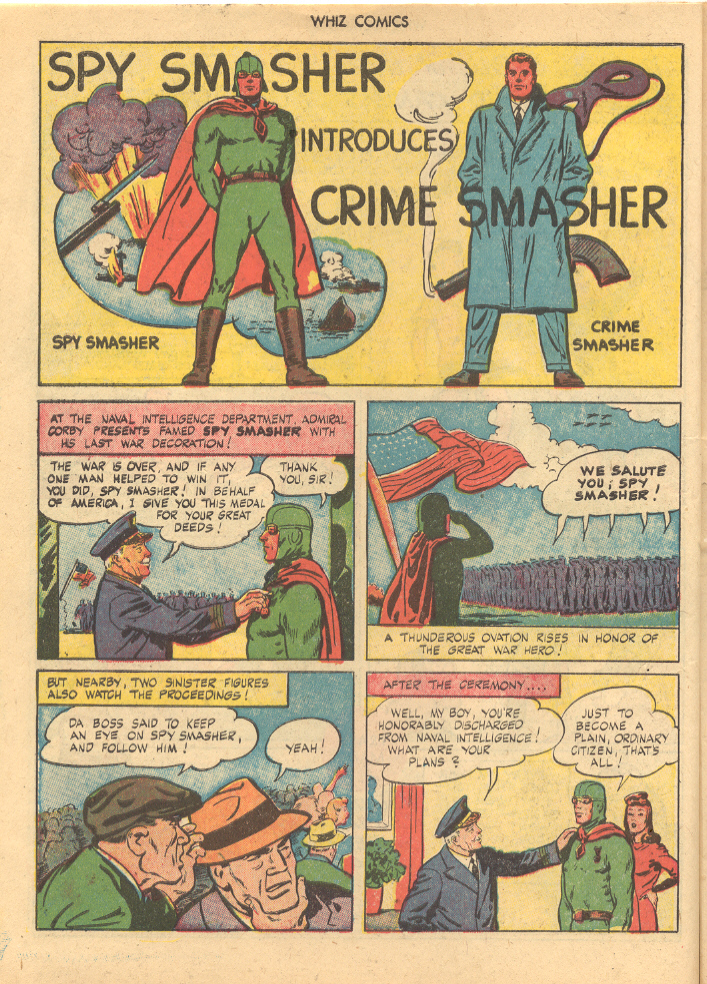
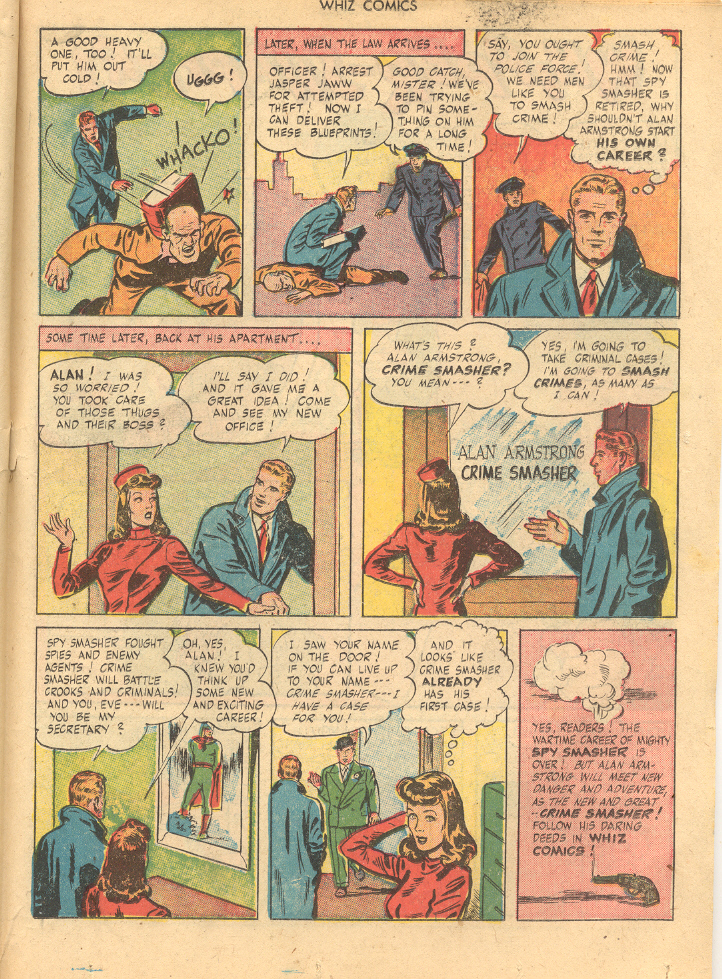
After several months where this situation was simply sidestepped and Spy Smasher continued to battle spies and saboteurs working in the employ of enemy powers that had by that time surrendered, finally in the pages of WHIZ COMICS #76 in 1946 was a transformation made. Alan Armstrong put away his costumed aviator’s disguise in favor of a trench coat back within the U.S. and took on the new identity as Crime Smasher.
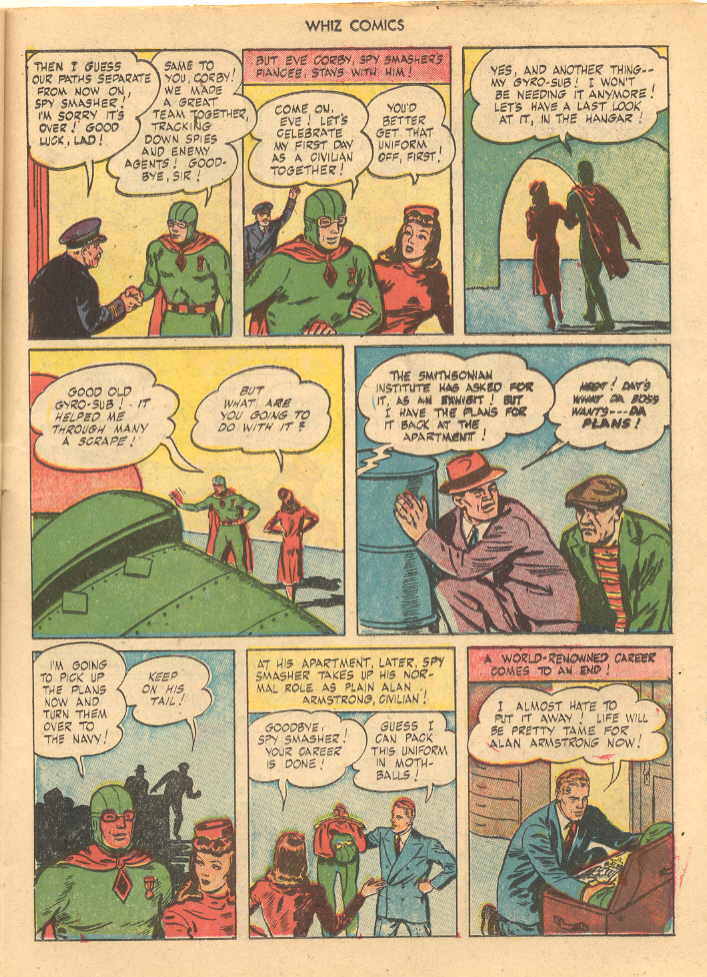
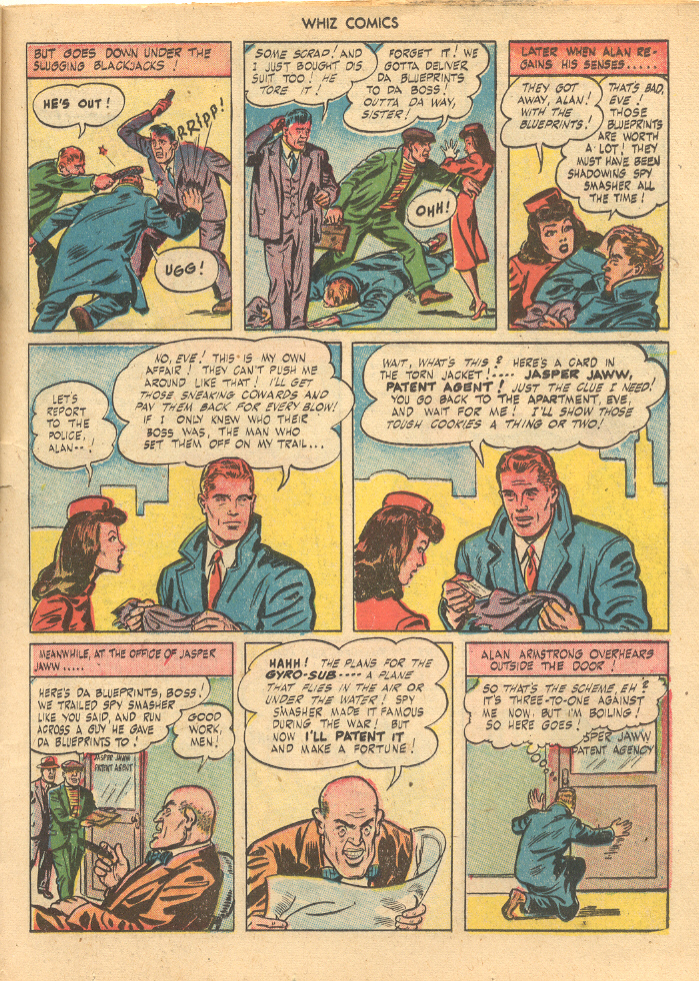
The story was written by Fawcett’s backbone writer in the postwar period Otto Binder, and illustrated by Al Carreno. In it, Alan Armstrong is mustered out of Naval Intelligence, returning to civilian life along with his recurring girlfriend Eve Colby. But when criminals seek to steal the secret to his no-longer-needed-in-the-war-effort Gyro-sub, Armstrong gets back into harness in order to stop them from making off with the craft’s secret.

Needing a job in the postwar economy and realizing that his skills can be put to good use in battling the spread of crime on the home shores, Armstrong decides to set himself up as a private investigator operating under the name Crime Smasher.
Unfortunately, without the backdrop of the war to help drive interest in his exploits and shorn of his distinctive uniform, Crime Smasher wasn’t long for the world. His berth in WHIZ COMICS was abandoned after issue #84 in 1947. A year later, a single issue of CRIME SMASHER was published by Fawcett (and may have burned of material initially produced for WHIZ COMICS but not used) but it failed to garner enough interest to continue with. Crime Smasher quietly retired, and would not be seen again until after rival publisher DC had acquired the rights to Fawcett’s super hero characters in the 1970s.

 The Tom Brevoort Experience
That’s very cool – Captain America, Blackhawk, and even the Boy Commandos managed to adapt to peacetime adventures without changing their names or general modes of operation, but I guess in the atmosphere of post-war optimism they thought spies would never again be a thing we needed someone to smash…
LikeLike
There are interesting things Private Investigators do: 1) skip tracing (finding debtors who have absconded, or sometimes finding missing persons or heirs); 2) background investigations (verifying a potential employee’s background or due diligence on a business transaction or. today, acting as a contractor doing “bring-ups” of people’s government security clearences): 3) doing general, civil investigations (getting statements on tort cases, or verifying that tort or Workers’ Comp claimants aren’t malingering); and 4) acting as couriers or 3d party neutrals in business transactions that have become faught0.
What they almost NEVER do is “smash crime.”
Max Allan Collins, in his Nate Heller PI historical novels, makes a big point that the cases where Heller gets involved with major crimes or fanous people are the exceptions in a life mostly spent mostly doing credit checks and divorce work.
Alan Armstrong was a pre-war Naval Officer. He had a good record in the war. Why leave the Navy? If he had annoyed people during the War (and counter intelligence [“CI”] people do that), the brand new US Air Force needed CI people (the novelist James Carroll’s fathher was an FBI Special Agent, without prior military service, who was made a General and put in charge of CI).
Also, as someone who probably worked with the FBI during the War (in the US and, during WWII, in Latin America, why didn’t he become a “G-Man?”
It seems like even Otto Binder was not thinking about where the good stories were.
LikeLike