

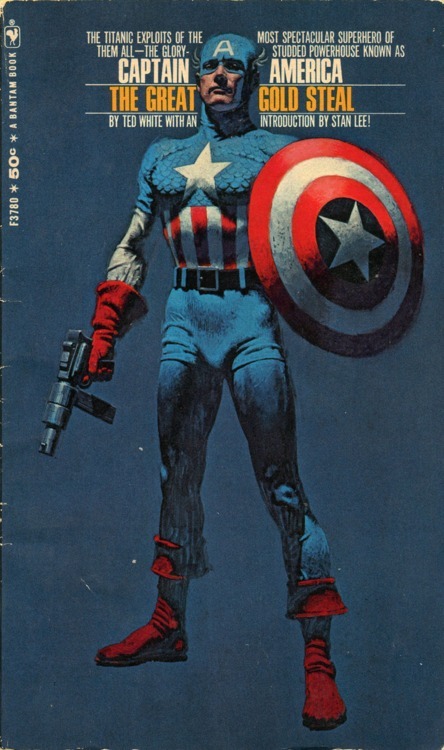
CAPTAIN AMERICA: THE GREAT GOLD STEAL
July, 1968
The very first novel starring a Marvel character, CAPTAIN AMERICA: THE GREAT GOLD STEAL by Ted White is a fascinating book, if for nothing else but the way that the star-spangled Avenger was depicted. He’d only been revived for four years at this point, and many of the attributed of his character that we consider ubiquitous today hadn’t quite jelled yet. Thus, Cap carries a gun on the cool painted cover, has a closet full of ordinary shields at Avengers mansion, and his entire skeleton had been laced with a flexible steel compound in anticipation of a future popular character. In addition, this pulpish tale featured the Red Skull as its mystery mastermind, unaware that the character had also been revived in the present in the contemporaneously-published comics.
I’m not all that big a fan of super hero stories done in prose, as I feel that virtually all such attempts wind up as being a pale reflection of the original four-color source material. Super heroes were designed for the comic book page, and it’s there they work best. (The exceptions are inevitably those characters who were designed first for prose–the Shadow, Remo Williams and the like.) And really, this novel is no exception–it’s fun, but not as much fun as a Captain America comic book of the same vintage. Nevertheless, it’s a much better book than THE AVENGERS BATTLE THE EARTH-WRECKER, which was published at around the same time.
2014 Notes: Actually, THE AVENGERS BATTLE THE EARTH-WRECKER came out a year earlier. So it was the first.
 The Tom Brevoort Experience
Ted White was still a few years away from being the Editor on Amazing. He would be the editor in 1976 at the 50th Anniversary of that Pioneering Science Fiction magazine.
While Otto Binder was a seemingly odd guy to write an Avengers novel, he had written on of the two 1940s All Winners Squad stories . . . .
LikeLike
Hadn’t Binder written prose back in the day as well?
LikeLike
In a big pre-John W. Campbell kind of way. He created Adam Link, with his brother (like Del Rey’s Helen O’Loy, a pre-Asimov “Asimovish” Robot.
LikeLike
Do comic characters often fail to translate due to the nature of prose? In a comic book, a writer and illustrator can give a characters back-story with a few visual panels, and a few lines of omniscient narrator text.
In prose, the author is expected to delve (even in just a few paragraphs) about origin and back-story.
LikeLike
Do comic characters often fail to translate due to the nature of prose? In a comic book, a writer and illustrator can give a characters back-story with a few visual panels, and a few lines of omniscient narrator text.
In prose, the author is expected to delve (even in just a few paragraphs) about origin and back-story.
LikeLike
Do comic characters often fail to translate due to the nature of prose? In a comic book, a writer and illustrator can give a characters back-story with a few visual panels, and a few lines of omniscient narrator text.
In prose, the author is expected to delve (even in just a few paragraphs) about origin and back-story.
LikeLike
Do comic characters often fail to translate due to the nature of prose? In a comic book, a writer and illustrator can give a characters back-story with a few visual panels, and a few lines of omniscient narrator text.
In prose, the author is expected to delve (even in just a few paragraphs) about origin and back-story.
LikeLike
Do comic characters often fail to translate due to the nature of prose? In a comic book, a writer and illustrator can give a characters back-story with a few visual panels, and a few lines of omniscient narrator text.
In prose, the author is expected to delve (even in just a few paragraphs) about origin and back-story.
LikeLike
Before I was so rudely interrupted by accidentially hitting the backspace key …
Do comic characters often fail to translate due to the nature of prose? In a comic book, a writer and illustrator can give a characters back-story with a few visual panels, and a few lines of omniscient narrator text.
In prose, the author is expected to delve (even in just a few paragraphs) about origin and back-story. Then the narrator often elaborates on a character’s motivation and thoughts as the story moves along. This is where a characterization may seem off … but were the story converted to comic book format, the story-telling is basically all on the “surface,” so those same moments of mischaracterization don’t matter as much.
LikeLike