

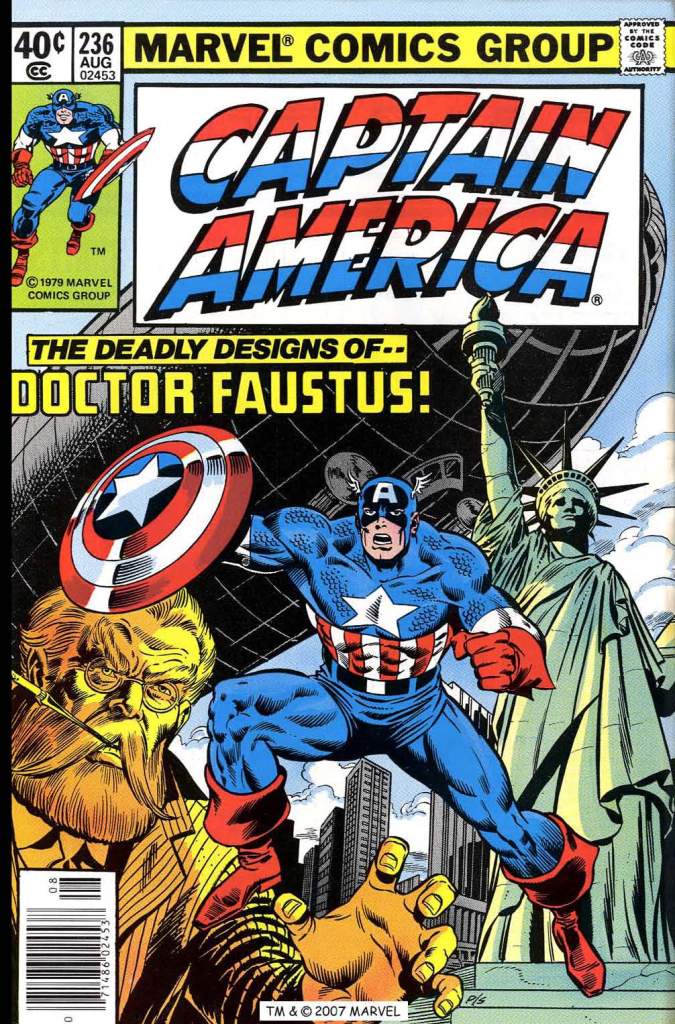
This latest issue of CAPTAIN AMERICA brought to a finale the long-running six-part Doctor Faustus storyline, one that seemed to amble and move along herky-jerky as though the specifics of the plot were being made up issue to issue. But this final installment made me re-evaluate the entire story, and in fact go back and read it all in a single sitting. So it’s a good example of how using a specific element from past storylines could be effective at creating interest in a certain kind of a reader–one like me, as it turns out.
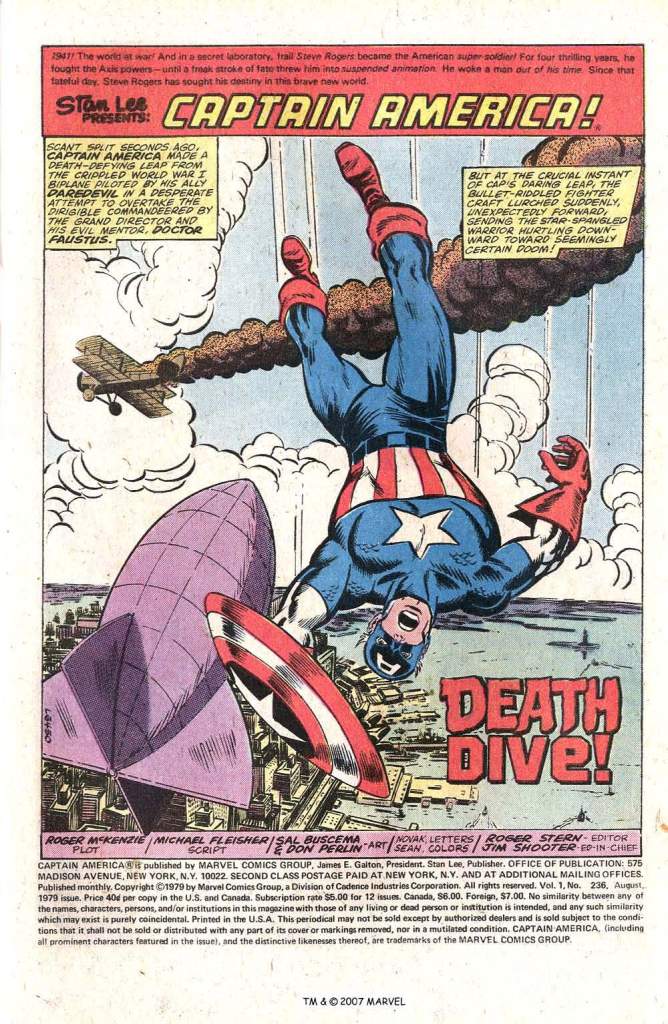
One immediate change in this final issue is that the script was done not by Roger McKenzie, who had been shepherding this saga from the beginning, but rather Michael Fleisher. Fleisher’s work in general was very hit-or-miss with me, but reading this issue at the time, I don’t think i was even aware that there had been a trade-off. I presume this was a matter of scheduling, that something came up to prevent McKenzie from being able to script this issue and so Fleisher stepped in as a last minute replacement. Artwise, the ever-solid Sal Buscema provided his rock steady breakdowns as usual, controlling the pacing and the storytelling. Don Perlin delivered the finished artwork from these, and they gave his often quiet work a lot more punch and impact as a result.
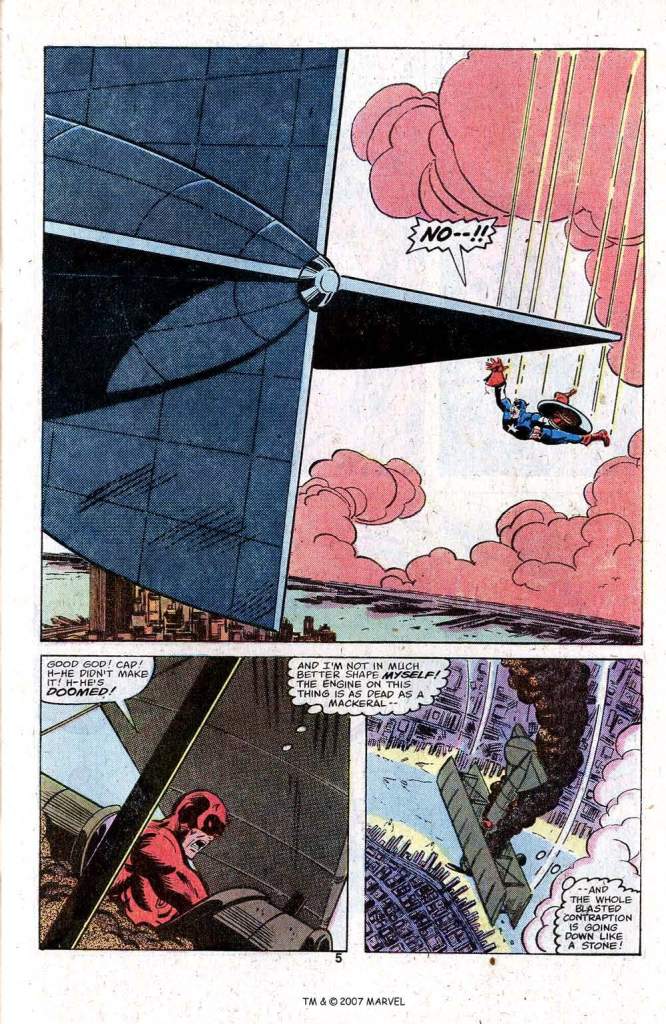
This issue picks up where the prior one left off, with Captain America plummeting to his death after an attempt to leap from the biplane that he and Daredevil had commandeered to the zeppelin controlled by Dr. Faustus’s forces had gone awry. DD isn’t in much better of a spot, the plane being riddled with bullets and its engine conking out–to say nothing of the fact that he’s blind and really shouldn’t be flying a plane in the first place. The creative team devotes an almost outlandish amount of real estate to the resolution of this cliffhanger, which happens when Daredevil throws Cap his billy club and Cap uses its cable-line to catch onto a building and break his fall. Don’t ask about the physics here, they don’t really work at all–just accept that the super-soldier can pull off such a thing. Daredevil, meanwhile, survives a crash landing in the biplane, maneuvering so as to not take any innocent bystanders with him as he comes down on the docks.
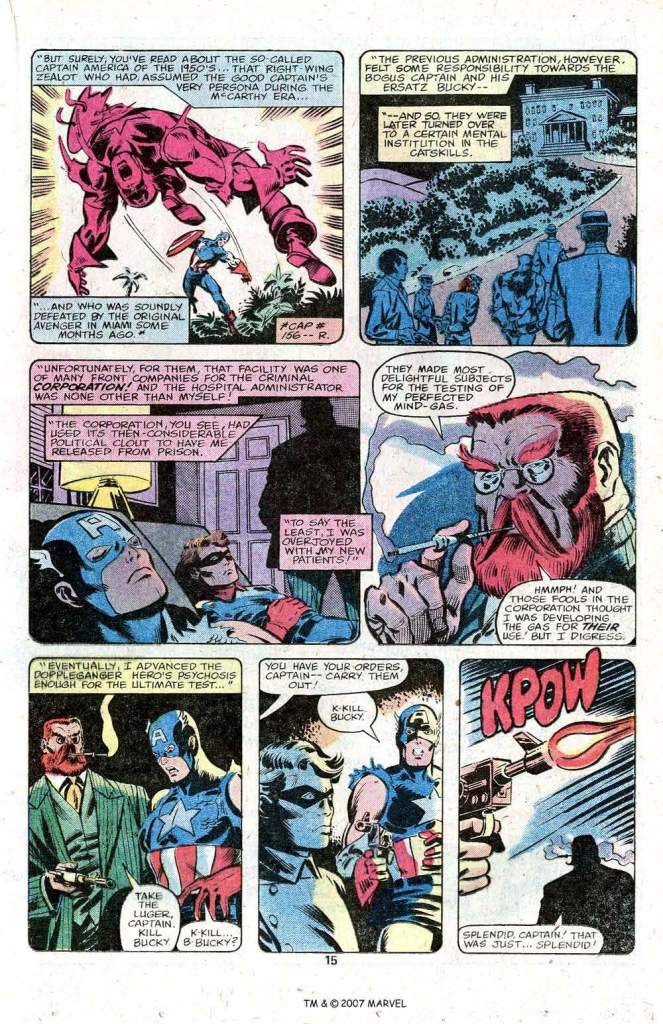
Back on board the zeppelin, we got to the development that caused me to get excited. A few issues ago, we saw the Grand Director of the National Force unmasked as a doppelganger of Steve Rogers, without explanation. Here, Faustus explains to the captive Peggy Carter that this is the Captain America of the 1950s, the one that had gone crazy thanks to his ersatz super-soldier serum being faulty and who had been long put on ice. I had heard about the 1950s Captain America story by this point–I think I may have read about it in ALL IN COLOR FOR A DIME or some such place–but I hadn’t read it yet for myself. But the notion of it fascinated me. Faustus explains that after the earlier story, the 1950s Cap and Bucky fell into his hands, and he was able to mold the hero into his Grand Director, having him kill his Bucky as proof of his mental conditioning. Of course, years later the lie was put to this fact, but for the moment, it seemed grimly convincing to me.
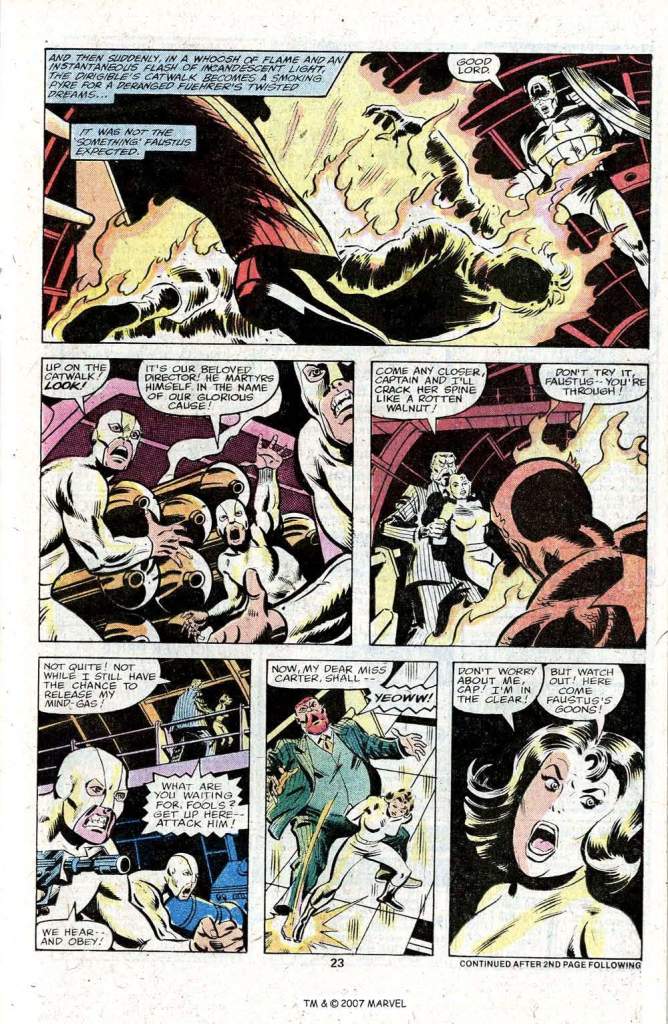
Meanwhile, having gotten themselves back together, Cap and Daredevil have grabbed a quinjet from nearby Avengers Mansion and are making another attempt to board the enemy blimp. Which means, once again, Daredevil is flying, which raises a lot of awkward questions that we’re simply going to table for the moment. This time, Cap’s aerial leap goes according to plan and he’s able to gain entrance to the zeppelin, confronting Faustus, the Grand Director and his forces. The Director has suffered a complete mental breakdown as a result of Faustus recounting his history, though, and when the Doctor tells him to do something, he responds by triggering his own personal self-destruct system and self-immolating. Again, this was a moment that was revised by later writers, but at this moment, the Captain America of the 1950s goes up in a blaze of glory, gone for good. It feels like dispensing with a story element that there wasn’t any further use for, and seems to me to be a bit of a waste–why bother giving all that backstory a page or two back if you were just going to trash the guy?
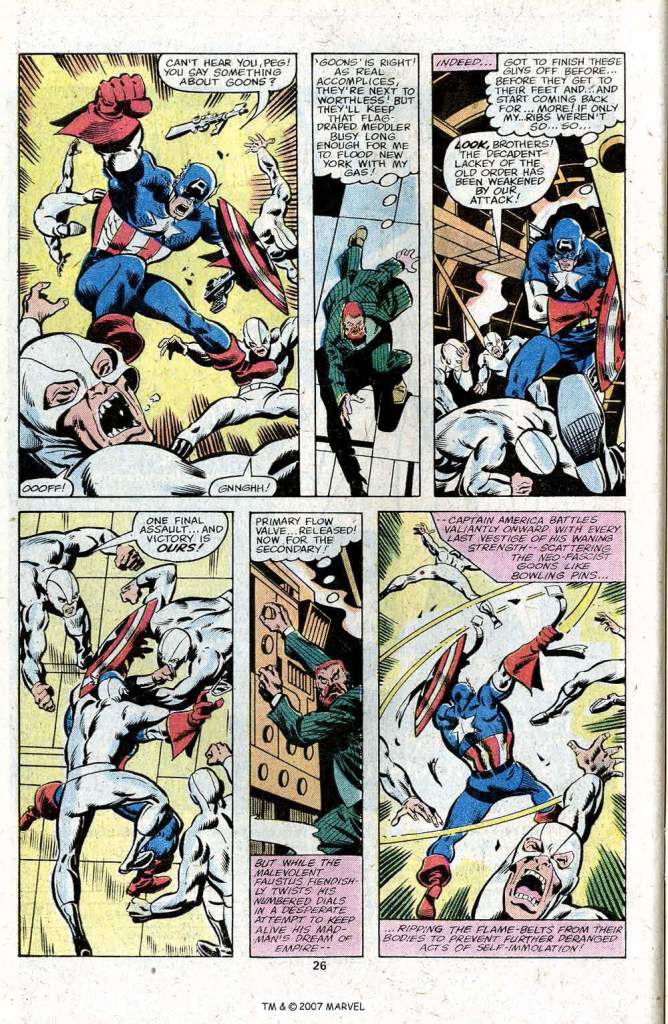
Anyway, the National Force, inspired for some reason by the martyrdom of their Grand Director, hurl themselves at Cap, leading to a typically bombastic Sal Buscema fight sequence. Sal’s battle work was often kinetic is a particular exaggerated way, and he completely sold the overblown impact of cap’s punches, as he did every super hero that he drew. Meanwhile, Faustus is trying to manage the controls to release his mind control gas all across Manhattan, figuring that he can still triumph. But as Cap tries to get to him, the ship lurches, and dislodges a bunch of the heavy gas cannisters directly on top of Faustus, pinning him helplessly. The zeppelin by this point is itself crashing.

But thankfully, it hits the waters of the New York Harbor. Daredevil manages to land his quinjet on the waves nearby, and one by one, survivors emerge from below the surface, including the long-captured Peggy Carter. Among the last to surface is Cap himself, carrying the defeated Dr. Faustus with him–him having been pinned in the sinking blimp seemed like it was going to be his super villain death for this story, but Cap thought the better of leaving him behind and managed to extract him. And that’s about it in terms of a wrap-up for this story–it’s abrupt and somehow not very satisfying. And yet, as I said at the beginning, the inclusion of the 1950s Cap made me pull out all of the recent issues and read the entire run again in a single sitting. I was endlessly fascinated by comic book history, and the idea that the Captain America who had been published during the 50s was a different guy who had gone bad was electrifying to me. I desperately wanted to read that earlier 1950s Cap story–and I would, in due time, when I was able to borrow those issues from my friend David Steckel, who got them from an older relative.
 The Tom Brevoort Experience
Daredevil not the only Marvel blindman who can fly ( a bi-plane/quinjet for DD ) & in 1951 spaceship for Dr. Kevin Scott ( the blind science wizard –as people called him ) [ Strange Tales#3 ( October 1951 ) 3rd story – Invisible Death — Moira ( his blind assistant, so his wife ), Albert. Invisible invaders from the planet Mondu are thwarted by a blind man who can sense their presence ( comics.org — ME, he can also navigate around on their planet as well as fly the spaceship ( they duplicated the aliens ship ( and wearing a duplicate uniform ) and he followed them home and committed acts of sabotage ) that took him there. Also the Mondu aliens beat the Badoon in their first appearance at trying to invade Earth while invisible to humans but not the Silver Surfer ).
LikeLiked by 1 person
Moira ( soon his wife, not so his wife — Dr. Kevin Scott ( Atlas Age ) ).
LikeLike
Tom, blind hero the Shroud flew his plane into Latveria [ Super-Villain Team-Up#6 ( June 1976 ) ]. I take it you are thinking how Daredevil could see the cockpit controls ( analog instruments -“Six Pack” ( airspeed, attitude, altimeter, heading, vertical speed, turn coordinator ) for basic flight, plus engine gauges ( tachometer, oil pressure/temp, fuel ) and navigation ( compass ) ) in order to fly the bi-plane & later the quinjet ( whose controls probably weren’t analog instruments ). Assuming someone taught DD/Matt how to fly, once in the air he probably relies on his Radar Sense like Bats do echolocation when they fly and hunt.
LikeLike
I kind of miss the days when comics could have neofascists as bad guys without being castigated for “going woke”.
LikeLike
Even back in those days, if you got letters published in the CAP or THOR lettercols, you might get recruiting pamphlets in the mail from Klan youth organizations.
They’re louder now, but they were out there back then, too.
LikeLike
I remember last year Googling Marvel and seeing a site that said because Marvel was bring back those stupid swim suit issue that it meant it was the end of woke. Why do I think the swim suit issues are stupid — because they are comic book characters ( I’d rather have an Official Handbook or Marvel-DC Crossovers or a One Shot with an artist I like than a stupid swim suit issue ).
LikeLike
I just read a 1971 Hulk story where he and the Abomination fall from outer space, ignite on re-entry … and the Hulk gets up at the start of the next issue grumbling he hurts.
LikeLike